Despite being a layman and despised by everyone, you have been devoted to me though we do not see each other. Why is this? It must be due to the merit accumulated in your past lives. As the time has come for you to inevitably become a Buddha in the next life, you are inspired with the Bodhi-mind. Besides, it is preached in the Lotus Sūtra, “He whose body is taken over by evil gods does not believe in this sūtra while he whose mind is replaced by the soul of Śākyamuni Buddha has faith in it.” Therefore, I feel most confident that just as the ray of the moonlight enters a body of water and makes it clear, the soul of Lord Preacher Śākyamuni Buddha entered your mind to eliminate impurity.
Matsuno-dono Goshōsoku, Letter to Lord Matsuno, Writings of Nichiren Shōnin, Volume 7, Followers II, Page 66
Therefore, Universal-Sage! When you see the keeper of this sūtra in the distance, you should rise from your seat, go to him, receive him, and respect him just as you respect me.
The Buddha gives this instruction to Universal-Sage Bodhisattva in Chapter Twenty-Eight of the Lotus Sūtra. When we open our eyes to the wonders of the world, and truly appreciate the innumerable beings who share it with us, we can feel alone and insignificant. The Buddha’s Wonderful Dharma shows us both the unimaginable expanse of this universe and the importance of our place in it. None of us can be replaced. Our purpose is neither the futile pursuit of pleasure, nor to make our isolated existence permanent. We are here to open the gate of the Buddha’s wisdom to all beings, to show all beings the joy of enlightenment, and to help them put themselves on the path to enlightenment. We do this by cultivating respect for all beings and, heeding the instructions in this verse, respecting all beings as much as we would the Buddha himself.
The Daily Dharma is produced by the Lexington Nichiren Buddhist Community. To subscribe to the daily emails, visit zenzaizenzai.com
Having last month considered those who have firm faith, we consider being able to see the Buddha expounding the Dharma on Mt. Gṛdhrakūṭa.
“Ajita! The good men or women who hear of my longevity of which I told you, and understand it by firm faith, will be able to see that I am expounding the Dharma on Mt. Gṛdhrakūṭa, surrounded by great Bodhisattvas and Śrāvakas. They also will be able to see that the ground of this Sahā-World is made of lapis lazuli, that the ground is even, that the eight roads are marked off by ropes of Jambunada gold, that the jeweled trees are standing in lines, and that the magnificent buildings are made of treasures. They also will be able to see that the Bodhisattvas are living in those buildings. They will be able to see all this because, know this, they have already understood [my longevity] by firm faith.
“Furthermore, the good men or women who do not speak ill of this sūtra but rejoice at hearing it after my extinction, should be considered, know this, to have already understood my longevity by firm faith. It is needless to say this of those who [not only rejoice at hearing this sūtra but also] read, recite and keep it. They also should be considered to be carrying me on their heads. Ajita! They need not build a stupa or a monastery in my honor, or make the four kinds of offerings’ to the Saṃgha because those who keep, read and recite this sūtra should be considered to have already built a stupa or a monastery or made offerings to the Saṃgha. They should be considered to have already erected a stupa of the seven treasures tall enough to reach the Heaven of Brahman, the upper part of the stupa being the smaller. They should be considered to have already equipped the stupa with streamers, canopies and jeweled bells, and enshrined my śarīras therein. They also should be considered to have already offered flowers, incense, necklaces, incense powder, incense applicable to the skin, incense to burn, drums, music, reed pipes, flutes, harps, various kinds of dances, and songs of praise sung with wonderful voices [to the stupa ] continuously for many thousands of billions of kalpas.
Since ancient times, the essential points of [Chapter 17] have been considered to be the “four faiths” (shishin) and “five categories” (go-hon). This division was first made in China by Chih-i in order to make the chapter more easily understood. The concept of the four faiths to be followed during the Buddha’s lifetime came from the idea that the ideal way of faith while the Buddha lived was to be divided into the following four stages: (1) receiving but one thought of faith and discernment concerning the eternity of the Buddha’s life, (2) apprehending its meaning, (3) devotion to preaching the Lotus Sutra abroad to others, and (4) beholding and perfecting profound faith and discernment.
The five categories of faith to be pursued after the Buddha’s extinction are derived from the idea that the ideal way of faith in the age of degeneration is divided into the following five categories: (1) first rejoicing over the Lotus Sutra, (2) reading and reciting it, (3) preaching it to others, (4) concurrently practicing the six pāramitās, and (5) intensively practicing the six pāramitās.
The first of the four faiths is to receive but one thought of faith and discernment concerning the eternity of the Buddha’s life. This is the first stage of faith, but the merits obtained by this practice are beyond limit or measure.
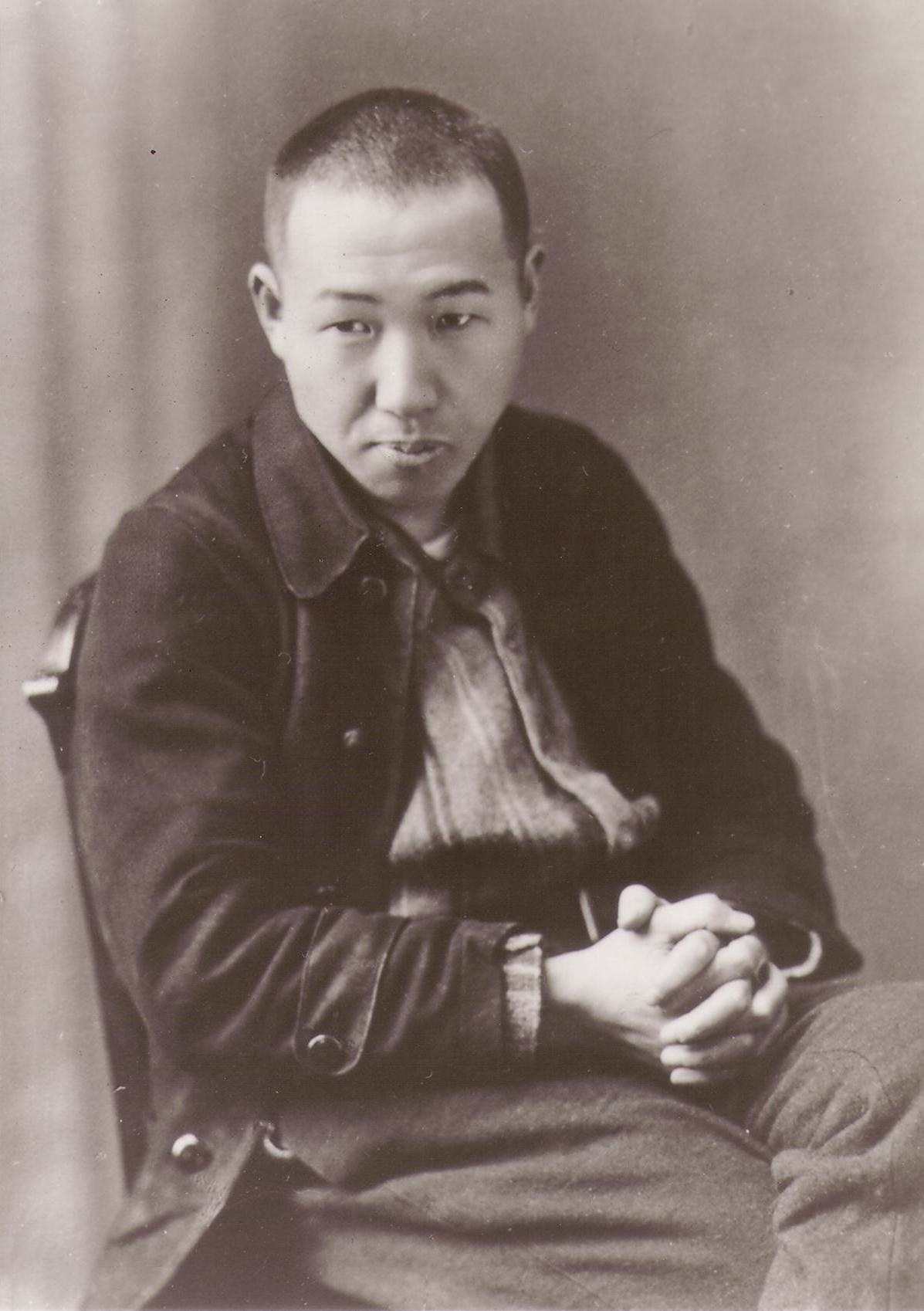
In Gene Reeves’ Stories of the Lotus Sutra he includes in his discussion of Chapter 1, Introduction, Kenji Miyawaza (1896-1933), the Japanese short story writer.
One person who understood well the importance of enchantment was Kenji Miyazawa, the poet, storyteller, science-fiction writer, scientist, and lover of the Lotus Sutra. Chanting Namu Myoho Renge-kyo, he imagined his spirit in boundless space, where he was filled with joy in the great cosmos, and from which he returned to earth, having acquired strength and courage to endure a life of suffering.
Known throughout the Tohoku area of Japan as “Kenji bosatsu” (Kenji the bodhisattva), Miyazawa devoted his whole life to the Dharma Flower Sutra – to practicing the Lotus Sutra, to embodying the Lotus Sutra, to living the Lotus Sutra – for example by helping struggling farmers of Iwate Prefecture with modern agricultural science.
One of his most ambitious works, A Night on the Milky Way Railroad, was turned into a popular animated film and used in various Japanese manga comic books. It is a story about a young boy, Giovanni, and his friend Campanella, who ride a train to the stars together – a celestial railroad, soaring through deep space – experiencing numerous adventures and encountering unusual characters. In the final passages of the story it becomes clear that this night train to the stars that Giovanni and his friend Campanella are riding is actually a ferry for souls traveling to life after death!
In a chapter called “Giovanni’s Ticket,” the conductor asks the passengers for their tickets. Campanella, who is dead from drowning, like the other passengers has a small gray, one-way ticket. Giovanni, who at first is very nervous because he thinks he has no ticket at all, discovers in a pocket a larger folded piece of green paper with mysterious characters written down the center. Examining this ticket, the conductor is astonished, and asks: “Did you get this ticket from three-dimensional space?” Bird-catcher, another passenger, then exclaims:
Wow, this is really something. This ticket will even let you go up to the real heaven. And not just to heaven, it is a pass that enables you to travel anywhere you want. If you have this, in fact, you can travel anywhere on this Milky Way Railway of the imperfect fourth-dimension of fantasy.
Giovanni alone on that train has a magical round-trip pass that enables him to freely travel from the “three-dimensional space” of ordinary reality to anywhere in the “fourth-dimensional space” of the invisible, spiritual, imaginative, and enchanting world that is the Milky Way Railroad.
What is this extraordinary railway ticket that enables one to enter the fourth-dimensional world and then return to the ordinary world? Giovanni’s ticket is the gohonzon (object of worship), or mandala, of Nichiren, with its inscription of the daimoku, the sacred title of the Lotus Flower of the Wonderful Dharma Sutra: “Namu Myoho Renge-kyo.” The daimoku, as it represents and embodies the Dharma Flower Sutra, provides a connection, a passage as it were, between earth and heaven, between earthly and cosmic perspectives, between science and imagination.
After reading Reeves’ description I purchased a copy of Miyazawa’s Milky Way Railroad and quickly devoured it, wanting to read more about Giovanni’s ticket. I was disappointed to find no mention of a gohonzon, nor Nichiren nor the Lotus Sutra or even any reference to Buddhism. “There were just ten strange characters printed on the ticket against a pattern of black arabesques.” Namu-Myōhō-renge-kyō is written with seven characters. Nichiren is written with two. What was the tenth character if this represented a gohonzon? (See note at end of article.)
Having so narrowly focused my reading I missed the story, and having now read it twice I can imagine – if not understand – how an interfaith view of religion might coexist with a faith in the teaching of the Lotus Sutra: “This ticket will even let you go up to the real heaven. And not just to heaven, it is a pass that enables you to travel anywhere you want.”
The book contains several references to Christian icons.
Suddenly the inside of the car burst into a white glow. A single island came into sight in the midst of the voiceless flow of the gorgeous Milky Way River. And that island cast a halo of white light as if all the splendor of diamonds and the gleaming of grass were concentrated in one place. On the island’s flat summit stood, ah, so vividly, a white cross. Silently, it stood as though hewn out for eternity from the clouds of the frozen North Pole. And it, too, shed a halo of light.
“Alleluia! Alleluia!” Voices rose from all sides. Turning around, Giovanni saw that the passengers (there were quite a number now!) were standing at attention, some holding black Bibles to their breasts, others crystal prayer beads. All of them had their hands reverently clasped. Instinctively, the two boys also rose to their feet. Campanella’s cheeks sparkled like bright red apples.
By and by, the island and the cross passed behind them. Across the way now were cliffs and palely colored smoke which, like the marsh grass drifting in the breeze, now and again veiled the cliffs in silver as if they were breathing. (p.56-57)
There’s even a Catholic nun in a black wimple, “Her eyes were lowered and directed straight before her, as if she were reverently listening for something, for some words or some voice.” (p.58)
For Giovanni, his ticket inspires in him the attitude of a Bodhisattva:
Giovanni now, without knowing why, began to feel a strange, unbearable sympathy for the man next to him. He thought of the bird catcher catching herons, and happily saying, “Ah, that was so good!” and wrapping the birds in white cloth, and looking sideways in amazement at Giovanni’s ticket, and finally exclaiming in surprise at it. As he thought of these things one after another, he was seized with the desire to do something for this stranger of a bird catcher, to give him something to eat, or anything. If it would really make the bird catcher happy, Giovanni was ready to stand on the radiant bank of the Milky Way River catching birds himself, even for a hundred years. He thought to ask, “What is it that you really want?” But that seemed too forward. Wondering how to put it, he looked around. But the bird catcher had vanished.
Miyazawa’s train has many passengers, all of whom we learn – with the exception of Giovanni – have recently drowned. Not all are traveling to the same destination.
“We’ll be arriving at the southern cross soon – get ready to get off,” the young man said to them.
“I’m staying on the train a little longer,” responded Tadashi.
Kaoru stood up uneasily and began to get ready. But she seemed reluctant to part from Giovanni and Campanella.
“We’ve got to get off here,” said the young man, looking down at Tadashi and pressing his lips together.
“I don’t want to! I’m staying on the train and riding some more first.”
Giovanni, unable to bear it, said, “Ride along with us! Our tickets are good for going on forever.”
“But we really must get off now,” said Kaoru sadly. “This is the place for going to Heaven.”
“Who wants to go to Heaven? We have to make a place even better than Heaven right here. That’s what my teacher said.”
“But Mom is up there, and furthermore, God said so Himself.”
“That kind of god is false!”
“Your god is false!”
“He is not!”
“What kind of god is your god?” young man broke in, laughing.
“I’m not sure, really. But … anyway, He’s the one true God,” said Giovanni.
“Of course the true God is the only one.”
“Anyway, my God is that one true God.”
“Well, then, there you are! And I pray that you’ll be meeting us before the true God.” The young man pressed his hands together gravely, and Kaoru, too, was praying.
At that precise moment, in the far distance of the Milky Way’s downstream course, a cross, bejeweled with bright orange and blue lights, appeared, standing shimmering in the midst of the river. Its top was lost in a pale cloud, circular like a halo.
The inside of the train was thrown into commotion as all the passengers (just as they had before at the Northern Cross) stood up and began to pray. On all sides there were cries of joy – cries like those of children picking out gourds for the Milky Way Festival. As the cross gradually came parallel to their window, they saw that the silver cloud, pale like the twirling skin of an apple, was gently, ever so gently, revolving.
“Alleluia! Alleluia!” Brightly and happily the passengers’ voices resounded together. From far off in the distant cold depths of the sky came the clear, bracing, indescribable blast of a trumpet.
The train gradually eased to a full stop directly opposite the cross in a blaze of signal lights and street lamps.
“Well, this is where we get off.” The young man took Tadashi’s hand, and Kaoru, adjusting her coat and straightening her collar, slowly followed them out of the train.
“I guess it’s goodbye!” she said, looking back at Giovanni and Campanella.
“Goodbye!” said Giovanni – gruffly, but in fact he was only struggling to hold back his tears.
Kaoru looked back once more with big sad eyes, and then they were gone. The car, already only half full, abruptly emptied out and was left deserted with the wind blowing about it in gusts. Looking out, the boys could see the passengers lined up, kneeling on the bank of the Milky Way in front of the Cross. They saw a figure robed in solemn whiteness passing over the invisible water of the heavenly river, hand extended toward them.
But then the glass whistle sounded, and, just as the train began to move, a silver fog came flowing softly upstream and their view was blotted out. They could make out only the radiant leaves of many walnut trees standing in the mist, and electric squirrels with gold halos peeping out of the mist with mischievous faces.
Now, soundlessly, the fog rolled away once more. They saw a street, lined with little street lamps, that looked like a highway to somewhere. For some time it ran along beside the track, and as they passed the lights, the boys saw those tiny specks of red flame blink on and off, as if in greeting.
Looking back, they saw that the cross was now incredibly tiny and far away. It looked like something you could hang around your neck. They wondered about Kaoru and Tadashi and the young man. Were they still kneeling on the bank, or had they set out in whatever direction it is that leads to Heaven? But it was so blurry, they couldn’t tell.
Giovanni heaved a deep sigh. “Campanella, it’s just you and me again. Let’s stick together all the way, whatever happens! … You know, if it’s for everyone’s happiness, I’m ready to have my body burned like that Scorpion – even a hundred times.”
“Ummmm. I feel the same.” Campanella’s eyes were swimming with gentle tears.
“But – what is it that will make everyone happy?” continued Giovanni.
“I don’t know,” Campanella muttered.
“Anyway, we’re going to hold on!” said Giovanni with an explosion of breath as if his chest were brimming with new-found energy.
“Ah – that’s the Coal Sack. It’s the hole in the sky!” Campanella seemed to shrink back as he pointed to a spot in the heavenly river. Giovanni, too, was shaken as he looked over there. Beyond on the heavenly river, a great black emptiness opened out.
However he strained his eyes, he couldn’t tell how far down the bottom might be, or what might be inside – it only made his eyes smart. “I wouldn’t be afraid in a big dark place like that anymore,” he said. “I’d go looking in there for what would make people happy. You and me – together to the end!”
“Together!” echoed Campanella. “Hey! Don’t those fields look great, and everyone’s gathered there, and – that must be Heaven itself! And there’s my mother!” Campanella cried out, pointing suddenly out the window to a beautiful place he saw in the distance.
Giovanni looked where he was pointing, but all he could see was dim, white, rolling smoke, and nothing at all like what Campanella was describing. Feeling indescribably lonesome, Giovanni looked aimlessly around. He saw two telephone poles standing on the opposite bank, their arms linked as if joined in an embrace.
“Campanella, we’ll stick together, right?” Giovanni turned as he spoke and … in the seat where Campanella had been sitting until now, there was no Campanella, only the dark green velvet seat.
Giovanni burst into tears and everything went black. (p.119-127)
In Reeves’ description of Miyazawa’s tale he concludes:
Like poets before him, Miyazawa understood the deepest meaning of the Lotus Sutra – an affirmation of the reality and importance of this world, the world in which suffering has to be endured, and can be, combined with an imaginative cosmic perspective engendered by devotion to the Lotus Sutra. And with his imaginative power and skill as a writer, Miyazawa offers Giovanni’s ticket to each of us. Like the Sutra itself, he uses his own imagination to invite us into an imaginary other world in order to have us become more this-worldly.
I wholeheartedly endorse Reeves’ statement that “the deepest meaning of the Lotus Sutra – an affirmation of the reality and importance of this world, the world in which suffering has to be endured, and can be, combined with an imaginative cosmic perspective engendered by devotion to the Lotus Sutra.” I just don’t see how you get from there to the place where all religions share a common, inter-faith truth.
The Japanese pamphlet “Miyazawa Kenji — Traveler of the Cosmic Mind” explains the ticket:
By the way, what were the “about ten characters” printed on the ticket? Kenji rendered Myoho Renge Kyo in Sanskrit transliteration as “Saddharmapundarika Sutra”, which when written in Chinese characters is 「薩達摩芬陀梨伽素多覧」—exactly ten characters! The “about ten characters” on Giovanni’s ticket signified “Myoho Renge Kyo.” In other words, Namu Myoho Renge Kyo is the very ticket that allows free travel anywhere.
Dependent origination is the Middle Way between the extremes of existence and non-existence. The view of existence, or “eternalism,” imagines that fixed entities, independent of conditions and immune from change, can be found underlying the phenomena that do change. The view of non-existence, or “annihilationism,” imagines there is no continuity at all within change and the entities that do arise will eventually vanish completely without a trace. Dependent origination is the Middle Way which cuts through those views by pointing out the ceaseless interplay of causes and conditions, which is the process of becoming, rather than the eternalism of being or the nihilism of non-being. The Middle Way points out that while there are no fixed entities there is a flow of continuity within the process of change. In the following sermon, the Buddha expounds the teaching of the Middle Way to Kātyāyana:
“This world, Kātyāyana, for the most part depends upon a duality – upon the idea of existence and the idea of nonexistence. But for one who sees the origin of the world as it really is with correct wisdom, there is no idea of nonexistence in regard to the world. And for one who sees the cessation of the world as it really is with correct wisdom, there is no idea of existence in regard to the world.
‘This world, Kātyāyana, is for the most part shackled by engagement, clinging, and adherence. But this one [with right view] does not become engaged and cling through that engagement and clinging, mental standpoint, adherence, underlying tendency; he does not take a stand about ‘my self.’ He has no perplexity or doubt that what arises is only suffering arising, what ceases is only suffering ceasing. His knowledge about this is independent of others. It is in this way, Kātyāyana, that there is right view.
” ‘All exists’: Kātyāyana, this is one extreme. ‘All does not exist’: this is the second extreme. Without veering towards either of these extremes, the Tathāgata teaches the Dharma by the middle.” (Bodhi 2005, p.356-357)
QUESTION: It is not entirely clear that the six realms of illusion exist in the realms of human beings, but I am beginning to think they seem to as I listen to you. Nevertheless, I cannot see the four realms of holy ones at all. What do you say about this?
ANWSER: You doubted the existence of six realms of illusion in the realm of men, but I tried hard to explain it until you said you seemed to understand it. The same might happen with four realms of holy ones. Therefore, I shall try to explain as much as possible what the sūtras state, supplemented with reason. We see the so-called principle of impermanence everywhere in front of our eyes. We humans understand this principle, through which two groups of Hinayāna sages (Two Vehicles) called śrāvaka and pratyekabuddha try to obtain enlightenment (arhatship). How can we say then that the realms of two Hinayāna sage groups are not included in the realm of men? A man, no matter how inconsiderate he may be, loves his wife and children. It shows that he is partly in the bodhisattva realm.
The only realm contained in the realm of men and yet hard to see is that of Buddhas. However, since we see nine other realms included in the realm of human beings, we can conjecture that the realm of Buddhas, too, is contained therein. You should firmly believe this and have no doubt about it. On the existence of the realm of Buddhas contained in the human realm, the Lotus Sūtra states in the second “Expedients” chapter that the purpose of Buddhas appearing in the world was “to cause all living beings to open the gate to the insight of the Buddha.” And in the Nirvana Sūtra, we come across a passage which states: “Though having only human eye, those who study Mahāyāna Buddhism are regarded the same as having Buddha-eye because they see the truth of Buddhism.” The reason why we, ordinary people, born in the Latter Age, can put faith in the Lotus Sūtra is that the realm of Buddhas is included in the realm of human beings.
Kanjin Honzon-shō, A Treatise Revealing the Spiritual Contemplation and the Most Verable One, Writings of Nichiren Shōnin, Doctrine 2, Page 135
Those who seek the enlightenment of the Buddha
Are as various as previously stated.
A kalpa will not be long enough
To describe the variety of them.
The Buddha speaks these verses in Chapter Three of the Lotus Sūtra. We may believe that only some kinds of people will hear the teaching of the Buddha. In this passage the Buddha reminds us that we cannot predict who will be able to join us in our practice and who will not. This is why it is so important to maintain our vow as Bodhisattvas to benefit all beings.
The Daily Dharma is produced by the Lexington Nichiren Buddhist Community. To subscribe to the daily emails, visit zenzaizenzai.com
Having last month considered the length of time since Śākyamuni became a buddha in gāthās, we consider the perverted people’s view in gāthās:
I see the [perverted] people sinking
In an ocean of suffering.
Therefore, I disappear from their eyes
And cause them to admire me.
When they adore me,
I appear and expound the Dharma to them.
I can do all this by my supernatural powers.
I live on Mt. Sacred Eagle
And also in the other abodes
For asaṃkhya kalpas.
The [perverted] people think:
“This world is in a great fire.
The end of the kalpa [of destruction] is coming.”
In reality this world of mine is peaceful.
It is filled with gods and men.
The gardens, forests and stately buildings
Are adorned with various treasures;
The jeweled trees have many flowers and fruits;
The living beings are enjoying themselves;
And the gods are beating heavenly drums,
Making various kinds of music,
And raining mandārava-flowers on the great multitude and me.
[This] pure world of mine is indestructible.
But the [perverted] people think:
“It is full of sorrow, fear, and other sufferings.
It will soon burn away.”
Because of their evil karmas,
These sinful people will not be able
To hear even the names of the Three Treasures
During asaṃkhya kalpas.
“My Pure Land will never be destroyed,
Yet all view it as being burned up, And grief and horror and distress Fill them all like this.
All those sinful creatures,
By reason of their evil karma,
Throughout asaṃkhyeya kalpas
Hear not the name of the Precious Three.”
… As long as we accumulate either negative or positive sins, that is, evil karma, we cannot obtain good results because we do not produce good causes. However much time may pass, we cannot meet the Buddha, nor hear his teachings, nor join the ranks of his disciples. This situation is expressed in the words “hear not the name of the Precious Three.”
The Precious Three are the three basic elements that Sakyamuni Buddha taught his disciples as the spiritual foundation of Buddhism soon after he began his missionary work: the Buddha, the Law, and the Saṃgha. Because of their supreme value, they are also called the Three Treasures.
Mention of this spiritual foundation immediately reminds us of the teaching “Make the self your light, make the Law your light.” These are most reassuring words and a great encouragement to us. But here the Buddha does not refer to the self that is filled with illusions but the self that lives in the Law. We must burn with the fire of the Law and cast its light over society. Though we must live through our own efforts, our way of life should always be in accordance with the Law.