All posts by John Hughes

The Importance of Trajectory

Interfaith logoYesterday I published The Trouble with Interfaith Truth. I asked Rev. Ryuei McCormick, who leads the Nichiren Buddhist Sangha of the San Francisco Bay Area, what he thought and this was his response.

A very good question. And feel free to share my response:

In East Asia they sometimes talked about the five vehicles – because they would include the vehicle moral practice to attain a human rebirth, and the moral and meditative practices for attaining a heavenly rebirth. These were of course considered provisional and preliminary to Buddhism. Nichiren Shonin alludes to this kind of thinking in the beginning of the Opening of the Eyes (Kaimoku-sho) when he talks about how Confucianism and Brahmanism prepared the way for Buddhism in China and India respectively. In the Pali Canon the Buddha often gave a “progressive teaching” consisting of a review of those spiritual teachings and values that he shared with Brahmanism: generosity, self-discipline, and aspiration for rebirth in the heavenly realms, as well as the dangers of sensual pleasures and the benefits of renunciation. Once his listeners heard and accepted those teachings (almost a Spirituality 101) he would then teach the four noble truths.

And then there is the mutual possession of the ten worlds and the Tiantai teaching that even adverse seeds can lead to buddhahood. And these Tiantai teachings play off such things as Vimalakirti’s admonitions to the voice-hearers.

So, the One Vehicle is actually all the teachings of the Buddha including those he gave that weren’t even particularly unique to Buddhism (such as the above “progressive teaching”) and those he gave as bodhisattvas in times and places where there was no Buddhism but the ground needed to be prepared (Nichiren alludes to this also in Kaimoku-sho by citing Tiantai Zhiyi’s belief that Confucius was just such a bodhisattva).

To be more specific based on what I have discerned from the sutras, the Lotus Sutra, Tiantai’s teachings, and Nichiren Shonin’s teaching (and this is written about at length in my Kaimoku-sho commentary Open Your Eyes), Christianity and other such monotheistic religions are okay insofar as the encourage people to do things that are wholesome and refrain from what is unwholesome. That will enable people to attain a human or heavenly rebirth which is conducive to having the kind of wholesome attitude and way of living that will enable a person to give ear to the Buddha Dharma (including the Lotus Sutra) whereas those in the four lower realms have a more difficult time. Note that among the guardians of the Dharma mentioned in the Lotus Sutra are the eight kinds of supernatural beings, among whom are devas (god realm), asuras (fighting demons realm), nagas (animal realm), and yakshas (spirits considered to exist in the hungry ghosts realm, though I’ll admit it’s kind of odd). It is even possible for bodhisattvas to be born in times and places where there is no established Buddha Dharma and so they will express values and insights that are similar, though they will not turn the Wheel of the Dharma fully (so Jesus is at best a bodhisattva and not a Buddha because he did not teach the four noble truths but a relatively more humane form of monotheism). Now of course, these teachings also perpetuate delusions (like monotheism) and when they come into conflict with Buddhism they then become religions that are no longer preparing the way to Buddhism but blocking it and therefore lead to unwholesome conduct in relation to Buddhism.

Towards the end of Kaimoku-sho, Nichiren makes it clear that there are countries that are just ignorant and evil and then there are countries that slander. I believe the distinction he is making is between non-Buddhist cultures that need to be persuaded to give ear to the Dharma and learn more about it until they are able to take up the Wonderful Dharma of the Lotus Sutra. This requires shoju or the way of accepting where people are at and encouraging them in their good qualities while leading them gradually to the Wonderful Dharma. Then there are those countries (like 13th century Japan) that were Buddhist and had centuries to digest the Buddha Dharma but they still turn away from the Lotus Sutra. These countries are slanderous because they are not just hostile to Buddhism out of ignorance but are Buddhists misrepresenting Buddhism and they should know better and they had their chance. For them, shakubuku or the way of subduing their arrogant misrepresentations of the Dharma must be used.

So I recognize the Dharma at work surreptitiously in other traditions, but I also see how their are unwholesome teachings that must be criticized not because they slander the Dharma (of which they are largely ignorant and even their misrepresentations lack authority because they are not coming from Buddhists themselves) but because they are inhumane and lead to lower realms because of the obvious harm they cause. For instance, fundamentalist Christians gathering in defiance of the law and endangering their own health and ours because they falsely and arrogantly assume they are immune to disease because they are “bathed in the blood of Christ.” Not on Buddhist or Dharmic grounds but simply on scientific grounds and for our own survival as a species these false religiosities must be opposed. That puts me at odds with fundamentalists but not with people of other traditions who truly are good hearted, open-minded, and share values and even insights with Buddhism (probably because their founders or saints were bodhisattvas or pratyekabuddhas).

With Buddhists I actually use shakubuku more than I expected and more than most people think. When I’m with other Buddhists I usually don’t need to contradict or argue as long as we are talking about shared values, insights, and so on. And there is a LOT of shared ground. However, I am quick to speak up when I think the Buddha Dharma is being misrepresented. More often than not I get admissions that my point is valid. I have pointed out to Zen Buddhists that they all too often pay more attention to the koans than to the sutras. I have pointed out to Pure Land Buddhists that ultimately there is no self- or other-power. I am very quick to point out that the Diamond Sutra and Heart Sutra are merely provisional sutras and are not the pinnacle of Buddha Dharma. I do this politely but firmly.

Another important point to consider, which those who emphasize the ecumenical implications of the One Vehicle (whether just within Buddhism or between Buddhism and non-Buddhism) is that trajectory is very important. In any given situation, is a teaching or practice leading people to a place where they will be able to appreciate and accept the Lotus Sutra on some level, or is it leading people away from the Lotus Sutra? This requires a lot of discernment and more discussion.

Namu Myoho Renge Kyo,
Ryuei

Next: The Example of Kenji Miyazawa

Meaning of Dependent Origination

Put simply, dependent origination means that all phenomena arise as the result of conditions and cease when those conditions change. The Buddha taught the general theory of dependent origination as follows: “When this exists, that comes to be; with the arising of this, that arises. When this does not exist, that does not come to be; with the cessation of this, that ceases.” (Bodhi 2000, p. 575) So there-are-no static isolated entities in existence. Everything arises and ceases depending on causes and conditions that arise due to yet other causes and conditions. There is no ultimate ground or primordial cause, but a network of causes and conditions. This undercuts the view of a metaphysical selfhood, fixed entity, or substance underlying the constant change that is life.

Open Your Eyes, p176

Lotus Sūtra Enables All Living Beings to Become Buddhas

There are two kinds of classic works on filial piety: the Classic of Filial Piety written by a non-Buddhist sage called Confucius of China and the Buddhist work on filial piety entitled the Lotus Sūtra. Although they differ in that one is a Buddhist sūtra and another is a non-Buddhist classic, what they preach is fundamentally the same.

For what purpose did Śākyamuni Buddha strive to attain Buddhahood for an incalculably long period of time known as the dust-particle kalpa (aeons)? It was for no other reason than filial piety. However, as all the living beings in the world of delusion are the Buddha’s parents, unless they all attain Buddhahood, He cannot claim to have fulfilled His filial duties. The Buddha, therefore, did not attain Buddhahood Himself. However, the Lotus Sūtra expounds the secret dharma enabling all living beings to attain Buddhahood. That is to say, it reveals the truth of attaining Buddhahood by all living beings in the ten realms through leading one person in the realm of hell, one person in the realm of hungry spirits, or just one person in each of the nine realms to Buddhahood. It is just as when we cut a bamboo joint, other joints are cut at the same time. Or it is like the shichō strategy in the game of go, where the death of one “stone” coincides with the death of many. It is the same with the truth of the Lotus Sūtra. As metal can cut trees and grass, and water has the virtue of extinguishing all fires, the Lotus Sūtra is equipped with the virtue of enabling all living beings to become Buddhas.

Hōren-shō, Letter to Hōren, Writings of Nichiren Shōnin, Volume 6, Followers I, Page 51

Daily Dharma – May 12, 2020

Upon seeing such passages in various sutras as “The truth lies beyond language,” and “It is found where the mind is extinguished,” they will embrace an evil thought that the holy scriptures of the Buddha do not reveal his true Enlightenment. As a result, devils get hold of these three categories of people in the Latter Age of Degeneration, and even destroy the country.

Nichiren wrote this passage in his Treatise on Chanting the Great Title of the Lotus Sūtra (Shō Hokke Daimoku-shō). He reminds us that even though words are limited, we must not cast out the Buddha’s true teaching as unable to lead us to enlightenment. We can revere the Buddha Dharma without making it into a dogma. When we ignore completely what the Buddha left for us, what remains is our own selfish desires and confusion. When the individuals in a society are focused only on their own personal benefit, how can that society survive?

The Daily Dharma is produced by the Lexington Nichiren Buddhist Community. To subscribe to the daily emails, visit zenzaizenzai.com

Day 20

Day 20 completes Chapter 15, The Appearance of Bodhisattvas from Underground, and concludes the Fifth Volume of the Sutra of the Lotus Flower of the Wonderful Dharma.

Having last month considered the handsome, black-haired man twenty-five years who says men 100 years old are his children, we repeat in gāthās and conclude today’s portion of Chapter 15, The Appearance of Bodhisattvas from Underground.

Thereupon Maitreya Bodhisattva, wishing to repeat what he had said, sang in gāthās:

It is not long
Since you renounced the family of the Śākyas
And sat under the Bodhi-tree
Near Gaya.

These sons of yours are innumerable.
They have practiced
The way to Buddhahood for a long time.
They have supernatural powers and the power of wisdom.

They have studied the Way of Bodhisattvas well.
They are not defiled by worldliness
Just as the lotus-flower
Is not defiled by water.

They sprang up from underground,
And are now standing before you respectfully.
This is difficult to understand.
How can we believe this?

You attained enlightenment quite recently.
But you have done so many things.
Remove our doubts!
Explain all this as it is!

Suppose a man twenty-five years old
Points to grey-haired and wrinkle-faced men
A hundred years old,
And says, “They are my sons.”
Suppose old men point to a young man
And say, “He is our father.”
No one in the world will believe
That a father is younger than his sons.

You are like the father.
You attained enlightenment quite recently.
These Bodhisattvas are resolute in mind.
They are not timid.
They have practiced the Way of Bodhisattva
For the past innumerable kalpas.

They are good at answering difficult questions.
They are fearless and patient.
They are handsome, powerful and virtuous.
They are praised by the Buddhas
Of the worlds of the ten quarter .
They expound [the Dharma] clearly.

They did not wish to live among men.
They preferred dwelling in dhyana-concentration.
They lived in the sky below
In order to attain the enlightenment of the Buddha.

We do not doubt your words
Because we heard them direct from you.
Explain all this so that the living beings in the future
May be able to understand your words, Buddha!

Those who doubt this sūtra
And do not believe it
Will fall into the evil regions.
Explain all this to us now!

How did you teach these innumerable Bodhisattvas
In such a short time,
And cause them to aspire for enlightenment
And not falter in seeking enlightenment?

[Here ends] the Fifth Volume of the Sūtra of the Lotus Flower of the Wonderful Dharma.

See The Ideal Way of Life

The Ideal Way of Life

In the verses spoken by the Bodhisattva Maitreya occur the following words:

“They have ably learned the bodhisattva-way,
And are as untainted with worldly things
As the lotus flower in the water.”

These words represent the ideal way of life that the Buddha teaches us in the Lotus Sutra. We should not withdraw from society but should lead beautiful and pure lives within society. The ideal of the Lotus Sutra consists in making all society pure and beautiful. The title Sutra of the Lotus Flower of the Wonderful Law expresses this ideal.

Buddhism for Today, p183

The Trouble with Interfaith Truth

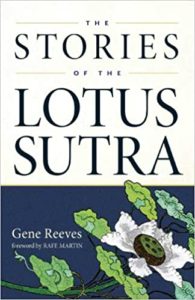
Interfaith logoGene Reeves’ The Stories of the Lotus Sutra was published by Risshō Kōsei Kai in 2010 as a companion to Reeves’ updated translation of the threefold Lotus Sutra. This is the second Kōsei kai book I’ve read that brings up the concept that all religions share a common, inter-faith truth. As Reeves puts it:

[W]ithout the nourishment of the Dharma [as revealed in the Simile of the Herbs] we would dry up and die. But this Dharma that nourishes all is not something to be found only in the Buddhist religion. It is universal. It is everywhere. The Dharma can be found even in the ordinary food that we eat and the water we drink, making it possible for us to live.

The Stories of the Lotus Sutra, p81

Or this conflating of Jesus and Krishna with the Eternal Buddha:

[E]ven when we think we cannot see him, the Buddha can be found right next to us. The Buddha may not even go by the name of a buddha. Sometimes perhaps he goes by the name of Christ, or Krishna, or even Jane. Belonging to a Buddhist temple or organization is not, in itself, the Buddha Way, nor is it the only way to enter or follow the Buddha Way. The “universal gate” is many gates, many more than you or I could possibly know in a lifetime.

The Stories of the Lotus Sutra, p71

Reeves comes at this whole issue of inter-faith Dharma from a number of directions.

One of the important insights to be gained from the teaching of skillful means is that many things that are not the whole truth are nevertheless important truths. Just as we should seek the potential to be a buddha in ourselves even though we are far from perfect, we should seek the truth, even the hidden truths, in what others say, in their words and in their stories.

“Others” includes of course other religions and their followers. Followers of the Dharma Flower Sutra can be glad when they encounter people of other faiths who have found carriages appropriate for themselves. The Sutra teaches that there are many successful ways, some, no doubt, beyond our imagination.

The Stories of the Lotus Sutra, p51

Or this:

Apart from the Buddha and blind to the Buddha Dharma, we are like someone wandering around, destitute, impoverished, without purpose, miserable. In a sense, this is the destiny of those who do not, in some way, follow the Buddha Way. This does not mean, however, that one has to be a Buddhist in the ordinary sense. To follow the Buddha is to put one’s trust in and devote oneself to the happiness of others and the life of the whole. It is to share in a kind of common human faith that life is meaningful, a faith that finds expression in a variety of religious and other forms.

The Stories of the Lotus Sutra, p70

I struggle with this concept that the One Buddha Vehicle includes Christian chariots along with the Śrāvakayāna sheep cart and Pratyekabuddha deer cart and Bodhisattva bullock cart.

Stretching the One Buddha Vehicle to cover all of the Buddha’s teachings is, for me, the essence of the Lotus Sutra. I view the Lotus Sutra as the blueprint that allows the practicer to gather from all of the building materials (other sutras) what is needed to create a hall within which one can practice the Buddha way. The Lotus Sutra is the ocean into which all streams have flowed. But I’m unable – or perhaps just unwilling – to stretch it further to include all religions.

These ideas troubled me and it occurred to be that someone who had a statue of a Roman Catholic saint eye-opened for his Buddhist altar might be able to share some insight. I sent this as an email to Ryuei McCormick.

Ryuei McCormick’s response

The Stories of the Lotus Sutra

Stories of the Lotus Sutra book cover
Available for purchase on Amazon

From the Introduction to Gene Reeves’ 2010 book published by Rissho Kosei-kai:

Be forwarned! This book might transform you into the kind of Buddhist who loves the Lotus Sutra and therefore deeply cares about this world. It is a commentary on the stories of the Lotus Sutra, a sutra that more than any other has been both loved and reviled. Though intended to be a companion volume to my translation of the Lotus Sutra, this does not mean that it cannot be read without the translation at hand. I think everything in this book can be understood on its own. Still, one’s understanding of the Dharma Flower Sutra will be greatly enhanced by reading the translation – or better yet by reading a Chinese version! …

During most of my adult life I have been both a teacher and a preacher, roles which I understand to be different, though, of course, teaching can be included within preaching and sometimes a little preaching may show up in a teacher. And that is what this book does, at least that is what I hope it does. I hope it will inspire at least some readers not only to understand the Lotus Sutra better but also to embrace it, at least some part of its core teaching. I hope some will be moved by it to improve their lives in some significant way. But where it has seemed relevant to do so, I have included factual information both about the text and about the subjects of the stories in the text.

I hope it will shed some light on and even open up the profound meaning of that text – which is normally known in East Asia as the Dharma Flower Sutra. (In this book I will use “Lotus Sutra” and “Dharma Flower Sutra” interchangeably.) Though any text, including the Dharma Flower Sutra, can be interpreted and understood in various ways, I believe that this text is first of all a religious text, intended primarily not to settle some dispute among monks in ancient India, or to expound philosophical doctrines, but rather to influence the lives of its hearers or readers in highly significant ways. In an important way, we might say that the text wants to teach and transform you! For that purpose to be fulfilled or even appreciated widely, it is important that the meaning and thrust of the Sutra be readily available to ordinary English-language readers. This attempt to interpret the Lotus Sutra in plain words is an attempt to have its rich meanings and significance available to a wider and widening audience.
The Stories of the Lotus Sutra, p1-3

See this blog post: The Trouble with Interfaith Truth


Book Quotes

 
Book List

Threefold Training

The noble eightfold path has also been restated as the threefold training, consisting of morality, concentration, and wisdom. Morality pertains to the ethical demands of right speech, right action and right livelihood. Specifically, the practice of morality can refer to the five precepts taken by laypeople, the ten virtuous precepts (i.e. the ten good acts), the ten precepts for novices, or even the full monastic precepts taken by monks and nuns. Concentration refers to the cultivation of the mind covered by right effort, right mindfulness and right concentration. Wisdom refers to the acquisition of right view and right intention. The Buddha taught that when morality, concentration, and wisdom are cultivated together, one is able to shake loose the bonds of craving and ignorance and attain the liberation of nirvāṇa.

More specifically, the practice of the eightfold path or the threefold training leads to four fruitions of the holy life. These four fruitions are referred to as “paths” when one first enters such a state and “fruits” when one realizes the benefits from the path attained. Specifically, the benefits of the four fruitions refers to our progressive liberation from ten fetters which keep us trapped in the ordinary life of birth and death and all the suffering, fear and anxiety which makes up that life.

Open Your Eyes, p172

Faith Like Fire and Faith Like Water

Of the people who put faith in the Lotus Sūtra today, some have faith like fire while others have it like water. Those who have faith like fire refer to those who become enthusiastic upon listening to the preaching but their passion cools down as times goes by, and eventually forget the teaching. On the other hand, those whose faith is like water mean those whose faith is like a ceaselessly flowing water, namely those who retain their faith without retreating.

Ueno-dono Gohenji, A Reply to Lord Ueno, Writings of Nichiren Shōnin, Faith and Practice, Volume 4, Page 126