Thereupon Star-King-Flower Bodhisattva said to the Buddha: “World-Honored One! Why does Medicine-King Bodhisattva walk about this Sahā-World? World-Honored One! This Medicine-King Bodhisattva will have to practice hundreds of thousands of billions of nayutas of austerities in this world.
This excerpt is from Chapter Twenty-Three of the Lotus Sutra. Star-King-Flower Bodhisattva is aware of the difficulties that Medicine-King or any other Bodhisattva will encounter while living in this world of conflict (Sahā) and asks the Buddha why this Bodhisattva would give up the pleasures of the higher realms to which he is entitled. The Buddha then tells the story of Medicine-King’s previous life, in which he gave up many attachments, including the attachment to his own body. These stories of Bodhisattvas are reminders of our own capacities, and that no matter what difficulties we face in our lives, our determination to benefit all beings, our certainty of enlightenment, and the help we receive from other beings will lead us to overcome any problems.
The Daily Dharma is produced by the Lexington Nichiren Buddhist Community. To subscribe to the daily emails, visit zenzaizenzai.com
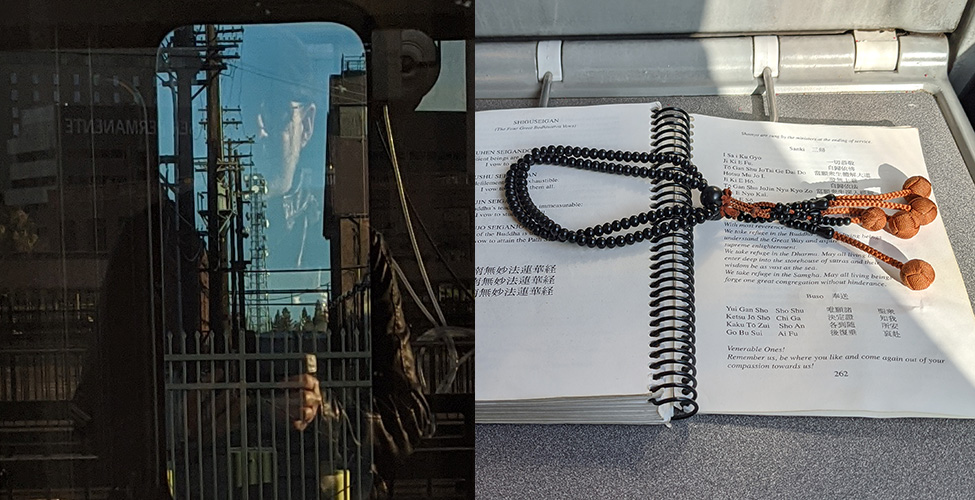
My reflection in the train door while waiting to board in Sacramento and my beads and sutra book after completing gonyo on the way to Hayward.
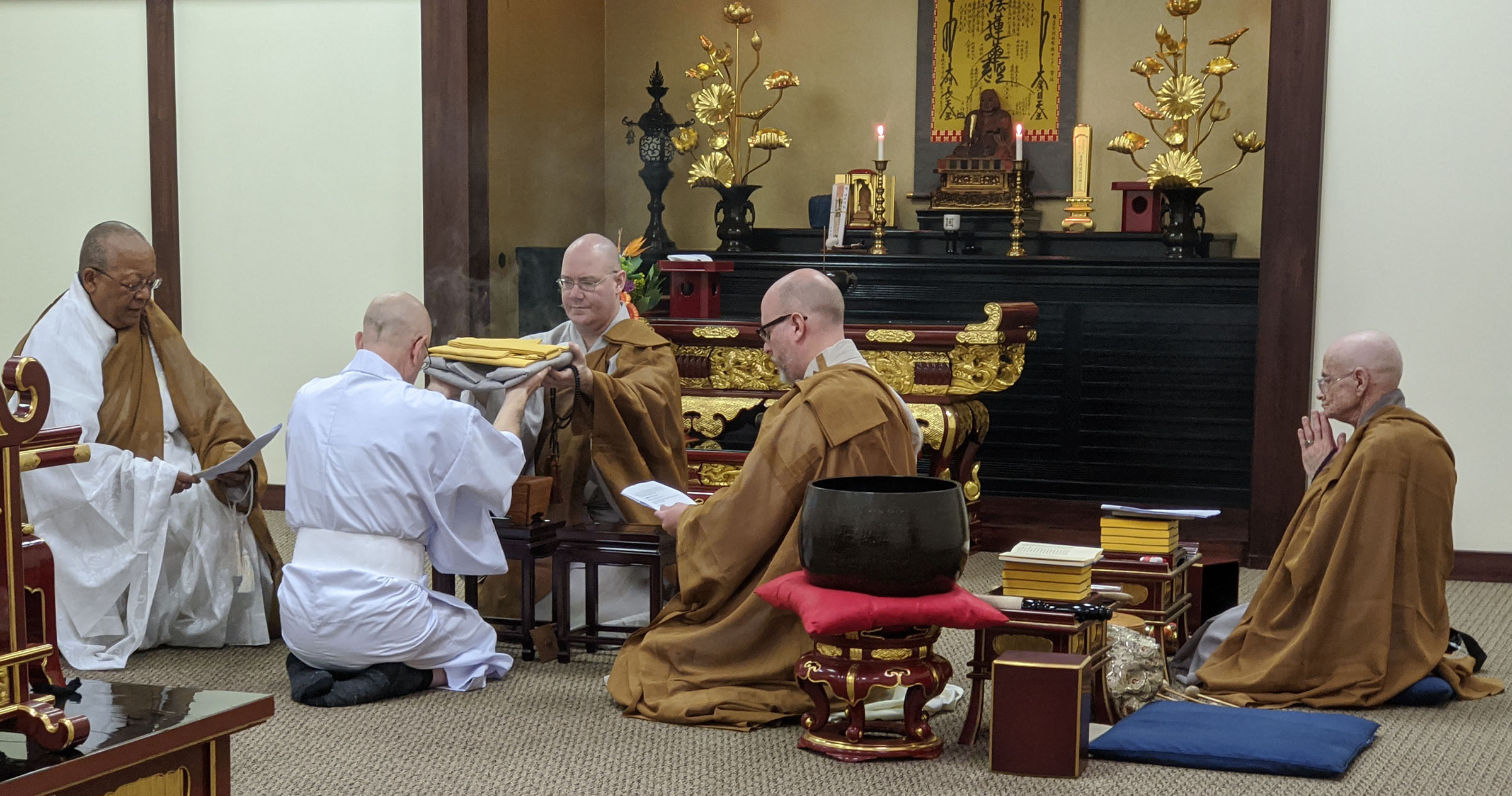
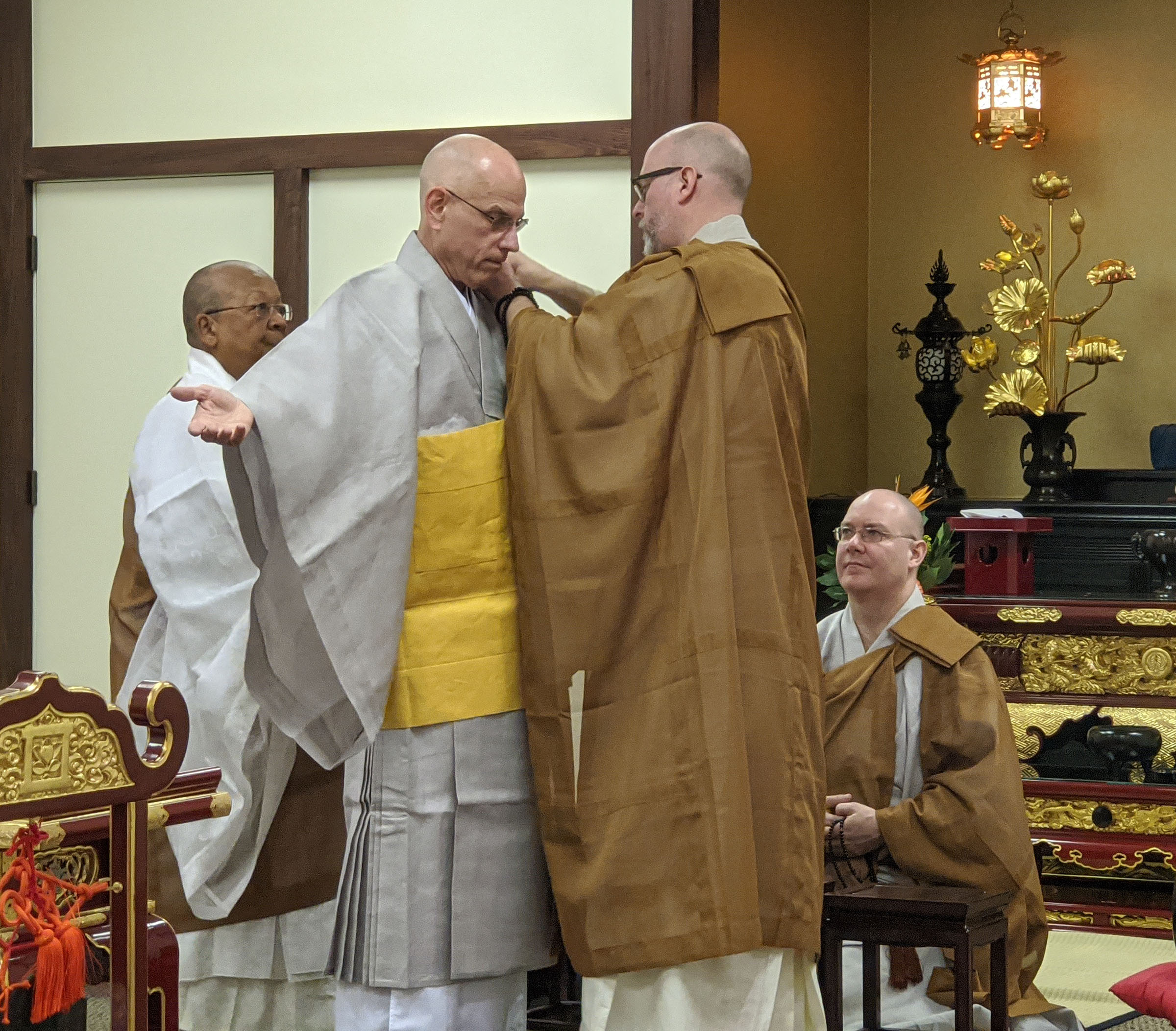
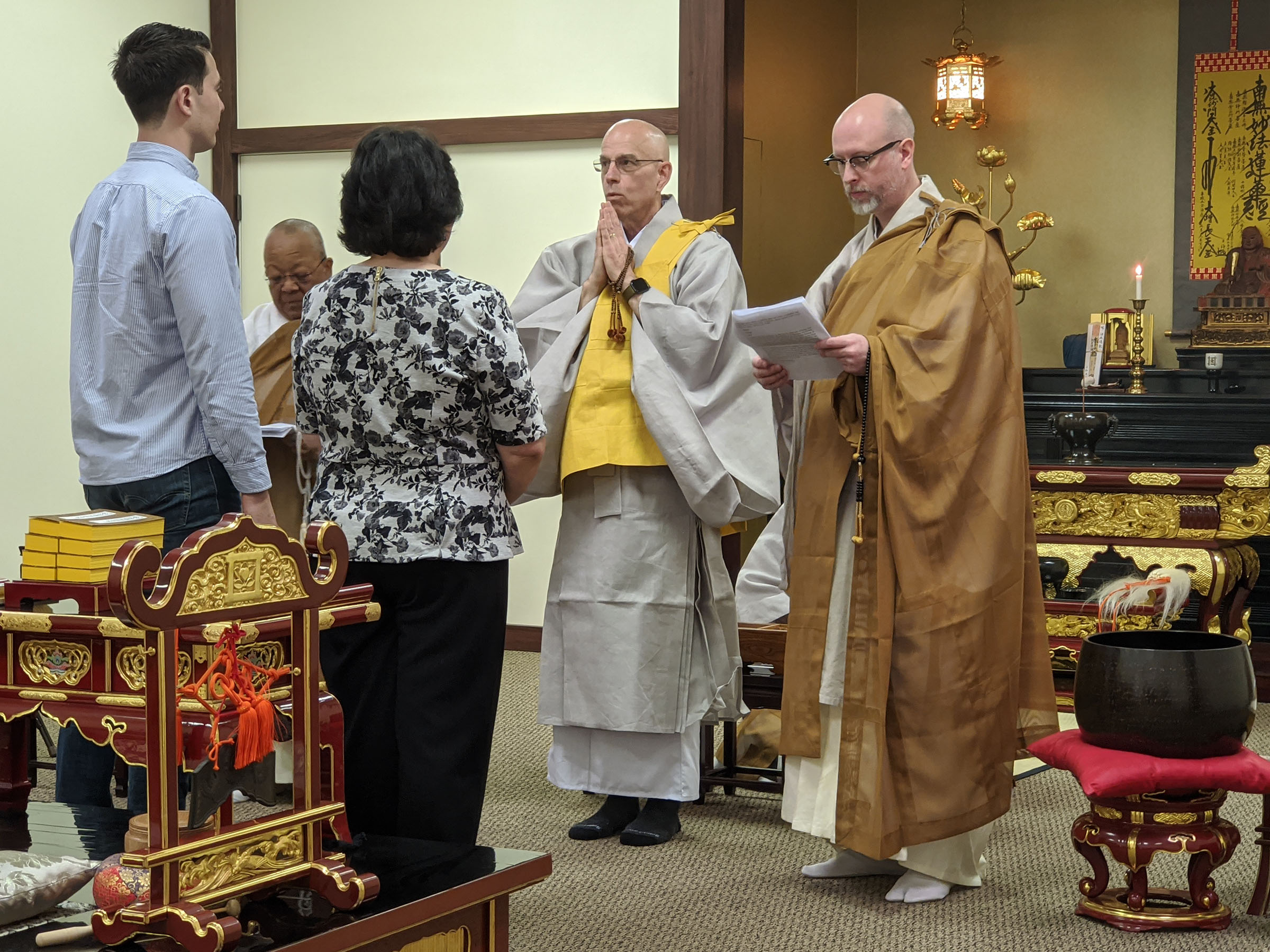
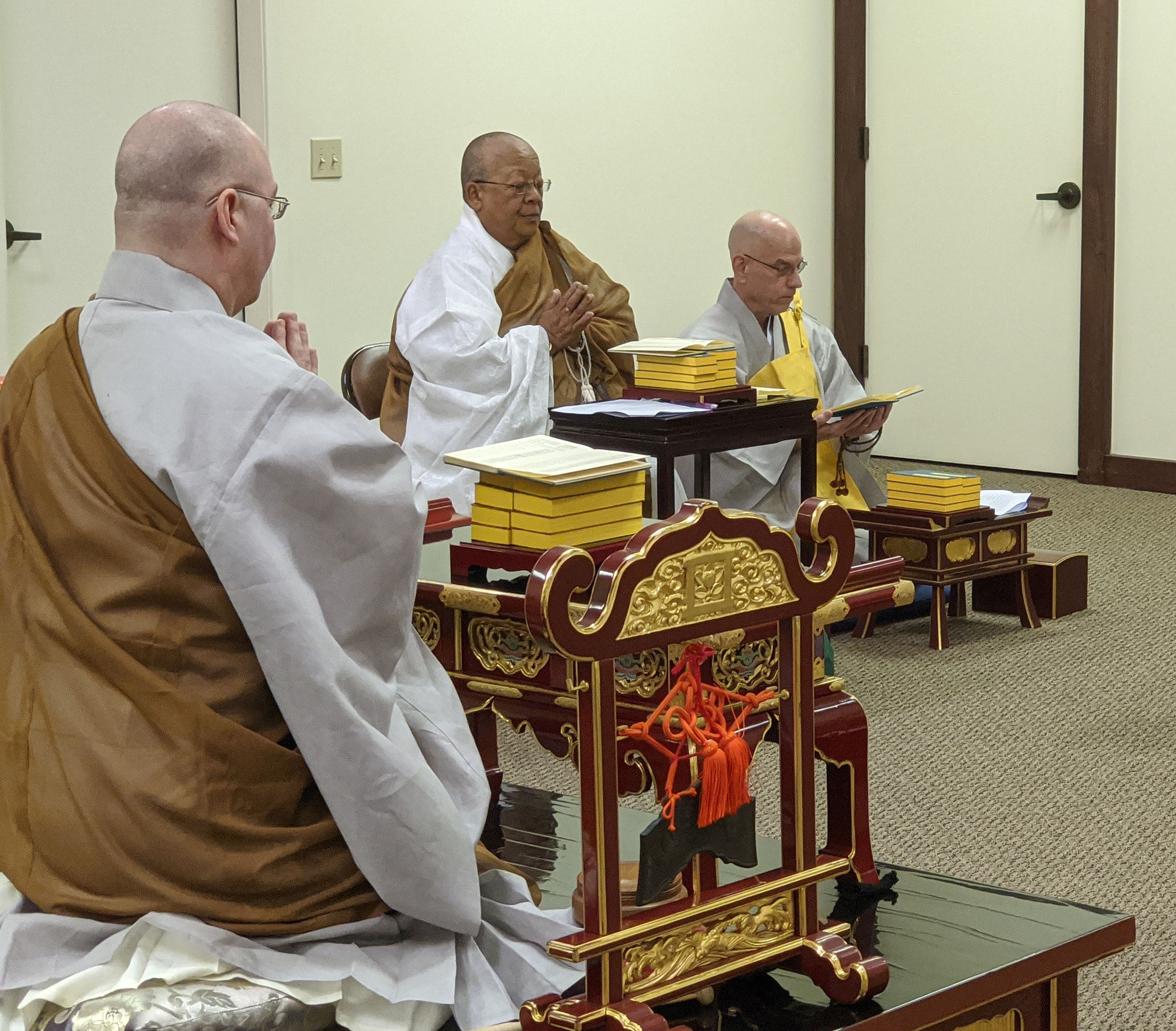
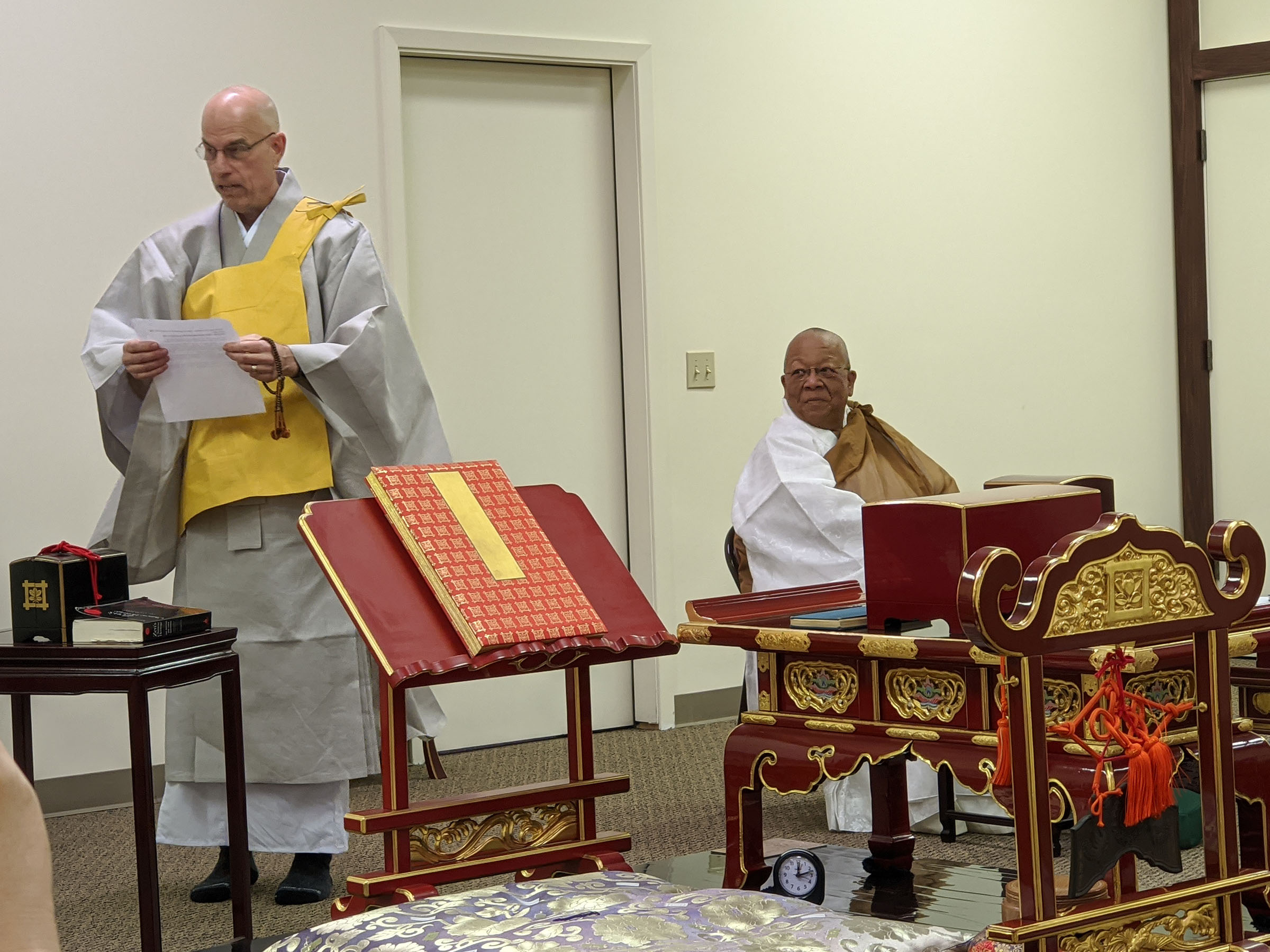
Today I traveled to Hayward and the Nichiren Buddhist International Center for a Tokudo Jukai-shiki cermony, the Attaining the Way and Bestowing the Precept Ceremony for inducting a novice priest.
The new novice is Mark Herrick, whom I’ve met several times while attending services in Oakland with Rev. Ryuei McCormick.
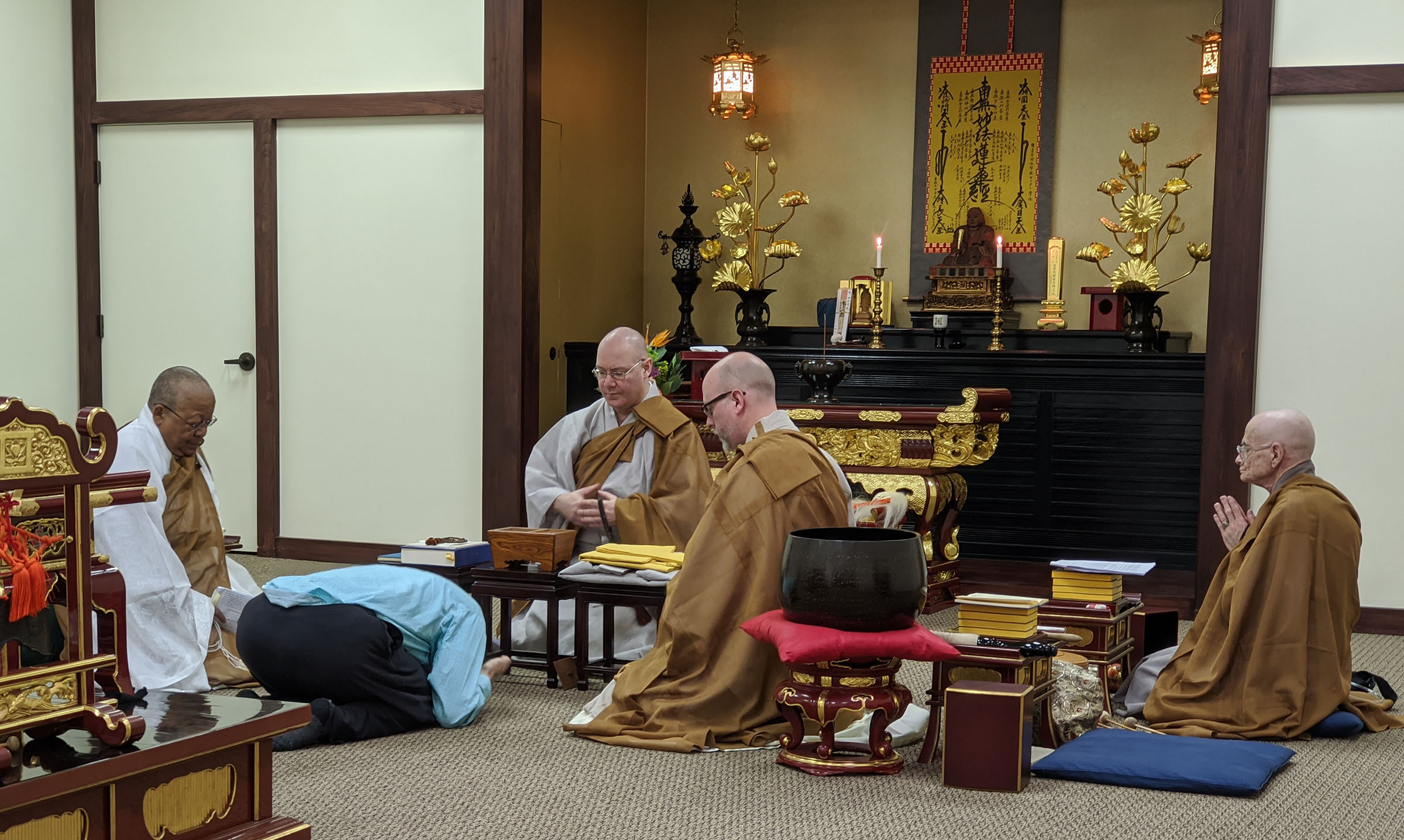
Mark Herrick bowing as Rev. Ryuei reads his “Respectful Address.” Nichiren Order of North America Bishop Myokei Caine-Barrett is at left. At right, Kanjin Cederman Shonin Head Priest Seattle Choeizan Enkyoji Nichiren Buddhist Temple. Far right is Ryusho Jeffus of Syracuse, New York.
Ryuei’s Hōkoku-bun
Here is a good man, who is undertaking the ceremony of crossing over and receiving the precepts before the Buddha, the founder, and the Three Treasures. His name is Mark Herrick. Since he was born in this world, spring and fall have passed 63 times. His previous good roots have now met with opportune conditions so that he has finally made the determination to leave home and accept the precept of the Lotus Sutra and wear the black-dyed robe.
We humbly reflect that since our founder Nichiren Daishōnin left home and crossed over at the age of 16 he put the Great Dharma of the Great Sage, Śākyamuni, the World Honored One, into the Odaimoku and spread it everywhere under heaven. He dedicated his life to saving all sentient beings. Now, this good man, Mark Herrick, takes his position as the newest disciple in this lineage. He is taking up Śākyamuni Buddha and Nichiren Daishōnin’s saving vow and activities as his own, thereby inheriting the seed of the Buddha to spread throughout the ages so that he can requite one ten thousandth of the favor of the Buddha.
May the Eternal Śākyamuni Buddha who attained awakening in the remote past, our founder Nichiren Daishonin, the past ministers who have contributed so much to our school, all place their hands upon his head and certify this crossing over and reception of the precepts with joy.
May the great vow of happiness in this world and the next be accomplished.
Namu Myōhō Renge Kyō
On this, the 16th Day, and 2nd Month of the year 2020
Preceptor, Ryuei McCormick, (Kaō)
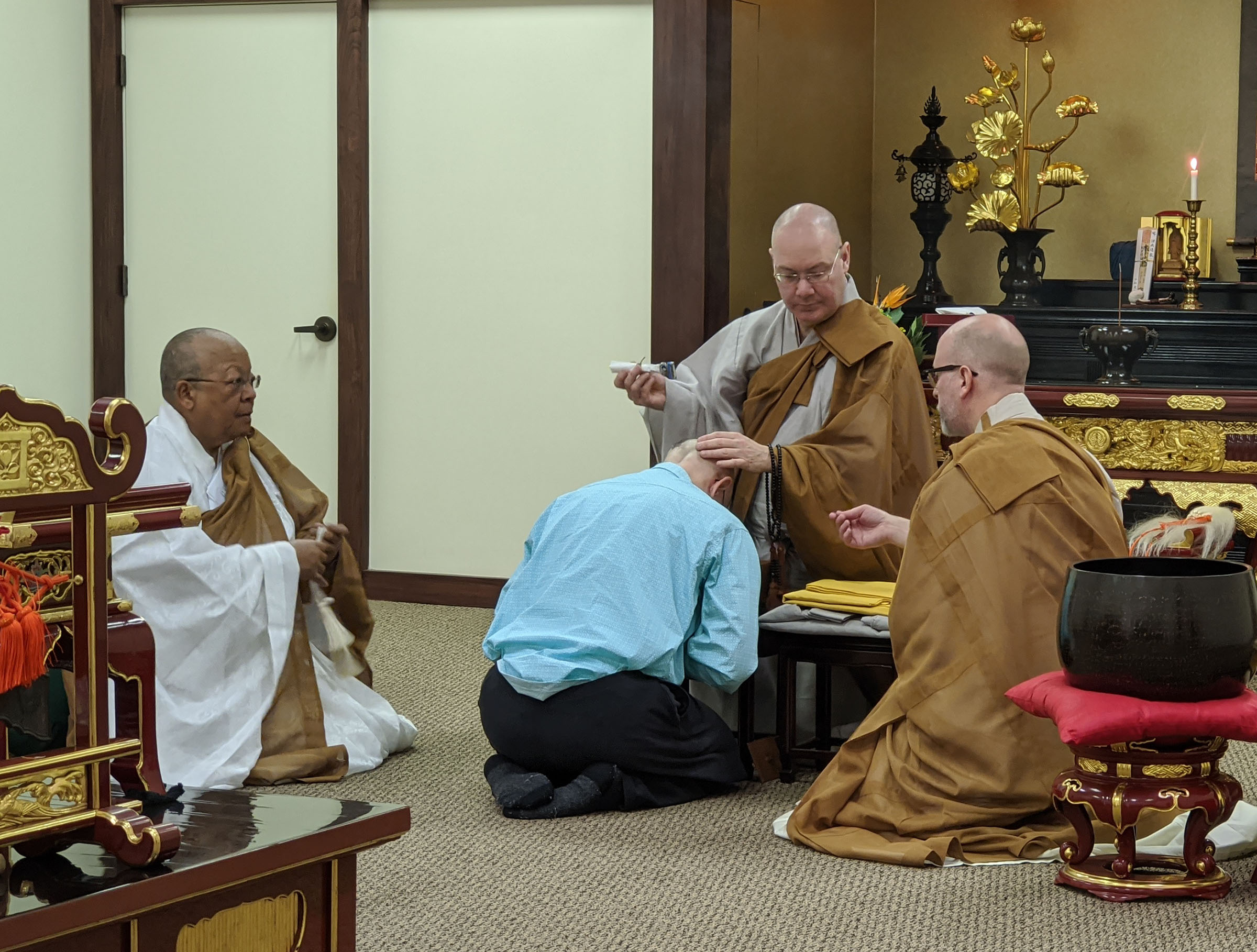
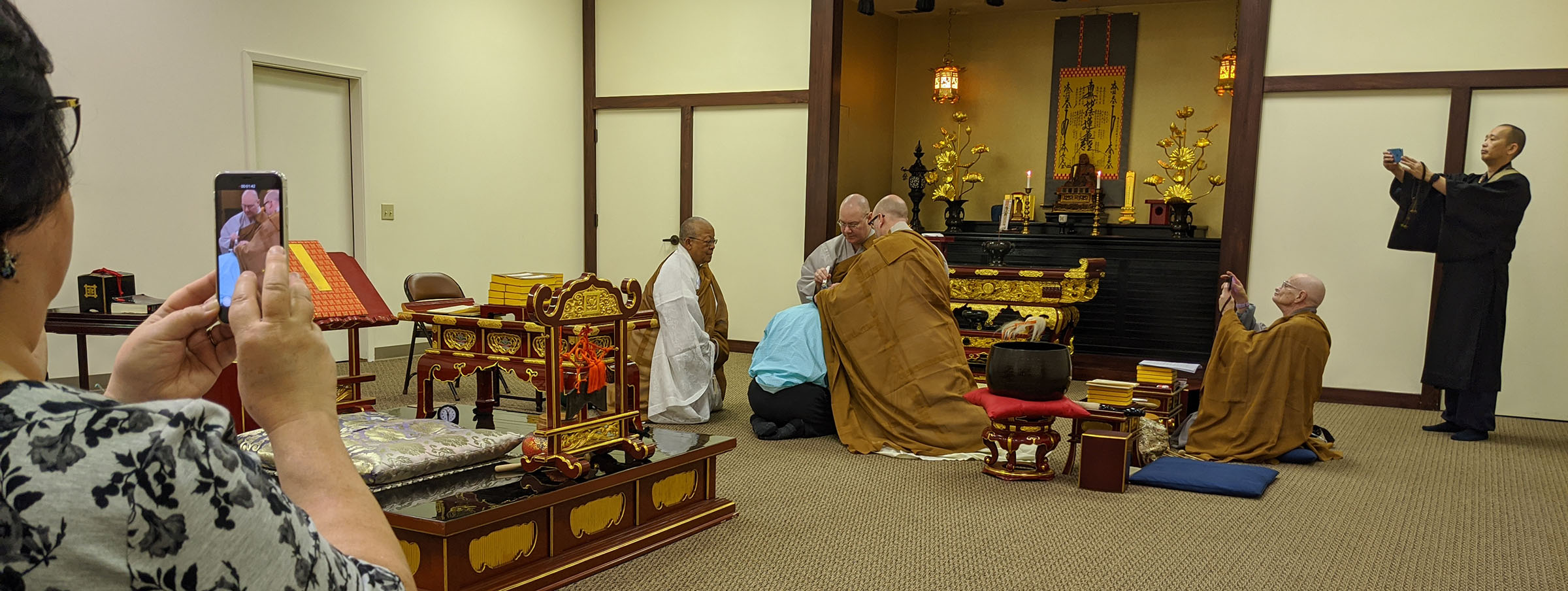
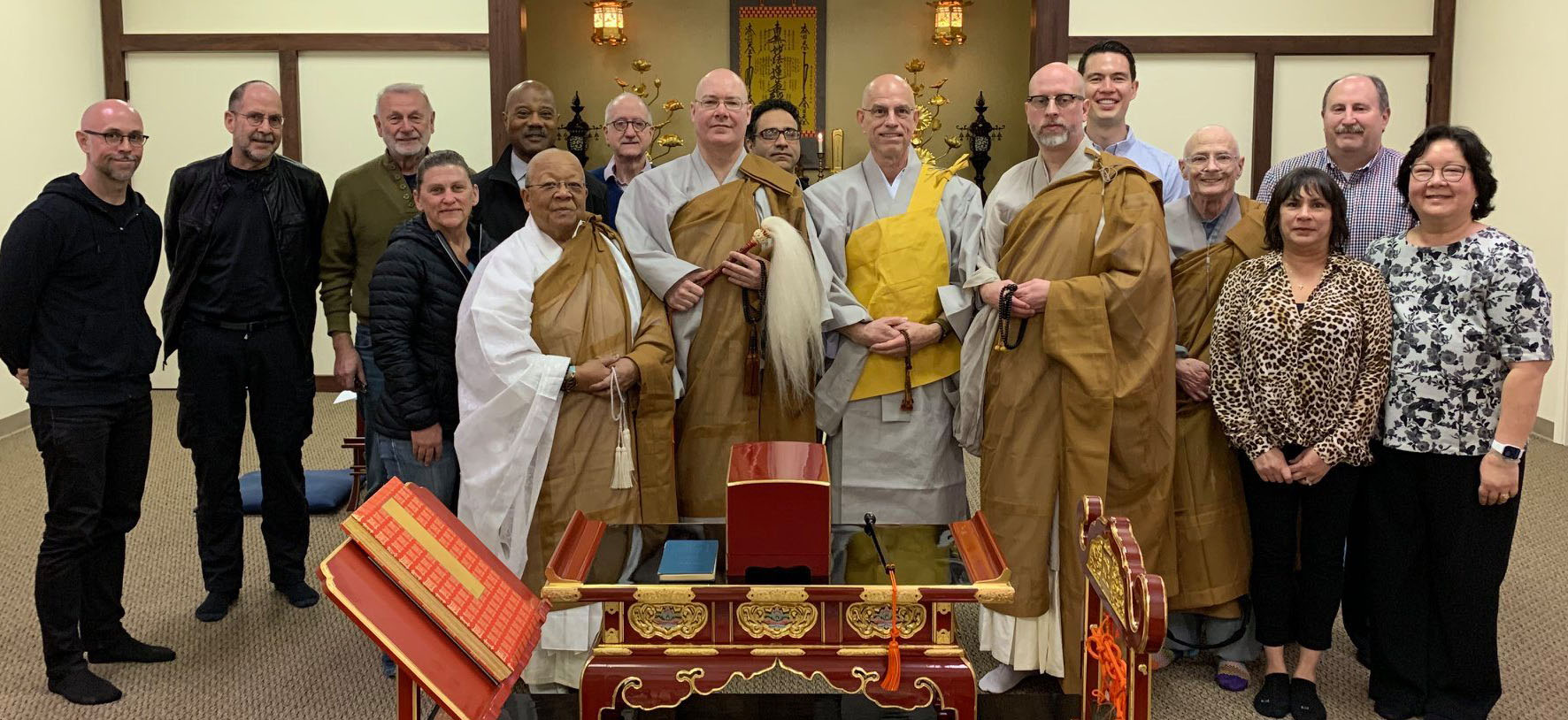
Ceremonial shaving of the headObviously taking photos of the ceremony was encouragedPresentation of the robesGetting dressed in the new robes for the first timeMike, now Ryugan (pronounced Yu Gan), “leaving home” before his wife and son.Ryugan takes the lowest seat among the ministers performing the serviceRyugan addressed the dozen guests in the audience.Group photo taken after the service
Having last month learned that the Buddhas teach only Bodhisattvas, we consider the teachings of the one vehicle by the present Buddhas.
“Śāriputra! The present Buddhas, the present World-Honored Ones, of many hundreds of thousands of billions of Buddha-worlds of the ten quarters benefit all living beings, and give them peace. These Buddhas also expound various teachings with innumerable expedients, that is to say, with stories of previous lives, parables, similes and discourses, only for the purpose of revealing the One Buddha-Vehicle. The living beings who hear the teachings from these Buddhas will also finally obtain the knowledge of the equality and differences of all things.
“Śāriputra! These [present] Buddhas teach only Bodhisattvas because they wish to show the insight of the Buddha to all living beings, to cause them to obtain the insight of the Buddha, and to cause them to enter the Way to the insight of the Buddha.
“Śāriputra! So do I. I know that all living beings have various desires. I also know that they have attachments deep in their minds. Therefore, I expound various teachings to them with stories of previous lives, parables, similes and discourses, that is to say, with various expedients according to their natures.
“Śāriputra! I do all this for the purpose of causing them to realize the teaching of the One Buddha-Vehicle, that is, to obtain the knowledge of the equality and differences of all things. Śāriputra! There is not a second vehicle in the worlds of the ten quarters. How can there be a third?
The One-vehicle means: All people can become buddhas. The enlightenment obtained by śrāvakas, pratyekabuddhas, and bodhisattvas alike is one by which they become buddhas, and it is the same in origin. Some can obtain the enlightenment of a śrāvaka and others can obtain that of a pratyekabuddhahood. Both aspects of enlightenment are gates to the Buddha knowledge.
This is allegorically explained as follows: A person who has entered this gate cannot enter the inner room of the Buddha-knowledge until he has first passed through the porch of the bodhisattva practice. At the same time, it cannot be said that the gate and the porch are not both included within the residence of the Buddha. However, if a person stays at the gate, he will be drenched when it rains and chilled when it snows. “All of you, come into the inner room of the Buddha’s residence. The eastern gate, the western gate, and the porch, all are entrances that lead to the inner room of the Buddha-knowledge.” This is the meaning of the Buddha’s words, “Besides the One Buddha-vehicle, there is neither a second vehicle nor a third. I have shown the existence of these two vehicles by my tactful power. There is only one true goal for all.”
The opening passage of [Chapter 10, The Teacher of the Dharma] contains the first mention, recurring throughout the sūtra, of what Chinese exegetes would call the “five practices” or ways of upholding and disseminating the Lotus Sūtra after the Buddha’s passing. Though English translations vary, the five practices are as follows: (1) to accept and uphold the Lotus (to “preserve” it, in the Kubo-Yuyama translation), indicating an underlying faith or commitment; (2) to read it; (3) to recite it from memory (Kubo and Yuyama collapse 2 and 3 as “to recite” the sūtra); (4) to explain it, which would include teaching and interpreting it; and (5) to copy it. These were in fact the forms of sūtra practice widely performed in East Asia, where the Lotus and other sūtras were enshrined, read, recited, copied, and lectured upon for a range of benefits, including protection of the realm, good fortune in this life, and the well-being of the deceased. These “five practices” together employ all three modes of action (karma): that is, actions of body, speech, and mind. For Nichiren, the first of the five, “accepting and upholding” — preserving — was the most important: “Embracing the Lotus Sūtra and chanting Namu Myōhō-renge-kyō at once encompasses all five practices.”
There is no place other than where we are that is more conducive or better for our enlightenment. There may be things we need to change in our environment but until we change ourselves first then every thing we change will end up being the same or similar. This is difficult to accept, because it can be very seductive to think, if only I change my job then it will be better. Yet, when we make a change based upon that thinking without fundamentally changing ourselves, then we invariably end up facing similar problems even if packaged differently.
This is indeed inexplicable yet precious. If Devadatta does not become a Buddha, the numerous evil people who were induced by him to enter into his evil comradeship would never be able to escape the torment of the Hell of Incessant Suffering. It is solely due to the great favor of the Lotus Sutra that all of Devadatta’s comrades, too, are allowed to be Buddhas.
Nichiren wrote this passage in his Treatise on Prayers (Kitō-shō). Devadatta was a cousin of the Buddha who was jealous of the Buddha’s accomplishments. He tried to set those who followed the Buddha against each other, and even tried several times to kill the Buddha. In the Lotus Sūtra, even Devadatta is assured of becoming a Buddha, opening the path of enlightenment even to those as perverse and deluded as him. When we learn to see even those who cause great harm as being capable of becoming enlightened, then it changes not only how we treat them, but how we see the world.
The Daily Dharma is produced by the Lexington Nichiren Buddhist Community. To subscribe to the daily emails, visit zenzaizenzai.com
Having last month considered the Buddha Sun-Moon-Light, we consider what happened after the Buddha Sun-Moon-Light preached Innumerable Teachings.
“Thereupon the last Sun-Moon-Light Buddha expounded a Sūtra of the Great Vehicle called the ‘Innumerable Teachings, the Dharma for Bodhisattvas, the Dharma Upheld by the Buddhas.’ Having expounded this sūtra, he sat cross-legged [facing the east] in the midst of the great multitude, and entered into the samādhi for the purport of the innumerable teachings. His body and mind became motionless.
“Thereupon the gods rained mandarava-flowers, maha-mandarava-flowers, manjusaka-flowers, and maha-manjusakaflowers upon the Buddha and the great multitude. The world of the Buddha quaked in the six ways. The great multitude of the congregation, which included bhikṣus, bhikṣunīs, upāsakās, upāsikās, gods, dragons, yakṣas, gandharvas, asuras, garuḍas, kiṃnaras, mahoragas, men, nonhuman beings, the kings of small countries, and the wheel turning-holy kings, were astonished. They rejoiced, joined their hands together [towards the Buddha], and looked up at him with one mind.
‘Thereupon the Tathagata emitted a ray of light from the white curls between his eyebrows, and illumined all the corners of eighteen thousand Buddha-worlds in the east just as this Buddha is illumining the Buddha-worlds as we see now.
The law “Nirvana is quiescence” teaches us that we can completely extinguish all the sufferings of human life and obtain peace and quietude when we destroy all illusions. How can we reach this state? The only way is to realize the two laws “All things are impermanent,” and “Nothing has an ego.”
The reason we worry about various kinds of sufferings is that we forget that all phenomena in this world are impermanent, that all things continuously change according to the law of cause and effect; we are deluded by phenomena and influenced by considerations of immediate gain or loss. If we study the way to buddhahood and by practicing it realize the truth of the impermanence of all things, we become able to attain a state of peace and quietude in which we can never be swayed by shifting circumstances. This is the state of “Nirvana is quiescence.”
The title of [Chapter 10] in Sanskrit is dharmabhāṇaka, literally “reciter of the dharma” or “proclaimer of the dharma.” In early Buddhism, the discourses of the Buddha were not committed to writing. Instead, they were memorized by monks who specialized in particular sections of the canon; these monks were called “reciters of the dharma,” as well as “keepers of the dharma” (dharmadhara) and “narrators of the dharma” (dharmakathika). With the rise of the Mahāyāna, the term dharmabhāṇaka seems to refer to those who preached the Mahāyāna sūtras.