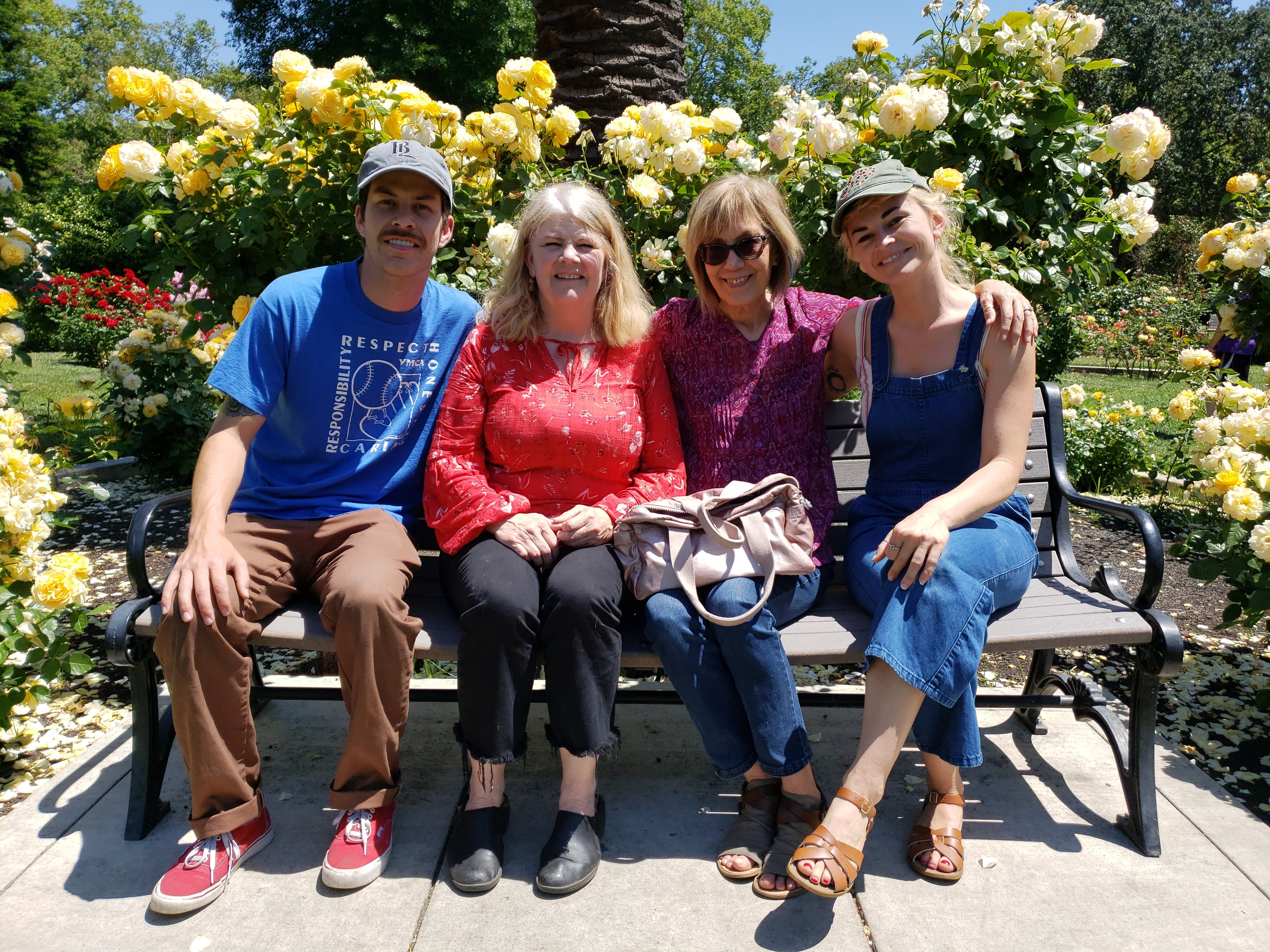
While I was at church, Richard and his girlfriend, Alexis, celebrated Mother’s Day with their mothers (Richard with Alexis’ mom and Alexis with Richard’s mom) at the McKinley Park Rose Garden.
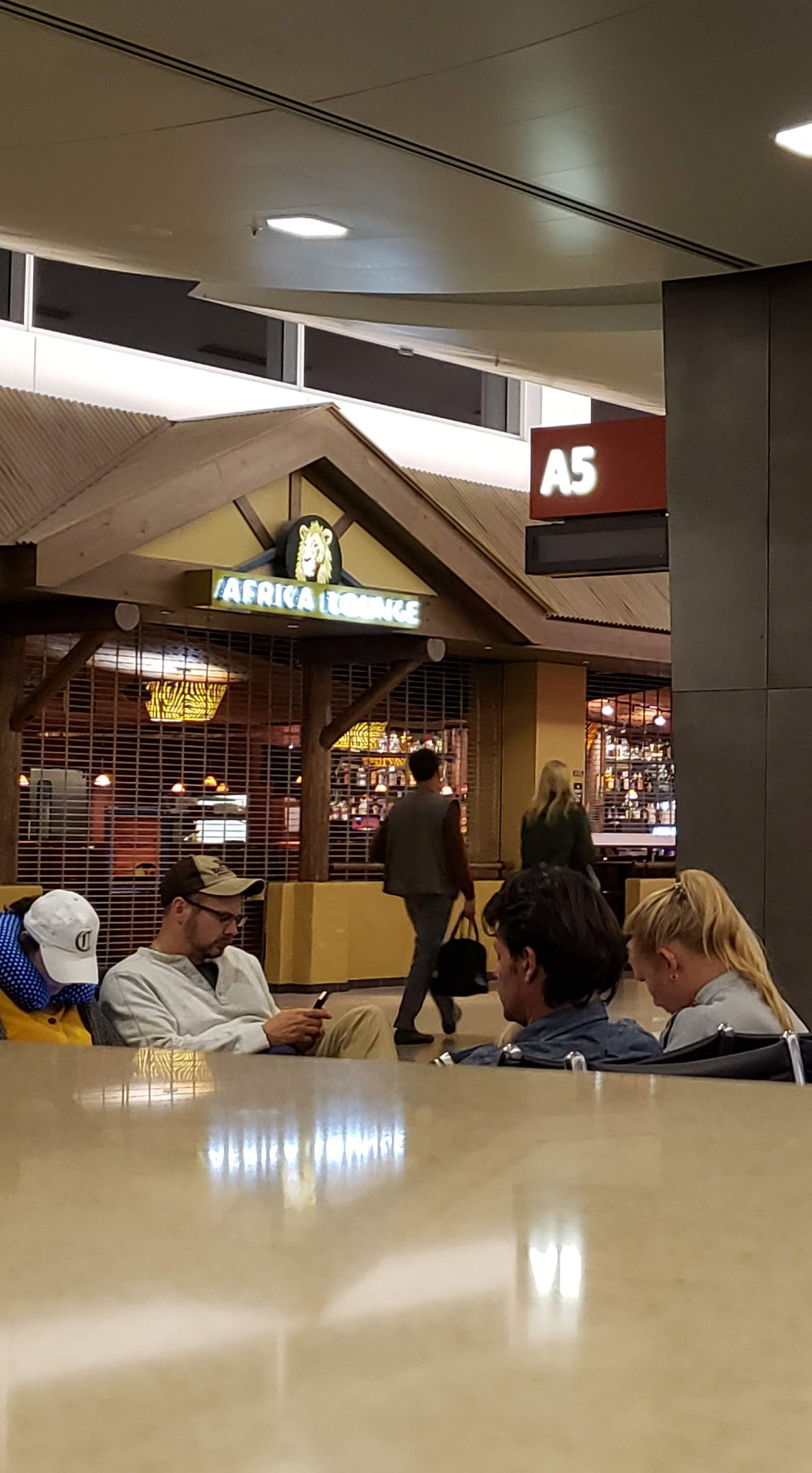
I’m sitting in the waiting area for Gate A5 at the Seattle-Tacoma Airport waiting for the next leg of my trip from Sacramento. I’ve got another two hours to kill before boarding red-eye flight to Detroit. I have a “Honey-Do” harvest awaiting me in Churchville, NY.
Yesterday I was working at the Sacramento Nichiren Buddhist Church replacing a corrugated metal roof that covers a flat portion of the “chicken shed” where the teriyaki chicken will be cooked at the church bazaar June 8-9. The 30-year roof had rusted through at several points.
Rev. Igarashi was helping me as I nailed down the metal roof sections.
At one point the topic of discussion turned to Mother’s Day, and Rev. Igarashi said it wasn’t celebrated in Japan.
I digress at this point to mention that I chatted at church today, Mother’s Day, with a young woman born and raised in Hiroshima who now lives in Sacramento, and she said she always celebrates Mother’s Day, buying flowers.
So, whatever the case in Japan, Mother’s Day wasn’t something Rev. Igarashi adopted. And after reading the Nihon ryōiki, I’m happy to believe that in a traditional household Mother’s Day isn’t restricted to a single day.
All of which provides me an opportunity to reprint a Nihon ryōiki story:
On an Evil Man Who was Negligent in Filial Piety to His Mother and Gained an Immediate Penalty of Violent Death
In Sou upper district, Yamato province there once lived a wicked man whose identity is lost except for his nickname, Miyasu. In the reign of the emperor residing at the Palace of Naniwa, he became a student of the Confucian classics, but he attained merely book knowledge and did not support his mother.
His mother had borrowed rice from him and could not return it. Miyasu angrily pressed his mother for payment. His friends, who could no longer endure the sight of the mother seated on the ground while the son sat on a mat, asked him, “Good man, why are you not respectful? Some people build pagodas, make Buddha images, copy scriptures, and invite monks to a retreat for their parents’ sake. You are rich and fortunate enough to lend much rice. Why do you neglect your dear mother and contradict what you have studied?” Miyasu ignored them, saying, “That’s none of your business.” Whereupon they paid the debt on her behalf and hurried away.
His mother, for her part, bared her breasts and, in tears, said to her son, “When I reared you, I never rested day or night. I have seen people repaying their parents for their affection, but, when I thought I could rely on my son, I incurred only disgrace. I was wrong in relying upon you. Since you have pressed me for repayment of the rice, I will now demand repayment of my milk. The mother-child tie is from this day broken. Heaven and earth will take cognizance of this. How sad, how pitiful! ”
Without a word Miyasu stood up, went into the back room, and, returning with the bonds, burnt them all in the yard. Then he went into the mountains where he wandered about not knowing what to do, ran wildly this way and that with disheveled hair and a bleeding body, and could not stay in his home. Three days later a fire broke out suddenly, and all of his houses and storehouses in and out of the premises burned. Eventually Miyasu turned his family into the streets, and he himself died of hunger and cold without any shelter.
Now we cannot help believing that a penalty will be imposed, not in the distant future, but in this life. Accordingly, a scripture says, “The unfilial are destined to hell; the filial, to the pure land.” This is what Nyorai preaches, the true teaching of Mahayana tradition. (Page 135-136)
This is the first collection of Buddhist legends in Japan, and these stories form the repertoire of miraculous events and moral examples that later Buddhist priests used for preaching to the people. As Kyokai describes his own intentions, “By editing these stories of miraculous events I want to pull the people forward by the ears, offer my hand to lead them to good, and show them how to cleanse their feet of evil” (p.222).
Nakamura’s book is actually two works in one: first an introduction to the Nihon ryōiki, and then an annotated translation. The introduction analyzes the life of the author and the influence of earlier writings, and provides a valuable synthesis of the world view reflected in the work.
The annotated translation renders the more than one hundred stories into English narrative, with copious notes. Difficult terms are identified in the text with the original Chinese characters, while historical matters and Buddhist technical terms are explained in the footnotes.
The translator and editor of this edition, Kyoko Motomochi Nakamura, offers this concept of “miracles” at the conclusion of his preface:
If miracles are narrowly defined as the intervention of the divine which is designed to suspend or change the law of nature, then wondrous occurrences in the Buddhist tradition are not miracles, but the work of karma (1.26). As a consequence of past karma, man becomes a sage, holy man, bodhisattva, or buddha, and attains self-mastery. To the popular imagination, however, wonders held such appeal that they served as signs to invite men through the gate along the path toward enlightenment. (Page 91)
The Nihon ryōiki is a collection of stories gathered by a monk named Kyōkai. The Nihon ryōiki, according to Nakamura, was compiled either in 782-805 or 810-824. Theories differ, but one important aspect is that at the time when this book was compiled Japanese Buddhism was in a transition away from nonsectarian “Buddhist institutes for the study of several different doctrines” toward a growing sectarian consciousness “in response to the challenge of the new Buddhist teachings introduced by Saichō (767-822) and Kūkai (744-835)” (Page 4).
Kyōkai’s Preface of Volume One offers this view of Good and Evil:
Good and evil deeds cause karmic retribution as a figure causes its shadow, and suffering and pleasure follow such deeds as an echo follows a sound in the valley. Those who witness such experiences marvel at them and forget they are real happenings in the world. The penitent withdraws to hide himself, for he burns with shame at once. Were the fact of karmic retribution not known, how could we rectify wickedness and establish righteousness? And how would it be possible to make men mend their wicked minds and practice the path of virtue without demonstrating the law of karmic causation? (Page 101)
And later in discussing his own limitations:
I am not gifted with either wisdom or lucidity. Learning acquired in a narrow well loses its way when out in the open. My work resembles that of a poor craftsman working on the carving of a master. I am afraid that I will cut my hand and suffer from the injury long afterward. My work is comparable to a rough pebble beside the K’un-lun Mountains. Its source in the oral tradition is so indistinct that I am afraid of omitting much. Only the desire to do good has moved me to try, in spite of the fear that this might turn out to be a presumptuous work by an incompetent author. I hope that learned men in future generations will not laugh at my efforts, and I pray that those who happen upon this collection of miraculous stories will put aside evil, live in righteousness, and, without causing evil, practice good. (Page 101-102)
From the Kyōkai’s Preface to Volume III, the three periods of Śākyamuni’s teachings:
The Inner Scriptures show how good and evil deeds are repaid, while the Outer Writings show how good and bad fortunes bring merit and demerit. If we study all the discourses Śākyamuni made during his lifetime, we learn that there are three periods: first, the period of the true dharma (shōbō), which lasts five hundred years; second, the period of the counterfeit dharma (zōbō), lasting a thousand years; and third, the period of the degenerate dharma (mappō), which continues for ten thousand years. By the fourth year of the hare, the sixth year of the Enryaku era [787], seventeen hundred and twenty-two years have passed since Buddha entered nirvana. Accordingly, we live in the age of the degenerate dharma following the first two periods. Now in Japan, by the sixth year of the Enryaku era, two hundred and thirty-six years have elapsed since the arrival of the Buddha, Dharma, and Samgha [538 or 553]. Flowers bloom without voice, and cocks cry without tears. In the present world those who practice good are as few as flowers on rocky hills, but those who do evil are as plentiful as weeds in the soil. Without knowing the law of karmic retribution, one offends as easily as a blind man loses his way. A tiger is known by its tail. Those devoted to fame, profit, and killing doubt the immediate repayment of good and evil which occurs as quickly as a mirror reflects. One who is possessed of an evil spirit is like one who holds a poisonous snake; the poison is always there ready to appear.
The great power of karmic retribution reaches us as quickly as sound echoes in a valley. If we call, the echo never fails to answer, and this is the way karmic retribution works in this life. How can we fail to be more careful? It is useless to repent after spending a lifetime in vain. Who can enjoy immortality since you are given a limited life? How can you depend on your transient life as being eternal? We are already in the age of the degenerate dharma. How can we live without doing good? My heart aches for all beings. How can we be saved from calamity in the age of the degenerate dharma? If we offer monks only a handful of food, the merit of our good deed will save us from the calamity of hunger. If we keep a precept of nonkilling for a day, we will be saved from the calamity of sword and battle. (Page 221-222)
He follows with an example of how karma works:
Once there was a full-fledged monk who lived on a mountain and practiced meditation. At every meal he shared his food with a crow which came to him every day. After a vegetarian meal, he chewed a toothpick, cleaned his mouth, washed his hands and played with a stone. The crow was behind the hedge when he threw the stone. He hit the crow without knowing that it was there. The crow died on the spot, its head crushed into pieces, and was reborn as a boar. The boar lived in the same mountain as the monk. It happened to go to the place above his hut, rooting about among the rocks for food, where upon one of the rocks rolled down and killed the monk. Although the boar had no intention of killing him, the rock rolled down by itself. A sin committed by an action which is neither good nor bad will in turn generate the same kind of action. In the case of intentional murder, how is it possible to escape the penalty? A deluded mind produces the seed and fruit of evil; an enlightened mind produces the seed of good to attain Buddhahood. (Page 222)
Having last month concluded Chapter 20, Never-Despising Bodhisattva, we witness the vow of the Bodhisattvas who sprang up from underground.
Thereupon the Bodhisattva-mahāsattvas as many as the particles of dust of one thousand worlds, who had sprung up from underground, joined their hands together towards the Buddha with all their hearts, looked up at his honorable face, and said to him:
“World-Honored One! After your extinction, we will expound this sūtra in the worlds of the Buddhas of your replicas and also in the place from which you will pass away. Why is that? It is because we also wish to obtain this true, pure and great Dharma, to keep, read, recite, expound and copy [this sūtra], and to make offerings to it.”
An unidentified priest lived at the Tadain Temple at Teshima in Settsu Province. After he had lived several decades, he devoted himself to the Hokekyō, reciting it single-mindedly and practicing the Three Deeds. He had passed many years in the mountains engaged in ascetic practices. A certain layman much appreciated and venerated this devout priest and served him faithfully.
One day the layman fell ill during an epidemic and finally died. He was laid in a coffin which was placed in a treetop. Five days later, however, he revived, got out of the coffin, and returned home.
At his house, the layman told his wife and children about the Land After Death:
“King Yama took out a ledger, examined the tablets of my life’s conduct and said, ‘Since you have been very sinful, you should be sent to hell. However, I will pardon you by extending your life span and let you go home. This is because you have devoutly venerated the reciter of the Hokekyō for all these years. As a result of this merit, you will be released from here. After returning home, venerate the Hokekyō reciter. This will be more appreciated than venerating many Buddhas during the three periods of time, and your virtue will excel all other merits.
“After hearing King Yama’s admonishment, I left his office and returned to this world. On my way home I saw some ten stupas, all of them finely decorated with seven jewels, risen of their own accord in a mountain field.
“The priest, whom I have venerated all these years, sat facing these adorned stupas. He breathed flames from his mouth and burned them all down. Next, I heard a voice in the sky which said to me, “You should know that these stupas appeared as the priest recited the Chapter of the Apparition of the Stupa in the Hokekyō. But he has angrily scolded and abused his disciples and followers. The violent flames of his anger flared out from his mouth and burned down those stupas. If the reciter had controlled his anger and recited the sūtra, the jeweled stupas undoubtedly would have filled this world. Tell this to your priest!’ ”
All those who heard the layman’s story, his wife and children, relatives, followers and all his neighbors, thought it most unusual. The layman went to the priest and told him what had happened in the Land After Death.
The priest listened to his story, regretted and repented of his deeds, left his people and the ignorant crowd, and lived alone, reciting the Hokekyō singlehandedly. Ten years later he finally passed away without any sickness while sitting in a posture of meditation. (Page 58-59)
One important concept to keep in mind, which I think is very difficult in our modern materialistic society, is the thought that all things are impermanent and insubstantial. It is easy to be lead astray and think that things are important and will last indefinitely, when in fact no thing will remain unchanged forever.
I attained perfect enlightenment and now save all living beings because Devadatta was my teacher.
The Buddha makes this declaration in Chapter Twelve of the Lotus Sūtra. Devadatta was a cousin of the Buddha who became jealous of the Buddha’s enlightenment. Several times he tried to kill the Buddha. He also caused a split in the Buddha’s Sangha, and convinced a young prince to kill his father and usurp the throne. Devadatta was so evil that he fell into Hell alive. Despite all this, the Buddha credits Devadatta with helping him become enlightened, and assures Devadatta personally that he will become enlightened. This shows us that even those beings who create great harm have Buddha nature. They may not deserve our admiration, but they at least deserve our respect.
The Daily Dharma is produced by the Lexington Nichiren Buddhist Community. To subscribe to the daily emails, visit zenzaizenzai.com
Day 24 concludes Chapter 19, The Merits of the Teacher of the Dharma, and closes the Sixth Volume of the Sutra of the Lotus Flower of the Wonderful Dharma.
Having last month learned of the eight hundred merits of the nose, we repeat in the eight hundred merits of the nose gāthās.
Thereupon the World-Honored One, wishing to repeat what he had said, sang in gāthās:
Their nose will be purified.
They will be able to know
The smells of all things,
Be they good or bad.
They will be able to recognize by smell
The sumanas-flowers and jātika-flowers;
Tamala[pattra] and candana;
Aloes and sappanwood;
Various flowers and fruits;
And all Jiving beings including men and women.
Anyone who expounds the Dharma will be able to locate
All living beings from afar by smell.
He will be able to locate by smell
The wheel-turning-kings of great [countries],
The wheel-turning-kings of small [countries],
And their sons, ministers and attendants.
He will be able to locate by smell
The wonderful treasures of personal ornaments,
The underground stores of treasures,
And the ladies of the wheel-turning-kings.
He will be able to recognize persons
By smelling their ornaments or garments
Or by smelling their necklaces
Or by smelling the incense applied to their skin.
Anyone who keeps
This Sūtra of the Lotus Flower of the Wonderful Dharma
Will be able to know by smell
Whether the gods are walking, sitting, playing or performing wonders.
Anyone who keeps this sūtra
Will be able to locate by smell, without moving about,
The flowers and fruits of trees,
And the oil taken from sumanas-flowers.
He will be able to recognize by smell
The flowers of the candana-trees
Blooming in steep mountains,
And the living beings in those mountains.
Anyone who keeps this sūtra
Will be able to locate by smell
The living beings in the Surrounding Iron Mountains,
In the oceans, and underground.
He will be able to know by smell
Whether asuras and their daughters
And their attendants are fighting
Or playing with each other.
He will be able to locate by smell
Lions, elephants, tigers,
Wolves, wild oxen and buffalos
In the wilderness and in steep places.
He will be able to know by smell
Whether an unborn child is a boy or a girl,
Or a child of ambiguous sex,
Or the embryo of a nonhuman being.
He will be able to know by smell
Whether a woman is an expectant mother,
Or whether she will give an easy birth
To a happy child or not.
He will be able to know by smell
What a man or a woman is thinking of,
Or whether he or she is greedy, ignorant or angry,
Or whether he or she is doing good.
He will be able to recognize by smell
The gold, silver, and other treasures
Deposited underground,
And the things enclosed in a copper box.
He will be able to know by smell
The values of various necklaces,
And the deposits of their materials,
And also to locate the necklaces [when they are lost].
He will be able to recognize by smell
The mandārava-flowers,
And the mañjūṣaka-flowers,
And the pārijātaka-trees in heaven.
He will be able to know by smell
Whether a heavenly palace
Adorned with jeweled flowers
Is superior, mean or inferior.
He will be able to recognize by smell
Gardens, forests, excellent palaces,
And the wonderful hall of the Dharma in heaven,
And other stately buildings where [the gods] enjoy themselves.
He will be able to know by smell
Whether the gods are hearing the Dharma
Or satisfying their five desires,
Or coming, going, walking, sitting or reclining.
He will be able to know by smell
Whether the goddesses, clad in the garments
Adorned with fragrant flowers,
Are playing as they are moving about.
He will be able to know by smell
Who has reached the Heaven of Brahman,
Who has entered into dhyāna,
And who has come out of it.
He will be able to know by smell
The person who has appeared for the first time in the Light-Sound Heaven
Or in the Universal-Pure Heaven or in the Highest Heaven,
And who has disappeared from there.
Anyone who keeps this sūtra
Will be able to locate by smell
The bhikṣus who are sitting or walking about
In seeking the Dharma strenuously,
And the bhikṣus who are reading or reciting [this] sūtra
Or devoting themselves
To sitting in dhyāna
Under the trees of forests.
He will be able to know by smell
The Bodhisattvas who are resolute in mind,
And who are sitting in dhyāna or reading [this] sūtra
Or reciting it or expounding it to others.
He will be able to locate by smell
The World-Honored One who is expounding the Dharma
Out of his compassion
Towards all living beings who respect him.
He will be able to know by smell
Those who rejoice at hearing [this] sūtra
From the Buddha,
And act according to the Dharma.
Anyone who keeps this sūtra
Will be able to have these merits of the nose
Although he has not yet obtained the nose
Of the Bodhisattva [who attained] the
Dharma without āsravas.
A priest lived in a temple near the Kazurakawa. He spent the months and years in difficult ascetic practices such as fasting and observing the repentance rites.
He once dreamed that a priest said, “A hijiri lives on the summit of Mt. Hira and recites the Hokekyō. Many Buddhas and various Deva Kings admire and respect him. Quickly go there and establish a relationship with him!”
The surprised priest awoke and hurried to Mt. Hira. After searching the mountain for several days, the priest finally heard the voice reciting the Hokekyō. The voice was incomparably beautiful and noble. It was neither too high nor too low but would deeply touch one’s heart. The overjoyed priest ran from the east to the west following the voice. However, he could not find the reciter but only heard the voice. He continued searching for a long time and finally reached a flat area.
There he saw a grotto covered with brush and moss. It was only two jō large, but was extraordinarily attractive. A large pine tree spread its roots over the grotto and extended its branches in the four directions screening the area in front of the cave. The wind blowing through the pine branches sounded no different than music. The rain would not wet the front yard which was sheltered by the branches which served as an umbrella. The summer heat would be lessened by the shade of the pine while the winter cold would be milder because of the thick branches.
Within the cave sat a most unusual hijiri of skin and bones wearing green moss for clothing. Seeing the priest, the hijiri said, “It is unusual that you have come here. Don’t come close to me but keep at a distance.” The priest asked the reason and the hijiri explained, “The smoke of the secular world gets into my eyes and causes me to shed tears. The smell of blood distresses my nose. Come to see me after seven days, and we will talk.”
As instructed, the priest remained at a distance of few tan from the cave. During that time, the priest listened to the hijiri’s recitation of the Hokekyō, and felt joyful and ennobled.
Many animals including deer, bears, monkeys, and birds brought fruits and nuts to the hijiri as their offerings. One of the monkeys was sent with nuts and fruits to the priest.
Seven days passed and the priest came closer to the hermit. The hermit told the priest, “I was originally a priest named Renjaku of the Kōfukuji Temple. When I read a passage of the Hokekyō which says, ‘If one does not venerate the Hokekyō, one will surely regret it later’, my mind became pious for the first time. When I read another passage of the sūtra which says, ‘If one recites the sūtra at a serene place with no one present, one will immediately become a pure and illuminated being,’ I left the temple and travelled through the mountains as I engaged in ascetic practices.
I have abandoned the mundane thoughts of being attached to and cherishing one’s own life; instead, I have accumulated virtues and become a hijiri on my own account. After travelling through mountains and valleys, I have finally come to this mountain and remained here since, probably as a result of my karmic relationship. After leaving the secular world, I have regarded the Hokekyō as my parents, the Law as my master, the teachings as my house, and the precepts as my protectors.
By the assistance of the Hokekyō, I see far into the distance, hear the voices of the sentient beings, and perceive all of the Law in my mind. Relying on the Hokekyō, I ascend to the Tosotsu Heaven, worship Miroku Buddha, and become familiar with various Buddhas and hear the Law at will. Your coming here must have a small karmic cause. Remain here and practice the Way.”
Although the priest wanted to accept the hijiri’s advice and invitation, he declined due to his inferior capacity and disposition, and left ashamed. With the help of the hijiri, the priest returned to his temple near Kazurakawa.
The priest told his experiences to his colleagues and friends and planted the seeds of Buddhism in their minds. It is said that those who listened to him were all impressed with the extraordinary story about the hijir’i and were overjoyed, shedding tears. (Page 47-48)
Normally the sufferings of this world and the peace of Nirvana would be viewed as irreconcilable opposites. According to Mahayana Buddhism, however, all things are manifestations of Dependent Origination. That is, they are essentially empty of substantial existence or permanent characteristics. Awakening, then, does not trade one type of experience (such as enduring this world of birth and death) for another type of experience (such as attaining a Nirvana falsely imagined as some kind of blissful high or perfect afterlife) because all experiences are impermanent and dependent upon causes and conditions. Instead, awakening recognizes the true nature of all experiences. In this way, awakening frees us from our self-centered ignorance. It allows us to appreciate and care about things just as they are, instead of demanding that they conform to our desires and opinions. This recognition is the true state of Nirvana; it is not an escape from this world into another one. Nirvana is not the cessation of experience, but a revolutionary change in the way we experience the world and ourselves. This is what it meant by “the world of birth and death is itself Nirvana,” because Nirvana is not apart from the world and its sufferings, but is the true nature of life and death itself.
Anyone who expounds this sūtra to the four kinds of devotees,
Or reads or recites this sūtra in a retired place,
After doing these [three] virtuous things,
Will be able to see me.
The Buddha sings these verses to Medicine-King Bodhisattva in Chapter Ten of the Lotus Sūtra. While the Buddha was alive 2500 years ago, people traveled great distances and endure great hardships just to see him. Today, even though the man named Siddhartha Gautama is no longer in our world, we are assured that the ever-present Śākyamuni is always with us and leading us to his enlightenment. When we make the effort to keep, read, recite, copy and expound this Sūtra, it is as if we are traveling great distances and enduring great hardships.
The Daily Dharma is produced by the Lexington Nichiren Buddhist Community. To subscribe to the daily emails, visit zenzaizenzai.com