
Conceptual Summary
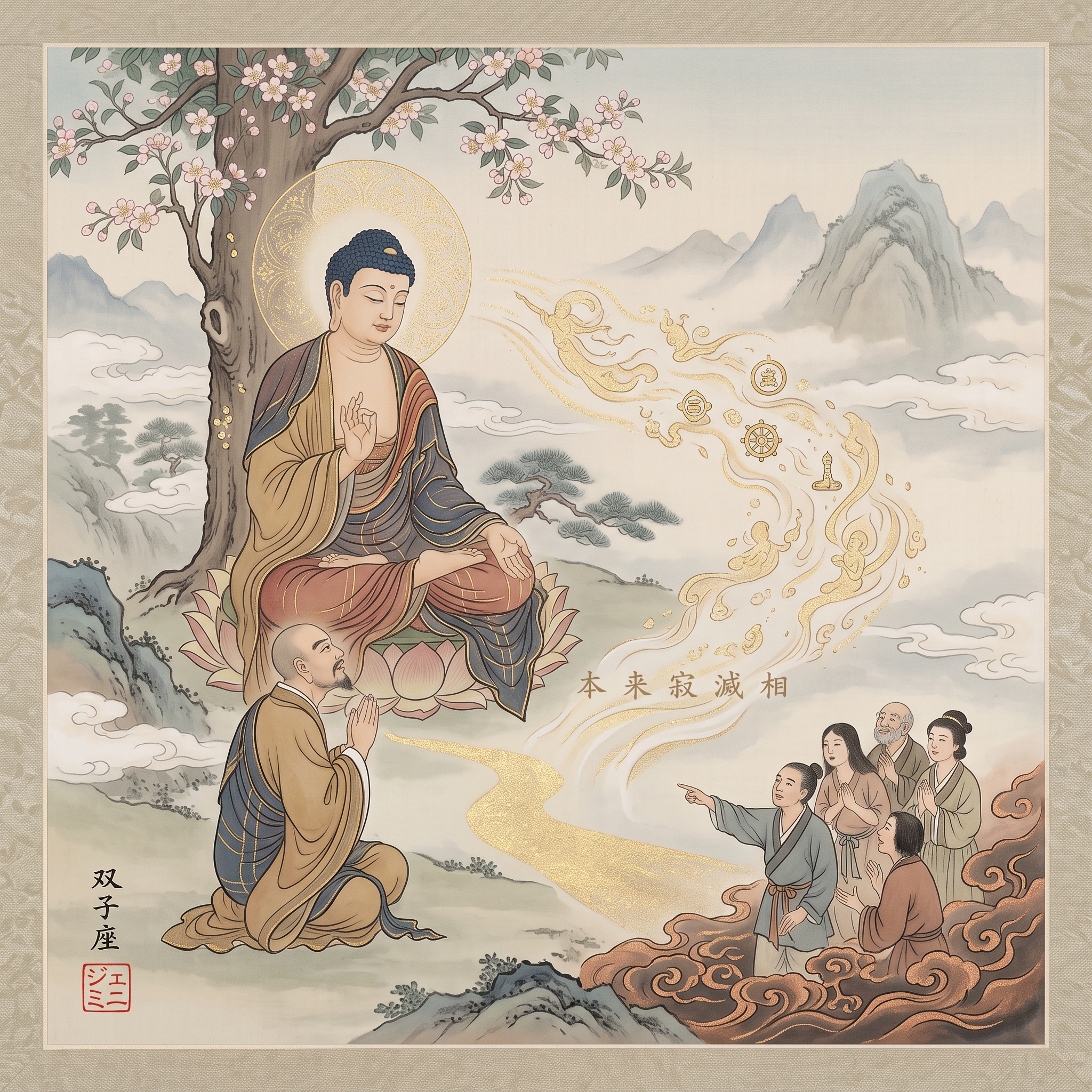
The illustration is a traditional Japanese Buddhist painting on silk, interpreting the Lotus Sutra passage where Śākyamuni Buddha reveals to Śāriputra that his prior teachings on Nirvāṇa were expedient, not absolute, extinction. The central Śākyamuni figure, seated in tranquil meditation, represents the ultimate realization. To show the 'expedient teachings,' a golden, luminous energy flows from him, guiding suffering individuals—those emerging from the murky clouds of delusion on the right—along a shimmering path towards the 'pure land' landscape. A key visualization is that these suffering figures are already stepping onto the luminous ground: they are not reaching for a far-off place, but realizing that the tranquil, enlightened state is present right now. The integration of the Kanji '本来寂滅相' (Honrai Jakumetsu Sō) reinforces that all things are from the outset inherently still and extinct of delusion. Śāriputra kneels below, receiving this profound, non-dualistic teaching.
Iconography & Character Identification
Item 1: Deities/Figures Featured:
Śākyamuni Buddha (釈迦如来): The central figure seated on the lotus throne.
Śāriputra (舎利弗): The kneeling disciple at the Buddha's feet.
The Multitude: A group of five relieved practitioners rising from the state of suffering (生死世界).
Item 2: Text Translations:
双子座 (Kanji Signature): Gemini
ジェミニ (Katakana Seal): Gemini
本来寂滅相 (Text within image): "From the outset, all things are in the state of tranquil extinction." (Quoted from the source text and Lotus Sūtra).
Therefore, Śāriputra!
I expounded an expedient teaching
In order to eliminate their sufferings.
That was the teaching of Nirvāṇa.
The Nirvāṇa which I expounded to them
Was not true extinction.
All things are from the outset
In the state of tranquil extinction.
The Buddha provides this explanation to his disciple Śāriputra in Chapter Two of the Lotus Sūtra. In this part of the story, the Buddha has announced that everything he had taught up until then, including the teachings of suffering and Nirvāṇa, were merely preparation for his highest teaching: the realization of the same enlightenment he reached. With the teaching of Nirvāṇa, the Buddha helps us take responsibility for our own situation rather than relying on an external force to make us happy. One problem with Nirvāṇa is that we can believe that it is something we do not have now. When we extinguish the fires of our delusion, we see the world with the Buddha’s eyes. We see the world for what it is, right here and right now.
The Daily Dharma is produced by the Lexington Nichiren Buddhist Community. To subscribe to the daily emails, visit zenzaizenzai.com