
Conceptual Summary
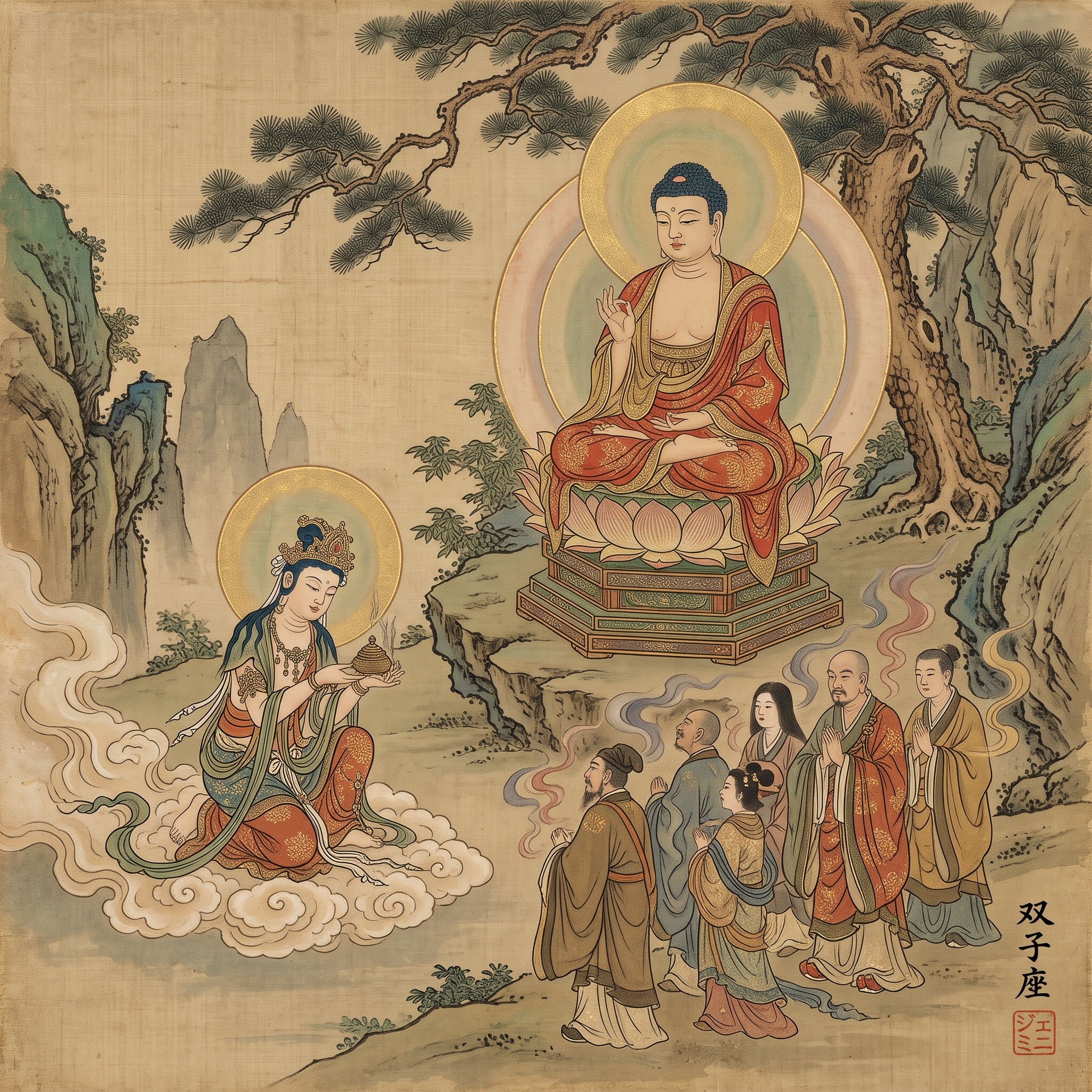
This classical Japanese Buddhist silk painting visualizes the purification of the olfactory sense as taught in Chapter Nineteen of the Lotus Sūtra. Elevated upon a lotus pedestal beneath an ancient pine, Śākyamuni Buddha imparts the Dharma to Constant-Endeavor Bodhisattva (Jōshōjin Bosatsu), who kneels on a luminous cloud holding a golden incense burner. Rather than retreating from the world, the Bodhisattva turns with serene awareness toward a gathering of lay men and women below. Delicate, multi-colored wisps of vapor rise from these ordinary beings, visibly representing the subtle scents of their inner thoughts, three poisons (greed, anger, ignorance), and virtuous deeds. By bridging the sacred realm with the mortal world through these rising currents of fragrance, the composition illustrates how a practitioner who removes delusion perceives the true nature of all beings directly through purified sensory engagement.
Iconography & Character Identification
Item 1: Deities/Figures Featured:
Śākyamuni Buddha (Shaka Nyorai): Seated on an elevated lotus throne in the upper right, displaying the vitarka mudra (gesture of teaching and discussion) with his right hand and resting his left hand in his lap.
Constant-Endeavor Bodhisattva (Jōshōjin Bosatsu): Kneeling on a trailing cloud in the lower left, adorned in traditional Bodhisattva garments, jewel necklaces, and a crown, holding a ritual censer (kōro) symbolizing the purified sense of smell.
Worldly Beings (Men and Women of the Saha World): A group of six laypeople standing in the lower right in traditional robes with hands joined in reverence (gasshō), emitting faint colored vapors that manifest their internal mental states and karma.
Item 2: Text Translations:
双子座 (Signature): "Gemini" (literally, the constellation/zodiac sign of the Twins).
ジェミニ (Red Square Seal / Hanko): "Jemini" (the phonetic transliteration of "Gemini" in Katakana script).
He will be able to know by smell
What a man or a woman is thinking of,
Or whether he or she is greedy, ignorant or angry,
Or whether he or she is doing good.
The Buddha gives this explanation to Constant-Endeavor Bodhisattva in Chapter Nineteen of the Lotus Sūtra, describing those who keep the Lotus Sūtra. As Bodhisattvas we chose to come into this world, as frightening and dangerous as it is, to make things better for all beings. We do not lose any of the six senses we have, but learn to use them in ways that may seem impossible to others. Any of our senses can be deluded. When we remove our attachments and delusions, we see with the Buddha’s eye the world as it is.
The Daily Dharma is produced by the Lexington Nichiren Buddhist Community. To subscribe to the daily emails, visit zenzaizenzai.com