
Conceptual Summary
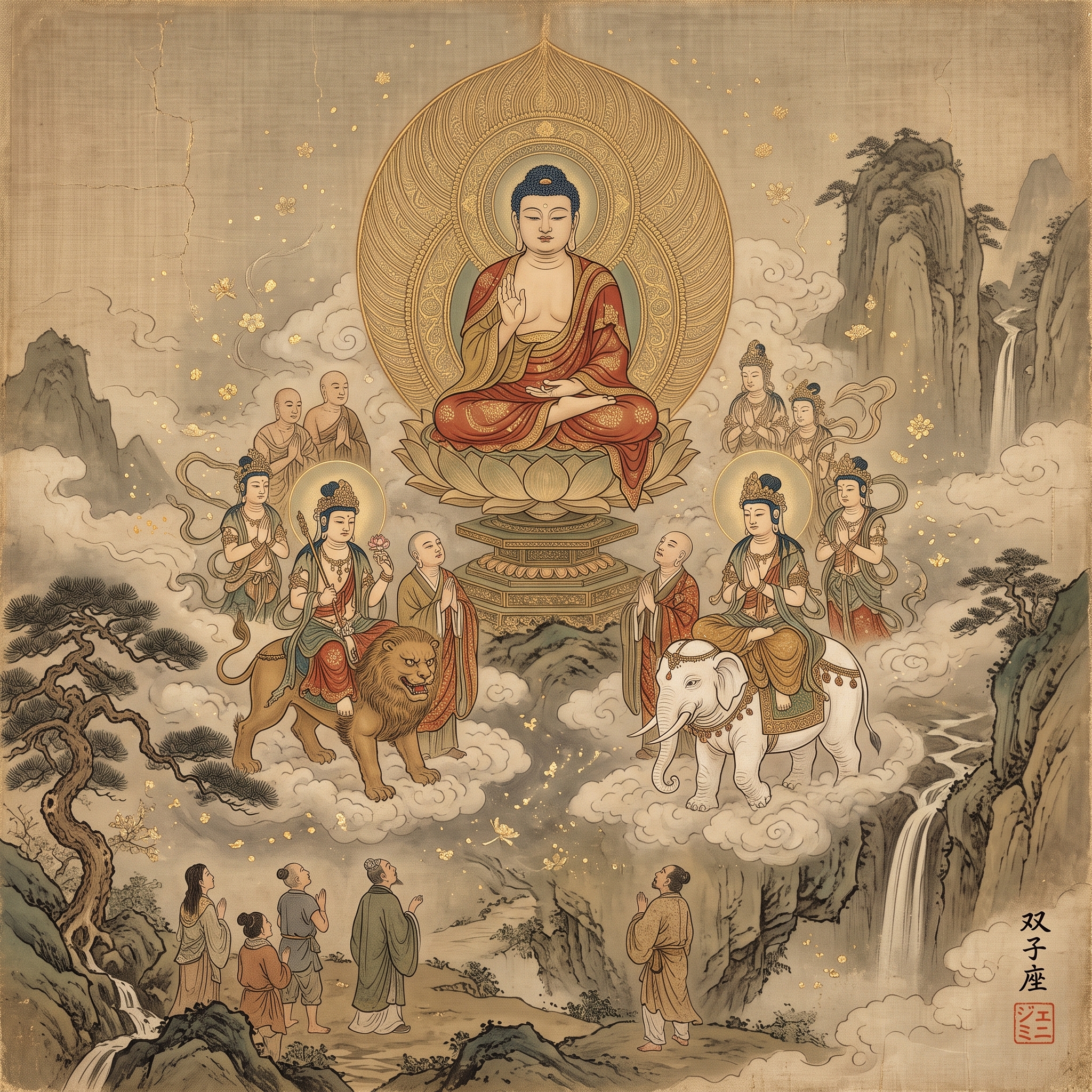
This classical Japanese Buddhist silk painting visualizes the eternal, ubiquitous nature of Śākyamuni Buddha and the Dharma as described in the Lotus Sūtra. Rather than depicting the Buddha as a distant, inaccessible figure, the composition uses luminous, swirling clouds and drifting golden lotus petals to represent the invisible, life-sustaining "air" of the Dharma that continuously permeates the world. Elevated at the center on a lotus pedestal over Vulture Peak, Śākyamuni expounds the teaching, yet his golden radiance blends seamlessly into the surrounding mist and mountain air. Below, ordinary laypeople stand amidst the earthly landscape gazing upward in sudden recognition, illustrating the moment when beings awaken from taking the world for granted and perceive the ever-present spiritual reality that has surrounded them all along.
Iconography & Character Identification
Item 1: Deities/Figures Featured:
Śākyamuni Buddha (Shaka Nyorai): Seated at the upper center on an ornate lotus throne, framed by a golden mandorla, with his right hand raised in the Abhaya Mudra (gesture of fearlessness and protection) and his left hand resting in his lap.
Mañjuśrī Bodhisattva (Monju Bosatsu): Seated on the left upon a roaring lion, holding a lotus blossom and a staff/sword representing transcendent wisdom.
Samantabhadra Bodhisattva (Fugen Bosatsu): Seated on the right upon a six-tusked white elephant with hands joined in añjali mudrā (prayer), representing universal worthy practice.
Monastic Disciples (Arhats/Śrāvakas) and Attendant Bodhisattvas: Four shaved-headed monks (commonly representing chief disciples like Śāriputra and Maudgalyāyana) and four celestial bodhisattvas flanking the central triad in attitudes of reverence.
Earthly Laypeople: Five everyday men, women, and youths standing on the rocky foreground path at the bottom, looking up through the mist with hands joined in realization.
Item 2: Text Translations:
双子座 (Futagoza): Literally translates to the constellation "Gemini" (the Twins), rendered in traditional vertical Kanji script as the artist's signature in the lower right corner.
ジェミニ (Jemini): The phonetic transliteration of "Gemini" written in Japanese Katakana, enclosed inside the red square hanko (artist's seal) directly beneath the Kanji signature.
The Buddhas seldom appear in the worlds.
It is difficult to meet them.
Even when they do appear in the worlds,
They seldom expound the Dharma.
The Buddha proclaims these verses in Chapter Two of the Lotus Sūtra. Later in the Sūtra he explains that in reality he became enlightened far in the past and will continue to lead all beings to enlightenment far into the future. The reason the Buddhas appear so rarely is not because they conceal themselves. It is because we do not recognize them for what they are. We cannot see the air we breathe, but it is crucial for our lives. Because of this we often take it for granted, unless we are so afflicted, or the air is so poisoned that we cannot breathe. Then we are aware of it. Likewise, the Buddha Dharma is available to us all the time.
The Daily Dharma is produced by the Lexington Nichiren Buddhist Community. To subscribe to the daily emails, visit zenzaizenzai.com