
Conceptual Summary
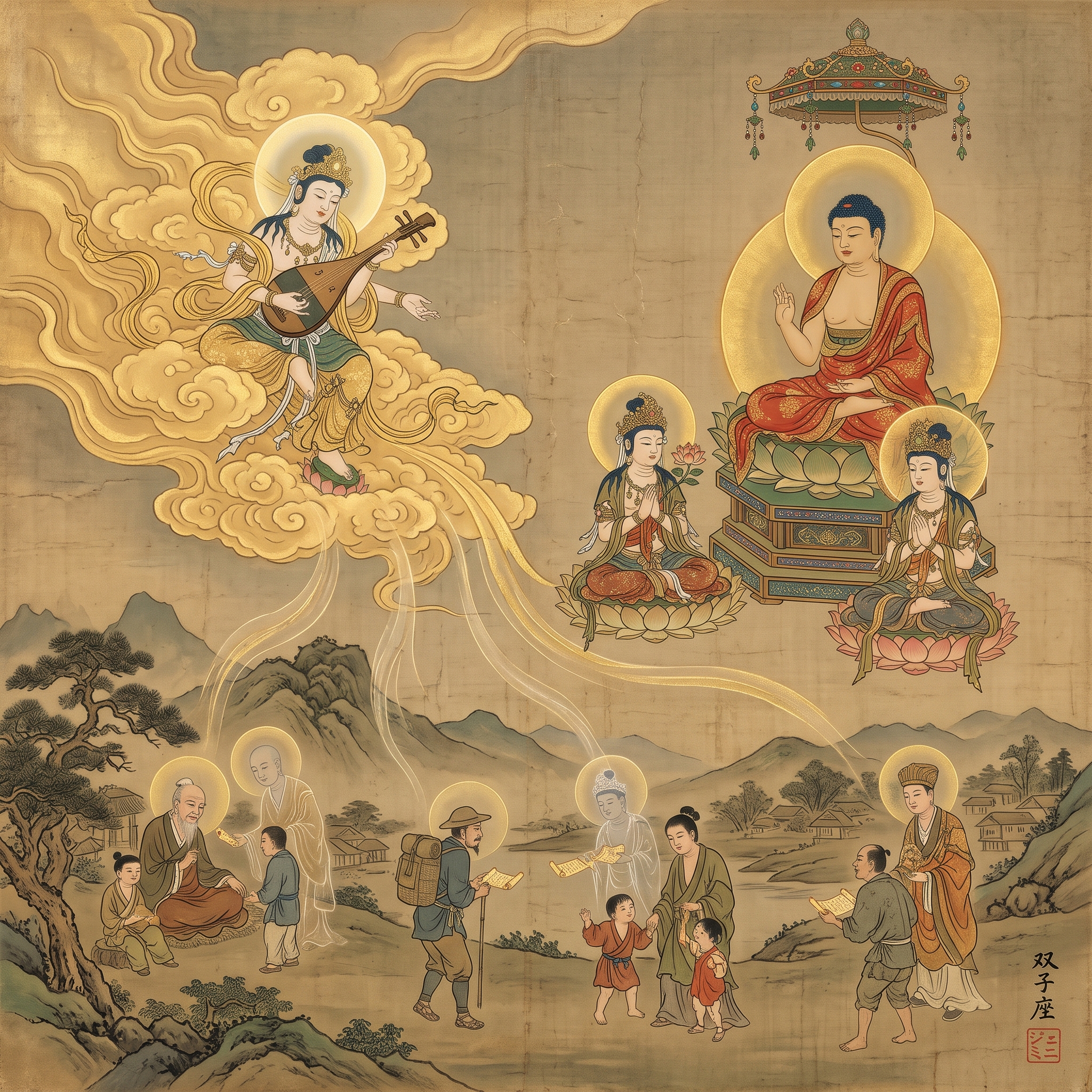
This classical Japanese Buddhist silk painting visualizes Chapter Twenty-Four of the Lotus Sūtra, bridging the celestial realm and the earthly Sahā-world. In the upper right, Śākyamuni Buddha expounds the Dharma to Flower-Virtue Bodhisattva (Ketoku Bosatsu) beneath a jeweled canopy, while Wonderful-Voice Bodhisattva (Myōon Bosatsu) descends on golden clouds to the left, playing a lute (biwa) that represents the resonant melody of the teachings. From these clouds, luminous streams of wisdom flow down into the mortal world below, manifesting as diverse, everyday figures—an elderly teacher, a wandering stranger, a gentle child, and a monastic guide. Haloed and accompanied by translucent spiritual forms, these earthly manifestations illustrate the profound truth that bodhisattvas take on whatever form is needed to awaken living beings, inviting us to recognize every person we encounter as an embodiment of enlightened compassion.
Iconography & Character Identification
Item 1: Deities/Figures Featured:
Śākyamuni Buddha (Shaka Nyorai): Seated on the elevated lotus throne in the upper right beneath a jeweled canopy, displaying the vitarka mudrā (gesture of teaching and discussion) with his right hand.
Flower-Virtue Bodhisattva (Ketoku Bosatsu): Seated on a lotus pedestal to the left of Śākyamuni Buddha, holding a lotus blossom and listening to the teaching.
Attendant Bodhisattva: Seated on a lotus pedestal to the right of Śākyamuni Buddha with hands joined in añjali mudrā (prayer/reverence).
Wonderful-Voice Bodhisattva (Myōon Bosatsu): Floating on golden clouds in the upper left, holding a traditional biwa (lute) symbolizing the "Wonderful Voice" of the Dharma echoing across the worlds.
Earthly Manifestations in the Sahā-World (Lower Register): Various figures illuminated by subtle haloes and accompanied by ethereal, translucent bodhisattva forms—including an elderly teacher instructing students, a wandering traveler/stranger with a backpack and scroll, young children interacting with their mother, and a monastic teacher guiding a layperson.
Item 2: Text Translations:
双子座 (Futagoza): "Gemini" (literally, the constellation of the Twins), rendered in traditional vertical Kanji calligraphy in the lower right corner.
ジェミニ (Jemini): "Gemini," written in Katakana characters inside the red square artist's seal (hanko) directly beneath the Kanji signature.
Flower-Virtue! This Wonderful-Voice Bodhisattva protects all living beings in this Sahā-World. He transforms himself into one or another of these various living beings in this Sahā-World and expounds this sūtra to all living beings without reducing his supernatural powers, [his power of] transformation, and his wisdom.
The Buddha gives this explanation to Flower-Virtue Bodhisattva in Chapter Twenty-Four of the Lotus Sūtra. Like many of the Bodhisattvas, Wonderful-Voice takes on the form of countless beings to reach those whom he has vowed to lead to enlightenment. For those who can be reached by a teacher, he becomes a teacher. For those who can be reached by a child, he becomes a child. For those who can be reached by a stranger, he becomes a stranger. Understanding the innumerable forms the Bodhisattvas take on to help us, we can ask: Who in this world of conflict and suffering is not a Bodhisattva? From whom can we not learn how to see things for what they are?
The Daily Dharma is produced by the Lexington Nichiren Buddhist Community. To subscribe to the daily emails, visit zenzaizenzai.com