
Conceptual Summary
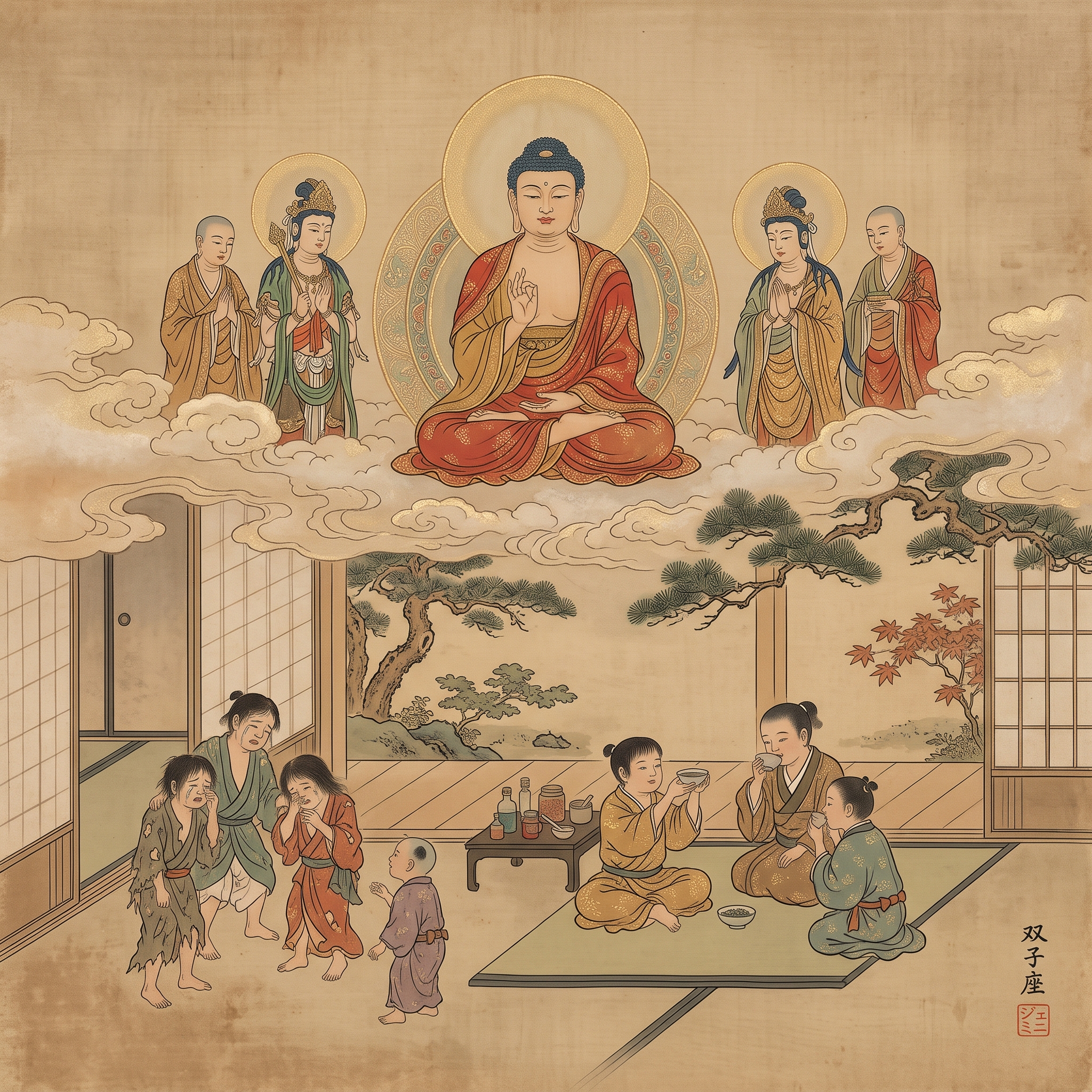
The illustration, created in a traditional Japanese Buddhist art style on aged silk, captures the emotional and spiritual arc of the "Parable of the Wise Physician" from Chapter Sixteen of the Lotus Sūtra. Above, Śākyamuni Buddha (Shaka Nyorai) appears in a compassionate, heavenly tier, symbolizing his ultimate guidance and presence even when he appears to be absent. He is surrounded by bodhisattvas and monks, set apart by gold leaf halos and floating clouds to distinguish the celestial realm from the earthly realm below. Below, the earthly narrative is illustrated within a traditional Japanese dwelling. On the left, disheveled children are shown in distress and grief, embodying their initial loneliness and helplessness. Transitioning to the right, other children have "recovered their right minds," gratefully receiving and consuming the healing medicine provided by their father, representing their awakening to his teachings. The earthly suffering and subsequent enlightenment are framed by natural elements like pine and maple trees, using mineral pigments and ink to unify the narrative of sorrow, realization, and cure under the Buddha’s overarching wisdom.
Iconography & Character Identification
Item 1: Deities/Figures Featured:
Śākyamuni Buddha (Shaka Nyorai): Sated in the center upper portion on a lotus, with the vitarka and dhyana mudra, representing the compassionate, wise father and teacher. (He is strictly distinct from Amida or Dainichi Nyorai).
Attendant Bodhisattvas and Disciples: Flanking the Buddha, representing his entourage who help transmit the Dharma and watch over sentient beings.
The "Wise Physician’s" Children:
Distressed/Grieving Children (bottom left): Shown weeping and in disarray, representing the poison-taken state, feeling "parentless and shelterless."
Healing/Recovered Children (bottom right): Shown seated on the tatami veranda, drinking the herbal medicine (antidote), representing their recovery of their "right minds" and acceptance of the Buddha's cure.
Item 2: Text Translations:
双子座: Gemini (Kanji signature, meaning "The Gemini Constellation")
ジェミニ (inside the red square seal/hanko): Gemini (Katakana translation of "Gemini")
They felt lonely and helpless because they thought that they were parentless and shelterless. Their constant sadness finally caused them to recover their right minds. They realized that the medicine had a good color, smell and taste. They took it and were completely cured of the poison.
The Buddha explains his parable of the wise physician in Chapter Sixteen of the Lotus Sūtra. In the story, the physician’s children take poison by mistake. Some refuse the antidote provided by their father until he leaves home and sends word back that he has died. The children realized that they had to accept what their father had left for them, rather than continuing to refuse his cure. In the Lotus Sūtra the Buddha stops adapting to our minds and brings us into his mind. It is only when we use our suffering to increase our determination to reach enlightenment, rather than as an indicator of our shortcomings, can we recover our right minds and realize what the Buddha teaches.
The Daily Dharma is produced by the Lexington Nichiren Buddhist Community. To subscribe to the daily emails, visit zenzaizenzai.com