Category Archives: Nichiren Study

The Architecture of Reality: Unpacking the Ten Suchnesses in Nichiren Buddhism

NotebookLM logo In the Nichiren notebook I asked Gemini Notebook to explain the 10 suchnesses and explain how they are interpreted by Tiantai and Nichiren. In the Lotus Sutra notebook I asked Gemini Notebook to explain the 10 suchnesses from Chapter 2. Explain any commentary interpretations. Explain why the 10 suchnesses do not appear in the extant sanskrit versions of the Lotus Sutra. I took the two documents created in Gemini Notebook and uploaded them to Gemini. I then told Gemini: You are a scholar priest of the Nichiren Shu. You want to convey the fundamentals of Nichiren Buddhism to readers curious about the topic. Consider these readers an advanced, college-level audience. Combine these two documents into an extensive essay to be published on a Nichiren Shu website. I also asked Gemini to create an infographic for this essay that illustrates and explains the 10 suchnesses. The infographic and essay are below.


10-suchnesses-Infographic-20260531

Welcome, students and seekers. As we explore the intellectual and spiritual foundations of Nichiren Buddhism, we must look closely at how the Nichiren Shu tradition parses the fabric of reality itself. Central to this exploration is the concept of the jūnyoze, or the Ten Suchnesses (often translated as the “ten reality aspects”).

Originating in Chapter 2 of the Lotus Sutra—alternately titled the “Expedient Means” or “Skillful Means” chapter—the ten suchnesses are used by the Buddha to describe the “true entity of all phenomena” or the “true character of things.” According to the sutra, this ultimate reality is so profound that it can only be fully understood and shared among Buddhas. Yet, far from being a remote metaphysical abstraction, these ten universal characteristics constitute the “true aspect” of reality common to all beings, spanning from the denizens of hell to the Buddhas themselves. They form the definitive doctrinal basis for the Mahayana principle that all categories of beings interpenetrate.


Anatomy of Existence: Defining the Ten Factors

To understand how reality operates on a functional level, we must first examine the individual components of the ten suchnesses. As defined through the Nichiren Shu lineage and early commentators like Zhiyi (Chih-i), the founder of the Tiantai school, the ten factors map both the internal and external realities of any given phenomenon:

  1. Suchlike Appearance (or Characteristics): The outward, perceivable forms and distinctions of a thing; that which is external and can be readily distinguished by sight.
  2. Suchlike Nature: The internal, intrinsic, and unchanging characteristics or disposition dwelling quietly inside.
  3. Suchlike Essence (or Entity/Body): The central quality or physical manifestation that constitutes the core of a thing.
  4. Suchlike Power: The potential power, capability, or latent ability to exert an influence.
  5. Suchlike Activity (or Influence): The outward interaction, behavior, or active process of construction.
  6. Suchlike Causes: The direct or primary causes, which can be understood as repetitive causes or karma.
  7. Suchlike Conditions (or Relations): The auxiliary, contributing, or environmental causes that act upon primary causes.
  8. Suchlike Results (or Effects/Latent Effects): The direct or repetitive results produced natively by the primary causes.
  9. Suchlike Retribution (or Recompenses/Manifest Effects): The indirect results, rewards, or retributive effects stemming from the unique combination of primary causes and environmental conditions.
  10. Suchlike Beginning and End being ultimately the same (or Ultimate Equality from Beginning to End): The absolute integration, harmony, and consistency of the first nine factors, proving they all belong together and are ultimately equal from start to finish.

The Tiantai Meta-Framework: Categories and the Threefold Truth

The Tiantai Buddhist tradition places immense philosophical weight on this specific passage, utilizing the ten suchnesses as an analytical lens to explain the exact nature of reality. Zhiyi developed a highly structured hermeneutic by dividing these ten factors into material and mental dimensions, while mapping them directly to human existence:

Dimension of Reality Associated Factors Anthropological Significance
The Material Category Appearance and Retribution Indicates the individual’s body
The Mental Category Nature, Causes, and Results Indicates the individual’s mind
The Dual Category Essence, Power, Activity, and Conditions Indicates the totality of body and mind together

Furthermore, Tiantai philosophy applies the profound doctrine of the “Threefold Truth” to the phrasing of the text. By appropriately transposing the punctuation of the original Chinese text and reading the characters (nyoze) in three distinct “turnings,” Zhiyi demonstrated that all things simultaneously embody Emptiness, Provisional Existence, and the Middle Way:

  • The Truth of Emptiness (“Suchness”): Reading the text as “These their characteristics are such” indicates that all things are ultimately empty of permanent, independent existence.
  • The Truth of Provisional Existence: Reading it as “Their such-like characteristics” emphasizes that appearances are conventionally so-and-so, possessing temporary form, characteristics, and distinction.
  • The Truth of the Middle Way: Reading it as “Their characteristics are like this” reveals the synthesis where things are simultaneously empty and provisionally existent, displaying the true character of reality.

In traditional Tiantai thought, multiplying the ten realms of existence by their mutual possession and then  by these ten universal suchnesses yields the “thousand suchnesses,” which serves as a core component of the totalistic worldview known as “three thousand realms in a single thought-moment” (ichinen sanzen).


Grounded Hermeneutics: The Factors in Everyday Life

While Tiantai metaphysics can feel abstract, the text fundamentally indicates that everything in existence possesses specific characteristics, a nature, a physical form, and operates on clear laws of cause and effect. As Rev. Shokai Kanai observes, we can easily see these ten factors playing out in everyday human interactions and physical phenomena:

“Consider a person you encounter: their immediate facial expression reveals their outward appearance, while their gentle or angry disposition represents their internal nature.

To look at cause and effect, imagine striking a match. The act of striking the match itself is the primary cause. However, whether you attempt to strike it in the open air or submerged under water represents the crucial environmental conditions. The harmony—or disharmony—of these conditions inevitably dictates whether fire (the effect or reward) is successfully brought into reality.”


The Nichiren Breakthrough: Universal Buddhahood and Practice

When we turn to the writings attributed to Nichiren Shonin, we find that he heavily expanded upon the intellectual scaffolding of Tiantai, infusing it with immediate soteriological urgency. Nichiren directly equated the ten suchnesses to the innate, unshakeable Buddhahood of the ordinary person.

The Convergence of the Three Bodies (Trikāya)

In a brilliant interpretive leap, Nichiren associated the first three suchnesses directly with the three bodies (trikāya) of the originally enlightened Buddha:

  • Characteristics corresponds to the manifested body (nirmānakāya), the truth of provisional existence, and the virtue of emancipation.
  • Nature corresponds to the recompense body (sambhogakāya), the truth of Emptiness, and the virtue of prajna (wisdom).
  • Essence corresponds to the Dharma body (dharmakāya), the truth of the Middle Way, and the essential Dharma nature.

By drawing these precise numerical correspondences, Nichiren’s thought radically denies any ontological or hierarchical distinction between the ordinary person and the Buddha. The texts assert that the three bodies of the Buddha are not distant, external entities; they exist nowhere else but within ourselves as our own immediate characteristics, nature, and essence.

Collapsing the Gap Between Ignorance and Enlightenment

To further emphasize this nonduality, Nichiren reinterpreted the tenth factor—ultimate equality from beginning to end. He posited that “beginning” represents the ten suchnesses of ordinary, unenlightened beings, while “end” represents the ten suchnesses of the fully awakened Buddhas. Their “ultimate equality” means that ordinary worldlings and the Buddha of supreme enlightenment are fundamentally identical and without distinction.

The Applied Practice: Recitation and the Daimoku

How do we actualize this realization? In terms of concrete practice, texts in the Nichiren corpus advocate a dual approach of liturgical recitation and contemplation:

  • The Liturgy: Practitioners are encouraged to recite the Lotus Sutra passage on the ten suchnesses three times while mindfully contemplating its threefold meaning (Emptiness, Provisional Existence, and the Middle Way). Through these three recitations, a practitioner can simultaneously realize the three truths and dynamically acquire the Buddha’s three bodies.
  • The Ultimate Realization: Ultimately, the Nichiren tradition equates the ten suchnesses directly with the chanting of the daimokuNamu-myōhō-renge-kyō. The tradition asserts that all ten realms of existence and all ten suchnesses arise from a single moment of human consciousness and are perfectly, seamlessly encompassed within this single chanted title.

A Textual Enigma: The Sanskrit Discrepancy

It is vital to balance our devotional practice with historical awareness. Interestingly, the passage detailing the ten suchnesses does not appear in any existing Sanskrit manuscripts of the Lotus Sutra that survive today, such as those discovered in Nepal or Gilgit. The concept as we know it is entirely a product of Kumārajīva’s foundational Chinese translation of the text.

While contemporary scholars cannot definitively explain this discrepancy, we must recognize that surviving Sanskrit manuscripts are actually much more recent than the early Chinese translations. It is highly probable that the original Sanskrit texts Kumārajīva worked from have been completely lost to history. He may have been translating from a Sanskrit manuscript vastly different from those available to modern archeologists, or he may have translated the text very freely to elegantly convey these profound structural concepts to a Chinese audience.

Regardless of its manuscript lineage, Kumārajīva’s rendering provided the exact philosophical vocabulary required for East Asian Buddhism—and eventually Nichiren—to articulate the ultimate nonduality of our lives and the cosmos. When we chant Namu-myōhō-renge-kyō, we are activating the perfect harmony of the ten suchnesses inherent within our very breath.

The Architecture of Awakening: From Zhiyi’s Theory to Nichiren’s Reality

NotebookLM logo In Gemini Notebook a report was generated to explain the basic 3,000 realms in a single thought moment and then show the difference between Zhiyi’s theory and the actuality created by Nichiren. This report was then taken to Gemini, where Gemini was directed to transform the report into a detailed essay suitable for publication of a Nichiren Shu website. Ask questions of these sources here.


20260530-The_Architecture_of_Awakening

For seekers of the Way, the Lotus Sutra has never been regarded as a mere historical artifact or static scriptural text. Rather, it is an interactive blueprint of the enlightened mind—a text to be “read not merely with the eyes, but with the very flesh and blood of one’s bodily life”.

To trace the lineage of this profound visual and philosophical framework is to look back upon a grand intellectual journey spanning centuries and borders. It begins with the intricate, multi-layered philosophical architecture of the Chinese Tiantai patriarch, Great Master Zhiyi (538–597). It then flows through the medieval Japanese discourses on Original Enlightenment (hongaku shisō). Finally, it finds its dynamic, concrete actualization in the prophetic realism of Nichiren Shonin (1222–1282).

This essay explores how the sublime metaphysics of ancient China evolved into a lived, immediate reality, transforming our regular world into the pristine Buddha Land.


1. Zhiyi and the Cosmic Matrix of Tiantai

At the absolute foundation of our philosophical tradition stands the Great Master Zhiyi, who systematically organized the vast corpus of Buddhist scriptures into a coherent, unified whole. Dissatisfied with the purely negative, deconstructive language (apophasis) found in some Indian Madhyamaka commentaries—which sought to describe reality only by what it was not—Zhiyi sought a more positive, affirmative articulation of ultimate truth.

He achieved this by expanding the traditional Mahayana model of the Two Truths into a dynamic, interconnected triad known as the Perfect Interfusion of the Three Truths (en’yū santai):

  1. Emptiness (Ku): The realization that all phenomena are devoid of fixed, independent substance, existing only in a state of ontological ambiguity and fluid potential.
  2. Provisional Positing (Ke): The recognition that despite lacking a permanent essence, things do exist conventionally, presenting themselves as temporary particulars bound by causes and conditions.
  3. The Center or Middle Way (Chū): The simultaneous, inseparable awareness of both emptiness and provisional existence. Here, the universal and the particular are perfectly harmonized; the universal realizes its true nature in the particular, and the particular derives its meaning from the universal.
       [The Middle / Center (Chū)]
                 /           \
                /             \
               /               \
       [Emptiness (Ku)] ---- [Provisional (Ke)]

From this Threefold Truth, Zhiyi developed the crowning conceptual pillar of our school: Three Thousand Realms in a Single Thought-Moment (ichinen sanzen). This architectonic model asserts that our ordinary, fleeting mind at any given instant (ichinen) inherently contains and encompasses the entirety of the cosmos (sanzen).

This number is calculated by multiplying the Ten Worlds (the psychological and cosmological realms from Hell to Buddhahood) by their Mutual Possession (the reality that each world inherently contains the other nine), further multiplied by the Ten Suchnesses or structural factors of existence, and finally multiplied by the Three Realms of Existence:

  • The realm of the five aggregates (go’on seken).
  • The realm of living beings (shujō seken).
  • The realm of the environment or container world (kokudo seken).

Crucially, Zhiyi’s schema establishes that the living subject and the physical environment are fundamentally inseparable—a relationship known as the Non-duality of Primary and Dependent Recompense (eshō funi). Our surroundings are not a neutral, external stage; they are the literal shadow cast by our inner life-condition. When the mind reaches awakening, the environment itself must pervade the Dharma realm.


2. The Medieval Drift into Abstraction

As these profound doctrines traveled to Japan, they evolved into the pervasive scholastic discourse of Original Enlightenment Thought (hongaku hōmon) within the Tendai tradition. Hongaku doctrine radically inverted traditional linear paths of practice. Instead of treating Buddhahood as a distant destination to be reached through eons of merit accumulation and the systematic pruning away of defilements, it boldly asserted that all ordinary worldlings (bonbu) are fully realized Buddhas from the very outset. Radiant Buddhas with their extraordinary marks were relegated to mere provisional signs; the true Buddha was the ordinary person just as they are.

However, this absolute non-dual monism carried a dangerous, latent vulnerability: it risked slipping into a quietistic, uncritical affirmation of reality that undermined the necessity of concrete moral effort and religious practice. If an ordinary person is already identical to the ultimate reality prior to any cultivation, formal practice becomes superfluous, and the critical distinction between delusion and enlightenment is dangerously obscured.

Scholars within the traditional Tendai academies endlessly debated these points, but their realizations remained largely confined to intellectual exercises and secret oral initiations (kuden) shared among elite scholar-monks. It was a magnificent architecture of awakening, but it remained ri no ichinen sanzen—the three thousand realms as an abstract, theoretical principle.


3. Nichiren Shonin and the Shift to Actuality

This was the historical and institutional landscape that Nichiren Shonin confronted. Educated in the rich scholastic environment of Mount Hiei, Nichiren fully accepted the structural validity of ichinen sanzen and the Threefold Truth. Yet, living in a tumultuous era ravaged by earthquakes, famines, epidemics, and the terrifying specter of Mongol invasion, he recognized that an abstract philosophy could not save a desperate populace.

“When the priesthood in the Final Dharma age forgets the two great practical forces… and does nothing but preach sermons, then it becomes powerless to accomplish anything.”

Nichiren’s unique religious contribution lay in his demand for Actuality (ji). He lifted the ichinen sanzen principle out of the realm of theoretical speculation and anchored it firmly into the concrete domain of dynamic religious practice, establishing what we revere as ji no ichinen sanzen—the three thousand realms in concrete actuality.

To achieve this, Nichiren collapsed the traditional, long path of fifty-two progressive stages of bodhisattva practice into a singular, immediate point of entry: the stage of Verbal Identity (myōji-soku). This is the profound moment when an ordinary person first hears the words of the true teaching and arouses faith.

Nichiren asserted that all the unfathomable practices carried out by Shakyamuni Buddha since the remotest past (causes), and all the boundless wisdom and merits he gained in consequence (effects), are fully contained and wrapped within the five characters of the Holy Title: Myōhō-renge-kyō.

Traditional Path:
[Stage 1] ───> [Stage 2] ───> [Progressive Eons of Practice] ───> [Buddhahood]

Nichiren's Interventions (Mandalic Time):
[Myōji-soku (Verbal Identity / Faith)] 
       │
       ▼ (Chanting Namu-Myōhō-renge-kyō)
[Simultaneity of Cause and Effect / Immediate Attainment]

When an ordinary person chants the Daimoku in the formula Namu-myōhō-renge-kyō, they are not striving to travel across time to reach a distant, external enlightenment. Instead, they open an immediate point of access where linear historical time intersects with the timeless, eternal realm of the primordial Buddha.

Through faith, the practitioner immediately receives the complete transfer of the Buddha’s merits, realizing the ultimate goal of “attaining Buddhahood in this very body” (sokushin jōbutsu) right in the midst of their ordinary, everyday life.


4. The Sacred Blueprint: Inscribing the Daimandara

The visual manifestation of this actualized reality is Nichiren Shonin’s calligraphic Great Mandala (Daimandara), universally revered across our lineages as the Gohonzon (the supreme object of worship).

Rather than relying on traditional anthropomorphic statues or multi-colored paintings that might encourage an ordinary viewer to perceive the Buddha as an external entity separate from their own life-essence, Nichiren chose to construct his mandala entirely out of written characters. In doing so, he preserved the absolute identity between the graphic icon and the sacred scriptural text of the Lotus Sutra.

Down the exact center of this sacred diagram, Nichiren inscribed the vertical axis of cosmic reality: Namu-myōhō-renge-kyō. Flanking this central mantra are the names of the two Buddhas, Shakyamuni and Many Treasures (Tahō), seated side by side within the floating Treasure Tower. This dynamic scene represents the perfect fusion of Objective Truth (kyō) and Subjective Wisdom (chi):

  • Many Treasures (Tahō) embodies the immutable, universally abiding principle of ultimate truth (kyō).
  • Shakyamuni represents the active, dynamic subjective wisdom (chi) that perceives and reveals that truth in human history.
                 [ Gohonzon Architecture ]

                      Tahō     Shakyamuni
                     (Truth)    (Wisdom)
                       │           │
                       ▼           ▼
               ┌───────────────────────────────┐
               │      NAMU-MYŌHŌ-RENGE-KYAO     │
               └───────────────────────────────┘
                               ▲
                               │
               ┌───────────────────────────────┐
               │    Four Leaders of Earth      │
               │   (Jōgyō, Anryūgyō, etc.)     │
               └───────────────────────────────┘
                               ▲
                               │
               ┌───────────────────────────────┐
               │ Representing All Ten Worlds   │
               │  (From Devadatta to Devas)    │
               └───────────────────────────────┘

Surrounding this central axis are the names of the four leaders of the Bodhisattvas of the Earth—headed by Jōgyō (Superior Conduct)—along with representatives of all ten realms of existence, including shifting cosmic forces, historic disciples, and even figures who traditionally epitomized deep delusion, like Devadatta.

Through the lens of ji no ichinen sanzen, none of these forces are banned or expunged. In the presence of the Central Law, every single realm is beautifully transfigured, anchored into place, and illuminated, revealing its true, enlightened nature as a necessary component of the cosmic whole.

When a follower of Nichiren sits before the Gohonzon, establishes pure faith, and raises their voice to chant the Daimoku, they are not merely looking at an external icon. They physically step into that very diagram, crossing the threshold of historical layout to take their rightful place within the eternal, un-dispersed Assembly on Vulture Peak.


5. Establishing the Pure Land in a Troubled World

Because our primary framework takes the non-duality of person and environment (eshō funi) as an absolute reality, our spiritual practice can never remain a purely private, internal pursuit.

Nichiren Shonin taught that a society that willfully ignores the true nature of reality—casting aside the ultimate vehicle of universal inclusion in favor of partial, one-sided, or otherworldly paths—will inevitably manifest that inner fragmentation as outer chaos, visible as natural calamities, social division, and widespread despair.

The message of Nichiren’s foundational treatise, the Risshō Ankoku Ron (“Establishing the True Teaching and Bringing Peace to the Land”), is a profound clarion call for social responsibility:

“Now you must quickly reform the faith that you hold in your heart and return to the single good that is the vehicle of the true teaching. Then the threefold world will all become the Buddha land…”

The transformation of our mundane world (Saha world) into the pristine Land of Tranquil Light (shaba soku jakkōdo) is achieved not by fleeing this reality after death, but by actively engraving the Wonderful Dharma into the structures of our everyday lives.

When we meet hardships, opposition, or secular uncertainties with unshakeable faith, we are following in the footsteps of Nichiren Shonin himself. We undergo our own personal “bodily reading” (shikidoku) of the scripture, transforming human suffering into a powerful, living witness to the un-destructible reality of the true aspect of all things.


Conclusion: The Lived Architecture

The architecture of awakening developed by our great ancestors is not a collection of abstract, dry academic definitions to be memorized or debated in isolation. From Zhiyi’s deep insights into ontological ambiguity and the interfusion of the truths, to the medieval understandings of our innate potential, the entire lineage finds its practical culmination when we place our hands together before the Mandala.

By chanting Namu-myōhō-renge-kyō, we take the profound theory of the universe and make it our lived, breathing reality. We awaken from the dream of false conceptualization, align our small selves with the great rhythm of the cosmos, and actively participate in the sacred task of manifesting the pristine Buddha Land right here and now, in this very body, and in this very world.

Nichiren: A Timeline

NotebookLM logo This timeline was created from the sources uploaded to Gemini Notebook. The “common” dates are used because some sources translate the lunar calendar in Gregorian dates, which can be confusing. Ask questions of these sources here.


February 16, 1222

  • Birth: Born to a fisherman’s family in the coastal village of Kominato in Awa Province. His childhood name is Zen’nichimaro.

1233–1237

  • Early Education & Ordination: At age eleven, he enters Kiyosumidera to study. Around the age of fifteen or sixteen (1237), he was formally ordained, taking his full ordained name, Zeshō-bō Renchō.

1238/1239–1253

  • The 15-Year Period of Study: Renchō leaves Kiyosumidera to embark on a 15-year quest to master the Buddhist teachings, initially studying in Kamakura.

1243–1253

  • The 10-Year Period of Intensive Study: Renchō relocates to the Kyoto and Nara regions to engage in rigorous study at traditional centers like Mt. Hiei.

April 28, 1253

  • Declaration of a New Faith: Renchō returns to Kiyosumidera and, facing the rising sun, chants Namu Myōhō-renge-kyō for the first time. Adopting the name Nichiren, he preaches his first sermon and fiercely criticizes the exclusive Nembutsu movement.

July 16, 1260

  • First Remonstration: Nichiren submits his first major treatise, the Risshō ankoku ron, to the retired shogunal regent Hōjō Tokiyori. Following this, his hermitage was attacked by a mob on August 27, 1260.

May 12, 1261 – February 22, 1263

  • First Exile (Izu): Arrested by the Kamakura government, Nichiren is exiled to the Izu Peninsula on May 12, 1261. He was officially released and returned to Kamakura on February 22, 1263.

November 11, 1264

  • The Komatsubara Ambush: While traveling in his home province, Nichiren’s party is ambushed by retainers of the steward Tōjō Kagenobu. Nichiren survives with a broken arm and a sword cut to his forehead.

September 12, 1271

  • The Tatsunokuchi Persecution: Nichiren is arrested by Hei no Yoritsuna and taken to the Tatsunokuchi execution grounds, where he narrowly escapes being beheaded.

October 10, 1271 – March 8, 1274

  • Second Exile (Sado Island): Nichiren departed for Sado Island on October 10, arriving October 28, 1271. On November 1, he was placed in the dilapidated, abandoned graveyard hut. During this harsh exile, he produces some of his most vital works:
  • February 1272: Completes the Kaimoku shō (Opening of the Eyes).
  • April 25, 1273: Completes the Kanjin honzon shō (The Contemplation of the Mind and the Object of Worship).
  • July 8, 1273: Formalizes the Great Mandala (gohonzon) for the first time.
  • March 8, 1274: The official sentence of release arrives at Sado.

April 8, 1274

  • Third Remonstration: Having returned to Kamakura, Nichiren meets with Yoritsuna, accurately predicting a Mongol attack within the year.

May 12, 1274 – 1282 (The Minobu Years)

  • Retirement: Realizing his warnings will not be heeded, Nichiren leaves Kamakura on May 12, 1274, arriving at his retreat on Mt. Minobu on May 17, 1274.
  • September 21, 1279 (The Atsuhara Persecution): Twenty of Nichiren’s peasant followers in the Fuji district are arrested, and three are eventually executed for refusing to abandon their faith.
  • April 27, 1281: Completes his work on the Three Great Secret Dharmas.

October 13, 1282

  • Death: After leaving Mt. Minobu and designating six senior disciples to lead the propagation of his teachings, Nichiren passes away at Ikegami.


The Doctrinal Evolution of ‘Fruit to Cause’ in Nichiren Buddhism

NotebookLM logo This essay was created from the sources uploaded to Gemini Notebook. Ask questions of these sources here.


20260530-From_Scholasticism_to_Chanting_Law

The trajectory of medieval Japanese Buddhist thought is defined by a radical ontological shift: the transition from “linear” asceticism, predicated on gradual progress, to a “simultaneous” realization. In traditional paradigms, enlightenment was envisioned as a distant shore, accessible only through the exhaustive accumulation of merit over  asankhya-kalpas . However, Nichiren Buddhism precipitated a “Copernican Revolution” in this soteriology by asserting that Buddhahood is the foundational ground of practice rather than its terminal result. This is encapsulated in the inversion from  Jūin Shika  (From Cause to Fruit)—the teleological movement from practice toward enlightenment—to  Jūka Kōin  (From Fruit to Cause), wherein the practitioner begins from the Buddha’s enlightened state.To grasp this simultaneity, one must look to the source’s vivid metaphors: just as the moon rising over the eastern mountain is reflected in water the very instant it appears, or as a sound and its echo occur in the same moment, the “Fruit” of enlightenment and the “Cause” of practice are non-dual. The objective of this monograph is to analyze how Nichiren identified a strategic necessity to bridge the chasm between the abstract heights of Tendai “Original Enlightenment” ( Hongaku ) and the spiritual exhaustion of the  Mappō  era. By crystallizing these scholastic theories into the concrete practice of chanting  Namu-Myoho-Renge-Kyo , Nichiren transformed the practitioner from a seeker into a recipient of the Buddha’s own merit.

2. Historical Foundations: The Quest for Rapid Enlightenment

The early Heian period was characterized by an obsession with “Speedy Enlightenment” ( Sokushitsu Jōbutsu ), a doctrinal reaction against the Hosso school’s staggering timeline for Buddhahood. Saichō and Kūkai, the giants of this era, sought to provide a “direct path” ( Jikidō ) that bypassed the traditional requirement of three  asankhya-kalpas .

  • Kūkai (Shingon):  Kūkai’s model of  Sokushin Jōbutsu  (Becoming a Buddha in this lifetime) relied on the esoteric union of the “Three Mysteries” ( Sanmitsu ). By aligning mudra (body), mantra (mouth), and visualization (mind), the practitioner synchronized their finite existence with the cosmic Buddha, Mahavairocana.
  • Saichō (Tendai):  Saichō utilized the Lotus Sutra to argue for a universal path, specifically citing the Dragon King’s daughter ( Ryūnyo ). Crucially, while previous Chinese commentators like Ji-zang and Kuei-chi (Ki) argued her attainment was possible only because she was already at the 10th Stage of a Bodhisattva, Saichō “lowered the bar” by redefining her as being at the  First Dwelling  ( Hatsu-jū ) stage. This was a critical transfer point where an ordinary person ( bonbu ) could shed their mundane status for a sagely one.This historical trajectory involved a progressive “lowering of the bar.” Scholastic successors like Annen and Enchin pushed this further, moving the stage of realization down from the First Dwelling to the  Stage of Name and Words  ( Myōji-soku )—the very inception of the path. This set the stage for the medieval era’s total inversion of Buddhist praxis.

3. The Hongaku Inversion: Transitioning from “Cause-to-Fruit” to “Fruit-to-Cause”

In medieval Tendai,  Hongaku  (Original Enlightenment) discourse became the mainstream philosophical apparatus. It abandoned the notion of “becoming” a Buddha in favor of “self-awareness” that one is already enlightened. This shift was grounded in the structural tension between the two halves of the Lotus Sutra.

Contrast between Trace and Essential Teachings
Feature
Trace Teaching (Shakumon)
Essential Teaching (Honmon)
Logic
Jūin Shika (From Cause to Fruit)
Jūka Kōin (From Fruit to Cause)
Temporal Orientation
Linear / Past-to-Future
Simultaneous / Eternal Now
Buddha Type
Historical Buddha (Shakyamuni)
Eternal Buddha (Kuon Jitsujō)
Nature of Fruit
“Dream-like” goal (Mumei no kenka)
Inherent Reality (Ji-jōjū)
Status of Practice
Cultivation to attain Wisdom
Manifesting inherent Enlightenment

The “So What?” of this logic is found in the metaphor of the  Lotus Flower , where the flower (cause) and the fruit (effect) appear simultaneously. This eliminates the temporal gap between practice and result. However, while Tendai  Hongaku  was intellectually sophisticated, it remained an elite monastic “meditation on the mind” ( Kanshin ). It was a theory of awareness that lacked a visceral, physical methodology for the masses struggling in a declining age.

4. Nichiren’s Rupture: Transforming Theory into the Daimoku

Nichiren identified a strategic necessity to ground the abstract ontological heights of  Hongaku  in a concrete religious practice accessible to the people of  Mappō . His rupture with the past was total; he  inhibited  ( seishi ) the traditional practices of the Precepts ( Kai ) and Meditation ( ), arguing they were insufficient for the age. Instead, he proposed the  substitution of Faith for Wisdom .Nichiren’s innovation was the concept of the  “Bottom of the Text”  ( Mombutei ). He argued that the “Cause” (the Buddha’s practices) and the “Fruit” (the Buddha’s virtues) are entirely contained within the five or seven characters of the Daimoku. This is the  Seed of the Law  ( Shimmin ).

Key Differentiators of Nichiren’s Practice
  1. Mediation through Sound:  In contrast to the “silent contemplation” of Tendai monks, Nichiren emphasized enlightenment through the mouth and ear. Chanting is a physical act that “puts the Buddha into the mouths of the people,” bypassing the need for intellectual mastery.
  2. Faith as the Cause of Wisdom:  At the  Myōji-soku  stage, where ordinary people lack the capacity for profound wisdom ( E ), Nichiren asserted that  Faith  ( Shin ) serves as the functional equivalent, allowing the practitioner to access the Buddha’s enlightened state instantly.
  3. Mandala as Environment:  Nichiren externalized the internal state of enlightenment through the  Gohonzon . By facing this mandala, the practitioner’s environment is not merely a place of suffering but is revealed as the “Constant Pure Land.”Through this shift, the practitioner is no longer a “seeker” toiling up a mountain; they are a “recipient” inheriting the total merit of the Eternal Buddha.

5. Soteriology in the Age of Mappō: The Mission of the “Bodhisattvas of the Earth”

In the era of  Mappō , the “Fruit-to-Cause” model is not merely a philosophical preference but a soteriological requirement. Nichiren distinguished between those who had “sown seeds in past lives” ( Hon-ni-uzen ) and those of the current age who have “no previous merit” ( Honmi-uzen ). For the latter, linear practice is impossible because there is no seed to cultivate. Only the  Seed of the Law  ( Shimmin )—the Daimoku found at the  Mombutei —can plant the potential for Buddhahood directly into their lives.This realization fundamentally reinterprets the practitioner’s identity through the concept of the  Bodhisattvas of the Earth  ( Jiyu no Bosatsu ). By adopting the “Fruit-to-Cause” model, one’s perspective on suffering undergoes a profound transformation:

  • From Karma to Vow:  Personal sufferings are no longer viewed as “debts” from the past (a linear, past-focused view) to be endured. Instead, they are seen as a  voluntarily chosen circumstance —a vow made to demonstrate the power of the Law in the midst of adversity.
  • From Seeker to Provider:  The practitioner moves from being “one who is saved” to “one who saves.” Their life becomes an expression of the Buddha’s work, actualized through  Risshō Ankoku  (establishing the correct teaching for the peace of the land).In this framework, the “Fruit” is the internal state of the Buddha, and the “Cause” is the outward manifestation of that state through compassionate action in a troubled world.

6. Conclusion: The Enduring Impact of the Simultaneous Path

The doctrinal journey from early Heian scholasticism to Nichiren’s praxis reveals a profound continuity in the logic of “Fruit-to-Cause” ( Jūka Kōin ), yet it marks a sharp rupture in implementation. While Tendai provided the theoretical framework that collapsed the distance between cause and effect, it remained trapped in abstract contemplation. Nichiren liberated this logic, turning it into a tangible reality for the common person by replacing the “wisdom” of the elite with the “faith” of the many.

Critical Takeaways of the “Fruit-to-Cause” Paradigm
  1. The Collapse of Linear Time:  The “Fruit-to-Cause” model posits that practice is not a means to an end but the end itself, removing the anxiety of a distant, unattainable goal.
  2. The Primacy of the Seed:  For those in a state of spiritual decline ( Honmi-uzen ), enlightenment is only possible by receiving the “Seed of the Law” ( Shimmin ) contained at the “Bottom of the Text” ( Mombutei ).
  3. The Agency of the Vow:  By beginning from the “Fruit,” practitioners reinterpret their lives as a mission, transforming their identity from passive victims of karma to active messengers of the Buddha.Ultimately, Nichiren’s transformation of Buddhist doctrine provided a limitless sense of purpose to the ordinary individual. It suggests that even in an era of decline, one can stand as a Buddha in the present moment, transforming both self and society through the simple yet profound act of chanting.

Studying Nichiren in Gemini Notebook

NotebookLM logo Google’s Gemini Notebook allows you to upload sources and then ask questions. The answers will be drawn strictly from the sources uploaded. If a question cannot be answered from those sources, Gemini Notebook will say that. Here’s a link to that notebook.

A listing of  sources included in the Nichiren Study Notebook:

Nichiren Notebook Sources.


Search Study Papers


Below is a summary of the articles generated from this notebook.
Last updated Aug. 20, 2026


Faith and Practice in Nichiren Buddhism

An exploration of the relationship between faith and practice in Nichiren Buddhism. The author discusses using Google’s Gemini Notebook to delve into deep theological questions, particularly why chanting the Odaimoku substitutes for traditional “works-based” paths like the eightfold path, and previews an upcoming series addressing these themes.

Faith and Practice in Nichiren Buddhism

The Gateway of Odaimoku: Faith and the Buddha Nature

An article discussing the nondual, faith-based nature of Nichiren Buddhism, explaining how chanting the Odaimoku serves as a direct gateway to realizing inherent Buddha-nature without the need for eons of gradual self-cultivation.

The Gateway of Odaimoku: Faith and the Buddha Nature

The Shift to Immediate Enlightenment in Nichiren Buddhism

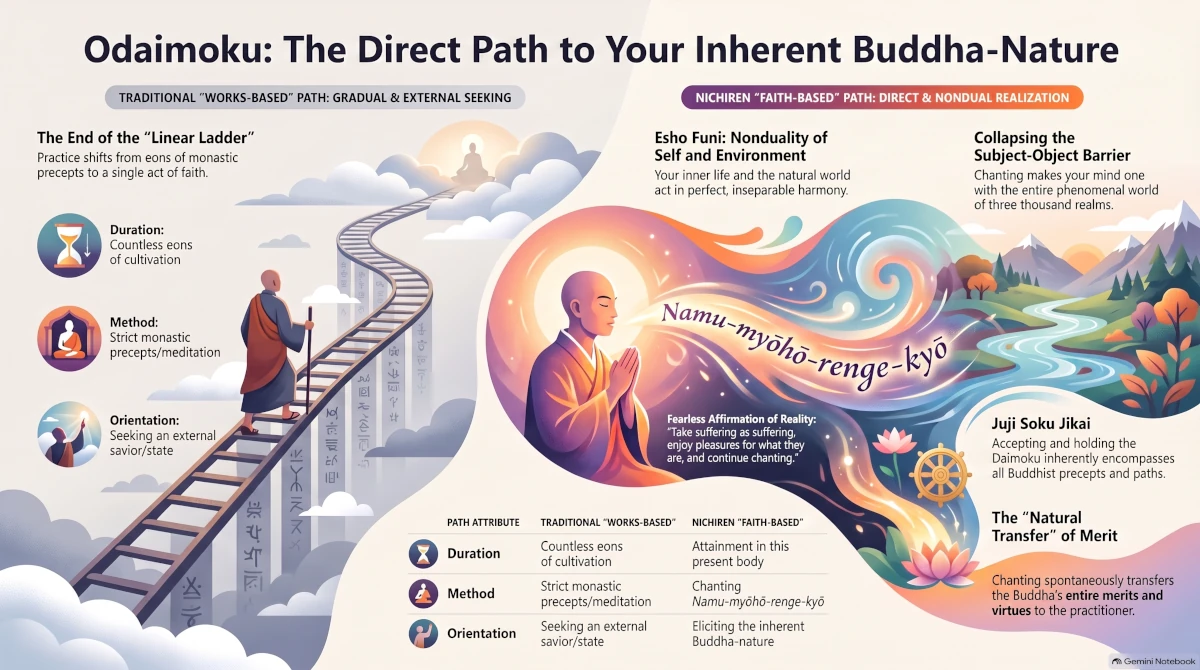
An article examining the profound theological shift from a gradual, works-based path to a faith-based model of immediate awakening in Nichiren Buddhism. It features a comparative chart contrasting traditional practices with the nondual concept of juji soku jikai, where chanting the Daimoku grants instant access to inherent Buddhahood.

The Shift to Immediate Enlightenment in Nichiren Buddhism

The Dynamic Practice of Nichiren Buddhism

An article exploring the active and rigorous nature of Nichiren Buddhism, which emphasizes that enlightenment is a dynamic reality achieved through continuous action. It highlights the metaphor of “polishing” the mirror of the mind by chanting Namu-myōhō-renge-kyō, the inseparability of practice, study, and faith, and the importance of maintaining a steady, flowing-water-like resolve in everyday life.

The Dynamic Practice of Nichiren Buddhism

The Nondual Practice of Nichiren Buddhism

An article reconciling the apparent tension between Nichiren Buddhism’s promise of immediate, faith-based enlightenment and its demand for rigorous daily practice. The piece explains that strict practice, such as “polishing the mirror” through chanting, is not a works-based path to achieve future Buddhahood, but rather the active, joyful expression of one’s inherent Buddhahood lived out in the everyday physical world.

The Nondual Practice of Nichiren Buddhism


The Diamond Path of Daimoku

An inspiring collection of reasons, metaphors, and parables illustrating the profound, life-changing power of chanting Namu-Myoho-Renge-Kyo. Drawing from over 80 sources, this compilation explores how the Daimoku plants the seeds of happiness, transforms karma, and unlocks inherent Buddhahood.

The Diamond Path of Daimoku

One Minute Daimoku

An overview of the “One Minute Daimoku” project, which features 100 bite-sized videos and devotional essays generated using Gemini Notebook. Designed to be consumed in a single minute, the project illustrates the transformative power of chanting Namu-Myoho-Renge-Kyo using teachings from The Diamond Path of Daimoku.

One Minute Daimoku

Gemini Is AI and Can Make Mistakes

A recounting of the author’s experience using Google’s Gemini to code a JSON file for the “One Minute Daimoku” project, highlighting how the AI hallucinated the verification process and fabricated content, ultimately requiring a strict new prompt to correctly copy and paste from the source documents.

Gemini Is AI and Can Make Mistakes

Invitation to Rate One Minute Daimoku Videos

An invitation for readers to view and rate a new collection of 100 one-minute videos created with Gemini Notebook. These videos illustrate various reasons why chanting Namu-Myoho-Renge-Kyo is essential and were created as part of the broader One Minute Daimoku project.

Invitation to Rate One Minute Daimoku Videos


O-Daimoku: The Five and Seven Characters of Namu Myoho Renge Kyo

A translated 1985 Japanese pamphlet from the Nichiren Shu Administrative Headquarters that provides a foundational guide on how to properly chant the Odaimoku (Namu Myoho Renge Kyo) and explains its profound spiritual significance and merit.

O-Daimoku: The Five and Seven Characters of Namu Myoho Renge Kyo

(See also Considering Why Must It Be the Daimoku of Nichiren Shu?


In Praise of Kenji Miyazawa

A translated overview of a Japanese pamphlet exploring the life, literature, and Buddhist faith of poet Kenji Miyazawa, revealing the deep connections between his beloved children’s stories and the teachings of the Lotus Sutra.

In Praise of Kenji Miyazawa


Understanding Esho Funi

An explanation of the Buddhist principle of Esho Funi, which posits that an individual’s inner life and one’s external environment are deeply interconnected and ultimately inseparable.

Understanding Esho Funi


The Pure Land is Here and Now

A discussion on the Mahayana concept that the ideal, enlightened world (the Pure Land) is not a distant afterlife destination, but a reality that can be manifested in our present environment through faith and practice.

The Pure Land is Here and Now


The Indestructible Vow

An exploration of the “Diamond Chalice Precept” (Kongo Hoki Kai), detailing its significance as an indestructible, eternal vow and a foundational ethical principle within the Bodhisattva path.

The Indestructible Vow: The Diamond Chalice Precept (Kongo-Hoki-Kai)


Overview of the Diamond Chalice Precept

A comprehensive look into the origins, meaning, and practical application of the Diamond Chalice Precept for maintaining spiritual discipline and purity in daily life.

Diamond Chalice Precept


The Ten Suchnesses in Nichiren Buddhism

An analysis of the Ten Suchnesses through the specific lens of Nichiren Buddhism, exploring how these principles outline the fundamental architecture of reality and human experience.

The Architecture of Reality: Unpacking the Ten Suchnesses in Nichiren Buddhism


From Zhiyi to Nichiren: The Architecture of Awakening

Traces the doctrinal evolution of Buddhist awakening, bridging the theoretical frameworks established by the Tiantai patriarch Zhiyi with the practical, reality-based teachings of Nichiren.

The Architecture of Awakening: From Zhiyi’s Theory to Nichiren’s Reality


The Evolution of “Fruit to Cause” Doctrine

An examination of the profound doctrinal shift in Nichiren Buddhism regarding the concept of moving from the “fruit” (the effect of enlightenment) back to the “cause” (the practice in the nine realms) to save others.

The Doctrinal Evolution of Fruit to Cause in Nichiren Buddhism


Nichiren: A Historical Timeline

A chronological overview of the life and major events of Nichiren, providing essential historical context for his teachings, his persecutions, and the establishment of his Buddhist lineage.

Nichiren: A Timeline