
Each morning at 1am I receive an email from zenzaizenzai.com containing that day’s Daily Dharma lesson. I have been adding these as posts at 500yojanas.org since 2015, when I created the website to mark my transition from Soka Gakkai to Nichiren Shu. Since December of last year I’ve been using Google’s Gemini tool to illustrate these posts.
Having done this for more than 10 years, I knew there was a limited number of lessons and they repeat periodically. My expectation was that the repetition would be no more than twice in any 12-month period.
Reality crashed into my expectation this morning when the Daily Dharma for November 26 appeared to be the same one I had illustrated and published just six days before on November 20. Not wanting to duplicate that lesson so soon, I went to zenzaizenzai.com and got a replacement to publish as today’s Daily Dharma.
In an effort to square my expectation with the reality I had experienced, I set about to explore this further.
I opened Google’s Antigravity app and explained to it:
At 500yojanas.org I publish a Daily Dharma each day. I have been doing this since 2015. There are 3,970 Daily Dharma posts at https://www.500yojanas.org/daily-dharma/ Each post is composed of three parts: The subject quote, the interpretation of the quote, and the signature (Beginning in December 2025 an illustration was added).
I want to know:
1. How many unique Daily Dharma
2. Distribution of duplicates. Does this reflect a random delivery
About 15 minutes later I got a report that explained:
Of the 3,970 posts in category 2 (daily-dharma), 11 are non–Daily Dharma posts (1 search/intro post id=3679 from 2015-01-01, 6 “Day X” Lotus Sūtra reading-series posts, and 4 essays: The Next 10 Years, The Illustrated Daily Dharma, More AI Fun, and Cheeky Little Monkey). That leaves 3,959 actual Daily Dharma posts (noting a 2025 hiatus with only 10 Daily Dharma posts starting 2025-12-22, when illustrations began).
In total, there are 366 unique Daily Dharma lessons. The minimum number of times a lesson has been repeated is eight in 10-plus years. The maximum number is 13. The mean is 10.82 times.
Is this random? Antigravity said:
No—this does not reflect pure (i.i.d.) random delivery with replacement, nor does it reflect fixed-order or fixed-date cycling. Instead, it behaves like a shuffled deck (sampling without replacement per ~366-post cycle) with occasional re-shuffles, resets, or manual overrides
I downloaded and analyzed all 3,970 posts in the daily-dharma category from 500yojanas.org (2015-01-01 through 2026-11-26).
1. How many unique Daily Dharmas are there?
Of the 3,970 posts in category 2 (daily-dharma), 11 are non–Daily Dharma posts (1 search/intro post id=3679 from 2015-01-01, 6 “Day X” Lotus Sūtra reading-series posts, and 4 essays: The Next 10 Years, The Illustrated Daily Dharma, More AI Fun, and Cheeky Little Monkey). That leaves 3,959 actual Daily Dharma posts (noting a 2025 hiatus with only 10 Daily Dharma posts starting 2025-12-22, when illustrations began).
Depending on how minor wording edits are treated, the unique counts are:
- 365 unique canonical Daily Dharmas (clustering copy-edit variants with similarity ≥ 0.75 and 2 accidental double-pasted posts on 2018-08-26 and 2019-02-12).
- 366 active pool slots: One Daily Dharma (“You, the World-Honored One, are our leader...”) exists as two slightly differently worded versions that circulate independently (12 and 11 times, totaling 23). Every single one of the 365 canonical texts was already introduced by 2017 (300 in 2015, 64 in 2016, 1 in 2017, and 0 genuinely new texts from 2018–2026).
- 473 unique exact texts after diacritic/punctuation normalization (
loose_norm, e.g., merging Sūtra/Sutra), or 493 under strict punctuation/diacritic normalization (strict_norm). Nearly all of the extra 108 variants over 365 come from ~60 edits in Feb–May 2026 changing “The Buddha” → “Śākyamuni Buddha”, ~35 minor typo/wording tweaks, a 2016 postscript note, and the 2 double-pasted posts.
2. Distribution of Duplicates & Randomness Analysis Frequency Distribution (Count-of-Counts)
For the 366 active pool slots across all 3,959 Daily Dharma posts, every slot appeared between 8 and 13 times (zero appeared 1–7 times):
| Appearances (k) | Active Pool Slots (nk) | % of Slots | Canonical Merged (U=365) | Total Posts (k × nk) | Unclustered loose_norm (U=473) |
|---|---|---|---|---|---|
| 1 | 0 | 0.00% | 0 | 0 | 91 |
| 2–7 | 0 | 0.00% | 0 | 0 | 23 |
| 8 | 3 | 0.82% | 3 | 24 (0.61%) | 13 |
| 9 | 25 | 6.83% | 25 | 225 (5.68%) | 37 |
| 10 | 99 | 27.05% | 99 | 990 (25.01%) | 115 |
| 11 | 160 | 43.72% | 159 | 1,760 (44.46%) | 143 |
| 12 | 67 | 18.31% | 66 | 804 (20.31%) | 43 |
| 13 | 12 | 3.28% | 12 | 156 (3.94%) | 8 |
| 23 | 0 | 0.00% | 1 | 23 (0.58% in merged) | 0 |
- 366 active slots summary: min = 8, max = 13, mean = 10.82, stdev = 0.95, Index of Dispersion D (variance-to-mean ratio) = 0.0833.
- 365 canonical summary: min = 8, max = 23, mean = 10.85, median = 11.0 (IQR = 1.0), D = 0.1204.
Does this reflect a random delivery?
No—this does not reflect pure (i.i.d.) random delivery with replacement, nor does it reflect fixed-order or fixed-date cycling. Instead, it behaves like a shuffled deck (sampling without replacement per ~366-post cycle) with occasional re-shuffles, resets, or manual overrides:
| Metric (3,959 posts) | Observed (366 slots / 365 canon.) | Pure Random (i.i.d. Fixed Pool, 2,000 MC trials) | Strict Shuffled 366-Deck (2,000 MC trials) |
|---|---|---|---|
| Dispersion D (variance/mean) | 0.083 / 0.120 | 0.999 [0.86, 1.16] (p = 0.001) | 0.014 [0.01, 0.01] (p = 0.001) |
| Count-of-counts χ² | 567.4 (canon., df=14) | 13.01 [5.14, 25.35] (p = 0.001) | — |
| Step gaps ≤ 7 posts | 3 | 75.1 [58, 92] (p = 0.001) | 0.77 [0, 3] (p = 0.083) |
| Step gaps ≤ 30 posts | 20 / 22 | 310.9 [280, 341] (p = 0.001) | 12.7 [6, 19] (p = 0.050) |
| Step gaps > 732 posts | 23 | — | 0.00 [0, 0] (p = 0.001) |
| Step-gap CV (sd/mean) | 0.446 / 0.449 | ~1.0 (exponential/geometric) | 0.409 [0.40, 0.42] (p = 0.001) |
| Repeated adjacent pairs (A → B) | 52 | 57.6 [43, 72] (p = 0.508) | 52.5 [39, 67] (p = 1.000) |
Key evidence behind this conclusion:
- Strongly non-i.i.d. random (p = 0.001): Under i.i.d. random sampling (whether fixed-pool or growing-pool), frequencies would spread from ~1 to ~23 (D ≈ 0.91–1.00), and ~288–311 repeats would occur within 30 days/posts. In reality, frequencies are ~8–12× tighter (D = 0.083–0.120) and only 20 repeats occurred within 30 posts (with 0 next-day repeats after Feb 2016).
- Not a fixed sequence or calendar schedule: Consecutive pair transitions (A → B repeating: 52) match random shuffling (p = 1.000), and same-calendar-date (MM-DD) consecutive repeats occurred only 5 / 3,594 times (0.139% vs. 0.274% random expectation, p = 0.122).
- Close to a shuffled deck, with occasional resets/noise: The median repeat gap is 366 calendar days (348–349 posts; 25th–75th percentiles: 252–498 days), and the gap CV = 0.446 closely matches a shuffled 366-card deck (0.409). However, a strict unbroken deck cannot produce gaps > 2 × 366 = 732 steps or counts from 8–13 (D = 0.014 vs. 0.083), whereas the archive has 23 gaps > 732 steps (up to 1,101 posts), pointing to occasional deck resets/re-shuffles, cooldown-based random draws, or manual selection.
The lesson that arrived today begins:
Those who believe in the Lotus Sutra are like the winter season, for many hardships come incessantly.
It turns out there’s a reason why this particular lesson is more likely to appear: Two Daily Dharma use this quote and then offer different interpretative paragraphs.
The Daily Dharma that arrived today follows the quote from Nichiren with this:
Nichiren wrote this in his Letter to the Nun Myoichi (Myoichi Ama Gozen Gohenji). Nichiren suffered through many hardships in his life, including exile, banishment from his family and home province, being placed on the execution mat, and having his home at Matsubagayatsu burned by members of the Pure Land sect. Through all these difficulties, Nichiren kept his faith in the Buddha’s wisdom and fulfilled his mission to benefit all beings in this world of conflict by leading them with the Wonderful Dharma of the Lotus Sūtra. Nichiren’s faith and practice inspire our faith and practice. Whatever obstacles we may face, we progress towards enlightenment under the guidance of the Ever-Present Buddha.
The Daily Dharma that arrived on November 20 offered this interpretation:
Nichiren wrote this in a letter to one of the lay women who followed his teachings, Myoichi Ama. Knowing the hardships Nichiren faced in his life helps us understand his great fearlessness and determination to spread the Wonderful Dharma. One of the most difficult things about hardship is that it can seem like it will never end. Nichiren reminds us that hardships do end, and that we who practice the Lotus Sutra are assured of our future enlightenment. The example of Nichiren’s life also shows us that as Bodhisattvas, we can use our hardships to lead other beings to enlightenment.
I went back to Antigravity asked it to determine whether there are any duplicate quotes with different interpretive lessons among the Daily Dharma. Not only did Antigravity confirm that the “Winter is surely followed by spring…” lesson appears twice in the pool with different interpretations, but there’s a second duplicate.
The other duplicate relates to the quote from Chapter 2:
No, no, I will not say any more.
My teaching is wonderful and inconceivable.
If arrogant people hear me,
They will not respect or believe me.
One interpretive paragraph says:
The Buddha sings these verses to Śāriputra in Chapter Two of the Lotus Sūtra. We sometimes think of arrogance as acting as if we know something that we really do not. These verses contrast arrogance with respect and faith. Faith does not mean blind belief. It is still important to ask questions when we don’t understand. Respect does not mean blind obedience, but it does mean that we have confidence in what the Buddha teaches, no matter how difficult it may seem. Arrogance blocks our ability to hear the Buddha. Respect and Faith open our hearts to his enlightenment.
The alternate interpretive paragraph says:
The Buddha sings these verses in Chapter Two of the Lotus Sūtra. This was his response the first time Śāriputra asked to receive the Buddha’s highest teaching. The Buddha knew we must be prepared for his wisdom. We must discern clearly the difference between what we know and what we do not know. Because all things are impermanent, the truths we cling to may no longer apply. The ignorance and confusion at the root of our suffering will disappear as we set aside what is no longer true and gain wisdom.
I doubt anyone else cares, but I was happy to find peace between my expectation and reality.
Postscript
After I finished writing this I decided I really needed an illustration.
I told Antigravity: I need a 16:9 illustration to go with an article I have written about the distribution of Daily Dharma lessons.
After a few seconds of thinking Antigravity responded: “Generating a 16:9 widescreen illustration in the 500yojanas.org aged-silk Japanese Buddhist painting style; I will inspect and share it as soon as it finishes.”
A couple of minutes later Antigravity announced:
Here is your 16:9 widescreen illustration, matching the aged-silk Kamakura/Heian Japanese Buddhist painting aesthetic of 500yojanas.org with no text or watermarks:
daily_dharma_seasonal_cycling_hero_v3_1795726121595.jpg
Visual Concept
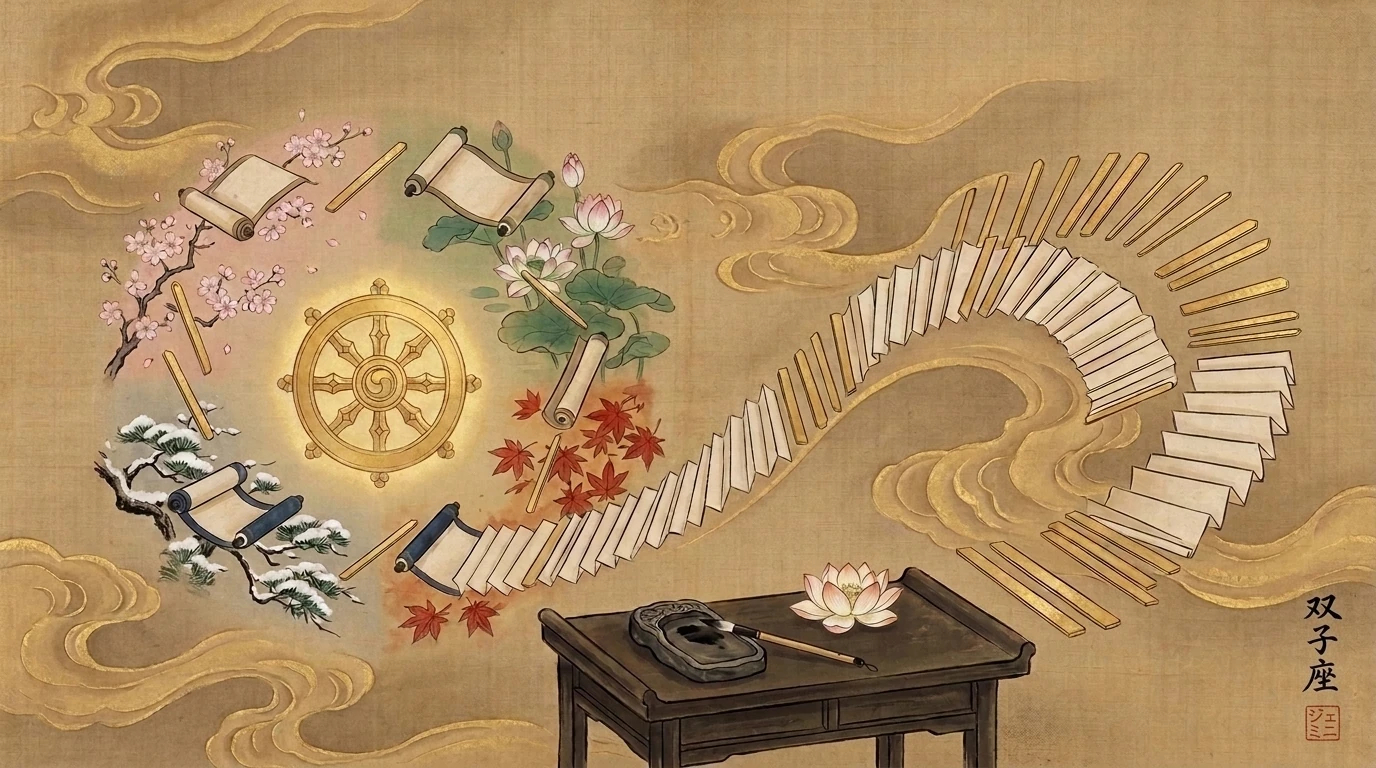
The ~365-Day Cycle (left): A luminous golden Dharmachakra encircled by sutra scrolls and gilded slips drifting through the four seasons (cherry blossoms, summer lotus, autumn maple leaves, and snow-dusted pine).Shuffled-Deck Flow (right): An undulating ribbon of folded sutra cards and wooden slips fans out evenly across swirling golden suyari-gumi clouds—representing balanced, non-chaotic delivery over time.
Study Foreground: A quiet wooden temple desk with an inkstone, brush, and open lotus blossom anchors the composition.
Let me know if you’d like any adjustments—such as a cleaner modern editorial/data-art style, a different color palette, or adding the 双子座 / ジェミニ signature seal in the corner.
I had it add the signature and seal.