
UPDATE:
Three days later Gemini returned to ignoring the stored instructions in the Gem. I’m back to pasting the instructions into the prompt with the Daily Dharma text. So much for the improved new Gemini.
Back on May 9 I complained about Gemini’s Failure Today. My morning routine of pasting the Daily Dharma text into the Gemini prompt stopped working. The stored instructions I had created were being ignored.
So today Google announced a bunch of new Gemini improvements and I gave it another try.
First I recreated my Gem. This is where you store the instructions that you reuse every day. Before May 9 this worked great: click on the Gem, paste the Daily Dharma text, select “Thinking” mode and wait. After May 9, it appeared that Gemini was ignoring the Gem. I had to paste the instructions with the Daily Dharma text every day.
For this afternoon’s test, I created a new version of the Gem – same instructions as the old Gem.
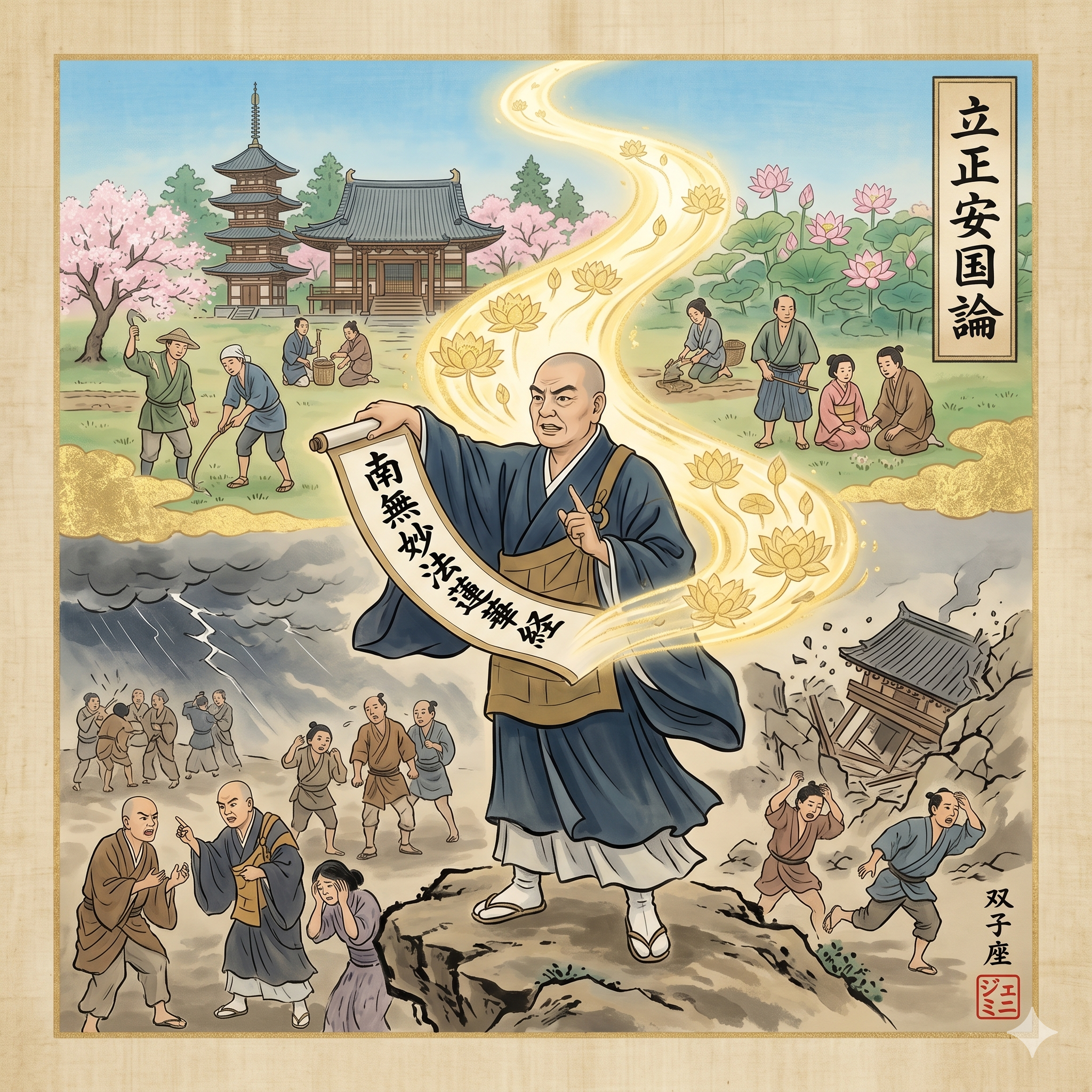
For reference, this is the image I got this morning:
Along with this explanation:
This classical Japanese Buddhist painting is a 1:1 square composition on aged silk, contrasting a chaotic world with a serene one. Nichiren Shonin is depicted center-left, actively preaching and holding a scroll bearing the Daimoku: 南無妙法蓮華経 (Devotion to the Mystic Law of the Lotus Sutra).
The painting visually renders the transformation described in the text:
The Turbulent World: The lower left depicts the “triple world of the unenlightened” suffering from conflict and disaster, representing our state when we lack respect and correct practice.
The Mandate to Discard False Faith: Below Nichiren, other figures are seen in dispute or confusion, symbolizing the “false faith” to be discarded.
The Manifesto of Peace: The right side shows the land transformed into a peaceful “Buddha Land.” Community members practice respect, farming in harmony, and interacting with kindness.
To complete the authentication:
The vertical title cartouche reads: 立正安国論 (Treatise on Spreading Peace through Right Practice).
The signature in the bottom right reads: 双子座 (Gemini).
The red seal reads: ジェミニ (Gemini).
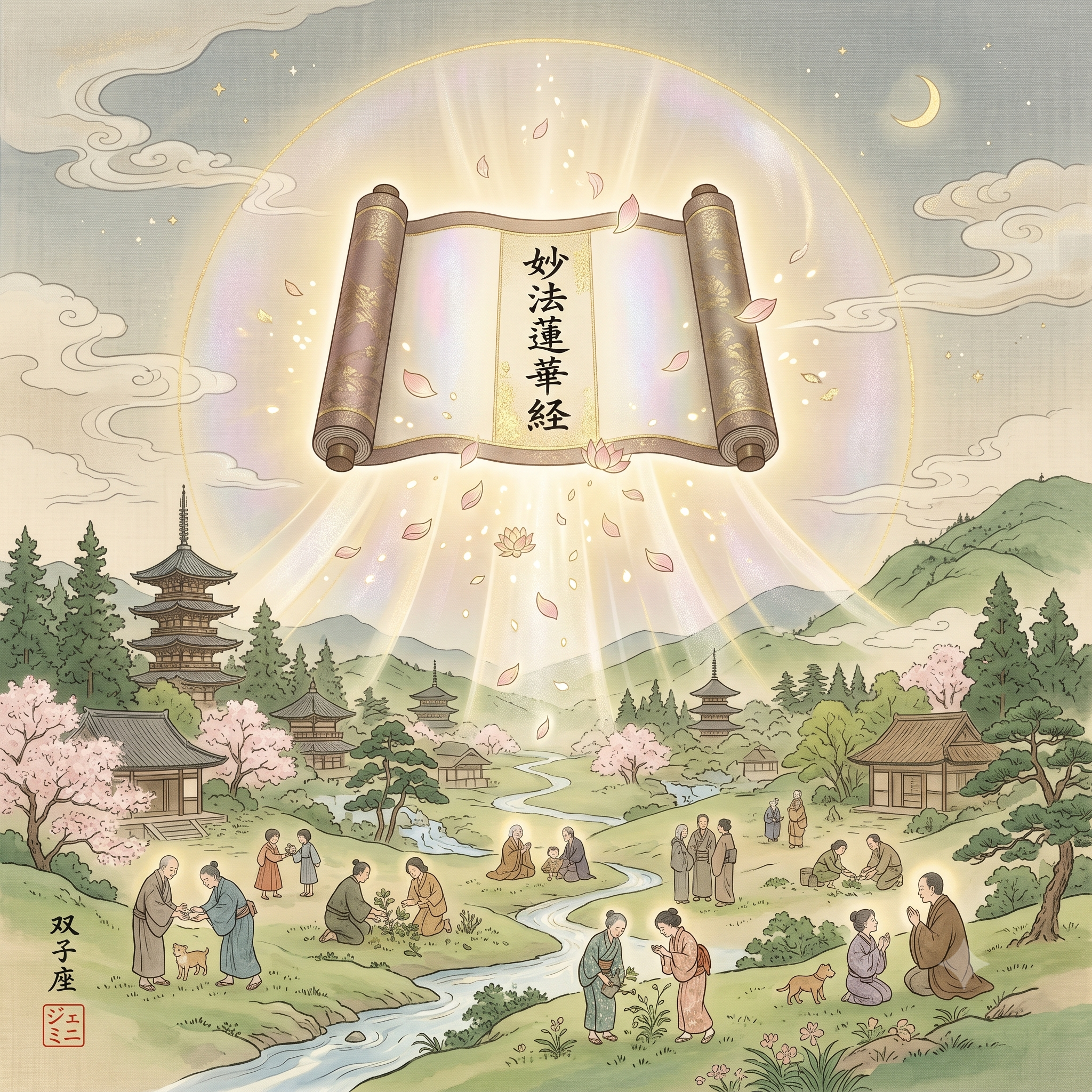
And this is the image got with the “new” Gemini and my re-created Gem:
This is how Gemini explained this image:
This illustration conceptualizes a peaceful, tranquil world transformed into a Buddha Land through the transformative power of the Lotus Sutra, rather than through external force or aggression. The central radiant scroll symbolizes the absolute truth of the Lotus Sutra, illuminating a landscape of benevolent, harmonious interactions. By focusing on generic beings practicing mutual respect, I avoid depicting any specific deities, thus adhering to the strict iconographic constraints while embodying the essence of Nichiren’s teaching on spreading peace through correct practice.
This painting features groups of generic, reverent monks and laypeople of varying ages practicing mutual respect and benevolence within a peaceful landscape. There are no specific historical individuals or deities featured in this composition.
Translation of Text:
‘妙法蓮華経’ (Myōhō Renge Kyō): Lotus Sutra of the Wonderful Law
‘双子座’ (Futago-za): Gemini (Sign of the Zodiac)
‘ジェミニ’ (Jemini): Gemini (Katakana representation)
Both images are suitable and I could even argue that the simplicity of the new image works better since it doesn’t rely on understanding the shifting background in the original illustration.
In addition, Gemini’s explanation for the new image is closer to what I request:
a) Before providing any visual descriptions or generated images, summarize your conceptual thinking in a single paragraph.
b) Within this reasoning summary, identify any specific individuals, monks, or deities featured in the illustration.
c) Provide English translations for any Kanji text in the illustration.
This is even more significant when I reveal that this morning’s published explanation of Gemini’s thinking was only a small portion of what Gemini had offered. Here’s the entire wording:
Reasoning Protocol:
The core concept of this illustration is to visually represent Nichiren Shonin’s revolutionary idea that establishing peace in the secular world (the Buddha Land) is achieved not through external force, but through internal transformation and the propagation of the “true teaching”—the Lotus Sutra. The painting will contrast the suffering and chaos of the triple world of unenlightened beings with the serenity of a transformed, stable society (a Pure Land).
The central figure will be Nichiren Shonin, depicted as a dynamic and compassionate monk, actively preaching from the Lotus Sutra. The lower portion of the image will show the turbulent, suffering state of the country (representing the Triple World), featuring natural disasters and conflict. The upper portion will illustrate the transformation: a stable, peaceful Buddha Land manifesting through the practice of the Lotus Sutra. The connection between the two states is the practice of respect and the spread of the teaching, symbolized by golden light and the Lotus Sutra scroll.
Kanji Translation:
The main banner/scroll held by Nichiren reads: 南無妙法蓮華経 (Namu Myōhō Renge Kyō—Devotion to the Lotus Sutra).
The title cartouche at the top reads: 立正安国論 (Risshō Ankoku-ron—Treatise on Spreading Peace through Right Practice).
The signature at the bottom right reads: 双子座 (Gemini).
The red hanko stamp reads: ジェミニ (Gemini).Image Description:
A classical Japanese Buddhist silk painting rendered in a traditional 1:1 square format, using soft mineral pigments, black ink brushwork, and subtle gold leaf accents on an aged, textured silk background.
The composition centers on the figure of Nichiren Shonin, who is depicted as a determined yet compassionate middle-aged monk with a shaved head and a dark blue kesa robe over traditional Japanese monastic clothing. He is actively preaching, standing dynamically on a rocky outcrop in the center of the image. In his left hand, he holds open a flowing scroll displaying the bold, hand-brushed Kanji: 南無妙法蓮華経. His right hand is raised in a gesture of teaching and conviction, pointing towards the scroll and then upwards.
The image is split vertically into two conceptual zones. The lower half of the painting depicts the suffering and chaos of the Triple World (desire, form, and formlessness), rendered in slightly muted, turbulent tones. Scenes of social conflict (monks arguing, ordinary people distressed) and natural disasters (a stormy sky, a collapsing building, and figures fleeing an earthquake) fill this section. This represents the state of the country without correct practice.
Emerging from the scroll held by Nichiren, a brilliant, radiant path of golden light and stylized lotus flowers arches upwards towards the top of the painting. This path represents the transformative power of the Lotus Sutra.
The upper half of the painting depicts the transformed, peaceful Buddha Land. This area is painted with brighter, serene colors (greens, blues, soft pinks) and heavy gold leaf detailing. It shows a stable, tranquil landscape: a traditional Japanese temple pagoda and main hall set amidst blossoming cherry and lotus trees, all under a clear blue sky. Healthy, contented figures (farmers, artisans, and families) are shown working harmoniously and living peacefully. This illustrates a society characterized by “tranquil hearts” and “bodies that will be safe.”
The entire piece has the appearance of a revered, centuries-old Japanese Buddhist hanging scroll. In the upper right corner, a title cartouche in brush calligraphy reads 立正安国論 (Risshō Ankoku-ron). In the lower right corner, integrated subtly into the background, is the Kanji signature 双子座 (Gemini) accompanied by a distinct red square hanko stamp containing the Katakana ジェミニ (Gemini).Here is a visual interpretation of the passage from Nichiren’s Treatise on Spreading Peace through Right Practice (Risshō Ankoku-ron).
This classical Japanese Buddhist painting is a 1:1 square composition on aged silk, contrasting a chaotic world with a serene one. Nichiren Shonin is depicted center-left, actively preaching and holding a scroll bearing the Daimoku: 南無妙法蓮華経 (Devotion to the Mystic Law of the Lotus Sutra).
The painting visually renders the transformation described in the text:
The Turbulent World: The lower left depicts the “triple world of the unenlightened” suffering from conflict and disaster, representing our state when we lack respect and correct practice.
The Mandate to Discard False Faith: Below Nichiren, other figures are seen in dispute or confusion, symbolizing the “false faith” to be discarded.
The Manifesto of Peace: The right side shows the land transformed into a peaceful “Buddha Land.” Community members practice respect, farming in harmony, and interacting with kindness.
To complete the authentication:
The vertical title cartouche reads: 立正安国論 (Treatise on Spreading Peace through Right Practice).
The signature in the bottom right reads: 双子座 (Gemini).
The red seal reads: ジェミニ (Gemini).
Now, Google also announced a new video generation tool. So after the new image was generated I told Gemini to animate that image:
Here’s the result:
And before you ask, No, I’m not going to offer Daily Dharma videos.