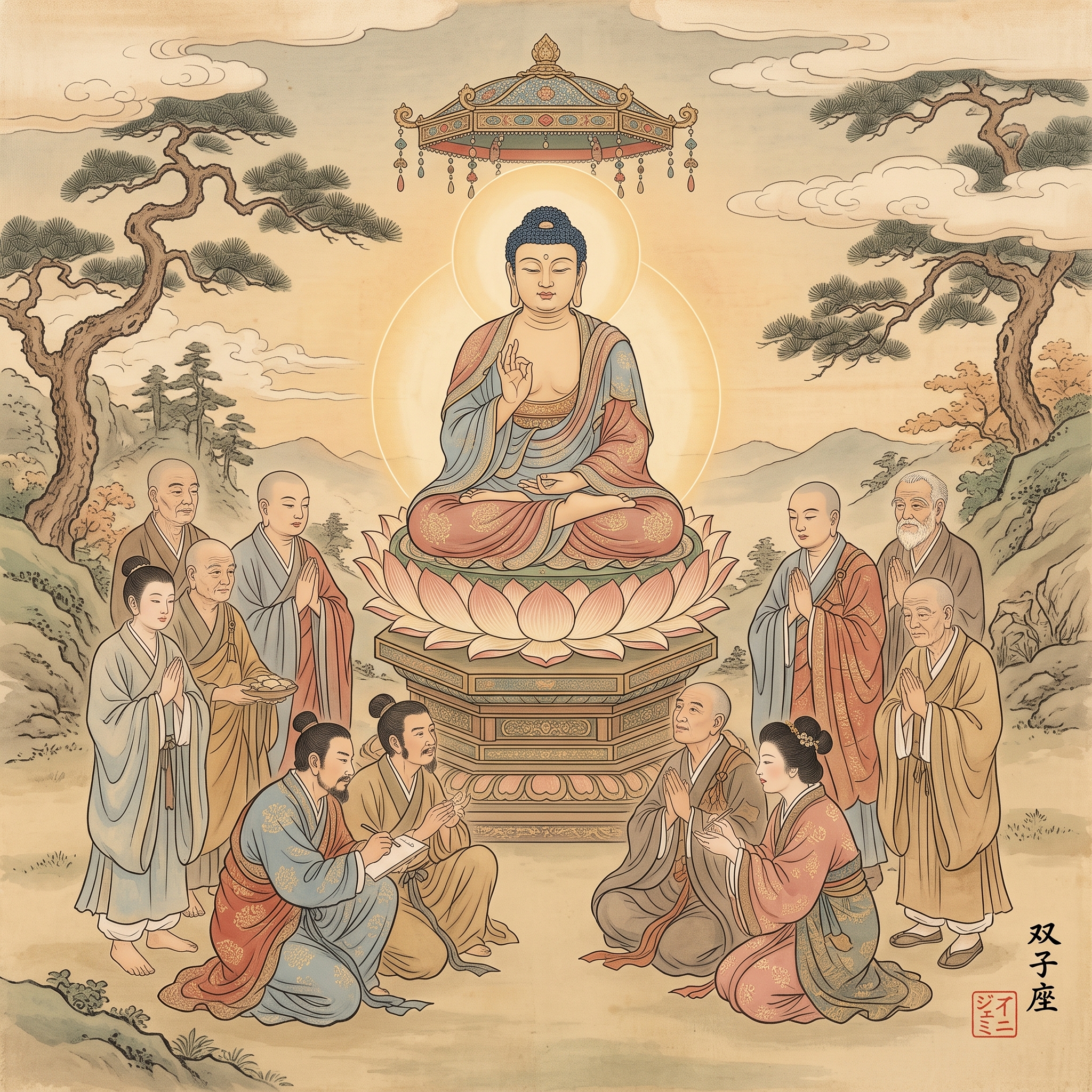
After finishing my examination of the power and purpose of the Odaimoku and exploring Gemini Notebook’s concept of what a daily practice might look like, I still had a lingering concern. We are told that we do not practice to become a Buddha; rather, the practice is the active expression of the Buddha that we already are. Is there a danger in imagining that the realm of the Buddha is always present?
Assess the accuracy of this statement against the sources here. Focus on any weakness in the argument:
Hongaku (original enlightenment) presupposes that the realm of the Buddha is inherent in each moment. This is founded on the concept of 3,000 realms in a single thought moment. Since all 10 realms are present at each moment and all 10 realms are present in each realm, the realm of the Buddha is just as close as that of hell.
Here’s Gemini Notebook’s response:
manifesting-buddha-nature
This statement carries profound theological weight and is highly accurate on an ontological level, representing the core nondual teachings of both medieval Japanese Tendai and Nichiren Shōnin. However, when viewed through the lenses of daily human experience and practical application, the argument contains crucial weaknesses and subtle traps that both historic scholars and Nichiren himself sought to resolve.
An examination of the strengths of this statement, followed by a look at the hidden weaknesses of the argument, reveals how these concepts play out in real life.
The Ontological Accuracy: Absolute nonduality
Your statement’s premises are firmly grounded in the classical metaphysics of the Lotus Sutra:
The Inherence of Buddhahood (Hongaku): Original enlightenment thought indeed presupposes that the Buddha-realm is not a distant, supernatural goal to be constructed over lifetimes of grueling labor, but the originally inherent nature of all reality, sentient and insentient alike.
The Foundation of Ichinen Sanzen: This immanentalist view is mathematically and philosophically modeled on the Tiantai doctrine of the three thousand realms in a single thought-moment (ichinen sanzen). This doctrine asserts that your ordinary, moment-to-moment mind and the entire physical universe are mutually encompassing.
The Mutual Possession of the Ten Worlds (Jikkai Gogu): Because each of the Ten Worlds contains all ten within itself, the boundaries between the sacred and the profane are completely collapsed. As Nichiren Shōnin famously wrote to the wife of the Lord of Ōmonsu:
“Some sutras state that hell exists underground while others state that the Buddha exists to the west. Upon closer inspection, however, it is preached that both hell and the Buddha exist within our five-foot bodies.”
Because the hell-realm inherently contains the Buddha-realm, and the Buddha-realm inherently contains the hell-realm, the absolute nondual distance between supreme awakening and supreme torment is indeed collapsed to a single moment of consciousness.
The Hidden Weaknesses of the Argument
While ontologically flawless, a flat, unqualified acceptance of this statement introduces three significant theological and practical weaknesses:
1. The Phenomenological Asymmetry (The Experiential Gap)
The primary weakness of the argument is that it assumes ontological equidistance translates into experiential equidistance. In the everyday life of an ordinary worldling (bonbu), the realms of hell and the Buddha are not experienced as being equally close.
Delusion, anger, greed, and suffering are the default, highly active states of the human mind in this chaotic, spiritually degraded era (mappō). To experience the function of hell, you do not need to exert any spiritual effort; a single moment of rage, greed, or neglect of others immediately manifests it.
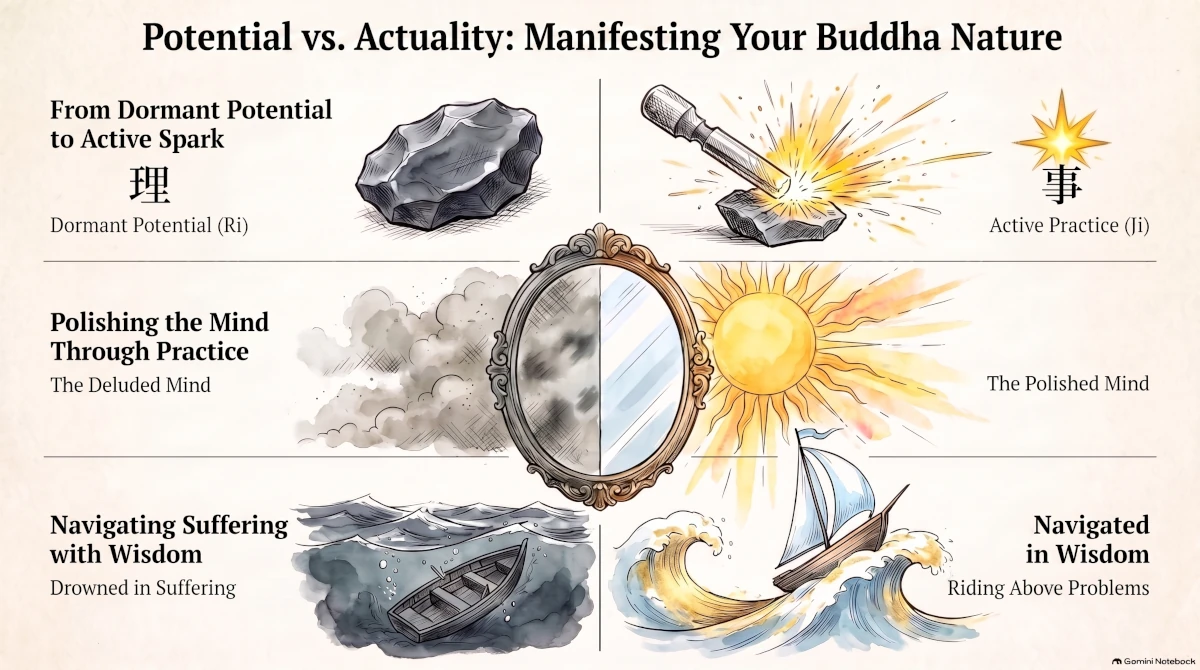
In contrast, the Buddha-realm within your mind is heavily obscured, latent, and dormant. In the Kanjin Honzon Shō, Nichiren compares the Buddha-realm in ordinary humans to fire latent within a flint. While the fire is inherently there, it remains completely invisible and inaccessible until you strike the stone. Therefore, while hell manifests spontaneously, the Buddha-realm requires an active, dynamic catalyst—specifically, the physical action of chanting Namu-myōhō-renge-kyō with faith—to be evoked into reality.
2. The Trap of Moral Laxity and Sacralizing the Status Quo
By asserting that the Buddha-realm is “just as close” and already fully present in each moment without any distinction, the argument risks falling into the ultimate historic pitfall of radical Hongaku thought.
If your ordinary, deluded thoughts and behaviors are equated with Buddhahood exactly as they are without transformation, the necessity of ethical conduct, compassion, and practice vanishes. This absolute equation historically led to moral laxity, where even defilements and harmful acts were rationalized as “the Buddha’s work”.
Nichiren strictly guarded against this quietist trap by distinguishing between:
Ri no Ichinen Sanzen (Principle): The passive, abstract potential for Buddhahood, which is useless if it remains dormant in your mind.
Ji no Ichinen Sanzen (Actuality): The dynamic actualization of Buddhahood.
You do not manifest your inherent Buddha-nature simply by intellectually knowing it is there. Rather, it must be actively polished and given concrete, relational expression through your daily behavior, your faith, and your vocal practice of the Daimoku.
3. The Symmetrical Fallacy of Mutual Possession
The mutual possession of the Ten Worlds is not a flat, symmetrical identity. While the Buddha-realm contains the hell-realm, and the hell-realm contains the Buddha-realm, the internal structure of these states of life is entirely different:
In the Buddha-realm, the lower nine realms (including hell) are fully integrated and subdued under the light of supreme wisdom. The Buddha retains the capacity for hell only as a latent vehicle of compassion, allowing him to enter states of suffering to guide and save others.
In the hell-realm of an ordinary worldling, the Buddha-nature is completely submerged and overpowered by delusions and spiritual blindness.
To say they are “just as close” overlooks this structural hierarchy. Without the guiding light of the True Dharma, the ordinary worldling remains bound by the agonizing chains of suffering, even though the key to their liberation lies within their own breast.
Conceptual Summary
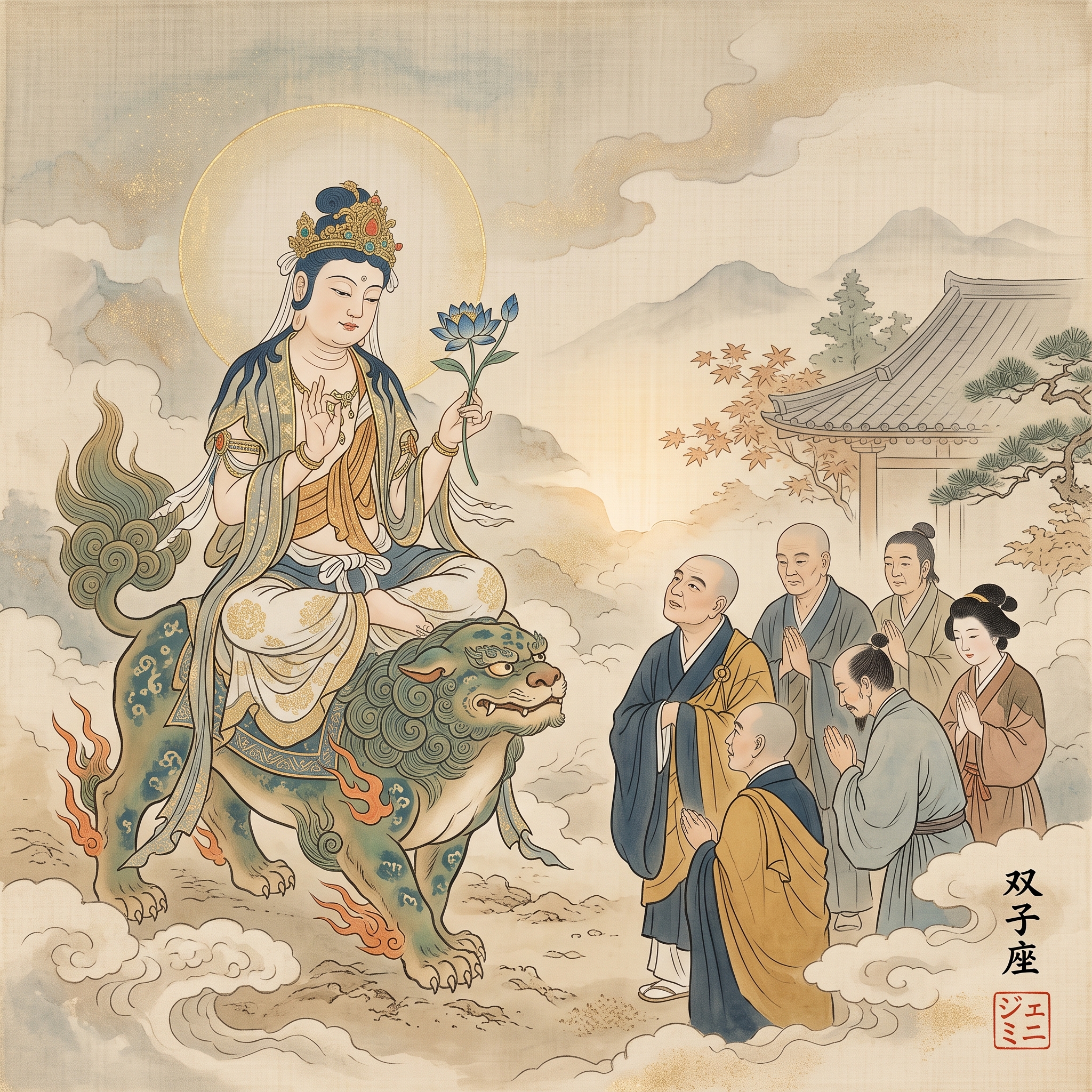
The illustration interprets the Lotus Sūtra passage where Śākyamuni Buddha instructs Mañjuśrī Bodhisattva on the compassionate conduct required in the latter days of the Dharma. The central figure is Mañjuśrī, identified by his iconographic mount, the lion, symbolizing wisdom. He is shown looking down with a serene expression at a diverse group of monks and laymen, representing the beings who do not yet understand the Dharma. Mañjuśrī's mudra and the lotus flower symbolize the skillful means and wisdom he will employ to lead them. The serene, ethereal setting, with clouds and a soft glow, suggests the spiritual realm of a Bodhisattva's activity, while the gold leaf accents evoke the 'supernatural powers' mentioned in the text. The overall composition captures the patient determination of the Bodhisattva to save all beings, regardless of their current capacity to understand, as outlined in the source text.
Iconography & Character Identification
Item 1: Deities/Figures Featured: Mañjuśrī Bodhisattva (seated on a lion), four monks, and two laypersons.
Item 2: Text Translations:
'双子座' (Kanji signature): Gemini
'ジェミニ' (Katakana seal): Gemini
Mañjuśrī! A Bodhisattva-mahāsattva who keeps this Sūtra of the Lotus Flower of the Wonderful Dharma in the latter days after [my extinction] when the teachings are about to be destroyed, should have great loving-kindness towards laymen and monks, and great compassion towards those who are not Bodhisattvas. He should think: ‘They do not know that the Tathāgata expounded expedient teachings according to the capacities of all living beings. They do not hear, know or notice it, or ask a question about it or believe or understand it. Although they do not ask a question about this sūtra, or believe or understand it, I will lead them and cause them, wherever they may be, to understand the Dharma by my supernatural powers and by the power of my wisdom when I attain Anuttara-samyak-saṃbodhi.
The Buddha gives this explanation to Mañjuśrī Bodhisattva in Chapter Fourteen of the Lotus Sūtra. Until we reach enlightenment, we may not be able to reach all beings. Rather than blaming them for not having the capacity to learn from us, or blaming ourselves for not being skillful enough to reach them, the Buddha reminds us to be patient and realize there is no hurry to being free from our delusions.
The Daily Dharma is produced by the Lexington Nichiren Buddhist Community. To subscribe to the daily emails, visit zenzaizenzai.com
What’s a Buddhist practice guide without a manual. When Gemini Notebook asked, “Would you like me to compile a matching study guide summarizing the scriptural sources?” I said, sure, why not. Here’s what the Nichiren Notebook created.
Download PDF
SCRIPTURAL FOUNDATIONS OF CONCENTRATED PRACTICE
A Reference and Contemplation Guide Summarizing the Context, Doctrinal Integrity, and Practical Integration of Key Texts
PREPARED FOR PERSONAL AND MONASTIC STUDY
Compiled in Accordance with the Writings of Nichiren Shōnin
August 2026
Introduction: The Shift to Concentrated Practice
A profound theological shift defines the transition from classical, gradual Mahayana self-cultivation to the immediate, nondual, effect-based path of Nichiren Buddhism. Traditional Buddhist paths present a linear framework of progression (Proceeding from Cause to Effect, or Jūin Shika), wherein a practitioner must systematically observe hundreds of prohibitive monastic rules and master the six Paramitas over countless lifetimes to build enlightenment from scratch. For practitioners in the Latter Day of the Law (Mappō), whose capacity has deteriorated in this chaotic and spiritually degraded era, attempting to climb this progressive ladder is described by Nichiren Shōnin as unsuited to the times.
To resolve this crisis of capacity, Nichiren Shōnin established the path of Proceeding from Effect to Cause (Jūka Kōin). Because Śākyamuni Buddha completed the arduous, eon-spanning journey of causal practices and obtained their resulting virtues on behalf of all beings, he encapsulated his entire cause and effect within the five characters of the title of the Lotus Sutra: Myō Hō Ren Re Kyō. When a practitioner embraces and chants Namu Myōhō Renge Kyō with single-minded faith, the Buddha spontaneously transfers the totality of his merits directly to them. This study guide compiles the scriptural backgrounds, historical contexts, and doctrinal implications of three essential texts that historically validate, reconcile, and guide this concentrated practice.
1. Isshō Jōbutsu Shō (Becoming a Buddha in One Lifetime) Historical and Manuscript Context
The Isshō Jōbutsu Shō is traditionally assigned in the Shōwa standard edition to the year Kenchō 7 (1255), when Nichiren Shōnin was thirty-four years of age and residing in Kamakura, shortly after his first public proclamation of the Daimoku at Seichō-ji in 1253. While traditional catalogues like that of Toki Jōnin do not record it, it remains one of the most treasured and beautifully written early treatises in the primary section of the canon. It addresses a fundamental question: how can an ordinary person, burdened with deluded karma, dissolve the cycle of birth and death to realize unexcelled bodhi in this very lifetime?
Core Doctrinal Principle: The Tarnished Mirror
To explain the immediacy of Buddhahood, the text utilizes the celebrated metaphor of the mirror, drawing on East Asian nondual paradigms:
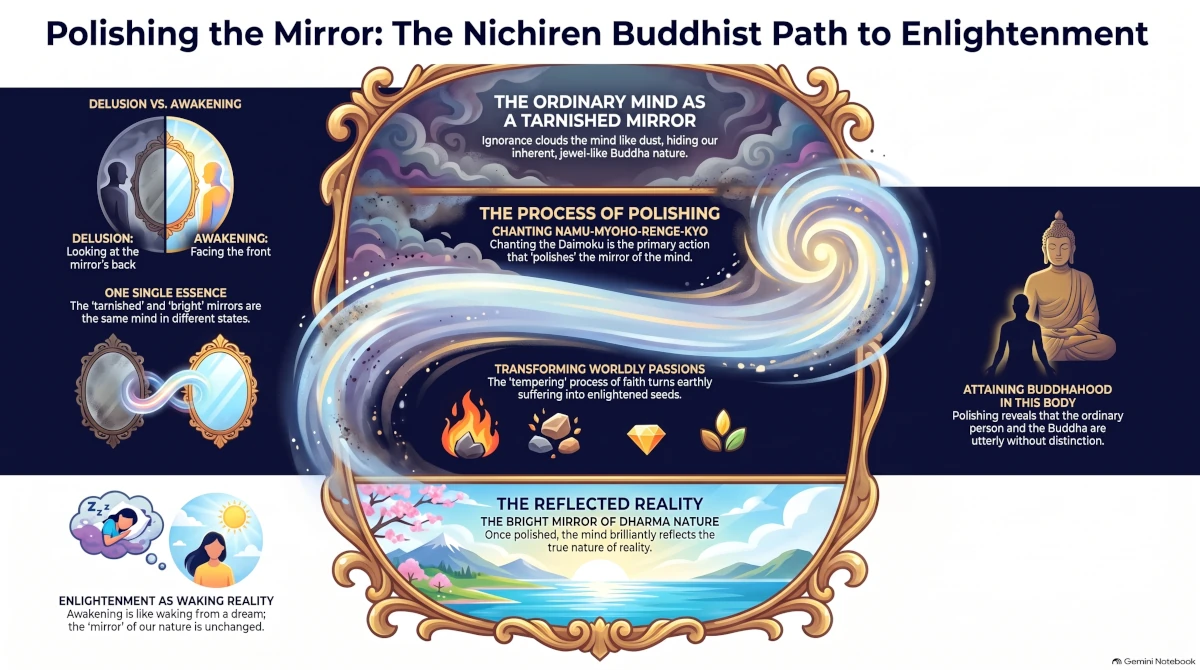
“While deluded, one is called an ordinary worldling, and when awakened, one is called a Buddha. To illustrate, even a tarnished mirror, when polished, will appear like a jewel. The mind that is clouded by the illusions of the dark nature of ignorance is like a tarnished mirror, but once polished, it will surely become like a jewel, reflecting the true aspect of reality and the uncreated Dharma-nature. Simply chanting Namu-myōhō-renge-kyō is what is called ‘polishing.'”
This teaching establishes that the deluded mind (ordinary person) and the awakened mind (Buddha) are not separate, distinct entities. Rather, they are the exact same mirror viewed in different states of clarity. This concept entirely bypasses the need to eradicate thoughts or construct a new, holy state. Instead, the act of chanting Namu-myōhō-renge-kyō directly cleanses the mirror of the mind, allowing the originally inherent, uncreated Buddha-nature to shine forth.
The Transition to Concentrated Chanting
Scholars note that the Isshō Jōbutsu Shō represents a key transitional moment in the evolution of Nichiren’s teachings. While it still employs the classical language of meditative discipline—speaking of ‘observing the mind’ (kanjin) or ‘discerning the wonderful principle originally inherent in living beings’—it radically defines this contemplation. It asserts that the actual practice of observing the mind is fully achieved and completed through the single, physical act of chanting the Daimoku. This represents a movement from quietist, silent introspection to active, vocalized devotion, preparing the foundation for the exclusive practice that defines Nichiren Buddhism in the Latter Day of the Law.
2. Ueno-dono Goke-Ama Gohenji (Reply to the Widow of Lord Ueno) Historical Context and the Reality of Grief
In 1259, Nichiren Shōnin converted Nanjō Hyōe Shichirō, a samurai and personal retainer of Hōjō Tokiyori who served as the steward (jitō) of the Ueno district near Mount Fuji. Known as Lord Ueno, Hyōe Shichirō passed away in 1265. His widow, who took Buddhist vows as a nun (Ueno-ama), remained deeply devoted to Nichiren and raised her children—including her eldest son, Nanjō Tokimitsu—to be staunch pillars of the Fuji area Lotus community. The collected works include more than forty letters to the Nanjō family.
This specific letter of condolence, the Ueno-dono Goke-Ama Gohenji, is assigned to either 1265 (shortly after Lord Ueno’s death, addressing a fresh, immediate sorrow) or 1274 (post-Sado). In this letter, Nichiren reassures the grieving widow that her late husband, having been an earnest practitioner of the Lotus Sutra, undoubtedly attained Buddhahood in his very body. He does not dismiss her natural human sorrow, but rather validates her grief, noting that even the great disciples of Śākyamuni Buddha wept at his parinirvana to display the behavior of ordinary human beings.
Core Doctrinal Principle: Hell is the Land of Tranquil Light
To console the widow and explain how her late husband attained supreme awakening, Nichiren Shōnin presents a revolutionary, nondual explanation of the realms of existence:
“Now whether in the case of the Pure Land, or whether in the case of hell, neither is found outside us. They exist solely within our hearts. One awakened to this is called a Buddha. One deluded to it is called an ordinary worldling. What enables this awakening is the Lotus Sutra. And if this is so, then one who embraces the Lotus Sutra awakens to hell being precisely the Land of Tranquil Light.”
This teaching collapses the spatial distance between this suffering world (sahā) and the pure realms of the Buddhas. Because hell and the Pure Land are both manifestations of the mind, the practitioner who embraces the Lotus Sutra is empowered to transform their immediate environment. Even in the midst of the most devastating personal trials and grief, the light of original enlightenment remains fully present. The Dual Practice of Consciousness
Towards the conclusion of the letter, Nichiren Shōnin introduces a highly practical guideline for daily living, which he attributes to ‘a virtuous man of antiquity’:
“Maintain the ground of the mind in the ninth consciousness, but keep your practice in the six consciousnesses.”
The six consciousnesses govern the sensory, intellectual, and physical movements of our daily, secular lives in the world. The ninth consciousness (amala-vijñāna) represents the fundamentally pure, undefiled ground of true suchness and our inherent Buddha-nature. This guidance instructs the follower not to escape from the world, but to keep their deepest, core awareness firmly anchored in the unshakeable, eternal reality of the Daimoku (the ninth consciousness), while continuing to act with diligence, integrity, and compassion within their daily professions, families, and chores (the six consciousnesses).
3. Onkō Kikigaki (Lectures Heard and Recorded) Historical Context and Oral Transmission
The Onkō Kikigaki, also known as the Nikō ki, presents itself as a direct record of lectures on the Lotus Sutra delivered by Nichiren Shōnin to his senior disciples during his retirement on Mount Minobu. According to the introductory note, these lectures were given in succession from the nineteenth day of the third month of the first year of Kōan (1278) through the twenty-eighth day of the fifth month of the third year of the same era (1280), and were recorded by his close disciple Sado Ajari Nikō (1253-1314), the founder of the Minobu lineage.
Modern academic specializations generally classify the Onkō Kikigaki as a composite, late-medieval text (compiled c. 1500) that draws heavily on Tendai original enlightenment (hongaku) oral transmission literature. However, because the final thirty-one topics comment on Nichiren Shōnin’s personal instructions and so closely mirror the encouraging, practical tone of his authenticated letters, it is widely recognized as having successfully preserved the genuine, living voice and direct guidance of the founder.
Core Doctrinal Principle: Flowing Water versus Fire
Among the most celebrated practical instructions preserved in the Onkō Kikigaki is the crucial distinction concerning the character of a disciple’s faith:
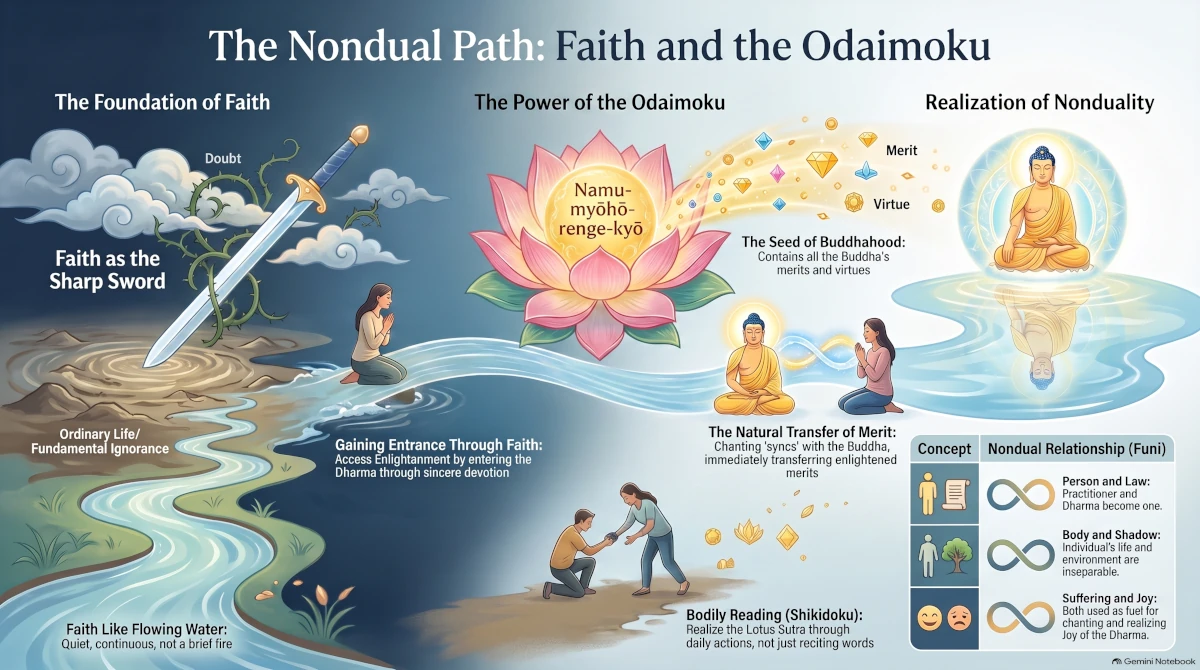
“Of the people who put faith in the Lotus Sutra today, some have faith like fire while others have it like water. Those who have faith like fire refer to those who become enthusiastic upon listening to the preaching but their passion cools down as time goes by, and eventually forget the teaching. On the other hand, those whose faith is like water mean those whose faith is like a ceaselessly flowing water, namely those who retain their faith without retreating.”
This teaching serves as an essential warning for lay practitioners. It is easy to arouse a temporary, highly emotional faith when first encountering the Dharma, but such a stance is volatile and easily extinguished when major obstacles or intellectual doubts arise. True practice demands a quiet, steady, and persistent commitment that flows day and night, quietly moving past every barrier, never retreating or slackening. This steady, water-like practice represents the true keeping of the indestructible Diamond Chalice Precept.
4. Doctrinal Synthesis: The Core Themes of Concentrated Faith
When viewed collectively, the Isshō Jōbutsu Shō, the Reply to the Widow of Lord Ueno, and the Onkō Kikigaki provide a cohesive theological framework that fully reconciles the immediate, nondual, ‘faith-based’ nature of Nichiren Buddhism with the demand for strict, rigorous, and steady daily practice. In this nondual theology, strict practice is not a works-based means to acquire a future, distant Buddhahood. Rather, practice is the active, necessary expression and polishing of a Buddhahood that is already inherently present within your life. Through the doctrine of Juji Soku Jikai (upholding the Law is itself keeping the precepts), the ordinary devotee is fully empowered to manifest the Pure Land of Tranquil Light directly within the trials, griefs, and secular duties of the present world, keeping their faith flowing steadily like water.
Comparative Summary of Essential Texts
The following table summarizes the key historical, doctrinal, and practical dimensions of these three pivotal texts:
Essential Text
Context & Date
Core Doctrinal Principle
Practical Application
Isshō Jōbutsu Shō
(Becoming a Buddha in One Lifetime)
Kenchō 7 (1255);
Kamakura.
Recipient: Toki Jōnin.
The Tarnished Mirror:
Delusion and awakening are not separate; chanting the Daimoku is the actual act of ‘polishing’ the mind.
Polishing the mirror of the mind morning and evening through the single, active practice of the Odaimoku.
Ueno-dono Goke-Ama Gohenji
(Reply to the Widow of Lord Ueno)
Bun’ei 2 (1265) or Bun’ei 11 (1274);
Minobu.
Recipient: Widow of Lord Ueno.
Hell is the Land of Tranquil Light; maintain the ground of the mind in the ninth consciousness, but practice in the six consciousnesses.
Anchoring your deepest awareness in the pure, eternal Daimoku while executing your daily, secular labor in the physical world.
Faith Like Flowing Water versus Faith Like Fire:
Continuous, steady devotion vs. volatile, temporary enthusiasm.
Maintaining a quiet, persistent, and unyielding practice that flows continuously day and night, unaffected by obstacles.
References for Further Study
Asai Endō. Nichiren Shōnin’s View of Humanity: The Final Dharma Age and the Three Thousand Realms in One Thought-Moment. Translated by Jacqueline I. Stone. Japanese Journal of Religious Studies 26, nos. 3-4 (1999): 239–259.
Shigyō Kaishû. Jūnyoze no koto no kenkyū (A study of the ‘Jūnyoze no koto’). Seishin 26 (1941): 104–112.
Stone, Jacqueline I. Original Enlightenment and the Transformation of Medieval Japanese Buddhism. Honolulu: University of Hawai’i Press, 1999.
Stone, Jacqueline I. The Atsuhara Affair: The Lotus Sutra, Persecution, and Religious Identity in the Early Nichiren Tradition. Japanese Journal of Religious Studies 41, no. 1 (2014): 153–189.
Watson, Burton, et al., trans. Letters of Nichiren. Edited by Philip B. Yampolsky. New York: Columbia University Press, 1996.
Tomorrow: The Distance from the Buddha Realm to Hell
Conceptual Summary
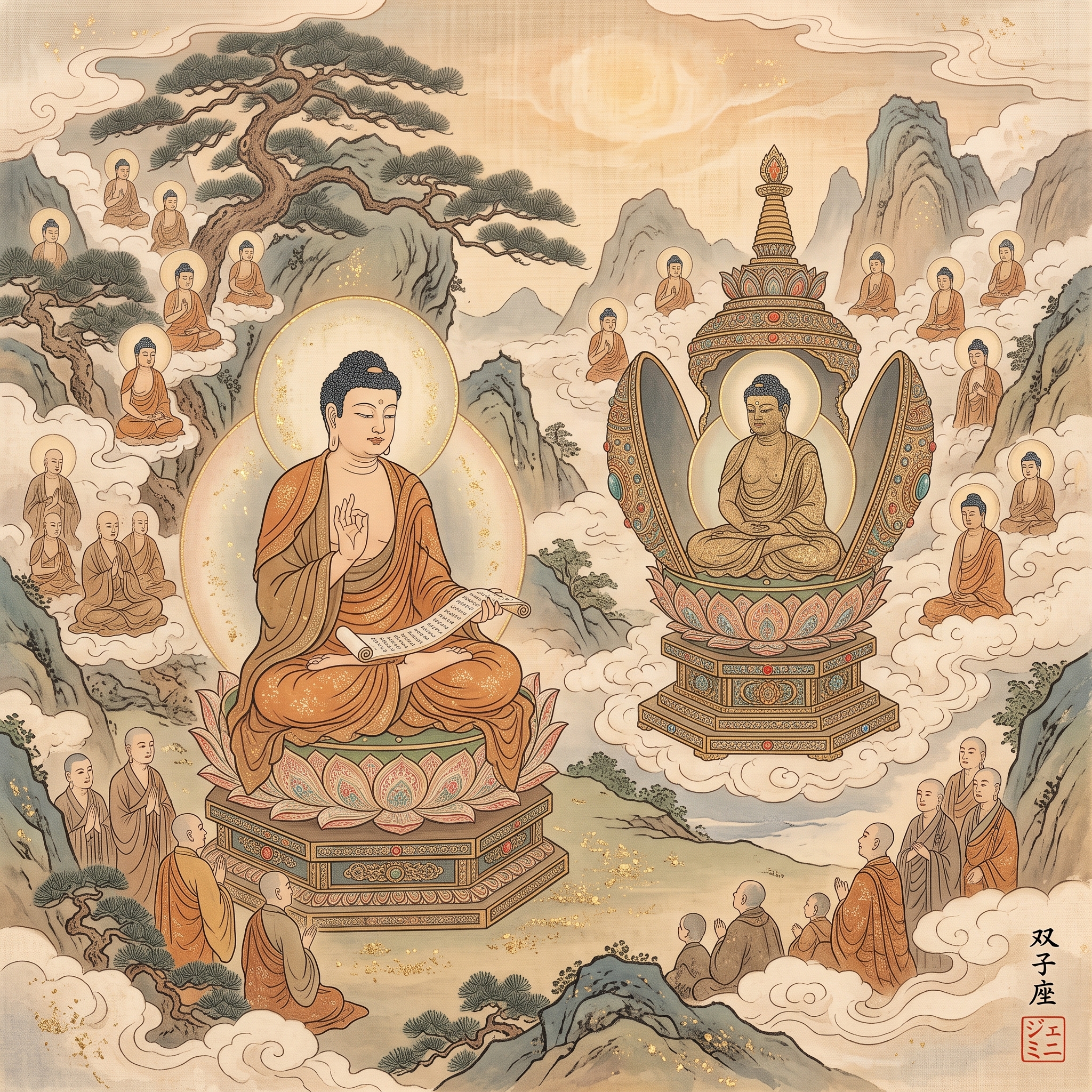
The illustration is a visual interpretation of the "Stupa of Many Treasures" chapter from the Lotus Sūtra. It employs classical Japanese Buddhist iconography on a textured silk background to depict Śākyamuni Buddha (left) explicitly expounding the sūtra. This act is the catalyst for the miraculous appearance of the jewel-encrusted Treasure Stupa, which floats on clouds. As mandated by the sūtra, Śākyamuni uses his psychic power to purify the world, thereby summoning the Buddhas of his replicas from the ten directions. These multiple, identical Buddha-emanations are visible surrounding the two main figures on clouds and mountainsides, materializing the line: "And to see the Buddhas of my replicas." The presence of the assembly and the emergence of Many-Treasures Tathāgata within the split stupa visually validate the power of preaching the Lotus Sūtra, adhering to the requested style and thematic constraints.
Iconography & Character Identification
Item 1: Deities/Figures Featured:
Śākyamuni Buddha (释迦牟尼佛) - The primary expounder, seated left on a lotus throne, holding a sutra scroll.
Many-Treasures Tathāgata (Prabhūtaratna, 多寶佛) - Seated within the split Treasure Stupa (right).
Buddhas of the Replicas/Emanation Buddhas (分身佛) - Numerous small, identical Buddhas appearing on clouds in the background.
The Four Heavenly Kings/Assembly members - Bodhisattvas, monks, and divine beings attending the assembly in the foreground.
Item 2: Text Translations:
Signature (Kanji): 双子座 (Futago-za) – Gemini / The Twins.
Seal (Katakana): ジェミニ (Jemini) – Gemini.
Anyone who expounds this sūtra
Will be able to see me,
To see Many-Treasures Tathāgata,
And to see the Buddhas of my replicas.
The Buddha sings these verses in Chapter Eleven of the Lotus Sūtra. We can hear this teaching with an aspiration to see visions of Śākyamuni Buddha and other Buddhas. But we can also hear the Buddha’s promise that when we keep in mind his assurance that we and all beings have the capacity for enlightenment, we will see the world differently. We will start to interpret the actions of ourselves and others in a new light. We will see many more beings who are helping us to become enlightened, rather than beings who are frustrating our efforts at pursuing our selfish goals.
The Daily Dharma is produced by the Lexington Nichiren Buddhist Community. To subscribe to the daily emails, visit zenzaizenzai.com
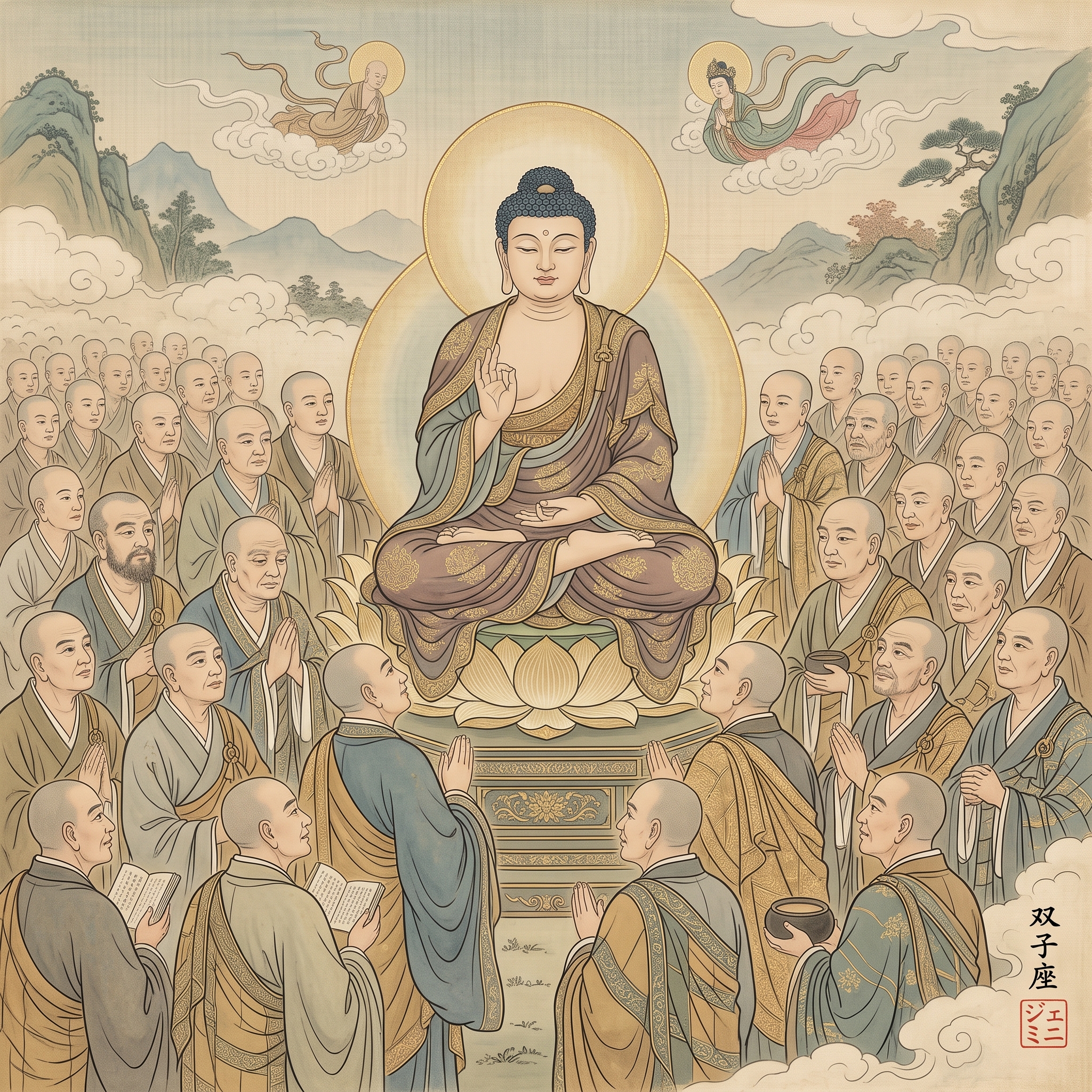
Conceptual Summary
The illustration is a visual interpretation of Śākyamuni Buddha’s assurance from Chapter Six of the Lotus Sūtra that even the Śrāvakas, who are primarily focused on individual liberation, will ultimately reach supreme enlightenment. To translate this concept visually, the image depicts a central, resplendent Śākyamuni Buddha seated in the 'teaching the Dharma' gesture, radiating a golden halo against a subtle, silk-textured background. He is surrounded by a vast and uncountable multitude of monastics (Śrāvakas), their number suggesting the incalculable assembly mentioned in the sūtra. Some monastics in the foreground are shown with eyes closed in introspection or holding text scrolls, emphasizing their focus on eliminating delusions, while others are gazing up towards the Buddha. Their diverse appearances and the sheer density of the crowd symbolize all beings. The style uses traditional Japanese mineral pigments and subtle gold leaf to evoke the sacred and timeless nature of the message, highlighting the Buddha's boundless compassion as he leads all toward their true nature. The environment, including subtle celestial figures, confirms their future status as "sons of the King of the Dharma."
Iconography & Character Identification
Item 1: Deities/Figures Featured:
Śākyamuni Buddha (Seated centrally in teaching pose with golden halo)
A vast assembly of Śrāvakas (monastics and disciples) filling the foreground and background
Subtle celestial figures or attendant spirits in the soft clouds above.
Item 2: Text Translations:
双子座 (Kanji signature): Gemini (Zodiac sign, meaning 'the pair of sons'). This likely identifies the artist or the creative collective responsible for the work.
ジェミニ (Katakana in red seal): Jemini (the Japanese transliteration of the word Gemini, consistent with the Kanji signature).
The Śrāvakas will have already eliminated āsravas,
And reached the final stage of their physical existence.
They will become sons of the King of the Dharma.
Their number also will be beyond calculation.
Even those who have heavenly eyes
Will not be able to count them.
The Buddha sings these verses in Chapter Six of the Lotus Sūtra. The Śrāvakas are those who want only to eliminate their delusions and end their suffering. They do not yet realize that the Buddha leads them to become Bodhisattvas and work for the benefit of all beings. They do not believe they can reach the Buddha’s own wisdom. The Buddha assures even these beings that in the course of time, as they realize their true nature, they too will become enlightened.
The Daily Dharma is produced by the Lexington Nichiren Buddhist Community. To subscribe to the daily emails, visit zenzaizenzai.com
Reconcile the theological shift from a gradual, “works-based” path to the immediate, “faith-based” nonduality of Nichiren Buddhism with Nichiren’s emphasis on strict ‘polishing’ and practice.
At first glance, a profound theological tension seems to exist between the immediate, “faith-based” nonduality of Nichiren Buddhism and its relentless demand for strict, rigorous “polishing” and practice. On one hand, you are taught that the eon-spanning, works-based path of gradual self-cultivation is collapsed. Through the single act of faith, the practitioner immediately accesses the complete virtues of the Buddha. On the other hand, Nichiren strictly warns that this is a “difficult practice” requiring followers to “polish the mirror of the mind” night and day, morning and evening, without neglect.
This tension is resolved when you realize that in Nichiren’s nondual theology, strict practice is not a works-based means to attain a future Buddhahood, but rather the active, necessary expression of a Buddhahood that is already inherently present within you.
1. The Reversal of the Path: Practice as Expression, Not Cause
Traditional Buddhist schools operate on the model of “proceeding from cause to effect” (jūin shika). In this works-based framework, a practitioner must systematically keep hundreds of monastic precepts, eliminate defilements, and master the six paramitas over countless lifetimes to gradually construct enlightenment.
Nichiren’s nondual framework completely inverts this path to “proceeding from effect to cause” (jūka kōin). Because Śākyamuni Buddha’s eon-spanning causal practices and resulting virtues are perfectly encapsulated within the five characters myō-hō-ren-ge-kyō, the moment you take faith in the Daimoku, the Buddha “spontaneously transfers” the entirety of his merits directly to you.
Therefore, you do not practice in order to become a Buddha; you practice because you are a Buddha. Your daily chanting is not a grueling climb up a spiritual ladder; it is the dynamic, joyful outflow of the uncreated state of original enlightenment already operating within your life.
2. The Nonduality of the Mirror and the Act of Polishing
To reconcile this immediate nonduality with the demand for rigorous effort, you must examine Nichiren’s central metaphor of the tarnished mirror. Nichiren explains:
“While deluded, one is called an ordinary worldling, and when awakened, one is called a Buddha. To illustrate, even a tarnished mirror, when polished, will appear like a jewel.”
In this teaching, the unpolished mirror and the bright, jewel-like mirror are not two separate entities; they are the exact same mirror viewed from different sides. Ignorance is looking at the back of the mirror; enlightenment is looking directly into its front.
Crucially, the mirror does not need to be structurally altered or replaced; it simply must be turned and polished. Even though delusion and awakening are ontologically one, their distinction remains empirically real in your day-to-day experience. If you cease polishing, the dust of fundamental ignorance immediately accumulates, reversing your view to the back of the mirror. Thus, strict, daily “polishing” through chanting Namu-myōhō-renge-kyō is the precise mechanism by which you continuously align yourself with the “front” of the mirror.
3. The Indestructible Precept: Juji Soku Jikai
This nondual reconciliation is formally institutionalized in the doctrine of juji soku jikai (“upholding the Law is itself keeping the precepts”).
Traditional Buddhist paths rely on highly fragile “earthenware” monastic precepts, which are easily shattered by human error. In contrast, Nichiren reveals that by embracing and chanting the Daimoku with faith, you receive the Diamond Chalice Precept (Kongō-hōki-kai). Because this precept is absolute and carved from the indestructible reality of the Buddha’s own life, it is ontologically impossible to break, even if you should try.
Because your connection to the Dharma is permanently secured, the rigor of your practice is no longer a fearful, defensive effort to avoid violating moral rules. Instead, the practitioner is instructed to simplify their focus: dispense with the first five Paramitas and secondary disciplines, and devote your entire life to the single, concentrated practice of the Daimoku.
The strictness is shifted from external behavioral restriction to the internal intensity of your “resolve” (kokorozashi), which acts as the supreme, life-giving offering of your entire being to the Law.
4. “Bodily Reading” and Faith Like Flowing Water
Finally, this nondual alignment must be actively lived out in the crucible of the physical world. Nichiren calls this the “bodily reading” (shikidoku) of the Lotus Sutra. It is the total commitment to embody the scripture not just with your mind or voice, but with your physical actions.
Because you live in the chaotic, spiritually degraded reality of the Final Dharma age (mappō), maintaining this alignment is fundamentally a “difficult practice” that invites constant psychological and external challenges. To survive these trials without regressing, Nichiren instructs followers to avoid a brief, enthusiastic faith that resembles a blazing fire—which flares up brightly but quickly cools down when encountering adversity. Instead, your faith must resemble flowing water, which moves steadily, quietly, and continuously, day and night, never retreating or slacking.
Ultimately, this steady, water-like practice is woven directly into the fabric of your daily existence. Nichiren famously advised his followers that your secular work and daily labor are themselves the 24-hour practice of the Lotus Sutra.
Because the worldly law is the shadow cast by the body of the Buddha Dharma, there is no separation between sacred contemplation and everyday activity. Every challenge faced at home or in your profession becomes the very water in which the pure moon of your innate Buddhahood is brilliantly reflected.
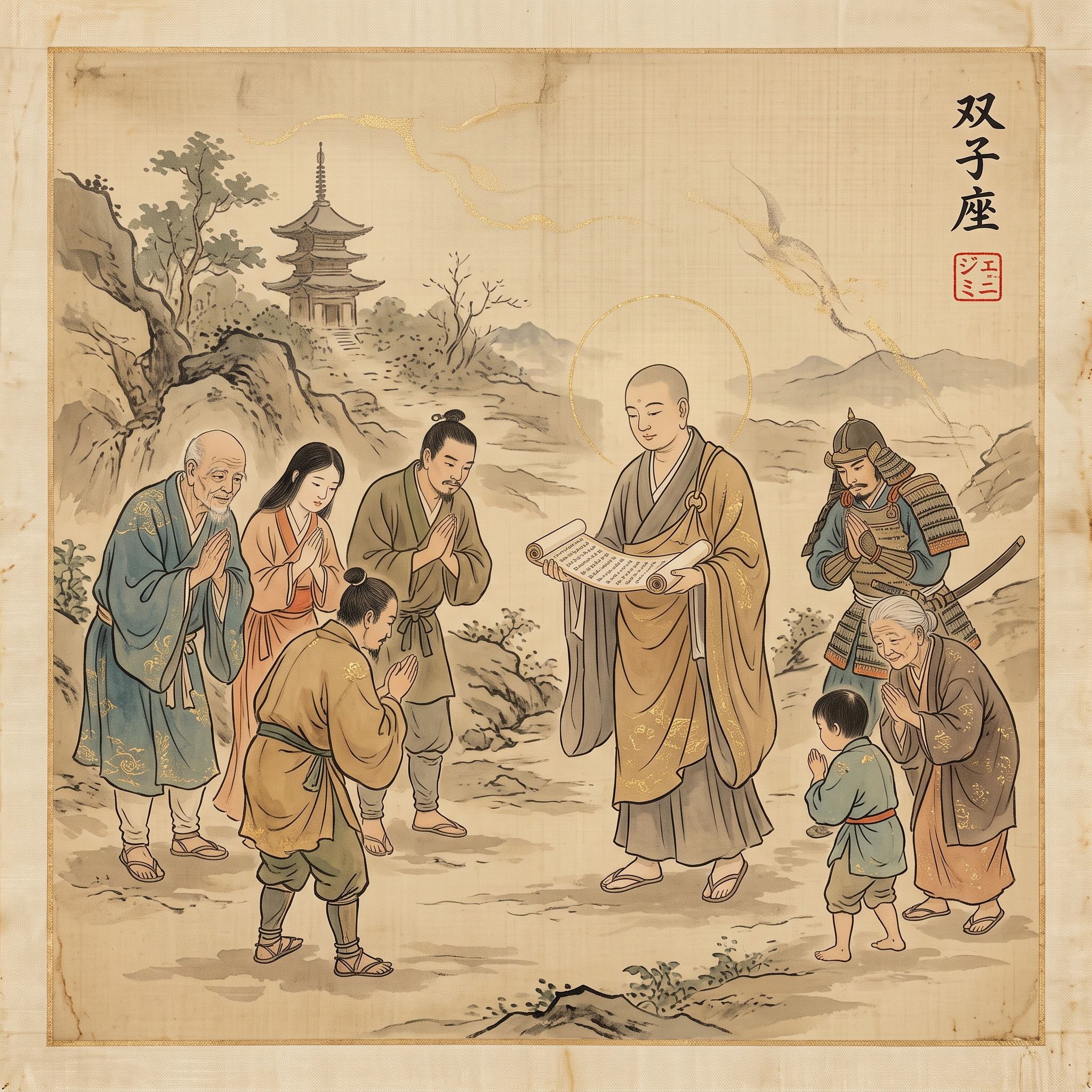
Conceptual Summary
The illustration is a direct interpretation of the instructional verses found in Chapter Ten of the Lotus Sūtra, translating the metaphor of a difficult, "evil world" into a tangible landscape. By depicting an diverse assembly of ordinary people—warriors, elders, and children—venerating a single monk with the same reverence usually reserved for the Buddha, the image visualizes the principle that those who safeguard the sūtra embody the Buddha's own presence. The presence of the background pagoda serves to create a sanctified space within this challenging world, emphasizing that the sūtra transforms its surroundings. The central figure’s humility, emphasized by their halo, avoids ego and instead highlights the sūtra itself as the source of worthiness, exactly as the commentary suggests.
Iconography & Character Identification
Item 1: Deities/Figures Featured:
A central Buddhist monk (the Sūtra Keeper, identifiable by the halo and the open scroll), functioning as the representative for Śākyamuni Buddha’s presence.
A diverse group of six lay practitioners, including an elder, women, a male householder, a samurai warrior, and a child, representing "all beings" or the extended "Bodhisattvas and great beings" of the world.
Item 2: Text Translations:
The Kanji signature '双子座' translates as "Gemini" or "The Gemini Constellation."
The Katakana characters in the red square seal 'ジェミニ' translate phonetically as "Gemini."
Join your hands together and bow
To the person who keeps this sūtra
In the evil world after my extinction,
Just as you do to me!
The Buddha sings these verses to Medicine-King Bodhisattva at the beginning of Chapter Ten of the Lotus Sūtra. By extension he is giving this instruction to all Bodhisattvas and great beings of the universe, and explaining to them that those who keep the Lotus Sūtra are as precious in this world of conflict at the Buddha himself. If we hear these verses with a mind of ego and attachment, we could conclude that we deserve respect and begin to demand it from others. Those who demand respect only generate fear. The Buddha gained respect by respecting all beings. When we treat others as Buddhas, we are certain to have that treatment reflected back towards us.
The Daily Dharma is produced by the Lexington Nichiren Buddhist Community. To subscribe to the daily emails, visit zenzaizenzai.com
In Nichiren Buddhism, enlightenment is not a static state of intellectual understanding, but a dynamic reality that must be continuously actualized through action. While provisional teachings often encourage passive contemplation or a reliance on distant, otherworldly salvations, Nichiren places supreme weight on a highly active, rigorous, and localized discipline. To understand the depth of this practice, one must look at how the mirror of the mind is maintained, how daily life is transformed into a sacred arena, and why true practice demands a steady, uninterrupted resolve.
1. The Metaphor of the Tarnished Mirror: “Polishing” the Mind
A central pillar of this teaching is that the potential for Buddhahood is not something external to be acquired, but a reality inherently present within every individual. To explain how this innate potential is revealed, Nichiren employs the famous metaphor of the tarnished mirror:
“While deluded, one is called an ordinary worldling, and when awakened, one is called a Buddha. To illustrate, even a tarnished mirror, when polished, will appear like a jewel.”
The human mind, when clouded by fundamental ignorance, is like an unpolished mirror. Crucially, the tarnished mirror and the bright, jewel-like mirror are not two separate objects; they are the exact same entity in different states. There is no need to discard your ordinary mind. Instead, you must diligently polish it morning and evening.
When practitioners ask how this polishing is practically achieved, Nichiren’s answer is absolute:
“Simply chanting Namu-myōhō-renge-kyō is what is called ‘polishing.'”
By focusing your voice and mind on the Odaimoku, you directly wipe away the dust of delusion and allow the bright mirror of your inherent Buddha-nature to shine forth.
2. The Inseparability of Practice, Study, and Faith
For a practitioner of the Lotus Sutra, spiritual progress relies upon the balanced cultivation of faith, practice, and study (learning). These elements are not separate pathways; they are deeply intertwined components of a single spiritual life. Nichiren writes:
“Strive to carry out the two ways of practice and learning. Without practice and learning Buddhism will cease to exist. Endeavor yourself and cause others to practice these two ways of practice and learning, which stem from faith.”
Study illuminates your understanding of the Buddha’s intent, preventing your practice from drifting into blind dogmatism or shallow custom. Practice, in turn, is the active expression of your study. Without this dual commitment, faith cannot grow. Even if you can only share a single word or phrase with others, you are encouraged to actively teach and study to keep the living spirit of the Dharma alive.
3. Strict Diligence: Integrating Faith into Daily Works
Nichiren’s view of practice is famously rigorous. In his letter to Lord Toki (Tokidono Gosho), he urges followers to maintain an unwavering focus on their ultimate spiritual potential:
“Nichiren’s followers must strive to attain Buddhahood by shortening sleeping hours and by cutting the time for rest. If not, you will repent forever.”
This intensity reflects the understanding that while people routinely undergo immense hardships, make sacrifices, and lose sleep to achieve transient, worldly goals—such as passing examinations or securing business profits—the true, eternal goal of perfecting your character deserves far greater dedication.
However, this strictness does not mean turning away from the secular world to live in monastic isolation. Nichiren teaches that faith must be actively manifested in your daily work, your home, and your society. He famously advised Shijō Kingo that “the service to your lord itself is practicing the teaching of the Lotus Sutra twenty-four hours a day.”
Your profession, your family responsibilities, and your interactions with others are the very mirror reflecting your inner life and spiritual polish.
4. Upholding the “Difficult Practice” Like Flowing Water
Although chanting the Odaimoku is outwardly simple enough for anyone to perform, Nichiren strictly categorizes it as a “difficult practice.” He notes:
“To receive the Lotus Sutra is easy; to uphold it is difficult. But the realization of buddhahood lies in upholding it.”
Human nature is volatile and easily swayed by changing circumstances. It is easy to arouse a temporary, highly enthusiastic faith when first encountering the Dharma, but such a stance is like fire—it flares up brightly but is quickly extinguished when major obstacles or intellectual doubts arise. Instead, Nichiren advises Lord Matsuno to maintain a constant faith resembling flowing water. Water flows quietly, steadily, and continuously, day and night, never retreating or slackening no matter what obstacles block its path. To practice in this way is to possess a stout heart. It means refusing to compromise your devotion to the true teaching, actively rebuking error through the confrontational practice of shakubuku to protect the integrity of the Dharma, and remaining completely unmoved like a mountain of gold when facing the storms of life. By dedicating your voice, body, and mind to this continuous effort, the simple act of chanting is transformed into the most profound, direct path to supreme awakening.
Tomorrow: The Nondual Practice of Nichiren Buddhism
Conceptual Summary
The illustration is a traditional Japanese Buddhist painting on silk, interpreting Chapter Three of the Lotus Sūtra. It captures the moment Shakyamuni Buddha expounds the Dharma to an assembly specifically described as those who 'make efforts' and 'have compassion towards others.' The scene emphasizes this human response rather than cosmic scale. The assembly includes a mix of dedicated monastic figures, representing disciplined effort, and compassionate laypeople, shown interacting and supporting one another in the foreground, embodying the text’s focus on mutual care and the benefit of helping others. This composition illustrates that the Wonderful Dharma is intended for, and best realized by, those actively engaged in practice and altruism. The serene environment and warm light radiating from the Buddha keep the viewer’s mind open to the teachings, while avoiding complex cosmic iconography that might distract from the central message of human potential for enlightenment.
Iconography & Character Identification
Item 1: Deities/Figures Featured:
Central Deity: Shakyamuni Buddha (historical Buddha) is seated on a lotus throne, identifiable by his classical representation, teaching mudra, and specific blue-tressed halo. He is positioned under a jeweled baldachin.
The Assembly (Disciples and Listeners): An inclusive group of approximately ten figures gathers below the Buddha. This group includes monks (bhikkhus) in traditional patched robes and tonsured heads, and lay devotees (upasakas and upasikas) in varied period-appropriate attire. They are shown actively listening, with many performing anjali (hands pressed together), reflecting their sincere effort and engagement.
Item 2: Text Translations:
Signature (Black Ink): 双子座 (Futagoza) translates as "Gemini" (the constellation or zodiac sign).
Seal (Red Hanko): ジェミニ (Jemini) translates as "Gemini."
Expound it
To those who make efforts,
Who have compassion towards others,
And who do not spare their lives!
The Buddha sings these verses to all those gathered to hear him teach in Chapter Three of the Lotus Sūtra. These are instructions for us to know who will benefit from the Wonderful Dharma. It is difficult for those who are absorbed in their own suffering to realize the benefit of helping others. It is difficult for those who are distracted by their preoccupations, or who do not believe they can become enlightened, to maintain their efforts to lead all beings to enlightenment. These insights also help us keep our minds open to the Buddha’s teachings.
The Daily Dharma is produced by the Lexington Nichiren Buddhist Community. To subscribe to the daily emails, visit zenzaizenzai.com
Build a comparative chart contrasting the stages of the traditional “works-based” path (the six paramitas and monastic precepts) with the nondual “faith-based” model of juji soku jikai.
To fully visualize the profound theological shift from a gradual, “works-based” path to the immediate, “faith-based” nonduality of Nichiren Buddhism, it is helpful to look at how the entire structure of Buddhist practice is transformed. Traditional Buddhist paths present a linear journey of self-purification, where you must slowly climb a ladder of virtues across countless lifetimes to reach enlightenment. In contrast, Nichiren’s teachings collapse this distance entirely, revealing that the ultimate fruit of Buddhahood is fully present and immediately accessible in your very first step of faith.
The following comparative chart contrasts these two paradigms across their core doctrinal dimensions:
Theological Dimension
Traditional “Works-Based” Path (Gradual / Provisional Teachings)
Nondual “Faith-Based” Path (Juji Soku Jikai / Original Gate)
Philosophical Orientation
Linear Progression (Cause-to-Effect / Jūin Shika): Delusion and enlightenment are treated as separate, sequential states. Practitioners must systematically eradicate delusions and cultivate virtues before they can enter the Buddha realm.
Simultaneity & Nonduality (Effect-to-Cause / Jūka Kōin): Delusion and enlightenment are fundamentally nondual (funi). The complete, uncreated enlightenment of the Buddha is immediately accessed and manifested within your ordinary life in the moment of practice.
Soteriological Timeframe
Eon-Spanning (Asamkhyeya Kalpas): Achieving awakening requires countless lifetimes of difficult, painful, and self-sacrificial practices to slowly accumulate merit and purify the mind.
Immediate Awakening (Sokushin Jōbutsu): The infinite eons of linear cultivation are completely collapsed. You can realize Buddhahood with your very body, in this present lifetime, through a single moment of faith.
The Nature of Precepts
Earthen Vessel Precepts (Goki-kai): Composed of hundreds of specific prohibitive rules (e.g., 250 for monks, 500 for nuns) that regulate external behaviors. Highly fragile; if violated or broken, the precept-body is shattered and lost.
Diamond Chalice Precept (Kongō-hōki-kai): A singular, absolute, and internal precept that directly aligns with your inherent Buddha-nature. It is indestructible; once embraced, it can never be broken or lost, even if you should try.
Mechanics of Practice
Individual Effort (Jiriki): Relying on personal meditative discipline, strict monastic boundaries, and the step-by-step mastery of the Six Paramitas (generosity, morality, patience, effort, meditation, wisdom).
Natural Transfer of Merit (Tariki within Jiriki): Śākyamuni Buddha’s infinite causal practices and resulting merits are fully contained in the Daimoku (Namu-myōhō-renge-kyō). Chanting with faith naturally transfers these merits to you.
The Three Trainings (San-gaku)
Monastic Disciplines: Morality (Śīla), Meditation (Samādhi), and Wisdom (Prajñā) are practiced as separate, sequential fields of study and behavior.
Three Great Secret Laws (Sandai Hihō): The Three Trainings are perfectly concentrated and simultaneously completed in the Kaidan (Morality), the Honzon (Meditation), and the Daimoku (Wisdom).
Stage of Attainment
Ultimate Identity (Kukyō-soku): Buddhahood is treated as a distant, future goal achieved only at the final, fifty-second stage of the spiritual path.
Verbal Identity (Myōji-soku): Buddhahood is fully entered and manifested at the very first step of practice, where you take faith upon hearing the names and letters of the True Dharma.
Primary Pedagogical Metaphor
The Arduous Ascent: Climbing a steep mountain, or clearing and preparing a field through grueling labor in the spring to eventually reap a future harvest.
The Blue Fly on the Swift Horse: A tiny, fragile fly travels ten thousand miles effortlessly by clinging to the tail of a swift horse—analogous to your faith clinging to the completed power of the Daimoku.
Deeper Doctrinal Insights into the Shift
Consider how three of these dimensions redefine the relationship between the practitioner and the Buddha:
1. From Progressive Precepts to the Indestructible Vessel
In traditional monastic Buddhism, keeping the precepts is akin to maintaining a highly fragile clay pot (an “Earthen Vessel”. If you commit a major offense, the vessel shatters, and you must begin the arduous process of rebuilding your moral standing from scratch.
The Diamond Chalice Precept entirely bypasses this precarious behavioral regulation. Nichiren explains that because the Daimoku is the absolute essence of the Buddha’s life, when you accept and hold Namu-myōhō-renge-kyō, you receive a precept-body that is indestructible. Even if you should make mistakes, stumble, or fail, the diamond does not turn into clay; every broken shard of a diamond remains pure diamond. The essential connection to your innate Buddhahood is never severed.
2. The Power of “Natural Transfer” (Juji Soku Jikai)
Traditional Mahayana teachings demand that a bodhisattva master the Six Pāramitās over three immeasurable eons (asamkhyeya kalpas) to earn the merit required for Buddhahood. In the Latter Day of the Law (Mappō, attempting such a complex and grueling path is unsuited to the capacity of ordinary people.
Through the doctrine of juji soku jikai (“upholding the Dharma is itself keeping the precepts”), Nichiren reveals that Śākyamuni Buddha performed all of those eon-spanning causal practices and attained their resulting virtues on your behalf. He then encapsulated those completed merits entirely within the five characters myō-hō-ren-ge-kyō. When you embrace the Daimoku with faith, the Buddha “spontaneously transfers” the entirety of his merits directly to you. You do not have to perform the causal works because you are riding upon the completed “effect” of the Buddha.
3. Collapsing the Stages of Practice at the Beginning
In traditional Tiantai scholasticism, the path to enlightenment is divided into the Six Identities (roku-soku). The second stage, Verbal Identity (myōji-soku), is merely the intellectual beginning of the path, where you first hear the name of the Dharma. You are expected to spend lifetimes progressing through the subsequent stages of meditation and purification before reaching Ultimate Identity (kukyō-soku).
Nichiren’s “faith-based” model collapses this sequence. Because the names and letters of the Lotus Sutra are the direct voice and mind of the Buddha, the moment you take faith and vocalize the Daimoku, the ultimate fruit of Buddhahood is fully realized then and there. As Nichiren beautifully asserts: “Faith is the cause for wisdom and represents the stage of verbal identity… The single word ‘faith’ is defined as the seed of wondrous enlightenment.”
By chanting Namu-myōhō-renge-kyō, you are not acting in order to become a Buddha; rather, your practice is an active, joyful outflow of the Buddhahood already operating.
Tomorrow: The Dynamic Practice of Nichiren Buddhism