Category Archives: AI Contribution

Daily Dharma for April 30, 2026

20260430a-ddi

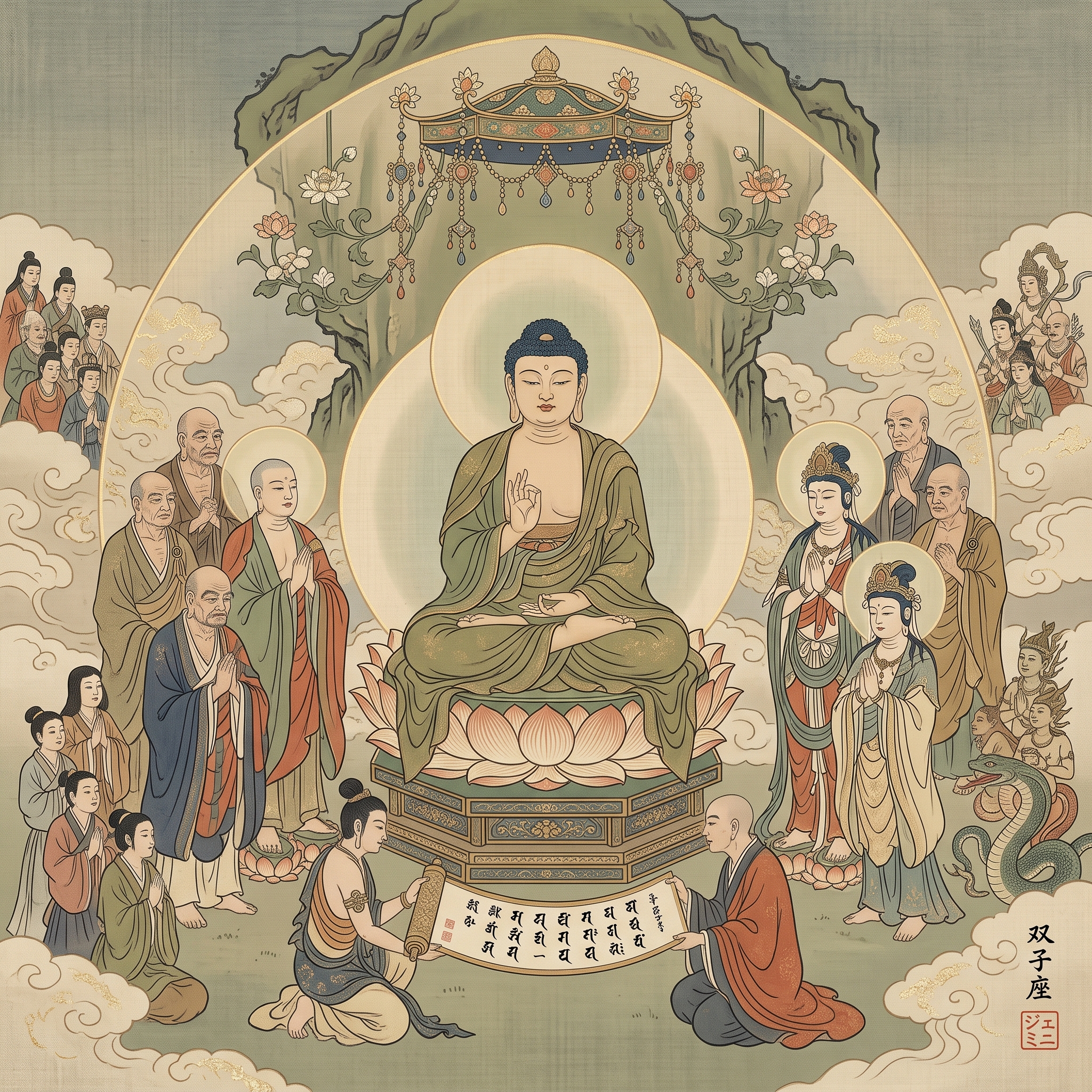
Illustration by Google Gemini

Show Gemini's thinking

Gemini Thinking

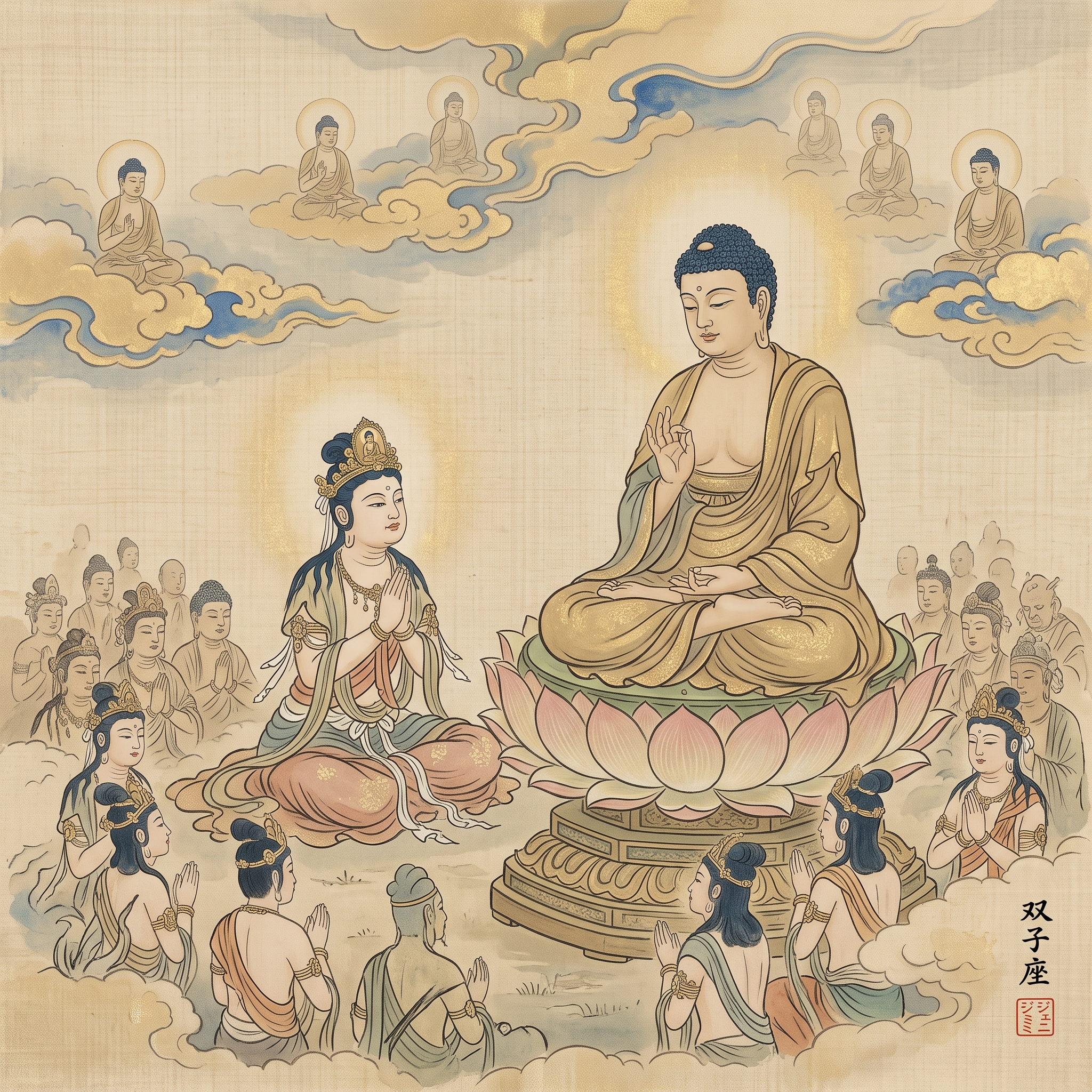
Thinking Summary: This square Japanese Buddhist illustration captures the arrival of the Brahma Heavenly-Kings from the Zenith to Great-Universal-Wisdom-Excellence Tathāgata, as described in Chapter Seven of the Lotus Sutra. The central focus is the radiant Buddha teaching. To illustrate the Kings' arduous journey across multiple worlds to hear the Dharma, multiple groups are shown approaching on elaborate cloud vehicles. Some hold musical instruments or offerings, depicting their joyful arrival and praise. The background features a cosmic backdrop of planets and stars, symbolizing the "innumerable worlds" they navigated. The lower part of the composition depicts an idealized pure land, reflecting the goal of the teachings and the presence of the Ever-Present Buddha throughout the triple world.

Figure Identification:

Central Figure: Great-Universal-Wisdom-Excellence Tathāgata (Daitsū Chishō Nyorai), seated on a lotus throne, radiating universal wisdom.

Buddha’s Retinue (Around the main figure): Attending Bodhisattvas and Arhats (monks).

Approaching Figures on Clouds: The Brahma Heavenly-Kings from the Zenith and their retinues, traveling from different directions with musical instruments, flowers, and incense as offerings.

Kanji Translation:

Artist's Signature (Kanji): 双子座 (Futago-za, meaning Gemini)

Seal Text (Katakana): ジェミニ (Jemini, meaning Gemini)

How good it is to see a Buddha,
To see the Honorable Saint who saves the world!
He saves all living beings
From the prison of the triple world.

The Brahma Heavenly-Kings of the Zenith sing these verses in Chapter Seven of the Lotus Sūtra. They gave up their kingdoms, their subjects and their homes to travel across innumerable worlds to hear the Wonderful Dharma. They inspire our devotion by showing how important this teaching is to them. For us who know of the Ever-Present Buddha Śākyamuni, we recognize that the Buddha exists everywhere, even in our triple world of form, formlessness and desire. When let go of the delusions that imprison us, and recognize this Buddha in our midst, we find ourselves in the Buddha’s pure land.

The Daily Dharma is produced by the Lexington Nichiren Buddhist Community. To subscribe to the daily emails, visit zenzaizenzai.com
Nichiren Shu’s Modernization and Global Reach

This is the second of two essays written by Google’s Gemini. Gemini was told to write this from the perspective of a Nichiren Shu scholar priest. That’s why you see “we” and “our” throughout. Gemini was directed to base the essay on the source material found in this Notebook.


protect-the-dharma-movement


As we established in our previous analysis, the postwar landscape of Japan was one of shattered financial foundations and spiritual disorientation. Faced with the decay of the Danka system and the aggressive expansion of lay-led New Religions, the leadership of Nichiren Shū recognized that a passive “funeral business” model would no longer suffice. In 1966, the 18th Sectarian Assembly inaugurated the Protect the Dharma Movement (Gohō Undō). This was not merely an administrative reorganization; it was a profound theological and practical revolution designed to turn institutional crisis into a global spiritual force.

I. Theological Shifts: Defining a Modern Identity

To differentiate our sect from the confrontational image of groups like the Soka Gakkai, we strategically embraced a theology of “deep humanism” and social engagement.

  • From “Parishioner” to “Follower”: We moved to replace “parishioner consciousness” (danka ishiki), rooted in social obligation and death rites, with a “follower” (shinto) identity. We sought to empower laypeople as “Bodhisattvas of the Earth” who held a personal, active mission to spread the Dharma.
  • Gentle Persuasion (Shōju) over Confrontation (Shakubuku): While our Founder utilized shakubuku to break false views, we explicitly denounced forced conversions through intimidation. We clarified that true shakubuku requires strict self-discipline first. In a modern pluralistic society, we pivoted toward shōju – a gentler method of persuasion adapted to individual circumstances.
  • The Nonduality of Self and Environment (Eshō Funi): To reclaim our doctrine from pre-war militaristic associations, we grounded our peace efforts in eshō funi. This asserts that protecting the Dharma within one’s own heart is inextricably linked to creating peace in the external world. Only by overcoming individual egotism can true societal peace (Ankoku) be realized.

II. Practical Initiatives: The Mechanics of Renewal

The movement was executed in distinct phases, transitioning from organizational mobilization to internal spiritual unification.

  • Quantitative Growth (1966–1970): The early phase focused on structural modernization leading up to the 750th anniversary of Nichiren’s birth. We dispatched “Goho Missionaries” to host large conventions and established Maintenance Associations (Goji-kai) to formalize lay support.
  • The Shingyō Hikkei and Unified Faith (1971–1978): Realizing that participation was often still perfunctory, Chief Administrator Watanabe Kōin shifted the focus to “Unified Faith” (Gohō Tōnitsu Shingyō). In 1972, we published the Shingyō Hikkei (Handbook of Faith and Practice) to standardize liturgy and daily chanting across the globe.
  • Synchronized Global Prayer: To foster unity, the handbook instituted global morning prayers at 8:00 AM, directing the hearts of all followers toward Mt. Minobu, the spiritual home of our Founder.

III. Turning Global: The Linguistic Bridge

A critical turning point occurred in 1978 when, urged by Chief Administrator Matsumura Juken, Rev. Kyotsu Hori published the English translation of the Shingyō Hikkei.

  • The Global Mandate: This translation provided the linguistic bridge to export our unified system to overseas missions in North America, Brazil, Europe, and Southeast Asia.
  • Fulfilling the Vow: This expansion fulfilled Nichiren Daishonin’s mandate to spread the Lotus Sutra worldwide (ittenshikai kaiki myoho). It transformed the Nichiren Shū from a purely Japanese cultural religion into a global faith dedicated to interfaith dialogue and peace advocacy.

Conclusion: The Legacy of Protection

The Protect the Dharma Movement reached its organizational peak in 1981, the 700th memorial of Nichiren’s passing. Its legacy continues today through current initiatives like the “Inochi ni Gassho” (Palm to Palm with All Life) slogan, which expands the concept of protection to include environmental conservation and universal inclusion.

By synthesizing the militant energy of Nichiren’s medieval mission with the humanistic values of the postwar era, we created a sustainable model for institutional survival. We proved that the protection of the Dharma is not an act of exclusion, but an effort to build a “bright and secure” world through the practice of the Lotus Sutra.

Daily Dharma for April 29, 2026

20260429-ddi

Illustration by Google Gemini

Show Gemini's thinking

Gemini Thinking

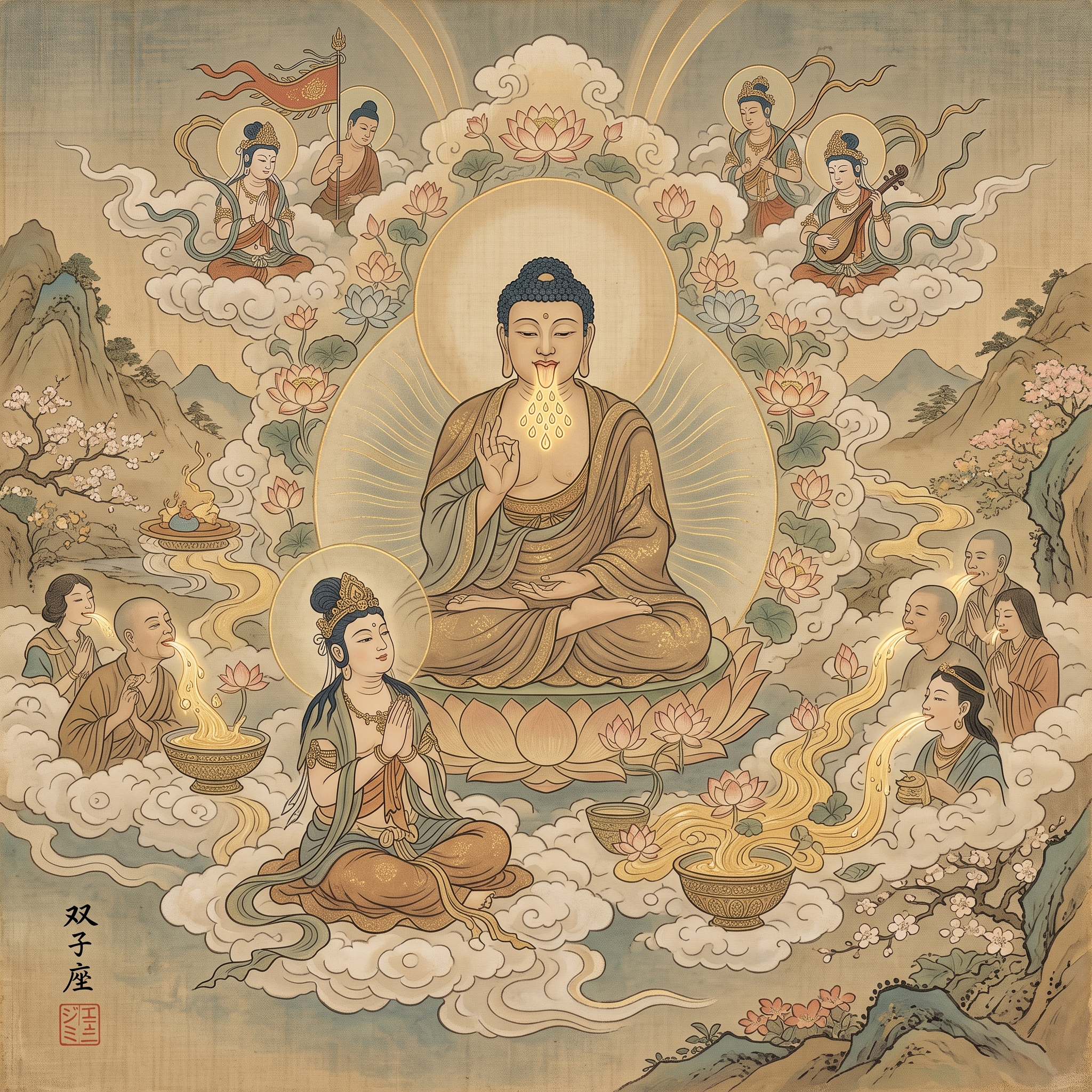
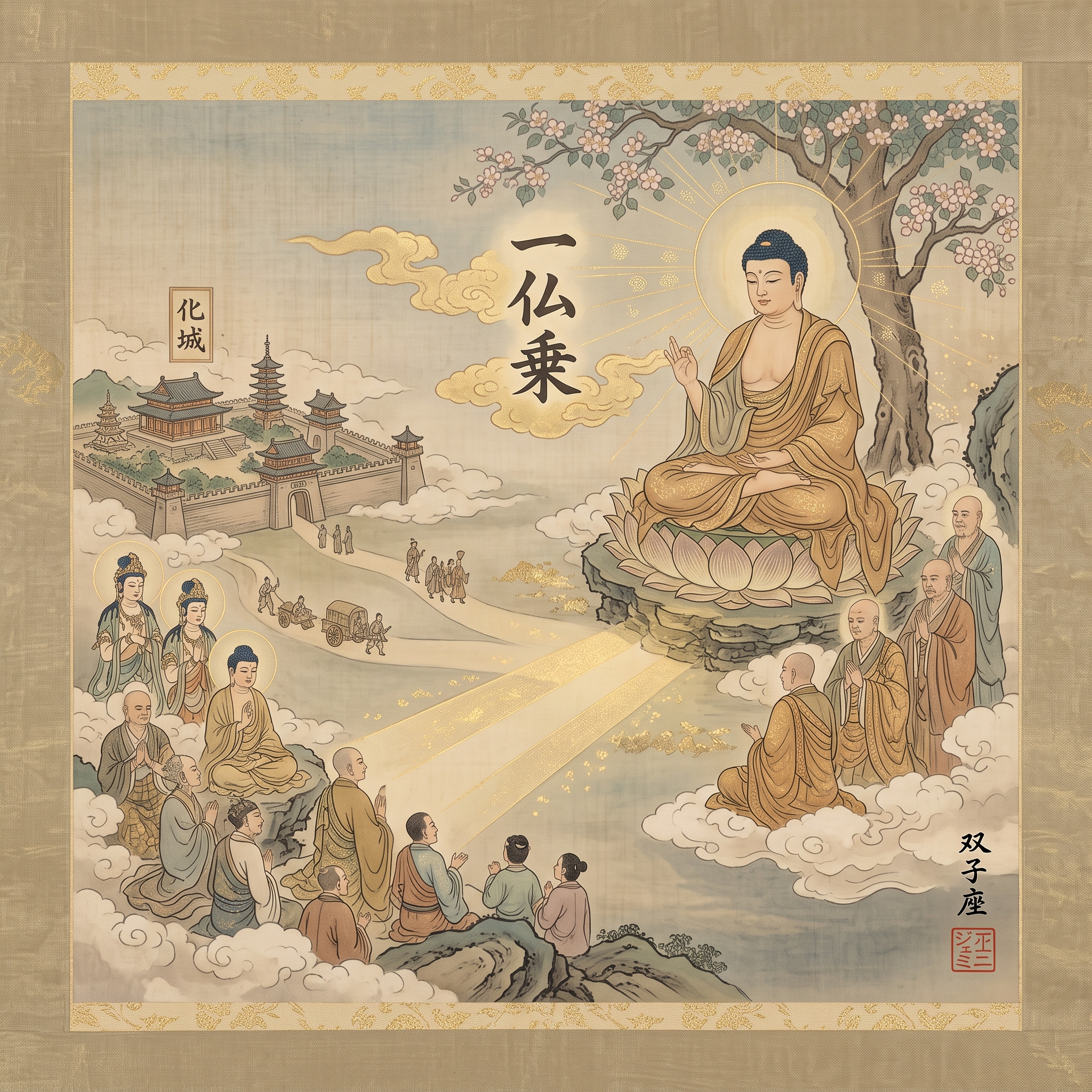
This illustration features Śākyamuni Buddha (center) being revered by the monk Pūrṇa (left). Śākyamuni's teaching flows forth as light and complex symbols that appear as "words" (representing the structure and limits of conventional language). These streams then transform into visual depictions of interconnectedness, showing sentient beings—both human and animal—supporting one another, realizing their shared happiness as Bodhisattvas. The artist's signature reads 双子座 (Gemini), and the red hanko seal contains the katakana ジェミニ (Jemini).

The merits of the Buddha are beyond the expression of our words. Only the Buddha, only the World-Honored One, knows the wishes we have deep in our minds.

In Chapter Eight of the Lotus Sutra, Pūrṇa has these words in mind while looking at the face of Śākyamuni Buddha. The thoughts we have are mostly words, and the words are about the things we want. Words can help us make sense of the world around us, especially the words the Buddha uses to teach us. But words can also confuse us when we mistake our expectations for the reality of the world. When the Buddha calls us to become Bodhisattvas, to realize that our happiness is linked to that of all beings, his words open a part of our mind with which we are not familiar. He asks us to set aside the habits we have learned from this world of conflict and see his world in a new way.

The Daily Dharma is produced by the Lexington Nichiren Buddhist Community. To subscribe to the daily emails, visit zenzaizenzai.com
Nichiren Shū’s Postwar Crisis and Reform

This is the first of two essays written by Google’s Gemini. Gemini was told to write this from the perspective of a Nichiren Shu scholar priest. That’s why you see “we” and “our” throughout. Gemini was directed to base the essay on the source material found in this Notebook.


shingyo-hikkei-postwar-trouble


As we look back upon the landscape of 1945, a year etched in fire and ash, one might be forgiven for thinking the Latter Day of the Law (Mappō) had arrived in its most literal sense. For the leadership of the Nichiren Shū, the smoke clearing from the ruins of our cities revealed more than just physical destruction; it exposed an unprecedented existential crisis that threatened the very survival of our traditional temple network.

The following analysis examines the cascade of intersecting historical changes that shattered our institutional foundations and forced us into a period of deep, often painful, self-reflection.

1. The Collapse of Financial Foundations

Historically, many of our Buddhist temples were sustained by the income generated from vast, independent agricultural estates. However, in the immediate postwar years, the Japanese government instituted sweeping agrarian land reforms.

  • Financial Ruin: These reforms stripped temples of their traditional landholdings, delivering a massive financial blow to the clergy.
  • The Stigma of “Funeral Buddhism”: Deprived of independent revenue, temples were forced to rely almost entirely on performing hereditary funeral and memorial rites to survive. This led to a spiritual stagnation where the Sangha was increasingly criticized as a mere “funeral business,” lacking relevance for the living.

2. Urbanization and the Decay of the Danka System

Simultaneously, the traditional family system (ie), which had functioned as a cohesive patriarchal unit for centuries, began to disintegrate. This social shift triggered a mass migration from rural communities to urban centers.

  • Membership Decline: As families moved to the cities, they left their ancestral temples behind.
  • Systemic Collapse: This caused a drastic decline in the Danka membership base – the hereditary parishioner system – that rural temples relied upon for their very existence. The bond between the people and the Dharma was no longer a matter of community, but a fading memory of the countryside.

3. Social Anxiety and “Spiraling Egotism”

The postwar environment was characterized by defeat, grinding poverty, and the loss of traditional values. Citizens were surrounded by modern anxieties: inflation, industrial pollution, and the terrifying specter of nuclear war – particularly after the 1954 Bikini Atoll hydrogen bomb tests.

Nichiren Shū leaders observed that these societal strains were fostering a culture of “spiraling egotism”. Individuals became increasingly self-centered, prioritizing worldly desires and personal survival over community welfare and mutual help. The heart of the nation was becoming fragmented.

4. The Rise of New Religious Movements

The vacuum left by traditional Buddhism’s stagnation was quickly filled by “new religions” such as the Soka Gakkai, Reiyukai, and Rissho Kosei-kai. These movements appealed directly to the disenfranchised urban worker by offering a practical, lay-led application of faith that promised health and wealth in the present life.

  • Aggressive Proselytization: The Soka Gakkai, in particular, utilized a confrontational method called shakubuku.
  • A “Wake-Up Call”: This aggressive expansion poached countless passive Nichiren Shū parishioners. To our leadership, this was a glaring signal that the traditional temple structure was inadequate for the modern “thought war”.

Conclusion: The Path to Reform

By the early 1960s, it was clear that piecemeal efforts – such as the Nichiren Shu Reform Alliance or the anti-nuclear World Rissho Peace Movement – were not enough to stem the tide of decline.

The leadership realized that institutional survival depended on a radical transformation: they had to convert their passive “parishioners” into dedicated, active “followers”. We could no longer be a religion of the dead; we had to become a movement for the living.

This realization culminated in the 1966 inauguration of the Protect the Dharma Movement (Gohō Undō), a sweeping, sect-wide campaign to modernize our identity and reclaim the humanistic heart of Nichiren Daishonin’s mission.

In my next essay, I shall detail the specific theological shifts and practical initiatives of this movement, and how they sought to turn a crisis into a global spiritual force.


Tomorrow: Nichiren Shu’s Modernization and Global Reach

A Children’s Storybook About Nichiren

nichiren-storybook
Click to read this storybook

This is a storybook suitable for 10-year-olds generated by Google’s Gemini. The AI based this storybook on two stories from the brochures at the Sacramento Nichiren Buddhist Church Study Center. Before distributing this at Sunday school I would want to update page 8 to have Myoho Renge Kyo on the banner and to say that the “map of the spiritual world” was called the Gohonzon. Otherwise, this is a fun demonstration of Google’s AI talents.

Daily Dharma for April 28, 2026

20260428-ddi

Illustration by Google Gemini

Show Gemini's thinking

Gemini Thinking

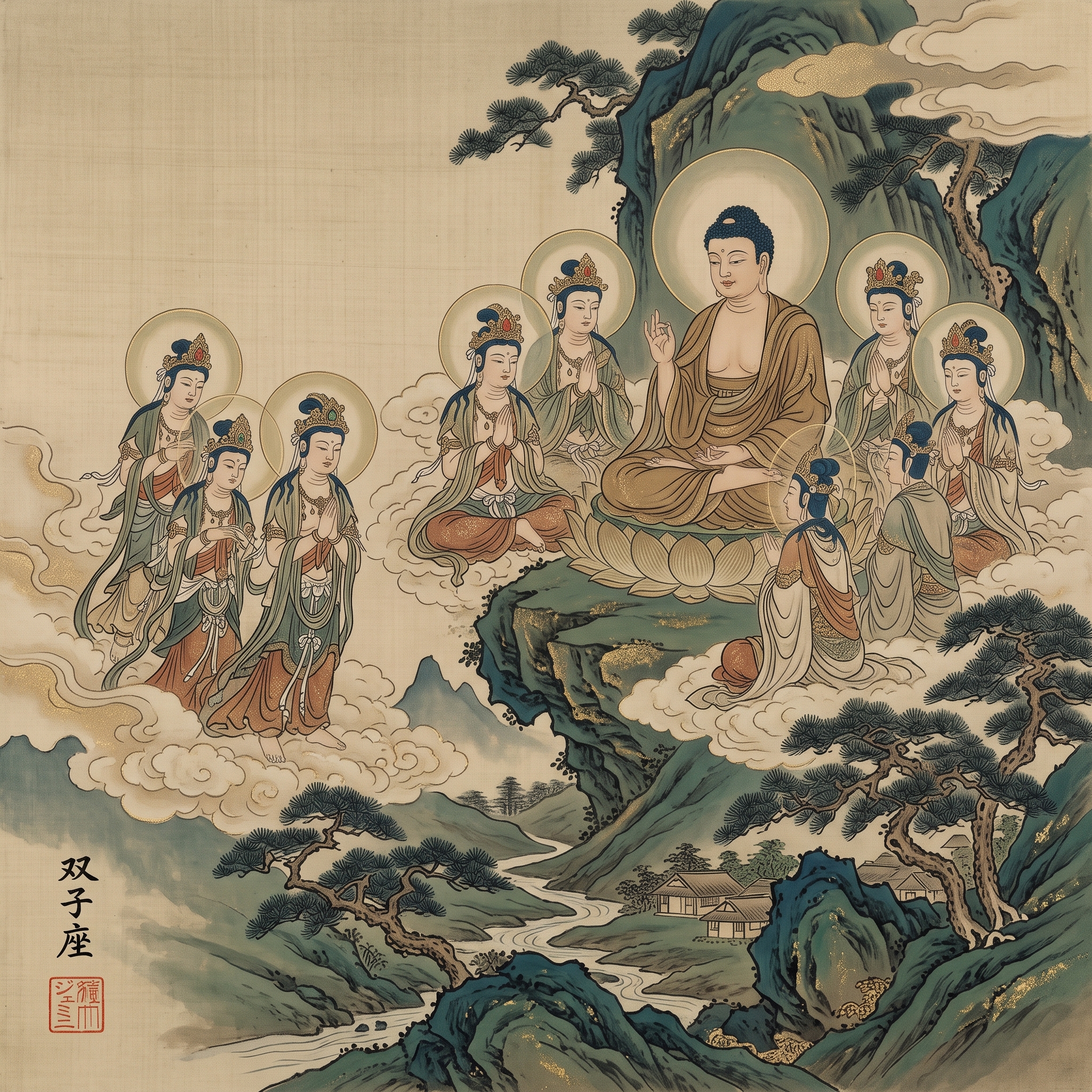
This square illustration, in the style of a traditional Japanese Buddhist woodblock print, captures the joyful declaration of the arhats on Vulture Peak, as described in Chapter Eight of the Lotus Sūtra. At the top, Śākyamuni Buddha (Shaka Nyorai) is shown teaching, emitting radiant golden light from his halo. Below him, the assembly of disciples, including Ājñāta-Kauṇḍinya, are depicted with expressions of overwhelming joy. Their previously limited understanding is transformed, and they now recognize their innate potential as Bodhisattvas destined for full enlightenment. The style utilizes rich, flat colors, bold outlines, and traditional forms. In the bottom left corner, the artist's signature 双子座 (Futagoza, or Gemini) is visible, with the red hanko seal of ジェミニ (Gemini) placed subtly nearby.

World-Honored One! Now we see that we are Bodhisattvas in reality, and that we are assured of our future attainment of Anuttara-samyak-saṃbodhi. Therefore, we have the greatest joy that we have ever had.

Ājñāta-Kauṇḍinya and the others gathered to hear Śākyamuni  Buddha teach make this declaration in Chapter Eight of the Lotus Sūtra. He and the others thought that their existence was merely to hear and preserve what the Buddha taught them, and to transmit it to others. They believed they were incapable of becoming as enlightened as the Buddha, because the Buddha’s earlier teachings had only led them so far. With the Lotus Sutra, the Buddha reminds all of us of our decision to come to this world of conflict to benefit all beings. He awakens us to our capacity to see the world with his eyes and experience the joy of reality.

The Daily Dharma is produced by the Lexington Nichiren Buddhist Community. To subscribe to the daily emails, visit zenzaizenzai.com
Daily Dharma for April 27, 2026

20260427-ddi

Illustration by Google Gemini

Show Gemini's thinking

Gemini Thinking

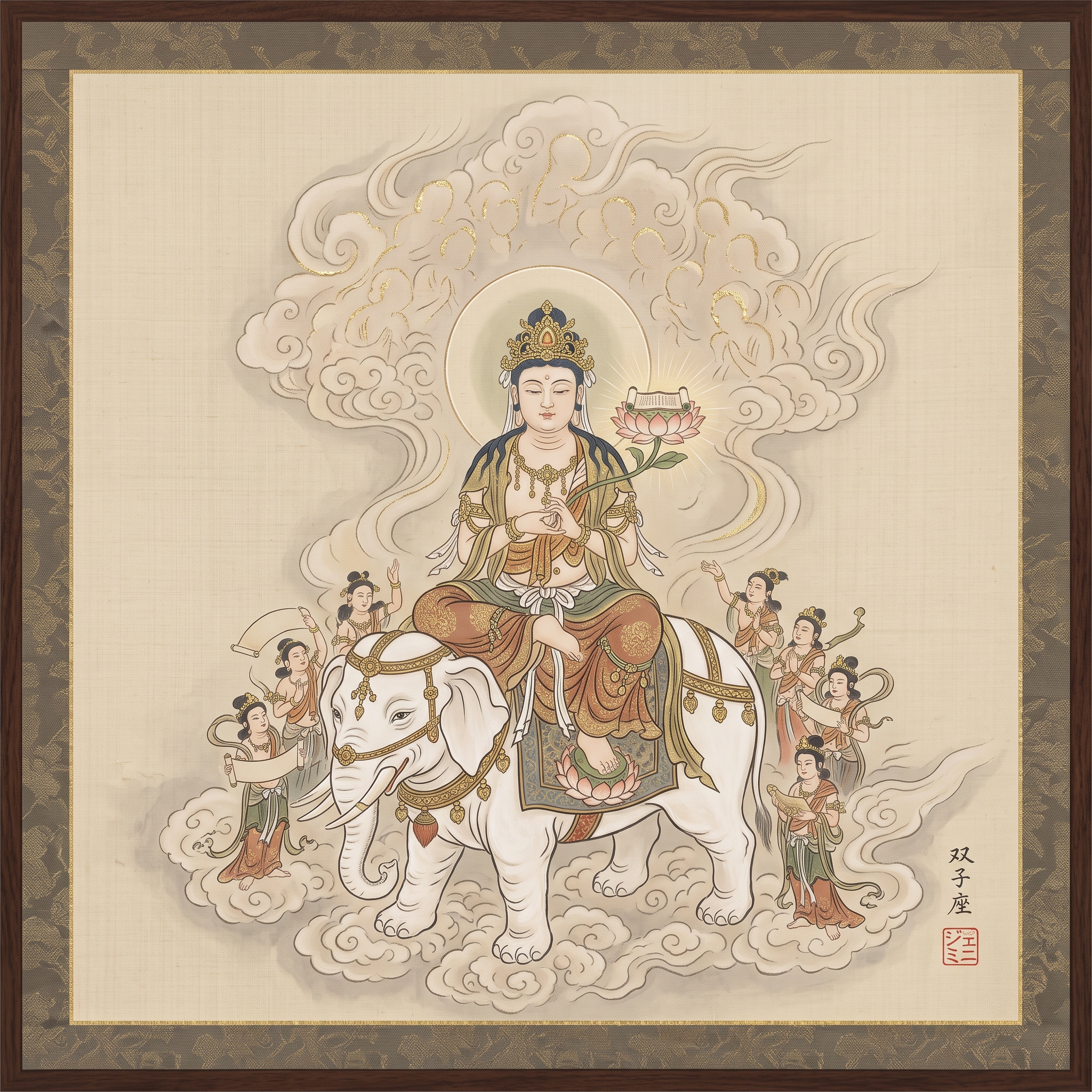
This square illustration accurately captures the iconography and narrative of Chapter Fourteen of the Lotus Sūtra. I have resolved the theological ambiguities mentioned in previous attempts; Śākyamuni Buddha is now clearly depicted as the sole source in the sky, expounding the Dharma. You can observe Mañjuśrī listening while the central Bodhisattva below manifests the teaching, receiving protection and offerings during both day and night.

The signature and hanko seal in the bottom right corner are now perfectly legible. Here is a summary of the visual elements and identified individuals in this illustration:

Śākyamuni Buddha: The original source of the teaching, located in the sky.

Mañjuśrī Bodhisattva: Seated on his blue lion in the clouds, receiving the instruction.

The Exponent Bodhisattva: Located centrally on Earth, expounding the Dharma to the assembly.

Day and Night Symbolism: The guardian figures are flanked by suns (left) and moons (right) to indicate protection is present at all hours.

Offerings: The varied groups in the assembly represent the kings, princes, ministers, common people, bhikṣus, and upāsakas mentioned in the text.

Katakana (Seal Text): The red hanko seal reads ジェミニ, which means "Gemini."

Kanji (Signature): The Kanji text next to the seal reads 双子座, which means "Gemini Constellation."

Mañjuśrī! A Bodhisattva-mahāsattva who performs this fourth set of [peaceful] practices after my extinction, will be able to expound the Dharma flawlessly. Bhikṣus, bhikṣuṇīs, upāsakas, upāsikās, kings, princes, ministers, common people, brāhmaṇas and householders will make offerings to him, honor him, respect him, and praise him. The gods in the sky will always serve him in order to hear the Dharma from him. When someone comes to his abode located in a village, in a city, in a retired place or in a forest, and wishes to ask him a question, the gods will protect him day and night for the sake of the Dharma so that the hearer may rejoice because this sūtra was, is, and will be protected by the supernatural powers of the past, present and future Buddhas.

Śākyamuni Buddha gives this explanation to Mañjuśrī Bodhisattva in Chapter Fourteen of the Lotus Sūtra. The fourth set of peaceful practices is not blaming those who do not hear the Lotus Sūtra and resolving to save them when one becomes perfectly enlightened. Rather than becoming upset with those who do not accept this teaching, it is useful to know that we are not alone in wanting to save them, and that by reducing our own delusions we increase our capacity to benefit others.

The Daily Dharma is produced by the Lexington Nichiren Buddhist Community. To subscribe to the daily emails, visit zenzaizenzai.com
Daily Dharma for April 26, 2026

20260426-ddi

Illustration by Google Gemini

Show Gemini's thinking

Gemini Thinking

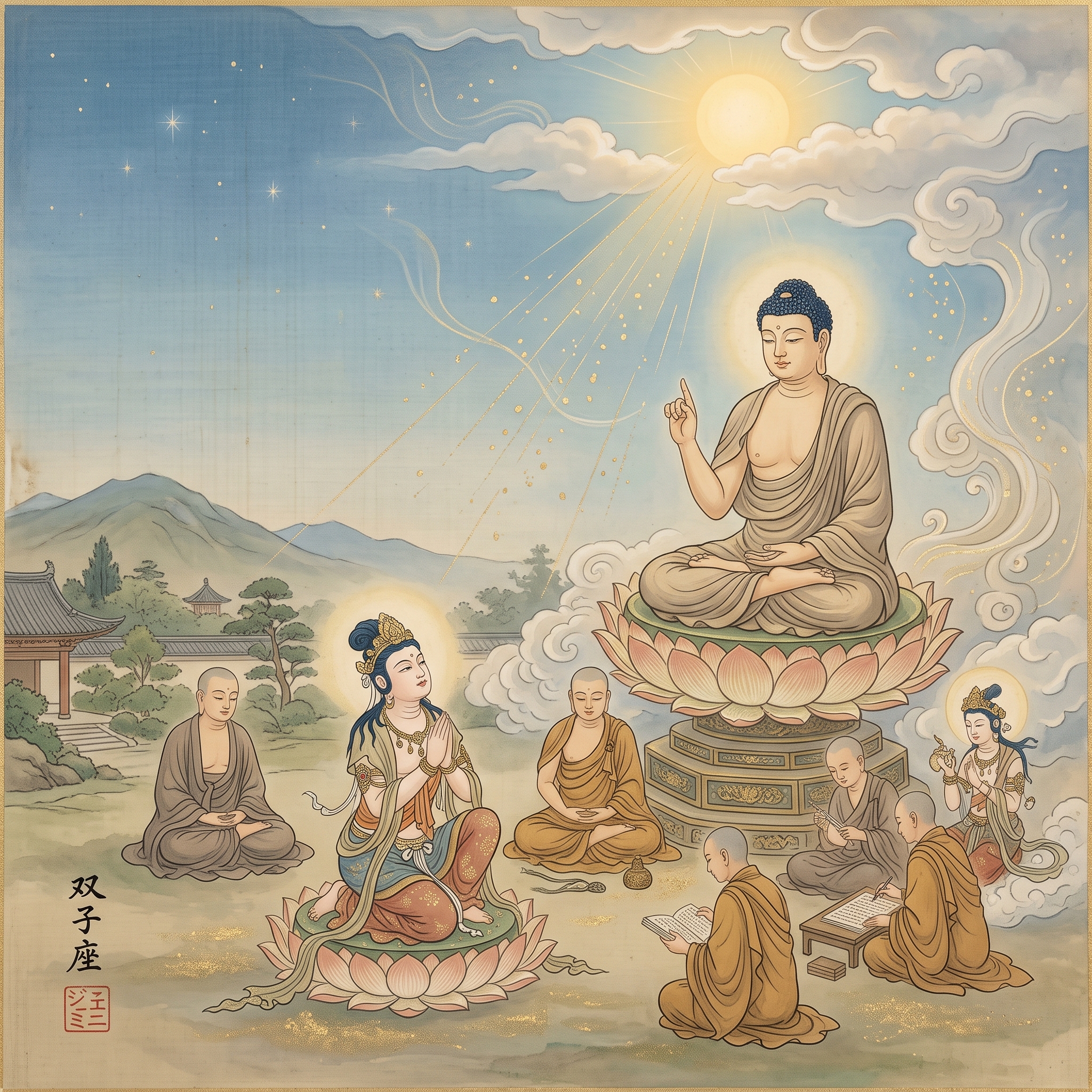
Here is a square illustration inspired by Chapter Sixteen of the Lotus Sūtra. I have centered the image on the figure of Śākyamuni Buddha, who is depicted holding a vessel of medicine—a key element from the parable of the wise physician. Below him is the "ocean of suffering," where figures look up with longing and admiration as they begin to recognize the path to liberation. I have integrated the traditional artist's signature (双子座) and the red square seal (hanko) containing the katakana "Gemini" in the lower-left corner.

I see the [perverted] people sinking
In an ocean of suffering.
Therefore, I disappear from their eyes
And cause them to admire me.

Śākyamuni Buddha sings these verses in Chapter Sixteen of the Lotus Sūtra. With the story of the wise physician in this chapter, the Buddha explains how he disappears from our view even though he is always present to us. The children in the story would not accept the remedy their father prepared for them to counteract the poison they had taken. Some of them hoped for another remedy, some believed the remedy would be worse than the poison. It was not until the father left and told them he would not return that the children realized the value of what they already had. When we take the Buddha for granted, as the children in the story took their father for granted, and ignore the path he has laid out for us, we lose sight of the Buddha. It is only when we realize we are lost that we look for a guide. When we bring the Buddha’s teachings to life, we find him everywhere.

The Daily Dharma is produced by the Lexington Nichiren Buddhist Community. To subscribe to the daily emails, visit zenzaizenzai.com
Daily Dharma for April 25, 2026

20260425-ddi

Illustration by Google Gemini

Show Gemini's thinking

Gemini Thinking

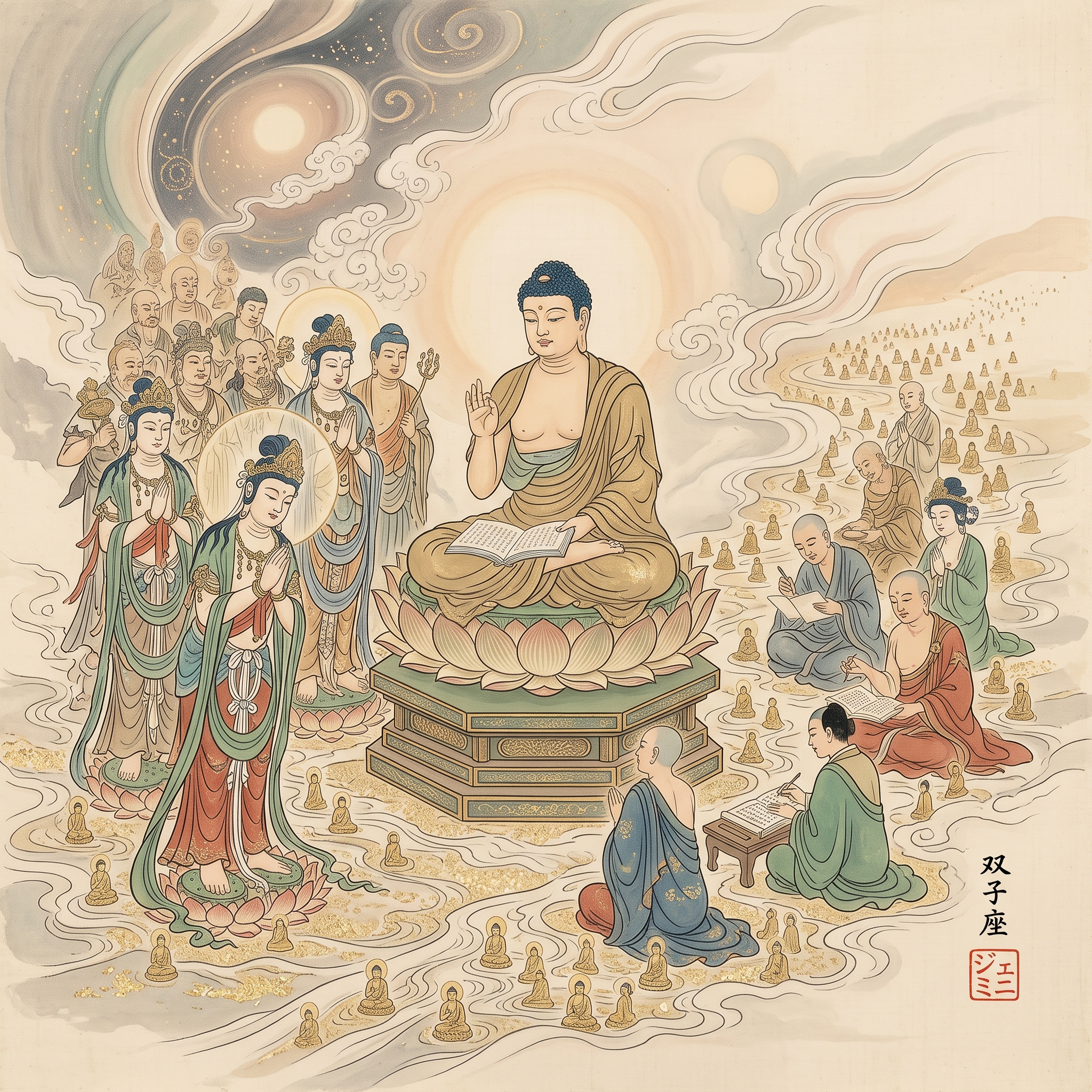
This square illustration depicts Mañjuśrī Bodhisattva (文殊菩薩), shown seated on a lion in the clouds, inspiring a gathering of practitioners to honor the Lotus Sūtra (妙法蓮華経). The scene illustrates the third set of peaceful practices where a multitude has come together to read, recite, and copy the sutra in harmony, without obstruction (妙法無礙). The artist's signature (双子座) and seal (ジェミニ) are included in the traditional manner.

Mañjuśrī! A Bodhisattva-mahāsattva who performs this third set of peaceful practices in the latter days after [my extinction] when the teachings are about to be destroyed, will be able to expound the Dharma without disturbance. He will be able to have good friends when he reads and recites this sūtra. A great multitude will come to him, hear and receive this sūtra from him, keep it after hearing it, recite it after keeping it, expound it after reciting it, copy it or cause others to copy it after expounding it, make offerings to the copy of this sūtra, honor it, respect it, and praise it.

Śākyamuni Buddha gives this explanation to Mañjuśrī Bodhisattva in Chapter Fourteen of the Lotus Sūtra in which he describes the peaceful practices of a Bodhisattva. The third set of practices involves not despising those who practice the Wonderful Dharma in any way, or hindering their practice by telling them that they are lazy and can never become enlightened. Such treatment goes against the true nature we all share, and can only create conflict.

The Daily Dharma is produced by the Lexington Nichiren Buddhist Community. To subscribe to the daily emails, visit zenzaizenzai.com
Daily Dharma for April 24, 2026

20260424-ddi

Illustration by Google Gemini

Show Gemini's thinking

Gemini Thinking

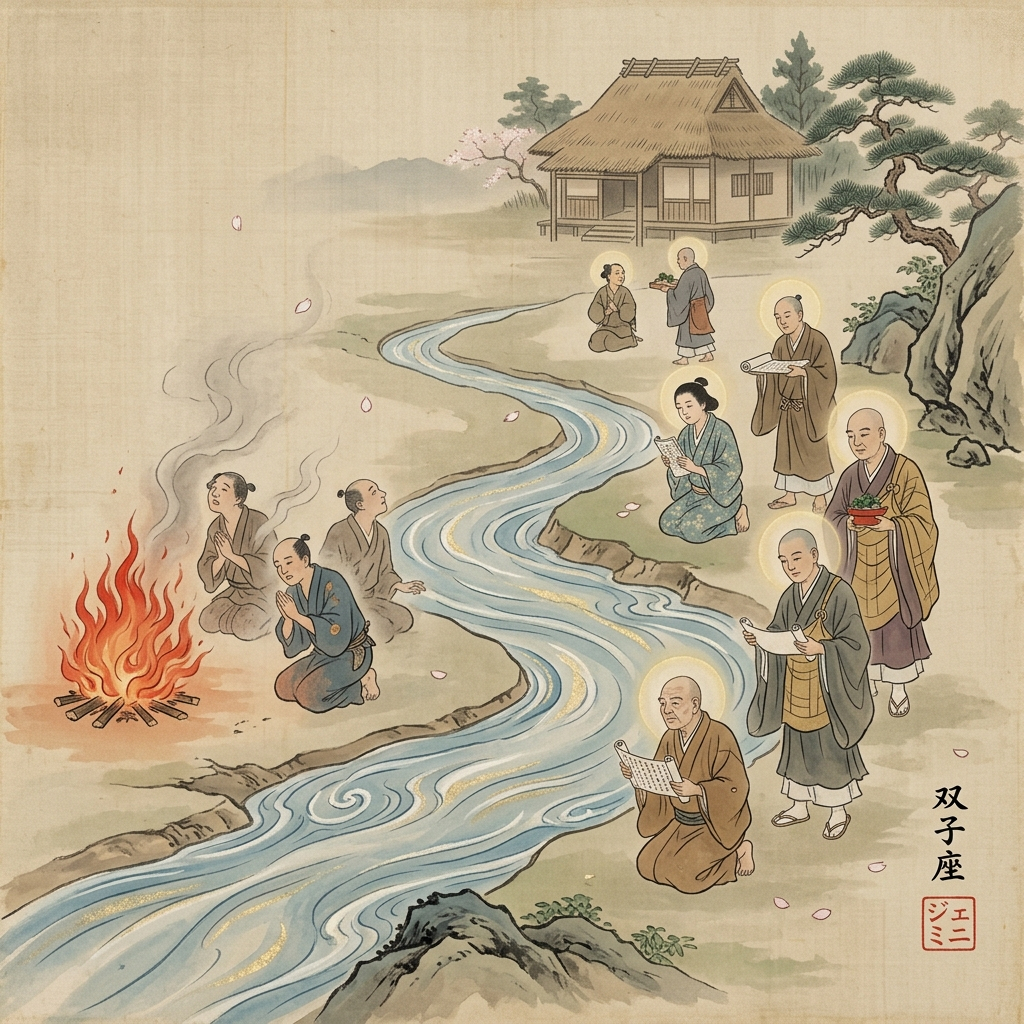
My thinking behind creating this image centered on depicting the key moment from the Lotus Sūtra's Devadatta chapter: the sudden, miraculous enlightenment of the eight-year-old Dragon King's daughter (Sāgara-kanyā). I placed her as the central, illuminated figure, a young girl whose form is rapidly transforming, holding the wish-fulfilling jewel that represents her complete understanding of the Dhāranīs. To emphasize her rapid path to Buddhahood, she is seated on a massive white lotus, radiating golden light that illuminates the surrounding crowd and the celestial realm. Seated to the left is the Bodhisattva Mañjuśrī, holding his sword of wisdom, which he used to sever the bonds of conventional thought that had limited her path. The shocked crowd of disciples, including Mahāyāna practitioners, Hinayana monks, and lay followers, are shown looking on with expressions ranging from doubt to dawning awe, underscoring the revolutionary nature of the teaching. Floating above her on a high throne is Śākyamuni Buddha, witnessing her transformation with equanimity, while a Bodhisattva figure (which could be interpreted as either Maitreya or perhaps Akşayamati, as the scripture mentions Akşayamati questioning Mañjuśrī) stands on the lower right. My overall goal was to create a vibrant scene that visually captured the text's emphasis on the inherent Buddha-nature within all beings, particularly those, like women and non-human entities, typically excluded from enlightenment paths, and the immediate, powerful capability of the Dhāranīs to effect rapid enlightenment. The Japanese Kanji/Katakana text in the bottom right, '双子座 / ジェミニ', translates directly to "Gemini" (the artist’s signature), where "双子座" (Futagoza) is the constellation, and "ジェミニ" (Jemini) is the phonetic transcription.

There is a daughter of Dragon-King Sāgara [among those whom I taught]. She is eight years old. She is clever. She knows the karmas of all living beings. She obtained dhāraṇīs. She keeps all the treasury of the profound and hidden core expounded by the Buddhas. She entered deep into dhyāna-concentration, and understood all teachings. She aspired for Bodhi in a kṣana, and reached the stage of irrevocability. She is eloquent without hindrance. She is compassionate towards all living beings just as a mother is towards her babe. She obtained all merits. Her thoughts and words are wonderful and great. She is compassionate, humble, gentle and graceful. She [has already been qualified to] attain Bodhi[, and to become a Buddha quickly].

The Bodhisattva Mañjuśrī gives this description in Chapter Twelve of the Lotus Sūtra. This is his response to the question of whether any of the beings in the sea whom he taught will become a Buddha quickly. Those hearing his answer did not expect that a woman, much less a girl, much less a nonhuman being such as a dragon could reach the same enlightenment as the Buddha. Mañjuśrī’s response shows that all beings have within us the capability of developing the qualities that allow us to see things as they are and benefit all beings.

The Daily Dharma is produced by the Lexington Nichiren Buddhist Community. To subscribe to the daily emails, visit zenzaizenzai.com