
Gemini Thinking
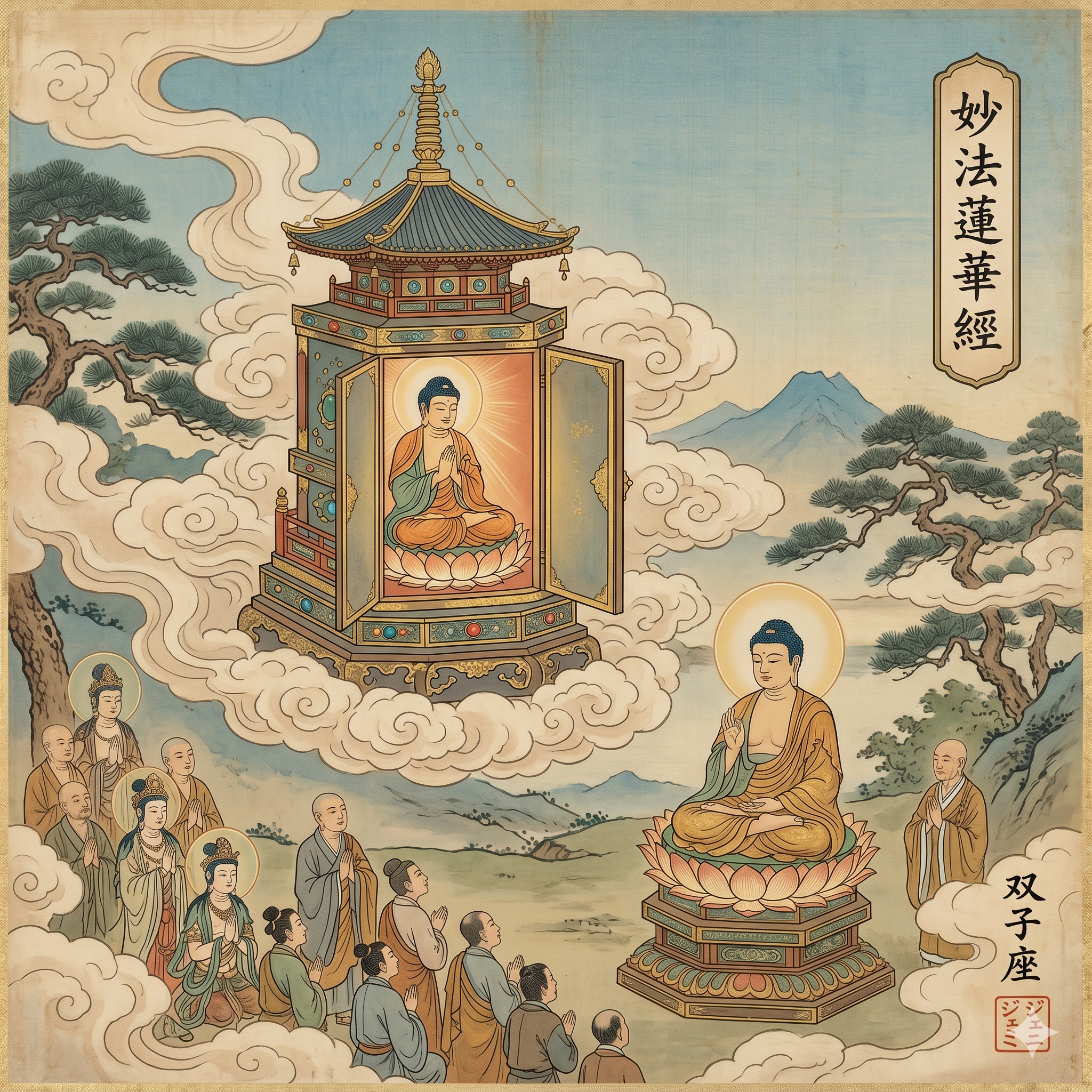
A serene, classical Japanese Buddhist painting (yamato-e style) rendered on an aged silk scroll, composed perfectly in a 1:1 square format. The artwork utilizes traditional mineral pigments (azurite blue, malachite green, cinnabar red), subtle colors, and extensive, soft application of gold leaf for halos and decorative elements.
The composition centers on a large, multi-storied, jewel-encrusted Japanese-style stūpa (pagoda) floating amidst swirling, stylized clouds. The central structure of the stūpa has miraculously split open, revealing Many-Treasures Buddha (Tahō Nyorai) seated inside. He is bathed in a warm, golden radiance, depicted with a compassionate expression and wearing ornate robes adorned with gold leaf patterns. His hands are in a gesture of praise and confirmation as he looks down toward Śākyamuni.
Below the floating stūpa, seated upon a multi-tiered lotus throne supported by a jeweled dais, is Śākyamuni Buddha (Shaka Nyorai). He has a calm, meditative expression and a prominent circular gold halo. He is performing the dharmachakra mudra (teaching gesture), expounding the Lotus Sutra. He is surrounded by a large multitude of monks, bodhisattvas, and lay disciples gathered on the ground, looking up with expressions of reverence and awe at the miraculous appearance of the stūpa and Tahō Buddha.
The background shows a stylized, peaceful landscape of rolling green hills, ancient pine trees, and a distant temple compound, all depicted with soft, flowing brushwork characteristic of classical Japanese painting. The overall color palette is muted yet rich, emphasizing warm golds, deep reds, and natural mineral tones.
Text Integration
In the lower-right corner, subtly integrated into the composition, is the vertical Kanji artist's signature: 双子座.
Immediately below the signature is a small, red square hanko (seal) containing the Katakana text: ジェミニ.
Along the upper-right edge of the painting, a narrow, vertical cartouche features the title of the sutra in classical Kanji: 妙法蓮華經 (Myōhō Renge Kyō).
The painting possesses an antique, devotional quality, with subtle aging and fine crackle texture visible on the silk surface.
Thereupon a loud voice of praise was heard from within the stūpa of treasures: “Excellent, excellent! You, Śākyamuni, the World-Honored One, have expounded to this great multitude the Sūtra of the Lotus Flower of the Wonderful Dharma, the Teaching of Equality, the Great Wisdom, the Dharma for Bodhisattvas, the Dharma Upheld by the Buddhas. So it is, so it is. What you, Śākyamuni, the World-Honored One, have expounded is all true.”
This declaration comes from Many-Treasures Buddha (Tahō, Prabhutaratna) at the beginning of Chapter Eleven of the Lotus Sūtra. In the story, Many-Treasures came from a world far away from this world of conflict when he heard the Buddha giving his highest teaching and appeared in a tower (stūpa) of wonderful treasures to confirm the truth of this teaching. By the Teaching of Equality, he means that all beings can become enlightened through this teaching. By the Great Wisdom, he means that the teaching is the same as the Buddha’s own mind. By the Dharma for Bodhisattvas, he means that to receive this teaching we awaken to our natures to benefit all beings. And by the Dharma Upheld by the Buddhas, he means that all Buddhas in all worlds encourage and help those who practice this sūtra.
The Daily Dharma is produced by the Lexington Nichiren Buddhist Community. To subscribe to the daily emails, visit zenzaizenzai.com