Category Archives: Blog

Viewing Nichiren Through a Tendai Lens

When I first started publishing quotes from The Collected Teachings of the Tendai Lotus School by Gishin back in February, I mentioned that I was unclear on where Nichiren’s teachings diverge. I asked Rev. Ryuei McCormick about the difference between Tendai and Nichiren on the 3,000 realms in a single thought moment, and I published his response yesterday. But I wanted a fuller explanation of the similarities and differences between Tendai and Nichiren.

As I was organizing the quotes from Gishin, I recalled that I had a copy of Bruno Petzold’s book, Buddhist Prophet Nichiren–A Lotus In The Sun. Petzold was a German journalist and educator who lived in Japan in the early 20th century. While in Japan he became fascinated with Buddhism and eventually became a Tendai monk. At the beginning of World War II, Petzold was decorated by the Emperor of Japan for his 25 years of service. Soon afterwards the Tendai Sect conferred upon him the rank of Sōjō, or archbishop. He died in 1949 and his ashes are buried at Hieizan, the home of the Tendai sect on Mount Hiei.

That Tendai background is evident in his treatment of Nichiren and his teachings. When I first picked up his book in 2021, I was unsure how to approach Petzold’s obvious Tendai-centered discussion. His was not a devout view of Nichiren. Now, however, Petzold’s view of Nichiren through the lens of Tendai teachings offers insight into how Nichiren, the one-time Tendai monk, used Tendai teachings as a foundation for his doctrine.

In the book, Petzold explains at one point:

Nichiren incorporates into his own system the whole Tendai philosophy. He adopts the classification of the Five Periods and the Eight Teachings; he acknowledges the doctrines of the Perfectly Amalgamated Three Truths (i.e. the Synthesis of vacuity and phenomenal reality in the Middle) and of the Identity of the One Mind and the Three Thousand (representing the totality of phenomena), and he upholds the practice of the Three Meditations in One Mind. He teaches the Oneness of the World. He proclaims that the whole universe in its essence is nothing but Buddha’s own body, so that even trees and grasses do not only attain Buddhahood, but are direct manifestations of Buddha. Similarly he maintains that the cosmos or the Tathāgata is our own body and soul; that the Buddha, Truth and Paradise are not outside of our own self; that Buddhahood can be attained in our present life and in our present body; that the Buddha, the mind and the living beings form One Unity. There is not one single important Tendai doctrine which is not a part of Nichiren’s system.

Petzold, Buddhist Prophet Nichiren , p 50-51

That’s not to suggest there is no difference. As Petzold explains:

[N]ichiren’s tenet for criticism of the Tendai Hokke Sect lies in its harmonizing tendencies. His objection to their meditation is based on their acceptance of Dharma Daishi’s zen meditation, which contradicts the teaching of Tendai Daishi; and the subsequent disassociation of the proper Tendai Teaching (shikan) from its original source, the Hoke-kyō.

Petzold, Buddhist Prophet Nichiren , p 109

Today, I’m publishing Senchu Murano’s Preface, which he wrote for Petzold’s book. As Murano explains, Petzold’s view of Nichiren was greatly colored by three books published in the early 20th century:

  • Nichiren, the Buddhist Prophet by Anesaki Masaharu, 1916
  • Japanese Civilization: Its Significance and Realization, Nichirenism and the Japanese National Principles by Satomi Kishio, 1923
  • Nichiren-shū kōyō (Manual of the Nichiren Sect), Shimizu Ryōzan, 1928

During the month of May I will publish select quotes from Petzold, many of which outline where Nichiren doctrine departs from Tendai teachings. I would prefer to read a book written from the Nichiren perspective, but Petzold meets my current needs.


Buddhist Prophet Nichiren–A Lotus In The Sun

Book Quotes

 
Book List

Nichiren’s Departure from Tendai and Chih-i

Back in February, I started publishing quotes from “The Collected Teachings of the Tendai Lotus School,” which was written by Gishin in 830 CE. Those quotes offer a very readable explanation of the Japanese Tendai teachings that Nichiren was immersed in as a young monk. But he did not accept those teachings wholly, making modifications and adjustments based on his understanding.

At the time, I told Rev. Ryuei McCormick, “What I would love to find is a detailed discussion of where Nichiren diverged from Chih-i, especially a full explanation of the difference between Chih-i’s 3,000 realms in a single thought moment based on the 10 Suchnesses and Nichiren’s 3,000 realms in a single thought moment based on Chapter 16 and, in particular, the difference in application.”

Here’s his response:

Theoretically there is no discernible difference, though perhaps it could be argued that Miaole and later Nichiren made ichinen sanzen central, whereas in the Great Calming and Contemplation it is “merely” used to describe the contemplation of the truth of the provisional existence of the aggregates-entrances-elements, not even of the truth of emptiness or the truth of the Middle Way. It is, in effect, a contemplation that can lead one in to the deeper understanding of emptiness, the middle, and the threefold truth that embraces all three truths at once.

However, I think the real difference is found in this statement of Nichiren about how his approach differs from that of his Tiantai predecessors:

There are two ways of observing the three thousand worlds in a single thought-moment. One is in terms of principle, the second is in terms of the actual phenomena. At the time of T’ien-t’ai and Dengyō and so on, it was [observed in] principle. Now it is [observed in] actual phenomena. Since [the latter form of] contemplation is superior, the great difficulties [accompanying it] are also superior. The former is the three thousand worlds in a single thought-moment of the provisional teaching [of the Lotus Sūtra], and the latter is the three thousand worlds in a single thought-moment of the original teaching [of the Lotus Sūtra]. They are as different as Heaven and Earth, and at the time of death, you should keep this in mind. (Toki Nyūdō-dono Go-henji also known as Chibyō-shō, Shōwa Teihon p. 1522. Authenticated copy extant. Also see p. 257, WNS: D2)

What this means is that ichinen sanzen in principle is about contemplating that in principle the realm of buddhahood is always present in every thought-moment and therefore we can discern it in meditation or have faith that eventually we will be able to realize it. This is in line with the Trace Gate of the Lotus Sutra wherein all the voice-hearers and others have their future buddhahood predicted. Buddhahood is part of their lives but they won’t personally realize it until much later, for now they must take it on faith. On the other hand, ichinen sanzen in actuality (or in terms of phenomenal practice) is the active expression here and now of the realm of buddhahood that is present in every thought-moment. It is expressed via the practice of the Odaimoku (as well as contemplation of the Gohonzon). This is in line with the Original Gate wherein because buddhahood has no beginning and no end the Eternal Shakyamuni Buddha (and therefore our own buddhahood) is constantly present and active in some manner in every situation. Put another way, if Shakyamuni Buddha’s buddhahood has no beginning or end then our own buddhahood also has no beginning or end, and if Shakyamuni Buddha has been spending all these past eons showing how to attain buddhahood then our own buddhahood is being spent showing how to attain buddhahood. All of this means that in chapter 16’s presentation of buddhahood as without a beginning or end, buddhahood is not just a principle or theoretical possibility but something that is always actual if concealed and obscured. How do we realize this? For Nichiren, faith as expressed in and by the Odaimoku is the gateway.

When I asked for permission to publish his response, Rev. Ryuei said:

Yes, as long as you say that the translation of that gosho passage was done by me. That is from Dharma Flower. You can find the original context here: https://www.nichirenbayarea.org/chapter-11-the-three-great-secret-dharmas

Tomorrow: Bruno Petzold’s Comparison of Tendai and Nichiren Doctrine

Differing Details of Previous Lives

This is another in a series of weekly blog posts comparing and contrasting the Sanskrit and Chinese Lotus Sutra translations.


Note: For an explanation of how Kern and Kumārajīva differ in their organization of the Lotus Sutra, see Kumārajīva vs. Kern Table of Contents.


At the start of Chapter 23, The Previous Life of Medicine-King Bodhisattva, Senchu Murano’s English translation of Kumārajīva’s Chinese Lotus Sutra has Star-King-Flower Bodhisattva say to the Buddha:

“World-Honored One! Why does Medicine-King Bodhisattva walk about this Sahā-World? World-Honored One! This Medicine-King Bodhisattva will have to practice hundreds of thousands of billions of nayutas of austerities in this world. World-Honored One! Tell me why! Not only the gods, dragons, yakṣas, gandharvas, asuras, garuḍas, kiṃnaras, mahoragas, men and nonhuman beings but also the Bodhisattvas who have come from the other worlds’ and the Śrāvakas present here will be glad to hear the reason.”

Kern has Nakshatrarājasankusumitābhigña ask the Buddha:

Wherefore, O Lord, does the Bodhisattva Bhaiṣajyarāja pursue his course in this Sahā world, while he is fully aware of the many hundred thousands of myriads of koṭis of difficulties he has to meet? Let the Lord, the Tathāgata, &c., deign to tell us any part of the course of duty of the Bodhisattva Mahāsattva Bhaiṣajyarāja, that by hearing it the gods, Nāgas, goblins, Gandharvas, demons, Garuḍas, Kinnaras, great serpents, men, and beings not human, as well as the Bodhisattvas Mahāsattvas from other worlds here present, and these great disciples here may be content, delighted, overjoyed.

“Wherefore” is archaic, which one would expect in a document published in 1884, but it means “for what reason,” which is essentially just “why.” Of interest, is the fact that two of the seven English translations of Kumārajīva Chinese Lotus Sutra substitute “how” for “why.”

Burton Watson begins his translation of Chapter 23, “Former Affairs of the Bodhisattva Medicine King,” with:

“World-Honored One, how does the bodhisattva Medicine King come and go in the saha world?”

Leon Hurvitz, whose translation is considered the academic gold standard, has:

“O World-Honored One! How does the bodhisattva Medicine King travel in the Sahā World.”

Clearly, asking why, or the archaic wherefore, sets the stage for the chapter differently than asking how the bodhisattva travels about Sahā World.

In discussing the previous life of Medicine King as Gladly-Seen-By-All-Beings Bodhisattva, there is another example of Murano’s effort to insert his clarification into his translation.

Here’s how Kern has Sarvarūpasandarsana (Gladly-Seen-By-All-Beings) respond to hearing the Lotus Sutra:

Then he made another reflection: Let me do homage to the Lord Kandravimalasūryaprabhāsasrī and this Dharmaparyāya of the Lotus of the True Law. No sooner had he entered upon such a meditation than a great rain of Mandārava and great Mandārava flowers fell from the upper sky. A cloud of Kālānusārin sandal was formed, and a rain of Uragasāra sandal poured down. And the nature of those essences was so noble that one karsha of it was worth the whole Sahā-world.

Murano makes explicit the cause of the rain of flowers and incense:

“He entered into this samadhi at once. He filled the sky with the clouds of mandārava-flowers, mahā-mandārava-flowers and the powdered incense of hard and black candana, and rained down those flowers and incense. He also rained down the powdered incense of the candana grown on this shore of the sea [between Mt. Sumeru and the Jambudvipa]. Six shu of this incense was worth the Sahā-World. He offered all these things to the Buddha.

None of the other English translations of Kumārajīva’s Chinese Lotus Sutra have these events explicitly caused by Gladly-Seen-By-All-Beings.

Other minor differences between Kern’s Sanskrit and Kumārajīva’s  Chinese abound. For example, after the Bodhisattva’s sacrifice of his body he is reborn in the household of a king. Murano puts it this way:

He said to his father in a gāthā:

Great King, know this, [in my previous existence]
I walked about this world, and at once obtained
The samadhi by which I can transform myself
Into any other living being. With a great endeavor,
I gave up my own dear body.

“Having sung this gāthā, he said to his father, ‘Sun-Moon-Pure-Bright-Virtue Buddha is still alive.”

Kern, however, has the Bodhisattva address both his father and his  mother.

Kern also has the Bodhisattva burning “his own arm” and ending “deprived of a limb.” Murano and the other English translations of Kumārajīva Chinese Lotus Sutra have him burning both arms. Only Hurvitz differs. He says the Bodhisattva “burned his forearm” and ended “without an arm.”

Next: The Translator’s Touch

The Advanced Transmission of the Lotus Sutra

This is another in a series of weekly blog posts comparing and contrasting the Sanskrit and Chinese Lotus Sutra translations.


Traditionally, the entrustment section of a Mahayana sutra, in which the Buddha transfers the teaching to the Bodhisattvas in the audience, is at the conclusion. This is where H. Kern’s English translation of the 11th century Nepalese Sanskrit Lotus Sutra places it. Kern titles the chapter, The Period.

Kumārajīva’s Chinese Lotus Sutra places this entrustment following Chapter 21, The Supernatural Powers of the Tathāgatas, in which the Buddha celebrates the vow of the Bodhisattvas from underground to keep the sūtra after the Buddha’s extinction. Even the extant Sanskrit compilation used by Leon Hurvitz has the Entrustment chapter following the chapter detailing the supernatural powers of the Tathāgatas.

Placing the “Transmission” following “The Supernatural Powers of the Tathāgatas” sets up the understanding that the Lotus Sutra includes not one, but two entrustments.  As explained in Two Buddhas Seated Side by Side:

Among Chinese exegetes, Zhiyi was the first to identify both Chapters 21 and 22 as describing Śākyamuni’s transmission to the future. Nichiren built upon Zhiyi’s reading to claim that there had been two transmissions: a specific transmission to Viśiṣṭacaritra and the other bodhisattvas who had emerged from beneath the earth, which occurs in the “Transcendent Powers” chapter, beginning from “Thereupon the Buddha addressed the great assembly of bodhisattvas, beginning with Viśiṣṭacaritra …”), and a general transmission, which occurs in the “Entrustment” chapter, to all the bodhisattvas, including those from other worlds and those instructed by Śākyamuni when he was still in his provisional guise as the historical Buddha, as he is represented in the trace teaching, as well as to persons of the two vehicles and others in the Lotus assembly.
Two Buddhas, p217-218

Beyond the location of the chapter, other differences are found when comparing Kern’s Sanskrit against Kumārajīva Chinese translation.

Kern begins his final chapter with this description:

Thereupon the Lord Śākyamuni, the Tathāgata, &c., rose from his pulpit, collected the Bodhisattvas, took their right hands with his own right hand, which had become strong by the exercise of magic, and spoke on that occasion as follows: Into your hands, young men of good family, I transfer and transmit, entrust and deposit this supreme and perfect enlightenment arrived at by me after hundred thousands of myriads of koṭis of incalculable Æons. Ye, young men of good family, do your best that it may grow and spread.

Senchu Murano’s English translation of Kumārajīva Chinese text opens with:

Thereupon Śākyamuni Buddha rose from the seat of the Dharma, and by his great supernatural powers, put his right hand on the heads of the innumerable Bodhisattva-mahāsattvas, and said:

“For many hundreds of thousands of billions of asaṃkhyas of kalpas, I studied and practiced the Dharma difficult to obtain, and [finally attained] Anuttara-samyak-saṃbodhi. Now I will transmit the Dharma to you. Propagate it with all your hearts, and make it known far and wide!”

All of the other English translations of Kumārajīva have the Buddha making contact with the assembled Bodhisattvas heads, not their hands.

The BDK English Tripiṭaka has “Śākyamuni Buddha caressed the heads of the innumerable bodhisattva mahāsattvas…”

Gene Reeves has the Buddha “Laying his right hand on the heads of the innumerable bodhisattvas.”

More interesting, is that Kern’s Sanskrit translation does not include Kumārajīva’s instruction of what to do if someone rejects the Lotus Sutra.

Murano has this:

I am the great almsgiver to all living beings. Follow me, and study my teachings without begrudging efforts! In the future, when you see good men or women who believe in the wisdom of the Tathāgata, you should expound this Sūtra of the Lotus Flower of the Wonderful Dharma to them, and cause them to hear and know [this sūtra] so that they may be able to obtain the wisdom of the Buddha. When you see anyone who does not receive [this sūtra] by faith, you should show him some other profound teachings of mine, teach him, benefit him, and cause him to rejoice. When you do all this, you will be able to repay the favors given to you by the Buddhas.

Kern doesn’t include this exception:

I am a bountiful giver, young men of good family, and ye, young men of good family, follow my example; imitate me in liberally showing this knowledge of the Tathāgata, and in skillfulness, and preach this Dharmaparyāya to the young men and young ladies of good family who successively shall gather round you. And as to unbelieving persons, rouse them to accept this law. By so doing, young men of good family, you will acquit your debt to the Tathāgatas.

All of the English translations of Kumārajīva include this exception when meeting someone who rejects the Lotus Sutra.

The Modern Risshō Kōsei-kai translation offers:

For those living beings who do not believe in and accept it, you should show and teach them other profound teachings of the Tathagata, thereby benefiting and delighting them. If you can do so, you will have responded in kind to the generosity of the buddhas.

Burton Watson’s translation offers:

If there are living beings who do not believe and accept it, you should use some of the other profound doctrines of the Thus Come One to teach, benefit and bring joy to them. If you do all this, then you will have repaid the debt of gratitude that you owe to the Buddhas.

One imagines that Nichiren would have preferred Kern’s admonition to “rouse them to accept this law,” to Kumārajīva encouragement to tolerate dissent.

Next: Differing Details of Previous Lives

Dedication to the Lotus Sutra

This is another in a series of weekly blog posts comparing and contrasting the Sanskrit and Chinese Lotus Sutra translations.


At the conclusion of the opening prose section of Chapter 21, The Supernatural Powers of the Tathāgatas, Senchu Murano’s English translation of Kumārajīva’s Chinese Lotus Sutra offers this advice:

Therefore, keep, read, recite, expound and copy this sūtra, and act according to the teachings of it with all your hearts after my extinction! In any world where anyone keeps, reads, recites, expounds or copies this sūtra, or acts according to its teachings, or in any place where a copy of this sūtra is put, be it in a garden, in a forest, under a tree, in a monastery, in the house of a person in white robes, in a hall, in a mountain, in a valley, or in the wilderness, there should a stupa be erected and offerings be made to it because, know this, the place [where the stupa is erected] is the place of enlightenment. Here the Buddhas attained Anuttara-samyak-saṃbodhi. Here the Buddhas turned the wheel of the Dharma. Here the Buddhas entered into Parinirvana.”

H. Kern’s English translation of the 11th century Nepalese Sanskrit Lotus Sutra however redirects the focus from the sutra itself back to the Buddha:

Therefore, young men of good family, you should, after the complete extinction of the Tathāgata, with reverence keep, read, promulgate, cherish, worship it. And wherever on earth, young men of good family, this Dharmaparyāya shall be made known, read, written, meditated, expounded, studied or collected into a volume, be it in a monastery or at home, in the wilderness or in a town, at the foot of a tree or in a palace, in a building or in a cavern, on that spot one should erect a shrine in dedication to the Tathāgata. For such a spot must be regarded as a terrace of enlightenment; such a spot must be regarded as one where all Tathāgatas &c. have arrived at supreme, perfect enlightenment; on that spot have all Tathāgatas moved forward the wheel of the law; on that spot one may hold that all Tathāgatas have reached complete extinction.

Back in Chapter 3, in Kumārajīva’s telling, the Buddha emphasizes that the One Vehicle, the Sutra of the Lotus Flower, is the object of worship:

This vehicle is
The purest and most wonderful.
This is unsurpassed by any other vehicle
In all the worlds.
This vehicle is approved with joy by the Buddhas.
All living beings should extol it.
They should make offerings to it,
And bow to it.

Again in Chapter 10, in Kumārajīva’s telling:

“Medicine-King! Erect a stupa of the seven treasures in any place where this sūtra is expounded, read, recited or copied, or in any place where a copy of this sūtra exists! The stupa should be tall, spacious and adorned. You need not enshrine my śarīras in the stupa. Why not? It is because it will contain my perfect body.”

As the Introduction to the Lotus Sutra offers:

One of the special concepts of the Lotus Sutra is that a place where the Lotus Sutra is expounded is itself the Place of Enlightenment. This means that anywhere we accept, believe, recite, and practice the Lotus Sutra is the Place of Enlightenment. It is not necessary for us to erect temples, fine buildings, or monuments in select holy places.

“Dedication to the Tathāgata” misdirects our focus away from the Wonderful Dharma of the Lotus Flower Sutra.

Next: The Advanced Transmission of the Lotus Sutra

Baby Buddhas

20230409_rev.igarashi-edwin-alexis-web
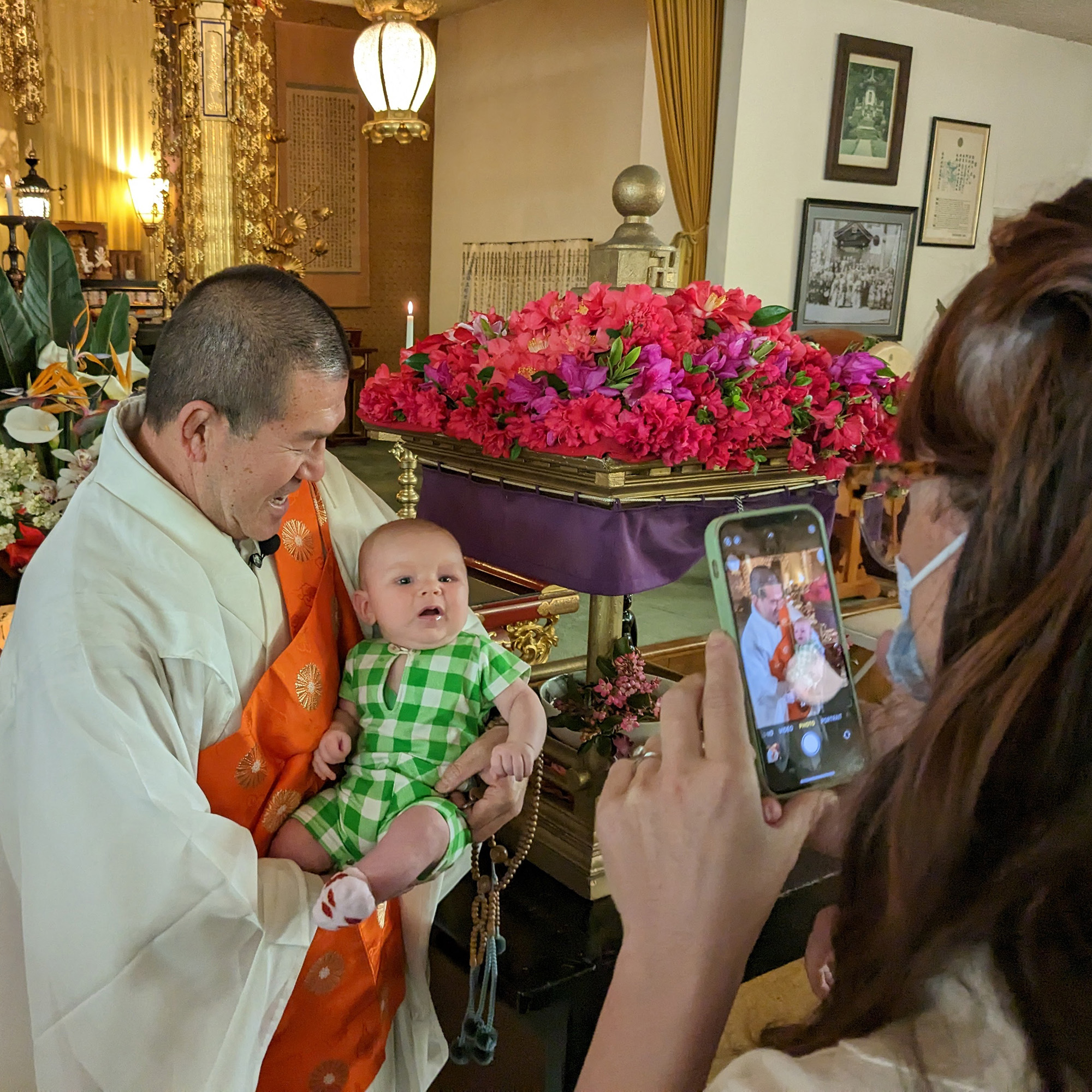
Following the Hanamatsuri service at the Sacramento Nichiren Buddhist Church, Rev. Igarashi holds Edwin as his mother, Alexis, snaps a photo.
20230409_edwin-richard-web
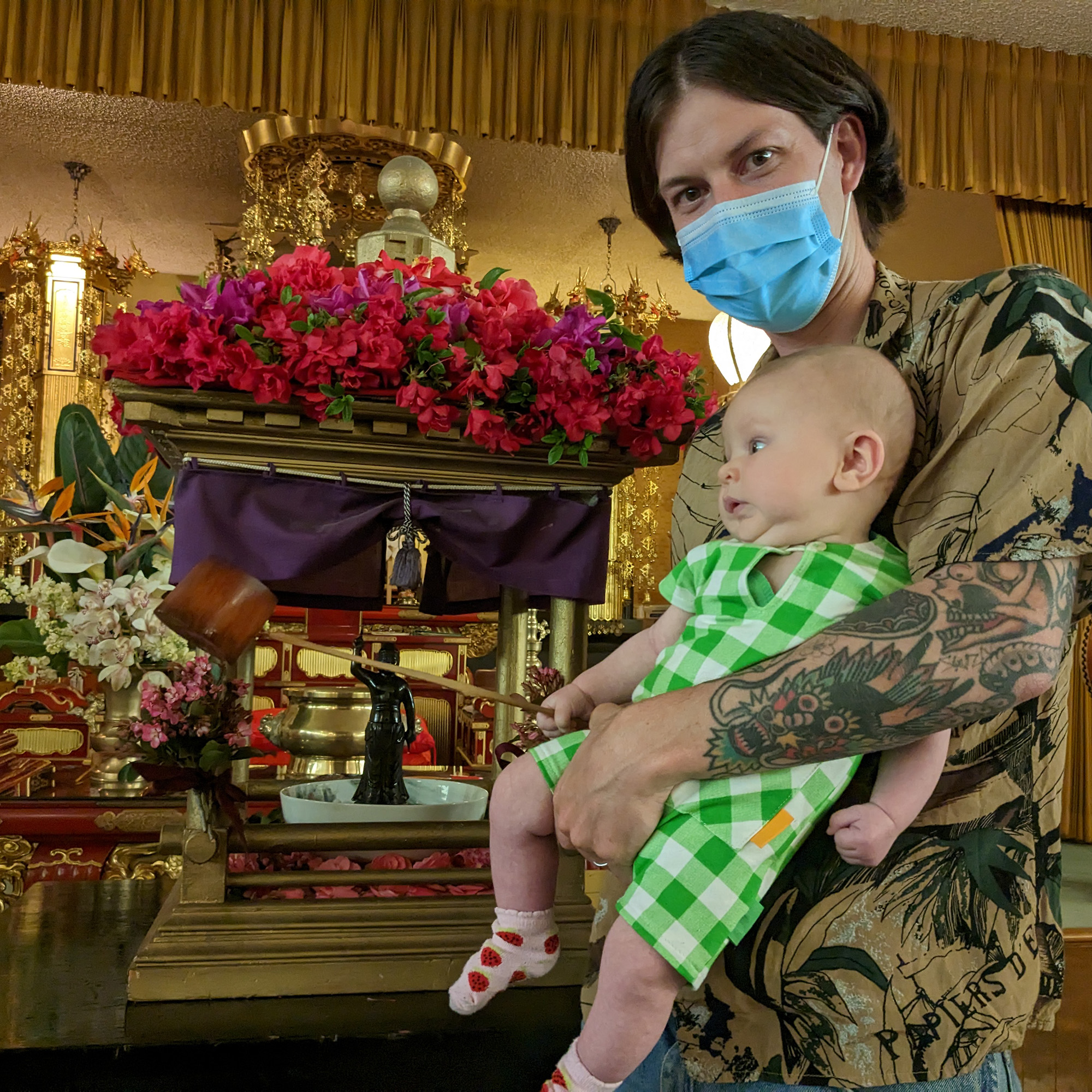
Richard holds his son, Edwin, who has been given the ladle used to bathe the baby Buddha during the Hanamatsuri service at the Sacramento Nichiren Buddhist Church.
20230409_three-generations
Three generations of Nichiren Buddhists celebrating the birth of the Buddha (April 8th) at the Sacramento Nichiren Buddhist Church.

Differing Views of Supernatural Scenes

This is another in a series of weekly blog posts comparing and contrasting the Sanskrit and Chinese Lotus Sutra translations.


Senchu Murano’s English translation of Kumārajīva’s Chinese Lotus Sutra begins Chapter 21, The Supernatural Powers of the Tathāgatas, with this scene:

Thereupon the Bodhisattva-mahāsattvas as many as the particles of dust of one thousand worlds, who had sprung up from underground, joined their hands together towards the Buddha with all their hearts, looked up at his honorable face, and said to him:

“World-Honored One! After your extinction, we will expound this sūtra in the worlds of the Buddhas of your replicas and also in the place from which you will pass away. Why is that? It is because we also wish to obtain this true, pure and great Dharma, to keep, read, recite, expound and copy [this sūtra], and to make offerings to it.”

Thereupon the World-Honored One displayed his great supernatural powers in the presence of the multitude, which included not only the many hundreds of thousands of billions of Bodhisattva-mahāsattvas who had already lived in this Sahā-World [before the arrival of the Bodhisattvas from underground], headed by Mañjuśrī, but also bhikṣus, bhikṣunīs, upāsakās, upāsikās, gods, dragons, yakṣas, gandharvas, asuras, garuḍas, kiṃnaras, mahoragas, men and nonhuman beings.

H. Kern’s English translation of the 11th century Nepalese Sanskrit Lotus Sutra has an identical beginning for his Chapter 20, Conception of the Transcendent Power of the Tathāgatas:

Thereupon those hundred thousands of myriads of koṭis of Bodhisattvas equal to the dust-atoms of a macrocosm, who had issued from the gaps of the earth, all stretched their joined hands towards the Lord, and said unto him: We, O Lord, will, after the complete extinction of the Tathāgata, promulgate this Dharmaparyāya everywhere (or on every occasion) in all Buddha-fields of the Lord, wherever (or whenever) the Lord shall be completely extinct. We are anxious to obtain this sublime Dharmaparyāya, O Lord, in order to keep, read, publish, and write it.

But then Kern’s translation transforms Kumārajīva’s “multitude, which included not only the many hundreds of thousands of billions of Bodhisattva-mahāsattvas who had already lived in this Sahā-World [before the arrival of the Bodhisattvas from underground]” from passive observers to active participants.

Thereupon the hundred thousands of myriads of koṭis of Bodhisattvas, headed by Mañjuśrī; the monks, nuns, male and female lay devotees living in this world; the gods, Nāgas, goblins, Gandharvas, demons, Garuḍas, Kinnaras, great serpents, men, and beings not human, and the many Bodhisattvas Mahāsattvas equal to the sands of the river Ganges, said unto the Lord: We also, O Lord, will promulgate this Dharmaparyāya after the complete extinction of the Tathāgata. While standing with an invisible body in the sky, O Lord, we will send forth a voice, and plant the roots of goodness of such creatures as have not (yet) planted roots of goodness.

And then Kern includes this quote from the Buddha:

Then the Lord addressed the Bodhisattva Mahāsattva Viśiṣṭacāritra, followed by a troop, a great troop, the master of a troop, who was the very first of those afore-mentioned Bodhisattvas Mahāsattvas followed by a troop, a great troop, masters of a troop: Very well, Viśiṣṭacāritra, very well; so you should do; it is for the sake of this Dharmaparyāya that the Tathāgata has brought you to ripeness.

At this point Murano offers:

[The Buddha] stretched out his broad and long tongue upwards until the tip of it reached the World of Brahman. Then he emitted rays of light with an immeasurable variety of colors from his pores. The light illumined all the worlds of the ten quarters. The Buddhas who were sitting on the lion-like seats under the jeweled trees also stretched out their broad and long tongue and emitted innumerable rays of light. Śākyamuni Buddha and the Buddhas under the jeweled trees displayed these supernatural powers of theirs for one hundred thousand years.

Kern, however, includes Many-Treasures Buddha and adds new details to this scene:

Thereupon the Lord Śākyamuni, the Tathāgata, &c., and the wholly extinct Lord Prabhūtaratna, the Tathāgata, &c., both seated on the throne in the center of the Stūpa, commenced smiling to one another, and from their opened mouths stretched out their tongues, so that with their tongues they reached the Brahma-world, and from those two tongues issued many hundred thousand myriads of koṭis of rays. From each of those rays issued many hundred thousand myriads of koṭis of Bodhisattvas, with gold colored bodies and possessed of the thirty-two characteristic signs of a great man, and seated on thrones consisting of the interior of lotuses. Those Bodhisattvas spread in all directions in hundred thousands of worlds, and while on every side stationed in the sky preached the law. Just as the Lord Śākyamuni, the Tathāgata, &c., produced a miracle of magic by his tongue, so, too, Prabhūtaratna, the Tathāgata, &c., and the other Tathāgatas, &c., who, having flocked from hundred thousands of myriads of koṭis of other worlds, were seated on thrones at the foot of jewel trees, by their tongues produced a miracle of magic.

The Lord Śākyamuni, the Tathāgata, &c., and all those Tathāgatas, &c., produced that magical effect during fully a thousand years.

Leon Hurvitz, who used both Kumārajīva’s Chinese translation and a Sanskrit compilation of the Lotus Sutra, follows Kumārajīva and notes the difference in the Sanskrit.

Next: Dedication to the Lotus Sutra

Expiating Sins

This is another in a series of weekly blog posts comparing and contrasting the Sanskrit and Chinese Lotus Sutra translations.


As with last week’s chapter, there is no substantive difference between Senchu Murano’s English translations of Kumārajīva’s Chapter 20, Never-Despising Bodhisattva, and H. Kern’s English translation of Chapter 19, Sadāparibhūta from an 11th century Nepalese Sanskrit document

For example, Murano has:

When he was about to pass away, he heard [from a voice] in the sky the twenty thousand billion gāthās of the Sūtra of the Lotus Flower of the Wonderful Dharma, which had been expounded by the Powerful-Voice-King Buddha. Having kept all these gāthās, he was able to have his eyes, ears, nose, tongue, body and mind purified as previously stated. Having his six sense-organs purified, he was able to prolong his life for two hundred billion nayuta more years.

Kern has:

Under those circumstances, Mahāsthāmaprāpta, the Bodhisattva Mahāsattva Sadāparibhūta happened to hear this Dharmaparyāya of the Lotus of the True Law when the end of his life was impending, and the moment of dying drawing near. It was the Lord Bhīṣhmagargitasvararāja, the Tathāgata, &c., who expounded this Dharmaparyāya in twenty times twenty hundred thousand myriads of koṭis of stanzas, which the Bodhisattva Mahāsattva Sadāparibhūta heard from a voice in the sky, when the time of his death was near at hand. On hearing that voice from the sky, without there appearing a person speaking, he grasped this Dharmaparyāya and obtained the perfections already mentioned: the perfection of sight, hearing, smell, taste, body, and mind. With the attainment of these perfections he at the same time made a vow to prolong his life for twenty hundred thousand myriads of koṭis of years, and promulgated this Dharmaparyāya of the Lotus of the True Law.

Vowing to attain a long life after purification and receiving it as a consequence of his purification is an interesting point to consider.

What’s of more interest to me is a difference between the prose section of the chapter and the gāthās that is in both Kumārajīva’s Chinese text and Kern’s Sanskrit.

Murano offers this about those who abused Never-Despising Bodhisattva:

“Great-Power-Obtainer! The four kinds of devotees: the bhikṣus, bhikṣunīs, upāsakās, and upāsikās at that time failed to meet the Buddha, hear the Dharma, and see the Saṃgha for twenty thousand million kalpas because they abused me with anger. They suffered much in the Avici Hell for one thousand kalpas. Having expiated their sin in this way, they met [me, who was] Never-Despising Bodhisattva again, and were led into the Way to Anuttara-samyak-saṃbodhi.

In Kern’s telling:

As to the hundreds of monks, nuns, male and female lay devotees, Mahāsthāmaprāpta, to whom under that Lord the Bodhisattva Mahāsattva Sadāparibhūta promulgated this Dharmaparyāya by saying: I do not contemn you; you all observe the course of duty of Bodhisattvas; you are to become Tathāgatas, &c., and in whom awoke a feeling of malignity towards that Bodhisattva, they in twenty hundred thousand myriads of koṭis of Æons never saw a Tathāgata, nor heard the call of the law, nor the call of the assembly, and for ten thousand Æons they suffered terrible pain in the great hell Avīci. Thereafter released from the ban, they by the instrumentality of that Bodhisattva Mahāsattva were all brought to full ripeness for supreme, perfect enlightenment.

This distinction of “expiating” sins as opposed to the vague “release from a ban” is present in the other English translations of Kumārajīva’s Chinese. The Modern Risshō Kōsei-kai translation has “When their recompense was complete…”, and Burton Watson has “After they finished paying for their offenses…”.

More important, however, is a switch in the focus of this expiation in the gāthās.

In telling the story of how Never-Despising Bodhisattva earned his name in the gāthās, Murano has:

Never-Despising Bodhisattva
Went to them,
And said,
“I do not despise you
Because you will practice the Way
And become Buddhas.”

When they heard this,
They spoke ill of him and abused him.
But Never-Despising Bodhisattva
Endured all this.

Thus he expiated his sin.
When he was about to pass away,
He heard this sūtra,
And had his six sense-organs purified.

This is absent entirely from Kern:

3. Other monks and nuns who did not believe but in what they saw, he would approach (and say): I never am to contemn you, for you observe the course leading to supreme enlightenment.

4. It was his wont always to utter those words, which brought him but abuse and taunts from their part. At the time when his death was impending he heard this Sūtra.

This “expiation” of Never-Despising’s sins is consistent among the translations of Kumārajīva.

The BDK English Tripiṭaka translation has:

As he neared the time of his death,
When he had expiated his past errors,
He was able to hear this sutra,
And his six sense faculties became pure.

Gene Reeves offers:

When he had been cleansed of his sins
And his life was coming to an end,
He heard this sutra
And his six faculties were purified.

Interestingly, Murano explicitly rejects this interpretation of the gāthās in a footnote following the line “Thus he expiated his sin.”

The expiation of sin is referred to in connection with those who abused the Bodhisattva, not with the Bodhisattva, on p. 294.

One assumes Murano blames Kumārajīva for this misinterpretation. Nichiren disagreed. See Expiating His Past Errors

Next: Differing Views of Supernatural Scenes

The Uniform Scent of the Lotus Sutra

This is another in a series of weekly blog posts comparing and contrasting the Sanskrit and Chinese Lotus Sutra translations.


In Chapter 19, The Merits of the Teacher of the Dharma, we are told that those “who keep, read, recite, expound or copy this Sūtra of the Lotus Flower of the Wonderful Dharma, will be able to obtain eight hundred merits of the eye, twelve hundred merits of the ear, eight hundred merits of the nose, twelve hundred merits of the tongue, eight hundred merits of the body, and twelve hundred merits of the mind.” That’s how Senchu Murano renders in English Kumārajīva’s Chinese text. H. Kern’s English translation of an 11th century Nepalese Sanskrit document is essentially identical, other than the fact that Kern numbers it Chapter 18, The Advantages of a Religious Preacher.

To show how close the two are, I put the gāthās for the eight hundred merits of the nose side by side. Here’s a PDF showing the results.

Below are the handful of verses where I felt the meaning diverged enough to note.

Murano Kern
Anyone who keeps This Sūtra of the Lotus Flower of the Wonderful Dharma
Will be able to know by smell
Whether the gods are walking, sitting, playing or performing wonders.
28. The wise man who keeps this exalted Sūtra recognizes, by the power of a good-smelling organ, a woman standing, sitting, or lying; he discovers wanton sport and magic power.
He will be able to know by smell
Whether an unborn child is a boy or a girl,
Or a child of ambiguous sex,
Or the embryo of a nonhuman being.
34. He infers from the odor, whether the child that women, languid from pregnancy, bear in the womb be a boy or a girl.
He will be able to know by smell
Whether a woman is an expectant mother,
Or whether she will give an easy birth
To a happy child or not.
35. He can discern if a woman is big with a dead child; he discerns if she is subject to throes, and, further, if a woman, the pains being removed, shall be delivered of a healthy boy.
He will be able to know by smell
What a man or a woman is thinking of,
Or whether he or she is greedy, ignorant or angry,
Or whether he or she is doing good.
36. He guesses the various designs of men, he smells (so to say) an air of design; he finds out the odor of passionate, wicked, hypocritical, or quiet persons.
He will be able to know by smell
Whether a heavenly palace
Adorned with jeweled flowers
Is superior, mean or inferior.
40. By the power of his organ of smell he, without leaving his stand on earth, perceives how and whose are the aerial cars, of lofty, low, and middling size, and other brilliant forms shooting (through the firmament).

Murano’s addition of “Or a child of ambiguous sex, Or the embryo of a nonhuman being” compared to Kern’s verse 34 prompted a check of  the other English translations of Kumārajīva’s Chinese Lotus Sutra. All agree.

The BDK English Tripiṭaka translation offers:

They can smell and discriminate exactly
The scent of a pregnant woman
And determine whether the embryo
Will be male or female,
Without sex organs, or nonhuman.

The 1975 Rissho Kōsei-kai translation offers:

If there be a woman with child,
Who discerns not yet its sex,
Male, female, organless, or inhuman,
He, by smell, can discern it.

Leon Hurvitz, who used both Kumārajīva’s Chinese translation and a Sanskrit compilation of the Lotus Sutra, offers:

If there are pregnant women,
And it is not yet known whether theirs will be boy or girl,
Or defective or monstrous,
By smelling their scents he can know in each case.

This chapter exemplifies the uniformity of the Lotus Sutra message despite inconsequential differences.

Next: Expiating Sins

Seeking Authentic Generosity

Today is the first day of Higan week, the three days before the equinox and the three days after. As explained in a Nichiren Shu brochure:

For Buddhists, this period is not just one characterized by days with almost equal portions of light and dark. Rather, it is a period in which we strive to consciously reflect upon ourselves and our deeds.

Each of the days before and after the equinox are devoted to one of the Six Paramitas, the practice of perfection taught to Bodhisattvas. Today we consider the first perfection, Generosity.


The … three dangers inherent in the practices of giving – servility, contempt, and poor judgment about the effects of giving – show us something important: they make clear that, although vital, “selflessness” is not all there is to the perfection of generosity. Being unselfish is certainly the most important condition for admirable forms of generosity; we should not underestimate its centrality. But beyond selflessness, there are other essential conditions that are not generally recognized in traditional Buddhist texts. Perhaps this is understandable. Self-centeredness is so pervasive and so powerful an illusion that most energy and ethical strategy has gone into overcoming it. But if it is not the only illusion, then the possibility remains that, in the effort to overcome the pervasive illusions of selfishness, we fail to recognize other imperfections that stand in the way of authentic generosity.

Six Perfections: Buddhism & the Cultivation of Character, p 37