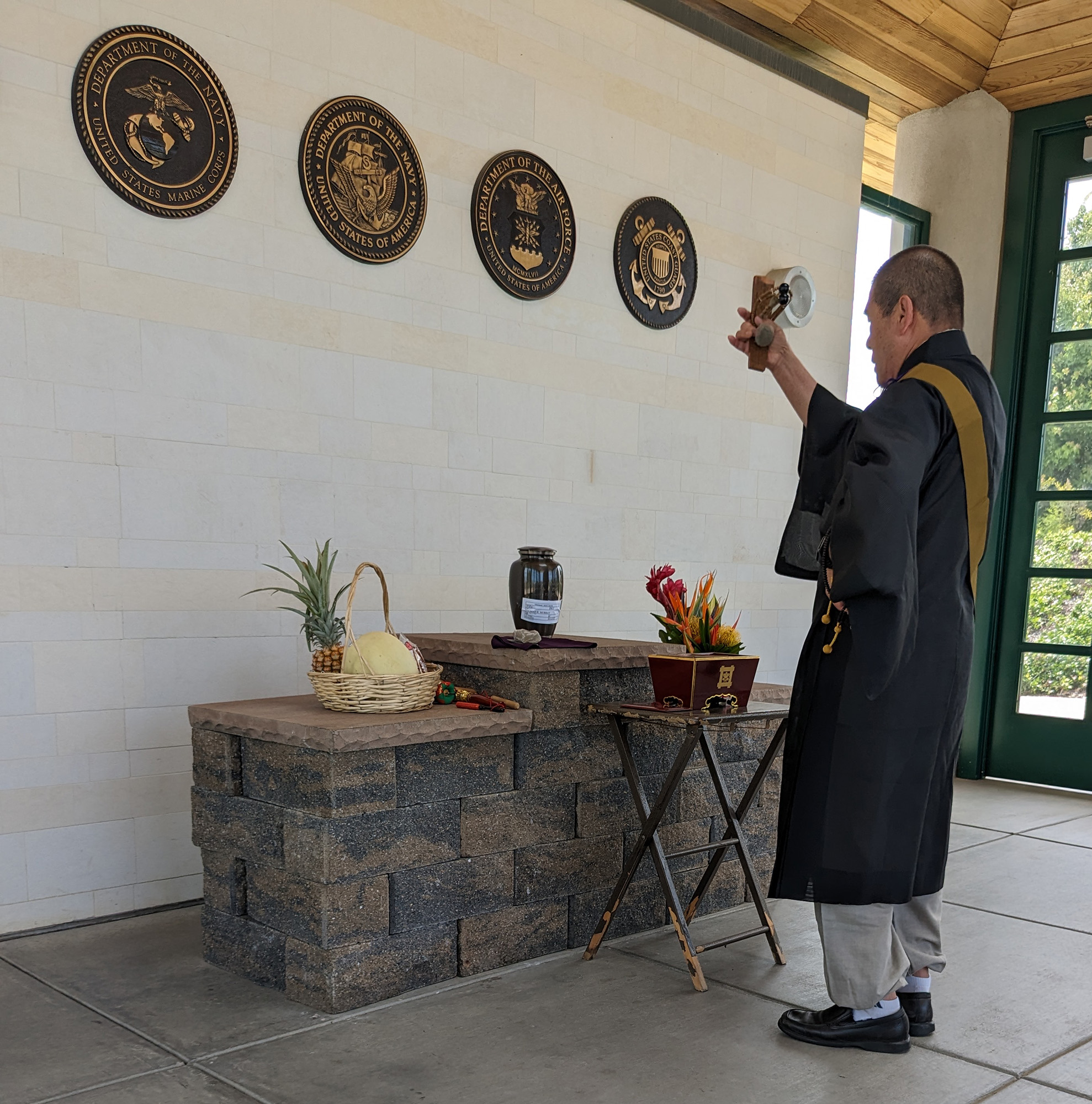
Enjoyed the opportunity today to attend Rev. Shoda Kanai’s Kito Blessing service from the Nichiren Buddhist Kannon Temple of Nevada. Following the blessing, Rev. Kanai bestowed a Gohonzon on a new church member.

Category Archives: Blog
The Color, Smell and Taste of the Dharma
This is another in a series of weekly blog posts comparing and contrasting the Sanskrit and Chinese Lotus Sutra translations.
If there is anything notable in comparing H. Kern’s Chapter 15, Duration of the Life of the Tathāgata, and the English translations of Kumārajīva’s Chapter 16, The Duration of the Life of the Tathāgata, it is their similarity.
Still, I’m disappointed in Kern’s translation of the Parable of the Skillful Physician and His Sick Children when compared to Senchu Murano’s translation of Kumārajīva’s Chinese Lotus Sutra.
Murano offers this:
“The sons who had not lost their right minds saw that this good medicine had a good color and smell, took it at once, and were cured completely. But the sons who had already lost their right minds did not consent to take the medicine given to them, although they rejoiced at seeing their father come home and asked him to cure them, because they were so perverted that they did not believe that this medicine having a good color and smell had a good taste.
In the past, I’ve made a big deal about how this is an excellent definition of faith. In fact, this was the motivation behind my yearlong 800 Years of Faith Project. We can observe that something looks nice and, without taking the medicine, we can determine that it smells nice. But only with faith can we accept that the medicine will taste good before we actually take the medicine.
Kern’s translation completely negates this interpretation:
Those amongst the children of the physician that have right notions, after seeing the color of the remedy, after smelling the smell and tasting the flavor, quickly take it, and in consequence of it are soon totally delivered from their disease. But the sons who have perverted notions cheerfully greet their father and say: Hail, dear father, that thou art come back in safety and welfare; do heal us. So they speak, but they do not take the remedy offered, and that because, owing to the perverseness of their notions, that remedy does not please them, in color, smell, nor taste.
But it was when comparing the other English translations of Kumārajīva’s Chinese Lotus Sutra that I found my interpretation of the parable was a product of Murano’s intervention.
In the other English translations of Kumārajīva’s Chinese Lotus Sutra, those children who are deranged can’t believe that the medicine, having a fine color and smell, is good for them. Nothing is said about taste.
The Modern Risshō Kōsei-kai translation offers:
The others, who have lost their senses, are also delighted to see their fathers return and ask him to cure them. But they are unwilling to take the medicine he offers them. Why is this? The poison’s effect have reached deeper inside them and made them lose their senses. Therefore, although the medicine is fine in color and smell, they do not think it is good.
The BDK English Tripiṭaka translation offers:
The remaining children, those who are delirious, seeing their father coming to them, rejoice and ask him to seek a cure for their illness. Although he offers them the medicine, they will not take it. Why is this? The poison has so deeply penetrated them that they have become delirious. They do not think that the medicine with good color and aroma is good.
This is another demonstration of the value of Senchu Murano’s Insight and the clarity that insight brings.
Next: Piety and Merits
Tendai Lotus Teachings and Nichiren
Beginning today and running through April 28, I’ll be publishing quotes taken from “The Collected Teachings of the Tendai Lotus School,” which was written by Gishin in 830 CE and translated from the Japanese by Paul L. Swanson. The book was published as part of the BDK English Tripiṭaka (97-II) in 1995. (PDF)
Having read Swanson’s Foundations of T’ien-T’ai Philosophy and Haiyan Shen’s The Profound Meaning of the Lotus Sutra: Tien-tai Philosophy of Buddhism and Paul Groner’s Saicho : The Establishment of the Japanese Tendai School, I have a dilettante’s understanding of the basics of the teachings of Chih-i, a Chinese monk who lived in the 6th century CE and wrote extensively on the structure and ideas of the Lotus Sūtra. And having had that introduction I found Gishin’s explanation of the Tendai teachings an excellent summary.
Nichiren’s teachings draw extensively from Tendai and Chih-i, but I’m not confident in my understanding of where Nichiren’s teachings diverge. That has led me to wonder whether there is a reason why Nichiren Shu appears to have ignored Gishin’s text and instead embraced the work of Korean monk Chegwan, who wrote “A Guide to the Tiantai Fourfold Teachings” in the late 10th century. (See History and Teachings of Nichiren Buddhism, p 99.)
I asked Rev. Ryuei McCormick whether there is a specific issue with Gishin’s work that troubles Nichiren Shu, and he replied:
This is a question I have also asked and not received a satisfactory answer from anyone. I can’t remember who replied to me but the answer from a Nichiren Shu priest was basically that Chegwan’s book wasn’t tainted by the Tendai esoteric associations. But as Paul Swanson points out, neither is the book by Gishin. So I can only shrug. I have certainly found nothing in Gishin’s book that would go against Nichiren’s teachings. Frankly, I think Chegwan and Gishin’s books are very complimentary.
I will return to the question of how Nichiren’s teaching departs from Tendai and Chih-i on April 29 after I’ve finished publishing the selected quotes from Gishin’s “The Collected Teachings of the Tendai Lotus School.”
Ether and the Sky
This is another in a series of weekly blog posts comparing and contrasting the Sanskrit and Chinese Lotus Sutra translations.
In considering Chapter 11, Beholding the Stūpa of Treasures – or as H. Kern titles the chapter, Apparition of a Stūpa – I noticed an interesting difference among the nine easy and six difficult acts.
Murano has:
It is not difficult
To grasp the sky,
And wander about with it
From place to place.It is difficult
To copy and keep this sūtra
Or cause others to copy it
After my extinction.
Kern, on the other hand, says:
22. To throw down the totality of ether-element after compressing it in one fist, and to leave it behind after having thrown it away, is not difficult.
23. But to copy a Sūtra like this in the period after my extinction, that is difficult.
At the time I thought it interesting to consider the “ether-element” and “the sky” in context of the five elements of physical existence:
- Earth
- Water
- Fire
- Wind
- Void (Ether)
But the quibble over sky vs. ether was a rabbit hole I thought I would step around after my brief glance inside.
Then I got to Chapter 15, The Appearance of the Bodhisattvas from Underground, or as Kern has it, Chapter 14, Issuing of Bodhisattvas from the Gaps of the Earth.
Where were these great bodhisattvas before they sprung up through the earth and filled the skies?
Murano says at the start and later in gāthās:
They had lived in the sky below this Sahā-World.
But Kern says:
who had been staying in the element of ether underneath this great earth, close to this Sahā world.
Later in gāthās, Kern says:
40. They dwell in the domain of ether, in the lower portion of the field, those heroes who, unwearied, are striving day and night to attain superior knowledge.
Now it seemed I needed to explore that rabbit hole and the difference between ether and the sky.
Back in Chapter 11, the other English translations of Kumārajīva’s Chinese Lotus Sutra agreed with Murano on the difficult task. For example, the Modern Risshō Kōsei-kai translation offers:
If someone
Could grab hold of the sky
And, carrying it, travel about,
That would not be difficult.
Gene Reeves offered:
If someone
Took the sky in his hand
And wandered around with it,
That would not be difficult.
But even in that chapter there was a hint of dissent. Leon Hurvitz, who used both Kumārajīva’s Chinese translation and a Sanskrit compilation of the Lotus Sutra, offered:
If there should be a man
Who, holding open space in his hand,
Were to walk about with it,
Even that would not be difficult.
I was happy to leave that rabbit hole unexplored in Chapter 11, but Murano’s placement of the bodhisattvas in the “sky below this Sahā-World” was not supported by the other translators of Kumārajīva.
The 1975 Risshō Kōsei-kai translation has the bodhisattvas “dwelling in [infinite] space below this sahā-world.” A footnote for “[infinite] space” offered this:
Sanskrit ākāśa (space, ether) is often used as a synonym for śūnyatā (void).
Burton Watson has the bodhisattvas “dwelling in the world of empty space underneath the sahā world.”
None of the translators of Kumārajīva’s Chinese Lotus Sutra has the bodhisattvas dwelling in the sky.
In one of the side tunnels of this rabbit hole I found a nugget of information that offered one possible reason why Murano chose the word sky.
In Japanese, the five elements of physical existence are called godai.
Hisao Inagaki’s “A Dictionary of Japanese Buddhist Terms” (1989) explains godai in these terms:
Godai ‘The five great (elements)’; also godaishu ‘the five great seeds’; the five elements which constitute things in the world: (1) chidai, the earth element; (2) suidai , the water element; (3) kadai, the fire element; (4) fūdai, the wind element; and (5) kūdai, the space element.
The 1965 Japanese English Buddhist Dictionary (Daitō Shuppansha publisher) offers this definition of godai:
Godai pañca mahābhūtāni. The five elements. I. The five elements which are believed to be the components of all forms of matter: the earth-element (pṛthivī-dhātu), water-element (ap-dhātu), fire-element (tejo-dhātu), wind-element (vāyu-dhātu), and air-element (ākāśa-dhātu).
The Princeton Dictionary of Buddhism includes “sky” among the synonyms for ākāśa: “space” or “spatiality”; “sky,” and “ether.” In addition, there are several online resources that define “ākāśa-dhātu” as the element of “sky or space.” See here and here and here. So Murano’s choice of “sky” rather than the empty space other translators used is defensible.
Personally, I’m disappointed that the home of these bodhisattvas is a void beneath this world. I enjoyed the idea that these bodhisattvas were in the sky. I’ve never been to Australia, but I imagined these great bodhisattvas in the sky would be quite a spectacle.
The Message Beyond the Details
This is another in a series of weekly blog posts comparing and contrasting the Sanskrit and Chinese Lotus Sutra translations.
Beyond the question of whether the chapter seeks to help ordinary bodhisattvas, there are only minor differences between H. Kern’s Peaceful Life chapter and the English translations of Kumārajīva’s Peaceful Practices chapter.
For example, at the conclusion of the first section of gāthās, Kern has:
24. Let the sage first, for some time, coerce his thoughts, exercise meditation with complete absorption, and correctly perform all that is required for attaining spiritual insight, and then, after rising (from his pious meditation), preach with unquailing mind.
25. The kings of this earth and the princes who listen to the law protect him. Others also, both laymen (or burghers) and Brahmans, will be found together in his congregation.
Senchu Murano’s translation of Kumārajīva’s Chinese has similar language:
A Bodhisattva will be peaceful,
And free from timidity
If he stays in a quiet room
For some time,
Recollects the Dharma correctly,
Understands the Dharma
According to the meanings of it,
And then emerges
From his dhyāna-concentration,
And leads kings, princes,
Common people and brahmanas
By expounding this sūtra to them.
But Murano concludes this section of gāthās with:
Mañjuśrī, all this is the first set of things
That the Bodhisattva should do
Before he expounds the Sūtra
Of the Lotus Flower of the Wonderful Dharma
In the world after [my extinction].
All of the English translations of Kumārajīva’s Chinese offer this summary graph at the conclusion of these gāthās. For example, Gene Reeves offers:
Mañjuśrī, this is called the first teaching
In which bodhisattvas should dwell at peace,
Enabling the, in future generations,
To teach the Dharma Flower Sutra.
In the prose section immediately following these gāthās, Kern has:
Further, Mañjuśrī, the Bodhisattva Mahāsattva who, after the complete extinction of the Tathāgata at the end of time, the last period, the last five hundred years, when the true law is in a state of decay, is going to propound this Dharmaparyāya, must be in a peaceful state (of mind) and then preach the law, whether he knows it by heart or has it in a book. In his sermon he will not be too prone to carping at others, not blame other preaching friars, not speak scandal nor propagate scandal.
All of the English translations of Kumārajīva’s Chinese skip this point of “whether he knows it by heart or has it in a book.” In Murano’s translation, we get:
“Second, Mañjuśrī! A Bodhisattva-mahāsattvas who wishes to expound this sūtra in the age of the decline of the teachings after my extinction should perform the following peaceful practices. When he expounds or reads this sūtra, he should not point out the faults of other persons or sūtras.
In comparing the translations, Kern’s translation often has additional details.
Here’s how Murano’s translation of Kumārajīva’s Chinese begins the second section of gāthās:
The Bodhisattva should wish
To make all living beings peaceful,
And then expound the Dharma to them.
He should make a seat in a pure place,
Apply ointment to his skin,
Wash dirt and dust off himself,
Wear a new and undefiled robe,
Clean himself within and without,
Sit on the seat of the Dharma peacefully,
And then expound the Dharma in answer to questions.
Kern renders this same scene with much more detail:
26. The wise man is always at ease, and in that state he preaches the law, seated on an elevated pulpit which has been prepared for him on a clean and pretty spot.
27. He puts on a clean, nice, red robe, dyed with good colors, and a black woolen garment and a long undergarment;
28. Having duly washed his feet and rubbed his head and face with smooth ointments, he ascends the pulpit, which is provided with a footbank and covered with pieces of fine cloth of various sorts and sits down.
29. When he is thus seated on the preacher’s pulpit and all who have gathered round him are attentive, he proceeds to deliver many discourses, pleasing by variety, before monks and nuns,
Again, as pointed out repeatedly in this comparison of Kern’s translation of an 11th century Sanskrit document and Kumārajīva’s fifth century Chinese version of the Lotus Sutra, the details may be different but the message remains the same.
Next: Ether and the Sky
The Plight of an Ordinary Bodhisattva
This is another in a series of weekly blog posts comparing and contrasting the Sanskrit and Chinese Lotus Sutra translations.
In the many, many times I’ve read Chapter 14, Peaceful Practices, I’ve begun with the understanding that Mañjuśrī Bodhisattva wants to know how “ordinary” bodhisattvas should accomplish their propagation in the evil world described in the previous chapter. This has made the chapter a message to me, such a very ordinary bodhisattva.
Now I learn that this focus on “ordinary” bodhisattvas is an invention of Senchu Murano.
Murano opens the chapter with:
Thereupon Mañjuśrī Bodhisattva-mahāsattva, the Son of the King of the Dharma, said to the Buddha:
“World-Honored One! These Bodhisattvas are extraordinarily rare. They made a great vow to protect, keep, read, recite and expound this Sūtra of the Lotus Flower of the Wonderful Dharma in the evil world after your extinction because they are following you respectfully. World-Honored One! How should an [ordinary] Bodhisattva-mahāsattvas expound this sūtra in the evil world after [your extinction]?”
Murano uses square brackets to mark text that doesn’t appear in Kumārajīva’s Chinese Lotus Sutra. In other places these parenthetical insertions add clarity without changing the meaning. Not here. This insertion of “[ordinary]” appears in the first edition of Murano’s translation of the Lotus Sutra, so it’s not something introduced by later editors.
It was only when comparing H. Kern’s English translation of a 11th century Sanskrit Lotus Sutra that I realized what Murano had done.
Kern opens the chapter with:
Mañjuśrī, the prince royal, said to the Lord: It is difficult, Lord, most difficult, what these Bodhisattvas Mahāsattvas will attempt out of reverence for the Lord. How are these Bodhisattvas Mahāsattvas to promulgate this Dharmaparyāya at the end of time, at the last period?
When I checked against the other English translations of Kumārajīva’s Chinese Lotus Sutra I discovered they agreed with Kern’s Sanskrit document. We’re talking about the great Bodhisattvas who have vowed to spare nothing in promulgating this sutra in the evil age, not a subset of ordinary bodhisattvas.
The BDK Tripiṭaka translation of the Lotus Sutra begins Chapter 14:
Thereupon the Prince of the Dharma, Bodhisattva Mahāsattva Mañjuśrī addressed the Buddha, saying: “O Bhagavat! These bodhisattvas are very rare. In respectful obedience to the Buddha they have made this great vow: ‘In the troubled world to come, we will preserve, recite, and teach this Lotus Sutra!’
“O Bhagavat! How can these bodhisattva mahāsattvas teach this sutra in the troubled world to come?“
Rissho Kosei-Kai’s 1975 translation begins chapter 14:
At that time the Bodhisattva-Mahāsattva Mañjuśrī, the Law-king’s son, spoke to the Buddha, saying: “World-honored One! Rare indeed are such bodhisattvas as these! Reverently according with the Buddha, they have made great vows that in the evil age to come they will protect, keep, read, recite, and preach this Law-Flower Sutra. World-honored One! How are these bodhisattva-mahāsattvas to be able to preach this sutra in the evil age to come?“
Only Leon Hurvitz’s translation, which incorporates both Kumārajīva’s Chinese and a 19th century compilation Sanskrit document, offers of hint of why Murano might have felt compelled to insert “[ordinary].”
Hurvitz begins Chapter 14:
At that time, Mañjuśrī the dharma prince, the bodhisattva-mahāsattva, addressed the Buddha, saying, “O World-Honored One! Very rarely do there exist such bodhisattvas as these, who out of respectful obedience to the Buddha utter a great vow to keep and hold, to read and recite this Scripture of the Dharma Blossom in the latter evil age! O World-Honored One! How can a bodhisattva-mahāsattva preach this scripture in the latter evil age?“
This is not unlike what I discovered when considering the name of the sutra Śākyamuni taught before the Lotus Sutra. If one assumes Hurvitz’s translation is the gold standard and that there is some ambiguity about which bodhisattvas we’re inquiring about, then one can appreciate why “How can a bodhisattva-mahāsattva preach this scripture in the latter evil age?” could become “How should an [ordinary] Bodhisattva-mahāsattvas expound this sūtra in the evil world after [your extinction]?”
A Tiny Blessing

Today was the Setsubun service at the Sacramento Nichiren Buddhist Church.
Setsubun literally means ‘season-division,’ dividing Winter from Spring. Prayers are said for our good health and protection against calamity or misfortunes. Traditionally, toshi-otoko (a man of the year) and yoshi-onna (a woman of the year), who were born in the year with the same animal name as the current year, throw soy beans to chase out evil spirits from each house and throw hard candy to welcome good luck throughout the year. At the Sacramento Nichiren Buddhist Church we toss the candy into the audience and afterward hand out envelopes of roasted soy beans. This year was my turn – Year of the Rabbit – to toss the candy.
This was a special Setsubun because it was the first time my grandson, Edwin Lou Woodford Hughes, attended services. He was born just two weeks ago on Jan. 21, 2023. Rev. Igarashi gave his standard Setsubun purification to all in the congregation and then invited my son, Richard, to bring up Edwin to receive a special blessing. Amazingly, Edwin slept through it all.


Knowing Nichiren

The Spring 2023 issue of Tricycle Magzazine has an excellent interview with Princeton Emerita Professor Jacqueline Stone discussing the history of Nichiren Buddhism. I highly recommend Knowing Nichiren.
Lifetime Beginner
I recently finished reading Nikkyō Niwano’s autobiography Lifetime Beginner and, frankly, I’m glad that I read Buddhism for Today before reading this. The book was originally published in Japan in 1975 and the first English translation published in 1978. As explained by Rissho Kosei-kai:
This is a refreshingly candid account of the author’s life, from his childhood on a small farm in northern Japan, through his years of religious search, and finally to the founding and growth of Rissho Kosei-kai, a lay Buddhist organization with well over six million members throughout the world.
As with all things Rissho Kosei-kai, I’m ambivalent, but rather than dwell on the troublesome aspects I want to underscore the important teaching I found.
Two Halves of the Lotus Sutra
The Lotus Sutra is divided into two sections. In the first half, defined as the “Law of Appearance,” the World-honored One, the historical Buddha, Shakyamuni, discusses the organization of the universe, human life, and human relationships on the basis of his experience and enlightenment. This section of the sutra teaches human beings how they ought to live. In the second half, the “Law of Origin,” Shakyamuni Buddha expands his teachings. For the first time, he says that the true Buddha exists without beginning and without end and that he himself has consistently preached the Law and taught people throughout the universe since the infinite past.
The Buddha of the Law of Origin—the Eternal Original Buddha— is the basic life-force of the universe; he is the truth, life, and law of the entire cosmos. The teachings of the Law of Origin inform us that by tuning the wavelength of our own lives to that of the universe we can achieve the spiritual state we should attain and become truly happy. The Law of Appearance contains what is often called the expedient teachings; the Law of Origin contains the true teachings. The former is essential for a transition into the latter, but neither teaching is superior to the other: they are the complementary halves of a single Truth. (p160)
The Essential Unity
The completely egalitarian Lotus Sutra teaches that not only human beings but all beings in the universe share the potential to attain buddhahood through full manifestation and complete development of their essences, each according to their true natures. When all things, including humanity, have attained this state, we shall achieve perfect peace in the Land of Eternally Tranquil Light, which ought to be the ultimate goal of all mankind.
This is the ideal concept of the teachings of the Lotus Sutra, but it is not sufficient to save man, who is weak and requires spiritual support to be able to live in peace. All things in the world of phenomena are transient, and nothing is permanent enough to serve as a spiritual support except the Eternal Original Buddha, the great force of life that is the origin of the universe. Human beings and all other beings are but visible manifestations of this great invisible universal life-force.
Since the life-force is eternal and indestructible, in essence human life too is eternal, though the manifested physical body dies. A person enlightened to this truth in the deepest part of his understanding experiences everlasting tranquility. This very tranquility itself is at the same time the joy of life that throbs in man’s physical and spiritual being.
Profound enlightenment to this truth leads to an awareness of the essential unity binding all things into one great family of life. This awareness in turn inspires a deep sense of equality and love for all beings, a greater love that is called compassion. A person who is compassionate in this sense is truly valuable, and a society of such people is a paradise. This is fundamental in the teachings of the Lotus Sutra. Living daily in correct spiritual and physical attunement with these teachings inspires the joy of living with the Eternal Original Buddha, generates love and compassion, and eliminates the need for the kind of spiritual support provided by revelations from protective deities.
(p161-162)
Bruce Springsteen told the concert crowd at Amalie Arena in Tampa, Fla., on Wednesday, Feb. 1, 2023, “At 15, it’s all tomorrows. And at 73, it’s a whole lot of yesterdays.” That’s certainly how I feel today at 71 years of age. I wish I had heard at age 15 the advice Nikkyō Niwano gave to Rissho Kosei-kai youth in January 1958:
“You young people are filled with energy and with the power to absorb things. This is why I want all of you to read at least part of the Threefold Lotus Sutra daily. Even a few lines are enough if you are very busy. But try to read the entire sutra once a month. If you do this, in three or four years you will make new spiritual discoveries within yourself. These discoveries will be an inspiration to you and will bring great light and good tidings into your life. Remember that we make our own happiness. And with this in mind, go forward with determination.” (p170-171)
In March 2015, I began my 32 Days of the Lotus Sutra Practice. Next month will mark the completion of the eighth year of my monthly reading of the Lotus Sutra. In that time I’ve made “new spiritual discoveries” and these discoveries have brought “great light and good tidings” into my life.
Encouragement
This is another in a series of weekly blog posts comparing and contrasting the Sanskrit and Chinese Lotus Sutra translations.
Chapter 13 in the Kumārajīva translation and Chapter 12 in H. Kern’s translation follow the story of Devadatta and the Dragon King’s Daughter. If you assume the chapter title foreshadows the content, then there is a distinction difference in focus between Kumarajiva and the 11th century Sanskrit document Kern translated.
Among the English translators of Kumarajiva, we have titles of:
- “Encouragement for Keeping This Sūtra,” Senchu Murano.
- “Encouragement to Uphold the Sutra,” Gene Reeves.
- “Encouraging Devotion,” Soka Gakkai, (Burton Watson).
- “Exhortation to Hold Firm,” Rissho Kosei-Kai, 1975.
- “Encouragement to Hold Firm,” Rissho Kosei-Kai, 2019.
Kern has simply “Exertion” and Leon Hurvitz, who incorporates both Kumārajīva and a 19th century compilation Sanskrit document, offers “Fortitude.”
The contents of Kumārajīva’s chapter and the Sanskrit document Kern translated clearly offer the same lesson, but Kumārajīva focuses on encouraging future devotees while Kern simply stresses that it will take work to propagate the Lotus Sutra in a world full of “malign beings, having few roots of goodness, conceited, fond of gain and honor, rooted in unholiness, difficult to tame, deprived of good will, and full of unwillingness.”
There is, however, a notable difference between how Kumārajīva handles the concerns of Maha-Prajapati Bhikṣunī, the Buddha’s stepmother.
Murano sets the stage in this way:
There were Maha-Prajapati Bhikṣunī, the sister of the mother of the Buddha, and six thousand bhikṣunīs, some of whom had something more to learn while others had nothing more to learn. They rose from their seats, joined their hands together with all their hearts, and looked up at the honorable face with unblenching eyes.
Thereupon the World-Honored One said to Gautamī:
“Why do you look at me so anxiously? You do not think that I assured you of your future attainment of Anuttara-samyak-saṃbodhi because I did not mention you by name, do you? Gautamī! I have already said that I assured all the Śrāvakas of their future attainment [of Anuttara-samyak-saṃbodhi].
Kern, however, offers:
Then the noble matron Gautamī, the sister of the Lord’s mother, along with six hundred nuns, some of them being under training, some being not, rose from her seat, raised the joined hands towards the Lord and remained gazing up to him. Then the Lord addressed the noble matron Gautamī: Why dost thou stand so dejected, gazing up to the Tathāgata? (She replied): I have not been mentioned by the Tathāgata, nor have I received from him a prediction of my destiny to supreme, perfect enlightenment. (He said): But, Gautamī, thou hast received a prediction with the prediction regarding the whole assembly.
Perhaps not a big deal that Kern has Maha-Prajapati voice her concerns – “I have not been mentioned by the Tathāgata, nor have I received from him a prediction of my destiny to supreme, perfect enlightenment” – but notable.
Another minor difference is the number of nuns accompanying Maha-Prajapati. Kumarajiva has 6,000 and Kern only 600. Hurvitz sticks with the 6,000.
Personally, the biggest difference between the translations involves the the Bodhisattvas. I’ve always been moved by Murano’s story.
Thereupon the World-Honored One looked at the eighty billion nayuta Bodhisattva-mahāsattvas. These Bodhisattvas had already reached the stage of avaivartika, turned the irrevocable wheel of the Dharma, and obtained dhārāṇis. They rose from their seats, came to the Buddha, joined their hands together [towards him] with all their hearts, and thought, “If the World-Honored One commands us to keep and expound this sūtra, we will expound the Dharma just as the Buddha teaches.”
They also thought, “The Buddha keeps silence.’ He does not command us. What shall we do?”
The image of the Buddha inviting the Bodhisattvas but sitting silent is not present in Kern’s translation.
Thereafter the Lord looked towards the eighty hundred thousand Bodhisattvas who were gifted with magical spells and capable of moving forward the wheel that never rolls back. No sooner were those Bodhisattvas regarded by the Lord than they rose from their seats, raised their joined hands towards the Lord and reflected thus: The Lord invites us to make known the Dharmaparyāya. Agitated by that thought they asked one another: What shall we do, young men of good family, in order that this Dharmaparyāya may in future be made known as the Lord invites us to do?
All of the English translations of Kumārajīva note the silence of the Buddha. Even Hurvitz mentions it. Given the chapter’s focus on “Encouragement,” this silence is important. The loss of that dimension from Kern’s translation diminishes the significance of the Bodhisattvas’ vow.