
Day 27

Day 27 concludes Chapter 23, The Previous Life of Medicine-King Bodhisattva.

Having last month detailed the string of comparisons that reveal the position of the Sutra of the Lotus Flower of the Wonderful Dharma, it’s time to follow up with the saving grace of the this sutra.

Star-King Flower! This sutra saves all living beings. This sutra saves them from all sufferings, and gives them great benefits. All living beings will be able to fulfill their wishes by this sutra just as a man who reaches a pond of fresh water when he is thirsty, just as a man who gets fire when he suffers from cold, just as a man who is given a garment when he is naked, just as a party of merchants who find a leader, just as a child who meets its mother, just as a man who gets a ship when he wants to cross [a river], just as a patient who finds a physician, just as a man who is given a light in the darkness, just as a poor man who gets a treasure, just as the people of a nation who see a new king enthroned, just as a trader who reaches the seacoast. Just as a torch dispels darkness, this Sutra of the Lotus Flower of the Wonderful Dharma saves all living beings from all sufferings, from all diseases, and from all the bonds of birth and death. The merits to be given to the person who, after hearing this Sutra of the Lotus Flower of the Wonderful Dharma, copies it, or causes others to copy it, cannot be measured even by the wisdom of the Buddha. Neither can the merits to be given to the person who copies this sutra and offers flowers, incense, necklaces, incense to burn, powdered incense, incense applicable to the skin, streamers, canopies, garments, and various kinds of lamps such as Lamps of butter oil, oil lamps, lamps of perfumed oil, lamps of campaka oil, lamps of sumanas oil, lamps of patala oil, lamps of varisika oil, and lamps of navamalika oil [to the copy of this sutra].

The Daily Dharma from October 18, 2015, offers this insight:

Star-King-Flower! This sūtra saves all living beings. This sūtra saves them from all sufferings, and gives them great benefits. All living beings will be able to fulfill their wishes by this sūtra just as a man who reaches a pond of fresh water when he is thirsty, just as a man who gets fire when he suffers from cold.

The Buddha gives this description of the merits of the Lotus Sūtra to Star-King-Flower Bodhisattva in Chapter Twenty-Three of the Lotus Sūtra. The comparison of our bodily desires to our desire for enlightenment shows the kind of joy we can expect when we realize what this teaching can accomplish. Anyone whose thirst is quenched is sure to become thirsty again, no matter how pleasant it is to drink. The Buddha Dharma fulfills a thirst of which we may not even be aware. We are certain that things in this world of conflict will bring us joy. When we realize they can only bring us pleasure, and know the difference between joy and pleasure, we become aware of our true wishes and what this sūtra does for us.

The Daily Dharma is produced by the Lexington Nichiren Buddhist Community. To subscribe to the daily emails, visit zenzaizenzai.com
The Particular and the Universal

The particular derives its being from the universal nature of things, while the universal could not fully realize its true nature without manifesting itself in a particular. Both are real, but either by itself is imperfectly real. The Middle Path consists in uniting the two aspects of existence, universal and particular, and in seeing therein the true reality.

Nichiren, The Buddhist Prophet

Daily Dharma – Sept. 26, 2016

World-Honored One! It is by my supernatural powers, know this, that a Bodhisattva can hear these dhāraṇīs. Anyone who keeps the Sūtra of the Lotus Flower of the Wonderful Dharma [while it is] propagated in the Jambudvīpa, should think, ‘I can keep [this sūtra] only by the supernatural powers of Universal-Sage.’

Universal-Sage Bodhisattva (Fugen, Samantabhadra) makes this declaration to the Buddha in Chapter Twenty-Eight of the Lotus Sūtra. The supernatural powers of this Bodhisattva are beyond the perception of our human senses: sight, hearing, touch, taste, smell and thought. When we hear thunder, we know something causes it whether or not we understand that cause. In the same way, when we are practicing this Wonderful Dharma, we know it is because of the great help we receive from innumerable beings, even if we do not understand the powers they use to reach us.

The Daily Dharma is produced by the Lexington Nichiren Buddhist Community. To subscribe to the daily emails, visit zenzaizenzai.com
Day 26

Day 26 concludes Chapter 21, The Supernatural Powers of the Tathāgatas, includes Chapter 22, Transmission, and introduces Chapter 23, The Previous Life of Medicine-King Bodhisattva.

Having last month considered that “all the profound achievements of the Tathagata are revealed and expounded explicitly in this sutra,” this month I’ll use the gathas to review the Supernatural Powers of the Tathāgatas.

The Buddhas, the World-Saviors, have
Great supernatural powers.
They display their immeasurable, supernatural powers
In order to cause all living beings to rejoice.

The tips of their tongues reach the Heaven of Brahman.
Innumerable rays of light are emitted from their bodies.
For those who are seeking the enlightenment of the Buddha
The Buddhas do these things rarely to be seen.

The sound of coughing of the Buddhas
And the sound of their finger-snapping
Reverberate over the worlds of the ten quarters,
And the ground [of those worlds] quakes in the six ways.

The Buddhas joyfully display
Their immeasurable, supernatural powers
Because [the Bodhisattvas from underground]
[Vow to] keep this sutra after my extinction.

Even if I praise for innumerable kalpas
The keeper of this sutra,
To whom it is to be transmitted,
I cannot praise him highly enough.

His merits are as limitless,
As infinite, as boundless
As the skies of the worlds
Of the ten quarters.

Anyone who keeps this sutra
Will be able to see me. He also will be able to see Many-Treasures Buddha,
[The Buddhas of] my replicas,
And the Bodhisattvas whom I have taught today.

Anyone who keeps this sutra will be able to cause me to rejoice.
He also will be able to bring joy
To [the Buddhas of] my replicas
And also to Many-Treasures Buddha who once passed away.

He also will be able to see
The present, past and future Buddhas
Of the worlds of the ten quarters,
Make offerings to them, and cause them to rejoice.

I smile in reading this. The “Buddhas joyfully display” their powers in response to the Bodhisattvas’ vow. And I am “able to bring joy/To [the Buddhas of] my replicas/And also to Many-Treasures Buddha” and “cause [present, past and future Buddhas] to rejoice” by keeping the Sutra of the Lotus Flower of the Wonderful Dharma.

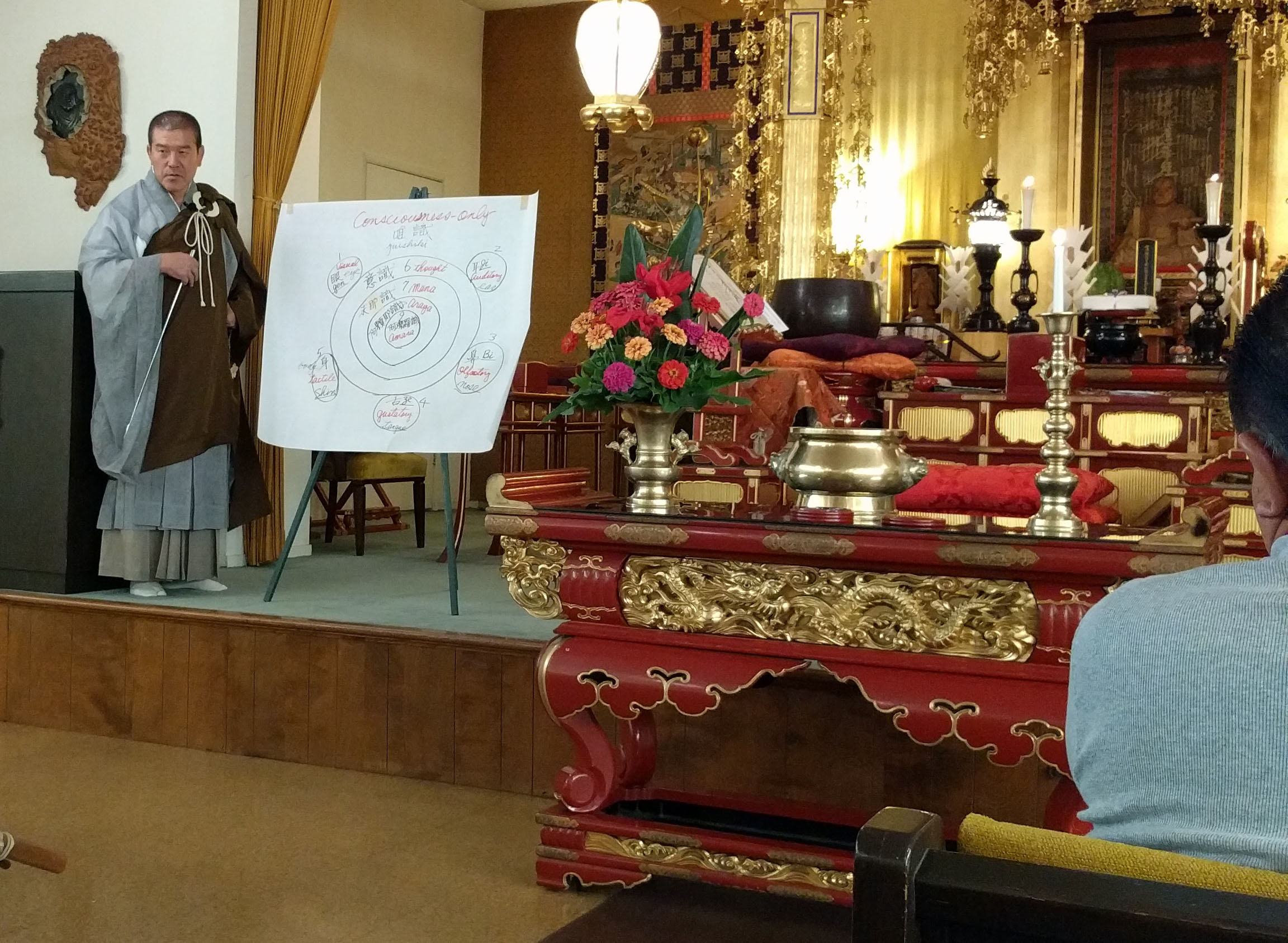
Consciousness-Only

Ven. Kenjo Igarashi offering a lesson in Conciousness-Only
Sunday lesson
Sunday lesson

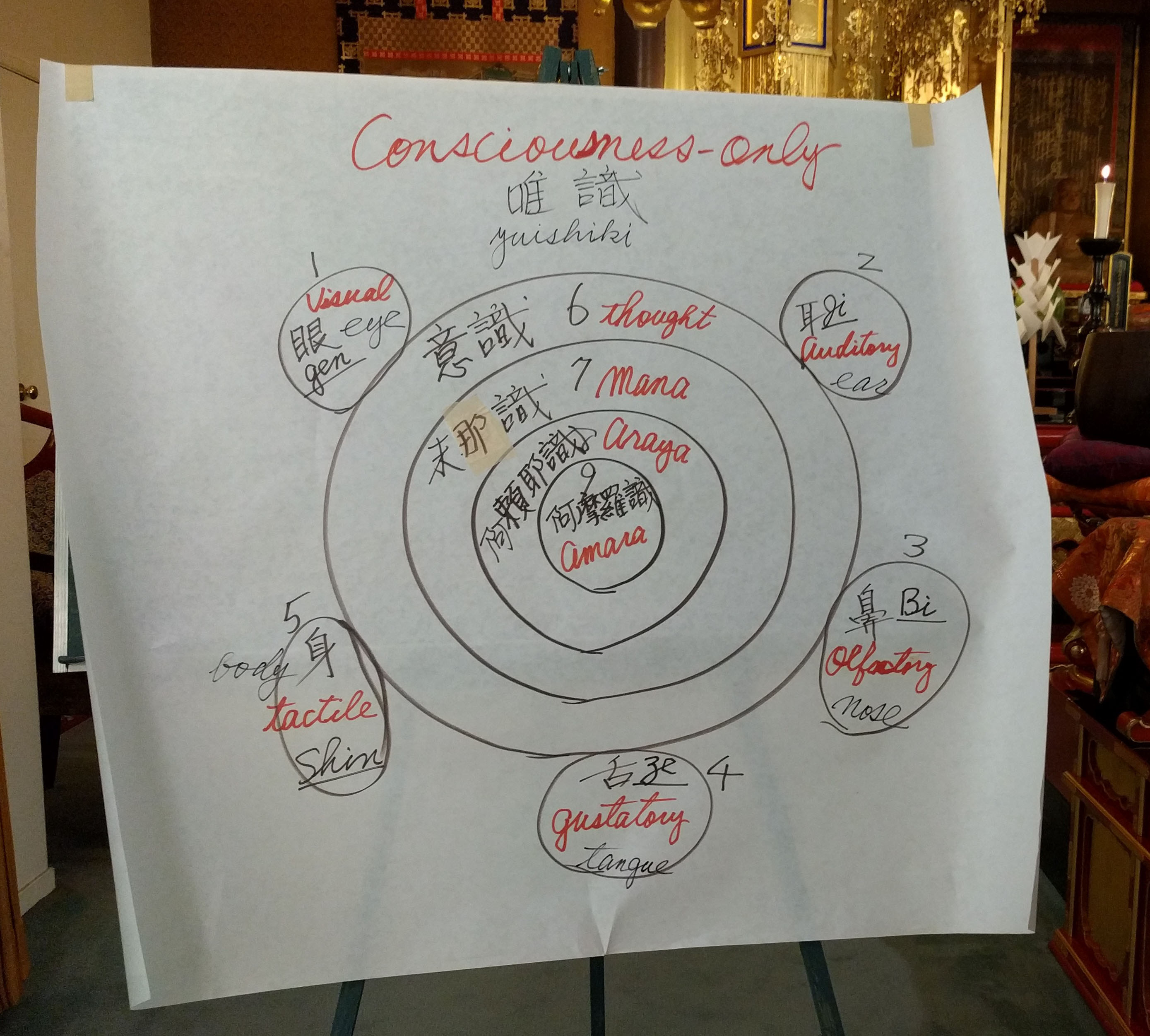
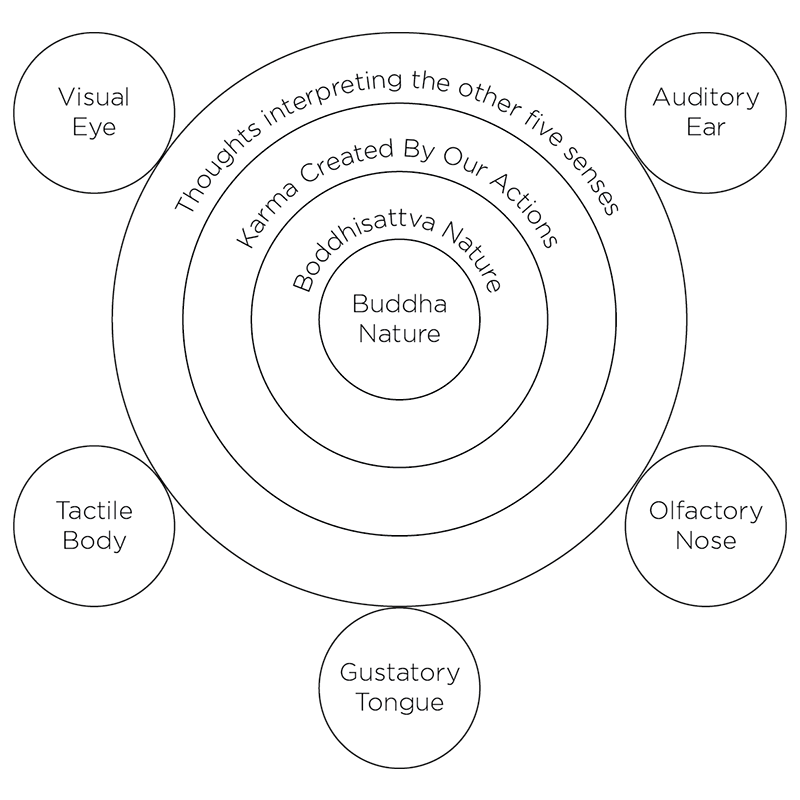
Viewed from the inside out, our inherent Buddha nature is surrounded by a Boddhisattva Nature of pure compassion. This basic goodness is hidden from us by our karma created by our actions. Viewed from the outside in, the visual, tactile, gustatory, olfactory and auditory inputs are interpreted by our thoughts and prompt our actions. These actions harden the shell around our basic goodness.

Ven. Kenjo Igarashi offered a lesson in Consciousness-Only as seen from the Nichiren perspective following the Sunday Ohigan ceremony in which he offered prayers for the ancestors of church members.

And before I begin I must underline that this is my understanding of what he said and is only as accurate as I can make it. Any errors are mine alone.

On one level, the chart he displayed offered an explanation of what exists when we are alive and what remains in the “special realm” after we die.

The eye, ear, nose, tongue and body sense organs do not “know” anything. The sixth level, thought, interprets the five sense organs. What we do with this information – our good and bad actions – are stored in the seventh level.

The eye, ear, nose, tongue, body and mind are the transitory part subject to birth and death that create the illusion that we conceive of as our world.

Our good and bad actions create a shell of intentions that shape our future. This shell encloses our pure Bodhisattva compassion. And that Bodhisattva compassion itself encloses our innate Buddha nature.

Prayers for our ancestors in which we transfer our merit received from chanting Namu Myoho Renge Kyo and studying the Sutra of the Lotus Flower of the Wonderful Dharma seek to mitigate that shell of intentions that will control our ancestors’ future lives.

For myself, I saw this chart and was reminded of Chapter 19, The Merits of the Teacher of the Dharma, and promised effect “the good men or women who keep, read, recite expound or copy this sutra after my extinction, will be able to obtain.”

And considering this from the inside out, I appreciated this picture of universal Buddha nature, this seed, that exists wrapped in compassion. The goal of chanting Namu Myoho Renge Kyo is to realize this equality and difference.

Daily Dharma – Sept. 25, 2016

Those who have much lust will be saved from lust if they constantly think of World-Voice-Perceiver Bodhisattva and respect him. Those who have much anger will be saved from anger if they constantly think of World-Voice-Perceiver Bodhisattva and respect him. Those who have much stupidity will be saved from stupidity if they constantly think of World-Voice-Perceiver Bodhisattva and respect him.

The Buddha gives this description of World-Voice-Perceiver Bodhisattva (Kannon, Kanzeon, Avalokitesvara) to Endless-Intent Bodhisattva in Chapter Twenty-Five of the Lotus Sūtra. World-Voice-Perceiver is the embodiment of compassion for all beings, the wish that all beings be freed from suffering and realize the enlightenment of the Buddha. This compassion is the antidote to the three poisons of lust, anger and stupidity. By aspiring to the example of World-Voice-Perceiver and awakening our own compassion, we can overcome these poisons and bring benefits to all beings.

The Daily Dharma is produced by the Lexington Nichiren Buddhist Community. To subscribe to the daily emails, visit zenzaizenzai.com