
All posts by John Hughes

Day 4

Day 4 finishes Chapter 2, Expedients, and completes the first volume of the Sutra of the Lotus flower of the Wonderful Dharma.

Having last month covered the truth of the reality of all things, we come to some predictions of enlightenment.

Those who met a past Buddha,
Who heard the Dharma from him,
And who obtained various merits and virtues
By almsgiving or by observing the precepts
Or by patience or by making endeavors
Or by dhyana or by wisdom,
Have already attained
The enlightenment of the Buddha.

Those who, after the extinction of a Buddha,
Were good and gentle,
Have already attained
The enlightenment of the Buddha.

Those who, after the extinction of a Buddha,
Erected billions of stupas,
And who purely and extensively adorned [those stupas]
With treasures
Such as gold, silver, crystal,
Shell, agate, ruby, and lapis lazuli,
And who offered those adornments to his sariras;
Or those who made the mausoleum [of the Buddha]
With stone, bricks, or clay,
Or with many kinds of wood,
Such as candana, aloes, or agalloch;
Or those who made the mausoleum of the Buddha
With heaps of earth
In the wilderness;
Or the boys who made the stupa of the Buddha
With heaps of sand by playing,
Have already attained
The enlightenment of the Buddha.

Those who carved an image of the Buddha
With the [proper] physical marks in his honor
Have already attained
The enlightenment of the Buddha.

Those who made an image of the Buddha
With the seven treasures;
Or those who made it
Of copper, copper-gold alloy, nickel,
Pewter lead, tin, iron, wood, or clay;
Or those who made it in plaster work,
Have already attained
The enlightenment of the Buddha.

Those who drew or caused others to draw in color
A picture of the Buddha adorned with his physical marks,
Each mark representing one hundred merits,
Have already attained the enlightenment of the Buddha.

The boys who by playing drew
A picture of the Buddha
With a piece of grass or wood,
Or with a brush,
Or with the back of their fingernails,
Became able to accumulate merits one by one.
Having great compassion towards others,
They attained the enlightenment of the Buddha,
Taught only Bodhisattvas,
And saved many living beings.

Those who respectfully offered
Flowers, incense, streamers, and canopies
Enshrined in a stupa-mausoleum;
Or those who caused men to make music
By beating drums, by blowing horns and conches,
And by playing reed-pipes, flutes, lyres, harps,
Lutes, gongs, and copper cymbals,
And offered the wonderful sounds produced thereby
To the image or picture of the Buddha;
Or those who sang joyfully in praise of him for his virtues;
Or those who just murmured [in praise of him],
Have already attained
The enlightenment of the Buddha.

Those who, without concentrating their minds,
Offered nothing but a flower to the picture of the Buddha,
Became able to see
Innumerable Buddhas one after another.

Those who bowed to the image of the Buddha,
Or just joined their hands together towards it,
Or raised only one hand towards it,
Or bent their head a little towards it
And offered the bending to it,
Became able to see innumerable Buddhas one after another.
They attained unsurpassed enlightenment,
Saved countless living beings,
And entered into the Nirvana-without-remainder
Just as fire dies out when wood is gone.

Those who entered a stupa-mausoleum
And said only once “Namo Buddhaya,”
Without even concentrating their minds,
Have already attained the enlightenment of the Buddha.

Those who heard the Dharma
In the lifetime of a past Buddha
Or after his extinction
Have already attained the enlightenment of the Buddha.

Of all these, I always want to clip and save this:

The boys who by playing drew
A picture of the Buddha
With a piece of grass or wood,
Or with a brush,
Or with the back of their fingernails,
Became able to accumulate merits one by one.
Having great compassion towards others,
They attained the enlightenment of the Buddha,
Taught only Bodhisattvas,
And saved many living beings.

Merit comes not from what you do in praise but from your intent in praising.
Wondering How Wonderful Tomorrow Will Be

People know how difficult it is to do Otsutome every day, and that each day it is a battle between ego and faith. However, the Buddha teaches us how to control the ego and our own desires. After overcoming such a challenge, you will become comfortable with Odaimoku. Performing Otsutome is not a duty, but proof of your faith to the Buddha and Nichiren Shonin. Continuing to chant is such a wonderful experience, and you will want to perform Otsutome every day, and like me, you will say, “I wonder how wonderful tomorrow will be!”

Spring Writings

Daily Dharma – March 14, 2017

In this profound sūtra
The teachings for the Śrāvakas are criticized.
Those who hear
That this sūtra is the king of all the sūtras,
And think over this sūtra clearly after hearing it,
Know this, will approach the wisdom of the Buddha.

The Buddha sings these verses to Medicine-King Bodhisattva in Chapter Ten of the Lotus Sūtra. He has already declared that the sūtra he is teaching is the closest to his own wisdom, that it is different from anything he has taught before, and that it is the teaching for Bodhisattvas. The expedient teachings he gave to Śrāvakas before this sūtra were limited because they did not show the way to enlightenment for all beings. As we keep this sūtra in our minds, and learn to recognize it in our daily lives, we not only approach our own enlightenment, we lead all beings to enjoy the Buddha’s wisdom.

The Daily Dharma is produced by the Lexington Nichiren Buddhist Community. To subscribe to the daily emails, visit zenzaizenzai.com

Day 3

Day 3 covers the first half of Chapter 2, Expedients.

Having last month covered the gathas concerning the confusion sown by the Buddha’s revelations, we come to Sariputra’s question.

Thereupon Sariputra, seeing the doubts of the four kinds of devotees, and also because he, himself, did not understand [why the Buddha had said this], said to the Buddha:

“World-Honored One! Why do you extol so enthusiastically [what you call] the highest [Truth, and the power of the Buddhas to employ) expedients? [Why do you extol) the Dharma which [you say] is profound, wonderful, and difficult to understand? I have never heard you say all this before. The four kinds of devotees also have the same doubts. World-Honored One! Explain all this! Why do you extol so enthusiastically the Dharma which [you say] is profound, wonderful, and difficult to understand?”

Thereupon Sariputra, wishing to repeat what he had said, sang in gathas:

Sun of Wisdom, Great Honorable Saint!
You expound the Dharma for the first time after a long time.
You say that you obtained
The powers, fearlessness, samadhis,
Dhyana-concentrations, emancipations,
And other inconceivable properties [of a Buddha].

No one asks you about the Dharma you attained
At the place of enlightenment.
[The Dharma] is too difficult for me to measure.
[So it is for others; therefore,] no one asks you.

Although you are not asked, you extol the teachings
[Of the past Buddhas] which you practiced.
Your wisdom is wonderful.
It is the same wisdom that the other Buddhas obtained.

The Arhats-without-asravas
And those who are seeking Nirvana
Are now in the mesh of doubts, wondering:
“Why does the Buddha say all this?”

Those who are seeking the vehicle of cause-knowers,
And the bhiksus, bhiksunis, gods, dragons,
Gandharvas, and other supernatural beings,
Are exchanging glances of perplexity.

They are looking up at you, at the Honorable Biped
Thinking:
“What is this for?
Buddha! Explain all this!”

You once said to me:
“You are the most excellent Sravaka.”
With all my wisdom, however, I now doubt.
I do not understand
Whether the Truth I attained is final or not,
Whether the teachings I practiced are true or not.

Your sons born from your mouth are looking up at you
With their hands joined together, entreating:
“With your wonderful voice,
Explain all this as it really is!”

As many gods and dragons
As there are sands in the River Ganges,
And the eighty thousand Bodhisattvas
Who are seeking Buddhahood,
And the wheel-turning-holy-kings
Of billions of worlds
Are joining their hands together respectfully,
Wishing to hear the Perfect Way.

This is a good point to insert an explanation of expedient teaching from Lotus Path: Practicing the Lotus Sutra Volume 1:

Previous to teaching the Lotus Sutra the Buddha taught expedients to lead people to the ultimate teaching of the Lotus Sutra. In many ways it was as if he were leading the blind to the train station so they could then find the way to the true complete teachings contained in the Lotus Sutra. But we need to remember that the train station is not the destination, the expedients are not the sum of the Buddha’s teachings.
Lotus Path: Practicing the Lotus Sutra Volume 1

Lotus Sutra Meaning in Your Life

[A]s we begin to study the Lotus Sutra – not just from a theoretical point but from a life embracing point – the critical thing is what creates meaning for you in your life. It may be at first the divisions are simply nice to know about, but have little relevance to your day-to-day practice. Eventually though you may come to feel a stronger personal connection to the sutra and wish to understand more deeply where our practice comes from and the reasons for Nichiren’s adoption of the object of veneration, or even things like why recite the two chapters we do over others in the sutra.

Lecture on the Lotus Sutra

Daily Dharma – March 13, 2017

Tears keep falling when I think of the current unbearable hardships, but I cannot stop tears of joy when I think of obtaining Buddhahood in the future. Birds and insects chirp without shedding tears. I, Nichiren, do not cry, but tears keep falling. These tears are shed not for worldly matters, but solely for the sake of the Lotus Sutra. Therefore they should be called tears of nectar.

Nichiren wrote this as part of his letter to monk Sairen-bō in his Treatise on All Phenomena as Ultimate Reality (Shohō-Jissō Shō). For the sake of the Lotus Sūtra, Nichiren endured two harsh exiles, his house being burnt down, ambushes by soldiers with swords, being placed on the execution mat himself, and the persecution of his followers. Despite all these obstacles, he held true to the Buddha’s teaching in the face of all opposition. Most of us who practice the Lotus Sūtra today have lives of relative comfort. It is wonderful that we have Nichiren’s example. He was a human being just like us, and we too are capable of his faith and determination.

The Daily Dharma is produced by the Lexington Nichiren Buddhist Community. To subscribe to the daily emails, visit zenzaizenzai.com

Day 2

Day 2 completes Chapter 1, Introductory.

Having last month learned of the Bodhisattva who was called Fame Seeking, we begin Manjusri’s repetition of what he saw, this time in gathas.

Thereupon Manjusri, wishing to repeat what he had said, sang in gathas in the midst of the great multitude:

According to my memory,
innumerable, countless kalpas ago,
There lived a Buddha, a Man of the Highest Honor,
Called Sun-Moon-Light.

That World-Honored One expounded the Dharma,
And caused innumerable living beings
And many hundreds of millions of Bodhisattvas
To enter the Way to the wisdom of the Buddha.

Seeing the Great Saint
Who had renounced the world,
The eight sons born to him when he was a king
Followed him, and performed brahma practices.

The Buddha expounded
To the great multitude
A sutra of the Great Vehicle
Called the ‘Innumerable Teachings.’

Having expounded this sutra, the Buddha sat cross-legged
On the seat of the Dharma [facing the east],
And entered into the samadhi
For the purport of the innumerable teachings.

The gods rained mandarava-flowers.
Heavenly drums sounded by themselves.
The gods, dragons, and other supernatural beings
Made offerings to the Man of the Highest Honor.

The worlds of the Buddhas quaked much.
The Buddha emitted a ray of light
From between his eyebrows,
And showed things rarely to be seen.

Back at the beginning of February on Day 31 I mentioned that I had recently been reading “Readings of the Lotus Sutra,” a book of essays on the Lotus Sutra edited by Stephen F. Teiser and Jacqueline I. Stone. One essay, Gender and Hierarchy in the Lotus Sutra, uses the parables of the sutra to conclude that the sutra focuses on children who are inferior to their father in wisdom and realization. I used this to point out that this was not true in Chapter 27, King Wonderful-Adornment as the Previous Life of a Bodhisattva. In reading Day 2, it is untrue here as well. These sons realize their father’s accomplishment, dedicate themselves to the pursuit of Buddhahood and eventually become Buddhas themselves. Clearly, the conclusions of the essay Gender and Hierarchy in the Lotus Sutra suffers from its focus the parables of the Burning House, the Rich Man and His Poor Son and the Skillful Physician and His Sick Children. There is much more to the Lotus Sutra than the parables.

The Final Climb

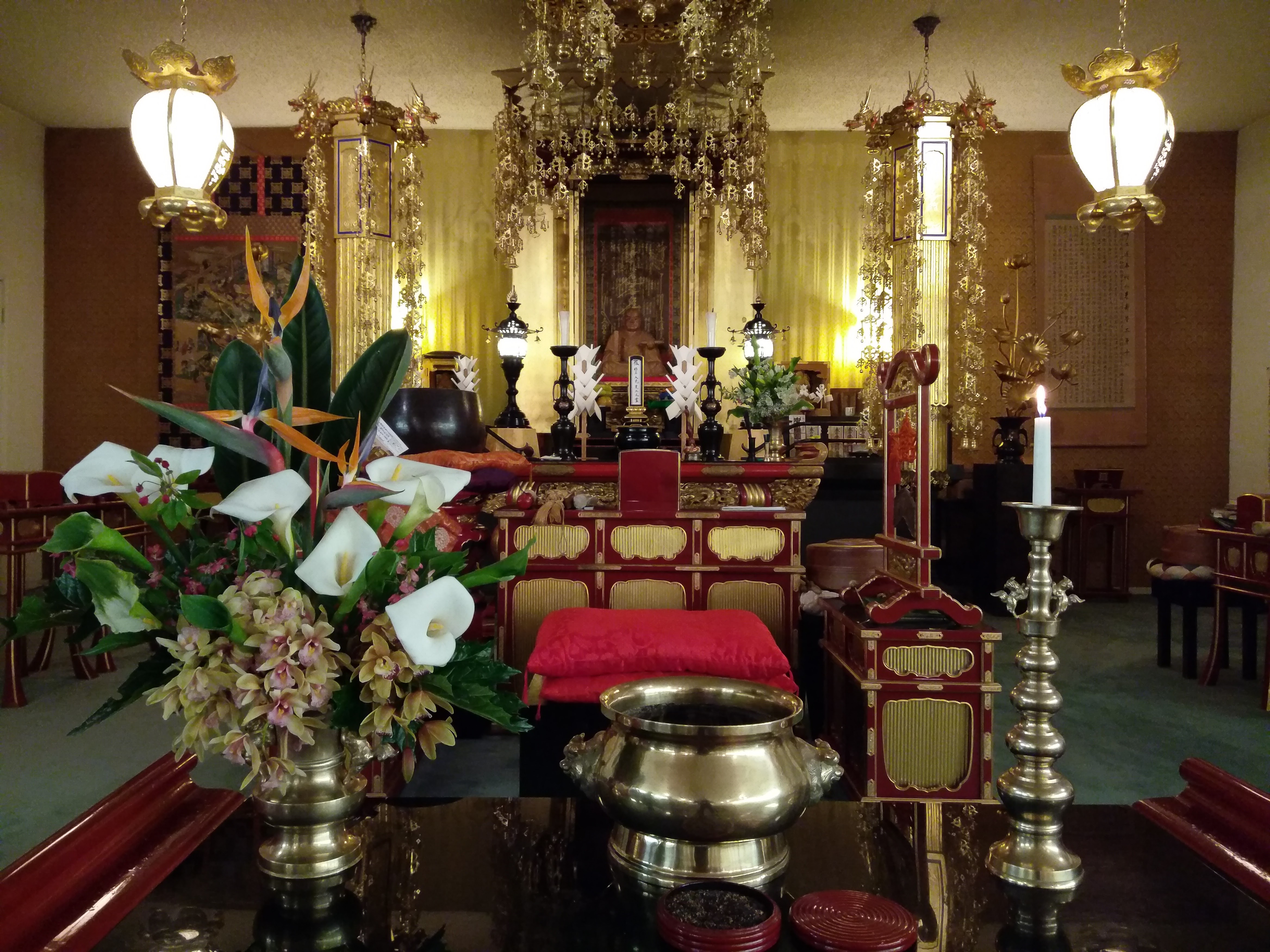
Flowers and the altar on Sunday, March 12, at the Sacramento Nichiren Buddhist Church

Today was the Kaji Kito purification ceremony at the Sacramento Nichiren Buddhist Church and appended to that was the 7-Day Memorial Service for a prominent member of the church. After the service the Ven. Kenjo Igarashi offered a reminder of the purpose of this and the other memorial ceremonies.

In the first seven days after passing, the person must climb a steep hill. The difficulty of the task is compounded by the weight of the person’s bad karma. Someone who did many evil deeds would be burdened by a great weight during the climb. The prayers offered during the service and daily during the initial seven days seek to transfer our merit to the deceased in order to ease the weight of their bad karma.

Following the explanation Rev. Igarashi was quick to point out that the recently deceased church member had “no bad karma” and therefore had an easy climb.

Rev. Igarashi’s most recent newsletter lecture – The Similarities Between Ohigan and Volunteering – seeks to counter the criticism of modern Buddhism that it is too focused on funerals. There is much to agree with in his conclusion:

[D]uring this month of Ohigan, we must get together and recite the sutra and chant the Odaimoku in order to help those spirits that cannot rest in peace or are unable to cultivate their own virtue, and approach this in the same manner that we approach what is considered to be “volunteering.”

Daily Dharma – March 12, 2017

Śāriputra! Some disciples of mine, who think that they are Arhats or Pratyekabuddhas, will not be my disciples or Arhats or Pratyekabuddhas if they do not hear or know that the Buddhas, the Tathāgatas, teach only Bodhisattvas.

The Buddha makes this declaration to his disciple Śāriputra in Chapter Two of the Lotus Sutra. When the Buddha says he only teaches Bodhisattvas, he does not mean that he excludes anyone from his teaching. It is only when we realize and develop our capacities as Bodhisattvas, beings who exist to benefit all beings, rather than being preoccupied with our own suffering, can we hear, practice and appreciate the Buddha Dharma.

The Daily Dharma is produced by the Lexington Nichiren Buddhist Community. To subscribe to the daily emails, visit zenzaizenzai.com

Day 1

Day 1 covers the first half of Chapter 1, Introductory

Having last month covered the ray of light emitted from the white curls between Sakyamuni’s eyebrows that illumined all the corners of eighteen thousand worlds in the east, we consider Maitreya’s reaction.

Thereupon Maitreya Bodhisattva thought:

“The World-Honored One is now displaying a wonder [, that is, a good omen]. Why is he displaying this good omen? The Buddha, the World-Honored One, has entered into a samadhi. Whom shall I ask why he is displaying this inconceivable, rare thing? Who can answer my question?”

He thought again:

“This Manjusri, the son of the King of the Dharma, has already met innumerable Buddhas and made offerings to them in his previous existence. He must have seen this rare thing before. Now I will ask him.”

At that time the bhiksus, bhiksunis, upasakas, upasikas, gods, dragons, and other supernatural beings thought, “Whom shall we ask why the Buddha is emitting this ray of light, that is, why he is displaying this wonder?”

At that time the congregation included the four kinds of devotees: bhiksus, bhiksunis, upasakas and upasikas. They also included gods, dragons, and other supernatural beings. Maitreya Bodhisattva, wishing to have his doubts removed, and also understanding the minds of the congregation, asked Manjusri:

“Why is the World-Honored One displaying this good omen, this wonder? Why is he emitting a great ray of light, illumining eighteen thousand worlds to the east, and causing us to see those beautifully-adorned worlds of the Buddhas?”

And with this we underscore an important message early in this sutra: When in doubt, ask for clarification. There are no stupid questions.