
Applied to the fellowship of believers in the Buddhist Church, the same kind of reciprocity of benefaction and gratitude, of entrusting and perpetuation, exists between Nichiren and his followers forever. Consequently, the Church is the organ for perpetuating Nichiren’s ideals through the efforts of his followers.
Nichiren, The Buddhist ProphetAll posts by John Hughes
Daily Dharma – Feb. 3, 2017
The “mutual possession of ten realms” doctrine is as difficult to maintain as it is to see fire in a rock or flowers in wood. However it is not totally impossible because rocks spark when struck together and a tree blooms in spring. It is most difficult to believe that the realm of Buddhas is contained in the realm of humans because it is like saying that fire is in water or water in fire.
Nichiren wrote this in his treatise on Spiritual Contemplation and the Most Venerable (Kanjin Honzon-Shō). “Mutual Expression of Ten Realms” is one of the more difficult ideas from the Chinese Master T’ien-t’ai. Nichiren uses it to illustrate what the Buddha teaches in the Lotus Sūtra: that Buddha nature is contained within all beings. Even though this idea is difficult, we can see it in the transformations of everyday objects we encounter: rocks, fire, flowers and trees. With his similes, Nichiren reminds us that with the Lotus Sūtra as our guide, we can see the Buddha Dharma in all aspects of our lives.
The Daily Dharma is produced by the Lexington Nichiren Buddhist Community. To subscribe to the daily emails, visit zenzaizenzai.com
Day 28
Day 28 covers all of Chapter 24, Wonderful-Voice Bodhisattva, and concludes the Seventh Volume of the Sutra of the Lotus Flower of the Wonderful Dharma.
Last month covered the great supernatural powers and the power of wisdom obtained by Wonderful-Voice Bodhisattva-mahasattva, and now we consider the benefits.
Thereupon Flower-Virtue Bodhisattva said to the Buddha:
World-Honored One! This Wonderful-Voice Bodhisattva planted deeply the roots of good. World-Honored One! What is the name of the samadhi by which he can transform himself into various living beings and appear in various places to save all living beings?
The Buddha said to Flower-Virtue Bodhisattva:
Good man! This is called the ‘samadhi by which one can transform oneself into any other living being.’ Wonderful-Voice Bodhisattva entered into this samadhi and benefited innumerable living beings as previously stated.
When the Buddha expounded this chapter of Wonderful-Voice Bodhisattva, the eighty-four thousand people, who had come accompanying Wonderful-Voice Bodhisattva, obtained the ability to practice the samadhi by which they could transform themselves into other living beings. Innumerable Bodhisattvas of this SahaWorld also obtained the ability to practice this samadhi. They also obtained dharanis.
The Daily Dharma from Dec. 19, 2016, offers this:
This description comes at the end of Chapter Twenty-Four of the Lotus Sūtra. In the story, Wonderful-Voice Bodhisattva had come to our world of conflict and delusion from his perfect world to hear the Buddha teach the Wonderful Dharma. The Bodhisattvas in this world asked the Buddha about the transformations Wonderful-Voice made to benefit others. This chapter shows how those beings who have vowed to benefit us appear in ways we may not recognize right away. It also shows us the capability we have as Bodhisattvas to transform ourselves for the benefit of others. The Daily Dharma is produced by the Lexington Nichiren Buddhist Community. To subscribe to the daily emails, visit zenzaizenzai.com
True Happiness
[A] healthy, balanced happiness does not imply chasing extreme happiness that may suddenly turn to deep emptiness. And needless to say, balanced happiness does not mean that when experiencing extreme unhappiness you should be a pessimist or take a dim view of your life and lose hope. Harmonized happiness means that even when you are happy you also have some troubles, and although you feel unhappy, you never lose sight of hope, and you realize the happiness to be found in your daily life. That is true happiness.
Spring WritingsPractice and Study
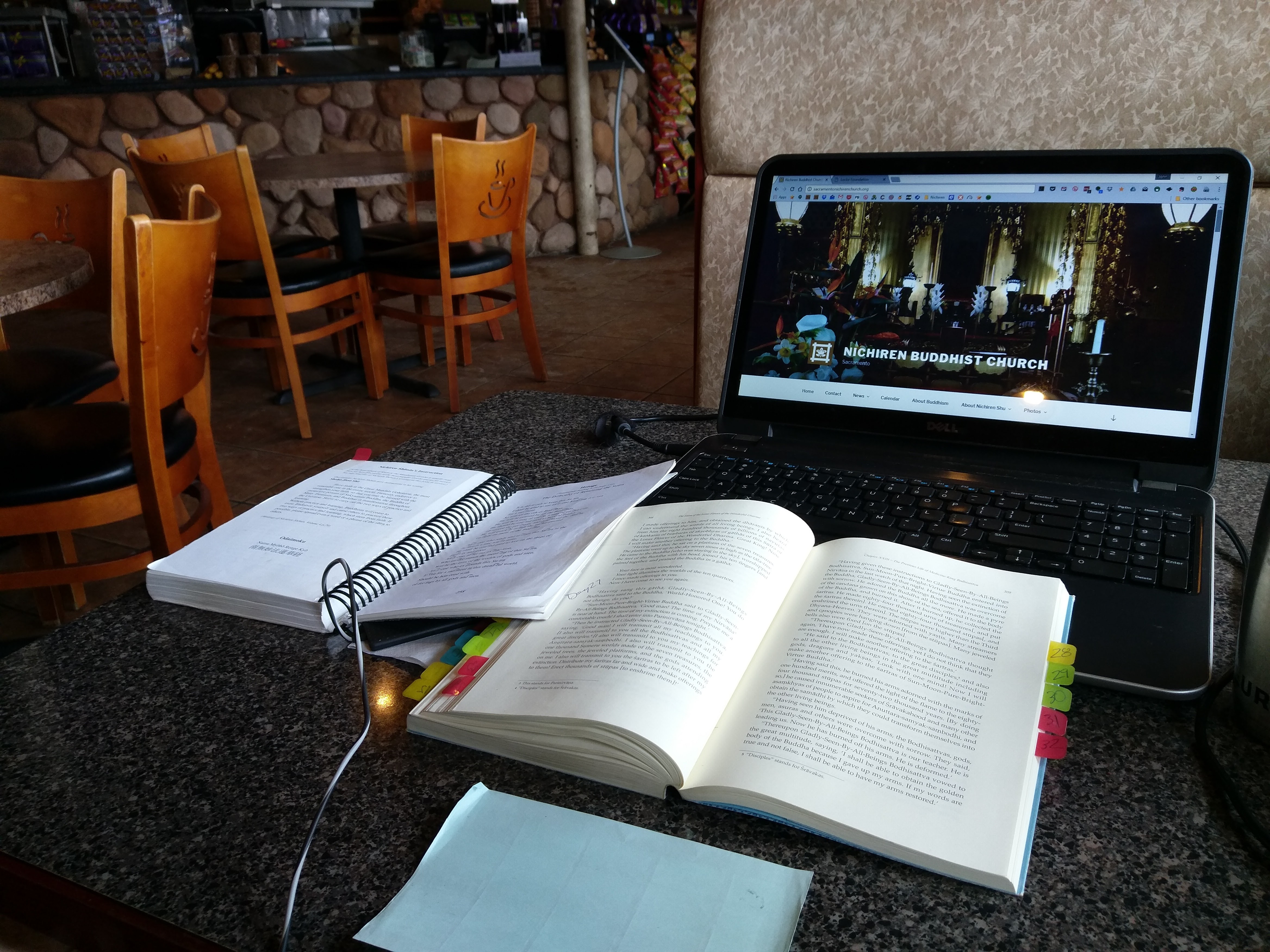
My daily practice involves reciting portions of the Lotus Sutra in shindoku in the morning and then in the evening reciting the same section from Senchu Murano’s English Translation.
The shindoku is a Japanese pronunciation of the Chinese translation using Romanized text. As Rev. Ryuoh Michael Faulconer explains in the introduction to his Myo Ho Renge Kyo Romanized, “It is a form of faith reading done as practice which our inner Buddha nature understands. When we chant in our native language, we do so to further our understanding.”
Practice and study.
Daily I recite the admonition from Nichiren Shonin’s Instruction in Shoho Jisso Sho: “Earnestly endeavor to strength your faith, so that you may be blessed with the protective powers of Skyamuni Buddha, the Buddha of Many Treasures, and Buddhas in manifestation throughout the Universe. Strive to carry out the two ways of practice and learning. Without practice and learning, Buddhism will cease to exist.”
And I suppose this blogging and my daily posting of the Lotus Sutra section read each days qualifies as part of my effort to “[e]ndeavor yourself and cause others to practice these two ways of practice and learning, which stem from faith.”
But what to do when I’m traveling and away from my home altar?
For a week I’m in the suburbs of Rochester, New York. Specifically, I’m in Jitters Cafe, “Rochester’s Hometown Coffee Roaster,” in North Chili, which is the closest coffee shop to my father-in-law’s home in Churchville, New York.
On past trips I’ve stayed in hotels and kept to my daily practice schedule before and after visits to my father-in-law. But this time my wife and I are saving the hotel cost and bunking on my father-in-law’s couch. And rather than trying to practice in my father-in-law’s house, I’ve decided to do my reading of the shindoku and English versions of the Lotus Sutra each morning over coffee and then take advantage of the free WiFi to post here.
Daily Dharma, Feb. 2, 2017
Anyone who expounds this sūtra
Will be able to see me,
To see Many-Treasures Tathāgata,
And to see the Buddhas of my replicas.
The Buddha sings these verses in Chapter Eleven of the Lotus Sūtra. We can hear this teaching with an aspiration to see visions of Śākyamuni Buddha and other Buddhas. But we can also hear the Buddha’s promise that when we keep in mind his assurance that we and all beings have the capacity for enlightenment, we will see the world differently. We will start to interpret the actions of ourselves and others in a new light. We will see many more beings who are helping us to become enlightened, rather than beings who are frustrating our efforts at pursuing our selfish goals.
The Daily Dharma is produced by the Lexington Nichiren Buddhist Community. To subscribe to the daily emails, visit zenzaizenzai.com
Day 27
Day 27 concludes Chapter 23, The Previous Life of Medicine-King Bodhisattva.
Last month having returned to the Previous Life of Medicine-King Bodhisattva, we come now to his sacrifice and restoration.
Thereupon Gladly-Seen-By-All-Beings Bodhisattva thought again, ‘I have now made these offerings, yet I do not think that they are enough. I will make another offering to the sariras.’
He said to the Bodhisattvas, to the great disciples, and also to all the other living beings in the great multitude including gods, dragons and yaksas, ‘Look with one mind! Now I will make another offering to the sariras of Sun-Moon-Pure-Bright-Virtue Buddha.’
Having said this, he burned his arms adorned with the marks of one hundred merits, and offered the light of the flame to the eighty-four thousand stupas for seventy-two thousand years. [By doing so,] he caused immumerable seekers of Sravakahood and many other asamkhyas of people to aspire for Anuttara-samyak-sambodhi, and obtain the samadhi by which they could transform themselves into the other living beings.
Having seen him deprived of his arms, the Bodhisattvas, gods, men, asuras and others were overcome with sorrow. They said, ‘This Gladly-Seen-By-All-Beings Bodhisattva is our teacher. He is leading us. Now he has burned off his arms. He is deformed.’
Thereupon Gladly-Seen-By-All-Beings Bodhisattva vowed to the great multitude, saying, ‘I shall be able to obtain the golden body of the Buddha because I gave up my arms. If my words are true and not false, I shall be able to have my arms restored.’
When he had made this vow, his arms were restored because his merits, virtues and wisdom were abundant. Thereupon the one thousand million Sumeru-worlds quaked in the six ways, and the gods rained down jeweled flowers. All the gods and men had the greatest joy that they had ever had.
Is this a lesson in why taking this sutra literally can be problematic or a measure of what faith in the Sutra of the Lotus Flower of the Wonderful Dharma requires?
The Real Message of the Lotus Sutra
The Lotus Sutra starts out dealing with matters relevant to the contemporary disciples of the Buddha. When the Buddha asks in Chapter XV who will propagate the Lotus Sutra in the ages after the death of the Buddha we shift the focus of the teaching to the future. It becomes apparent at this point that the real message of the Lotus Sutra is not for the people originally present, nor for the Buddha emanations, but for the Bodhisattvas from beneath the ground who represent ourselves.
Lecture on the Lotus SutraDaily Dharma – Feb. 1, 2017
Those who believe in the Lotus Sutra are like the winter season, for many hardships come incessantly. Winter is surely followed by spring. We have never heard nor seen that winter returned to fall. We have never heard that the believers in the Lotus Sutra go back to ordinary people. The Lotus Sutra says, “All people who listen to this sutra will attain Buddhahood.”
Nichren wrote this in a letter to one of the lay women who followed his teachings, Myoichi Ama. Knowing the hardships Nichiren faced in his life helps us understand his great fearlessness and determination to spread the Wonderful Dharma. One of the most difficult things about hardship is that it can seem like it will never end. Nichiren reminds us that hardships do end, and that we who practice the Lotus Sutra are assured of our future enlightenment. The example of Nichiren’s life also shows us that as Bodhisattvas, we can use our hardships to lead other beings to enlightenment.
The Daily Dharma is produced by the Lexington Nichiren Buddhist Community. To subscribe to the daily emails, visit zenzaizenzai.com
Day 26
Day 26 concludes Chapter 21, The Supernatural Powers of the Tathāgatas, includes Chapter 22, Transmission, and introduces Chapter 23, The Previous Life of Medicine-King Bodhisattva.
Having last month completed the task of transmitting the Sutra of the Lotus Flower of the Wonderful Dharma to the Bodhisattvas who sprang up from underground, it’s time to discuss The Previous Life of Medicine-King Bodhisattva.
Thereupon Star-King-Flower Bodhisattva said to the Buddha:
World-Honored One! Why does Medicine-King Bodhisattva walk about this Saha-World? World-Honored One! This MedicineKing Bodhisattva will have to practice hundreds of thousands of billions of nayutas of austerities in this world. World-Honored One! Tell me why! Not only the gods, dragons, yaksas, gandharvas, asuras, garudas, kirnnaras, mahoragas, men and nonhuman beings but also the Bodhisattvas who have come from the other worlds and the Sravakas present here will be glad to hear the reason.
Before proceeding I want to underscore the purpose in discussing Star-King-Flower Bodhisattva austerities, I want to over this overview from Rev. Ryusho Jeffus’ Lecture on the Lotus Sutra:
In Chapter 23, the Previous Life of Medicine-King Bodhisattva, the Buddha tells Star-King-Flower Bodhisattva that there is no suffering that cannot be overcome through the practice of the Lotus Sutra. Just as a man who is thirsty is able to quench that thirst when he reaches a pond, so too can we overcome any tribulation. It is here that the Buddha talks about a torch dispelling darkness as well as eliminating the sufferings from diseases and breaking the bonds of birth and death.
When I am working in the hospital as a chaplain I carry an amulet that I dedicated solely for the purpose of healing for all the sick patients I visit. On that amulet I have the phrase “this Sutra of the Lotus Flower of the Wonderful Dharma saves all living beings from all sufferings, from all diseases.” It is my ongoing prayer for the health of all the people I visit in the hospital as well as the physicians and nurses who administer care to those patients.
Lecture on the Lotus Sutra