All posts by John Hughes

Each Character of the Lotus Sūtra

A plant can increase in number when its seed is planted. A dragon can transform a small body of water into a lot of rain, and humans can turn a small flame into a fiery blaze. Likewise, although the piece of cloth for a clerical robe and an unlined kimono is limited to one each, their number will be 69,384 each when they are donated to the Lotus Sūtra consisting of 69,384 Chinese characters. As each Chinese character of the Lotus Sūtra represents a living Buddha, the offering to the sūtra is equivalent to the offerings to 69,384 Buddhas. These Buddhas of the Lotus Sūtra are equipped with the hearts of regeneration that enable the Two Vehicles to attain Buddhahood as if a rotten seed has been revitalized; their life spans are as eternal as that of the Original True Buddha revealed in the sūtra; their throats are made of the ever-lasting Buddha-nature; and their primary object is the practice of the One Vehicle teaching. The figures of Buddhas appearing in this world to save living beings are not that of the true Buddha. Rather than Buddhas of corresponding manifestation with 32 marks or 80 minor marks of physical excellence, those Buddhas represented by each character of the Lotus Sūtra are the true Buddhas. Of those who encountered the Buddha and became His followers during His lifetime, some were unable to become Buddhas. Nevertheless, according to the golden words of the Buddha, those who embrace the teaching of the Lotus Sūtra after the passing of the Buddha “will never fail to attain Buddhahood” (the “Expedients” chapter).

When I have this clerical robe tailored, put on upon the unlined kimono and recite the Lotus Sūtra, though Nichiren is a priest without observing a Buddhist precept, as the Lotus Sūtra is the golden words of the Buddha, the merit of your donation will reach you just as a poisonous snake spits out a gem or sandalwood trees grow among eraṇḍa.

Onkoromo narabini Hitoe Gosho, Thank-you Note for a Clerical Robe and an Unlined Kimono, Writings of Nichiren Shōnin, Volume 6, Followers I, Page 8-9

Daily Dharma for February 23, 2026

20260223-ddi

Illustration by Google Gemini

Show Gemini's thinking

Gemini Thinking

Comprehending Verse's Essence
I'm now diving deep into the provided Japanese Buddhist verse. The focus is on the Bodhisattva Kannon and the concept of compassion. I am working to grasp the verse's core essence, which seems to revolve around Avalokiteśvara, and reliable compassion.

Defining Visual Representation
I am now focusing on determining the most appropriate visual representation. My current approach involves the key elements: Kannon, the environment's atmosphere, and the integration of a signature. The goal is a serene, traditionally Japanese illustration in a nihonga style, reflecting the essence of the verse about the Bodhisattva. The setting involves traditional Japanese elements.

Assessing The Visual Alignment
I'm currently verifying the alignment of the visual content with the provided instructions. I am ensuring that the illustration meets all specified criteria, including the subject matter and the required style. I am focusing on the intended theme.

Confirming Style & Content
I am now confirming that the style adheres to all the parameters of Japanese Buddhist art. I'm double-checking the thematic elements; the compassion being shown and the presence of the suffering figure. The image is a square, and I've verified that the signature and seal are in their proper place.

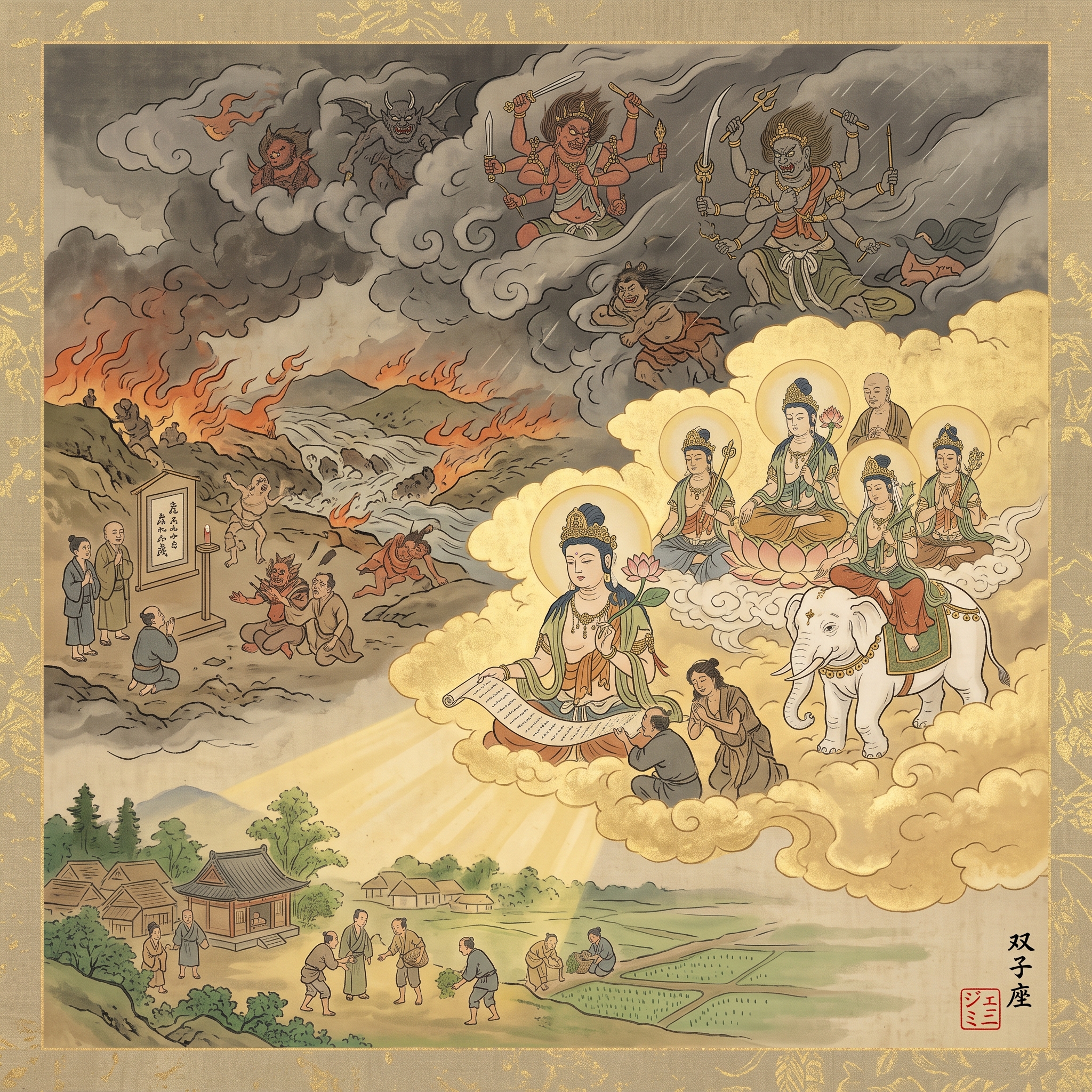
Do not doubt him even at a moment’s thought!
The Pure Saint World-Voice-Perceiver is reliable
When you suffer, and when you are confronted
With the calamity of death.

Śākyamuni Buddha sings these verses in Chapter Twenty-Five of the Lotus Sūtra. The calamity of death is something we all will face eventually, whether it our own or that of those we love. The other calamities in our lives are relatively minor losses which can prepare us for this great calamity. The Bodhisattva World-Voice-Perceiver is the embodiment of Compassion: the desire to benefit all beings. When we learn to use all of the suffering in our lives, especially the calamity of death, as a way to remove our delusions and benefit others, then we can see the world with the eyes of the Buddha and know the joy he declares is at the core of our being.

The Daily Dharma is produced by the Lexington Nichiren Buddhist Community. To subscribe to the daily emails, visit zenzaizenzai.com

The Canonical Robe

Now, in ancient times there lived a monk among the Buddha’s disciples. Once during a famine, as the Buddha did not have enough to eat, this monk sold his own kesa stole and donated the money to the Buddha. The Buddha was curious about the donation and thus asked the monk for details. The monk explained. The Buddha then declined to accept the offering by saying, “A Buddhist priest’s stole is the canonical robe in which various Buddhas in the past, present, and future lives gain emancipation. I do not think I can repay such a great favor which was gained by selling such a precious robe.” The monk then asked the Buddha what he should do with the money for the kesa stole he sold. The Buddha asked in return whether or not the monk had a mother. “Yes, I have,” answered the monk. The Buddha then told the monk that he should offer the money to his own mother. The monk then said to the Buddha, “The Buddha is the Most Venerable One in the triple world. You are the eyes of all living beings. You are able to repay the money of a great canonical robe that may cover all the worlds in the universe or a wide kesa stole that may spread over the great earth. On the contrary, my mother is as ignorant as cattle and more hopeless than a sheep. How will she be able to repay the indebtedness of offering a kesa stole?” In response, the Buddha carefully questioned the monk, “Who gave birth to you? Isn’t it your mother who gave birth to you? There is no doubt that she will be able to repay the indebtedness of this kesa robe.”

Toki-dono Gohenji, Response to Lord Toki, Writings of Nichiren Shōnin, Followers I, Volume 6, Page 6-7

Daily Dharma for February 22, 2026

20260222-ddi

Illustration by Google Gemini

Show Gemini's thinking

Kanji Translation

The kanji text on the scroll reads:

法華経 (Hokekyō)

This translates to The Lotus Sutra.

Gemini Thinking

Defining the Scope
I'm currently working through the initial request, clarifying the parameters. The focus is on a traditional Japanese Buddhist illustration, excluding particular figures but including a signature and stamp. I'm carefully analyzing all the aspects to ensure I grasp the full scope.

Clarifying the Scene
I'm now zeroing in on the specific scene. It's focused on Shakyamuni Buddha teaching Shariputra about the Bodhisattva path within the Lotus Sutra. I am considering the setting, traditionally a mountain landscape representing Vulture Peak, as a serene backdrop. Key figures are Shakyamuni and Shariputra, and the listening monks.

Refining the Details
I'm now integrating the details of the scene. I am considering the serene mountain landscape and the core figures: Shakyamuni Buddha, Shariputra, and the listening monks. I'm focusing on the Dharmachakra Mudra for the Buddha and the attentive posture of Shariputra, emphasizing the act of "hearing" the teachings. I am now deciding on subtle visual cues that represent the light or sound of the teaching itself.

Visualizing the Composition
I am now focusing on the composition of the scene and its stylistic elements. I'm prioritizing the inclusion of Shakyamuni, Shariputra, and the monks. I am considering the "Dharmachakra Mudra," and now thinking of incorporating the symbol of the sutra itself to ground the illustration. I am also planning the placement of the artist's signature and seal. I'm refining the composition to emphasize the act of "hearing" the teachings. I am deciding how to depict the visual elements of light.

Defining the Visuals
I'm now fully immersed in the creation process, focusing on the visual aspects. I will begin by setting up the square format, and traditional style requirements. I'm focusing on Shakyamuni Buddha and the Dharma Chakra Mudra, with Shariputra and other monks in their places. I am thinking of adding additional elements to visually represent the teaching's purpose. I must remember the signature, seal, and minimal text details, and the aged aesthetic.

Verifying Scene Fidelity
I am now focused on evaluating the consistency of the illustration with the user's prompt. The goal is to make sure all elements align correctly, like the Japanese Buddhist art style and the Lotus Sutra scene. I need to make sure the key features, like Shakyamuni, Shariputra, the scroll and the Bodhisattva concept are present and coherent.

Confirming Artistic Alignment
I have finished cross-checking the illustration. It precisely captures all elements described, from the stylistic elements to the Lotus Sutra scene. I confirmed Shakyamuni's presence, along with Shariputra and the 'Hokkekyō' scroll. The Bodhisattva concept is also represented and the signature/seal are in the right places, and the exclusion of the other Buddhas is also confirmed.

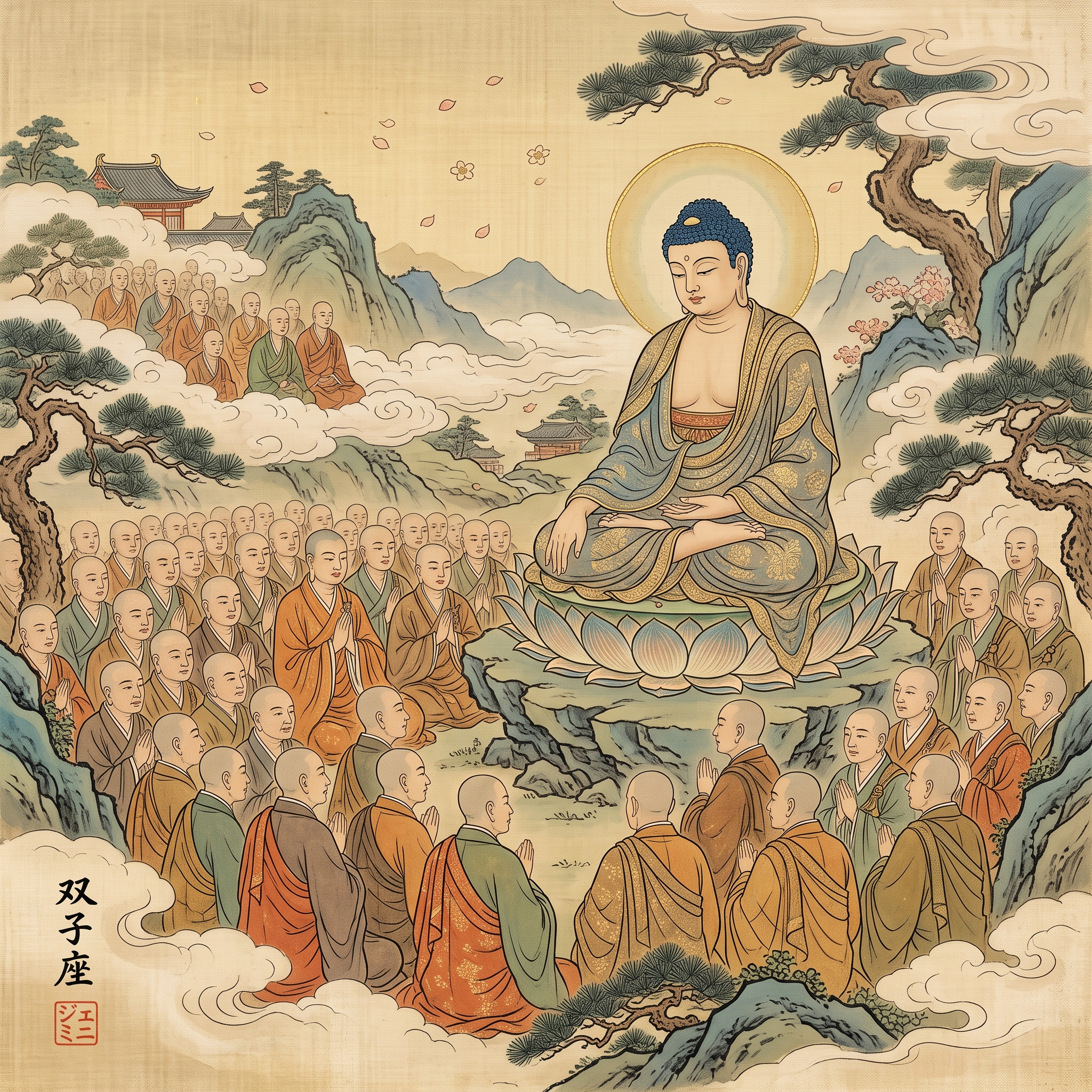
Śāriputra! Some disciples of mine, who think that they are Arhats or Pratyekabuddhas, will not be my disciples or Arhats or Pratyekabuddhas if they do not hear or know that the Buddhas, the Tathāgatas, teach only Bodhisattvas.

Śākyamuni Buddha makes this declaration to his disciple Śāriputra in Chapter Two of the Lotus Sutra. When the Buddha says he only teaches Bodhisattvas, he does not mean that he excludes anyone from his teaching. It is only when we realize and develop our capacities as Bodhisattvas, beings who exist to benefit all beings, rather than being preoccupied with our own suffering, can we hear, practice and appreciate the Buddha Dharma.

The Daily Dharma is produced by the Lexington Nichiren Buddhist Community. To subscribe to the daily emails, visit zenzaizenzai.com

A Good Medicine for the Diseases of People

[The “Hōkikō Gobō Shōsoku” is a letter written by Nichirō by order of Nichiren and it is addressed to Nikkō.]

A passage composed of the 28 Chinese characters that states, “The Lotus Sūtra is good medicine for the diseases of people of the Jambudvīpa; if a patient can hear this sūtra, his disease will disappear at once, and he will neither grow old nor die,” is taken from the “Medicine King Bodhisattva” chapter of the Lotus Sūtra. When Nichiren’s wet nurse who had a serious illness for about a year died, Nichiren Shōnin chanted this passage and placed it in her mouth with pure water. It revived her at once. Lord Nanjō Tokimitsu is not a high-ranking samurai but he is a devoted follower of Nichiren Shōnin. It would be better for him to pray to King Yama beseeching for help just this once, though it might be his karma from his previous life. As a way of curing his illness, please get a cup of pure water from the Shōnin River between 4 a.m. and 8 a.m., write down the 28 character passage of the “Medicine King Bodhisattva” chapter on a piece of paper and burn it. Then, please mix the ashes in the water and have him drink it.

Hōkikō Gobō Shōsoku, Letter to Nikkō, Writings of Nichiren Shōnin, Volume 5, Pages 217-218

Daily Dharma for February 21, 2026

20260221-ddi

Illustration by Google Gemini

Show Gemini's thinking

Gemini Thinking

Defining the Illustration Parameters
I'm now zeroing in on the core of the task: crafting a square illustration that captures the essence of a traditional Japanese Buddhist painting. The initial stage has been to deconstruct the request, focusing on the stylistic requirements, namely traditional Japanese Buddhist illustration. This will then be brought to life using the quote by Nichiren.

Refining the Composition's Details
I've been working to refine the composition further. I'm focusing on the details of the scene and figures now. I have specified Nichiren as a monk in robes and Shijō Kingo as a samurai, with a tearful expression. I'm visualizing Tatsunokuchi as a beach scene with waves, cliffs, and pine trees, all under a dramatic sky to convey the mood. The focus is on the moment just before the execution, to heighten the somber feeling. I have also determined the signatures that need to be in the painting.

Structuring the Narrative Scene
I'm now integrating all these elements. I am focusing on the balance between figures, the landscape, and the emotional weight of the moment. I will pay attention to the details, like Nichiren's expression and Shijō Kingo's tears, against the backdrop of Tatsunokuchi. I am now finalizing the details for the text and placement of the signatures.

Outlining the Core Elements
I'm now zeroing in on defining the central components for the illustration. I am concentrating on the precise depiction of figures. I must ensure the correct style of the traditional Japanese Buddhist illustration. I am planning the arrangement of Nichiren, Shijō Kingo, the horse, and the Tatsunokuchi setting. The focus is to capture the somber mood and the emotional bond between the characters.

Analyzing Visual Elements
I'm currently focused on evaluating the image's components and verifying they align with the user's description. The composition seems suitable, and I'm cross-referencing to ensure all key details, including the requested characters and setting, are present and accurate. The style is also a primary focus to ensure correct implementation of the prompt.

Confirming Request Compliance
I've confirmed the image's adherence to the prompt. It includes the required characters within the specified Tatsunokuchi setting. The signature and seal are present as instructed, and the artistic style aligns well with the prompt. I'm satisfied with the composition's fit to the description. I'm ready to move forward.

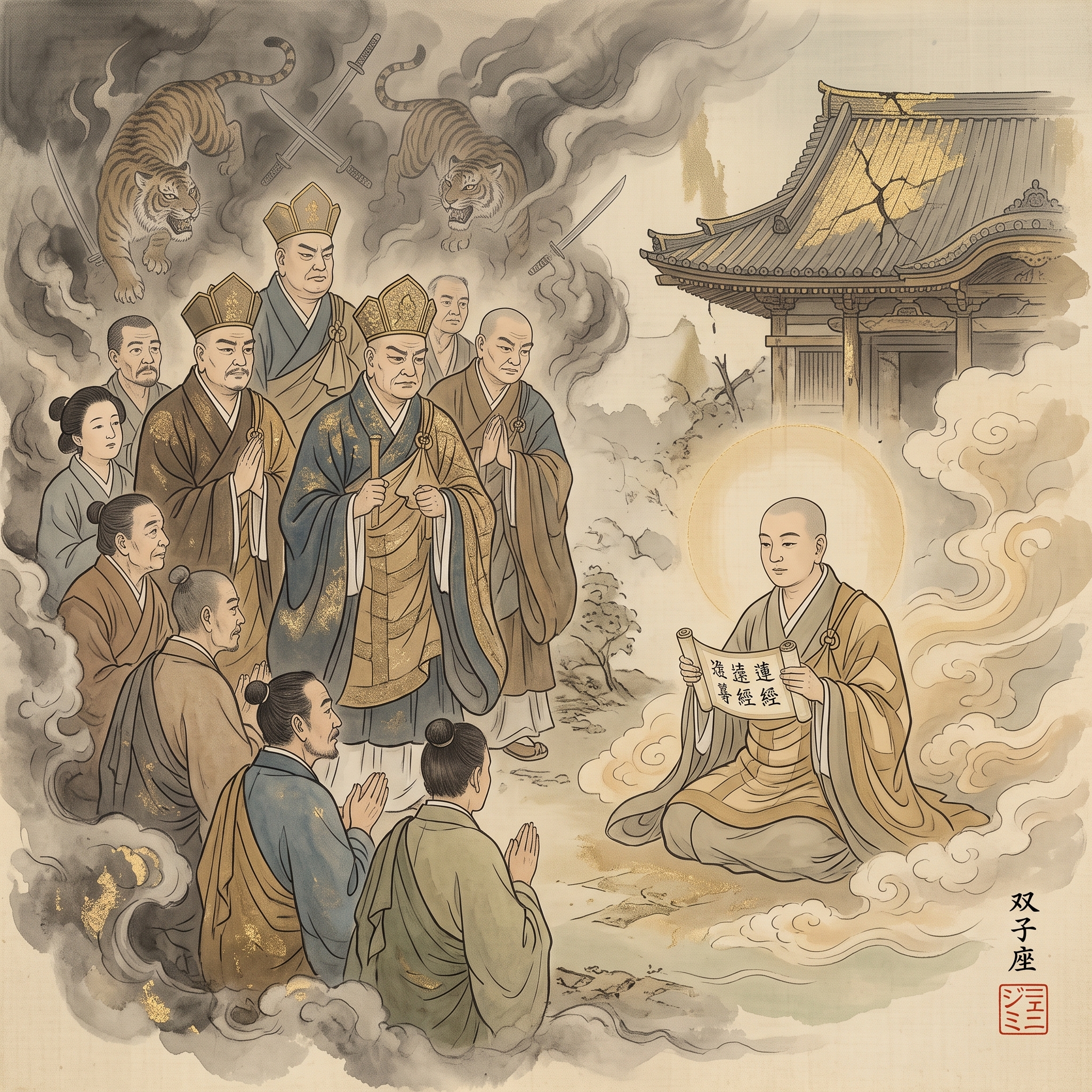
I still remember vividly how you accompanied me to Tatsunokuchi holding a horse by the bridle, and breaking into tears when I was about to be beheaded there. I will never forget this no matter how many lifetimes come and go. If by chance you should fall into hell, I will refuse the invitation of Śākyamuni Buddha to become a Buddha. Instead I will go into hell with you. If we both entered into hell, how could it be that we would not find Śākyamuni Buddha and the Lotus Sutra there?

Nichiren wrote this passage in his “Emperor Shushun” Letter (Sushun Tennō Gosho) addressed to his disciple Shijō Kingo. Despite the hardships he faced in his life, Nichiren never forgot the kindnesses shown to him by ordinary people. His great determination to save all beings made him fearless even were he to be threatened by the Buddha with the torments of the Hell realms for the sake of those dear to him. Nichiren knew that he would be able to find the Buddha anywhere, and that his devotion would overcome any difficulty.

The Daily Dharma is produced by the Lexington Nichiren Buddhist Community. To subscribe to the daily emails, visit zenzaizenzai.com

Clouds of Ignorance

Thinking over these matters, I begin to dream while resting on my meditation cushion. Awakened by a deer crying for his mate, I realize that within me the moon of “the unity of the triple truth” and “threefold contemplation in a single thought” has been shining brightly all along, but because the moon was covered by the clouds of deep ignorance I have suffered through the cycle of birth and death in the nine realms until today. My present realization is:

Even the clouds of ignorance
That spread over us
Would be dispersed
By the winds of Mt. Sacred Eagle
Filled with the sound of the Sacred Dharma.

Minobu-san Gosho, Mt. Minobu Letter, Writings of Nichiren Shōnin, Volume 5, Page 131

Daily Dharma for February 20, 2026

20260220-ddi

Illustration by Google Gemini

Show Gemini's thinking

Gemini Thinking

Comprehending Nichiren's Words
I'm currently focused on the essence of Nichiren Daishonin's writing. I'm trying to distill the core meaning: the shedding of "tears of nectar" in the face of difficulties. My focus is on the themes of endurance and devotion to the Lotus Sutra, which seem central.

Visualizing Nichiren's Hardships
I'm now focusing on translating the textual elements into a visual concept. I've broken down the key components: Nichiren's figure, the challenging environment, and the symbolic "tears of nectar." The stylistic direction is set, moving toward traditional Japanese aesthetics to convey the themes of endurance and devotion. I am concentrating on the most critical details and how they interact.

Conceptualizing Nichiren's Image
I'm now focused on the specifics. I've broken down the composition into Nichiren, the challenging environment, and the symbolic tears. I'm aiming for a visual representation that emphasizes his humanity within the harsh natural setting, with a focus on the suggested birds and insects. I'm working to integrate the Japanese aesthetic elements such as misty, layered perspective.

Assessing The Composition
I am now focusing on evaluating the image's adherence to all constraints set forth in the prompt. I am currently examining how well the square aspect ratio and specific exclusion of figures are realized. I'm also analyzing the composition's conformity to stylistic requirements.

Verifying Compliance and Style
I'm currently focused on verifying the image meets all requirements. I see that it fulfills the constraints, including the square ratio and exclusion of specified elements. It also matches the stylistic guidelines. I'm satisfied that it's a good match for the prompt.

Tears keep falling when I think of the current unbearable hardships, but I cannot stop tears of joy when I think of obtaining Buddhahood in the future. Birds and insects chirp without shedding tears. I, Nichiren, do not cry, but tears keep falling. These tears are shed not for worldly matters, but solely for the sake of the Lotus Sutra. Therefore they should be called tears of nectar.

Nichiren wrote this as part of his letter to monk Sairen-bō in his Treatise on All Phenomena as Ultimate Reality (Shohō-Jissō Shō). For the sake of the Lotus Sūtra, Nichiren endured two harsh exiles, his house being burnt down, ambushes by soldiers with swords, being placed on the execution mat himself, and the persecution of his followers. Despite all these obstacles, he held true to the Buddha’s teaching in the face of all opposition. Most of us who practice the Lotus Sūtra today have lives of relative comfort. It is wonderful that we have Nichiren’s example. He was a human being just like us, and we too are capable of his faith and determination.

The Daily Dharma is produced by the Lexington Nichiren Buddhist Community. To subscribe to the daily emails, visit zenzaizenzai.com

With Strong Faith and Deep Determination

In the past, the Buddha, wishing to repay his debt to his mother Māyā, ascended to the Trāyastriṃsá Heaven on the fifteenth day of the fourth month. While he was there, everyone in the five regions of India from the rulers and their great vassals down to the ordinary men and women, sobbed with grief and lamented that they had lost the Buddha, like parents who had lost a child or a child who had lost his parents. For a man to be separated from a beloved wife or a woman from her beloved husband is unbearable. How much more unbearable a separation from the World Honored One of Great Enlightenment with the thirty-two marks and eighty signs, whose color is a beautiful purple-gold, and whose voice is that of the kalaviṅka bird, and who teaches that all sentient beings will attain Buddhahood. Because of the Buddha’s deep loving-kindness and compassion, their longing and grief for Him is indescribable. It exceeded the grief of the beautiful lady imprisoned in the Shang-yang Palace; it exceeded the grief of the two daughters of Emperor Yao, O-huang and Nu-ying, when they were parted from Emperor Shun; and it exceeded the longing of Su Wu, banished for nineteen years to live amidst the snow in a foreign land.

A man who longed to see the Buddha took wood to make an image of Him, but he was unable to carve the likeness of even one of the thirty-two marks of the Buddha. At that time the great King Udayāna summoned Viśvakarman, the Carpenter, down from the Trāyastriṃsá Heaven and had a statue carved from red sandalwood. That statue went to meet the original Buddha in the Trāyastriṃsá Heaven, because of King Udayāna’s deep faith. This was the first statue of the Buddha carved in Jambudvipa.

Again, there was a wealthy man called Sudatta. When the Buddha was to descend to India from the Trāyastriṃsá Heaven on the fifteenth of the seventh month, Sudatta wished to build a monastery, but he had no land on which to build. Prince Jeta, a son of King Prasenajit, owned a park called Jetavana, which was about 40 li wide. This park was such a sacred and peaceful place that if one were to bring in swords or knives, the weapons would suddenly break apart. When the wealthy man Sudatta asked for the park in which to build his monastery, the prince told him he would only sell it for the amount of gold it would take to cover the park 4 inches thick. Sudatta agreed to the terms, but the prince then said, “I was only joking. The park is not for sale.” Sudatta insisted, “The Son of Heaven can never be double-tongued. How could you lie, even for a moment?” and he told King Prasenajit what had happened. “Prince Jeta is the heir to the throne. How could he lie even in jest,” wondered the king. Prince Jeta had no choice but to sell the park. Then, when the wealthy man Sudatta paid for the park with gold piled four inches thick as promised and joyfully prepared to build the monastery, Śāriputra appeared with a rope to demarcate the grounds of the park. Then he looked up into the sky and laughed. Sudatta remarked, “A great sage always has a dignified bearing and maintains self-control. What strange thing have you seen to cause you to laugh?” Śāriputra replied, “Because of this monastery you are building the six heavens of the realm of desire are each raising armies to contend for you. Each of the gods wants the person who is cultivating such a tremendously good deed in his own heaven. I am laughing at them for fighting. When your life-span is over, you will be born in the Tuṣita Heaven.” Thus the monastery was built and named the Jeta Grove Monastery.

On the night of the fifteenth of the seventh month when the Buddha was about to enter the temple, Indra and the King of the Brahma Heaven built three bridges made of gold, silver, and crystal from the Trāyastriṃsá Heaven. The Buddha entered by the middle bridge, while Indra on his left and the King of the Brahma Heaven on his right held a canopy over the Buddha. Behind the Buddha came the four categories of Buddhists (monks, nuns, laymen, and laywomen); the eight kinds of supernatural beings (gods, asura, dragons, gandharva, kiṃnara, garuda, mahoraga, and yakṣa); twelve hundred arhats led by Kāśyapa, Kātyāyana, Maudgalyāyana, and Subhūti; twelve thousand hearers; and eighty thousand bodhisattvas.

All the people of the five regions of India gathered together to collect oil to offer lamps. Some lit ten thousand lamps, some lit one thousand lamps, some lit one hundred lamps, and some could only light one lamp. Among them was an impoverished woman, incomparably poor. She had no clothes except a mat woven of wisteria vines even coarser than a rush mat. She ran about in all four directions but was not able to get enough money to buy enough oil for even a single lamp. She looked up to the sky and cried, thinking that if her tears had been oil they could have fueled one hundred or one thousand or ten thousand lamps or more.

After much thought, she cut off her own hair, and braided it into a wig that she sold to buy oil for a single lamp. Perhaps because her devotion was accepted by the Buddha and gods, the three treasures, the heavenly deities, and the terrestrial deities, her lamp alone was not extinguished by the fierce winds that blow at the destruction of the world and the beginning of a new world cycle, and it lit the way as the Buddha entered the Jeta Grove Monastery.

As you see, even if people are rich and give great treasures as alms, if their faith is weak they cannot attain Buddhahood. Even though people are poor, if they have strong faith and deep determination they will attain Buddhahood without fail.

Minobu-san Gosho, Mt. Minobu Letter, Writings of Nichiren Shōnin, Volume 5, Pages 133-135

Daily Dharma for February 19, 2026

20260219-ddi

Illustration by Google Gemini

Show Gemini's thinking

Gemini Thinking

Analyzing the Core Elements
I'm now focusing on breaking down the initial request. I've pinpointed the key aspects: a Japanese Buddhist illustration with a traditional painting aesthetic, in a square format. I'm carefully noting the need to avoid specific Buddha figures while incorporating a signature and seal. This detailed breakdown will guide the subsequent stages.

Defining the Visual Narrative
I'm now establishing the visual narrative. I'm focusing on how to represent the provided quote. I am considering a figure in a worldly setting, like a market or a court, yet with a spiritual element. I'm working to show the integration of wisdom into daily activities, and considering scrolls or other symbols to represent this. I'm focusing on the signature and seal, and have specified "双子座" (kanji signature) and "ジェミニ" (katakana) with a red square seal. I'm aiming for the best placement.

Refining the Composition
I am now focusing on refining the composition. I've chosen a central figure, a Bodhisattva-like layperson in a stylized marketplace, holding an open sutra scroll. I am incorporating golden light and lotus petals to connect to surrounding activities. I'm focusing on a traditional Japanese ink and mineral pigment style, and have decided to include muted, earthy tones with flashes of gold. I am ensuring that the layout is dynamic and interconnected. I am working on the supporting scenes now.

I am working on the supporting scenes, which include a merchant interacting with customers, a scholar studying diverse texts, and a figure advising an official. All scenes will be connected by the light emanating from the sutra scroll, representing the application of Buddhist teachings in daily life. I am being precise about the elements that I am using. I am giving specific attention to how the composition will create a sense of harmony. I am aiming for a design that will highlight clarity in the mundane world. I am planning on working on the signature and seal elements as well.

Visualizing the Concept
I'm now in the process of translating the brainstormed visual metaphors into a detailed prompt. I've focused on creating a traditional Japanese ink and mineral pigment painting with a dynamic composition. A central figure, a Bodhisattva-like layperson, will be shown in a stylized marketplace, holding a glowing sutra scroll. I am ensuring that the layout connects surrounding scenes: a scholar, an official, and a merchant, all touched by the light from the scroll. I will place the signature and seal appropriately.

Analyzing the Output's Fidelity
I'm verifying the correspondence of the generation to the user's initial instructions, focusing on the accurate translation of their request. The traditional Japanese aesthetic is rendered appropriately, and the core theme appears to have been captured, and the formatting looks correct. My evaluation will consider whether the key elements were addressed and presented as requested.

Confirming Image Alignment
I have finished checking the alignment between the user's prompt and the generation. The core concept appears to have been well-handled. The Japanese style seems correct and the signature and seal are correctly placed, according to my understanding of the user's request. My next step will be to finalize the image's presentation and prepare it to be forwarded to the user.

When they expound the scriptures of non-Buddhist schools, or give advice to the government, or teach the way to earn a livelihood, they will be able to be in accord with the right teachings of the Buddha.

Śākyamuni Buddha gives this explanation to Constant-Endeavor Bodhisattva in Chapter Nineteen of the Lotus Sūtra, describing those who keep the Lotus Sūtra. In this chapter, the Buddha shows that our practice of this Wonderful Dharma is not separate from our existence in this world. The purpose of the Buddha’s wisdom is not to escape to a better life, but to see our lives for what they are, and to use that clarity for the benefit of all beings.

The Daily Dharma is produced by the Lexington Nichiren Buddhist Community. To subscribe to the daily emails, visit zenzaizenzai.com