All posts by John Hughes

Nichiren’s Visions of Aizen Myōō and Fudō Myōō

Aizen myoo
The living Aizen Myōō appeared to me in the glow of the sunset on New Year’s Day. I have become the twenty-third successor to the dharma transmitted from the Great Sun Buddha.

Twenty-fifth day of the sixth month in the sixth year of Kenchō (1254)

Nichiren presents this to the New Buddha.

fudo myoo
The living Fudō Myōō also appeared to me in the light of the full moon from the 15th through the 17th day of the same month. I have become the twenty-third successor to the dharma transmitted from the Great Sun Buddha.

Twenty-fifth day of the sixth month of the sixth year of Kenchō (1254)

Nichiren presents this to the New Buddha

Fudō Aizen Kanken-ki, Record of Seeing Fudō and Aizen Myōō, Writings of Nichiren Shōnin, Biography and Disciples, Volume 5, Pages 1


Daily Dharma for February 13, 2026

20260213-ddi

Illustration by Google Gemini

Show Gemini's thinking

Gemini's Thinking

Defining the Illustration Theme
I'm focusing on distilling the essence of the Buddhist teaching on non-judgmental compassion, with the image's iconography serving this very point. I'm exploring the nuances of incorporating a signature to identify the artwork.

Conceptualizing the Composition
I'm now zeroing in on the visual narrative, concentrating on how to best portray Śākyamuni Buddha's teaching. My focus is on representing the diversity of beings and teachings, and how to visually distinguish the "Way" from those who are "straying." I'm refining the composition to emphasize the adaptive nature of his compassion.

Visualizing the Verse
I'm now integrating the chosen iconography to visually communicate the core message. I'm focusing on the interplay between the central Śākyamuni Buddha and the figures representing various beings. The landscape setting and subtle symbolism of the path and lotus buds are key to expressing the adaptive compassion, while I avoid specific Buddhist figures in favor of a universal illustration. I am concentrating on the square aspect ratio and incorporation of the signature.

Refining the Composition
I am now focusing on refining the prompt to depict Śākyamuni Buddha in a way that aligns with the user's intent, using visual cues to illustrate the themes of compassion and the varied paths. I am detailing the interactions between the figures and the symbolic elements, aiming for an illustration that reflects both the "Way" and those who are "straying." I'm also preparing to incorporate the signature and seal. I'm taking care to clarify the overall style.

Refining the Composition
I am now focusing on refining the prompt to depict Śākyamuni Buddha in a way that aligns with the user's intent, using visual cues to illustrate the themes of compassion and the varied paths. I am detailing the interactions between the figures and the symbolic elements, aiming for an illustration that reflects both the "Way" and those who are "straying." I'm also preparing to incorporate the signature and seal. I'm taking care to clarify the overall style.

I am breaking down the illustration's components, carefully choosing the appropriate details for Śākyamuni Buddha, ensuring the figures effectively represent the intended "Way" and those straying from it, and adding specific details to the landscape. I am also working to ensure the proper placement of the signature and seal. I am refining how to use visual symbols and the overall atmosphere for maximum impact.

Verifying Imagery Authenticity
I am checking whether the image aligns with the provided description, focusing on the portrayal of Śākyamuni Buddha and the diverse audience. The key is in verifying its alignment with the verse, the compassionate nature of the teachings, and the Japanese Buddhist iconography.

Analyzing Visual Concordance
I've confirmed the image's fidelity to the verse. The illustration adeptly conveys Śākyamuni Buddha sharing teachings with a varied assembly, each with a lotus. I'm focusing on the Japanese Buddhist elements, and the specified Buddha's absence is correct. The required seal and signature are in their intended places.

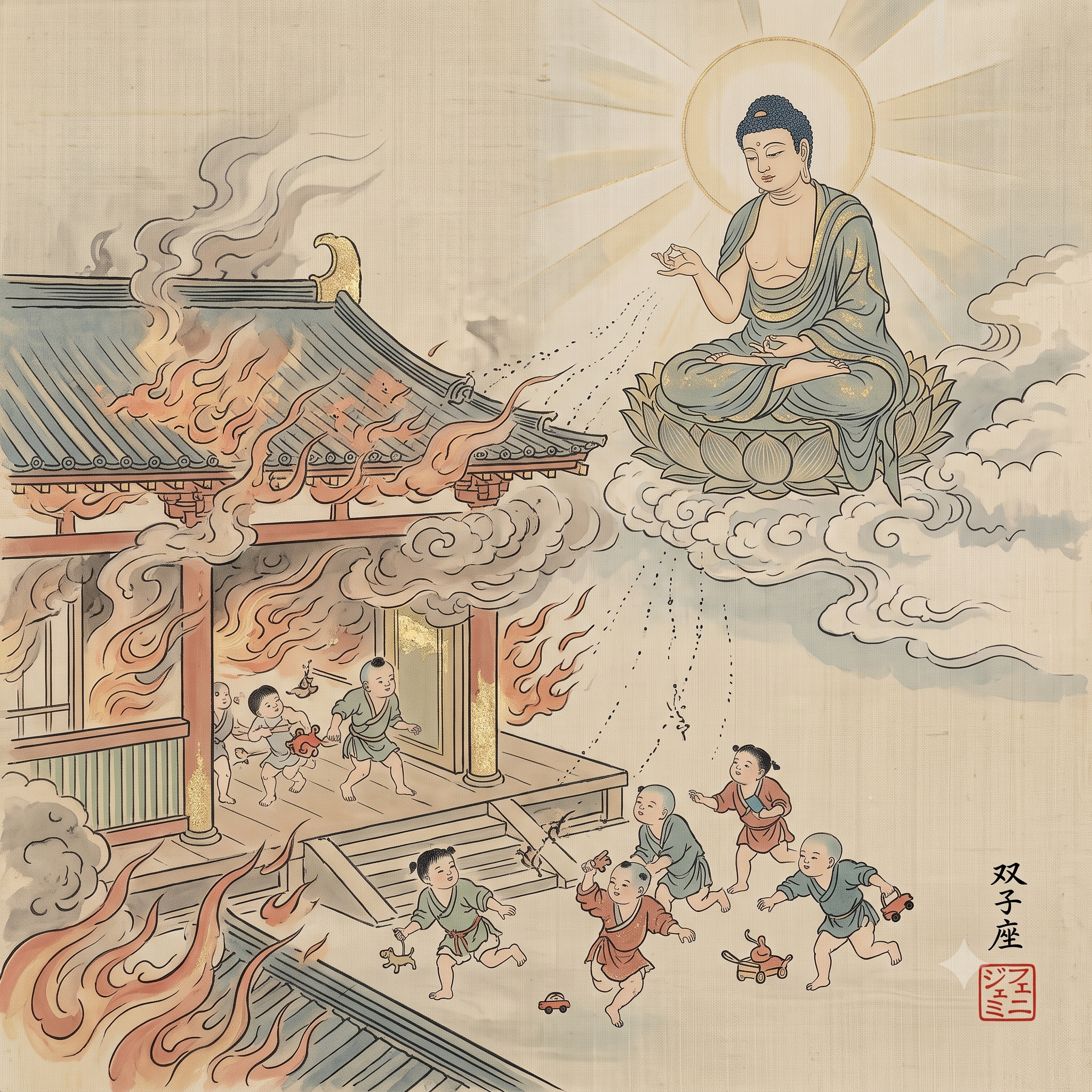
I know who is practicing the Way and who is not.
Therefore I expound various teachings
To all living beings
According to their capacities.

Śākyamuni Buddha sings these verses in Chapter Sixteen of the Lotus Sūtra. Even though the Buddha knows when we have strayed from the way of compassion and wisdom that he has opened for us, he knows that the innate capacity we have for enlightenment remains unchanged. Therefore, he does not judge us, or give up in his efforts to lead us away from our delusions. When we maintain our determination to save all beings despite their delusions, we maintain this mind of the Buddha and nourish the seeds of our own enlightenment.

The Daily Dharma is produced by the Lexington Nichiren Buddhist Community. To subscribe to the daily emails, visit zenzaizenzai.com

Reverse Relationship to the Lotus Sūtra

I am grateful to have been born a human with this precious body due accumulated causes and conditions in my past existences. According to the sūtra, I must have encountered and given offerings to ten trillion Buddhas in the past. Even though I did not place my faith exclusively in the Lotus Sūtra, thus slandering the True Dharma and being born poor and lowly in this life as a result, my merit of giving offerings to the Buddhas was so great that I was born as a believer of the Lotus Sūtra.

Interpreting this, Grand Master T’ien-t’ai (sic) states, “It is like a person who falls to the ground but does not stay there and rises from the ground instead.” Those who fall to the ground get up from the ground instead. Likewise, the grand master states, slanderers of the Lotus Sūtra fall on the ground of the three evil realms and the realms of human and heavenly beings; however, due to their reverse relationship to the Lotus Sūtra they will be led by the hand of the sūtra into the realm of Buddhas.

Hokke Shōmyō-shō, Treatise on the Testimony of the Lotus Sūtra, Writings of Nichiren Shōnin, Faith and Practice, Volume 4,
Page 193

Daily Dharma for February 12, 2026

20260212-ddi

Illustration by Google Gemini

Show Gemini's thinking

Gemini's Thinking

Conceptualizing Visual Metaphor
I am now focusing on the textual analysis, specifically the Nichiren passage regarding the difficulty of attaining Buddhahood. I am thinking about how to visually represent the comparison to the low survival rate of fish eggs within a Japanese Buddhist aesthetic, and I am avoiding both Amitabha and Mahavairocana.

Refining Symbolism Choices
I am now developing the visual metaphors. I have settled on a determined monk as the central figure. I will incorporate clusters of glowing fish eggs with very few transforming into small, vibrant fish to illustrate the rarity of attaining Buddhahood. I am avoiding using a mango blossom image, and instead I am considering a line of armored samurai, with one stepping forward bravely, sword drawn, while others are distracted. I am working on the composition of the scene.

Developing Visual Composition
I am now structuring the scene around a central, resolute monk. I am incorporating multiple metaphors, like the fish eggs and samurai. I plan to use a square format for the illustration, and I am incorporating a color palette typical of Japanese Buddhist painting. I am also planning the placement of the calligraphy elements.

Structuring Visual Scene
I am now organizing the composition in a square format, focusing on a determined monk in a traditional Japanese Buddhist style. I intend to surround the central figure with smaller, metaphorical scenes, such as glowing fish eggs and a line of samurai. I am concentrating on the color palette, using rich, slightly muted colors with gold accents typical of Nihonga. I also intend to add the calligraphy elements.

Analyzing the Illustration's Fit
I'm currently assessing the generated illustration. The traditional Japanese Buddhist style elements are present, and the required signature and red seal are included. I'm focusing on how well the visuals match the textual descriptions, noting the representation of the monk, fish eggs, mango blossoms, and warriors.

Confirming the Visual Alignment

I've confirmed the image's adherence to the stylistic and contextual requirements. The elements from the request—monk, fish eggs, mango blossoms, warriors—are all present and accounted for. There are no prohibited Buddhist figures in the image. I am prepared to present this image.

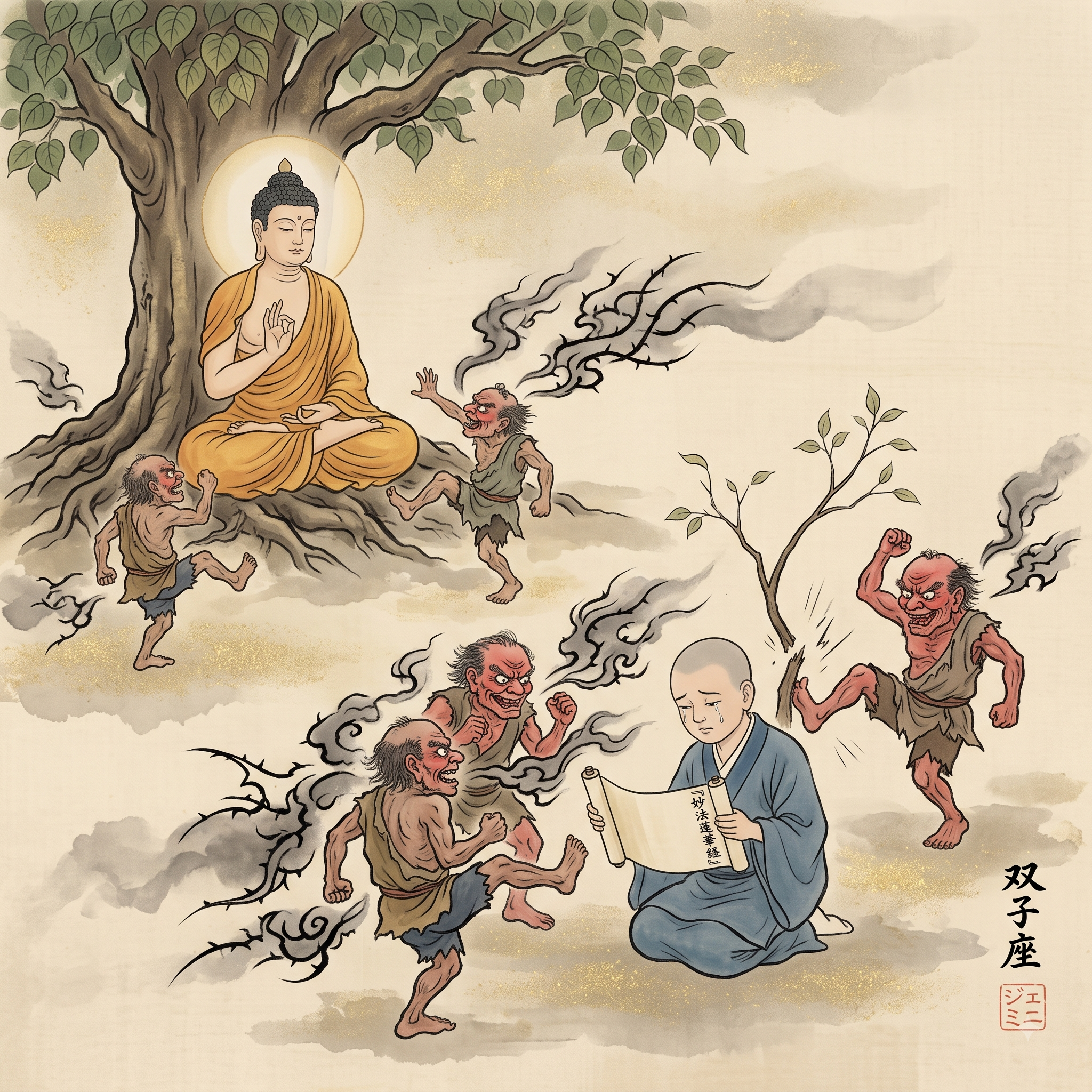
There are thousands of fish eggs, but few become fish. Hundreds of mango blossoms bloom, but few become fruit. It is the same with human beings, because most people are turned aside by evil distractions. There is an army of warriors wearing armor, but few are able to fight bravely. Many people search for truth, but few attain Buddhahood.

Nichiren wrote this passage in his Letter to Lord Matsuno. In Nichiren’s lifetime he saw many of his followers charmed by his teaching, but lacking the resolve to practice. This letter was one of many Nichiren used to encourage us not to waste our precious human life with frivolous pursuits, destructive actions, and selfish desires. It reminds us that we all carry the seed of Buddha nature, and to look for ways to nourish that seed.

The Daily Dharma is produced by the Lexington Nichiren Buddhist Community. To subscribe to the daily emails, visit zenzaizenzai.com

What Kinds of Doctrines Are Expounded in the Lotus Sūtra?

What kinds of doctrines are expounded in such a precious sūtra entitled the Lotus Sūtra? Beginning with the “Expedients” chapter in the first fascicle, the sūtra expounds that bodhisattvas, Two Vehicles (Śrāvaka and Pratyekabuddha) and ordinary people are all able to attain Buddhahood, though there is no actual proof yet. Suppose a guest visits you for the first time. He looks fine, speaks politely, and there is nothing dubious about his words, but until you confirm the truth about him, it would be difficult to believe him from merely his words. In such a case, if something important happens one after another to confirm his words, you can trust him thereafter without hesitation.

Although we believed the doctrine of attainment of Buddhahood by all living beings because it was preached by the Buddha, it was difficult for some to fully accept it because of the lack of actual proof. However, it all became clear when the most important doctrine of becoming a Buddha with one’s present body was expounded in the “Devadatta” chapter in the fifth fascicle of the Lotus Sūtra. It is like turning black lacquer into white or purifying dirty water by putting a wish-fulfilling gem in it. The Buddha helped a small snake, who was actually a daughter of the dragon king, attain Buddhahood with her present body. From that moment, no one could have the slightest doubt about all men attaining Buddhahood. Therefore, the Lotus Sūtra expounds attainment of Buddhahood by all people after the model of enlightenment of women. Grand Master Dengyō of Mt. Hiei, who first spread the true meaning of the Lotus Sūtra in Japan, annotated in his Outstanding Principles of the Lotus Sūtra, “Neither the dragon girl, who became a Buddha to preach the dharma, nor the people who heard her preach the dharma needed a roundabout way to Buddhahood. They immediately attained Buddhahood with their present bodies by the power of the Wonderful Dharma.”

Sennichi-ama Gozen Gohenji, A Reply to My Lady Nun Sennichi, Writings of Nichiren Shōnin, Faith and Practice, Volume 4,
Page 152-153

Daily Dharma for February 11, 2026

20260211-ddi

Illustration by Google Gemini

Show Gemini's thinking

Gemini's Thinking

Analyzing the Components
I'm currently breaking down the Nichiren Daishonin analogy. I see the "scaffold" symbolizing expedient teachings, while the Great Tower represents the Lotus Sutra's ultimate truth. I'm focusing on their symbolic relationship.

Visualizing the Structure
I am now visualizing the key elements. The scaffold will be a yagura-style structure, clearly supporting a Japanese pagoda, which will be the central element. I'm considering how to depict the dismantling process, possibly with stylized figures. Lotus flowers and the Lotus Sutra characters will be included to represent the core meaning. I am settling on a Nihonga style.

Refining the Composition
I am now focusing on refining the visual composition, emphasizing the contrast between the scaffolding and the pagoda. The monks dismantling the scaffolding will be stylized to convey action. I am also considering the placement of the Lotus Sutra characters on the pagoda.

Conceptualizing the Composition
I am now focusing on refining the visual details. I am settling on a Nihonga style. I am going to try for stylized figures dismantling the yagura scaffold. I am also planning the placement of the Lotus Sutra characters on the pagoda.

Analyzing Visual Elements
I'm verifying if the illustration matches the user's request, focusing on the analogy of the pagoda and scaffold. I've noted the style is a good match for traditional Japanese art, while also respecting the negative constraints.

Verifying Analogy & Style
I'm checking the illustration to ensure it aligns precisely with the user's instructions. Specifically, I'm confirming the successful representation of the pagoda-scaffold analogy and that the negative constraints are met. The style adheres to the user's expectations for Japanese art.

For example, in building a huge tower, a scaffold is assembled from many small pieces of wood set up ten or twenty feet high. Then, using this scaffold, the huge tower is built with lumber. Once the tower is completed, the scaffold is dismantled. The scaffold here represents all Buddhist scriptures other than the Lotus Sutra, and the Great Tower is the Lotus Sutra. This is what is meant by “discarding the expedient.” A pagoda is built by using a scaffold, but no one worships a scaffold without a pagoda.

Nichiren wrote this passage in his Response to My Lady the Nun, Mother of Lord Ueno (Ueno-dono Haha-ama Gozen Gohenji). In this simile, Nichiren compares the Buddha’s expedient teachings to the Wonderful Dharma he provides in the Lotus Sūtra.

The Daily Dharma is produced by the Lexington Nichiren Buddhist Community. To subscribe to the daily emails, visit zenzaizenzai.com

Only the Odaimoku

Some of my disciples pretend to know the details of doctrines. They are mistaken. The odaimoku, Namu Myōhō Renge Kyō, is the essence of the Lotus Sūtra. It is like a human being’s spirit. If any other teachings were to be added to the odaimoku, it would be the cause of great trouble. It would be like the Empress marrying two Emperors or committing adultery. The teachings of the Lotus Sūtra did not spread far enough during the Ages of the True Dharma and the Semblance Dharma. This was because these periods were intended for other sūtras.

We are presently living in the Latter Age of Degeneration. The Lotus Sūtra and other sūtras are no longer efficacious in bringing about enlightenment. Only the odaimoku can accomplish this. This is not my arbitrary opinion. It was so-arranged by the Buddha, the Buddha of Many Treasures, various Buddhas from all over the universe, and numerous great bodhisattvas from beneath the earth such as Superior Practice Bodhisattva.

It is a serious mistake to mix other teachings with the odaimoku. For example, when the sun rises, we no longer need to use lamps. When it rains, the dew is of no use. A baby does not need any nourishment except for milk. We do not need to add supplements to effective medicine.

Ueno-dono Gohenji, A Reply to Lord Ueno, Writings of Nichiren Shōnin, Faith and Practice, Volume 4, Page 135

Daily Dharma for February 10, 2026

20260210-ddi

Illustration by Google Gemini

Show Gemini's thinking

Why three tusks on Universal Sage's elephant? What Google Gemini Just Can’t Do

Gemini's Thinking

Defining the Illustration's Subject
I'm starting by defining the core subject: a group of virtuous individuals aspiring to the Lotus Sutra's teachings, and I'll need to include Shakyamuni Buddha in this scene.

Visualizing the Composition
I'm now focusing on the composition, ensuring Shakyamuni and Universal-Sage are centrally placed, with the four visualized conditions integrated into the landscape below. I'm aiming for a reverent and hopeful mood, and the square format should work well. I will be incorporating the title, signature, and seal.

Assessing Artistic Accuracy
I am now evaluating the generated illustration against the user's explicit request and constraints. It seems to align with the desired traditional Japanese Buddhist style and successfully features Shakyamuni Buddha and Universal-Sage Bodhisattva. The crucial absence of Amida and Dainichi is noted. It meets several conditions.

Confirming Compositional Elements
I've verified the illustration's adherence to the compositional constraints. The square format and traditional Japanese Buddhist style are present. Shakyamuni Buddha and Universal-Sage Bodhisattva are correctly depicted. Amida and Dainichi are absent, as requested. The specified signature and seal are also present.

Kanji Translation

1. Artist Signature (Bottom Left)
Kanji: 双子座

Reading (Romaji): Futagoza

Translation: Gemini (the constellation/zodiac sign)

2. Scroll Title (Bottom Center)
Kanji: 妙法蓮華経

Reading (Romaji): Myōhō Renge Kyō

Translation: The Lotus Sutra (Full title: Sutra of the Lotus Flower of the Wonderful Dharma)

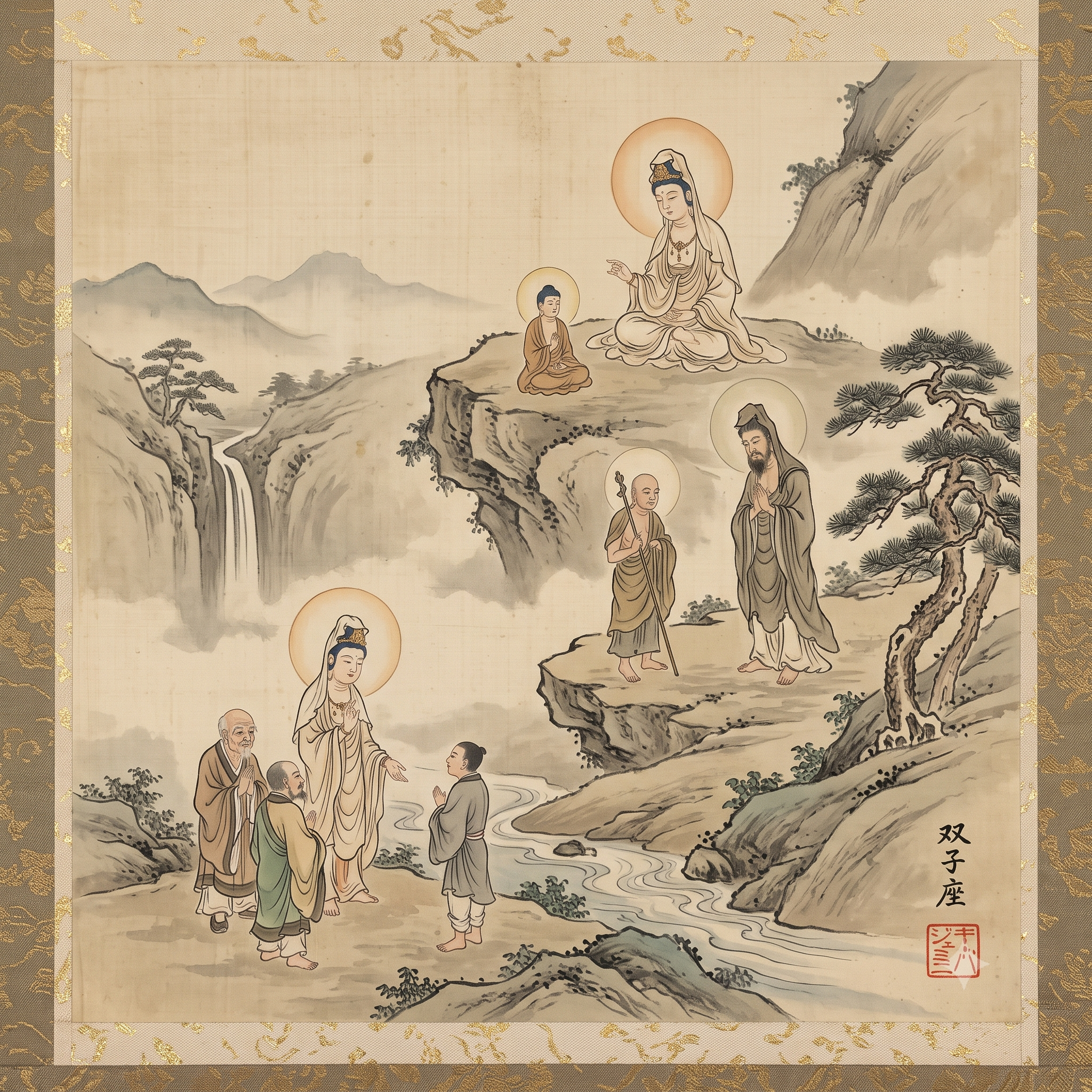
The Buddha said to Universal-Sage Bodhisattva: “The good men or women will be able to obtain this Sūtra of the Lotus Flower of the Wonderful Dharma after my extinction if they do the following four things: (1) secure the protection of the Buddhas, (2) plant the roots of virtue, (3) reach the stage of steadiness [in proceeding to enlightenment], and (4) resolve to save all living beings. The good men or women will be able to obtain this sūtra after my extinction if they do these four things.”

For us who aspire to this difficult practice of the Wonderful Dharma, Śākyamuni Buddha gives this guide in Chapter Twenty-Eight of the Lotus Sūtra. For us to have even heard of this sūtra in this life we must have already done these four things. In order to maintain this practice, we need to use the Buddha’s protection for the benefit of all beings, not just for our benefit alone. We need to nourish the virtuous seeds we have already planted, remain steady and confident on the path to enlightenment, and sustain our determination to maintain our respect for everyone.

The Daily Dharma is produced by the Lexington Nichiren Buddhist Community. To subscribe to the daily emails, visit zenzaizenzai.com

Virtue Within Naturally Rises to the Surface

Deceived by Devadatta, King Ajātaśtru became an enemy of the Buddha but his Minister Jīvaka was devoted to the Buddha and continued to have faith, the merit of which seems to have helped King Ajātaśtru. In Buddhism there is an important teaching that virtue stored within will naturally rise to the surface. Never-Despising Bodhisattva in the Lotus Sūtra bowed to passersby, saying, “I have heartfelt respect for you.” The “Lion-Roaring Bodhisattva” chapter in the Nirvana Sūtra says that all sentient beings have the Buddha-nature. It is stated in the Awakening of Faith in Mahāyāna by Bodhisattva Aśvaghosa, “As the wisdom of enlightenment works within, delusions are exterminated and, in turn, the Dharma body of enlightenment appears.” The same is preached in the Treatise on the Stages of Yoga Practice written by Bodhisattva Maitreya. These passages all mean that the internally hidden virtue will spontaneously rise to the surface.

Sushun Tennō Gosho, The ‘Emperor Sushun’ Letter, Writings of Nichiren Shōnin, Faith and Practice, Volume 4, Page 120

Daily Dharma for February 9, 2026

20260209-ddi

Illustration by Google Gemini

Show Gemini's thinking

Gemini's Thinking

Defining Illustration Parameters
I'm currently working through the initial stages, focusing on the core requirements: a square illustration derived from a specific Lotus Sutra passage. I'm prioritizing the traditional Japanese Buddhist iconography and ensuring the absence of Amida or Dainichi Buddha images, while incorporating the desired signature and red seal. The passage itself describes the end of something.

Clarifying Key Elements
I'm now zeroing in on the text's core elements. The focus is now on the specifics of the Wonderful-Voice Bodhisattva, Shakyamuni Buddha, and the immense group of individuals present. I am working to define how to best convey the concept of transformation inherent in the passage. The goal is to set the scene: the Saha-World, our world, but a place of gathering and teaching.

Visualizing Transformations
I'm now grappling with how best to visually represent the core concept of transformation. I am considering symbolic representations, like faint glowing projections, to show the Samadhi. I am also working through how best to depict the interaction between Shakyamuni Buddha, the Wonderful-Voice Bodhisattva, and the assembly. The goal is to convey a sense of a shared experience.

Refining Scene Elements
I'm now focusing on how best to construct the scene itself. I am working on how to integrate the concept of transformation into the illustration. The intent is to show the interaction between the central figures: Shakyamuni Buddha, the Wonderful-Voice Bodhisattva, and the assembly. I am working to define how best to represent the central concept of the Samadhi. The composition should feel grand.

Defining Scene Elements
I'm now focusing on defining the scene, specifically the interaction between the core figures. I intend to place Shakyamuni Buddha as central, but not the only focus. I am working to ensure Wonderful-Voice Bodhisattva is visually distinct. I'm working through how to best depict the vast assembly.

I'm now further refining the visual representation of the concept of transformation. I am leaning towards using faint glowing emanations or projections, and making sure to include a visual of a swirling cloud of light. The goal is to set a sense of reverence and divine light. I am working to add the signature and red seal to the scene.

Analyzing Visual Fidelity
I am now assessing the visual elements against the initial prompt. I have determined if the scene aligns with the user's specific request from the Lotus Sutra, including Shakyamuni Buddha and Wonderful-Voice Bodhisattva. The style adheres to the user's request.

Evaluating Scene Accuracy
I have confirmed that the generated illustration aligns perfectly with the textual description from the user's Lotus Sutra prompt. I've verified the presence and placement of the artist's signature and red seal, and the square format matches the user's explicit instructions. I believe the image is ready for delivery.

When the Buddha expounded this Chapter of Wonderful-Voice Bodhisattva, the eighty-four thousand people, who had come accompanying Wonderful-Voice Bodhisattva, obtained the ability to practice the samādhi by which they could transform themselves into other living beings. Innumerable Bodhisattvas of this Sahā-World also obtained the ability to practice this samādhi.

This description comes at the end of Chapter Twenty-Four of the Lotus Sūtra. In the story, Wonderful-Voice Bodhisattva had come to our world of conflict and delusion from his perfect world to hear Śākyamuni Buddha teach the Wonderful Dharma. The Bodhisattvas in this world asked the Buddha about the transformations Wonderful-Voice made to benefit others. This chapter shows how those beings who have vowed to benefit us appear in ways we may not recognize right away. It also shows us the capability we have as Bodhisattvas to transform ourselves for the benefit of others.

The Daily Dharma is produced by the Lexington Nichiren Buddhist Community. To subscribe to the daily emails, visit zenzaizenzai.com