Category Archives: LS32

Day 25

Day 25 covers all of Chapter 20, Never-Despising Bodhisattva, and opens Chapter 21, The Supernatural Powers of the Tathāgatas.

Having last month learned about Powerful-Voice-King Buddha, we meet Never-Despising Bodhisattva.

“There lived arrogant bhikṣus in the age of the counterfeit of the right teachings of the first Powerful-Voice-King Tathāgata, that is, after the end of the age of his right teachings which had come immediately after his extinction. [Those arrogant bhikṣus] were powerful. At that time there lived a Bodhisattva called Never-Despising. He took the form of a bhikṣu.

“Great-Power-Obtainer! Why was this bhikṣu called Never-Despising? It was because, every time he saw bhikṣus, bhikṣunīs, upāsakās or upāsikās, he bowed to them and praised them, saying, ‘I respect you deeply. I do not despise you. Why is that? It is because you will be able to practice the Way of Bodhisattvas and become Buddhas.’

“He did not read or recite sūtras. He only bowed to the four kinds of devotees. When he saw them in the distance, he went to them on purpose, bowed to them, and praised them, saying, ‘I do not despise you because you can become Buddhas.’

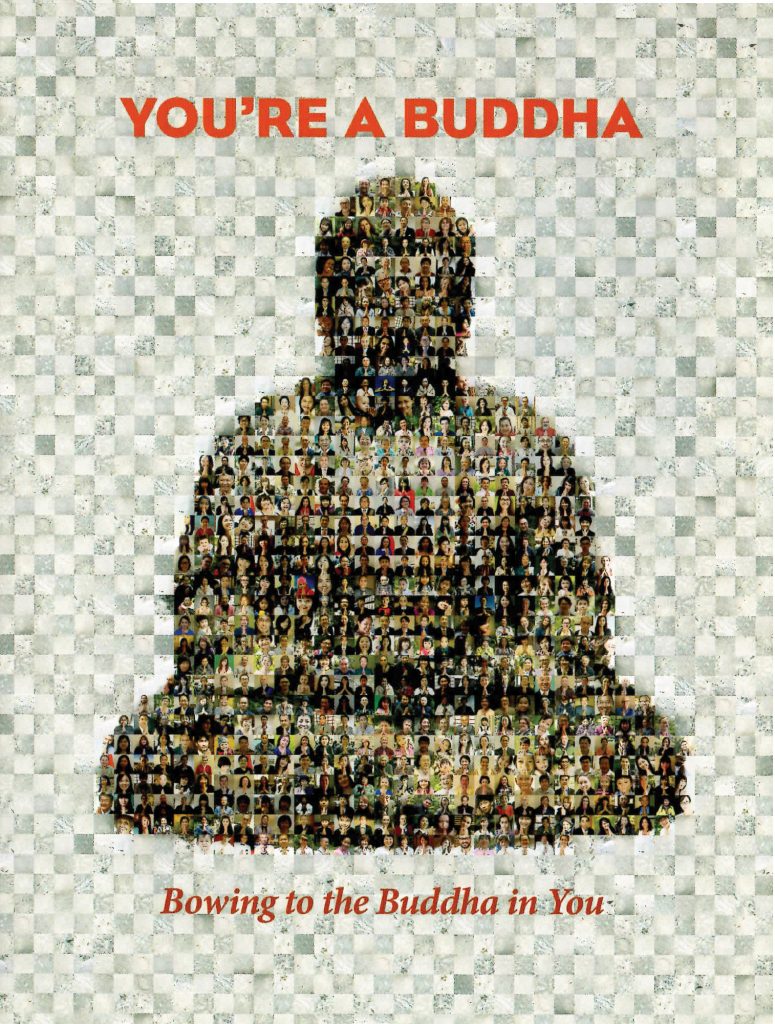
Brochure cover

When we press our palms together in gassho and bow to greet others, we are seeing the Buddha within them that is part of their true nature. Never-Despising Bodhisattva never met a man or woman he didn’t like. Within every person, he could see the divine Buddha nature or Buddha seed within waiting to be acknowledged and nourished. This is one of the most compelling teachings of Buddhism.

Read more…

Day 24

Day 24 concludes Chapter 19, The Merits of the Teacher of the Dharma and closes the Sixth Volume of the Sutra of the Lotus Flower of the Wonderful Dharma.

Having last month completed the eight hundred merits of the nose, we consider the twelve hundred merit of the tongue.

“Furthermore, Constant-Endeavor! The good men or women who keep, read, recite, expound or copy this sūtra, will be able to obtain twelve hundred merit of the tongue. Anything which tastes good, bad, delicious, distasteful, bitter or astringent, will become as delicious as the nectar of heaven and not distasteful when it is put on their tongues. When they expound the Dharma to the great multitude with their tongues, they will be able to raise deep and wonderful voices, to cause their voices to reach the hearts of the great multitude so that the great multitude may be joyful and cheerful. Hearing their speeches given in good order by their deep and wonderful voices, Śakra, Brahman, and the other gods and goddesses will come and listen to them. In order to hear the Dharma, dragons, dragons’ daughters, gandharvas, gandharvas’ daughters, asuras, asuras’ daughters, garuḍas, garuḍas’ daughters, kiṃnaras, kiṃnaras’ daughters, mahoragas, and mahoragas’ daughters also will come to them, respect them, and make offerings to them. Bhikṣus, bhikṣunīs, upāsakās, and upāsikās; and kings, princes, ministers, and their attendants [also will come and hear the Dharma]. The wheel-turning[holy-]kings of small [countries], and the wheel-turning-[holy-]kings of great [countries, each of whom has the] seven treasures and one thousand children, also will come with their [treasures, children and] internal and external retinues, riding in their [movable] palaces, and hear the Dharma. These [good men or women, that is,] Bodhisattvas will expound the Dharma so well that the brahmanas, householders, and people of their country will, throughout their lives, attend on them, and make offering to them. The Śrāvakas, Pratyekabuddhas, Bodhisattvas, and Buddhas also will wish to them. [These good men or women] will expound the Dharma in the places which the Buddhas will face. They will keep all the teaching of the Buddhas and raise deep and wonderful voices of the Dharma.”

The Daily Dharma from April 9, 2018, offers this:

When they expound the Dharma to the great multitude with their tongues, they will be able to raise deep and wonderful voices, to cause their voices to reach the hearts of the great multitude so that the great multitude may be joyful and cheerful. Hearing their speeches given in good order by their deep and wonderful voices, Śakra, Brahman, and the other gods and goddesses will come and listen to them.

The Buddha declares these lines to Constant-Endeavor Bodhisattva in Chapter Nineteen of the Lotus Sūtra, describing those who keep the Lotus Sūtra. When we share the Buddha Dharma with others, it is as if the Buddha’s mind is finding voice in our words. It should then come as no surprise to us that beings of all dispositions will want to hear more of what the Buddha has taught us. When we “practice the sūtra with our bodies,” as Nichiren described, when we make this teaching a part of our lives, then we find the words we need to reach all beings and lead them to the Buddha’s enlightenment.

The Daily Dharma is produced by the Lexington Nichiren Buddhist Community. To subscribe to the daily emails, visit zenzaizenzai.com

Day 23

Day 23 covers all of Chapter 18, The Merits of a Person Who Rejoices at Hearing This Sutra, and opens Chapter 19, The Merits of the Teacher of the Dharma.

Having last month learned the merits of the fiftieth person who rejoices at hearing even a gāthā of the Lotus Sūtra, we consider the additional merits to be earned by inviting others to learn about the Lotus Sūtra.

“Furthermore, Ajita! Anyone who goes to a monastery in order to hear this sūtra and hears it even for a moment while he is sitting or standing, in his next life will be able to go up to the palace of heaven, riding in a beautiful and wonderful elephant-cart or horse-cart or in a palanquin of wonderful treasure by his merits. Anyone who, while sitting in the place of the expounding of the Dharma, persuades another per on to it down or shares his seat with him to hear [the Dharma] when he sees him coming to the place, in his next life by his merits, will be able to obtain the seal of King Sakra, of the Brahman Heavenly-King or of a wheel-turning-holy-king.

“Ajita! Anyone who[, while he is staying outside the place of the expounding of the Dharma,] says to another person, ‘Let us go and hear the sūtra called the Lotus Flower of the Wonderful Dharma which is being expounded [in that place],’ and cause him to hear it even for a moment, in his next life by his merit , will be able to live with the Bodhisattvas who obtain dharanis. He will be clever and wise. He will not be dumb throughout thousands of millions of his future existences. His breath will not be foul. He will have no disease of the tongue or the mouth. His teeth will not be defiled, black, yell w, few, fallen out, uneven or crooked. His lips will not be pendulous, shrunk, chapped, cracked, broken, distorted, thick, large, yellow-black or loathsome. His nose will not be flat or awry. His face will not be black, long, distorted or displeasing. His lips, tongue and teeth will be well-shaped; his nose, long, high and straight. His face will be full; his eyebrows, thick and long; and his forehead, broad and even. In a word, he will have all the good features of a man. He will be able to see the Buddhas, hear the Dharma from them, and receive their teachings by faith throughout his future existences.

“Ajita, look! The merits of the person who causes even a single man to go and hear the Dharma are so many. It is needless to speak of the merits of the person who hears [this sūtra] with all his heart, reads it, recites it, expounds it to the great multitude, and acts according to its teachings.

The Daily Dharma from April 21, 2018, offers this:

Ajita, look! The merits of the person who causes even a single man to go and hear the Dharma are so many. It is needless to speak of the merits of the person who hears [this sūtra] with all his heart, reads it, recites it, expounds it to the great multitude, and acts according to its teachings.

The Buddha gives this explanation to Maitreya, whom he calls Ajita (Invincible) in Chapter Eighteen of the Lotus Sutra. While earlier parts of the Sūtra describe the possible reactions those who teach the Buddha Dharma may find, the Buddha here reminds us that we do not need to wait until we are strong enough, wise enough, or even practiced enough to use it to benefit others. This sūtra contains the Buddha’s enlightenment itself. When we hear it, we hear the Buddha. When we expound it, it is the Buddha speaking through us.

The Daily Dharma is produced by the Lexington Nichiren Buddhist Community. To subscribe to the daily emails, visit zenzaizenzai.com

Day 22

Day 22 covers all of Chapter 17, The Variety of Merits.

Having last month considered the innumerable merits of a moment’s faith in gāthās, we consider the merits of those who firmly believe in the Buddha’s longevity.

Those who firmly believe [my longevity ],
And have no doubts about it
Even for a moment,
Will be able to obtain more merits [than he].

The Bodhisattvas who have practiced the Way
For the past innumerable kalpas,
Will believe my longevity
When they hear of it.

They will receive this sūtra on their heads,
And wish:
“May we live long and save all living beings
Just as the World-Honored One of today,
Who is the King of the Śākyas, [saves them]
By expounding the Dharma without fear
At the place of enlightenment
With [a voice like] a lion’s roar!
When we sit at the place of enlightenment,
Respected by all living beings,
May we preach that we also shall live
As long [as the World-Honored One of today]!”

Those who have firm faith,
And who are pure and upright,
And who hear much and memorize all teachings,
And who understand my words
According to their meaning,
Will have no doubts [about my longevity].

With faith firm, I have no doubts.

Day 21

Day 21 covers all of Chapter 16, The Duration of the Life of the Tathāgata.

Having last month concluded Chapter 16, The Duration of the Life of the Tathāgata, we begin again at the top with Śākyamuni’s call to “Understand my sincere and infallible words by faith.”

Thereupon the Buddha aid to the great multitude including Bodhisattvas and others, “Good men! Understand my sincere and infallible words by faith!”

He said to the great multitude again, “Understand my sincere and infallible words by faith!”

He said to them once again, “Understand my sincere and infallible words by faith!”

Thereupon the great multitude of Bodhisattvas, headed by Maitreya, joined their hands together and said to the Buddha, “World-Honor done, tell us! We will receive your words by faith.”

They said this three times. Then they said once again, “Tell us! We will receive your words by faith.”

The Introduction to the Lotus Sutra offers this:

Sakyamuni begins [Chapter 16, The Duration of the Life of the Tathāgata,] by appealing three times for his listeners to “understand my sincere and infallible words by faith.” To this appeal, all the Bodhisattvas headed by Maitreya responded each time, “World-Honored One, tell us! We will receive your words by faith.” Then Sakyamuni replied, “Listen to me attentively! I will reveal to you my hidden core and supernatural powers” (p. 241).

Here “hidden core” means his deepest innermost self, and “supernatural powers” are actions outflowing from that hidden core.

Introduction to the Lotus Sutra

Day 20

Day 20 completes Chapter 15, The Appearance of Bodhisattvas from Underground, and concludes the Fifth Volume of the Sutra of the Lotus Flower of the Wonderful Dharma.

Having last month concluded Chapter 15, The Appearance of Bodhisattvas from Underground, we begin again with Śākyamuni’s response to the greetings from the leaders of the Bodhisattva-mahāsattvas who sprang up from underground.

Thereupon the World-Honored One said to them in the presence of the great multitude of Bodhisattvas:

“Truly, truly good men! I am peaceful. I am in good health. The living beings are ready to be saved. They do not fatigue me because I already taught them in their consecutive previous existences, and also because they have already honored the past Buddhas respectfully and planted the roots of good. As soon as they saw me and heard my teachings, they received my teachings by faith and entered into the wisdom of the Tathāgata, except those who had previously studied and practiced the teachings of the Lesser Vehicle. Now I am causing [the followers of the Lesser Vehicle] to hear this sūtra and to enter into the wisdom of the Buddha.”

Thereupon the [four] great Bodhisattvas sang in gāthās:

Excellent, excellent, Great Hero!
World-Honored One!
The living beings are ready to be saved
Because in their previous existence
They already asked the [past] Buddhas
About their profound wisdom,
And having heard about it, understood it by faith.
We rejoice at seeing you.

Thereupon the World-Honored One praised the leading great Bodhisattvas, saying, “Excellent, excellent, good men! [l am glad that] you rejoice at seeing me.”

The Daily Dharma from May 8, 2017, offers this:

Truly, truly good men! I am peaceful. I am in good health. The living beings are ready to be saved. They do not fatigue me because I already taught them in their consecutive previous existences, and also because they have already honored the past Buddhas respectfully and planted the roots of good.

The Buddha makes this proclamation to the leaders of the Bodhisattvas from Underground in Chapter Fifteen of the Lotus Sūtra. These Bodhisattvas appeared when the Buddha asked who would teach the Lotus Sūtra after the Buddha’s death, and asked about the Buddha’s health and whether those he was teaching could keep what he provided for them. The Buddha assures us not only of the certainty of our future enlightenment, but that for us to receive his teaching, there was an earlier time, which we may have forgotten, when we met him. This awareness of our future and our past helps us to see our place in the world and maintain our determination to benefit all beings.

The Daily Dharma is produced by the Lexington Nichiren Buddhist Community. To subscribe to the daily emails, visit zenzaizenzai.com

Day 19

Day 19 concludes Chapter 14, Peaceful Practices, and begins Chapter 15, The Appearance of Bodhisattvas from Underground.

Having last month considered in gāthās guidelines for expounding this Sūtra, we hear the Parable of the Parable of the Priceless Gem in the Top-Knot.

I will tell you a parable.
A wheel-turning-holy-king was powerful.
Some of his soldiers
Distinguished themselves in war.
He was glad to honor them.
He gave them elephants or horses,
Vehicles or ornaments,
Paddy fields or houses,
Villages or cities,
Garments or various treasures,
Menservants or maidservants,
Or other valuables.

He took a brilliant gem
Out of his top-knot
And gave it to the bravest man
Who had done the most difficult feats.

I am like the king.
I am the King of the Dharma.
I have the great power of patience
And the treasury of wisdom.
I save all living beings in the world by the Dharma
Out of my great compassion towards them.

The people were under the pressure
Of various sufferings.
They were fighting with the Maras
In order to emancipate themselves
From suffering.
Because I saw all this,
I expounded various teachings to them.
I expounded many sūtras with skillful expedients.

Now I know that they can understand the Sutra
Of the Lotus Flower of the Wonderful Dharma.
Therefore, I expound it to them lastly
Just as the king took the brilliant gem
Out of his top-knot
And gave it [to the bravest man lastly].

For me, the importance here is the idea that “people were under the pressure of various sufferings” and “I expounded many sūtras with skillful expedients.” Finally, “Now I know that they can understand the Sutra of the Lotus Flower of the Wonderful Dharma. Therefore, I expound it to them lastly.” This is the same message we get in Chapter 3, A Parable. Having convinced his children to come out of the burning house, the Buddha relates: “Seeing that many hundreds of thousands of millions of living beings have come out of the painful, fearful and rough road of the triple world through the gate of the teachings of the Buddha, and obtained the pleasure of Nirvāṇa, I thought, ‘I have the store of the Dharma in which the immeasurable wisdom, powers and fearlessness of the Buddhas are housed. These living beings are all my children. I will give them the Great Vehicle. I will not cause them to attain extinction by their own ways. I will cause them to attain the extinction of the Tathāgata.’ ”

Day 18

Day 18 concludes Chapter 13, Encouragement for Keeping this Sutra, and begins Chapter 14, Peaceful Practices.

Having last month heard the vow of the eighty billion nayuta Bodhisattva-mahāsattvas, we repeat in gāthās.

Thereupon the Bodhisattvas sang in gāthās with one voice:

Do not worry!
We will expound this sūtra
In the dreadful, evil world
After your extinction.

Ignorant people will speak ill of us,
Abuse us, and threaten us
With swords or sticks.
But we will endure all this.

Some bhikṣus in the evil world will be cunning.
They will be ready to flatter others.
Thinking that they have obtained what they have not,
Their minds will be filled with arrogance.

Some bhikṣus will live in aranyas or retired places,
And wear patched pieces of cloth.
Thinking that they are practicing the true Way,
They will despise others.

Being attached to worldly profits,
They will expound the Dharma to men in white robes.
They will be respected by the people of the world
As the Arhats who have the six supernatural powers.

They will have evil thoughts.
They will always think of worldly things.
Even when they live in aranyas,
They will take pleasure in saying that we have faults.

They will say of us,
“Those bhikṣus are greedy for worldly profits.
Therefore, they are expounding
The teachings of heretics.
They made that sūtra by themselves
In order to deceive the people of the world.
They are expounding that sūtra
Because they wish to make a name for themselves.”

In order to speak ill of us, in order to slander us
In the midst of the great multitude,
In order to say that we are evil,
They will say to kings, ministers and brahmanas,
And also to householders and other bhikṣus,
“They have wrong views.
They are expounding
The teachings of heretics.”
But we will endure all this
Because we respect you.

They will despise us,
Saying to us [ironically],
“You are Buddhas.”
But we will endure all these despising words.

See Rejoicing At Being Struck

Rejoicing At Being Struck

On Sept. 12, 1271, the military government at Kamakura arrested Nichiren arbitrarily and took him to the place of execution, called Tatsu-no-kuchi (“the dragon’s mouth”). When one of his assailants found scrolls of the Lotus Sutra in Nichiren’s pocket, he hit Nichiren on the face with one of them. Nichiren realized that this scroll was the one containing [Chapter 13, Encouragement for Keeping this Sutra.] At first he felt humiliated at being struck in the face, but when he realized which scroll it was, he rejoiced instead. By coincidence, he was being beaten by the same scroll which predicted such a fate for one who propagates the Sutra.

Introduction to the Lotus Sutra

Day 17

Day 17 covers all of Chapter 12, Devadatta, and opens Chapter 13, Encouragement for Keeping this Sutra.

Having last month considered Accumulated-Wisdom Bodhisattva’s question of whether anyone taught by Mañjuśrī is qualified to become a Buddha quickly, we hear Mañjuśrī’s answer and Accumulated-Wisdom’s response.

Mañjuśrī answered:

“Yes. There is a daughter of Dragon-King Sagara [among those whom I taught]. She is eight years old. She is clever. She knows the karmas of all living beings. She obtained dhārāṇis. She keeps all the treasury of the profound and hidden core expounded by the Buddhas. She entered deep into dhyāna-concentration, and understood all teachings. She aspired for Bodhi in a ksana, and reached the stage of irrevocability. She is eloquent without hindrance. She is compassionate towards all living beings just as a mother is towards her babe. She obtained all merits. Her thoughts and words are wonderful and great. She is compassionate, humble, gentle and graceful. She [has already been qualified to] attain Bodhi[, and to become a Buddha quickly].”

Accumulated-Wisdom Bodhisattva said:

“As far as I know, [when he was a Bodhisattva,] Śākyamuni Buddha sought Bodhi, that is, enlightenment incessantly for innumerable kalpas. He accumulated merits by practicing austerities. Even the smallest part, even the part as large as a poppy-seed of this world-this world being composed of one thousand million Sumeru-worlds-is not outside the places where the Bodhisattva made efforts to save all living beings at the cost of his life. It was after doing all this that he attained Bodhi, that is, enlightenment. I do not believe that this girl will be able to attain perfect enlightenment[, that is, to become a Buddha] in a moment.”

See The Lesson of the Dragon King’s Daughter