
[Vaiśravaṇa Heavenly-King, the Protector of the World, said to the Buddha:]
“World-Honored One! I will protect this teacher of the Dharma with these divine spells. I also will protect the person who keeps Myōhō Renge Kyō so that he may have no trouble within a hundred yojanas’ distance.”
Tao Sheng: The Wisdom of the Buddha
Tao-sheng Commentary on the Lotus Sutra, p187[Their wisdom] cannot be understood by any Śrāvaka or Pratyekabuddha because the [present] Buddhas attended on many hundreds of thousands of billions of [past] Buddhas, and practiced the innumerable teachings of those Buddhas bravely and strenuously to their far-flung fame until they attained the profound Dharma which you have never heard before, [and became Buddhas,] and also because [since they became Buddhas] they have been expounding the Dharma according to the capacities of all living beings in such various ways that the true purpose of their [various] teachings is difficult to understand.
But then the three vehicles are all provisional exigencies (ch’üan). And the Greater Vehicle does not contradict that by which it becomes great. Therefore, [the Buddha] does not mention it, [the Greater Vehicle]. The two vehicles are in diametrical opposition to the sphere of “great.” This refers to [what they] “cannot know.”
[…they attained the profound Dharma which you have never heard before…]
If the reason why this is so is not explained, how can one believe it? [The Buddha] had to make repeated explanations. Accumulating [what he was supposed] to do in such a way, [“in former times the Buddha”] attained to the ultimate [achievement]; that is what is meant by “that had never been before.” [The phrase stating that the Buddha’s wisdom is] incalculable conjoins with the [next] phrase with the word wisdom. This thus explains effect by means of cause.[…they have been expounding the Dharma according to the capacities of all living beings…]
Words and traces represent external compliance [with li or reality]. By following the traces one might overlook the meaning. Being ignorant of the meaning, one encounters difficulty in understanding [what is real]. This [phrase] joins with the phrase the gateways of their wisdom. Now that the reason has been explained, the subtle meaning will reveal its face (literally, “turn its head”).
Myōhō Renge Kyō Promise for Feb. 13, 2025
Just as Bodhisattvas are superior to Śrāvakas or to Pratyekabuddhas, Myōhō Renge Kyō is superior to any other sūtra.
Tao-sheng: Casting Aside Encumbrances
Tao-sheng Commentary on the Lotus Sutra, p187Since I became a Buddha, I [also] have been expounding various teachings with various stories of previous lives, with various parables, and with various similes. I have been leading all living beings with innumerable expedients in order to save them from various attachments, because I have the power to employ expedients and the power to perform the pāramitā of insight.
What has been stated so far is all about praising the Buddha’s wisdom. The present statement is the direct recounting of what Śākyamuni says he did himself. Entitling the [present] chapter (“Expedient Devices”) has yielded this phrase. The preceding words, accords with what is appropriate, may then be seen as bringing “encumbrances”; it is necessary thus to explain this again. [The Buddha] said “[what he preaches] accords with what is appropriate,” in the sense that “in accordance with” the kind of disease there should be “what is appropriate.” Diseases are myriad in kind. [By the same token] the teaching cannot be in a set pattern; but its fundamental purpose is to lead [beings] to cast aside their “encumbrances.” Otherwise [even] for a day, their “encumbrances” would not be loosened from (or “abandon”) li. Hence, he said, “since achieving Buddhahood.”
Myōhō Renge Kyō Promise for Feb. 12, 2025
Anyone who, while seeking the enlightenment of the Buddha, sees or hears Myōhō Renge Kyō, and after hearing Myōhō Renge Kyō, understands Myōhō Renge Kyō by faith and keeps Myōhō Renge Kyō, know this, will approach Anuttara-samyak-saṃbodhi.
Tao-sheng: Something Hard to Understand
The gate to it is difficult to understand and difficult to enter.
[The value of] wisdom consists in preaching. Preaching is what the gateways refer to. Not only is wisdom incomprehensible but the “gateways” also are hard to fathom. Fathoming the “gateways” means realizing that there are no three [vehicles]. Is not this something that is “hard to understand?”
Myōhō Renge Kyō Promise for Feb. 11, 2025
A Bodhisattva who wishes
To expound Myōhō Renge Kyō without fear
In the evil world
After [my extinction]
Should perform proper practices
And approach proper things.
Tao-sheng: The Buddha’s Intent
Tao-sheng Commentary on the Lotus Sutra, p186“The wisdom of the [present] Buddhas is profound and immeasurable.
Although [the Buddha’s] speeches are varied in myriad ways, yet the intent [of the words] lies in manifesting the One. When beings deviate from the import of the words, creating a “profound [chasm]” with respect to “wisdom,” it is not because the “wisdom” [as such] is “profound,” but merely because the beings themselves are far away (literally, “profound”) from “wisdom. ” This expression laments the failure [of beings in reaching the Buddha’s intent]. How can this be taken as a praise for “wisdom”?
Karma And Vow
Rev. Ryuei Michael McCormick of the Shingan-ji [True Vow Temple] in the San Francisco Bay Area has an excellent lecture on Transmigration and Karma. Very imformative and a great introduction.
The Composition of Buddhalands
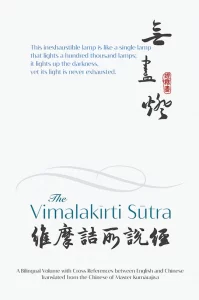
Recently I read a copy of the Buddhist Text Translation Society’s Vimalakīrti Sūtra. This is at least my third reading of this sūtra and what struck me this time through was the discussion of Buddhalands.
In Chapter 16 of the Lotus Sūtra we’re told:
[This] pure world of mine is indestructible.
But the [perverted] people think:
“It is full of sorrow, fear, and other sufferings.
It will soon burn away.”
Morning and evening each day in the service prayer we vow, “May we realize this world is the Eternal Buddha’s Pure Land!”
That’s always been hard to understand. The Vimalakīrti Sūtra sheds some light on this.
In the sūtra, Vimalakīrti shows his audience a distant Buddhaland called Myriad Fragrances in which the Buddha Collection of Supreme Fragrances reigns. Everything in this world is composed of fragrance, even the Dharma.
Later in the sūtra Ananda discusses with the Buddha what happened at Vimalakīrti ‘s house:
Ananda said to the Buddha, “This is unprecedented, World Honored One! This fragrant food is able to accomplish the Buddhas’ work!”
The Buddha said, “Indeed, Ananda! Indeed! There are some Buddhalands where the brilliance of the Buddha’s light accomplishes the Buddhas’ work; where the myriad Bodhisattvas accomplish the Buddhas’ work; where people conjured by the Buddha accomplish the Buddhas’ work; where bodhi trees accomplish the Buddhas’ work; where the Buddha’s robes and bedding accomplish the Buddhas’ work; where food accomplishes the Buddhas’ work; where gardens, groves, and pavilions accomplish the Buddhas’ work; where the thirty-two hallmarks and eighty subsidiary characteristics accomplish the Buddhas’ work; where the Buddha’s body accomplishes the Buddhas’ work; or where empty space accomplishes the Buddhas’ work. In response to these conditions, living beings are led to undertake the practice of the precepts.
“There are places where dreams, illusions, shadows, echoes, reflections in a mirror, the moon’s reflection in water, mirages in the heat, and other such analogies accomplish the buddhas’ work; or where sounds, language, and words accomplish the Buddhas’ work. There are pure Buddhalands where tranquil silence, the absence of words, explanations, comments, and opinions, nonaction, and the unconditioned accomplish the Buddhas’ work. In this way, Ananda, there is nothing about the Buddhas’ deportment, nothing in what they do, that does not accomplish the Buddhas’ work.
“Ananda! Living beings are troubled by the four demons and the eighty-four thousand afflictions; through these troubles, the Buddhas carry out their work. This is to enter the Dharma-door of all Buddhas. Bodhisattvas who enter this door do not give rise to joy, craving, or conceit when they see pure and well-adorned Buddhalands, nor do they give rise to worry, aversion, or contempt when they see impure Buddhalands. They have only pure thoughts toward all Buddhas and feel unprecedented joy and reverence.
“The merit of all Buddhas is equal. In order to teach living beings, the Buddhas manifest different Buddhalands.”
I’m reminded of the verse in the Sūtra of Innumerable Meanings in which we learn that the Buddha “emerges according to the good karmic actions of living beings.”
I also want to note that I enjoyed the translation. Compared to the BDK America 2004 translation, this is more readable, but not quite as good as Burton Watson’s 1997 Columbia University Press translation.
An example of the difference can be seen on page 106, where Vimalakīrti has just shown everyone the Buddha Collection of Supreme Fragrances and his Bodhisattvas sitting down for a meal.
Then Vimalakīrti asked the assembled Bodhisattvas, “Humane Ones, who among you can go to that Buddha for food?” But all of them were silenced by Mañjuśrī’s awe-inspiring spiritual power. Vimalakīrti said, “Humane Ones, is none of you ashamed?”
Mañjuśrī said, “Didn’t the Buddha say not to look down on those not yet learned?”
In reading this I stumbled. Mañjuśrī isn’t doing anything. What’s going on? Watson’s translation offers this on page 113:
Then Vimalakirti addressed the bodhisattvas, saying, “Sirs, who among you can bring us some of that Buddha’s food?”
Out of deference to Manjushri’s authority and supernatural powers, however, all of them remained silent.
[Addressing Manjushri,] Vimalakirti said, “Sir, a great assembly such as this this is shameful, is it not?”
Manjushri replied, “As the Buddha has told us, never despise those who have yet to learn.”
I suppose one could argue that Watson has inserted his opinion rather than simply translating the Chinese text, but I find his version to more readable as a result and therefore better for it.