
Petzold, Buddhist Prophet Nichiren , p 75-77In view of his uncompromising attitude, it is no wonder that Nichiren earned the reputation of being intolerant. His vehemence against other sects cannot be questioned. And yet, it seems that he has been somewhat misrepresented.
In the Risshó-ankokuron there is an argument between the Visitor and the Master of the House, who represents Nichiren, which turns on the question of whether or not the Government should suppress by force such heresies as taught by Hōnen. …
The Master, that is, Nichiren, consequently takes the stand: In the fight against blasphemy, only the sin, not the person, must be killed, by depriving the blasphemers of the gifts they receive from the State and communities, i.e. by cutting them off from their livelihood. This will induce the false prophets to give up priesthood and thus be silenced and unable to commit their sin.
This was not exactly the method of the Inquisition, and [Arthur] Lloyd [who translated Risshó-ankokuron] is therefore wrong in drawing a parallel between this treatise by Nichiren, written in 1258-60, and the revision of the measures of Innocent III for “the detection and punishment of heretics” brought about by the Council of Toulouse in 1229. As is evident from the preceding quotations, Nichiren had no inclination to engage in the edifying sport of roasting heretics at the stake. Instead, he insisted on rendering the “enemies of Buddhism” harmless by boycotting them. The application of this method he considered not only as right, but as his duty, in pointing to the “Mahā-Pari-Nirvāṇa-Sūtra” that says: “However virtuous a priest may be, if he neglects to eject transgressors, to make them repent or renounce their sins, hearken! he is wicked and hostile to Buddhist Law. If he casts them out to make them be repentant and amend their negligence, he is worthy to be my disciple and truly virtuous.” (Satomi, p. 100)
Monthly Archives: May 2023
Daily Dharma – May 25, 2023
Ajita! Anyone who[, while he is staying outside the place of the expounding of the Dharma,] says to another person, ‘Let us go and hear the sūtra called the Lotus Flower of the Wonderful Dharma which is being expounded [in that place],’ and causes him to hear it even for a moment, in his next life by his merits, will be able to live with the Bodhisattvas who obtain dhāraṇīs.
The Buddha gives this explanation to Maitreya (whom he calls Ajita – Invincible) in Chapter Eighteen of the Lotus Sutra. The dhāraṇīs are promises made by Bodhisattvas to protect those who keep and practice the Lotus Sūtra. They are included in the sūtra so that we can use them to remind these Bodhisattvas, and ourselves, of the protection we enjoy from our practice. This protection is not just meant for us. It is for all beings. When we share the teaching of the Wonderful Dharma with others, we help them become aware of their potential to become enlightened.
The Daily Dharma is produced by the Lexington Nichiren Buddhist Community. To subscribe to the daily emails, visit zenzaizenzai.com
Day 6
Day 6 continues Chapter 3, A Parable

Having last month concluded today’s portion of Chapter 3, A Parable, we return to the top and consider why the Buddha was not guilty of falsehood when he gave his children the large carts of treasures.
“The children rode in the large carts, and had the greatest joy that they had ever had because they had never expected to get them. Śāriputra! What do you think of this? Do you think that the rich man was guilty of falsehood when he gave his children the large carts of treasures?”
Śāriputra said:“No, World-Honored One! He saved his children from the fire and caused them to survive. [Even if he had not given them anything,] he should not have been accused of falsehood because the children should be considered to have already been given the toys [they had wished to have] when they survived. He saved them from the burning house with the expedient. World-Honored One! Even if he had not given them the smallest cart, he should not have been accused of falsehood because he thought at first, ‘I will cause them to get out with an expedient.’ Because of this, he should not. Needless to say, he was not guilty of falsehood when he remembered his immeasurable wealth and gave them the large carts in order to benefit them.”
The Buddha said to Śāriputra:
“So it is, so it is. It is just as you say. Śāriputra! The same can be said of me. [I thought, ‘] I am the father of the world. I eliminated fear, despondency, grief, ignorance and darkness. I obtained immeasurable insight, powers and fearlessness. I have great supernatural powers, the power of wisdom, the paramita of expedients, the paramita of wisdom, great compassion, and great loving-kindness. I am not tired of seeking good things or of benefiting all living beings. I have appeared in the triple world, which can be likened to the rotten and burning house, in order to save all living beings from the fires of birth, old age, disease, death, grief, sorrow, suffering, lamentation, stupidity, darkness, and the three poisons, to teach all living beings, and to cause them to attain Anuttara-samyak-saṃbodhi. I see that all living beings are burned by the fires of birth, old age, disease, death, grief, sorrow, suffering and lamentation. They undergo various sufferings because they have the five desires and the desire for gain. Because they have attachments and pursuits, they have many sufferings in their present existence, and will suffer in hell or in the world of animals or in the world of hungry spirits in their future lives. Even when they are reborn in heaven or in the world of humans, they will still have many sufferings such as poverty or parting from their beloved ones or meeting with those whom they hate. Notwithstanding all this, however, they are playing joyfully. They are not conscious of the sufferings. They are not frightened at the sufferings or afraid of them. They do not dislike them or try to get rid of them. They are running about this burning house of the triple world, and do not mind even when they undergo great sufferings.[‘]
Whoever Believes in This Sutra Obeys the Precepts
Petzold, Buddhist Prophet Nichiren , p 73-74[N]ichiren rejects the Hinayāna and Mahāyāna kai, and maintains that purity can be gained only through a pure teaching. And as the teaching was preached by Buddha, the purity of Buddha himself becomes a thing of fundamental importance. Nichiren says in this respect that by manifesting the fundamental truth of the enlightenment of the very substance of Myō Hō Ren Ge Kyō all living beings inherited also the purity of the Wonderful Teaching. Since they were unaware of it themselves, they lost the purity of it. If one believes that the wonderful substance of the Original Buddha Śākyamuni is the very essence of one’s own substance, and if one trusts in and practices Namu Myō Hō Ren Ge Kyō, then the kaitai of incomparable purity becomes active naturally. Textually, Nichiren says in the Kanjin Honzon: “The Venerable Śākyamuni of wonderful enlightenment is our blood and flesh. His merits of cause and effect are our bones and marrow.” “Śākyamuni’s two dharmas of cause and practice and effect-virtue are possessed completely in the five characters of Myō Hō Ren Ge Kyō. If we accept and keep these five characters, then he naturally gives us his merits of cause and effect.” Nichiren says, thus, that the wonderful substance of ourselves is manifested openly and truly only by the Myō Hō Ren Ge Kyō. Whoever believes in this sutra obeys the precepts.
It is clear, then, that belief in the Hoke-kyō, implying its acceptance and keeping, facilitates the rise of the substance of morality. In simple terms, Nichiren has reduced the various śīlas [morality] into an acceptance of the teachings of the Hoke-kyō. The verbal expression of this is the recitation of Namu Myōhōrengekyō. Dogmatic justification of his conviction is the aim of his Kaitai sokushin jóbutsugi, which itself is the theoretical foundation of his practice of Daimoku.
Daily Dharma – May 24, 2023
Excellent, excellent, Ajita! You asked me a very important question. All of you should concentrate your minds, wear the armor of endeavors, and be resolute. Now I will reveal, I will show, the wisdom of the Buddhas, their supernatural powers without hindrance, their dauntless powers like a lion’s, and their great power of bravery.
The Buddha makes this declaration to Maitreya Bodhisattva, whom he calls Ajita (Invincible) in Chapter Fifteen of the Lotus Sūtra. In the story, innumerable Bodhisattvas spring up from underground and vow to the Buddha to keep the sūtra after his extinction. Maitreya, knowing the minds of many others who have come to hear the Buddha teach, asks about these Bodhisattvas, whom he has never seen before. This question from Maitreya then leads to the Buddha later giving his most difficult teaching in Chapter Sixteen. The Buddha’s declaration in this passage shows how important questioning is to our faith.
The Daily Dharma is produced by the Lexington Nichiren Buddhist Community. To subscribe to the daily emails, visit zenzaizenzai.com
Day 5
Day 5 begins Chapter 3, A Parable
Having last month concluded today’s portion of Chapter 3, A Parable, we consider why Śāriputra felt like dancing with joy.
Thereupon Śāriputra, who felt like dancing with joy, stood up, joined his hands together, looked up at the honorable face, and said to the Buddha:
“Hearing this truthful voice of yours, I feel like dancing [with joy]. I have never felt like this before. Why is that? We [Śrāvakas and the Bodhisattvas] heard this Dharma before. [At that time] we saw that the Bodhisattvas were assured of their future Buddhahood, but not that we were. We deeply regretted that we were not given the immeasurable insight of the Tathāgata.
“World-Honored One! I sat alone under a tree or walked about mountains and forests, thinking, ‘We [and the Bodhisattvas] entered the same world of the Dharma. Why does the Tathāgata save us only by the teachings of the Lesser Vehicle?’
“Now I understand that the fault was on our side, not on yours, because if we had waited for your expounding of the Way to Anuttara-samyak-saṃbodhi, we would have been saved by the Great Vehicle. When we heard your first teaching, we did not know that that teaching was an expedient one expounded according to our capacities. Therefore, we believed and received that teaching at once, thought it over, and attained the enlightenment [to be attained by that teaching].
“World-Honored One! I reproached myself day and night [after I saw that the Bodhisattvas were assured of their future Buddhahood]. Now I have heard from you the Dharma that I had never heard before. I have removed all my doubts. I am now calm and peaceful in body and mind. Today I have realized that I am your son, that I was born from your mouth, that I was born in [the world of] the Dharma, and that I have obtained the Dharma of the Buddha.”
The Daily Dharma from Feb. 28, 2023, offers this:
Hearing this truthful voice of yours, I feel like dancing [with joy]. I have never felt like this before. Why is that? We [Śrāvakas and the Bodhisattvas] heard this Dharma before. [At that time] we saw that the Bodhisattvas were assured of their future Buddhahood, but not that we were. We deeply regretted that we were not given the immeasurable insight of the Tathāgata.
The Buddha’s disciple Śāriputra makes this proclamation to the Buddha in Chapter Three of the Lotus Sūtra. The Buddha had just explained that everything he taught before the Lotus Sūtra was not his true enlightenment; it was preparation for receiving his highest teaching. Śāriputra, the wisest of the Buddha’s disciples, understood immediately that he would be able to do far more than end his own suffering. He would eventually become a Buddha himself. Those gathered were also overjoyed, knowing that Śākyamuni was not the only Buddha they would meet. This ties together the Buddha’s insight that when we are assured of our enlightenment, we are able to meet innumerable enlightened beings.
The Daily Dharma is produced by the Lexington Nichiren Buddhist Community. To subscribe to the daily emails, visit zenzaizenzai.com
Where to Begin Learning About Nichiren Buddhism
Today I’ve added links to Rev. Ryūei Michael McCormick’s “Dharma Flower: The Faith, Teaching, and Practice of Nichiren Buddhism” to my Where to Begin page. Rev. Ryuei explains that he began writing this back in the late 1990s as a collection of notes for lectures he was giving. Those notes became the book Dharma Flower by the year 2000. Rev. Ryuei expects to publish a revised and updated version in book form in the future. For now, however, this is an excellent resource available online for those who want a detailed explanation of Nichiren Buddhism.
Dharma Flower: The Faith, Teaching, and Practice of Nichiren Buddhism
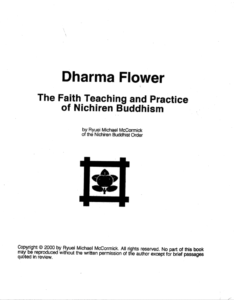
This excerpt is from Rev. Ryūei Michael McCormick’s “Dharma Flower: The Faith, Teaching, and Practice of Nichiren Buddhism,” which is available online at nichirenbayarea.org
This “Page” will provide the links to the various parts and chapters of my manuscript Dharma Flower: The Faith, Teaching, and Practice of Nichiren Buddhism. I first wrote it back in the late 90′s as a collection of notes for lectures I was giving in San Francisco. Those notes became Dharma Flower by the year 2000, and since then I have sent out copies of it on request. It has since been translated into Danish, and French, Spanish, and Italian. Someone once requested permission to do a Vietnamese translation. I now wish to make the English version more widely available via this blog.I wrote it when I was just a Shami (which is to say a novice or minister-in-training in the Nichiren Shū. I had been practicing some form of Nichiren Buddhism since the mid-1980′s and these writings were an attempt to digest everything I had learned and present it in the form of a coherent system. So it is what it is because it is what I needed at the time. Hopefully it will be helpful to others.
Again, I hope that this product of a certain stage in my spiritual journey will be helpful to others and I offer it in a spirit of humility to other Nichiren Buddhists in the hopes that it will illuminate and encourage. Oh but first:
Copyright ©2000 by Ryūei Michael McCormick. All rights reserved. No part of this book may be reproduced without the written permission of the author except for brief passages quoted in review.
- Preface
- Acknowlegements
- Introduction
- Chapter 1: The Lotus Sutra and the Practice of Nichiren Buddhism
- The Wheel of Becoming
- Chapter 3: The Wheel of the Dharma
- Chapter 4: Dependent Origination
- Chapter 5: Mahayana Buddhism
- Chapter 6: Three Truths
- Chapter 7: The Nine Consciousness
- Chapter 8: Non-Duality Part 1
- Chapter 9: Non-Duality Part 2
- Chapter 10: Three Thousand Worlds In A Single-Thought-Moment
- Chapter 11: The Three Great Secret Dharmas
- Glossary
- Sources and References
The Substance of Morality
Petzold, Buddhist Prophet Nichiren , p 71-73[I]n order to understand Nichiren’s theory of the substance of morality thoroughly, we must consider the evolution of this concept through the whole history of Buddhism, especially its formulation by the Tendai philosophy.
The Abhidharmakośa of Hinayāna, on which the Sarvāstivā School is based, declares the substance of morality of non-action (mu sa no kai tai) to be a “material thing” (Shiki hō). The Jōjitsu ron (Satyasiddhi), on which the Jōjitsu or Satyasiddhi School stands, which is part Hinayāna and part Mahāyāna, judges the substance of morality of non-action to be “neither matter nor mind” (hi shiki hi shin). The Hossō School of Mahāyāna, the Chinese form of the Indian Yogācāra School, holds the substance of morality of non-action to be the “seed of the good mind” (zenshin no shuji).
Tendai Daishi, who stands on the principle of the “one thought being the three thousand,” considers the substance of morality to be a quasi-matter of non-action possessed originally within the nature of the mind. By declaring the substance of morality to be “temporal matter of nonaction,” Tendai Daishi acknowledges it as a “material thing,” as the Sarvāstivā held. By declaring the substance of morality to be “possessed originally within the nature of the mind,” he acknowledges it as “mental,” as the Yogācāra school held. In short, Tendai Daishi harmonizes the Hinayāna theory of kaitai and the Temporal Mahāyāna theory of kaitai from the standpoint of the theory “that all things have real form” (i.e. “that all things are absolute” as stated in the shakumon of the Hoke-kyō). The substance of morality in Hinayāna is “single matter”; that of Temporal Mahāyāna is the “single mind,” while that of the shakumon of the Hoke-kyō is the “plural mind.”
Nichiren’s conception of the formula “one thought being the three thousand” takes its stand on the hommon of the Hoke-kyō and therefore differs from Tendai Daishi’s conception which, according to Nichiren, stands on the shakumon. While shakumon makes clear that the “three thousand” (i.e. all psychical and physical phenomena) are possessed completely within the nature of the mind of the living beings; hommon elucidates that the substance and form of the Original Buddha is omnipresent within the “three thousand” dharma worlds. Whereas in shakumon, and thus to Tendai Daishi, the substance of morality is “the temporal matter of non-action of the nature,” in hommon and to Nichiren the substance of morality is “the wonderful matter of nonaction of the substance.” Thus, to Tendai’s “temporal,” Nichiren opposes “wonderful”; to “nature,” “substance”—the distinction here being that nature is understood to be the Absolute Reality considered as mind, i.e. abstract; while substance is the Absolute Reality as matter, i.e. concrete and tangible.
To Nichiren the substance of morality is not obtainable by “the good mind” or by “reason meditation,” but solely by the deep and fundamental “believing mind” (shin jin), that receives the vow and keeps it. This “believing mind” originates with the Original Buddha, and ultimately its effect harmonizes the man with the omnipresent substance of the Original Buddha. This highest effect is a result of the co-operation between self-power (ji riki) and other-power (ta riki).
Daily Dharma – May 23, 2023
Anything which tastes good, bad, delicious, distasteful, bitter or astringent, will become as delicious as the nectar of heaven and not distasteful when it is put on their tongues.
The Buddha gives this explanation to Constant-Endeavor Bodhisattva in Chapter Nineteen of the Lotus Sūtra, describing those who keep the Lotus Sūtra. In our habitual pursuit of pleasure, we often forget that what is pleasant to some people is irritating to others. This is most obvious with food. Flavors that some find delicious others find disgusting. When we understand that the things in the world are not the cause of our happiness or misery, and that our minds affect how we perceive the world, we find more joy and wonder than we thought possible, and no longer depend on this capricious existence for our happiness.
The Daily Dharma is produced by the Lexington Nichiren Buddhist Community. To subscribe to the daily emails, visit zenzaizenzai.com