Category Archives: Blog

The Logic of 3000 Realms and a Missionary Life

It has taken me a week to go through the hour-long recording of last week’s adult study class and the sermon that followed the service. While that does disappoint me, the purpose here is to make the information available. Even a week later.

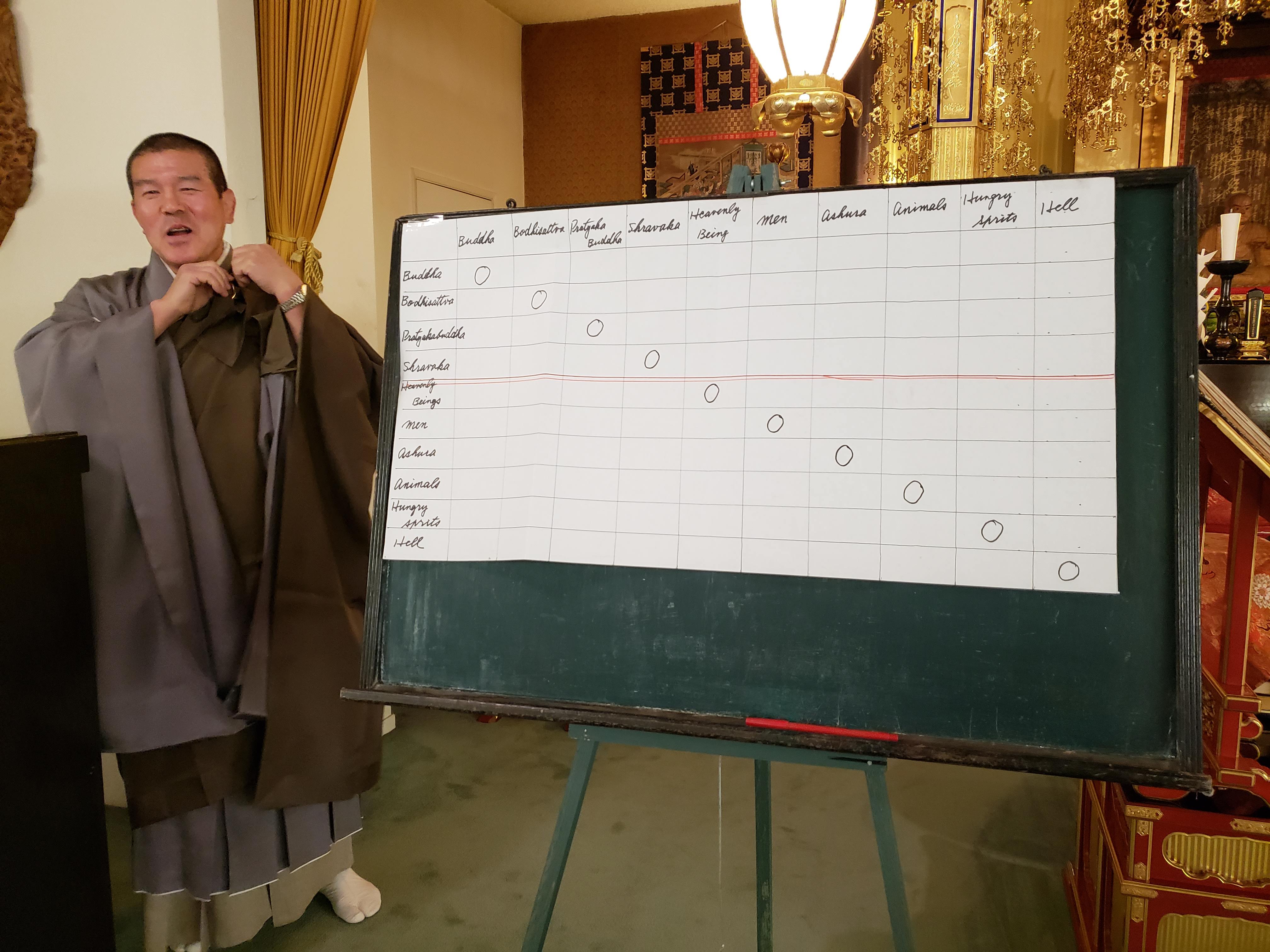
Ven. Kenjo Igarashi explains the logic of 3000 realms in a single moment.

I have seen many diagrams of the concept of Ichinen Sanzen (this, for example) but Rev. Igarashi’s offered an excellent starting place for what he described as “The logic of Ichinen Sanzen. The theory of Ichinen Sanzen. Noumenon. A kind of study.” It was not, he stressed, a deep exploration of the topic.

“Today I just explain the logic of Ichinen Sanzen,” Rev. Igarashi begain. “We already know the 10 realms – Buddha, Bodhisattva, Pratyekabuddha, Śrāvaka, Heavingly Beings, Man, Asura, Animals, Hungry Spirits, and Hell. So this is the 10 realms.”

He then walked though the chart showing how each realm contains the other realms.

“The Buddha – his mind, his spirit, his action – all the time everything is in Buddha,” he explained. “Nichiren Shonin, his actions all the time Bodhisattva. He has Buddha nature too. The Pratyekabuddha — also Engaku — he is walking all the time in Pratyekabuddha mind and action. Also Śrāvaka walking all the time in Śrāvaka world, Śrāvaka spirit. These are the four enlightened worlds. Before Lotus Sutra the Pratyekabuddha and Śrāvaka they never become Buddha. Then in the Lotus Sutra they also are kind of enlightened people. That’s why some day they are going to get enlightenment in the Buddha world.”

The grid of 10 realms by 10 realms creates a 100-realm matrix. Within each of these 100 realms, are the 10 suchnesses outlined in Chapter 2 of the Lotus Sutra:

  1. Nyoze-sō, or appearances as such,
  2. Nyoze-Shō, or natures as such,
  3. Nyoze-tai, or entities as such,
  4. Nyoze-riki, or powers as such,
  5. Nyoze-sa, or activities as such,
  6. Nyoze-in, or primary causes as such,
  7. Nyoze-en, or environmental causes as such,
  8. Nyoze-ka, or effects as such,
  9. Nyoze-hō, or rewards and retributions as such,
  10. Nyoze-honmatsu-kukyō-tō, or equality as such despite these differences.

“So we develop in the mother’s body we make forms little by little,” Rev. Igarashi explained. “Little by little make forms. Then born from the mother. At that time their nature already exists as humans. After growing the body like humans – embodiment. If body growning and got muscle. If we have got muscle we can do anything. You want to do anything. Then make functions notions. This is very important because if you make functions and our actions make cause. Cause makes condition. And condition make effect. If you make good action then you get good retribution.”

Applying the 10 suchnesses to the 100 realms produces 1000 things at any single moment.

“These 1000 things are not limited to only humans,” Rev. Igarashi explained.

At this point I’m going to borrow from the Lotus Seeds explanation of how these 1000 things are universally applicable:

The 1,000 worlds resulting from the multiplication of the one hundred worlds with the ten factors are made universal by the Three Realms. The Three Realms consist of the individual, who is composed of the Five Aggregates (form, feeling, perception, mental formations, and consciousness); the community of all beings, who are transmigrating through the Ten Worlds; and the land in which they all live. These Three Realms show that the one thousand worlds are present in and manifest themselves through all things without exception. That is, the possibilities that they point to are possessed by individuals, societies, and even non-human and inanimate phenomena.

“Everything has 3000 things,” said Rev. Igarashi. “So that’s why we have to worry about our actions. We are men. Or spirit is men. But we also find some time we’ll make an action in anger, or like hungry spirit – wanting more, more, more, or our actions will be like hell. That’s why we have to be careful. We try to make our actions like a Bodhisattvas or Buddha. If our action is Buddha or Bodhisattvas we can make good actions. That’s why Nichiren Shonin said, If you want to know your future life watch your present life. If you want to know your previous life, watch your present life because your present life makes your future life and your previous life makes your present life. …

“This is only the logic of the 3000 realms, the logic of Ichinen Sanzen, only study. Nichiren Shonin said that the phenomena of Ichinen Sanzen is Namu Myoho Renge Kyo. Everything is contained in Namu Myoho Renge Kyo. That’s why if you chant Namu Myoho Renge Kyo your spirit already understand Ichinen Sanzen. When we chant Namu Myoho Renge Kyo our actions automatically become good actions. …

“The logic of Ichinen Sanzen comes from Tendai. But we need to more than just understand. You must understand in your life, in your practice. Your practice is more important.

“This is not deep. This is just a shallow study. If everyone understand fine. So if you only understand a little bit that’s fine. Only chant Namu Myoho Renge Kyo. The phenomenon of Ichinen Sanzen is more important.”

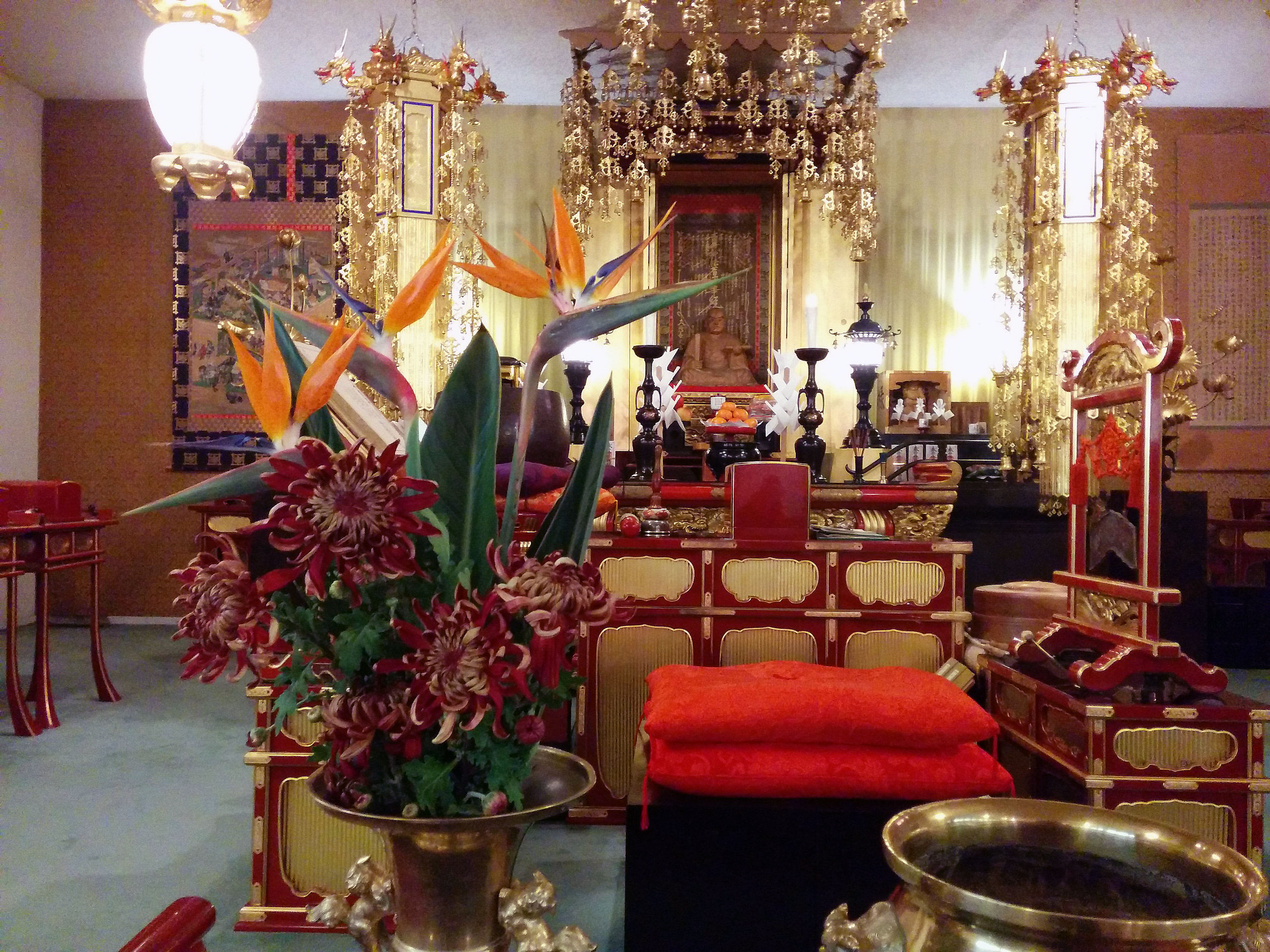
The Aug. 12, 2018, beautiful floral offering.

Rev. Igarashi’s sermon was in response to the passing of a priest who had returned to secular life.

Rev. Igarashi explained that he came from a lay family. He’s explained before that many young priests are the children of priests and have been raised to be priests. He, instead, had to study and pray.

“I asked Nichiren Shonin to please give me a minister’s job. When I was at Minobusan College student I visited Nichiren Shonin’s grave site all the time and prayed and chanted Namu Myoho Renge Kyo every day. Then after that I transferred to Rissho University and graduated. Then I joined the 100-day ascetic practice.

“During the ascetic practice the first time it’s very hard. No sleeping time. No food. No clothes. Almost nothing. And it is held during the wintertime so it’s very cold. Only food twice a day. Only rice porridge and some pickles. Everybody hungry. Everyone kind of like hungry spirit. For 100 days I just pray the same thing: If I can continue to minister job, please give me a minister’s job, otherwise if I change mind to turn to a secular life, please take my life during ascetic practice 100 days. …

“After 80 days I had fasted for one week. No food. Only water. So it’s very hard because I have to do everything with the other ministers – chanting, pouring water seven times a day. No sleeping time. …

When Rev. Igarashi found himself still alive after a week’s fasting, he took it as a sign.

“So that’s why I thought maybe I had some kind of minister’s job. Then after that I finished my 100 days ascetic practice. …

“Someone told me, Why don’t you go overseas? At the time my master was still young so that’s why I thought I would go overseas to the United States for three or four years. I told my master that after three or four years I would come back to Japan and help him.

A lot of things happened in California that prevented his return to Japan.

“So that’s why my master get angry,” he said. “So that’s why I was excommunicated.”

Rev. Igarashi began this sermon mentioning that he came to Los Angeles and something happened, and so he moved to San Francisco. Something happened there but he stayed there until he finally came to Sacramento. Always in his mind was the thought that he would return to Japan and return to secular life.

“I had a lot of chances to return to secular life, but I did not. I became a minister and I prayed, Give me my missionary job. I thought this is my missionary job. That’s why I just continued my missionary work. …

“So that’s why I have been here for over 43 years in the United States. Otherwise I think I’d return to secular life like other ministers. It’s a bit hard. The missionary job in the United States. But I pray and maybe Nichiren Shonin, and Śākyamuni Buddha and the protective Deities all the time support me. That’s why I’m here. …

“Please continue to pray. If you pray all the time Śākyamuni Buddha and Nichiren Shonin and the Deities will guide you and protect you. So please continue your practice of Nichiren Buddhism.”

The Perfect Teaching

Beginnings of Buddhism bookcoverProfoundMeaningBookCoverToday I’ve begun publishing quotes from The Beginnings of Buddhism and additional quotes from The Profound Meaning of the Lotus Sutra: Tien-tai Philosophy of Buddhism.

I have 90 quotes that I expect to publish from The Beginnings of Buddhism. In the past when I’ve finished a book, I’ve added all to the quotes to the website and scheduled one to be published per day until they run out. I don’t want to do that this time because of the nature of the topic. These quotes, while valuable in understanding the roots of early Buddhism, need to be kept in perspective of the Ultimate Truth revealed in the Lotus Sūtra.

From The Profound Meaning of the Lotus Sutra: Tien-tai Philosophy of Buddhism:

With regard to the Four Teachings, Chih-i argues that the positions of the Tripiṭaka, the Common, and the Separate Teachings must be abandoned. This is because, once they have fulfilled their roles as tentative positions, i.e., after one has progressed from these three teachings to the Perfect Teaching, and attained the ultimate position of the Perfect Teaching, these tentative positions are no longer needed. Moreover, at the moment when these tentative positions hinder one’s attainment of the ultimate position on the path of religious practice, they must be abolished too.

Moving forward I expect to publish something from The Profound Meaning of the Lotus Sutra: Tien-tai Philosophy of Buddhism each time I publish something from The Beginnings of Buddhism.  This will be more haphazard than my rigid daily schedule, but potentially more useful.

Some Books On Buddhism Are More Equal Than Others

Gotama Buddha: A Biography Based on the Most Reliable Texts
NBIC Book Store

“Gotama Buddha: A Biography Based on the Most Reliable Texts” by Hajime Nakamura is sold by the Nichiren Buddhist International Center under the heading “General Buddhism.”

If the point of the book wasn’t clear in the subhead – A Biography Based on the Most Reliable Texts – the author makes his intent in writing this book explicit when he opens his Preface with:

“My central concern in this volume is to elucidate how Gotama Buddha, or Sakyamuni, the historical figure revered as the teacher of humankind, lived his life and taught his doctrine.”

Having read this book, I’m at a loss to understand why the official Nichiren Shu organization tasked with the promotion of Nichiren Buddhism in the English-speaking world would find this book appropriate.

Keeping in mind that all Nichiren Buddhists view the Lotus Sūtra as Śākyamuni’s great vehicle capable of carrying everyone to the other shore, why does a Nichiren organization promote a book that has this to say of Mahāyāna Buddhists:

“In one sense Buddhism is a ‘founded religion,’ and in another sense it is not. Mahāyāna Buddhists rely on the one who teaches the Dharma, whether it be the bodhisattva Maitreya, Buddha Amitābha, or some other figure. They do not rely on Śākyamuni the individual. It was on this philosophical foundation that Mahāyāna Buddhism was able to declare its orthodoxy as the Buddha’s teaching.”

Page 261

The Lotus Sūtra does not rely on Śākyamuni, the individual?

The NBIC Book Store’s other offering in this category, The Beginnings of Buddhism by Kōgen Mizuno, is a much better exploration of early Buddhist teachings.

There were a few tidbits in “Gotama Buddha: A Biography Based on the Most Reliable Texts” that I felt merited keeping.

The Mahābodhi Society built a large modern temple at Sārnāth, called the Mūlagandha-kutī Vihāra, in 1931. Just coincidentally that’s the same year five families in Sacramento founded their Nichiren Church. In addition, a Japanese artist, Kōsetsu Nousu,  was invited to paint the murals depicting the life of the Buddha. This task required four years.

This is the description of the interior of the temple:

The central part of the temple enshrines relics discovered in Taxila. The innermost altar contains a replica of the fifth-century statue of the seated Buddha delivering his first discourse discovered in Sārnāth. (The original is in the Archaeological Museum in Sārnāth.) It is surrounded by banners and offerings of flowers and candles. There are also relics from Mirpur Khas and Nāgārjunakovda. Placed below the pedestal of the statue to the left is a long, narrow plaque inscribed with the words “Homage to the Lotus Sutra.” 

Page 268

Namu Myoho Renge Kyo, indeed.

Also of interest was this quote:

[The naga king Muchalinda sheltered the Buddha from rain for seven days while he was deep in meditation. When the storm had passed the naga] appeared in the form of a youth, venerating the Blessed One with the palms of his hands together and standing before him. Then the Blessed One, understanding the meaning of it, recited the following verse of uplift: “His solitude is happy, he who is content, who has heard the teachings, who has seen the Truth. Happy is freedom from malice toward others and self-restraint toward all living beings. Happy it is to be rid of all creed toward the world and to transcend all desires. The greatest happiness is control of the pride that comes of the thought ‘I am!’ ”

Page 222

Two points of interest. First is the “verse to uplift” itself. Reading these are what make such books interesting. The second point is the idea of a naga as a deity in the form of a cobra, with a great hood that shielded the Buddha from the rain. The Sanskrit means “serpent” but, as I’ve read before, the Chinese, not knowing what to make of this idea, transformed the naga into dragons. Of course, that gets picked up Japan. Nichiren, in discussing the Dragon King’s Daughter, says, “The Buddha helped a small snake, who was actually a daughter of the dragon king, attain Buddhahood with her present body.” (Sennichi-ama Gozen Gohenji, A Reply to My Lady Nun Sennici, Writings of Nichiren Shōnin, Faith and Practice, Volume 4, Pages 146-147)

Finally is the discussion of Śākyamuni’s visit home and his response when his father, the king, chides him for embarrassing his family by begging:

“Your lineage, O King, is the lineage of kings, but ours is that of the buddhas, extending from Dīpaṃkara and Koṇḍan͂n͂a down to Kassapa. These, and thousands of other buddhas, have begged for alms and lived on their alms alone.” And standing in the middle of the road, he recited this verse:

“Rouse yourself! Be not idle!
Follow the Good Way!
One who acts correctly rests in ease
In this world and the next.”

When Gotama had finished reciting that verse, the king attained the first stage of the sage. He attained the second stage on hearing this verse:

“Follow the Good Way!
Do not that which is evil!
One who acts correctly rests in ease
In this world and the next.”

A Life of Study

ProfoundMeaningBookCover
Available on Amazon

As I work my way through books on Buddhism, I’m constantly weighing them against Nichiren’s writings and the Lotus Sūtra. In introductory books such as Basic Buddhist Concepts and The Beginnings of Buddhism,  I find pieces of Buddhist concepts implied in the Lotus Sūtra but glossed over.  I wonder how this all fits together.

I find one compelling explanation in The Profound Meaning of the Lotus Sūtra. T’ien-t’ai Philosophy of Buddhism by Haiyan Shen. I’ve only just begun the first volume, but in there is this enlightening passage:

Chih-i has stressed the unique feature of the Lotus Sūtra by comparing the Lotus Sūtra with other sūtras:

“All these various sūtras aim at catering to the will of others [i.e., living beings], causing others to gain benefits. They do not discuss the intention of the Buddha, and to where his intention tends. The present [Lotus] Sūtra is not so. Regarding the doctrines [which make up the Buddhist] system [of thought], the Mahāyāna and Hinayāna methods of contemplation, the ten powers and [four forms of] fearlessness [of the Buddha], and various rules and customs [of the Buddhist religion], [the Lotus Sūtra] does not discuss them at all, for they have already been stated in the previous sūtras. [The Lotus Sūtra] only discusses the original career of the Tathāgata’s preaching, how he resorted to the sudden and gradual [methods of the teaching] in [his] middle career, and how he finally approached [his] end career [by revealing] the great cause [of universal salvation]. [The Lotus Sūtra exhibits] the framework of [the Buddha’s] teaching, and [makes known] the expedient means [the Buddha employs] to universally transform [sentient beings].

Mou Tsung-san also reiterates the superiority of the Lotus Sūtra, in a way which is akin to Chih-i’s viewpoint. Its superiority is demonstrated by the fact that it is not concerned with expressing certain doctrines, but it only establishes the merging and ultimate teaching in order to reveal the real intention of the Buddha for universal salvation of sentient beings underlying his various teachings. Mou Tsung-san considers this nature of the sūtra as belonging to the level of the transcendent. This is to say that the Lotus Sūtra is concerned with wisdom and insight into the Ultimate Truth. In order for one to understand this Truth, one first has to acquire the basic knowledge stated in other Buddhist scriptures.

Hurvitz has also indicated a similar view when he comments on the nature of the Lotus Sūtra. He states that the Lotus Sūtra takes the existence of a formulated Hinayāna philosophy (Four Noble Truths, dependent origination, substantiality of the dharmas, insubstantiality of the ego, personal release, etc) and of an equally formulated Mahāyāna philosophy (insubstantiality of the dharmas, bodhisattvahood, the Six Perfections, etc) for granted.

The Profound Meaning of the Lotus Sutra: Tien-tai Philosophy of Buddhism


And as I read I discover the threads of Buddhism taken for granted and acquire some of the basic knowledge merged in the Ultimate Truth contained in the Lotus Sūtra.

Facebook posting

Facebook stopped allowing third parties to post to Facebook profiles at the end of July. This prevented me from posting content from this website. Facebook, however, allows posting to pages and allows creating a “profile page.” Hence, I’ve created https://www.facebook.com/500yojanas/.

One Spirit; One Religion

Flowers from the July 29, 2018, service

Notes from Ven. Kenjo Igarashi‘s sermon following the July 29, 2018, Kaji Kito service.

“What is the religion? What is the faith?” Rev. Igarashi began.

When Rev. Igarashi first came to the Sacramento Nichiren Buddhist Church he would visit the homes of each of the members at the end of the year. He recalled one occasion when he tried to start chanting the Lotus Sutra before the family altar but was interrupted by an elderly woman chanting Namu-Amida. He explained to the woman that he was a Nichiren minister and he was holding a Nichiren Buddhist service and she was supposed to chant Namu-Myoho-Renge-Kyo. The woman apologized for her mistake. In other homes he would find both the Nichiren Shu mandala and another mandala in a butsudan.

“I think everyone doesn’t know what is our faith,” Rev. Igarashi said. “What is the religion. Religion is your spirit and your spirit is just one. If you have two or three or five spirits, then maybe you can believe a lot of other religions. But everyone has just one spirit and just one faith.”

Those people who travel from church to church ignore the teaching of Sakyamuni Buddha and Nichiren Shonin, he said.

“Everybody has Buddha nature. Everybody will become a Buddha. If you chant Namu-Myoho-Renge-Kyo you will get enlightenment. That’s one religion for one spirit. People who don’t understand this have two or three religions.”

Rev. Igarashi then mentioned the March 20, 1995, terrorist sarin attack on the Tokyo subway by members of the doomsday cult Aum Shinrikyo. (Wikipedia), explaining that the cult leader took advantage of young people, especially college students. Earlier this month, the members of the cult who had been on death row since their convictions were executed by hanging. (See news reports)

“If young people have strong faith, if the young ones know we have just one spirit and one religion, then I believe that they would never join this kind of cult,” Rev. Igarashi said. “That’s why I like to talk about how you have to have strong faith. Your spirit has one spirit. You have one spirit. One spirit with one religion is fine. So otherwise all the time you are thinking this religion is good or that religion is good. So that’s all the time your spirit and mind moves along. And that’s why all the time you have a chance to get caught up with a cult. So that’s why you have to be careful.

“We have the supreme teaching of Sakyamuni Buddha and Lotus Sutra and Nichiren Shonin doctrine. If you chant Namu-Myoho-Renge-Kyo your Buddha nature is going to open and you are going to get enlightenment. Then you’ll never come back to this suffering world. …

“You have just one spirit, one religion. We have Nichiren Buddhism, Lotus Sutra, and chant Namu-Myoho-Renge-Kyo. Everybody can get enlightenment. Everybody has Buddha nature. … That’s why if you chant Namu-Myoho-Renge-Kyo you are going to get enlightenment someday, maybe today or tomorrow or it takes a hundred years or 1000 years later. We don’t know but you have to keep upholding Nichiren Buddhism and the Lotus Sutra.”

Karma Kittens

Hiding in plain site

So I continue the quest to tame my foster kittens. It took me several tries today to find their hiding places. The carrier was easy enough, but the wire raceway under my desk was a stroke of genius – a black kitten hidden in the darkest corner under the desk.

My wife and I have decided to leave them alone since every time we touch them they decide they must find a new hiding place. Instead, we are only giving them food when we are in the room and withholding it when we leave. We’ll see how that works.

Now I’m killing time, allowing the kittens an opportunity to eat. No takers yet.

Available for purchase from NBIC.

I’ve been reading The Beginnings of Buddhism and gathering quotes that I’ll eventually reprint here. I enjoy the early teachings of Buddhism, considering them in the context of the Lotus Sūtra. Today, for example, I set aside a quote explaining the concept of karma as understood before Buddhism.

[W]hen Shakyamuni was teaching in a town named Devadaha, the issue of karma was being discussed. In those times, in India, there were five explanations for the causes of present happiness and unhappiness:

  1. Everything, happiness and unhappiness, is determined by karma from previous existences.
  2. All fate is determined by the will of an all-powerful deity who created and controls the world.
  3. Human fate is determined by the good or bad ways in which the elements—earth, water, fire, and wind—constituting the fleshly body are combined.
  4. The fate of the entire life of an individual is determined by the social class and family into which he was born.
  5. Human fate does not depend on any of these definite causes but is determined, from minute to minute, by completely accidental occurrences.

From the Buddhist standpoint, all of these explanations either are deterministic and fatalistic or rely purely on chance and therefore deny the significance and value of education and training and fail to take into account the importance of free will in efforts to determine and develop fate. For the sake of a correct interpretation of cosmic workings, Buddhism proposed doing away with these explanations and offered in their place the Law of Causation and the Four Noble Truths as accurate explanations of the world and of human life.

And so I gather up the cat food as I prepare to leave and offer the kittens the value of education and training and the importance of free will. No food until you come out of hiding.

‘Fraidy Cats

Sacramento SPCA Foster Kittens

So I’m killing time in my home-office-slash-foster-kitten-shelter. The Sacramento SPCA had some kittens needing socialization before they can be put up for adoption. They hiss and run away when approached. I volunteered to see if I could socialize them. Right now I’m just being  present, working quietly, trying not to make them anxious.  They are sleeping now, which I’ll call progress.

Ven. Kenjo Igarashi lights candle in front of altar.

Last Sunday, July 22, was the Obon service at the Sacramento Nichiren Buddhist Church. This was my fourth Obon service since joining the church and the first in which Ven. Kenjo Igarashi moved the stupas to the front of the altar. Normally these stupas are hidden off to right of the altar.

The rack of stupas represent all of people for whom Rev. Igarashi has held memorial services. In the photo above I’ve highlighted the stupa Rev. Igarashi made for my parents, Mary and Edwin Hughes, and my wife’s father, Richard Buchin. I can’t locate without help the stupa he created for my wife’s mother, Mary Buchin, since we asked him to use her Japanese name,  Michiko Wada.

Due to an operator error, I failed to record Rev. Igarashi’s sermon, which was an interesting lesson that included a bomb scare (locked box left on porch; eventually found to contain discarded SGI Gohonzon and other SGI material), unwanted discarded SGI books (the church is not in the recycling business) and a dragon fly who flew into the church one hot summer day to practice the Lotus Sutra, stayed the night and left the next morning when the priest’s assistant opened the doors.   Really wish I had that recording.

Nichiren Shōnin in front of Śākyamuni Buddha and Many Treasures Buddha in the Stupa of Treasures.

I’ll close out this post with a photo I downloaded from Facebook. It was posted by Chen Hsiongcai of Singapore.

One

Ven. Kenjo Igarashi during the monthly adult study class
Mrs. Igarashi’s flower arrangement for the service July 1, 2018

We begin as we did in the classroom. Putting hands together in gassho, Namu-Myoho-Renge-Kyo, Namu-Myoho-Renge-Kyo, Namu-Myoho-Renge-Kyo.

And before we continue, the disclaimer: I am allowed to record Ven. Kenjo Igarashi’s sermons and lectures as long as I don’t publish the actual recording. Since that requires that I must transcribe the hour-long class, there are bound to be errors introduced. Those are mine. Since I’m condensing and editing what I hear, what I write is more paraphrasing than quotes. Again, any errors are mine. I also want to thank Keiko Tsuda for help with the Japanese.

The lesson was about One, only One, Rev. Igarashi explained at the start.

“When I was a college student I was asked at an exam to answer the question, What is One?” He had to fill a legal-size paper with the answer.

“What is One?” he said. “A lot of things.”

He then wrote in Japanese on the chalkboard.

一仏一乗 — Ichibutsu Ichijyou — One Buddha, One Vehicle
一念三千 — Ichinen Sanzen — One moment contains 3000 realms
一念随喜 — Ichinen Zuiki — One moment of faith (Chapter 10)
一念信解 — Ichinen Shinge — One moment of faith that Sakyamuni Buddha’s life is eternal (Chapter 17)

“Lots of ichi,” he said.

The first example: One Buddha, One sutra. Only Sakyamuni Buddha; no other Buddha. And only one vehicle, not two or three.

“The Lotus Sutra teaches about second vehicle or third vehicle,” Rev. Igarashi explained, “but only one vehicle can lead to enlightenment. Only one Buddha; only one vehicle.”

Nichiren taught that only the Lotus Sutra possesses the key to opening enlightenment in our lives. Other teachings, other Buddhas cannot save people, cannot bring true enlightenment. That’s why only one Buddha; only one vehicle. Only Sakyamuni Buddha and the Lotus Sutra can save all of the people.

Rev. Igarashi explained that adding other teachings or other Buddhas to your practice is like adding sand and dirt to a bowl of rice and then eating.

“Why don’t you just eat pure rice?” he said. “Only the Lotus Sutra can bring enlightenment and save other people.”

(On the topic of Ichinen Sanzen, we’ll have to wait until next month. For a preview of the 3,000 realms contained in one moment of thought, see this quote from Lotus Seeds.)

The remaining examples of “one” focus on a single moment.

“Ichinen Zuiki: Only one second, maybe just a half-second, if you rejoice at hearing the Lotus Sutra — if you are listening a short time and then you rejoice — then you are going to get enlightenment — not long, long time,” he said.

He then read from Chapter 10, The Teacher of the Dharma:

“If after my extinction anyone rejoices, even on a moment’s thought, at hearing even a gāthā or a phrase of the Sūtra of the Lotus Flower of the Wonderful Dharma, I also will assure him of his future attainment of Anuttara-samyak-saṃbodhi.”

Anuttara-samyak-saṃbodhi means enlightenment.

“Ichinen Shinge: If you understand — if you believe — the Lotus Sutra and Sakyamuni’s life is eternal — if you believe for only one second or a half-second — you are going to get enlightenment, you are going to be a Buddha in your next life. Only a short time that you believe that Sakyamuni’s life is eternal,” Rev. Igarashi explained, and then quoted from Chapter 17, The Variety of Merits:

“Thereupon the Buddha said to Maitreya Bodhisattva-mahāsattva: “Ajita! Anyone who hears that my life is so long, and understands it by faith even at a moment’s thought, will be able to obtain innumerable merits.”

“Sakyamuni was born in India to save the people living in the defiled world, but already before he was born in India his spirit had already become enlightened a long, long, long time ago,” Rev. Igarashi explained.

Many people cannot believe that Sakyamuni’s life is eternal. That’s why he said in Chapter 17, if you believe for only a second, only a half-second, if you believe from the bottom of your heart, then you are assured by Sakyamuni of getting enlightenment and becoming a Buddha in your next life.

Some people believe we have to study or we have to practice for a long, long, long time over many, many lives otherwise we cannot get enlightenment. They give up.

“But it is not this long, long time but only one second, only half-second if you can believe then you can get enlightenment,” Rev. Igarashi said.

While Ichinen Zuiki, Ichinen Shinge — a single moment of faith — are very easy, if you are thinking of other religions it is not pure. You have to purify your mind and believe Sakyamuni’s life is eternal and the Lotus Sutra is the supreme teaching, then you are going to get enlightenment and get merit.

“Sometimes when people chant Namu Myoho Renge Kyo or the Lotus Sutra, tears fall without explanation,” Rev. Igarashi said. “That means they are very happy. The Lotus Sutra makes them very happy. Maybe he or she understands what the Lotus Sutra says and realizes she will get enlightenment and merits. They are just crying naturally during Namu-Myoho-Renge-Kyo.”

At this point Rev. Igarashi shifted to a discussion of the Parable of the Burning House in Chapter 3 and the deer carts, sheep carts and bullock carts the children wanted.

The śrāvakas and the pratyekabuddhas — nijyou or followers of the two vehicles — think only of their own enlightenment and leaving the suffering world. “We call this thinking very small,” Rev. Igarashi said. “That’s why we call nijyou Hinayana Buddhism. Hinayana Buddhism is a small boat that carries only one person at a time.”

Because nijyou followers only think about themselves, sutras before the Lotus Sutra said they could not get enlightenment. But the Lotus Sutra said even those people can get enlightenment. “We have a big boat to cross the suffering ocean,” Rev. Igarashi said. “Everybody can get in.”

Ichibutsu Ichijyou — only one Buddha, only one vehicle — can save all suffering people.

“We have to practice and we have to try to save all of the people. Trying to save other people is our practice — not only me, not only one,” he said. “Many people are thinking, I’m happy so I don’t care about other people. That’s not the thinking of the big vehicle, Daijyou. That’s why we have to think about Ichibutsu Ichijyou and Daijyou. It is very important. Then we just believe that Sakyamuni Buddha’s life is eternal and a moment’s faith is all that is required.”

Which brought us to Tanshin Mugei — 但信無解.

One only has to believe. Understanding is not required — Tanshin Mugei — believe it even if you don’t understand.

[He also returned to a topic covered in Dec. 17, 2017, service: The story of Ksudrapanthaka, disciple of the Buddha who couldn’t remember anything, even his name. See this post.]

If you seriously believe, even if you don’t understand, you will get enlightenment.

“Many people feel they must understand before they believe,” Rev. Igarashi said. “But if you try practicing, naturally you will come to understand the meaning of the Lotus Sutra. That’s why Nichiren Shonin said ‘Your belief will change to wisdom.’ So even if you don’t understand, if you chant Namu-Myoho-Renge-Kyo, Namu-Myoho-Renge-Kyo, Namu-Myoho-Renge-Kyo, your belief will naturally change to wisdom and then you will understand what the Lotus Sutra is, what Buddhism is.”

Getting to the point

The beautiful flowers arranged by Mrs. Igarashi

Each Sunday I press the record button on my voice recorder and place it on the podium from which Ven. Kenjo Igarashi makes his sermon.

“Not a serious speech this time,” said Rev. Igarashi after I set the recorder down.

I smiled and shook my head at this self-deprecation.

“Don’t care,” I said with a smile, leaving the recorder and walking to my seat.

This was the first service after the grueling week of preparation for the annual two-day Summer Food Bazaar and Rummage Sale, and Rev. Igarashi’s sermon used the church’s need for maintenance, and thus money, to discuss personal faith and practice.

[All quotes paraphrase Rev. Igarashi’s actual words.]

“Our church needs money for maintenance of the buildings, everything,” he said after pointing out that we had to re-roof the church, social hall and the minister’s residence last year. “What I want is to support this church not by money. I want everybody to support this church by everybody’s faith in Nichiren Buddhism. It is more important. Not just money.

“Everybody is thinking just give money. That’s it. I donate money to church. That’s it. That’s no good. Your strong faith supports the church and manages the church, too. That’s why I’m thinking all the time if we can manage the church without the bazaar, with only member’s support. That’s my idea, but actually it is very difficult.”

Rev. Igarashi then offered a comparison with Christian televangelists who say “God needs more money, so give me money.” Or “I have to be rich and have a luxurious life so you can become rich.”

“I want to try to give you a good life,” he said. “I pray for you to have a good life, good health. That’s more important [than being rich]. Because everybody has lots of karma, lots of good and bad karma and bad actions in your life. So your bad actions and bad karma make trouble with other people. Everything happens from your spirit, from your mind, because everybody has lots of bad karma. … That’s why we fight with other people. Not from outside. Everything happens from your karma, your bad actions. … We are born into this world because everybody has bad karma.

At this point, Rev. Igarashi described bad karma as a pointed sharp protuberance that pokes others, causing conflict and fighting between ourselves and others. I imagined a karmic Pinocchio nose, growing longer and sharper with each bad action.

“That is why we practice Buddhism and purify our spirit and then try to make smooth our spirit,” he said. “That’s why all the time I’m giving you purification (kaji kito) to purify your spirit. Then you will be happy in your life. If I’m happy, I’m rich.

“Everything starts from your mind. It is more important [than money or riches]. That’s why coming to church and purifying your spirit is more important.

“Please come to church and practice and try to purify your spirit and don’t make bad actions. This is more important than money.

“Namu-Myoho-Renge-Kyo and practicing the Lotus Sutra are more important.”