Category Archives: LS32

Day 19

Day 19 concludes Chapter 14, Peaceful Practices, and begins Chapter 15, The Appearance of Bodhisattvas from Underground.


Having last month considered the benefits of the peaceful practices, we conclude Chapter 14, Peaceful Practices.

He will see only wonderful things in his dream.
He will dream:
‘Surrounded by bhikṣus,
The Tathāgatas are sitting
On the lion-like seats,
And expounding the Dharma.’

He also will dream:
‘As many living beings, including dragons and asuras,
As there are sands in the River Ganges
Are joining their hands together
Towards me respectfully,
And I am expounding the Dharma to them.’

He also will dream:
‘The bodies of the Buddhas are golden-colored.
They are emitting innumerable ray of light,
And illumining all things.
The Buddhas are expounding all teachings
With their brahma voices.
I am among the four kinds of devotees
To whom a Buddha is expounding
The unsurpassed Dharma.
I praised the Buddha
With my hands joined together.
I heard the Dharma from him with joy.
I made offerings to him, and obtained dharanis.
I also obtained irrevocable wisdom.
The Buddha knew
That I entered deep into the Way to Buddhahood.
So he assured me of my future attainment
Of perfect enlightenment, saying:
‘Good man, in your future life,
You will be able to attain immeasurable wisdom,
That is, the great enlightenment: of the Buddha.
Your world will be pure and large
Without a parallel.
There will be the four kinds of devotees there.
They will hear the Dharma from you
With their hands joined together.’

He also will dream:
‘I am now in the forest of a mountain.
[ studied and practiced good teachings.
[ attained the truth of the reality of all things.
I am now in deep dhyāna-concentration.
I see the Buddhas of the worlds of the ten quarters.’

He also will have a good dream:
‘The bodies of the Buddhas are golden-colored.
They are adorned with a hundred marks of merits.
Having heard the Dharma from them,
I am now expounding it to others.’

He also will dream:
‘Although I was a king,
I gave up the five desires
And the most wonderful pleasures.
I left my palace and attendants,
And reached the place of enlightenment.
I sat on the lion-like seat under the Bodhi-tree,
And sought enlightenment.
After seven days, I obtained the wisdom of the Buddhas
And attained unsurpassed enlightenment.
I emerged [from dhyāna] and turned the wheel of the Dharma.
I expounded the Dharma to the four kinds of devotees
For a thousand billion kalpas.
I expounded the Wonderful Dharma-without-āsravas
And saved innumerable living beings.
Then I entered into Nirvana
Just as a flame dies when smoke is gone.’

Anyone who expounds
This supreme teaching
In the evil world after [my extinction]
Will obtain great benefits as previously stated.

The Daily Dharma from Aug. 21, 2022, offers this:

He will see only wonderful things in his dream.
He will dream:
‘Surrounded by bhikṣus,
The Tathāgatas are sitting
On the lion-like seats,
And expounding the Dharma.’

The Buddha sings these verses in Chapter Fourteen of the Lotus Sūtra, speaking of those who keep and practice the Wonderful Dharma. Dreams for many of us can be frightening places. They can be where we relive bad situations in our past or develop fantastic scenarios for disasters in the future. When we accept our nature as Bodhisattvas, and live assured of our future enlightenment, we find that even the thoughts over which we have no control begin to harmonize with the world around us. When we learn to recognize the Buddha in our everyday lives, our old traumas become vehicles for compassion.

The Daily Dharma is produced by the Lexington Nichiren Buddhist Community. To subscribe to the daily emails, visit zenzaizenzai.com

Day 18

Day 18 concludes Chapter 13, Encouragement for Keeping this Sutra, and begins Chapter 14, Peaceful Practices.


Having last month considered Mañjuśrī’s question at the start of Chapter 14, Peaceful Practices, we consider the proper practices the Bodhisattva-mahāsattvas should perform and the the proper things the Bodhisattva should approach.

“First, he should perform proper practices, approach proper things, and then expound this sūtra to all living beings.

“Mañjuśrī! What are the proper practices the Bodhisattva-mahāsattvas should perform? He should be patient, mild and meek. He should not be rash, timorous, or attached to anything. He should see things as they are. He should not be attached to his nonattachment to anything. Nor should he be attached to his seeing thing as they are. These are the proper practices the Bodhisattva-mahāsattvas should perform.

“What are the proper things the Bodhisattva-mahāsattvas should approach? He should not approach kings, princes, ministers or other government directors. He should not approach heretics, aspirants for the teaching of Brahman, Nirgraṇṭhas, writer of worldly literature, writers of non-Buddhist songs of praise, Lokāyatas or Anti-Lokāyatas. He should not approach players of dangerous sports such as boxers or wrestlers. He should not approach naṭas or other various amusement-makers. He should not approach caṇḍālas, boar-keepers, shepherds, poulterers, dog-keepers, hunters, fishermen, or other people who do evils for their livelihood. When they come to him, he should expound the Dharma to them, but should not wish [to receive anything from them]. He should not approach those who seek Śrāvakahood, be they bhikṣus, bhikṣunīs, upāsakās or upāsikās. He should not exchange greeting with them. He should not stay with them in the same monastery, promenade or lecture-hall. When they come to him, he should expound the Dharma to them according to their capacities, but should not wish [to receive anything from them]. Mañjuśrī! The Bodhisattva-mahāsattvas should not expound the Dharma to a woman with a desire for her. He should not wish to look at her. When he enters the house of others, he should not talk with a little girl, an unmarried woman or a widow. He should not approach or make friend with anyone of the five kinds of eunuchs. He should not enter the house of others alone. If he must enter it alone for some rea on, he should think of the Buddha with all his heart. When he expounds the Dharma to a woman, he should not laugh with his teeth visible to her. He should not expose his breast to her. He should not be friendly with her even for the purpose of expounding the Dharma to her. Needless to say, he should not be so for other purposes. He should not wish to keep young disciples, śramaṇeras or children. He should not wish to have the same teacher with them.

The Daily Dharma from Oct. 25, 2022, offers this:

Mañjuśrī! What are the proper practices the Bodhisattva-mahāsattva should perform? He should be patient, mild and meek. He should not be rash, timorous, or attached to anything. He should see things as they are. He should not be attached to his non-attachment to anything. Nor should he be attached to his seeing things as they are. These are the proper practices the Bodhisattva-mahāsattva should perform.

The Buddha makes this explanation to Mañjuśrī in Chapter Fourteen of the Lotus Sūtra in which he describes the peaceful practices of a Bodhisattva. When we learn to see things differently, we act differently. Conversely, when we act in ways that are not beneficial, either to ourselves or to others, it is an indication that we are not seeing things as they are. At the same time, not being attached to non-attachment helps us realize that becoming enlightened is a process, and that becoming proud of our achievements is another indication of being stuck and not seeing things as they are.

The Daily Dharma is produced by the Lexington Nichiren Buddhist Community. To subscribe to the daily emails, visit zenzaizenzai.com

Day 17

Day 17 covers all of Chapter 12, Devadatta, and opens Chapter 13, Encouragement for Keeping this Sutra.


Having last month considered when the Buddha was a King seeking the Dharma in his previous existence, we repeat in gāthās when the Buddha was a King seeking the Dharma in his previous existence

Thereupon the World-Honored One, wishing to repeat what he had said, sang in gāthās:

I remember that I became a king in a kalpa of the past.
Although I was a king,
I did not indulge in the pleasures of the five desires
Because I was seeking the Great Dharma.

I tolled a bell, and said loudly in all directions;
“Who knows the Great Dharma?
If anyone expounds the Dharma to me,
I will become his servant.”

There was a seer called Asita.
He came to [me, who was] the great king, and said:
“I know the Wonderful Dharma.
It is rare in the world.
If you serve me well,
I will expound the Dharma to you.”

Hearing this, I had great joy.
I became his servant at once.
I offered him
Anything he wanted.

I collected firewood and the fruits of trees and grasses,
And offered these things to him respectfully from time to time.
I never felt tired in body and mind
Because I was thinking of the Wonderful Dharma.

I sought the Great Dharma strenuously
Because I wished to save all living beings.
I did not wish to benefit myself
Or to have the pleasures of the five desires.

Although I was the king of a great country,
I sought the Dharma strenuously.
I finally obtained the Dharma and became a Buddha.
Therefore, I now expound it to you.

The Daily Dharma from Dec. 16, 2022, offers this:

I collected firewood and the fruits of trees and grasses,
And offered these things to him respectfully from time to time.
I never felt tired in body and mind
Because I was thinking of the Wonderful Dharma.

The Buddha teaches these verses in Chapter Twelve of the Lotus Sūtra. They are part of a story of one of his previous lives. He was a king who gave up his throne to search for someone to teach him. When he found a seer who knew the Wonderful Dharma, he became the servant of the seer and served him with enthusiasm. These verses remind us of the enthusiasm that comes from hearing the Buddha’s teachings.

The Daily Dharma is produced by the Lexington Nichiren Buddhist Community. To subscribe to the daily emails, visit zenzaizenzai.com

Day 16

Day 16 concludes Chapter 11, Beholding the Stūpa of Treasures, and completes the Fourth Volume of the Sūtra of the Lotus Flower of the Wonderful Dharma.


Having last month considered the question of who will protect this sutra, we consider the difficulty in teaching this sutra.

Good men! Think this over clearly!
It is difficult
[To expound this sūtra].
Make a great vow to do this!

It is not difficult
To expound all the other sūtras
As many as there are sands
In the River Ganges.

It is not difficult
To grasp Mt. Sumeru
And hurl it to a distance
Of countless Buddha-worlds.

It is not difficult to move [a world]
[Composed of] one thousand million Sumeru-worlds
With the tip of a toe
And hurl it to another world.

It is not difficult
To stand in the Highest Heaven
And expound innumerable other sūtras
To all living beings.

It is difficult
To expound this sūtra
In the evil world
After my extinction.

It is not difficult
To grasp the sky,
And wander about with it
From place to place.

It is difficult
To copy and keep this sūtra
Or cause others to copy it
After my extinction.

It is not difficult
To put the great earth
On the nail of a toe
And go up to the Heaven of Brahman.

It is difficult
To read this sūtra
Even for a while in the evil world
After my extinction.

It is not difficult
To shoulder a load of hay
And stay unburned in the fire
At the end of the kalpa [of destruction].

It is difficult
To keep this sūtra
And expound it to even one person
After my extinction.

It is not difficult
To keep the store
Of eighty-four thousand teachings
Expounded in the sūtras
Composed of the twelve elements,
And expound it to people,
And cause the hearers to obtain
The six supernatural powers.

It is difficult
To hear and receive this sūtra,
And ask the meanings of it
After my extinction.

It is not difficult
To expound the Dharma
To many thousands of billions of living beings
As many as there are sands
In the River Ganges
So that they may be able
To obtain the benefits:
Arhatship and the six supernatural powers.

It is difficult
To keep
This sūtra
After my extinction.

Since I attained
The enlightenment of the Buddha,
I have expounded many sūtras
In innumerable worlds.

This sūtra is
The most excellent.
To keep this sūtra
Is to keep me.

The Daily Dharma from Oct. 27, 2021, offers this:

It is not difficult
To grasp the sky,
And wander about with it
From place to place.
It is difficult
To copy and keep this sūtra
Or cause others to copy it
After my extinction.

The Buddha sang these verses in Chapter Eleven of the Lotus Sūtra for all those who had come to hear him teach. When we start on the path of enlightenment by finding joy in the Buddha Dharma, we might believe that the world will change around us to meet our expectations, and that we will have no more difficulties. Then when we do find hard times, we may even abandon this wonderful practice and go back to our habits of gratifying ourselves. Our founder Nichiren lived through unimaginable hardships so that we who follow him would not lose this precious teaching. The Buddha in these verses reminds us that difficulties are part of our practice, and that we can find a way to use any situation in life to benefit others.

The Daily Dharma is produced by the Lexington Nichiren Buddhist Community. To subscribe to the daily emails, visit zenzaizenzai.com

What’s in a Dharani?

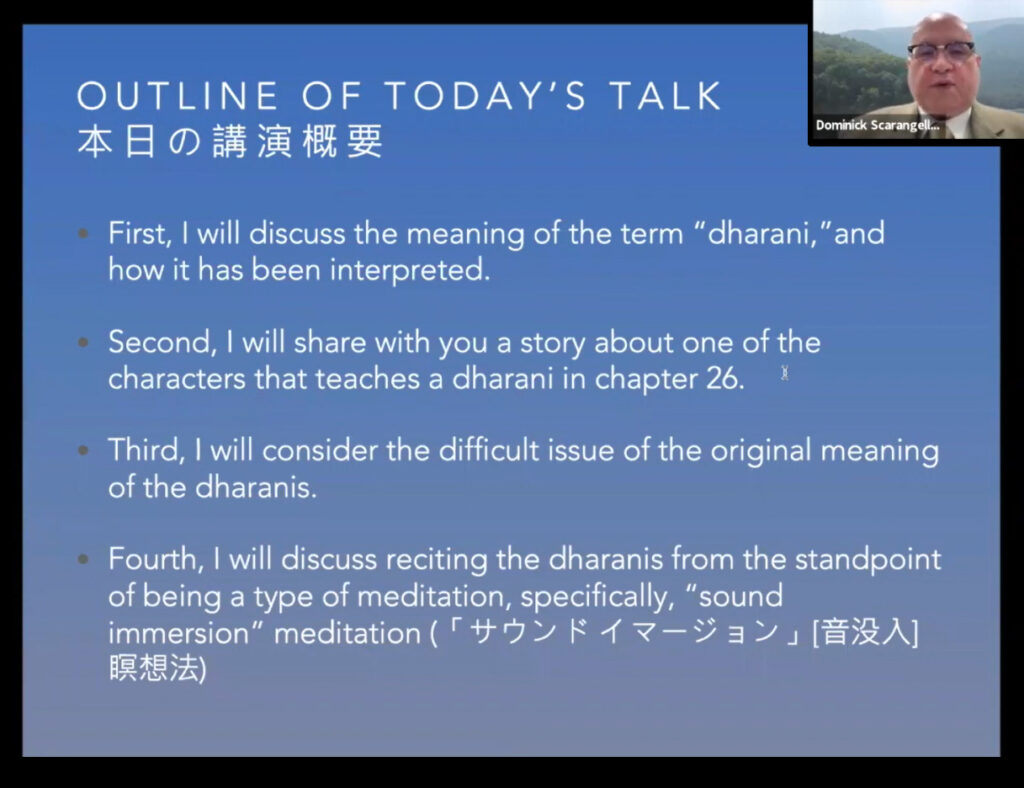
I encourage anyone with an interest in the Lotus Sutra and, in particular, Chapter 26, Dhārāṇis, to watch this video of the Dec. 4, 2022, Rissho Kosei-Kai of North America Bodhi Day talk by Dr. Dominick Scarangello. As the screenshot above explains, Dr. Scarangello’s hour-long lecture covers a wealth of material.

If you want to know more about the Mother of Demons, Hariti, start the lecture here.

See also How Hārītī Came to Defend the Dharma

Other Dharani resources

Day 15

Day 15 concludes Chapter 10, The Teacher of the Dharma, and opens Chapter 11, Beholding the Stūpa of Treasures.


Having last month considered the thirsty man on a plateau, we consider the requirements for expounding the Lotus Sutra.

“Medicine-King! How should the good men or women who live after my extinction expound this Sūtra of the Lotus Flower of the Wonderful Dharma to the four kinds of devotees when they wish to? They should enter the room of the Tathāgata, wear the robe of the Tathāgata, sit on the seat of the Tathāgata, and then expound this sūtra to the four kinds of devotees. To enter the room of the Tathāgata means to have great compassion towards all living beings. To wear the robe of the Tathāgata means to be gentle and patient. To sit on the seat of the Tathāgata means to see the voidness of all things. They should do these [three] things and then without indolence expound this Sūtra of the Lotus Flower of the Wonderful Dharma to Bodhisattvas and the four kinds of devotees.

See The Greatest Doctrine of the Buddha

Day 14

Day 14 covers all of Chapter 9, The Assurance of Future Buddhahood of the Śrāvakas Who Have Something More to Learn and the Śrāvakas Who Have Nothing More to Learn, and opens Chapter 10, The Teacher of the Dharma.


Having last month considered the promise given to those who rejoice at hearing the Lotus Sutra, we consider the promise of Buddhahood for those who keep, read, recite, expound and copy even a phrase of the Sūtra of the Lotus Flower of the Wonderful Dharma.

“Medicine-King! If anyone asks you who will become a Buddha in his future life, answer that such a person as previously stated will! Why is that? The good men or women who keep, read, recite, expound and copy even a phrase of the Sūtra of the Lotus Flower of the Wonderful Dharma, and offer flowers, incense, necklaces, incense powder, incense applicable to the skin, incense to burn, canopies, banners, streamers, garments and music to a copy of this sūtra, or just join their hands together respectfully towards it, should be respected by all the people of the world. All the people of the world should make the same offerings to them as they do to me. Know this! These good men or women are great Bodhisattvas. They should be considered to have appeared in this world by their vow to expound the Sūtra of the Lotus Flower of the Wonderful Dharma out of their compassion towards all living beings, although they already attained Anuttara-samyak-saṃbodhi [in their previous existence]. Needless to say, those who keep all the passages of this sūtra and make various offerings to this sūtra [are great Bodhisattvas]. Medicine King, know this! They should be considered to have given up the rewards of their pure karmas and appeared in the evil world after my extinction in order to expound this sūtra out of their compassion towards all living beings. The good men or women who expound even a phrase of the Sūtra of the Lotus Flower of the Wonderful Dharma even to one person even in secret after my extinction, know this, are my messengers. They are dispatched by me. They do my work. It is needless to say this of those who expound this sūtra to many people in a great multitude.

The Daily Dharma from Nov. 7, 2022, offers this:

The good men or women who keep, read, recite, expound and copy even a phrase of the Sūtra of the Lotus Flower of the Wonderful Dharma, and offer flowers, incense, necklaces, incense powder, incense applicable to the skin, incense to burn, canopies, banners, streamers, garments and music to a copy of this sūtra, or just join their hands together respectfully towards it, should be respected by all the people of the world.

The Buddha declares these lines to Medicine-King Bodhisattva at the beginning of Chapter Ten of the Lotus Sūtra. The notion of respect appears in many parts of this Sūtra. These lines tell us that we should be respected by people of the world, even though sometimes we are not. It is more important for us to respect each other, and everyone who practices the Wonderful Dharma in any way. It is also important that we respect ourselves, knowing that we are working for the benefit of all beings.

The Daily Dharma is produced by the Lexington Nichiren Buddhist Community. To subscribe to the daily emails, visit zenzaizenzai.com

Day 13

Day 13 covers all of Chapter 8, The Assurance of Future Buddhahood of the Five Hundred Disciples.


Having last month considered the Buddha’s prediction for Pūrṇa, we repeat in gāthās the Buddha’s description of Pūrṇa’s ability to employ expedients.

Thereupon the Buddha, wishing to repeat what he had said, sang in gāthās:

Bhikṣus, listen to me attentively!
The Way practiced by my sons
Is beyond your comprehension
Because they learned how to employ expedients.

Knowing that people wish to hear
The teachings of the Lesser Vehicle,
And that they are afraid of having the great wisdom,
[My sons, that is,] the Bodhisattvas transform themselves
Into Śrāvakas or cause-knowers,
And teach the people with innumerable expedients.

Saying to the innumerable living beings, [for instance,]
“We are Śrāvakas.
We are far from the enlightenment of the Buddha,”
They save them, and cause them to attain [Śrāvakahood]
Even the lazy people who wish to hear the Lesser Vehicle
Will become Buddhas with this expedient in the course of time.

My disciples are performing
The Bodhisattva practices secretly
Though they show themselves in the form of Śrāvakas.
They are purifying my world
Though they pretend to want little
And to shun birth-and-death.
In the presence of the people,
They pretend to have the three poisons and wrong views.
They save them with these expedients.
They change themselves into various forms.
If I speak of all their transformations,
The listeners will doubt me.

Under hundreds of thousands of millions of past Buddhas,
This Pūrṇa practiced strenuously what he should do.
He expounded and protected
The teachings of those Buddhas.

In order to obtain unsurpassed wisdom,
He became the most excellent disciple
Of those Buddhas.
He was learned and wise.
He expounded the Dharma without fear,
And made his listeners rejoice.
He was never tired
Of helping those Buddhas do their work.

He obtained great supernatural powers
And the four kinds of unhindered eloquence.
Seeing who was clever, and who was dull,
He always expounded the Pure Dharma.

He expounded the dharma of the Great Vehicle
To hundreds of thousands of millions of living beings,
And caused them to dwell in the Dharma
So that the worlds of those Buddhas might be purified.

The Daily Dharma from Oct. 6, 2022, offers this:

My disciples are performing
The Bodhisattva practices secretly
Though they show themselves in the form of Śrāvakas.
They are purifying my world.

The Buddha sings these verses in Chapter Eight of the Lotus Sūtra. The Śrāvakas are those who hear the teachings of the Buddha and put it into practice only for themselves. They are concerned with ending their own suffering and do not believe they have the capacity to reach the Buddha’s enlightenment. But because they can serve as an example to those who are also unsure about receiving this great wisdom, they can be an inspiration to make progress on the path. With the Lotus Sūtra, the Buddha declares that all beings have the capacity for enlightenment, and reveals that all of our pursuits are for the sake of benefiting others. It is when we realize this directly and openly that we perform the Bodhisattva practice, the selfless effort of awakening the world.

Imagining Buddha Lands

This is another in a series of weekly blog posts comparing and contrasting the Sanskrit and Chinese Lotus Sutra translations.


Throughout the first half of the Lotus Sutra we find descriptions of what a future Buddha world will look like.  Pūrṇa’s future Buddha world in Chapter 8 is a good example. The differences between English translations of Kumārajīva’s Chinese Lotus Sutra and H. Kern’s English translation of an 11th century Sanskrit Lotus Sutra are instructive.

Using Murano’s translation of Kumārajīva we begin with the prediction for Pūrṇa:

He will perform the Way of Bodhisattvas step by step for innumerable, asaṃkhya kalpas, and then attain Anuttara-samyak-saṃbodhi in this world. He will be called Dharma-Brightness, the Tathāgata, the Deserver of Offerings, the Perfectly Enlightened One, the Man of Wisdom and Practice, the Well-Gone, the Knower of the World, the Unsurpassed Man, the Controller of Men, the Teacher of Gods and Men, the Buddha, the World-Honored One.

Kern renders this:

After completing such a Bodhisattva-course, at the end of innumerable, incalculable Æons, he shall reach supreme and perfect enlightenment; he shall in the world be the Tathāgata called Dharmaprabhāsa, an Arhat, &c., endowed with science and conduct, a Sugata, &c. He shall appear in this very Buddha field.

Note that they agree that Śākyamuni says Pūrṇa’s Buddha world will be “in this world,” or as Kern emphasizes, “in this very Buddha field.” What are we to make of “this world” becoming Pūrṇa’s pure land?

Murano describes the world:

The world of that Buddha will be composed of one thousand million Sumeru-worlds, that is, as many Sumeru-worlds as there are sands in the River Ganges. The ground [of that world] will be made of the seven treasures. It will be as even as the palm of a hand. There will be no mountains nor ravines nor ditches. Tall buildings adorned with the seven treasures will be seen everywhere in that world, and the palaces of gods of that world will hang so low in the sky that gods and men will be able to see each other.

In Kern’s telling we get this version:

Further, monks, at that time the Buddha-field spoken of will look as if formed by thousands of spheres similar to the sands of the river Ganges. It will be even, like the palm of the hand, consist of seven precious substances, be without hills, and filled with high edifices of seven precious substances. There will be cars of the gods stationed in the sky; the gods will behold men, and men will behold the gods.

Again we get the palaces of the gods imagined as flying cars.

The description of the inhabitants and their environment is consistent. Murano offers:

There will be no evil regions nor women. The living beings of that world will be born without any medium. They will have no sexual desire. They will have great supernatural powers, emit light from their bodies, and fly about at will. They will be resolute in mind, strenuous, and wise. They will be golden in color, and adorned with the thirty-two marks. They will feed on two things: the delight in the Dharma, and the delight in dhyāna.

Kern explains:

Moreover, monks, at that time that Buddha-field shall be exempt from places of punishment and from womankind, as all beings shall be born by apparitional birth. They shall lead a spiritual life, have ideal bodies, be self-lighting, magical, moving in the firmament, strenuous, of good memory, wise, possessed of gold-colored bodies, and adorned with the thirty-two characteristics of a great man. And at that time, monks, the beings in that Buddha-field will have two things to feed upon, viz. the delight in the law and the delight in meditation.

I would argue that Kern’s translation lessens the negative connotation about women contained in Murano’s translation. In fact, Kern’s version is not unlike the Modern Rissho Kosei-Kai translation of the Lotus Sutra, which goes to great lengths to eliminate gender stereotypes.

“In that land, there will be no gender distinction, for all living beings there will come into existence by transformation, free of carnal desire.”

As for the occupants of this world, Murano offers:

There will be innumerable, asaṃkhya Bodhisattvas, that is, thousands of billions of nayutas of Bodhisattvas. They will have great supernatural powers and the four kinds of unhindered eloquence. They will teach the living beings of that world. There will also be uncountable Śrāvakas there. They will have the six supernatural powers including the three major supernatural powers, and the eight emancipations. The world of that Buddha will be adorned with those innumerable merits. The kalpa [in which Pūrṇa will become that Buddha] will be called Treasure­Brightness; and his world, Good-Purity. The duration of the life of that Buddha will be innumerable, asaṃkhya kalpas, and his teachings will be preserved for a long time. After his extinction, stupas of the seven treasures will be erected [in his honor] throughout that world.”

While Kern says:

There will be an immense, incalculable number of hundred thousands of myriads of koṭis of Bodhisattvas; all endowed with great transcendent wisdom, accomplished in the (four) distinctive qualifications of an Arhat, able in instructing creatures. He (that Buddha) will have a number of disciples, beyond all calculation, mighty in magic, powerful, masters in the meditation of the eight emancipations. So immense are the good qualities that Buddha-field will be possessed of. And that Æon shall be called Ratnāvabhāsa (i.e., radiant with gems), and that world Suviṣuddha (i.e., very pure). His lifetime shall last immense, incalculable Æons; and after the complete extinction of that Lord Dharmaprabhāsa, the Tathāgata, &c., his true law shall last long, and his world shall be full of Stūpas made of precious substances. Such inconceivable good qualities, monks, shall the Buddha-field of that Lord be possessed of.

Note that in Murano’s telling the Bodhisattvas have “great supernatural powers and the four kinds of unhindered eloquence. They will teach the living beings of that world.” Kern, on the other hand, describes these Bodhisattvas as “all endowed with great transcendent wisdom, accomplished in the (four) distinctive qualifications of an Arhat, able in instructing creatures.”

This description of Bodhisattvas as Arhats is very un-Mahayana. As the Oxford Dictionary of Buddhism explains:

As taught in early Buddhism, the Arhat attains exactly the same goal as the Buddha. Mahāyāna Buddhism, however, comes to regard Arhatship as an inferior ideal to that of Buddhahood, and portrays the Arhat (somewhat unfairly) as selfishly concerned with the goal of a ‘private nirvāṇa.’ In contrast, emphasis is placed on the great compassion (Mahākaruṇa) of the Buddhas and Bodhisattvas who dedicate themselves to leading all beings to salvation.


As a postscript I’m adding The Princeton Dictionary of Buddhism’s definition of a Sumeru world:

[Mount Sumeru is] the central axis of the universe in Buddhist cosmology; also known as Mount Meru, Mount Sumeru stands in the middle of the world as its axis and is eight leagues (yojana) high. It is surrounded by seven mountain ranges of gold, each separated from the other by an ocean. At the foot of the seventh range, there is a great ocean, contained at the perimeter of the world by a circle of iron mountains (cakravāda). In this vast ocean, there are four island continents in the four cardinal directions, each flanked by two island subcontinents. The northern continent is square, the eastern semicircular, the southern triangular, and the western round. Although humans inhabit all four continents, the “known world” is the southern continent, named Jambudvīpa, where the current average height is four cubits and the current life span is one hundred years. The four faces of Mount Sumeru are flat and are each composed of a different precious stone: gold in the north, silver in the east, lapis lazuli in the south, and crystal in the west. The substance determines the color of the sky over each of the four continents. The sky is blue in the southern continent of Jambudvīpa because the southern face of the Mount Sumeru is made of lapis. The slopes of Sumeru are the abode of demigods (asura), and its upper reaches are the heavens of the four heavenly… . At the summit of the mountain is the heaven of the thirty-three (Trāyastriṃsá), ruled by the king of the gods, Sakra. Above Mount Sumeru are located the remaining heavens of the sensuous realm (kāmadhātu).

Next: The Buddha as Father and Procreator

Day 12

Day 12 concludes Chapter 7, The Parable of the Magic City, and completes the Third Volume of the Sutra of the Lotus Flower of the Wonderful Dharma.


Having last month considered the Parable of the Magic City, we consider how the Buddha is our great leader.

“Bhikṣus! I, the Tathāgata, am like the leader. I am your great leader. I know that the bad road, which is made of birth-and-death and illusions, is dangerous and long, and that we should pass through it and get off it. If you had heard only of the One Vehicle of the Buddha, you would not have wished to see or approach the Buddha, but would have thought, ‘The Way to Buddhahood is too long for us to pass through unless we make painstaking efforts for a long time.’

“I knew that you were mean and timid. In order to give you a rest halfway, I expounded expediently to you the teaching of Nirvāṇa by the two vehicles. To those who attained the two [ vehicles], I say, ‘You have not yet done all that you should do. You are near the wisdom of the Buddha. Think it over and consider it! The Nirvāṇa you attained is not true. I divided the One Vehicle of the Buddha into three only expediently.’

“I say this just as the leader, who saw that his party had had a rest in the great city which he had made by magic in order to give them a rest, said to them, ‘The place of treasures is near. This city was not true. I made it by magic.”‘

The Daily Dharma from Aug. 19, 2022, offers this:

I knew that you were mean and timid. In order to give you a rest halfway, I expounded expediently to you the teaching of Nirvāṇa by the two vehicles. To those who attained the two [vehicles], I say, ‘You have not yet done all that you should do. You are near the wisdom of the Buddha. Think it over and consider it! The Nirvāṇa you attained is not true. I divided the One Vehicle of the Buddha into three only expediently.

The Buddha gives this explanation in Chapter Seven of the Lotus Sūtra after he tells the parable of the magic city. In that parable he compares himself, leading all beings to enlightenment, to a guide leading a group of travelers through a dangerous wilderness. The Buddha knows how frightening this world of conflict can be, so he uses teachings about ending suffering to keep us moving on the path. But then as the guide in the parable made the magic city disappear so that the travelers would continue to the real city, the Buddha tells us to abandon preoccupations with our own suffering so that we can enjoy his enlightenment.

The Daily Dharma is produced by the Lexington Nichiren Buddhist Community. To subscribe to the daily emails, visit zenzaizenzai.com