

Category Archives: LS32

Measures of Faith

20200902_myohorengekyo-romanized_insidecover
Each PostIt arrow represents one complete recitation the 28 chapters of the Lotus Sutra in shindoku
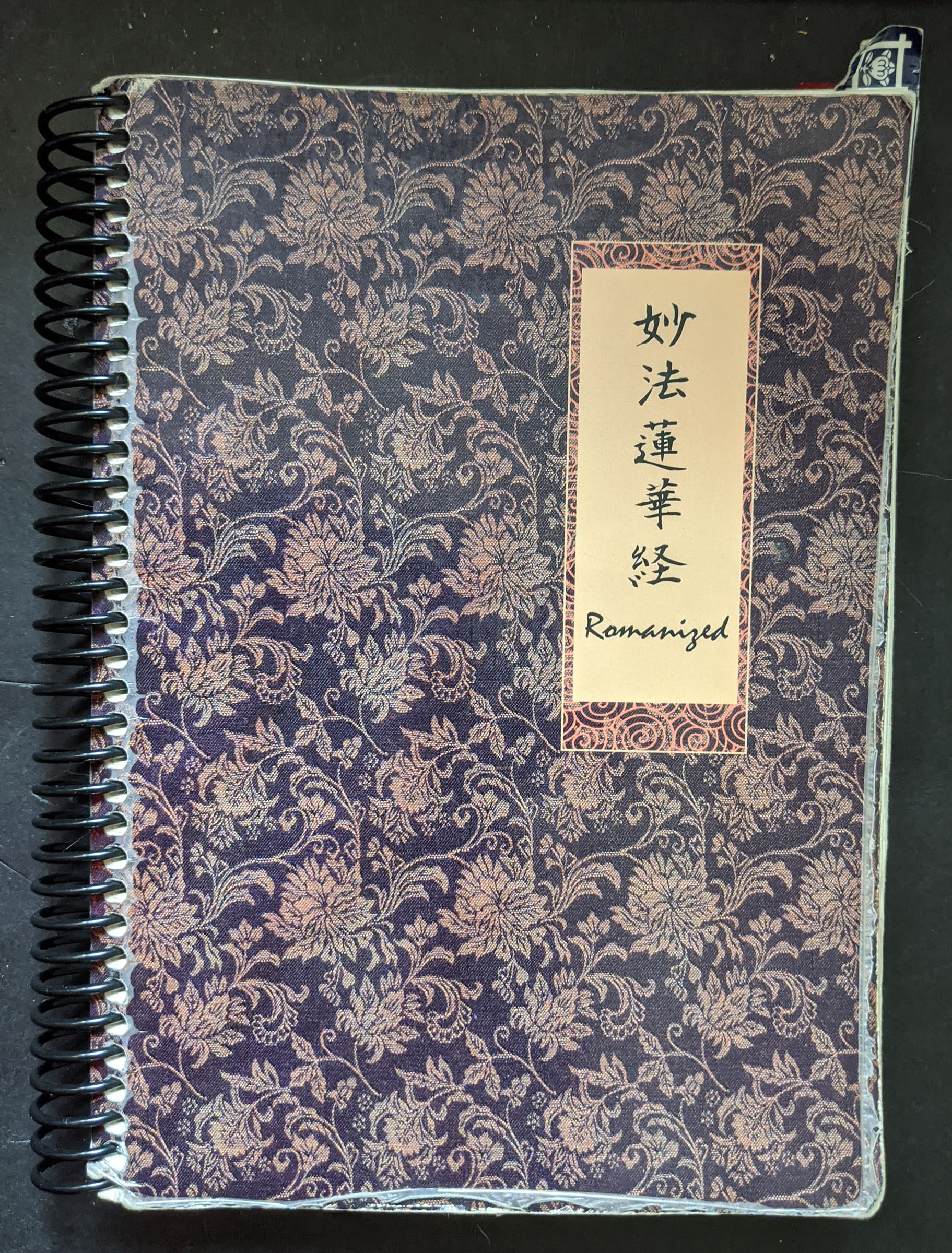
20200902_myohorengekyo-romanized-cover
The cover of Myohorengekyo Romanized is beginning to show wear from my daily handling.

Today marks one of those artificial milestones meant to measure progress along a linear path. On this blog, it would be distance traveled in a 500 yojanas journey to a place of treasures. I have now recited the 28 chapters of the Lotus Sutra in shindoku 64 times since March 2015. There’s no real value to having reached this milestone.

Each morning I pick up Mohorengekyo Romanized and recite that day’s portion of the sutra. The eight fascicles of the sutra are divided into four parts, rendering the sutra’s 28 chapters in 32 parts.  I mark my place in the book with a PostIt Note arrow and at the end of the cycle I tape the arrow in the inside cover of my Myohorengekyo Romanized book. When I complete a row of 16 cycles – an arbitrary number that corresponds to the number of arrows that fit in a column – I dutifully comment on the occasion:

While I feel compelled to mark this milestone, I do not believe I’m on a linear journey. Having progressed this far along this path I’ve come to understand the importance of the moment – the 3000 realms in a single thought moment, the constant arising and perishing of each instant.

What I want to come back to today is that moment of faith, the step along this 500 yojanas journey. Yes, there was a first step, but each moment is another step, a confirmation of faith in the path of the One Vehicle leading to supreme perfect enlightenment.

For the past few weeks I’ve been participating in the Enkyoji Buddhist Network’s Online Class. One of the lessons concerned the topic of Faith, Practice and Study. My answer to a question about faith fits well with this discussion of moments:

In Chapter 16 of the Lotus Sutra we learn of the wise physician whose children have poisoned themselves while he was away on business. Some of these children are worse off than others. Seeing their plight the father creates a medicine to cure them. This medicine is guaranteed to look appealing, smell appetizing and taste delicious. Some of the children take the medicine immediately and are cured instantly. The other children, those so badly poisoned that they have lost their right minds, refuse to take the medicine. These children see that the medicine looks appealing and agree that it smells appetizing, but these children refuse to believe that it will taste delicious. These children lack fatih.

Faith is required in order to practice Buddhism. Faith is the initial step that begins the journey, the key that unlocks the gate leading to the path. We are not expected to blindly step off a cliff and have faith that gravity will disappear. Instead, we are asked to believe that the medicine left behind by the Eternal Buddha not only looks and smells great, but tastes good as well. Having faith, we begin our practice and as we continue our practice we validate and deepen our faith.

Each moment of faith, equal and unique, rising over and over.

Between Day 32 and Day 1: Perspectives On The One Path

In reciting The Sutra of Contemplation of The Dharma Practice of Universal Sage Bodhisattva I was struck by a minor line early in the sutra:

“Hear me clearly! Hear me clearly, and consider this well! In the past, on Mount Vulture Peak and at other places, the Tathāgata has already expounded the one genuine path from many perspectives. And now, at this place, for the benefit of all living beings in the future who wish to follow the Supreme Way that is the Great Vehicle—and who wish to learn and follow the practice of Universal Sage,3 I will now expound the method4 for that, which I have kept in mind. Impurities, in any number, should be eliminated whether one perceives Universal Sage or not. This I will now explain to you, accordingly, in great detail.

This idea of one genuine path from many perspectives ties nicely with the Three-Fold Lotus Sutra.  Looking in book order, we have the Innumerable Meanings:

Seeing that conditioned desires are innumerable, the bodhisattva expounds the teachings in infinite ways. Because there are infinite ways of exposition, there are infinite meanings as well. The infinite meanings stem from a single dharma.

The Lotus Sutra follows with:

I know that all living beings have various desires. I also know that they have attachments deep in their minds. Therefore, I expound various teachings to them with stories of previous lives, parables, similes and discourses, that is to say, with various expedients according to their natures.

Śāriputra! I do all this for the purpose of causing them to realize the teaching of the One Buddha-Vehicle, that is, to obtain the knowledge of the equality and differences of all things. Śāriputra! There is not a second vehicle in the worlds of the ten quarters. How can there be a third?

And finally today’s reminder that what he have heard are many perspectives on the one genuine path.

The Merit Accomplished When the Tathāgata Establishes the Grounds to Teach

This merit means that he reveals an unusual, incomprehensible event to the great assembly. Seeing it, the great assembly is struck with wonder. Delighted, they want to hear about it and think: “The Tathāgata should now explain something to us.” Therefore it is called the accomplishment of a basis to explain the motive. That is why the Tathāgata emits a great ray of light that reveals various events occurring in the worlds of another direction.

The Tathāgata first displays for the great assembly external events, such as the earth quaking in six ways. Then he reveals the profound and subtle truth (Dharma) within this religious discourse that he realized by himself. He also utilizes the physical and human worlds; a variety of types and dimensions; the different defilements and purities possessed; the different buddhas, doctrines (Dharmas), and disciples in order to illustrate the Three Jewels; the different vehicles; the worlds with buddhas and those without buddhas. He causes living beings to see practitioners who have not yet attained the result [of the path] as well as those who have gained the path and attained the result. Just as it says in the Lotus Sutra, “[A]ll who had achieved the path through practice…”

“A variety of types” means various sights. Briefly expressed, there are four: 1) nourishment, 2) listening to the Dharma, 3) practice, and 4) delight. Just as it says in the Lotus Sutra:

At that moment the Buddha emitted a ray of light from the tuft of white hair between his eyebrows [which totally illuminated all of the eighteen thousand worlds in the east, down as far as the lowest hell and up as far as the highest heaven. In those lands the beings of the six destinies were completely visible. Moreover the buddhas present in those lands were seen and the Dharma they were teaching was heard. Also seen there were the monks, nuns, laymen, and laywomen who had achieved the path through practice. Moreover, all the bodhisattvas, great beings, possessed of various inclinations, motives, and appearances, were seen practicing the bodhisattva path.

Furthermore all the buddhas in final nirvana (parinirvāṇa) were seen. Also seen were all the buddhas after their final nirvana], and their buddha-relic stupas made of the seven precious treasures.

It should be known that those practicing the bodhisattva path give guidance to living beings using the expedient means of the four methods of conversion. [The four methods of conversion] should be individually applied in accordance with what is taught in the Saddharmapuṇḍarīka-sūtra.

Vasubandhu's Commentary on the Lotus Sutra, p 105-106

Day 32

Day 32 covers Chapter 28, The Encouragement of Universal-Sage Bodhisattva, closing the Eighth Volume of the Sutra of the Lotus Flower of the Wonderful Dharma.

Having last month considered Universal-Sage’s vow to protect the practicer of the Lotus Sutra, we receive the dhārāṇis spells from Universal Sage.

“World-Honored One! The bhikṣus, bhikṣunīs, upāsakās or upāsikās who seek, keep, read, recite and copy this Sūtra of the Lotus Flower of the Wonderful Dharma in the defiled world in the later five hundred years after [your extinction], if they wish to study and practice this sūtra, should concentrate their minds [on study and practice] strenuously for three weeks. When they complete [the study and practice of] three weeks, I will mount a white elephant with six tusks, and appear before them with my body which all living beings wish to see, together with innumerable Bodhisattvas surrounding me. I will expound the Dharma to them, show them the Way, teach them, benefit them, and cause them to rejoice. I also will give them dhārāṇi spells. If they obtain these dhārāṇis, they will not be killed by nonhuman beings or captivated by women. Also I myself will always protect them. World-Honored One! Allow me to utter these dhārāṇis spells!”

Thereupon he uttered spells before the Buddha:

“Atandai (1), tandahatai (2), tandahatei (3), tandakusharei (4), tandashudarei (5), shudarei (6), shudarahachi (7), botsudahasennei (8), sarubadarani-abatani (9), sarubabasha-abataru (10), hu­abatani (11), sōgyahabishani (12), sōgyaneku-kyadani (13), asogi (14), sōgyahagyadai. (15), teirei-ada-sōgyatorya-aratei-haratei (16), sarubasogya-sammaji-kyarandai (17), sarubadaruma­shuharisettei (18), saru-basatta-rodakyōsharya-atogyadai (19), shin-abikiridaitei (20).”

[He said to the Buddha:]

“World-Honored One! It is by my supernatural powers, know this, that a Bodhisattva can hear these dhārāṇis. Anyone who keeps the Sūtra of the Lotus Flower of the Wonderful Dharma [while it is] propagated in the Jambudvipa, should think, ‘I can keep [this sūtra] only by the supernatural powers of Universal-­Sage.’ Anyone who keeps, reads and recites this sūtra, memorizes it correctly, understands the meanings of it, and acts according to it, know this, does the same practices that I do. He should be considered to have already planted deeply the roots of good under innumerable Buddhas [in his previous existence]. He will be caressed on the head by the hands of the Tathāgatas. Anyone who copies this sūtra will be reborn in the Heaven of the Trāyastriṃs̒a Gods immediately after his present life. On that occasion, eighty-four thousand goddesses will come and receive him, making many kinds of music. A crown of the seven treasures will be put on his head, and he will enjoy himself among the ladies in waiting. Needless to say, [more merits will be given to] the person who [not only copies this sūtra but also] keeps, reads and recites it, memorizes it correctly, understands the meanings of it, and acts according to it. Anyone who keeps, reads and recites this sūtra, and understands the meanings of it, will be given helping hands by one thousand Buddhas immediately after his present life. He will be fearless. He will not fall into any evil region. He will be reborn in the Tusiita Heaven. There he will go to Maitreya Bodhisattva who, adorned with the thirty-two marks, will be surrounded by great Bodhisattvas, and attended on by hundreds of thousands of billions of goddesses. He will be given the benefits of these merits. Therefore, anyone who has wisdom should copy this sūtra with all his heart, cause others to copy it, and also keep, read and recite it, memorize it correctly, and act according to it.

“World-Honored One! I will protect this sūtra with my supernatural powers so that it may be propagated and not be destroyed in the Jambudvipa after your extinction.”

See Doing the Work of the Buddha with the Strength of an Elephant

Doing the Work of the Buddha with the Strength of an Elephant

It is significant that Universal Sage and his elephant come not to offer us a ride to some paradise above the masses of ordinary people but to bring the strength of an elephant for doing the Buddha’s work in the world, so that the Dharma can blossom in us, empowering us to be bodhisattvas for others, enabling us to see the Buddha in others and to experience the joy of seeing buddhas everywhere.

In doing the work of the Buddha, we should recognize that there are many kinds of Dharma – teachings, truths, and correct ways of doing things. In the Buddha’s time there were Hindu dharmas and Jain dharmas, dharmas stemming from one’s birth or caste, and dharmas appropriate to one’s stage of life. In many respects, the Buddha’s teachings provided an alternative to conventional Indian dharmas. Thus, in Buddhism, Dharma is always Buddha Dharma. In other words, Buddha Dharma is such that without the Buddha there is no Buddha Dharma and, since the Buddha is first and foremost a teacher, the Buddha is not the Buddha without Buddha Dharma. The Buddha and his Dharma, the Dharma and its teacher, cannot be separated into independent realities.

There is a very interesting passage in Chapter 28: “If there are any who receive and embrace, read and recite, remember correctly, practice, and copy this Dharma Flower Sutra, it should be known that they have seen Shakyamuni Buddha. It is as though they heard this sutra from the Buddha’s mouth. It should be known that they have made offerings to Shakyamuni Buddha. It should be known that the Buddha has praised them for doing good. It should be known that Shakyamuni Buddha has touched the heads of such people with his hand. It should be known that such people are covered by the robes of Shakyamuni Buddha.” (LS 397)

The Sutra itself, in other words, is not just an embodiment of Buddha Dharma but of Shakyamuni Buddha himself, and thus is one of the ways in which the Buddha appears to and for us.

The Stories of the Lotus Sutra, p305-306

Merits Necessary To Teach the Dharma

As for the merit, on what means does he rely to teach the Dharma? He utilizes three methods:

  1. [He] utilizes the accomplishments of meditative trance. There are two types of accomplishments: The first is the power of self-mastery, since [in meditative trance] the body and mind remain imperturbable. The second is the elimination of all the obstructions, something that occurs along with the power of self-mastery. The power of self-mastery also has two types:The first type is for [the Tathāgata] to conform [the teaching] to living beings to illustrate the antidotes [and enable them to] attain the elements conducive to enlightenment. The second type functions as an antidote to the tenacious defilements that exist from beginningless time. Just as it says in the Lotus Sutra:

    The Buddha, having expounded this sutra, sat in the posture of meditation and entered the meditative trance called “the abode of the exposition of infinity” where he remained imperturbable in body and mind…

  2. He utilizes the physical worlds.
  3. He utilizes the human worlds.

That is why [the Tathāgata] caused the earth to quake and knew what had happened over the past countless world-ages (kalpas). Just as it says in the Lotus Sutra:

Then mandārava [and great mandārava, manjūsaka and great manjūsaka flowers fell like rain from the sky, scattering over the Buddha and the great assembly. And the entire buddha world quaked in six ways. Thereupon the entire assembly of monks, nuns, laymen, and laywomen in that gathering, the devas, nāgas, yakyas, gandharvas, asuras, garudas, kimnaras, mahorāgas, humans and nonhumans, kings and noble emperors, attained an unprecedented experience]. Joyfully, and with the palms of their hands pressed together in reverence, they gazed attentively at the Buddha.

Vasubandhu's Commentary on the Lotus Sutra, p 104-105

Day 31

Day 31 covers Chapter 27, King Wonderful-Adornment as the Previous Life of a Bodhisattva.

Having last month heard Cloud-Thunderpeal-Star-King-Flower-Wisdom Buddha’s prediction for King Wonderful-Adornment, we consider the reaction of King Wonderful-Adornment

“King Wonderful-Adornment came down from the sky and said to that Buddha [staying in the sky], ‘World-Honored One! You are exceedingly exceptional. You have merits and wisdom. Therefore, the fleshy tuft on your head shines bright. Your eyes are long, wide, and deep blue in color. The curls between your eyebrows are as white as a bright moon. Your teeth are white, regular and bright. Your lips are as red and as beautiful as the fruits of a bimba-tree.’

“Thereupon King Wonderful-Adornment, having praised the Buddha for his many hundreds of thousands of billions of merits including those previously stated, joined his hands together towards the Tathāgata, and with all his heart, said to that Buddha again, ‘World-Honored One! I have never seen anyone like you before. Your teachings have these inconceivable, wonderful merits. The practices performed according to your teachings and precepts are peaceful and pleasant. From today on, I will not act according to my own mind. I will not have wrong views, arrogance, anger or any other evil thought.’ Having aid this, he bowed to that Buddha and retired.”

The Daily Dharma from June 5, 2020, offers this:

World-Honored One! I have never seen anyone like you before. Your teachings have these inconceivable, wonderful merits. The practices performed according to your teachings and precepts are peaceful and pleasant. From today on, I will not act according to my own mind. I will not have wrong views, arrogance, anger or any other evil thought.

King Wonderful-Adornment makes this declaration to Cloud-Thunderpeal-Star-King-Flower-Wisdom Buddha in Chapter Twenty-Seven of the Lotus Sūtra. The king had been led to this Buddha by his sons, who showed him the wonders they learned from their practice of the Buddha Dharma. With his mind purified by hearing the Buddha’s teachings, he makes this aspiration to behave differently. Whether or not he can keep this aspiration, he shows his realization that hearing the teachings is not enough. Practicing them means changing our minds and how we live.

The Daily Dharma is produced by the Lexington Nichiren Buddhist Community. To subscribe to the daily emails, visit zenzaizenzai.com

Seventeen Titles of the Lotus Sutra of the Great Vehicle

That merit is accomplished when the Tathāgata wants to teach the Dharma means the Tathāgata explains the Sutra of the Great Vehicle to the bodhisattvas. It should be known that this [Lotus] Sutra of the Great Vehicle has seventeen titles that reveal its profound merit. What are these seventeen and what do they show?

  1. [The Lotus Sutra] is called “The Infinite Meanings Sutra” because it completes the meaning of words, and because this religious discourse explains the subtle realm of their profound truth (Dharma). “The subtle realm of their profound truth” means the ultimate realm of all the buddhas, the tathāgatas.
  2. It is called “The Most Excellent Sutra.” This shows that among the three divisions of the Buddhist scriptures, the most excellent division is well completed in this religious discourse.
  3. It is called “The Greatly Expanded Sutra” since it well completes the foundation of all the vast discourses of the Great Vehicle in accordance with the faculties of living beings.
  4. It is called “The Instruction for the Bodhisattvas,” since it well completes the instruction for those bodhisattvas with mature faculties in accordance with their capacities.
  5. It is called “[The Sutra] that is Protected by the Buddhas,” since the buddhas, the tathāgatas, abide in this Dharma.
  6. It is called “The Mysterious Dharma of All the Buddhas,” since the profundity of this Dharma is known only by the buddhas.
  7. It is called “The Storehouse of All the Buddhas,” since the storehouse of all the meritorious meditative states of the tathāgatas is in this sutra.
  8. It is called “The Mysterious Subject of All the Buddhas,” since it is not conferred on those who do not have the capacity [to understand it], such as living beings with immature faculties.
  9. It is called “The Sutra that Produces All the Buddhas,” since the great enlightenment of all the buddhas can be produced by hearing this religious discourse.
  10. It is called “The Seat of Enlightenment of All the Buddhas,” since the highest, complete enlightenment of all the buddhas can be produced through this religious discourse, and not through any of the other sutras.
  11. It is called “The Wheel of the Dharma Set in Motion by All the Buddhas,” because all the obstructions can be destroyed through this religious discourse.
  12. It is called “The Adamantine Relic of All the Buddhas,” since the true absolute body (dharmakāya) of all the tathāgatas [that is found] in this sutra does not decay.
  13. It is called “The Sutra that is the Great Skillful Expedient Means of All the Buddhas,” since they rely on this religious discourse to develop great enlightenment and use it to explain all the good attributes of the heavenly beings (devas), disciples, and self-enlightened buddhas to living beings.
  14. It is called “The Sutra that Teaches the One Vehicle,” since this religious discourse reveals the ultimate essence of the highest, complete enlightenment of the tathāgatas, whereas the way of the other two vehicles does not.
  15. It is called “The Sutra that is the Abode of the Highest Meaning,” because this religious discourse is the ultimate abode of the dharmakāya of all the buddhas, the tathāgatas.
  16. It is called “The Saddharmapuṇḍarīka-sūtra.” This title has two meanings. What are these two?
    The first meaning is [that of a lotus] emerging from water. This indicates that which cannot be destroyed emerges from the turbid water of the Small Vehicle. There is another significance, [that of the disciples who are] just like a lotus emerging from turbid water. When all the disciples obtain entry to the Tathāgata’s great assembly, they too, like all the bodhisattvas, are seated on lotuses. And while listening to the explanation about the pure realm of the Tathāgata’s unsurpassed knowledge, they directly apprehend this profound subject matter.

    The second meaning is [that of] a blossoming lotus. Because of the trepidation living beings have regarding the Great Vehicle, they are unable to produce faith in it. Therefore a blossoming lotus represents the pure dharmakāya of all the tathāgatas, which causes living beings to engender faith.

  17. It is called “The Supreme Religious Discourse,” because of its accomplishment of verses. “The accomplishment of verses” means it includes countless words, phrases, syllables, and ten millions and hundreds of tens of millions of verses.

These seventeen statements about the religious discourse are general, while all others are particular. Just as it says in the Lotus Sutra, “[Buddha Candrasūryaprabhā] taught the sutra of the Great Vehicle called “[The Sutra] of Infinite Meanings” to the bodhisattvas. . .”

Vasubandhu's Commentary on the Lotus Sutra, p 102-104

Day 30

Day 30 covers all of Chapter 26, Dhāraṇīs

Having last month concluded Chapter 26, Dhāraṇīs, we return to Medicine-King Bodhisattva and question about the merits to be given to the good men or women who practice the Lotus Sūtra.

Thereupon Medicine-King Bodhisattva rose front his seat, bared his right shoulder, joined his hands together towards the Buddha, and said to him:
“World-Honored One! How many merits will be given to the good men or women who keep, read, recite, understand or copy the Sūtra of the Lotus Flower of the Wonderful Dharma?”

The Buddha said to him:

“Suppose some good men or women make offerings to eight hundred billion nayuta Buddhas, that is, as many Buddhas as there are sands in the River Ganges. What do you think of this? Are the merits given to them many or not?”

“Very many, World-Honored One!”

The Buddha said: “More merits will be given to the good men or women who keep, read or recite· even a single gāthā of four lines of this sūtra, understand the meanings of it or act according to it.”

See Mystic Syllables

Fifteen Meanings of One Who Is Worthy

As for “all of them were arhats,” the term “arhat” means “one who is worthy.” The fifteen meanings of one who is worthy should be known. What are these fifteen?

1) One who is worthy receives food and bedding, honor, and reverence; 2) one who is worthy leads the great assembly in giving guidance to all [living beings]; 3) one who is worthy enters such places as cities and villages; 4) one who is worthy overcomes all heretical systems; 5) one who is worthy quickly surveys all phenomena (dharmas) with wisdom; 6) one who is worthy teaches the Dharma untiringly and in good physical condition in accordance with the truth (Dharma); 7) one who is worthy sits tranquilly in a secluded forest, does not accumulate or gather food, clothing, or possessions, and is satisfied with little; 8) one who is worthy intently practices good conduct and does not become attached to any meditation; 9) one who is worthy carries out the noble practice of emptiness; 10) one who is worthy carries out the noble practice of signlessness; 11) one who is worthy carries out the noble practice of wishlessness; 12) one who is worthy suppresses [their desire for] the tranquility of worldly meditation; 13) one who is worthy has produced the superior qualities of all the supernatural powers; 14) one who is worthy has realized the superior merits of the supreme meaning; and 15) with their knowledge of true reality, one who is worthy [knows] the merits that those of the same group have attained in order to benefit all living beings.

Vasubandhu's Commentary on the Lotus Sutra, p 98