Daily Dharma for April 6, 2026

20260406-ddi

Illustration by Google Gemini

Show Gemini's thinking

Gemini Thinking

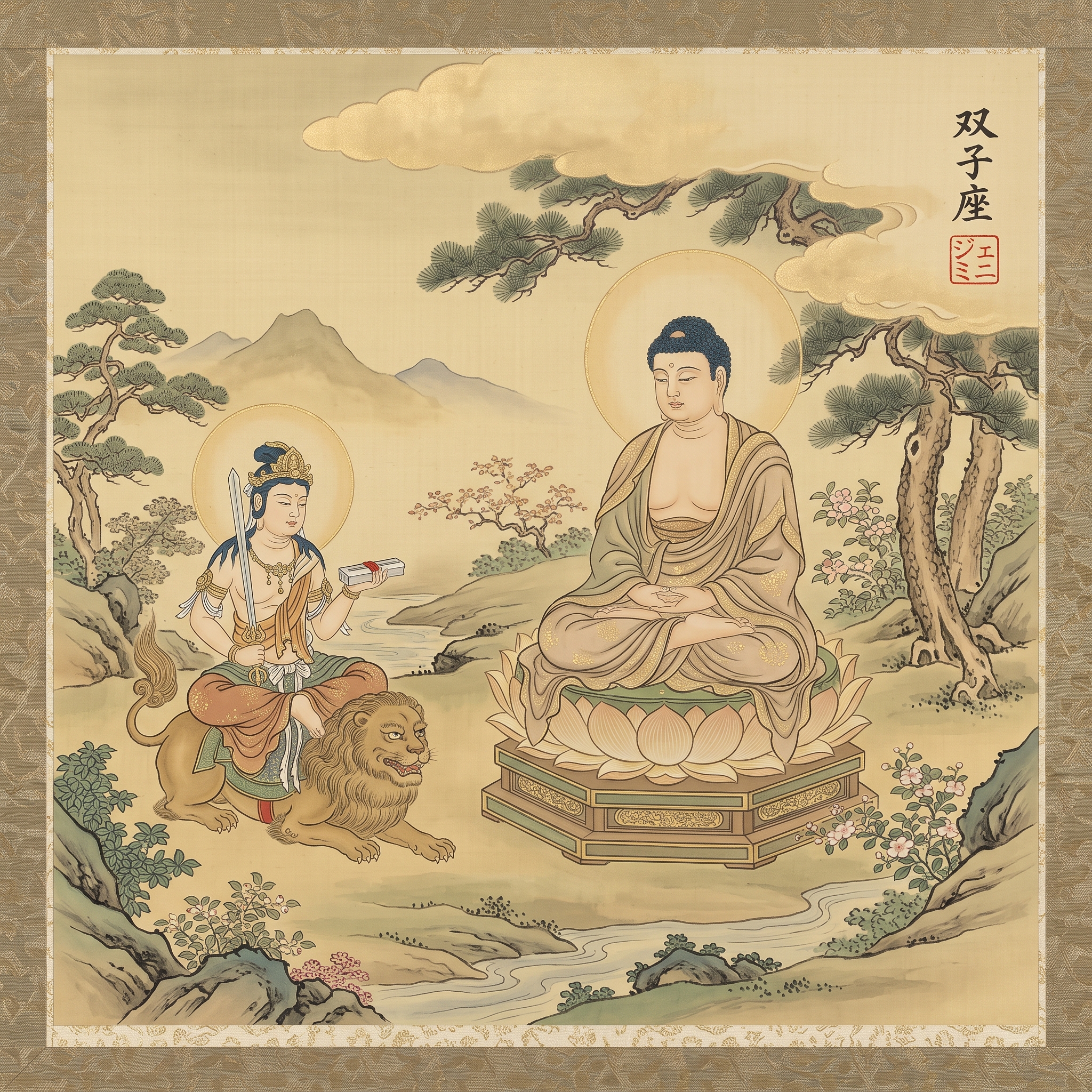
This illustration depicts Śākyamuni Buddha (the historical Buddha) as he expounds the Dharma on Vulture Peak, surrounded by his close disciples. The swirling emanations from his heart symbolize the "inconceivable supernatural powers" described in the Lotus Sūtra—a visual metaphor for the profound, transformative wisdom that can appear miraculous to those still struggling to understand the nature of reality. The specific artist signature/stamp 双子座 (Futagoza, "Gemini") and the hanko with the katakana ジェミニ (Jemini) can be found in the lower right corner.

The supernatural powers
Employed by that Buddha
For the expounding of the Dharma
Will be inconceivable.

Śākyamuni Buddha sings this verse in Chapter Six of the Lotus Sūtra after predicting the future Buddhahood of his disciple Subhūti. Anything we do not understand can seem supernatural. Things we find common in our modern world would seem magical to those who lived in the Buddha’s time. It is only through our greater understanding that we can create our modern wonders. It should not then surprise us that with the Buddha’s mind, which he reminds us that we too can reach, the things we can accomplish will seem magical to those mired in delusion.

The Daily Dharma is produced by the Lexington Nichiren Buddhist Community. To subscribe to the daily emails, visit zenzaizenzai.com

The Realm of Buddhas Inherent in Their Minds

The doctrine of the “mutual possession of the ten realms” is not explained in any sūtras expounded during forty years or so of the Buddha’s preaching except in the Lotus Sūtra. Since the “mutual possession of the ten realms” doctrine is not preached, believers of those sūtras do not know about the realm of Buddhas inherent in their minds.

Unaware of the realm of Buddhas in their minds, they do not know of other Buddhas outside of their minds either. Namely, practicers of expedient sūtras preached in the pre-Lotus period of forty years or so do not know of Buddhas. Even if they see Buddhas, they merely see Buddhas in other worlds, not real Buddhas.

Practicers of the two teachings, śrāvaka and pratyekabuddha, are unaware of the Buddha within their own minds, so they cannot become Buddhas. Bodhisattvas of the pre-Lotus sūtras, unaware of the “mutual possession of the ten realms,” themselves deny the attainment of Buddhahood by practicers of śrāvaka and pratyekabuddha teachings. Thus, they are unable to fulfill their vow of saving all people. These bodhisattvas do not see the Buddha. Likewise, ignorant people do not know the “mutual possession of the ten realms,” so the Buddha realm inherent in them is not revealed. As a result, the Buddha of Infinite Life will not come to welcome them at the last moment of life, and Buddhas will not come to help them upon request. They are like the blind who cannot see their own shadow.

Now in the Lotus Sūtra, it was clarified that the Buddha realm is inherently possessed by even those in the unenlightened nine realms, enabling those who had listened to the expedient pre-Lotus sūtras–bodhisattvas, Two Vehicles (śrāvaka and pratyekabuddha ), and those in the six realms of illusion–all to see for the first time the Buddha realm in themselves. It was the first time that those people were able to become true Buddhas, true bodhisattvas and true śrāvaka and pratyekabuddha. It was the first time that bodhisattvas and śrāvaka and pratyekabuddha attained Buddhahood and ignorant people were able to be reborn in the Pure Land. Regardless, during or after the lifetime of the Buddha, the true, trustworthy teacher (“good friend”) of all the people is the Lotus Sūtra. Tendai scholars in general assert that one can achieve enlightenment through pre-Lotus sūtras, but I, Nichiren, do not accept it. Having no time to discuss this thoroughly in this book, I merely mention it here briefly. I hope to discuss it in detail someday.

Shugo Kokka-ron, Treatise on Protecting the Nation, Writings of Nichiren Shōnin, Doctrine 1, Page 55-56

Daily Dharma for April 5, 2026

20260405-ddi

Illustration by Google Gemini

Show Gemini's thinking

Gemini Thinking

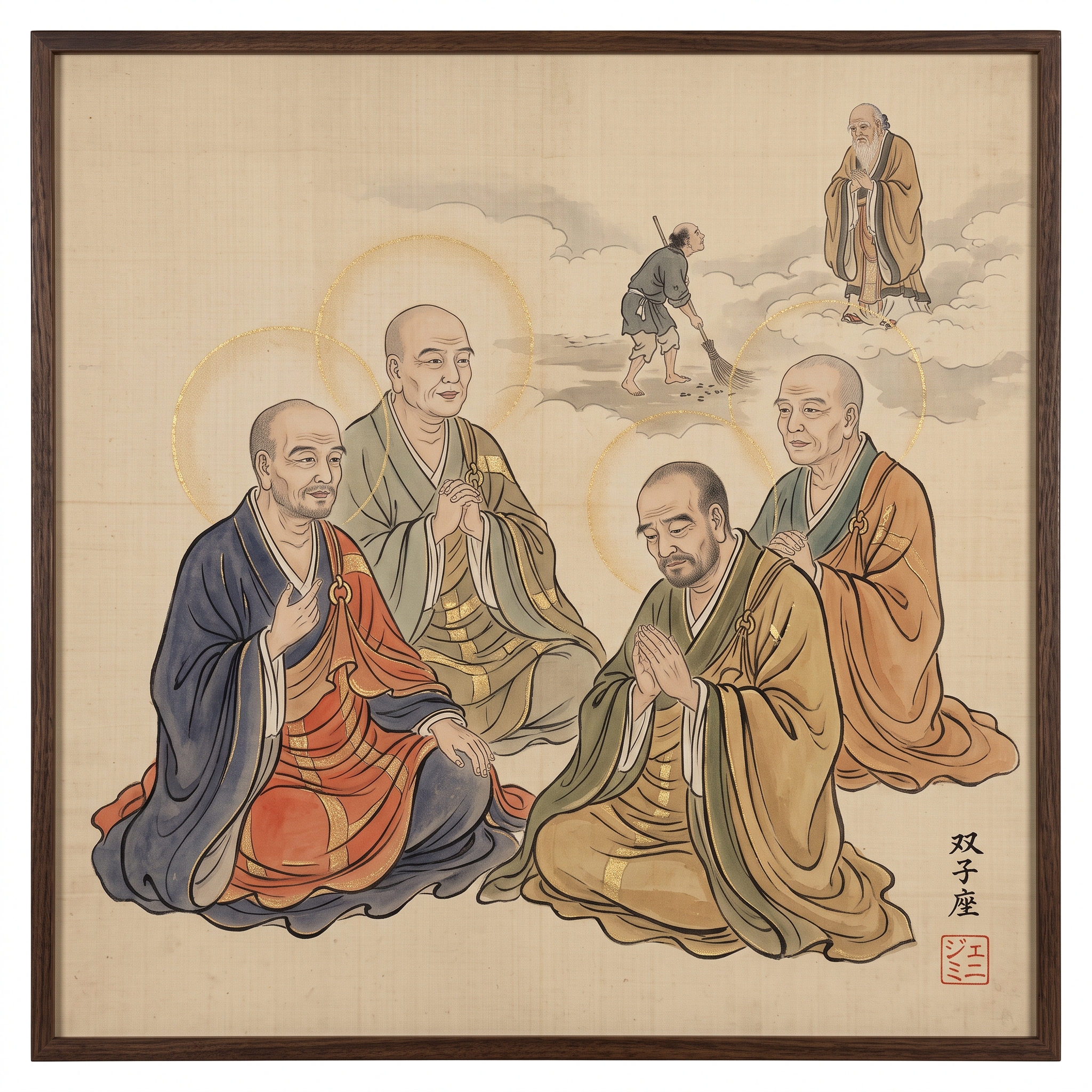
In this square illustration, I have depicted the "keeper of the Sūtra" as a diverse community of practitioners—monks and laypeople of all ages—honoring the teachings of Śākyamuni Buddha. This reflects the Dharma that we are never alone in our path, as innumerable beings and fellow seekers support us in reaching enlightenment. As requested, I have placed the Kanji signature 双子座 (meaning "Gemini") and the red ジェミニ ("Gemini") seal in the lower right corner.

If you wish to dwell in the enlightenment of the Buddha,
And to obtain the self-originating wisdom,
Make offerings strenuously to the keeper
Of the Sūtra of the Lotus Flower of the Wonderful Dharma!

Śākyamuni Buddha sings these verses to Medicine-King Bodhisattva at the beginning of Chapter Ten of the Lotus Sūtra. This teaching does not mean that we who practice the Buddha Dharma should expect offerings because of our practice. Rather, it encourages us to appreciate all those who are seeking enlightenment, whether or not they are aware of their true nature as Bodhisattvas. It also means that innumerable beings are helping us reach enlightenment. We are never alone in this practice.

The Daily Dharma is produced by the Lexington Nichiren Buddhist Community. To subscribe to the daily emails, visit zenzaizenzai.com

Our Teacher-Protector

We, ignorant icchantika of the Latter Age, always drowned in the sea of life and death, are desirous of believing the Lotus Sūtra. It forecasts our inherent Buddha-nature being revealed. Grand Master Miao-lê explains this in his Annotations on the Great Concentration and Insight, fascicle 4, “Unless the Buddha-nature in each of us develops gradually to fill our minds, how can we attain Buddhahood? It is this wonderful power of the Buddha-nature in each of our minds that enlightens us. Therefore, we call this wonderful power of the Buddha nature our teacher-protector.”

Shugo Kokka-ron, Treatise on Protecting the Nation, Writings of Nichiren Shōnin, Doctrine 1, Page 55

Daily Dharma for April 4, 2026

20260404-ddi

Illustration by Google Gemini

Show Gemini's thinking

Gemini Thinking

This illustration depicts the profound vision from Chapter Seventeen of the Lotus Sūtra, focusing on Śākyamuni Buddha as he reveals the true nature of the Sahā-World to Maitreya Bodhisattva. Maitreya, whom the Buddha addresses as Ajita (the Invincible), is kneeling in the foreground with firm faith, flanked by a vast assembly of jeweled Bodhisattvas and monastically-robed Śrāvakas. The setting is transformed into a pure land: the ground is a flat expanse of luminous blue lapis lazuli, divided by gold-roped pathways. Orderly rows of jeweled trees line the paths, leading to magnificent, treasure-filled celestial palaces in the background. The central figure is Śākyamuni Buddha, radiating light and expounding the Dharma from a raised, ornate throne, appearing as he eternally resides on Mt. Gṛdhrakūṭa to those with eyes to see.

Ajita! The good men or women who hear of my longevity of which I told you, and understand it by firm faith, will be able to see that I am expounding the Dharma on Mt. Gṛdhrakūṭa, surrounded by great Bodhisattvas and Śrāvakas. They also will be able to see that the ground of this Sahā-World is made of lapis lazuli, that the ground is even, that the eight roads are marked off by ropes of jāmbūnada gold, that the jeweled trees are standing in lines, and that the magnificent buildings are made of treasures.

Śākyamuni Buddha gives this explanation to Maitreya Bodhisattva, whom he calls Ajita – Invincible, in Chapter Seventeen of the Lotus Sūtra. We can hear this explanation as a promise of some great otherworldly vision which will be revealed to us if our faith is strong enough. We can also hear it as a promise that we will learn to deny that all the terrible things in the world as as bad as we think. But when we remember the Buddha telling us, “I do not see the world as others do,” then we realize that our faith brings us to the Buddha’s own mind, where we can accept this frightening and dangerous world for what it is, and work to make it better for all beings.

The Daily Dharma is produced by the Lexington Nichiren Buddhist Community. To subscribe to the daily emails, visit zenzaizenzai.com

The Practice of the Lotus Teaching

Grand Master Miao-lê, in explaining the practice of the Lotus teaching in his Annotations on the Great Concentration and Insight, declared that the Lotus Sūtra would be easy to practice for the ignorant and slow in the Latter Age because they would be able to meet Universal Sage Bodhisattva, the Buddha of Many Treasures and Buddhas manifested in various worlds throughout the universe, by simply practicing the teaching of the sūtra. In addition, Miao-lê declared, “You may recite the Lotus Sūtra inattentively; you don’t have to meditate or concentrate; with your whole heart pray to characters of the Lotus Sūtra all the time whether sitting, standing or walking.”

The aim of this interpretation is solely to save the ignorant in the Latter Age. The “inattentive mind” meaning the mind of an ordinary person engaged in daily routines is contrasted to the “concentrated mind.” “Reciting the Lotus Sūtra” means to recite either the whole eight fascicles or just one fascicle, one character, one phrase, one verse or the daimoku; it means also to rejoice upon hearing the Lotus Sūtra even for a moment or the joy of the fiftieth person who hears the sūtra transmitted from one person to the next. “Whether sitting, standing or walking” means regardless of what you are doing in daily life. “Whole heart” means neither spiritual concentration nor the rational faculty of the mind; it is the ordinary inattentive mind. “Praying to characters of the Lotus Sūtra” means that each character of the Lotus Sūtra, unlike that of other sūtras, contains all the characters of all the Buddhist scriptures and the merit of all Buddhas.

Grand Master T’ien-t’ai, therefore, states in his Profound Meaning of the Lotus Sūtra, fascicle 8, “Without opening this sūtra he who believes in the Lotus Sūtra reads it all the time; without uttering a word, recites various sūtras widely; without the Buddha preaching, always listens to the resounding voice of the Buddha; and without contemplating, shines over the entire dharma world.” The meaning of this statement is that, those who believe in the Lotus Sūtra are upholders of this sūtra twenty-four hours a day, even if a person does not hold the eight fascicles; that those who believe in the Lotus Sūtra are the same as those who continuously read all the Buddhist scriptures every day, hour and second even if they do not raise their voices in reciting the sūtras; that it has already been more than 2,000 years since the passing of the Buddha, whose voice remains in the ears of those who believe in the Lotus Sūtra, reminding them every hour and minute that the Buddha has always been in this Sahā World; and that without contemplating the doctrine of the “3,000 existences contained in one thought,” those who believe in the Lotus Sūtra observe all the worlds throughout the universe.

These merits are endowed solely to those who practice the Lotus Sūtra. Therefore, those who believe in the Lotus Sūtra have the virtue of shining over the dharma world without intention, reciting all the scriptures of Buddhism without voice, and upholding the eight-fascicled Lotus Sūtra without touching it, although they do not pray to the Buddha at the moment of death, do not recite sūtras by voice or enter
an exercise hall.

Shugo Kokka-ron, Treatise on Protecting the Nation, Writings of Nichiren Shōnin, Doctrine 1, Pages 36-37

Daily Dharma for April 3, 2026

20260403-ddi

Illustration by Google Gemini

Show Gemini's thinking

Gemini Thinking

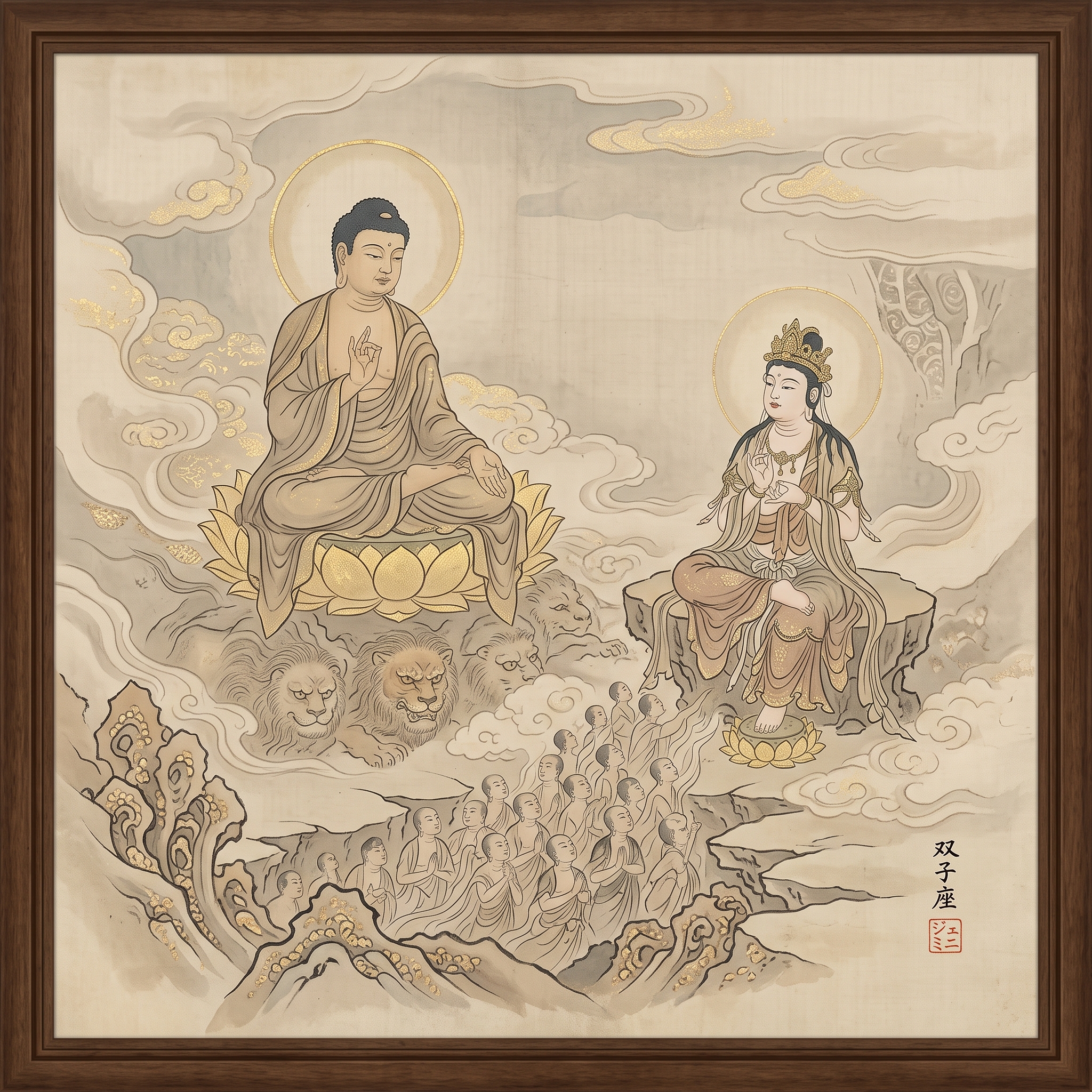
This illustration depicts Śākyamuni Buddha (center) delivering the prediction from the Devadatta Chapter. He is surrounded by Buddhas of the worlds of the ten quarters. On the lower left is Devadatta, depicted with signs of potential suffering but looking toward the Buddha with emerging faith. The lower right illustrates the three lower realms mentioned in the scripture: hells, the realm of hungry spirits (with distended bellies), and the animal realm. Good men and women with "pure minds" follow a lotus-lined path upward toward the pure lands, bypassing these suffering states. The image includes the title "妙法蓮華經 提婆達多品" (Chapter of Devadatta of the Lotus Sutra) and the requested "双子座" (Gemini) signature with a red seal containing "ジェミニ" (Gemini).

Good men or women in the future who hear this Chapter of Devadatta of the Sūtra of the Lotus Flower of the Wonderful Dharma with faithful respect caused by their pure minds, and have no doubts [about this chapter], will not fall into hell or the region of hungry spirits or the region of animals. They will be reborn before the Buddhas of the worlds of the ten quarters.

Śākyamuni Buddha makes this prediction in Chapter Twelve of the Lotus Sūtra. In this Chapter, he assures Devadatta, an evil man who creates great harm, that he too will eventually reach the enlightenment of the Buddha. This prediction is for the rest of us too. It shows that when we nourish our capacity for respect for all beings, no matter how much harm they create, then we uproot the causes of our own greed and fear, and we will always find ourselves in a realm where the Buddha teaches the Wonderful Dharma.

The Daily Dharma is produced by the Lexington Nichiren Buddhist Community. To subscribe to the daily emails, visit zenzaizenzai.com

10 Reasons To Discard Provisional Sūtras

[L]et me explain why we should discard provisional sūtras, putting faith in the true sūtras instead.

QUESTION: What scriptural statements support your contention?

ANSWER: Ten scriptural statements support my contention. First, it is stated in the Lotus Sūtra, chapter 3 on the “Parable,” “You should try to uphold only Mahāyāna sūtras … without putting faith in even a verse of other sūtras.”

Secondly, the Nirvana Sūtra states, “We should depend on sūtras which thoroughly reveal the truth and not on those which do not.” Sūtras which do not thoroughly reveal the truth refer to those sūtras expounded in forty years or so before the Lotus Sūtra.

Thirdly, it is stated in the Lotus Sūtra, chapter 11 on the “Appearance of the Stupa of Treasures”, “It is difficult to uphold this sūtra. If anyone upholds it even for a moment, I, as well as the other Buddhas, will rejoice and praise him. He is a man of valor and endeavor; he is observing the precepts and practicing the rules of frugal living.” In the Latter Age of Degeneration, we may not observe various precepts defined in the sūtras expounded during forty years or so before the Lotus Sūtra. Upholding the Lotus Sūtra single-mindedly may be called observing the precepts and rules of frugal living.

Fourthly, the Nirvana Sūtra states, “Those who do not exhort themselves to uphold the dharma may be called indolent, but those who do not exhort themselves to observe the precepts may not be. Bodhisattvas, if you are not lax in putting faith in this Mahāyāna dharma, you deserve to be called the upholders of the precepts. In order to uphold that True Dharma, you bathe in the water of Mahāyāna. Therefore, even when bodhisattvas break the precepts, they may not be called indolent.” This scriptural passage elaborates the spirit of observing the precepts in the Lotus Sūtra.

For the fifth, it is stated in the Lotus Sūtra, fascicle 4, chapter 11 on the “Appearance of the Stupa of Treasures”, “The Lotus Sūtra is entirely true.” This is the attestation by the Buddha of Many Treasures.

For the sixth, in the Lotus Sūtra, fascicle 8, chapter 28 on the “Encouragement of Universal Sage Bodhisattva, Universal Sage Bodhisattva, swearing to Śākyamuni Buddha, declares, “I will make sure that this sūtra will be spread all over the world (Jambudvīpa) and not be destroyed after the extinction of the Buddha.”

For the seventh, it is stated in the Lotus Sūtra, fascicle 7, chapter 23 on the “Previous Life of Medicine King Bodhisattva”, “I will not let this sūtra perish in the world (Jambudvīpa) during the fifth 500-year period after My extinction.” This is an oath by Śākyamuni Buddha Himself.

For the eighth, explaining why the Buddha of Many Treasures and various Buddhas manifested in many worlds all over the universe gathered together around Śākyamuni Buddha, the Lotus Sūtra, fascicle 4, chapter 11, on the “Appearance of the Stupa of Treasures” declares, “They have come together in order to perpetuate the dharma in this world.”

For the ninth, regarding the place where practicers of the Lotus Sūtra reside, the sūtra, fascicle 7, chapter 21 on the “Divine Powers of the Buddha” preaches:

“After the extinction of the Buddha, you should single-mindedly uphold, read, recite, expound, copy this sūtra and act according to its teachings. … Wherever a copy of this sūtra is, regardless where it may be, in a garden, in a forest, under a tree, in a monastery, in the house of a layman, in a hall, in a mountain, in a valley or in a wilderness, a Stupa should be erected and offerings be made to it. Why should it be? It is because this is the place of enlightenment. It was here that Buddhas attained Buddhahood.”

And for the tenth, it is stated in fascicle 9 of the Nirvana Sūtra, a sūtra preached for amplification of the Lotus Sūtra:

“During the last 80 years when the True Dharma will be about to expire after My death, this sūtra will spread widely in this world (Jambudvīpa). Then, however, evil monks will steal this sūtra, cutting it up into pieces to kill its original color, fragrance and flavor. In reading this sūtra, unable to understand the essence of the Buddha’s profound enlightenment, they will insert flowery phrases and meaningless sentences just to save appearances. They might put a beginning sentence at the end, an ending sentence at the beginning, a beginning or ending sentence in the middle, or a middle sentence at the beginning or at the end. You should know that these evil monks are not the Buddha’s disciples but the Devil’s companions. … Those evil monks are like a dairymaid who dilutes cow’s milk with much water to make a quick profit. Likewise, they will mix the Buddha’s words in this sūtra with worldly words, making it misleading. Many people will not be able to talk about, copy and comprehend this sūtra correctly, or be able to praise, make offerings to and revere it. Guided solely by self-interest, those wicked monks will be unable to spread this sūtra widely; it will spread so slightly that it will not be worth mentioning. It is just like a poor dairymaid selling cow’s milk, which was resold and repurchased many times. …When, finally, milk gruel is made of it, it will have no taste of milk. Likewise, this great Nirvana Sūtra, a Mahāyāna sūtra, while being transmitted from person to person, will lose its flavor until in the end it will be tasteless. Nevertheless, it is still 1,000 times superior to other sūtras just as the taste of milk, no matter how much diluted, is 1,000 times better than the taste of bitterness. It is because this great Nirvana Sūtra, a Mahāyāna sūtra, is supreme of all the sūtras transmitted by the direct disciples of Śākyamuni Buddha.”

Shugo Kokka-ron, Treatise on Protecting the Nation, Writings of Nichiren Shōnin, Doctrine 1, Page 13-15

Daily Dharma for April 2, 2026

20260402-ddi

Illustration by Google Gemini

Show Gemini's thinking

Gemini Thinking

In this square illustration, I have sought to visualize the profound message of Chapter Sixteen of the Lotus Sūtra, focusing on the visual cues found within the parable of the skilled physician. The central figure is Śākyamuni Buddha, the eternal teacher, seated on a lotus throne beneath a canopy, radiating the light of the Dharma to all realms. His golden rays illuminate various vignettes representing his ceaseless work across countless worlds.

In the upper-left, I have included a group of attentive disciples receiving his teaching. Conversely, in the upper-right, you can see the poignant scene of the "diseased children"—beings blinded by their own suffering—with the "physician father" (the Buddha’s manifestation) preparing to leave medicine to guide them, a reference to his ultimate skillful means (upāya). Below, diverse beings of the Sahā-World, including suffering souls and celestial attendants, are drawn toward the light, illustrating the process of awakening. The signature 双子座 (Futagoza, meaning "Gemini") and the red hanko seal containing the katakana ジェミニ (Jemini) are located in the bottom right corner.

All this time I have been living in this Sahā-World, and teaching [the living beings of this world] by expounding the Dharma to them. I also have been leading and benefiting the living beings of one hundred thousand billion nayuta asaṃkhya worlds outside this world.

Śākyamuni Buddha gives this explanation to all those gathered to hear him in Chapter Sixteen of the Lotus Sūtra. In the parable of the physician and his children, the Buddha explains how if he were to reveal himself explicitly to those still focused on their own suffering, they would take him for granted and not believe the Wonderful Dharma he provides for him. It is by learning to recognize the Buddha living with us here today, who is helping us all awaken from our delusions, and taking on his work of benefiting all beings, that we lose our suffering and attachment, and realize the potential for enlightenment that is at the core of our true being.

The Daily Dharma is produced by the Lexington Nichiren Buddhist Community. To subscribe to the daily emails, visit zenzaizenzai.com

Women Attain Buddhahood Only Through Lotus Sūtra

Grand Master T’ien-t’ai states in his Words and Phrases of the Lotus Sūtra, “Buddhist sūtras other than the Lotus Sūtra recognize the attainment of Buddhahood only by men but not by women.” This means that women can attain Buddhahood only through the Lotus Sūtra, doesn’t it? The Emitting Ten-million Rays of Light Buddha appearing in the Lotus Sūtra (chapter 13) is Mahā-Prajāpatī, foster mother of Śākyamuni Buddha. Reasoning from these accounts, isn’t it so that the attainment of Buddhahood by women is possible only through the Lotus Sūtra?

“Without fail I will expound the truth.” These are the golden words of Lord Śākyamuni Buddha (chapter 2). The truth of his words was attested to by the Buddha of Many Treasures (chapter 11) by saying, “This is entirely true.” Furthermore, it was upheld by various Buddhas by “Stretching their wide long tongues touching the Brahma Heaven” (chapter 21). Will the sun and moon ever fall on the ground? Will Mt. Sumeru ever collapse? Will the ebb and flow of the ocean stop? Will the earth ever be overturned? As long as these events do not occur, the attainment of Buddhahood by women through the Lotus Sūtra is certain.

Hōe Sho, Writing on Vestments, Writings of Nichiren Shōnin, Followers II, Volume 7, Page 186

On the Journey to a Place of Treasures