
Replacing Provisional Teachings With The True Teaching

[I]t is stated in the Annotations on the Great Concentration and Insight that the book of the Great Concentration and Insight explains the way of practicing meditation based on the principle of the Lotus Sūtra and that the pre-Lotus, provisional sūtras are expedient means in preparation for preaching the True Dharma of the Lotus Sūtra. It means that the whole of the Great Concentration and Insight is based on the doctrine of “replacing provisional teachings with the true teaching” of the Lotus Sūtra. Therefore, although the Great Concentration and Insight quotes the pre-Lotus sūtras and non-Buddhist writings, it does not accept what is preached in them; it just borrows their sentences without meanings.

Jisshō-shō, A Treatise on the Ten Chapters of the Great Concentration and Insight, Writings of Nichiren Shōnin,
Doctrine 2, Page 2-3

Daily Dharma for August 8, 2026

20260808-ddi

Illustration by Google Gemini

Show Gemini's thinking

Conceptual Summary
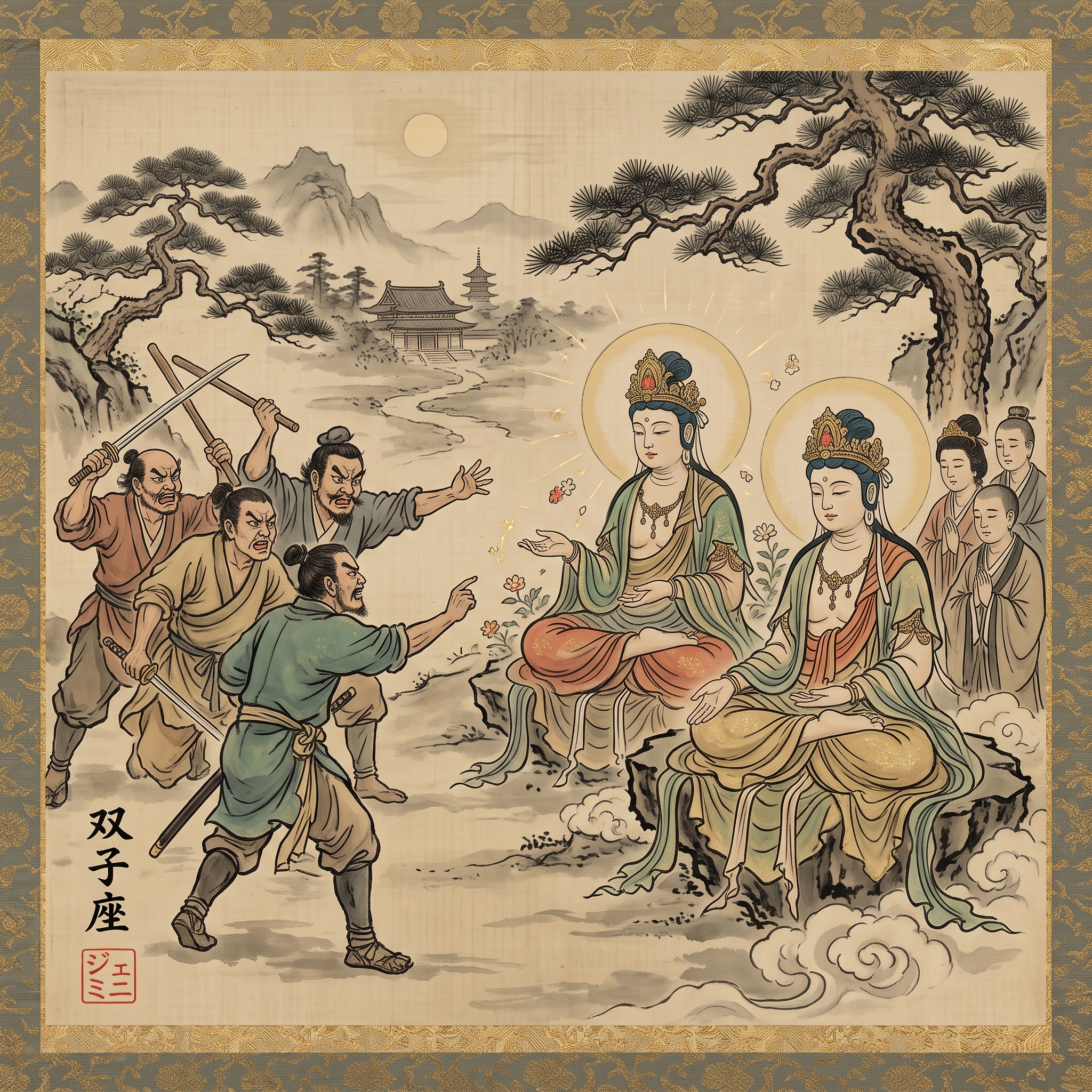
The illustration is a visual translation of the Parable of the Wise Physician from the Lotus Sūtra, utilizing a traditional Japanese Buddhist painting style with mineral pigments and gold leaf on silk. The composition centers on Śākyamuni Buddha, who is identified as the wise father in the narrative. In a direct interpretation of the source text, he is depicted as elderly, his form softened to imply the "decrepit" state he uses as an expedient mean (hōben). Rather than a physical departure, his symbolic departure—the faking of his death—is visually encoded by showing his form radiating light and gold, positioned above a table holding the potent "good medicine" (the Wonderful Dharma). The narrative unfolds below: on the left, children in distress, their postures exhibiting physical or mental anguish, represent those who have taken poison and lost their right minds, unable to trust the medicine. On the right, other children are seen accepting the cure; one kneels respectfully, reverently partaking of the Dharma, representing the successful transmission of the wisdom that cures delusion, as described in the text.

Iconography & Character Identification
Item 1: Deities/Figures Featured:

Śākyamuni Buddha (The Wise Physician/Father)

A group of suffering children (The Poisoned Sons)

A group of recovering or reverent children (The Sons Taking the Antidote)

Item 2: Text Translations:

The black Kanji signature in the corner is 双子座 (Futagoza), which translates to Gemini.

The text inside the red square seal (hanko) is the Katakana ジェミニ, which also transliterates to Gemini.

He said to them, ‘Know this! Now I am old and decrepit. I shall die soon. I am leaving this good medicine here. Take it! Do not be afraid that you will not be cured!’

The Buddha gives this explanation in Chapter Sixteen of the Lotus Sūtra. It is part of the Parable of the Wise Physician in which a father finds his children have taken poison and gives them an antidote. The poison has caused some of the children to lose their right minds and not trust that the medicine will cure them. By faking his death, the father used an expedient to get the children to realize that there was no other medicine that would cure them, and summon the courage to take it. When we accept the Wonderful Dharma and put it into our lives, we are cured of our delusions and find the Buddha’s wisdom.

The Daily Dharma is produced by the Lexington Nichiren Buddhist Community. To subscribe to the daily emails, visit zenzaizenzai.com
Past Lives Of Śākyamuni Buddha

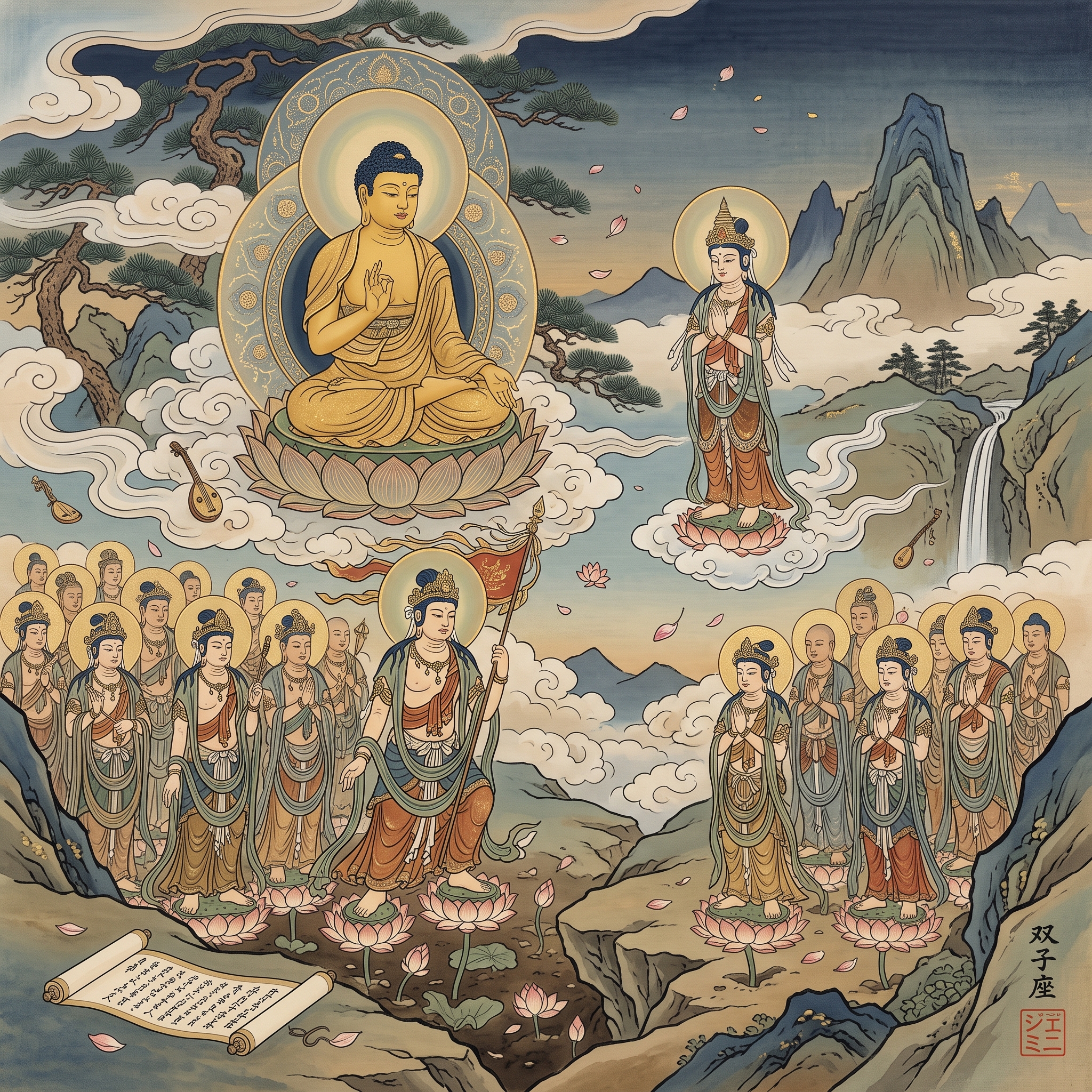
Medicine King Bodhisattva burnt his elbows as a light to be offered to Lotus Sūtra for 72,000 years. Whenever Never Despising Bodhisattva saw anyone, he always recited the 24-character verse: I respect you deeply. I will never despise you because you are destined to practice the way of the bodhisattva and become Buddhas.” For many years he was the object of abuse of numerous men and women, priests and nuns, who beat him with sticks and threw stones at him.

This Never Despising Bodhisattva is the current Śākyamuni Buddha. What is more, King Suzudan in the past was so eager to learn the teaching of the five written characters, Myō, Hō, Ren, Ge, and Kyō, that he enslaved himself to the hermit Asita for a thousand years until he became the current Śākyamuni Buddha.

Nichimyō Shōnin Gosho, A Letter to Nichimyō Shōnin, Writings of Nichiren Shōnin, Followers II,
Volume 7, Page 138

Daily Dharma for August 7, 2026

20260807-ddi

Illustration by Google Gemini

Show Gemini's thinking

Conceptual Summary
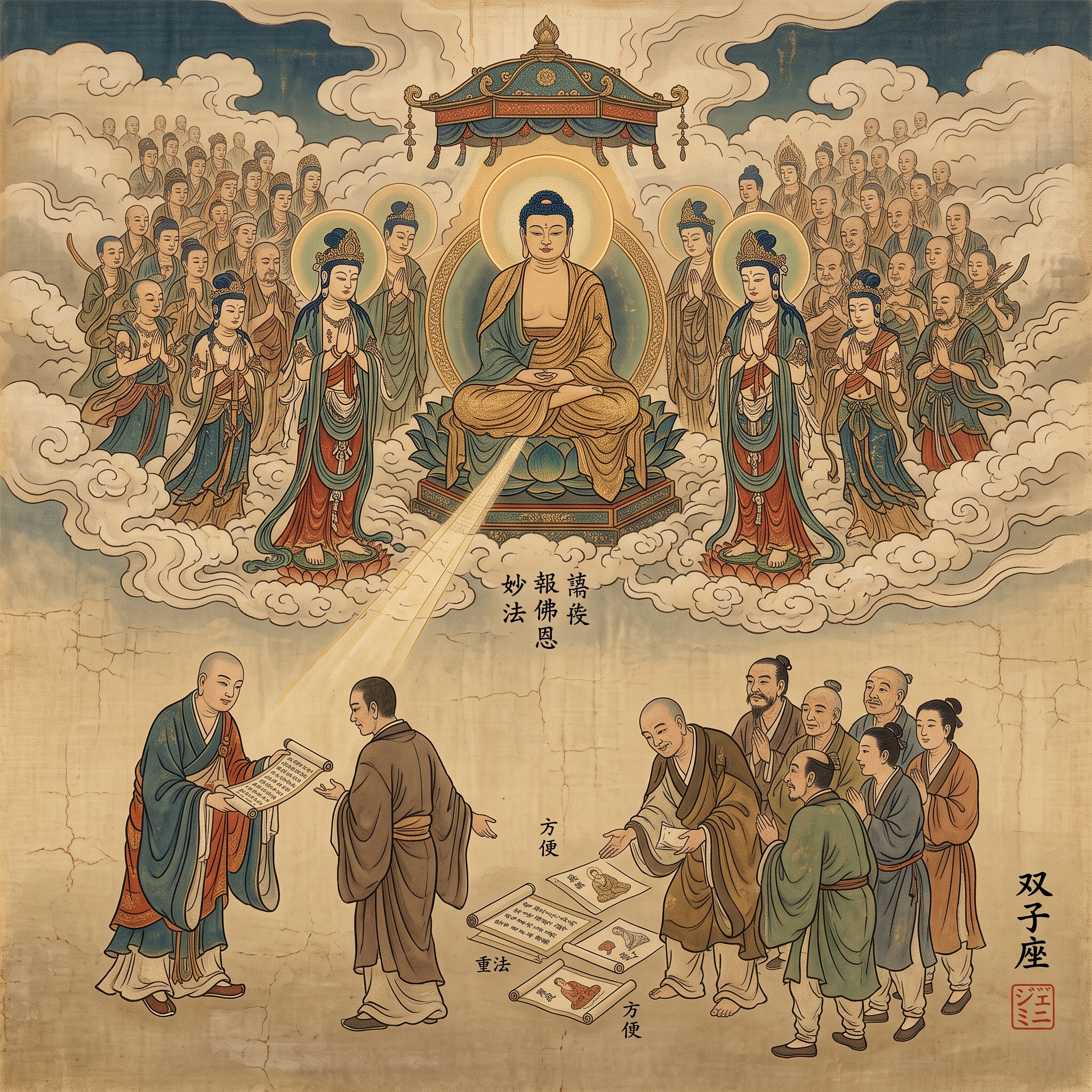
The illustration visualizes Nichiren’s teaching that “the service to your lord itself is practicing the teaching of the Lotus Sutra,” effectively erasing the divide between secular duty and spiritual practice. The composition is divided between the mundane realm on the ground and the celestial realm on clouds. Below, a samurai respectfully presents a scroll to his seated lord, surrounded by figures performing daily work—sweeping, gathering, and farming. Above, deities and celestial attendants observe the scene with approval. By depicting the highest guardian deities—like the Four Heavenly Kings—actively protecting the figures engaged in regular labor, the image emphasizes the Lotus Sutra's philosophy that all secular activities are non-contradictory to ultimate truth. Subtle touches of gold leaf and the inclusion of floating lotus blossoms unify the two planes, suggesting that the light of the Mystic Law permeates the everyday world and that nourishing one's Buddha nature is achieved through dedicated, compassionate service in society.

Iconography & Character Identification
Item 1: Deities/Figures Featured:

Human/Mundane Figures (Foreground):

One seated Lord or Daimyo receiving a petition.

One samurai (or vassal) kneeling and presenting a scroll to the lord.

Two seated male attendees observing.

Three laborers: one male figure sweeping with a broom, one male figure harvesting plants, and one female figure carrying a basket.

Celestial Figures (Background/Clouds):

One central celestial attendant holding an open scroll (often associated with the Bodhisattva of Universal Worthy).

One warrior deity (Vaisravana or Tamonten, one of the Four Heavenly Kings), holding a spear.

One secondary warrior deity with a sword.

Item 2: Text Translations:

Artist’s Signature (Bottom Right): 双子座 — (Kanji) Futago-za ("Gemini")

Artist’s Seal (Bottom Right): ジェミニ — (Katakana) Jemini ("Gemini")

Text on Scrolls (Center Background and Right): 妙法 — (Kanji) Myōhō ("Mystic Law" or "Wonderful Dharma," referring to the essence of the Lotus Sutra).

Please remember that the service to your lord itself is practicing the teaching of the Lotus Sutra. Interpreting the scriptural statement in the Lotus Sutra, Grand Master T’ien-t’ai, therefore, states in his Great Concentration and Insight: “All the activities and daily work of the people in the secular world do not contradict the truth preached by the Buddha.” Please contemplate the spirit of this scriptural statement again and again.

Nichiren wrote this passage in his Response to a Follower (Dannotsu Bō Gohenji). In our frustration with this world of conflict, we may think it best to remove ourselves from those who are increasing the delusions of others. In this letter, Nichiren reminds us that the relationships we have in our lives are important. Service to others does not necessarily mean giving them what they ask for. It means wishing that they lose their delusions and nourishing the Buddha nature within them.

The Daily Dharma is produced by the Lexington Nichiren Buddhist Community. To subscribe to the daily emails, visit zenzaizenzai.com
The Decree Of The Lord Śākyamuni Buddha

Nevertheless, for what purpose did you take the trouble of sending a messenger all the way to this island? It was for the purpose of sending me the articles of offering in memory of the third-year memorial service for your beloved mother, which is an important matter in your life. To me, however, it was like a dream for a few days. I felt like Priest Shunkan of the Hosshōji Temple when he encountered his former boy servant of many years on Yuōjima Island [sic], where he had been exiled. When Duke Yang of a northern barbarian country was taken prisoner by the Chinese and brought southward from the north, he saw the wild geese flying northward, and sighed, saying, “They must be flying to my homeland.” I am sure that the sorrow the Duke Yang experienced then is not comparable to what I am undergoing today.

Nevertheless, it is preached in the Lotus Sūtra, “The Teacher of the Dharma” chapter, “Suppose there is a good person, man or woman, who can secretly preach even a phrase of the Lotus Sūtra for just one person after My (the Buddha’s) passing. You should know that such a person is a messenger of the Buddha, one who has been dispatched by the Buddha to carry out the work of the Buddha.” He who chants even one word or phrase of the Lotus Sūtra or explains it for the people is an envoy of the Lord Śākyamuni Buddha. Therefore, I am the person who has come to this country under the decree of the Lord Śākyamuni Buddha, though my social standing is humble. Accordingly, those who speak ill of me, even one word, will fall into the Hell of Incessant Suffering while those who speak even a word or phrase for me will gain the merits superior to that which is received by supporting numerous Buddhas.

Shijō Kingo-dono Gohenji, Response to Lord Shijō Kingo, Writings of Nichiren Shōnin, Followers I,
Volume 6, Page 119

Daily Dharma for August 6, 2026

20260806-ddi

Illustration by Google Gemini

Show Gemini's thinking

Conceptual Summary
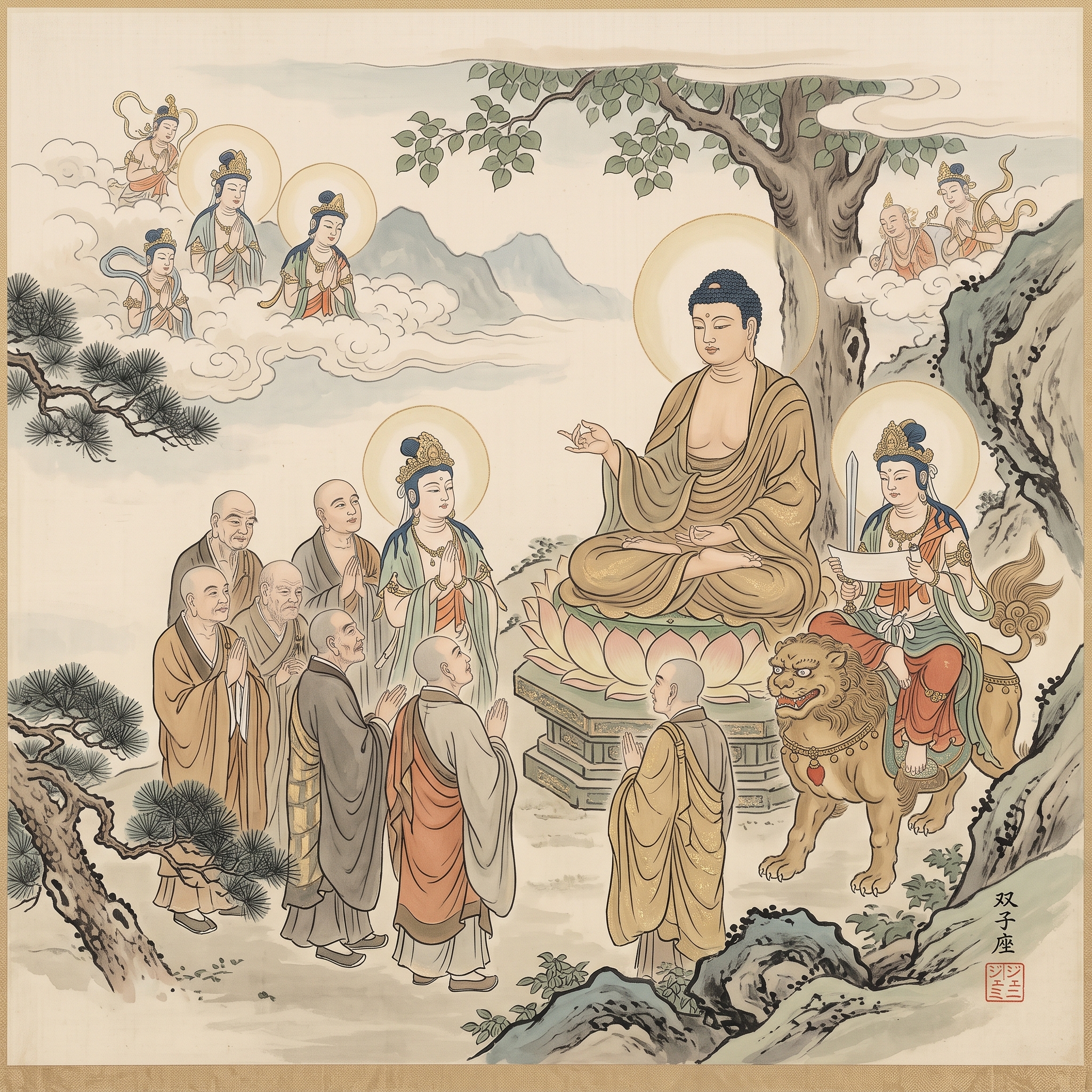
The conceptual thinking for this image focuses on materializing the central revelation of Chapter Sixteen of the Lotus Sūtra: the eternal presence of the Buddha. To convey this immeasurable lifespan while adhering to traditional Japanese Buddhist aesthetics (specifically, the Kamakura style), the illustration employs traditional inks, soft mineral pigments, and subtle gold leaf accents on a silk-like texture. Rather than visualizing the concept of "immeasurability" through vast, cosmic scenes which can become abstract, the focus is placed on the act of teaching to the gathered, virtuous audience mentioned in the text. The presence of gold leaf subtle highlights around the Buddha and the Bodhi tree symbolizes the unconditioned, timeless light of enlightenment that the historical Śākyamuni reveals to be his true, ever-present nature. By focusing on this direct relationship between the teacher and the gentle, disciplined listeners, the illustration visualizes the sūtra's premise that the eternal Buddha is always visible to those properly attuned to receive his message.

Iconography & Character Identification
Item 1: Deities/Figures Featured:
The primary central figure is Śākyamuni Buddha (the historical Buddha), depicted in the gesture of teaching (the Dharmachakra mudra). The supporting figures in the foreground represent the audience of disciples (monastic figures with shaved heads) and laypeople described in the text as "gentle and upright."

Item 2: Text Translations:
Kanji Signature: 双子座 (Futagoza) — Gemini (constellation)
Red Square Seal (Hanko): ジェミニ (Jemini) — Gemini (katakana transliteration)
Kanji Title in the Illustration: 無量寿 (Muryōju) — Immeasurable Life

To those who have accumulated merits,
And who are gentle and upright,
And who see me living here,
Expounding the Dharma,
I say:
“The duration of my life is immeasurable.”

The Buddha declares these verses in Chapter Sixteen of the Lotus Sūtra. This chapter is where the Buddha reveals for the first time his ever-present nature. He became enlightened in the remotest past, and will continue teaching all beings far into the future. There is a view that to see a Buddha in our time requires a supernatural way of seeing, even a personal vision or a revelation not available to ordinary people. What the Buddha teaches here is that he is always visible to anyone, anywhere. It is when we look for him to teach us and are compassionate and disciplined in our desires that he appears to us.

The Daily Dharma is produced by the Lexington Nichiren Buddhist Community. To subscribe to the daily emails, visit zenzaizenzai.com
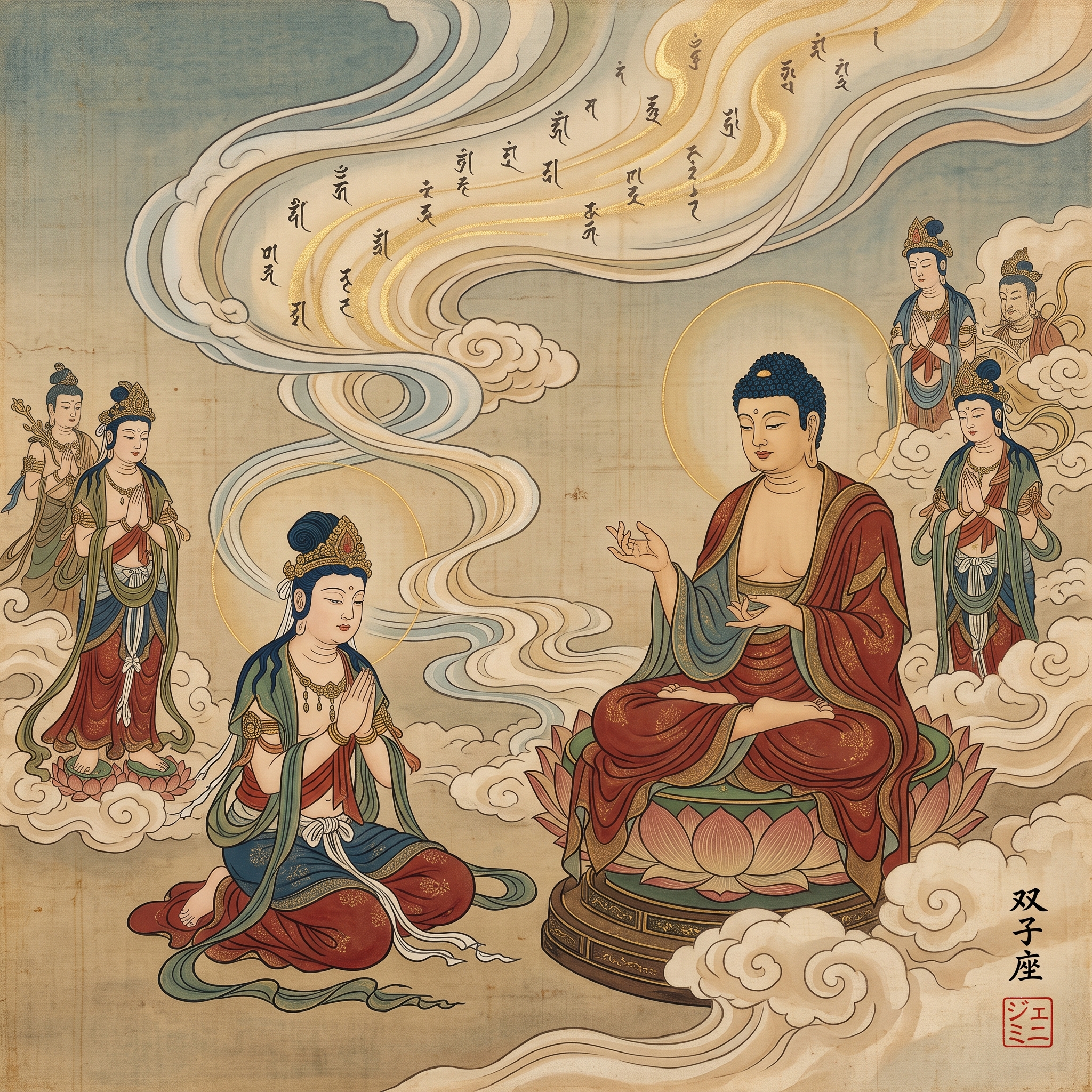
The True Mahāyāna Teaching Of The Lotus Sūtra

Śākyamuni Buddha’s last words state that it is not non-Buddhist religions but Buddhists themselves that will destroy Buddhism, just as an insect living inside the body of a lion will eat up its flesh. In fact, some Buddhists destroy Mahāyāna teachings through Hinayana teachings while others extinguish the true Mahāyāna teachings by the provisional Mahāyāna teachings. These people, however, cannot exterminate the true Mahāyāna teaching of the Lotus Sūtra just as non-Buddhist religions cannot destroy Buddhism.

Hōmon Mōsaru-beki-yō no Koto, The Way to Refute the Evil Teaching, Writings of Nichiren Shōnin, Biography and Disciples, Volume 5, Page 155

Daily Dharma for August 5, 2026

20260805-ddi

Illustration by Google Gemini

Show Gemini's thinking

Conceptual Summary
This painting interprets Śāriputra's joyful proclamation from Chapter Three of the Lotus Sūtra using traditional Japanese Buddhist silk painting techniques. Śāriputra stands prominently in the foreground clad in monastic robes, filled with profound joy rather than pride upon receiving the prediction of his future Buddhahood. Behind him, a radiant golden Dharma Wheel (Dharmachakra) turns, symbolizing his vow to teach the unsurpassed Law. He is surrounded by an attentive assembly of celestial deities (devas), humans, and a gathering of graceful Bodhisattvas who bow and listen with reverence. Rendered with fine black ink, mineral pigments, subtle washes, and delicate accents of gold leaf (截金, kirikane), the composition visually balances mutual respect—reflecting the text's theme that recognizing the Buddha-nature within oneself inspires deep veneration for the sacred potential in all beings.

Iconography & Character Identification
Item 1: Deities/Figures Featured:

Śāriputra (The Foremost in Wisdom): The central Arhat figure standing with hands joined in añjali mudrā (prayer gesture), illuminated by joy.

Bodhisattvas: An assembly of celestial beings surrounding the central figure, representing those who will receive teachings on the Dharma.

Devas & Humans (Gods and Men): Figures representing celestial deities and earthly humans who revere and respect the future Buddha.

Dharmachakra (Wheel of the Law): An iconography element symbolizing the turning of the wheel of the unsurpassed Dharma.

Item 2: Text Translations:

'双子座' (Kanji Signature): "Gemini" (lit. The Constellation of the Twins).

'ジェミニ' (Katakana Hanko Seal): "Gemini".

I shall become a Buddha without fail.
I shall be respected by gods and men.
I will turn the wheel of the unsurpassed Dharma,
And teach Bodhisattvas.

These verses are spoken by Śāriputra, regarded as the wisest of the Buddha’s disciples, at the beginning of Chapter Three of the Lotus Sūtra. His words come not from conceit, but from joy. How does our view of the problems in the world change when we have the assurance that we will become Buddhas? How does our view of others change when we know that they too will become Buddhas? For one thing, we might spend less effort demanding respect and more giving respect.

The Daily Dharma is produced by the Lexington Nichiren Buddhist Community. To subscribe to the daily emails, visit zenzaizenzai.com

Invitation to Rate One Minute Daimoku Videos

Diamond Path of Daimoku One Minute Daimoku videos

I’m in the process of building a new website that includes 100 reasons why someone should chant Namu-Myoho-Renge-Kyo. The original idea was to help my grandkids understand the value of chanting the Odaimoku, but as I worked in Gemini Notebook to extract reasons why chanting is important I realized that I, myself,  had lost sight of why the Odaimoku is the “Essence of the Essential.” Reading commentaries on the Lotus Sutra, studying other sutras – these are all fine but they shouldn’t become a distraction from the Odaimoku.

As part of this work, I’ve used Gemini Notebook‘s ability to create short explanatory videos illustrating each of the 100 reasons why you should chant Namu-Myoho-Renge-Kyo. Each of these videos is about one minute long and I hope to use them in the future as daily One Minute Daimoku inspiration videos.

Before I finish the overall project I want to get some feedback on the videos. I created a carousel of all 100 videos. When you finish watching a video you are invited to rank the video with one to five stars. The average will be displayed along with the number of viewers who have voted.

My email address appears at the bottom of the page. Feel free to contact me with questions or concerns.

One Minute Daimoku

The Practice Of The Perfect Teaching

What we should chant all the time as the practice of the perfect teaching is “Namu Myōhō Renge Kyō,” and what we should keep in mind is the way of meditation based on the truth of “3,000 existences contained in one thought.” Only wise men practice both chanting “Namu Myōhō Renge Kyō” and meditating on the truth of “3,000 existences contained in one thought.” Lay followers of Japan today should recite only “Namu Myōhō Renge Kyō.” As the name has the virtue of reaching the body for which it stands, when one chants “Namu Myōhō Renge Kyō” one will not fail to receive all the merit of the Lotus Sūtra.

Jisshō-shō, A Treatise on the Ten Chapters of the Great Concentration and Insight, Writings of Nichiren Shōnin,
Doctrine 2, Page 4

On the Journey to a Place of Treasures