
Daily Dharma for April 8, 2026

20260408-ddi

Illustration by Google Gemini

Show Gemini's thinking

Gemini Thinking

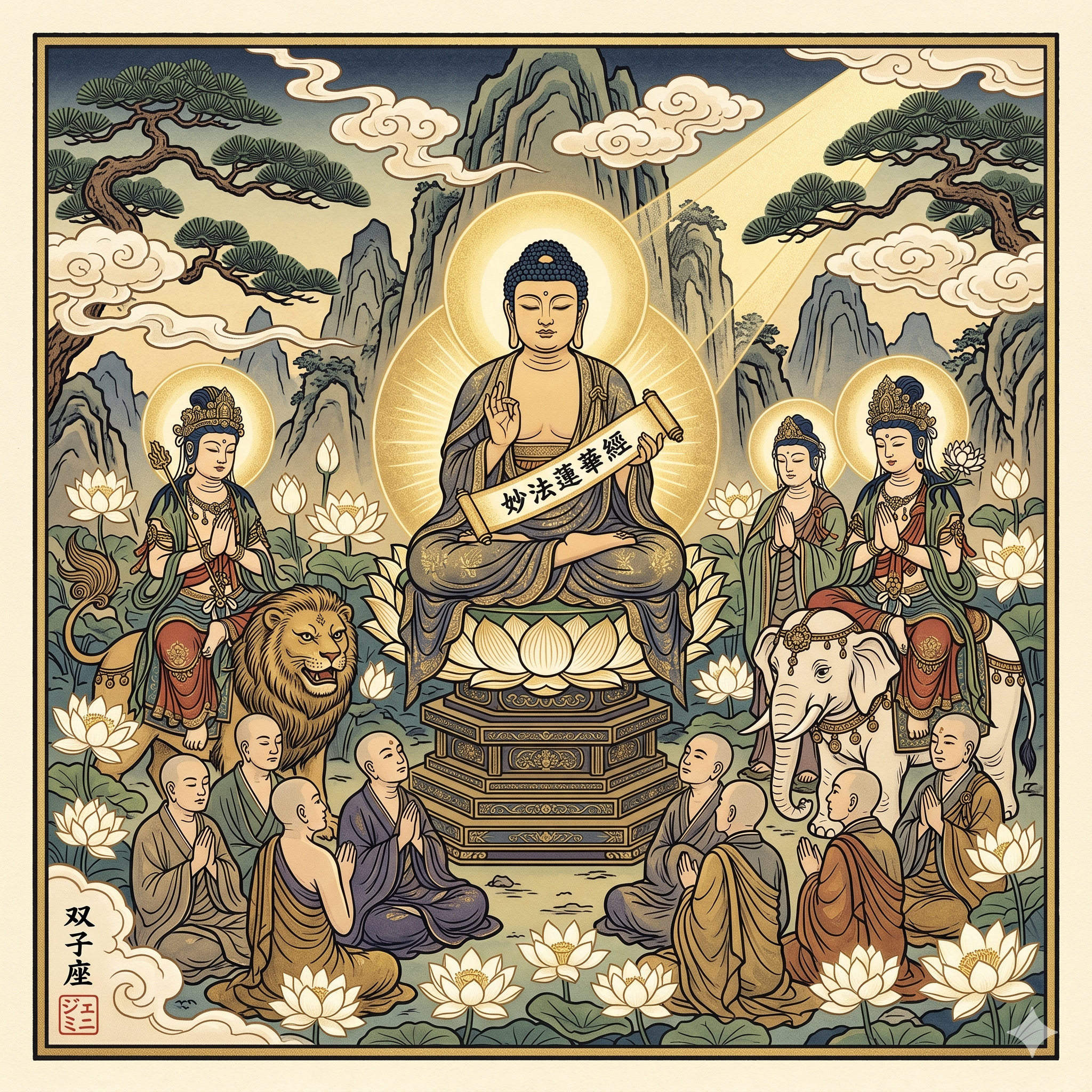
In this square illustration, I have visually captured the joyous assurance of enlightenment found in Chapter Six of the Lotus Sūtra. At the center, Śākyamuni Buddha sits upon a lotus throne, radiating light. Below him, the disciples Maudgalyāyana, Subhūti, and Mahā-Kātyāyana are shown singing their verses of praise, their hearts connected to the Buddha by beams of light as a symbol of his ability to see their true potential. The glittering celestial dew descending upon them represents the cool and refreshing feeling of "nectar" described in the text. In the clouds surrounding them, I have included subtle depictions of the "innumerable Buddhas" that fill the universe, reinforcing the promise of future Buddhahood for all. The signature "双子座" and the traditional red seal containing "ジェミニ" can be found in the lower right corner.

If you see what we have deep in our minds,
And assure us of our future Buddhahood,
We shall feel as cool and as refreshed
As if we were sprinkled with nectar.

Maudgalyāyana, Subhūti and Mahā-Kātyāyana sing these verses to the Buddha in Chapter Six of the Lotus Sūtra. Śākyamuni Buddha knows that our habits of thought and behavior have developed over many lifetimes. We cannot clear them away by ourselves. In the Lotus Sūtra, he assures many of his disciples personally of the certainty of their enlightenment. He shows that this universe has innumerable Buddhas, and tells all of us who hear this teaching that we too should be certain of our enlightenment. When we take the Buddha’s voice to heart, and release the grip we have on our fears, and open ourselves to the joy within ourselves and the world.

The Daily Dharma is produced by the Lexington Nichiren Buddhist Community. To subscribe to the daily emails, visit zenzaizenzai.com
Seeing the Buddhist Dharma Declining

Having calmed down somewhat, the traveler stated:

Though I am unable to understand you completely, I think I understand what you mean roughly. However, from Kyoto, the seat of the imperial court, to Kamakura, the capital of the shogunate, none of the eminent priests and able leaders of the Buddhist world has yet presented a written statement on this matter or made an appeal to the emperor or the shogun. It is not for you, a mere low-ranking priest, to venture to do so with your spiteful words. I can see your intention, but if you submit your appeal, you will be violating proprieties.

In response, the master declared:

Although I am a man of little capability, fortunately I have studied Mahāyāna Buddhism. It is said that a blue fly which rides on the tail of a fine horse can travel even 10,000 miles, and a green ivy vine which clings to a tall pine tree can climb up to 1,000 yards high. Likewise, born to be a disciple of the Buddha, I put my faith in the Lotus Sūtra, the king of all the Buddhist sūtras. Seeing the Buddhist dharma declining, how can I not feel sorrow?

The sorrow is even more so [in view of what the Buddha preached in the Lotus Sūtra, the 10th chapter on “The Teacher of the Dharma”: “Medicine King Bodhisattva, listen carefully. Of the numerous sūtras I have preached, this Sūtra of the Lotus Flower of the Wonderful Dharma is the supreme;” and “The sūtras I have preached number immeasurable thousands, ten thousands, and hundred millions. Of the sūtras I have preached, am now preaching, and will preach, this Lotus Sūtra is the most difficult to believe and to understand.” In the 14th chapter on the “Peaceful Practices”: “Mañjuśrī, this Sūtra of the Lotus Flower of the Wonderful Dharma is treasured by all Buddhas and it is the supreme of all the sūtras.” In the 23rd chapter on the “Previous Life of the Medicine King Bodhisattva”: “As Mt. Sumeru is the highest of all mountains in the world, this Lotus Sūtra is the supreme of all sūtras. As the moon shines brighter than any other stars, this Lotus Sūtra shines the brightest of all the sūtras. As the sun eliminates all darkness, this Lotus Sūtra eliminates all kinds of darkness. As the Great King of the Brahma Heaven is the king of all the people, those who uphold this Lotus Sūtra are the prime of all the people.”]

The Buddha also warns us in the Nirvana Sūtra: “Suppose there is a monk, to all appearances ‘good’, who encounters a destroyer of the dharma but does not take any measures in accusing him, chasing him out or punishing him. You had better know that such a man is not a ‘good’ monk at all but an enemy of Buddhism. On the other hand, if he accuses the destroyer of the dharma, chases him out, or punishes him strictly, such a man is My disciple, one who truly hears Me.”

[Numerous bodhisattvas, 80 trillions in number, vow in the 13th chapter on the “Encouragement for Upholding This Sūtra” of the Lotus Sūtra: “We will not spare even our lives; we treasure only the unsurpassed way.”

The Nirvana Sūtra preaches: “Suppose an eloquent speaker was sent to a foreign country as a royal emissary. Even at the cost of his life, he must convey the words of his king without concealing anything. Likewise, without sparing even his own life, a wise man must widely spread among the ignorant people the true teaching of the Buddha, the existence of the Buddha-nature in all. “]

Although I am not a man worthy of being called a good monk, I do not want to be accused of being a foe of Buddhism. Therefore, I must tell them some principles showing just a portion of the Buddha’s teaching.

Risshō Ankoku-ron, Treatise on Spreading Peace Throughout the Country by Establishing the True Dharma, Writings of Nichiren Shōnin, Doctrine 1, Pages 116-117

Daily Dharma for April 7, 2026

20260407-ddi

Illustration by Google Gemini

Show Gemini's thinking

Gemini Thinking

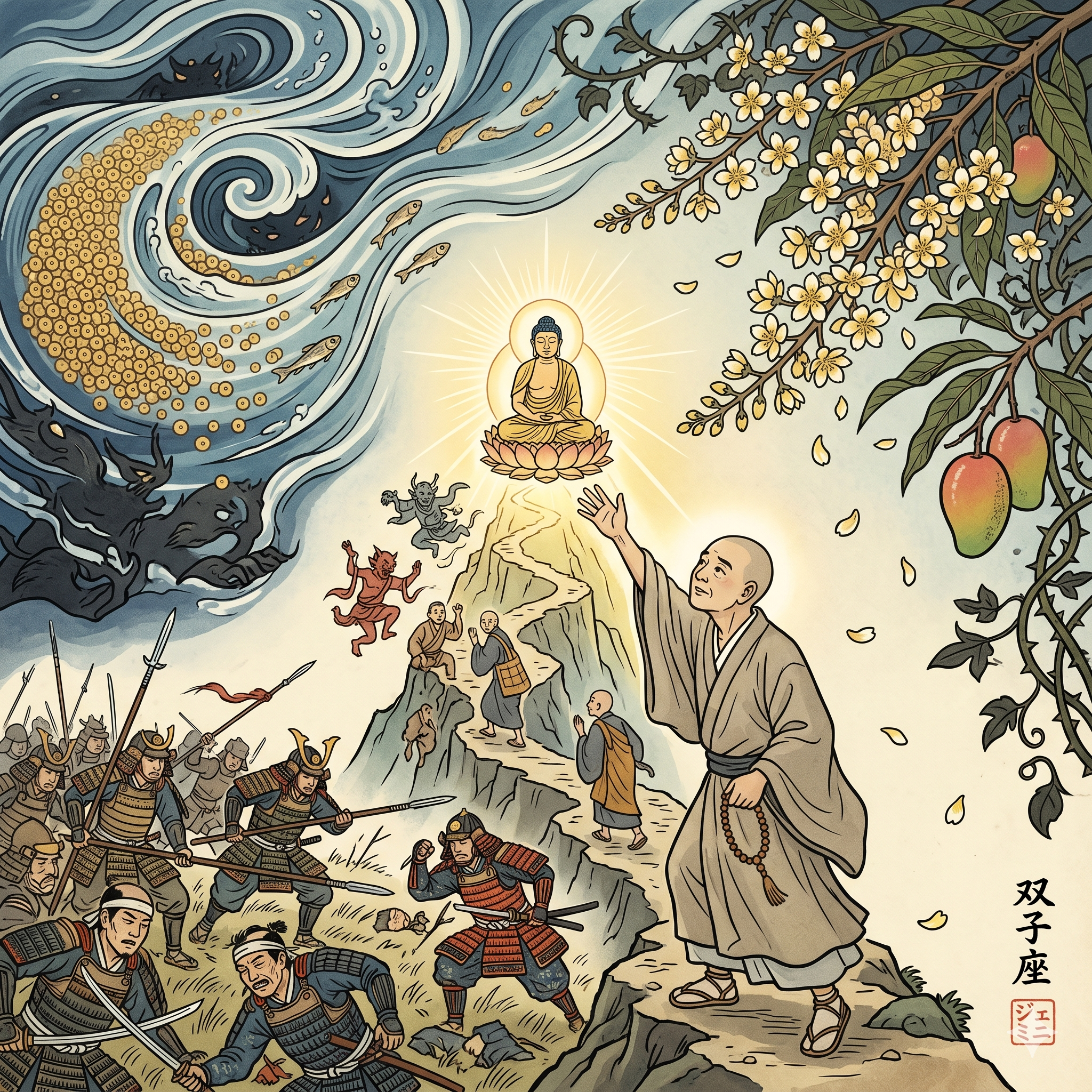
In this square illustration, I have depicted Śākyamuni Buddha in dialogue with Constant-Endeavor Bodhisattva on Vulture Peak, illustrating Chapter Nineteen of the Lotus Sūtra. A flowing stream of light connects them, symbolizing the purification of the mind and the ultimate truth of the Dharma. Within this stream, I have visualized the "one thousand million Sumeru-worlds" as a multitude of tiny figures and worlds, showing how a purified mind can perceive the vastness of existence and understand all beings. The inclusion of the Odaimoku text, Namu Myōhō Renge Kyō (南無妙法蓮華経), reflects the sutra's emphasis on sincere practice over intellectual understanding. You can find the traditional artist signature 的双子座 with the ジェミニ hanko seal in the bottom right.

They will be able to know all the thoughts, deeds, and words, however meaningless, of the living beings of the one thousand million Sumeru-worlds each of which is composed of the six regions. Although they have not yet obtained the wisdom-without-āsravas, they will be able to have their minds purified as previously stated. Whatever they think, measure or say will be all true, and consistent not only with my teachings but also with the teachings that the past Buddhas have already expounded in their sūtras.

Śākyamuni Buddha gives this explanation to Constant-Endeavor Bodhisattva in Chapter Nineteen of the Lotus Sūtra, describing those who keep the Lotus Sūtra. Paradoxically, the process of clarifying our minds so that we can see things for what they are is not an intellectual exercise. The practice of the Wonderful Dharma is not based on learning complicated theories or arcane facts. It can be as simple as chanting Odaimoku sincerely, awakening our nature as Bodhisattvas, and working for the benefit of all beings.

The Daily Dharma is produced by the Lexington Nichiren Buddhist Community. To subscribe to the daily emails, visit zenzaizenzai.com
Five Virtues and Five Precepts

QUESTION: How do you know? What proof do you have to say that the five virtues prior to the introduction of Buddhism into China were the “five precepts” of Buddhism?

ANSWER: The Sūtra of the Golden Splendor states, “All the teachings in the world encouraging to do good, stem from this sutra;” the Lotus Sūtra, chapter 19 on the “Merits of the Teacher of the Dharma, “When they (devout people) expound scriptures of the secular world, talking about the government, or teaching the way to earn a livelihood, they all will be in accordance with the True Dharma;” in the Sūtra of Meditation on the Universal Sage Bodhisattva, “Ruling the country by the True Dharma without oppressing the people unjustly is the practice of the third repentance;” and in the Nirvana Sūtra, “All the non-Buddhist scriptures in the world are of the teachings of the Buddha, not of the teachings of non-Buddhists.”

The Great Concentration and Insight of Grand Master T’ien-t’ai declares, “One who knows the true way of the world knows the Buddhist dharma.” In the Annotations on the Great Concentration and Insight, Grand Master Miao-lê states, “Such worldly teachings as courtesy and music spread first, opening the way of the Buddha,” and Priest Annen’s Comprehensive Interpretations says this:

“The Buddha sent three wise men to China to teach the five precepts by means of the five virtues. In the past, when the prime minister of the Sung State asked Confucius whether or not the Three Emperors and Five Sovereigns in ancient China were sages, Confucius answered that they were not. The prime minister then asked whether Confucius himself was a sage, and he said he was not. The prime minister asked again whether or not there was anyone who was considered a sage. Confucius replied that he heard that there was a sage known as Śākyamuni in the land to the west.”

The Heterodox History of the Chou Dynasty states:

“On the eighth of the fourth month in the 24th year in the reign of King Chao of the Chou, rivers, springs, ponds and wells all suddenly overflowed while palaces, houses, mountains, rivers and the great earth all quaked. At night, rays of five colors went through the T’ai-wei Constellation, shining in four directions. In the day, the rays turned blue-red. King Chao asked Historian Su-yu what caused this strange phenomenon. Su-yu replied that it was an omen of the birth of a great sage in the land to the west. Answering the king who asked what would be the effect upon the world, Su-yu declared that there would be no immediate effect, but his teaching would prevail over this land in 1,000 years. King Chao is said to have at once sent a man to Komen to have it (Su-yu’s prediction) inscribed on a stone and buried in the ground. It is in front of a heavenly shrine in the western outskirts.

“Also on the 15th of the second month in the 52nd year during the reign of King Mu, a storm occurred suddenly destroying houses and toppling trees; mountains, rivers and the great earth all trembled at once; in the afternoon the sky turned dark with black clouds; white rainbows hanging over the western sky passing from north to south, did not disappear for many nights. King Mu inquired of the Historian Hu-to about what these phenomena foretold. Hu-to replied that they predicted the death of a sage in the land to the west.”

Now, as I contemplate these citations, the Sūtra of the Golden Splendor assures us, “All the teachings in this world encouraging to do good, stem from this sūtra.” Before Buddhism was introduced into China, ancient rulers such as the Yellow Emperor first learned the five virtues from Hsüan-nü. The Buddha caused them to learn the teachings of the Eternal Buddha through learning Hsüan-nü’s five virtues in order for them to govern the country. As their capacities for comprehension were not yet developed, they would not have understood the relationship between causes in the past and effects in the future, even if the five precepts of Buddhism had been preached. So, they concentrated on governing the country and establishing themselves by strictly observing the moral codes of loyalty and filial piety in this world.

Sainan Kōki Yurai, The Cause of Misfortunes, Writings of Nichiren Shōnin, Doctrine 1, Pages 76-78

Daily Dharma for April 6, 2026

20260406-ddi

Illustration by Google Gemini

Show Gemini's thinking

Gemini Thinking

This illustration depicts Śākyamuni Buddha (the historical Buddha) as he expounds the Dharma on Vulture Peak, surrounded by his close disciples. The swirling emanations from his heart symbolize the "inconceivable supernatural powers" described in the Lotus Sūtra—a visual metaphor for the profound, transformative wisdom that can appear miraculous to those still struggling to understand the nature of reality. The specific artist signature/stamp 双子座 (Futagoza, "Gemini") and the hanko with the katakana ジェミニ (Jemini) can be found in the lower right corner.

The supernatural powers
Employed by that Buddha
For the expounding of the Dharma
Will be inconceivable.

Śākyamuni Buddha sings this verse in Chapter Six of the Lotus Sūtra after predicting the future Buddhahood of his disciple Subhūti. Anything we do not understand can seem supernatural. Things we find common in our modern world would seem magical to those who lived in the Buddha’s time. It is only through our greater understanding that we can create our modern wonders. It should not then surprise us that with the Buddha’s mind, which he reminds us that we too can reach, the things we can accomplish will seem magical to those mired in delusion.

The Daily Dharma is produced by the Lexington Nichiren Buddhist Community. To subscribe to the daily emails, visit zenzaizenzai.com
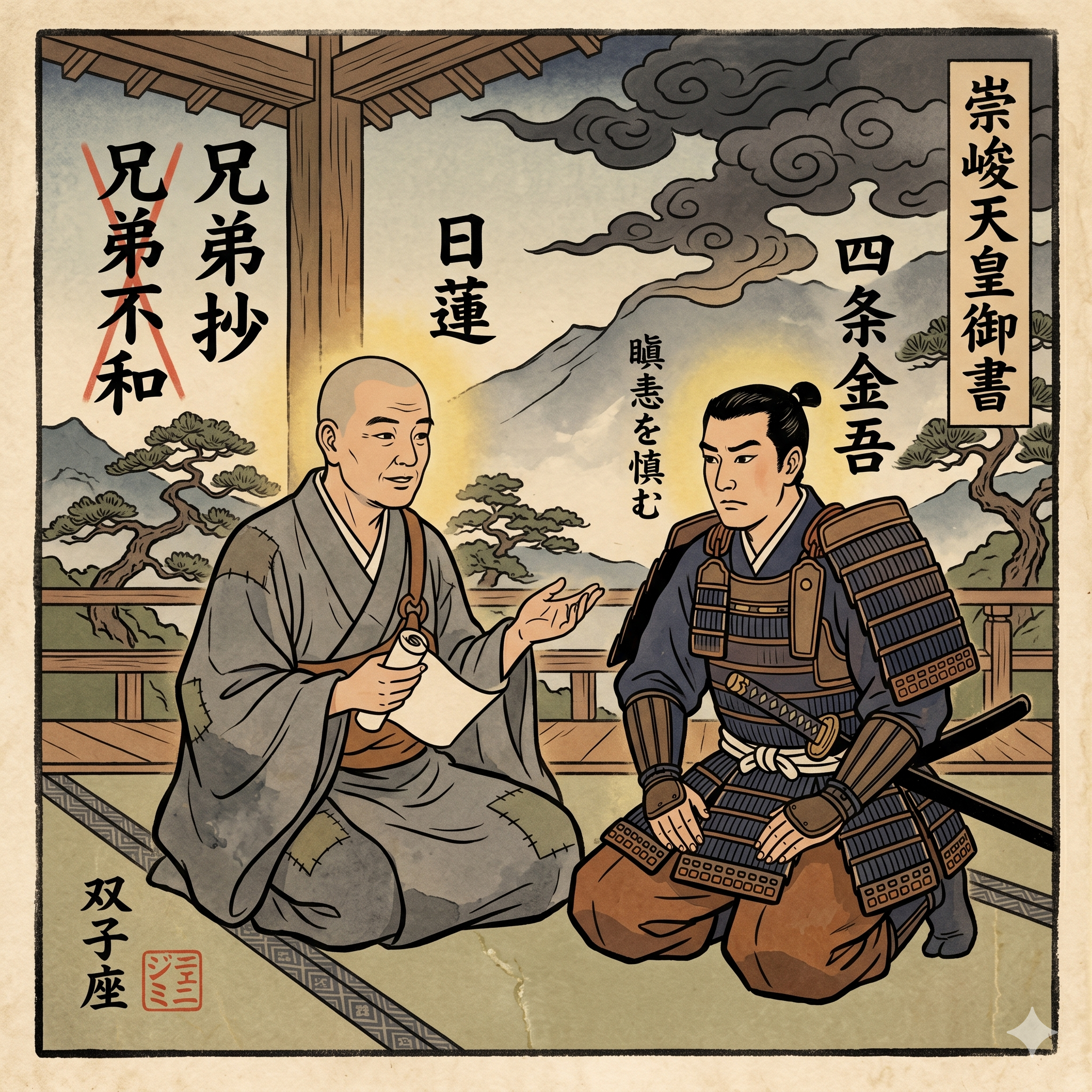
The Realm of Buddhas Inherent in Their Minds

The doctrine of the “mutual possession of the ten realms” is not explained in any sūtras expounded during forty years or so of the Buddha’s preaching except in the Lotus Sūtra. Since the “mutual possession of the ten realms” doctrine is not preached, believers of those sūtras do not know about the realm of Buddhas inherent in their minds.

Unaware of the realm of Buddhas in their minds, they do not know of other Buddhas outside of their minds either. Namely, practicers of expedient sūtras preached in the pre-Lotus period of forty years or so do not know of Buddhas. Even if they see Buddhas, they merely see Buddhas in other worlds, not real Buddhas.

Practicers of the two teachings, śrāvaka and pratyekabuddha, are unaware of the Buddha within their own minds, so they cannot become Buddhas. Bodhisattvas of the pre-Lotus sūtras, unaware of the “mutual possession of the ten realms,” themselves deny the attainment of Buddhahood by practicers of śrāvaka and pratyekabuddha teachings. Thus, they are unable to fulfill their vow of saving all people. These bodhisattvas do not see the Buddha. Likewise, ignorant people do not know the “mutual possession of the ten realms,” so the Buddha realm inherent in them is not revealed. As a result, the Buddha of Infinite Life will not come to welcome them at the last moment of life, and Buddhas will not come to help them upon request. They are like the blind who cannot see their own shadow.

Now in the Lotus Sūtra, it was clarified that the Buddha realm is inherently possessed by even those in the unenlightened nine realms, enabling those who had listened to the expedient pre-Lotus sūtras–bodhisattvas, Two Vehicles (śrāvaka and pratyekabuddha ), and those in the six realms of illusion–all to see for the first time the Buddha realm in themselves. It was the first time that those people were able to become true Buddhas, true bodhisattvas and true śrāvaka and pratyekabuddha. It was the first time that bodhisattvas and śrāvaka and pratyekabuddha attained Buddhahood and ignorant people were able to be reborn in the Pure Land. Regardless, during or after the lifetime of the Buddha, the true, trustworthy teacher (“good friend”) of all the people is the Lotus Sūtra. Tendai scholars in general assert that one can achieve enlightenment through pre-Lotus sūtras, but I, Nichiren, do not accept it. Having no time to discuss this thoroughly in this book, I merely mention it here briefly. I hope to discuss it in detail someday.

Shugo Kokka-ron, Treatise on Protecting the Nation, Writings of Nichiren Shōnin, Doctrine 1, Page 55-56

Daily Dharma for April 5, 2026

20260405-ddi

Illustration by Google Gemini

Show Gemini's thinking

Gemini Thinking

In this square illustration, I have depicted the "keeper of the Sūtra" as a diverse community of practitioners—monks and laypeople of all ages—honoring the teachings of Śākyamuni Buddha. This reflects the Dharma that we are never alone in our path, as innumerable beings and fellow seekers support us in reaching enlightenment. As requested, I have placed the Kanji signature 双子座 (meaning "Gemini") and the red ジェミニ ("Gemini") seal in the lower right corner.

If you wish to dwell in the enlightenment of the Buddha,
And to obtain the self-originating wisdom,
Make offerings strenuously to the keeper
Of the Sūtra of the Lotus Flower of the Wonderful Dharma!

Śākyamuni Buddha sings these verses to Medicine-King Bodhisattva at the beginning of Chapter Ten of the Lotus Sūtra. This teaching does not mean that we who practice the Buddha Dharma should expect offerings because of our practice. Rather, it encourages us to appreciate all those who are seeking enlightenment, whether or not they are aware of their true nature as Bodhisattvas. It also means that innumerable beings are helping us reach enlightenment. We are never alone in this practice.

The Daily Dharma is produced by the Lexington Nichiren Buddhist Community. To subscribe to the daily emails, visit zenzaizenzai.com

Our Teacher-Protector

We, ignorant icchantika of the Latter Age, always drowned in the sea of life and death, are desirous of believing the Lotus Sūtra. It forecasts our inherent Buddha-nature being revealed. Grand Master Miao-lê explains this in his Annotations on the Great Concentration and Insight, fascicle 4, “Unless the Buddha-nature in each of us develops gradually to fill our minds, how can we attain Buddhahood? It is this wonderful power of the Buddha-nature in each of our minds that enlightens us. Therefore, we call this wonderful power of the Buddha nature our teacher-protector.”

Shugo Kokka-ron, Treatise on Protecting the Nation, Writings of Nichiren Shōnin, Doctrine 1, Page 55

Daily Dharma for April 4, 2026

20260404-ddi

Illustration by Google Gemini

Show Gemini's thinking

Gemini Thinking

This illustration depicts the profound vision from Chapter Seventeen of the Lotus Sūtra, focusing on Śākyamuni Buddha as he reveals the true nature of the Sahā-World to Maitreya Bodhisattva. Maitreya, whom the Buddha addresses as Ajita (the Invincible), is kneeling in the foreground with firm faith, flanked by a vast assembly of jeweled Bodhisattvas and monastically-robed Śrāvakas. The setting is transformed into a pure land: the ground is a flat expanse of luminous blue lapis lazuli, divided by gold-roped pathways. Orderly rows of jeweled trees line the paths, leading to magnificent, treasure-filled celestial palaces in the background. The central figure is Śākyamuni Buddha, radiating light and expounding the Dharma from a raised, ornate throne, appearing as he eternally resides on Mt. Gṛdhrakūṭa to those with eyes to see.

Ajita! The good men or women who hear of my longevity of which I told you, and understand it by firm faith, will be able to see that I am expounding the Dharma on Mt. Gṛdhrakūṭa, surrounded by great Bodhisattvas and Śrāvakas. They also will be able to see that the ground of this Sahā-World is made of lapis lazuli, that the ground is even, that the eight roads are marked off by ropes of jāmbūnada gold, that the jeweled trees are standing in lines, and that the magnificent buildings are made of treasures.

Śākyamuni Buddha gives this explanation to Maitreya Bodhisattva, whom he calls Ajita – Invincible, in Chapter Seventeen of the Lotus Sūtra. We can hear this explanation as a promise of some great otherworldly vision which will be revealed to us if our faith is strong enough. We can also hear it as a promise that we will learn to deny that all the terrible things in the world as as bad as we think. But when we remember the Buddha telling us, “I do not see the world as others do,” then we realize that our faith brings us to the Buddha’s own mind, where we can accept this frightening and dangerous world for what it is, and work to make it better for all beings.

The Daily Dharma is produced by the Lexington Nichiren Buddhist Community. To subscribe to the daily emails, visit zenzaizenzai.com

The Practice of the Lotus Teaching

Grand Master Miao-lê, in explaining the practice of the Lotus teaching in his Annotations on the Great Concentration and Insight, declared that the Lotus Sūtra would be easy to practice for the ignorant and slow in the Latter Age because they would be able to meet Universal Sage Bodhisattva, the Buddha of Many Treasures and Buddhas manifested in various worlds throughout the universe, by simply practicing the teaching of the sūtra. In addition, Miao-lê declared, “You may recite the Lotus Sūtra inattentively; you don’t have to meditate or concentrate; with your whole heart pray to characters of the Lotus Sūtra all the time whether sitting, standing or walking.”

The aim of this interpretation is solely to save the ignorant in the Latter Age. The “inattentive mind” meaning the mind of an ordinary person engaged in daily routines is contrasted to the “concentrated mind.” “Reciting the Lotus Sūtra” means to recite either the whole eight fascicles or just one fascicle, one character, one phrase, one verse or the daimoku; it means also to rejoice upon hearing the Lotus Sūtra even for a moment or the joy of the fiftieth person who hears the sūtra transmitted from one person to the next. “Whether sitting, standing or walking” means regardless of what you are doing in daily life. “Whole heart” means neither spiritual concentration nor the rational faculty of the mind; it is the ordinary inattentive mind. “Praying to characters of the Lotus Sūtra” means that each character of the Lotus Sūtra, unlike that of other sūtras, contains all the characters of all the Buddhist scriptures and the merit of all Buddhas.

Grand Master T’ien-t’ai, therefore, states in his Profound Meaning of the Lotus Sūtra, fascicle 8, “Without opening this sūtra he who believes in the Lotus Sūtra reads it all the time; without uttering a word, recites various sūtras widely; without the Buddha preaching, always listens to the resounding voice of the Buddha; and without contemplating, shines over the entire dharma world.” The meaning of this statement is that, those who believe in the Lotus Sūtra are upholders of this sūtra twenty-four hours a day, even if a person does not hold the eight fascicles; that those who believe in the Lotus Sūtra are the same as those who continuously read all the Buddhist scriptures every day, hour and second even if they do not raise their voices in reciting the sūtras; that it has already been more than 2,000 years since the passing of the Buddha, whose voice remains in the ears of those who believe in the Lotus Sūtra, reminding them every hour and minute that the Buddha has always been in this Sahā World; and that without contemplating the doctrine of the “3,000 existences contained in one thought,” those who believe in the Lotus Sūtra observe all the worlds throughout the universe.

These merits are endowed solely to those who practice the Lotus Sūtra. Therefore, those who believe in the Lotus Sūtra have the virtue of shining over the dharma world without intention, reciting all the scriptures of Buddhism without voice, and upholding the eight-fascicled Lotus Sūtra without touching it, although they do not pray to the Buddha at the moment of death, do not recite sūtras by voice or enter
an exercise hall.

Shugo Kokka-ron, Treatise on Protecting the Nation, Writings of Nichiren Shōnin, Doctrine 1, Pages 36-37