
All posts by John Hughes

Day 25

Day 25 covers all of Chapter 20, Never-Despising Bodhisattva, and opens Chapter 21, The Supernatural Powers of the Tathāgatas.

Having last month meet Never-Despising Bodhisattva, we learn of his abuse and his reward.

Some of the four kinds of devotees had impure minds. They got angry, spoke ill of him and abused him, saying, ‘Where did this ignorant bhiksu come from? He says that he does not despise us and assure us that we will become Buddhas. We do not need such a false assurance of our future Buddhahood.’ Although he was abused like this for many years, he did not get angry. He always said to them, ‘You will become Buddhas.’

When he said this, people would strike him with a stick, a piece of wood, a piece of tile or a stone. He would run away to a distance, and say in a loud voice from afar, ‘I do not despise you. You will become Buddhas.’ Because he always said this, he was called Never-Despising by the arrogant bhiksus, bhiksunis, upasakas and upasikas. When he was about to pass away, he heard [from a voice] in the sky the twenty thousand billion gathas of the Sutra of the Lotus Flower of the Wonderful Dharma, which had been expounded by the Powerful-Voice-King Buddha. Having kept all these gathas, he was able to have his eyes, ears, nose, tongue, body and mind purified as previously stated. Having his six sense-organs purified, he was able to prolong his life for two hundred billion nayuta more years. He expounded this Sutra of the Lotus Flower of the Wonderful Dharma to many people [in his prolonged life]. The arrogant bhiksus, bhiksunis, upasakas and upasikas, that is, the four kind of devotees who had abused him and caused him to be called Never-Despising, saw that he had obtained great supernatural powers, the power of eloquence, and the great power of good tranquility. Having seen all this, and having heard the Dharma from him, they took faith in him, and followed him.

This Bodhisattva also taught thousand of billions of living beings, and led them into the Way to Anuttara-samyak-sambodhi. After the end of his prolonged life, he was able to meet two hundred thousand million Buddhas, all of them being called Sun-Moon­light. He also expounded the Sutra of the Lotus Flower of the Wonderful Dharma under them. After that, he was able to meet two hundred thousand million Buddhas, all of them being called Cloud­Freedom-Light-King. He also kept, read and recited this sutra, and expounded it to the four kinds of devotees under those Buddhas so that he was able to have his natural eyes, ears, nose, tongue, body and mind purified and to become fearless in expounding the Dharma to the four kinds of devotees.

The Daily Dharma from Jan. 9, 2017, offers this:

Although he was abused like this for many years, he did not get angry, He always said to them, ‘You will become Buddhas.’

The Buddha tells this story of Never-Despising Bodhisattva in Chapter Twenty of the Lotus Sūtra. This Bodhisattva did not read or recite sutras. His practice was simply to tell all those whom he encountered, “I respect you deeply. I do not despise you.” Despite his pure intentions, the deluded minds of those who heard him caused them to be angry with him, beat him, and chase him away. While he did not stand fast and endure their abuse, he did not lose his respect for them. This is an example for us who aspire to practice the Wonderful Dharma to show us how we can learn to treat all beings.

The Daily Dharma is produced by the Lexington Nichiren Buddhist Community. To subscribe to the daily emails, visit zenzaizenzai.com
Dividing the Lotus Sutra

The most important and frequently sited way of dividing up the Lotus Sutra is into two sections, one being the Provisional section, Shakumon, and the other the Essential, or Hammon. Chapters 1 through 14 are considered to be the Provisional teachings in the Lotus Sutra. Chapters 15 through 28 are the Essential portions of the Lotus Sutra.

One way of understanding this division is to think of the Provisional section as containing the causes for attaining the supreme enlightenment of Buddhas, whereas the Essential section contains the benefit or the result of the practices of the Provisional section.

Lecture on the Lotus Sutra

Daily Dharma – March 3, 2017

Let us go even to the end of one thousand billion worlds,
And find the place from where this light has come.
A Buddha may have appeared somewhere in the universe
In order to save the suffering beings.

These verses are sung by the Brahma King Great Compassion in Chapter Seven of the Lotus Sūtra. He invites his fellow Brahma Kings, creators of entire worlds, to leave the luxury of their palaces to find a Buddha who is leading all beings to enlightenment. They value the Buddha’s words more than anything that they have created for themselves, and know how rare it is to encounter an enlightened being. These kings give us an example of how we can learn to treasure the Buddha Dharma.

The Daily Dharma is produced by the Lexington Nichiren Buddhist Community. To subscribe to the daily emails, visit zenzaizenzai.com

Merits

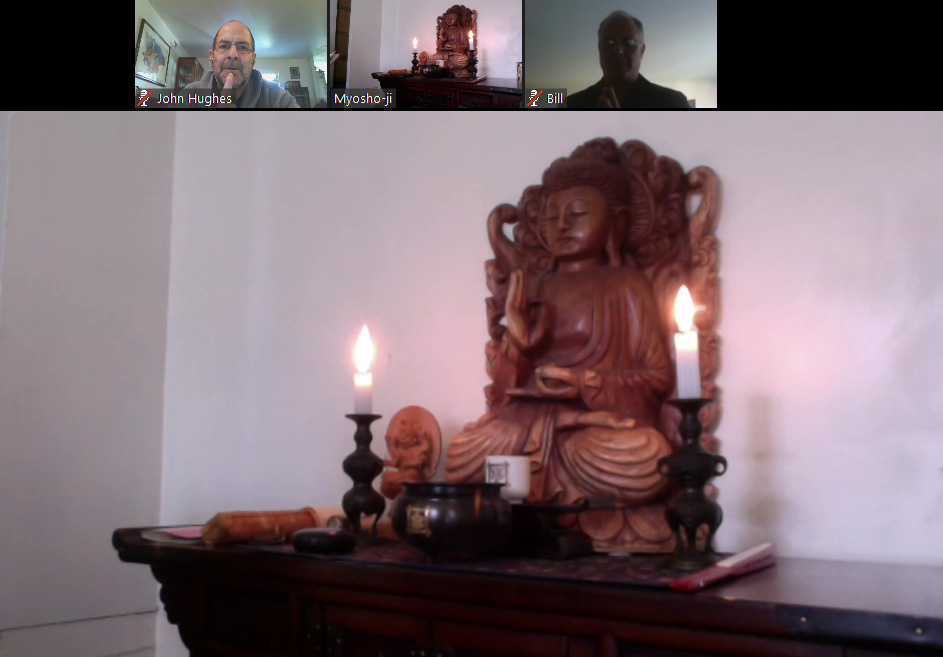
Screengrab from first service with Ryusho Shonin from Myosho-ji Temple since the move to Syracuse on Feb. 26, 2017.

Feb. 26, 2017, service at Sacramento Nichiren Buddhist Church

I don’t normally attend the Myosho-ji services when there is a local service, but being the first from Ryusho Shonin‘s new home in Syracuse, N.Y., I felt compelled. Why not.

This post is prompted by yesterday’s reading from The Merits of a Person Who Rejoices at Hearing This Sutra.

Suppose a man rejoices at hearing this sutra
Or at hearing even a gatha of it
In a congregation,
And expounds it to a second person.

The second person expounds it to a third person.
In this way it is heard by a fiftieth person.
Now I will tell you of the merits
Of the fiftieth person. …

The merits of the [fiftieth] person
[Who hears this sutra] are immeasurable.
Needless to say, so are the merits of the first person
Who rejoices at hearing it in the congregation.

In all of the time I was a member of Nichiren Shoshu and, after the split, Soka Gakkai, I never was comfortable expounding my Buddhist beliefs. That all changed when I came to Nichiren Shu and began my study of the Lotus Sutra. I’m both the 50th person and the first.

Today I had an email exchange with a man who asked, “What is the eternal Buddha?”

I suggested reading Chapter 16, The Duration of the Life of the Tathāgata, but the guy said he had read that and needed it broken down in layman’s terms. So I offered this:

Are you familiar with the three bodies of the Buddha? In the Lotus Sutra Sakyamuni represents all three, not just the historical Buddha who lived 3000 or so years ago. All other Buddhas are emanations of the eternal Buddha (as explained in Chapter 11, Beholding the Stūpa of Treasures). For Nichiren Buddhists the eternal Sakyamuni Buddha and the Bodhisattvas he has been teaching since the remotest past (see Chapter 15, The Appearance of Bodhisattvas from Underground) are the focus of devotion. Nichiren Buddhists believe that each person has an inherent Buddha nature (and all of the other 9 natures or worlds from hell to Bodhisattva) at any given moment. (See http://fraughtwithperil.com/ryuei/2010/06/18/chapter-10-ichinen-sanzen/)

All of this is gathered together and enclosed within the title of the sutra, Myoho-Renge-Kyo. Chanting devotion to the sutra – Namu-Myoho-Renge-Kyo – is the principle practice for this age and allows the individual to awaken this Buddha nature.

The question of how to describe Nichiren Buddhism is something I’ve been puzzling over recently. It was after I sent this email that I did evening gonyo and read today’s section from the Lotus Sutra, the conclusion of The Merits of the Teacher of the Dharma.

He will be able to expound the Dharma
With tens of millions of skillful words
Because he keeps
The Sutra of the Lotus Flower of the Wonderful Dharma.

Maybe not yet, but in time, yes.

Day 24

Day 24 concludes Chapter 19, The Merits of the Teacher of the Dharma and closes the Sixth Volume of the Sutra of the Lotus Flower of the Wonderful Dharma.

Having last month covered the merits of the mind in prose, we conclude this the chapter in gathas.

Thereupon the World-Honored One, wishing to repeat what he had said, ang in gathas:

Their minds will become pure, clear, keen and undefiled.
They will be able to recognize with their wonderful minds
The superior, mean and inferior teachings.
When they hear even a gatha [of this sutra],
They will be able to understand
The innumerable meanings of [this sutra].

When they expound [this sutra]
In good order according to the Dharma
For a month, four month or a year,
They will be able to understand at once
The thoughts of gods, dragons, men, yakisas, demigods,
And of all the other living beings
Inside and outside this world
Composed of the six regions
Because they keep
The Sutra of the Lotus Flower of the Wonderful Dharma.

They also will be able to hear and keep
The Dharma expounded to all living beings
By the innumerable Buddhas of the worlds
of the ten quarters
Who are adorned with the marks of one hundred merits.

When they think over the innumerable meanings [of this sutra],
And endlessly repeat the expounding of those meanings,
They will not forget or mistake the beginnings and ends of quotations
Because they keep the Sutra of the Lotus Flower of the Wonderful Dharma.

They will see the reality of all things.
Knowing the position [of this sutra in the series of sutras],
And the names and words [of this sutra],
according to the meanings of it,
They will expound [this sutra] as they understand it.

They will expound the Dharma
Already taught by the past Buddhas.
Therefore, they will be fearless
Before the multitude.

Anyone who keeps the Sutra of the Lotus Flower of the Wonderful Dharma
Will have his mind purified as previously stated.
Although he has not yet obtained the [wisdom-]without-asravas,
He will be able to obtain [these merits of the mind].

When he keeps this sutra,
He will be able to reach a rare stage.
He will be joyfully loved and respected
By all living beings.

He will be able to expound the Dharma
With tens of millions of skillful words
Because he keeps
The Sutra of the Lotus Flower of the Wonderful Dharma.

[Here ends] the Sixth Volume of the Sotra of the Lotus Flower of the Wonderful Dharma.

The Daily Dharma from Aug. 5, 2016, offers this:

They will see the reality of all things.
Knowing the position [of this sūtra in the series of sūtras],
And the names and words [of this sūtra], according to the meanings of it,
They will expound [this sūtra] as they understand it.

The Buddha sings these verses to Constant-Endeavor Bodhisattva in Chapter Nineteen of the Lotus Sūtra, describing those who keep the Lotus Sūtra. In our practice of the Wonderful Dharma, we may be able to enjoy the circumstances of being able to spend lots of time studying the Lotus Sūtra and the guidance given by our leader in this age of degeneration, Nichiren Shonin. But even if we do not have that luxury of time, as long as we remember how the Lotus Sūtra uses expedients to lead all beings to enlightenment, that the goal of this sūtra is not just to end suffering, we can teach it using our own capacities, however limited those may be. Each word of the sūtra is an embodiment of the Buddha. When we share these words with others, we share the Buddha.

The Daily Dharma is produced by the Lexington Nichiren Buddhist Community. To subscribe to the daily emails, visit zenzaizenzai.com

Dependent Origination

Dependent Origination means that every thing is dependent on other things, or causes, for its existence. That is, all phenomena arise as the result of causes and conditions. Therefore, no phenomena have any existence intrinsic to themselves-they depend on other phenomena. In order to have one thing, you need to have other things working together to bring about and to support its existence. Everything depends upon everything else in this way.

Lotus Seeds

Daily Dharma – March 2, 2017

Their tongues will be purified.
Their tongues will not receive anything bad.
Anything they eat will become
As delicious as nectar.

The Buddha sings these verses to Constant-Endeavor Bodhisattva in Chapter Nineteen of the Lotus Sūtra, describing those who keep the Lotus Sūtra. With food and drink it is easy to see how different people will find the same food either delicious or disgusting. Our experience and beliefs shape what we are comfortable putting into our bodies, and whether we do so for the sake of our health or the pleasure that comes from experiencing their flavor. But when we find that something with good flavor is bad for our health, or vice versa, we can change our tastes. This is another example of how the Lotus Sūtra teaches us how to live in the world. We learn to embrace situations we once found frightening or intolerable. We increase our capacity with our focus on benefiting others. As a wise teacher once said, we learn to enjoy problems the way we enjoy ice cream.

The Daily Dharma is produced by the Lexington Nichiren Buddhist Community. To subscribe to the daily emails, visit zenzaizenzai.com

Day 23

Day 23 covers all of Chapter 18, The Merits of a Person Who Rejoices at Hearing This Sutra, and opens Chapter 19, The Merits of the Teacher of the Dharma.

Having last month concluded the merits of the 50th person who rejoices at hearing the Lotus Sutra in prose, we now repeat what was said in gathas.

Suppose a man rejoices at hearing this sutra
Or at hearing even a gatha of it
In a congregation,
And expounds it to a second person.

The second person expounds it to a third person.
In this way it is heard by a fiftieth person.
Now I will tell you of the merits
Of the fiftieth person.

Suppose there was a great almsgiver.
He continued giving alms
To innumerable living beings
For eighty years according to their wishes.

Those living beings became old and decrepit.
Their hair became grey; their faces, wrinkled;
And their teeth, fewer and deformed.
Seeing this, he thought:
‘I will teach them because they will die before long.
I will cause them to obtain the fruit of enlightenment.’

Then he expounded the truth of Nirvana to them
As an expedient, saying:
‘This world is as unstable
As a spray of water,
Or as a foam, or as a filament of air.
Hate it, and leave it quickly!’

Hearing this teaching, they attained Arhatship,
And obtained the six supernatural powers,
Including the three major supernatural powers,
And the eight emancipations.

The superiority of the merits of the fiftieth person
Who rejoices at hearing even a gatha [of this sutra]
To the merits of this [great almsgiver]
Cannot be explained by any parable or simile.

The merits of the [fiftieth] person
[Who hears this sutra] are immeasurable.
Needless to say, so are the merits of the first person
Who rejoices at hearing it in the congregation.

The Daily Dharma from Nov. 25, 2016, offers this:

The Buddha sings these verses to Maitreya Bodhisattva in Chapter Eighteen of the Lotus Sutra. This chapter includes a story of a person who hears the Wonderful Dharma, then explains it to the best of their ability to someone else. In this way there is a chain of fifty people who hear versions of this teaching modified by the capacities of those transmitting it. The effectiveness of this teaching does not depend on who delivers it. No matter what our capacity, any of us can teach the Lotus Sutra and practice it in our lives.

The Daily Dharma is produced by the Lexington Nichiren Buddhist Community. To subscribe to the daily emails, visit zenzaizenzai.com

Daily Dharma – March 1, 2017

I now expound this Sūtra of the Lotus Flower of the Wonderful Dharma with great joy. This sūtra leads all living beings to the knowledge of all things. I did not expound it before because, if I had done so, many people in the world would have hated it and few would have believed it.

The Buddha makes this declaration to Mañjuśrī Bodhisattva in Chapter Fourteen of the Lotus Sūtra. It can be difficult to imagine anyone hating the Buddha’s teachings. We sometimes notice that the true opposite of affection and devotion is not enmity and distrust. It is indifference. When we hear the Buddha’s teaching and do not make it part of our lives, it is because we are so attached to our peculiar ignorance and misery that we are afraid to live any other way. The Buddha shows us that it is possible to exist in harmony with the world rather than in conflict. It is only when we practice his teachings that we can believe them.

The Daily Dharma is produced by the Lexington Nichiren Buddhist Community. To subscribe to the daily emails, visit zenzaizenzai.com

Day 22

Day 22 covers all of Chapter 17, The Variety of Merits.

Having last month finished Chapter 17, it’s time to begin again with
The Variety of Merits.

Thereupon the innumerable, asamkhya living beings in the great congregation, who had heard from the Buddha that the duration of his life was so many kalpas as previously stated, obtained great benefits.

At that time the World-Honored One said to Maitreya Bodhisattva-mahasattva:

Ajita! When I said that the duration of my life was so long, six hundred and eighty billion nayuta living beings, that is, the living beings as many as there are sands in the River Ganges, obtained the truth of birthlessness. Bodhisattva-mahasattvas numbering one thousand times the number of these living beings obtained the dharanis by which they could memorize all that they had heard. Bodhisattva-mahasattvas as many as the particles of earth of a Sumeru-world obtained eloquence without hindrance. Another group of Bodhisattva-mahasattvas as many as the particles of earth of a Sumeru world obtained the dharanis by which they could memorize many hundreds of thousands of billions of repetitions of teachings. Bodhisattva-mahasattvas as many as the particles of earth of one thousand million Sumeru-worlds obtained the faculty of turning the irrevocable wheel of the Dharma. Bodhisattva-mahasaltvas as many as the particles of earth of one million Sumeru-worlds obtained the faculty of turning the wheel of the pure Dharma. Bodhisattva-mahasattvas as many as the particles of earth of one thousand Sumeru-worlds obtained the faculty of attaining Anuttara-samyak-sambodhi after eight rebirths. Bodhisattva-mahasattvas four times the number of the particles of earth of the four continents obtained the faculty of attaining Anuttara-samyak-sambodhi after four rebirths. Bodhisattva­-mahasattvas three times the number of the particles of earth of the four continents obtained the faculty of attaining Anuttara-samyak-­sambodhi after three rebirths. Bodhisattva-mahasattvas twice the number of the particles of earth of the four continents obtained the faculty of attaining Anuttara-samyak-sambodhi after two rebirths. Bodhisattva-mahasattvas as many as the particles of earth of the four continents obtained the faculty of attaining Anuttara-samyak­-sambodhi immediately after this life. Living beings as many as the particles of earth of eight Sumeru-worlds aspired for Anuttara-­samyak-sambodhi.

When the Buddha said that these Bodhisattva-mahasattvas had obtained the great benefits of the Dharma, [the gods] in heaven rained mandarava-flowers and maha-mandarava-flowers on the many hundreds of thousands of billions of Buddhas sitting on the lion-like seats under the jeweled trees. They also rained those flowers on [the two Buddhas:] Many-Treasures Tathagata, who had passed away a long time ago, and Sakyamuni Buddha, both of whom were sitting on the lion-like seat in the stupa of the seven treasures. They also rained those flowers on the great Bodhisattvas’ and the four kinds of devotees. They also rained the fine powder of the incense of candana and aloes [on them). Heavenly drums automatically sounded wonderful and deep in the sky. [The gods] also rained thousands of heavenly garments and hung many necklaces made of pearls, mani gems or free-at-will gems over the nine quarters. They also burned priceless incense which was put in incense-burners of many treasures. The incense-burners automatically went around the great congregation, and the odor of the incense was offered to all the members of the congregation. Above each of the Buddhas [sitting under the trees], Bodhisattvas lined up vertically one upon another to the Heaven of Brahman, holding canopies and streamers. They praised the Buddhas, singing innumerable verses with their wonderful voices.

Someday I want to try to illustrate Bodhisattvas lined up vertically one upon another to the Heaven of Brahman, holding canopies and streamers.