Category Archives: Blog

Establishing A Foundation for What It Means To Be A Nichiren Buddhist

Starting today and running through the end of 2021, I will be publishing excerpts from The History and Teachings of Nichiren Buddhism, From Śākyamuni Buddha Through Nichiren Shōnin to the Present. As always, these are things I want to remember and they don’t necessary represent the full breadth of the material covered. For example, I’ve saved nothing from the 31 pages devoted to the history of various Nichiren schools after Nichiren’s death. This is valuable information for the book’s original audience – Nichiren Shu priests in training – but holds little interest in my quest to establish the Lotus Sutra and Nichiren’s teachings as the guiding light of my daily life.

This material is translated from a collection of essays and as a result each essay author exerts an influence over the material. For example take this explanation of the trials Śākyamuni overcame as he sat under the bodhi tree:

Under the Bodhi tree, demons appeared who tried to interfere with his meditation with temptations. In the Sutta-nipāta, a collection of some of the oldest scriptures, Śākyamuni recalls the demon’s temptations as follows: “Sensual passions are your first army. Your second is called Discontent. Your third is Hunger and Thirst. Your fourth is called Craving. Fifth is Sloth and Drowsiness. Sixth is called Terror. Your seventh is Uncertainty, Hypocrisy and Stubbornness. Your eighth is Gains, Offerings, Fame and Status wrongly gained, and whoever would praise self and disparage others.”

Although Śākyamuni says that demons used ten weapons, it should be noted that the demons are certainly not portrayed as supernatural beings separate from reality. These demons are the embodiments of the essential desires or afflictions humans possess from birth.

This categorical rejection of a spiritual world is a little surprising. While I understand why a non-Buddhist might suggest that demons simply represent “embodiments of the essential desires or afflictions humans possess from birth,” such a statement strips from Buddhism its mystical heritage. It is that heritage that I believe the Aragyo training makes real. Ministers who accomplish the 100-day ascetic training emerge with a real sense of the spiritual realm. Since two of my favorite priests – Revs. Kenjo Igarashi and Shoda Kanai – have completed multiple Aragyo trainings, I am biased toward that view.

Although dry and academic, this book provides an excellent foundation for what it means to be a Nichiren Buddhist.

Obon vs. Higan

20210926_higan-service-web
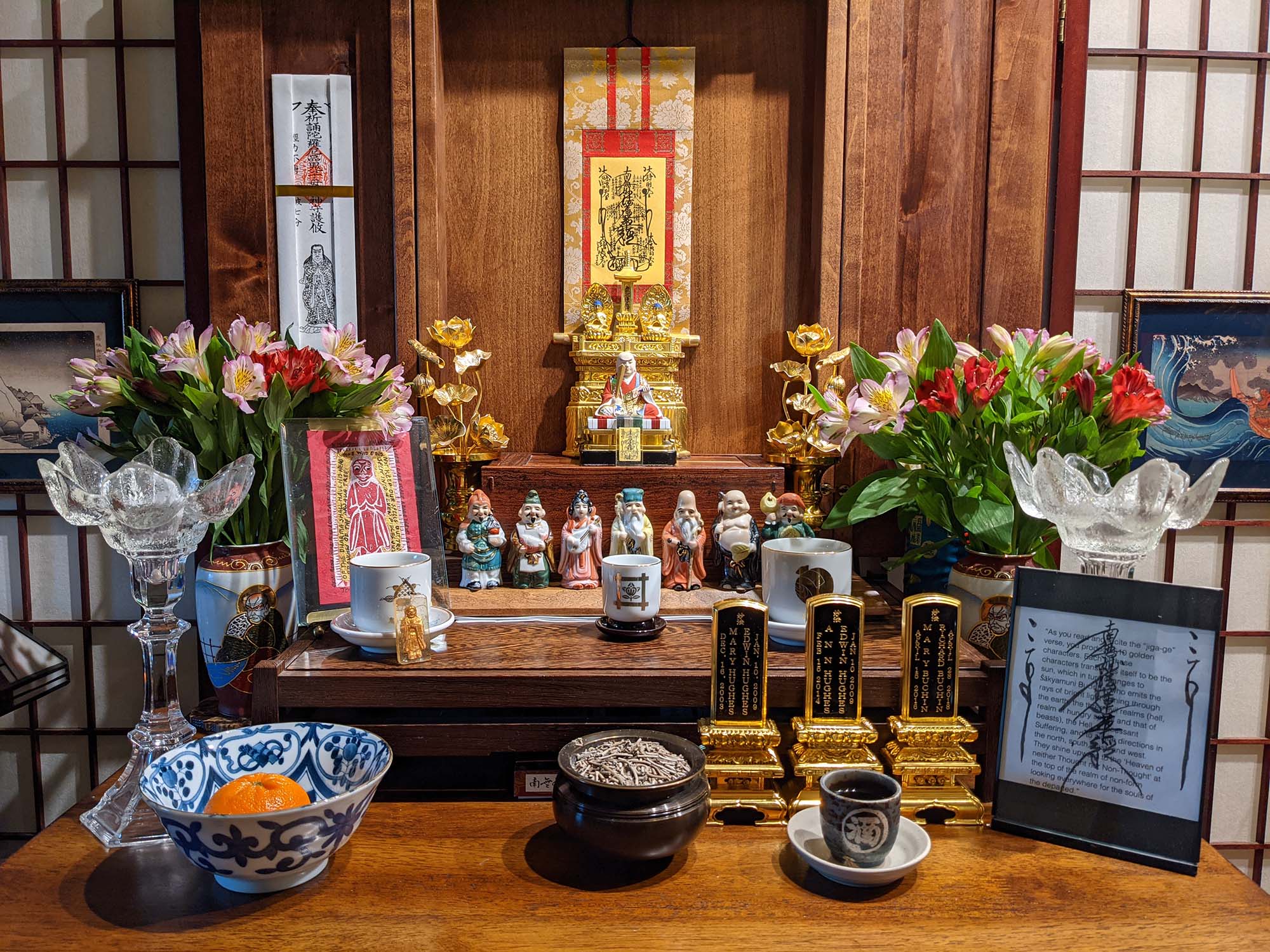
The memorial tablet in front of the statue of Nichiren is for all of the deceased members of the Sacramento Nichiren Buddhist Church

Attended the Fall Higan service at the Sacramento Nichiren Buddhist Church. Rev. Igarashi used the occasion to explain the difference between Obon and Higan, since both involve memorial services for our ancestors.

Rev. Igarashi explained that the two are completely different. For one telling of the story of Obon see Urobon-e or consider this excerpt from Nichiren’s On the Ullambana Service.

For Obon, Rev. Igarashi said, we just invite our ancestors to visit and serve them a lot of food and chanting. Higan, on the other hand, is a full week of focusing on the six paramitas.

As explained by the Nichiren Shu brochure on Higan, the Six Paramitas are:

  1. fuse means to offer one’s self wholeheartedly and unconditionally, without any expectation of its return.
  2. jikai is to follow and maintain the general precepts of the Buddha.
  3. nin-niku suggests a resilience to persevere through hardship.
  4. syojin refers to the necessity of conscientious effort in accomplishing one’s goals.
  5. zenjo points to qualities existent in meditation, calling upon one’s concentration, adjoined by calmness and poise.
  6. Chie is the Buddha’s wisdom, reinforced with its practical application.

In Rev. Igarashi’s telling, jikai or precepts, the 250 or 500 Hinayāna rules governing behavior of monks and nuns, were replaced by Nichiren with chanting Namu Myōhō Renge Kyō. In the age of Mappō, the latter age of degeneration, chanting Namu Myōhō Renge Kyō is jikai. “Just chanting Namu Myōhō Renge Kyō, Namu Myōhō Renge Kyō. That’s the same thing as upholding the precepts,” Rev. Igarashi explained.

“It is very important to understand that precepts is practice,” Rev. Igarashi said. “Of all the paramitas, the most important is practice.”

After a retelling of the Parable of the Magic City, Rev. Igarashi said:

“That’s why we need more practice, practice, practicing. We need to extinguish our bad karma, otherwise we will never get a better life. That’s why we need more practicing.”

Guide de pratique du Sutra du Lotus

Lotus Sutra Practice Guide in French

A French translation of Ryusho Jeffus’ Lotus Sutra Practice Guide: 35-Day Practice Outline is now available at nichiren-etudes.net.

The Kingdom of Buddha

I have now completed publishing “Nichiren, The Buddhist Prophet” by Masaharu Anesaki. Back in June, when I started, I offered a lengthy quote that I felt showed Anesaki’s insight into Nichiren’s Buddhism. It seems fitting to offer a concluding quote:

Buddhahood, or Truth, is eternal. It can be, and ought to be, made a fact in our own life. Nichiren is the man sent to lead all to that life, and he is now assisted by his followers, who are, therefore, the Saints prophesied in the [Lotus Sutra]. The attainment of Buddhahood is not a matter of individuals or of the aggregate of individuals, it is the embodiment of the all-embracing communion of all beings in the organic unity of Buddhahood which is inherent in them all. This realization is the Kingdom of Buddha, the establishment of the Land of Treasures, as Nichiren had declared in his Risshō Ankoku Ron and explained on many occasions.

Nichiren, The Buddhist Prophet, Chapter 9, Page 98-99


In September, as I did in March, I will devote the entire month to Higan and the Six Pāramitās. For the remainder of August I’m going to published some quotes from Nikkyō Niwano’s Buddhism for Today, which I have been using in my 32 Days of the Lotus Sutra posts.

The Start of the 49 Day Journey

20210822_service_web
In front of the statue of Nichiren is a memorial tablet created by Rev. Igarashi for Mark Washington

Today Rev. Igarashi held a memorial service for Mark Washington, the son of Renee Dennis, a member of the church. Mark died Aug. 20, 2021, of complications related to Covid-19.

Rather than attempt to paraphrase Rev. Igarashi’s special prayer and his sermon, I’ll just reprint an article published in the Sacramento Nichiren Buddhist Church newsletter in May 2016.

The Significance of the 49-Day Journey After Death

Last November [2015] marked the 40-year anniversary since I first became an overseas minister. Since then, I have spent these past several months reflecting on my various experiences throughout my journey as a Buddhist priest in the United States. It led me to realize that while I have much more that I wish to tell to you about Buddhism, there are also many concepts that need further explanation. One example that comes to mind is the importance of the 49th day memorial service for the deceased, which is specific to Buddhist traditions. Its significance is often times downplayed or even forgotten, when compared to the notion of holding funeral services. I wish to elaborate on this topic by briefly taking you through the 49-day journey of the deceased.

When an individual passes away, it is said that 49 nails are hammered into their body and soul, restraining both the physical body and soul from moving. Every seven days, starting from the day of the individual’s passing, until the 49th day, we hold memorial services for the individual. Seven nails will be removed every seventh day, until all 49 of these nails are removed, to ultimately free the deceased’s soul. On the 49th day, there will be a trial or hearing held in front of the so-called ”judge”, who will be standing in front of six gates, bearing no signs. However, we all know that each of these gates leads the individual to six possible realms of existence. These include hell, those of hungry spirits, animals, ashura, humans, or the heavenly beings. Everyone wants to either return as a human being, or enter the realm of heavenly beings. This judge in front of the six gates, will not guide this individual to the proper gate, but only instruct them to choose one. The individual will choose the gate based on what they may think is only instinct, yet this decision will also be guided by the actions that the individual took during their time on this earth.

While it may seem as if we take little part in the deceased individual’s 49-day journey, this is not the case. One way we can assist them, is by chanting ”Namu myo ho renge kyo”, which as you know, is the name of the Buddha nature that we all possess. We chant this odaimoku throughout the 49 days to call upon the deceased individual’s Buddha nature. If you recall, the Buddha nature can be imagined as the inside of a seed, while the outer shell represents bad karma resulting primarily from previous actions. Whenever we chant the odaimoku, the Buddha nature slowly grows. While this is a slow process, the more we chant, the more the Buddha nature shows, until it finally appears by sprouting through the outer shell. If the Buddha nature does not appear at the end of the 49 days, the individual will not be able to reach Enlightenment.

While death signifies the end of an individual’s time in this world, it does not mark the ultimate endpoint of their spirit. Please remember that your Buddhist practice can serve an important purpose in providing happiness for not only yourself, but also others, including the deceased.

Ven. Kenjo lgarashi

20210822_Mark-Washington_Renee-Denis
Mark Washington and his mother, Renee Dennis, at Christmas, 2020

Remembering Ryusho – One Year On

Offering for Ryusho JeffusToday is the one year anniversary of the death of Ryusho Shonin. I held a personal memorial service for him this morning, offering him cookies and a piece of local artwork. Sweets and art – two things Ryusho always appreciated.

A formal memorial service will be held for Ryusho on Sunday, Aug. 15, starting at 10:30am Pacific time – 1:30pm Eastern; 6:30pm GMT (London); 7:30pm CET (Prague). The service will be held over Zoom. If you want to attend, you must register in advance.

Register for Rev. Ryusho Jeffus Shonin’s memorial service
ryusho-1year-service-flier
Click to register to attend Rev. Ryusho Jeffus’ One Year Memorial Service

One Year Memorial Service for Rev. Ryusho Jeffus

Ryusho JeffusThe One Year Memorial Service for Rev. Ryusho Jeffus will be held online on Sunday, Aug. 15 via Zoom at 10:30 AM Pacific Time – 1:30 PM Eastern Time, 6:30 PM GMT (London), 7:30 PM CET (Prague).

You must register in advance if you want to attend.

To register, click here.

After registering, you will receive a confirmation email containing information on how to join Rev. Ryusho Shonin’s Service. Check your spam folder if the email does not arrive. For questions about the service, contact Mark Herrick.

Day 14

Day 14 covers all of Chapter 9, The Assurance of Future Buddhahood of the Śrāvakas Who Have Something More to Learn and the Śrāvakas Who Have Nothing More to Learn, and opens Chapter 10, The Teacher of the Dharma.

Having last month considered the Buddha’s prediction for Ananda, we consider the question posed by the new Bodhisattvas.

There were eight thousand Bodhisattvas who had just resolved to aspire [for Anuttara-samyak-saṃbodhi] in this congregation. They thought, ‘As far as we have heard, even great Bodhisattvas have never been assured of their future Buddhahood. Why have these Śrāvakas been so assured?’

Thereupon the World-Honored One, seeing what the Bodhisattvas had in their minds, said to them:

“Good men! Ānanda and I resolved to aspire for Anuttara-samyak-saṃbodhi under the Void-King Buddha at the same time [in our previous existence]. At that time Ānanda always wished to hear much while I always practiced strenuously. Therefore, I have already attained Anuttara-samyak-saṃbodhi[, but he has not yet]. Now he protects my teachings. He also will protect the store of the teachings of future Buddhas, teach Bodhisattvas, and cause them to attain [Anuttara-samyak-saṃbodhi], according to his original vow. Therefore, now he has been assured of his future Buddhahood.”


This month the Nichiren Buddhist Sangha of the San Francisco Bay Area discussed Chapter 9. It is a fine discussion but for me the discussion of the chapter underscores something stressed in the Sutra of Innumerable Meanings:

“O you of good intent! This sutra can be likened to a single seed from which a thousand million seeds result. And each of these seeds, in turn, also results in a thousand million in number. In this way, the production of seeds is limitless in measure. So it is also with this sutra—it is a single teaching that gives rise to a hundred thousand meanings, and each one of these, in turn, produces a thousand million in number. In this way, meanings are produced to an unlimited and boundless extent.”

In the Nichiren Buddhist Sangha of the San Francisco Bay Area discussion of Chapter 9 there is a lot of discussion about practice and in particular the perils of becoming disheartened if your personal practice falls short of your goal.

While it is important to remember that a single Daimoku is the equivalent of reciting the entire Lotus Sutra, I think the point Chapter 9 is making is that just knowing stuff is not enough. You have to put that knowledge to work. In the above quote from today’s portion of Chapter 9, we learn that Śākyamuni and Ananda both aspired for enlightenment under the Void-King Buddha, but Ananda was too focused on learning and neglected his practice. In the future, he will protect the store of the teachings of future Buddhas, just as he does now, but he will also teach Bodhisattvas, and that will be how he becomes a Buddha named Mountain-Sea-Wisdom-Supernatural-Power-King.

See Early Ideas about the Dharma-kāya

Feeding Visiting Relatives and Hungry Spirits

Enjoyed attending this morning’s Nichiren Buddhist Kannon Temple of Nevada combination Obon and Segaki Memorial Service.

20210718_obon
Rev. Shoda Kanai playing all of the instruments in his orchestral arrangement
20210718-segaki
Rev. Shoda Kanai feeding the hungry spirits. The tobas — paper stupas — are for people for whom this was there first Obon. Among those tobas is one for Rev. Ryusho Jeffus.
20210718-valued-customer
Included among the 18 participants in the Zoom service was this Valued Customer.

The Lotus Sutra as a History Lesson

Pokemon card Beginning today I will be posting excerpts from Source Elements of the Lotus Sutra: Buddhist Integration of Religion, Thought, and Culture as part of my daily 32 Days of the Lotus Sutra posting. The excerpts won’t align perfectly with the daily section being considered.

Keisho Tsukamoto’s Source Elements of the Lotus Sutra is not a book about the teaching of the Lotus Sutra as much as it is a book about how the evolution of Buddhism is reflected in the Lotus Sutra. As such it is filled with archeological and historical minutia that is of little interest outside academic circles. Today’s post, Embracing the Nāga cult, is a good example.

The book was originally published in Japanese in 1986 and republished in English by Kosei Publishing in 2007. When I purchased this book last year, it was going for $50 used. The cover price was originally $26.95. Today you would be hard-pressed to find this book for sale for less than $300. This is the Pokemon card in my Lotus Sutra library – do I hold on to it or sell it for a big profit.