I joined Nichiren Shoshu in 1989 and when the split with Soka Gakkai occurred I stayed with SGI. Beginning around 2010 I felt a strong need to expand my practice. I attended more meetings, and volunteered at the SGI community center. I also read all of Nichiren’s writings, first in the Nichiren Shoshu translation and then in the Soka Gakkai. But instead of growing closer to SGI, I grew further away. Finally on Jan. 1, 2015, I severed ties with SGI and called Rev. [Kenjo] Igarashi and asked when the next service was scheduled.
A man on a plateau, feeling thirsty, Dug a hole in order to get water. As long as he saw the dug-out lumps of earth were dry, He knew that water was still far off. When he found the earth wet and muddy, He was convinced that water was near.
In the same manner, Medicine-King, know this! Those who do not hear The Sūtra of the Lotus Flower of the Wonderful Dharma Are far from the wisdom of the Buddha.
That quote from the Lotus Sutra, Chapter 10, The Teacher of the Dharma, describes my experience. All of the moisture is sucked out of the ground by SGI’s focus on President Ikeda. The Lotus Sutra is not studied. Śākyamuni is not worshiped as the original Buddha. Nichiren’s role as a great bodhisattva, the reincarnation of Jogyo, is ignored. I found moisture in Nichiren Shū and as I have continued to practice and study I have found water. I have a personal website where I store this water, with quotes from books and daily recitations of the Lotus Sutra and other dharma material. I also created the church’s website and stocked it with brochures from the Nichiren Buddhist Information Center and Rev. Igarashi’s lectures in an effort to attract more people to the church. I am no longer the newest member of the congregation.
I have been reading book three of the Nichiren Mandala Study Workshop’s The mandala in Nichiren Buddhism. Book three focuses on analysis of the mandala structure and development of the Gohonzon within successive Nichiren lineages. Last night I came across this explanation of the split in Nichiren schools.
The first schisms and formation of lineages
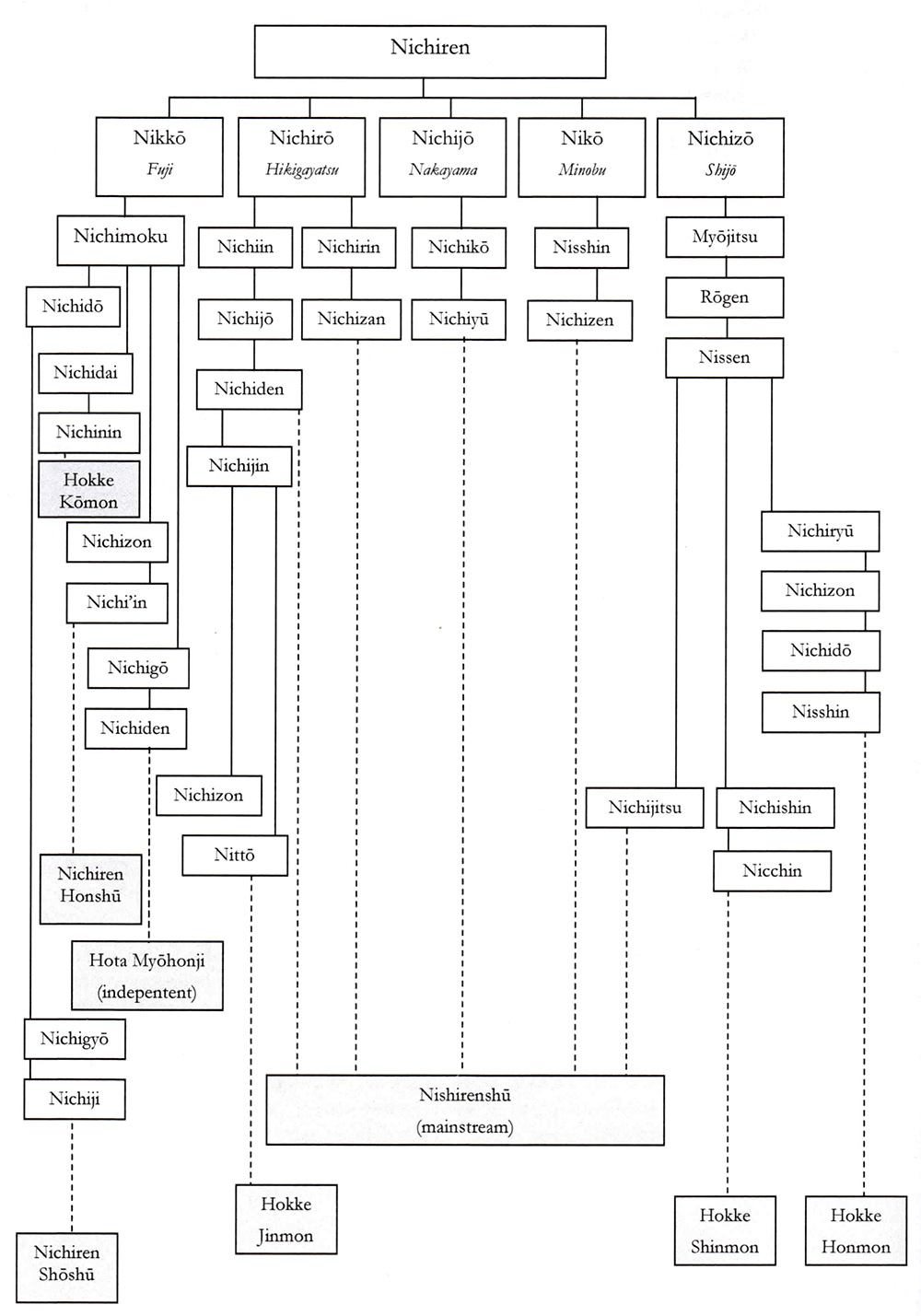
It is generally thought that the first division within the Nichiren Sangha was caused by different views about the calligraphic mandala versus the three-dimensional representation, made with a set of statues. Another important point of contention raised by the third and fourth generation disciples was the Shōretsu versus the Itchi approach to the Lotus Sūtra. The Shōretsu School considers the first half of the Sūtra as inferior, since the essence is found only in the second fourteen Honmon chapters. The Itchi School instead maintains that the entire 28 chapters should be considered as a whole. The two factions were basically centered on the following temples:
A flowchart illustrating lineages of Nichiren Buddhism. Click to see full image.Shōretsu group
In brief, the Shoretsu group considers just the Hoben and the Juryō chapters of the Lotus Sūtra as being essential and includes only the 2nd and 16th chapters in daily practice. The Itchi group studies and chant portions from the whole Sūtra. Nevertheless these two chapters are regarded as the most important and included among others in daily worship.
When I read this it occurred to me that this further explained the reason why I found the dirt so dry when I was digging for water under Soka Gakkai and Nichiren Shoshu. SGI and Nichiren Shoshu are Shōretsu. The Sacramento Nichiren Buddhist Church and Nichiren Shū are Itchi. (Rev. Igarashi considers himself a member of the Minobu school.) “Those who do not hear the Sūtra of the Lotus Flower of the Wonderful Dharma are far from the wisdom of the Buddha.” To consider any part of the Sūtra to be inferior sucks even more of the moisture from the ground. The wellspring is found in the 28 chapters of the Sūtra of the Lotus Flower of the Wonderful Dharma.
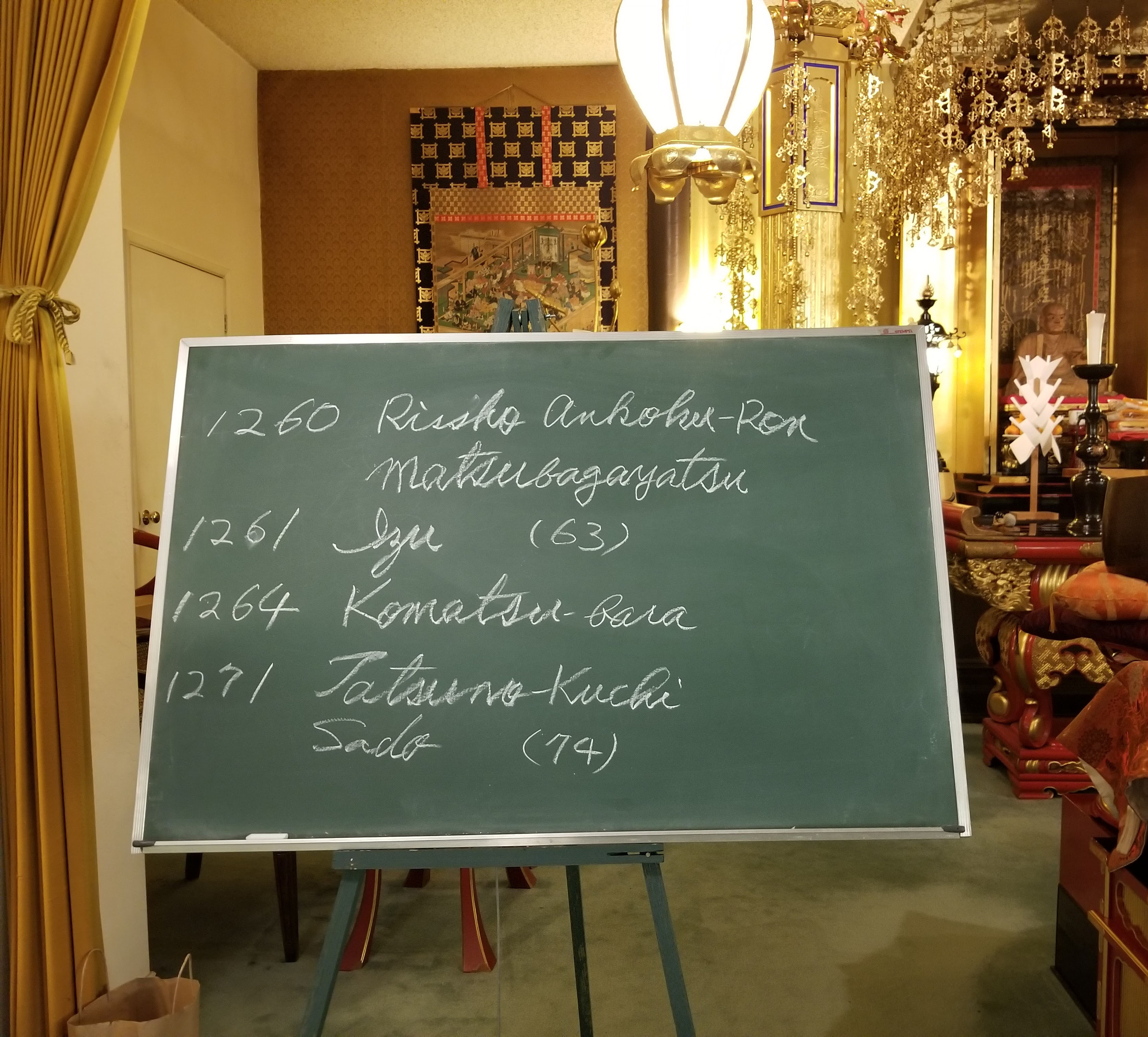
Attended the Sacramento Nichiren Buddhist Church Komatsubara Persecution Service on Sunday. Ven. Kenjo Igarashi‘s gosho covered the four great persecutions that followed Nichiren’s submission of the Rissho Ankoku-Ron.
As explained by Rev. Igarashi:
Nichiren Shonin used “strong words” in establishing the supremacy of the Lotus Sutra and Sakyamuni Buddha because he was trying to save the suffering people of Japan. But those strong words provoked many people to attack Nichiren Shonin.
Today we don’t use shakubuku to break people’s ideas and then teach them the correct view. Now we teach using shoju to lead and convince them by respectfully, accepting and understanding their viewpoints and situations.
In Nichiren’s time, however, the calamities and unhappiness were seen as the consequence of failing to embrace the Lotus Sutra and Sakyamuni. Strong words were necessary to break the wrong views and to enable the embracing of the supreme teaching of the Lotus Sutra. Only then would the protective deities return to Japan and make peace for the people.
Today many people don’t care. They’re just living day to day. But all life is the result of your cause and condition. That’s why you must extinquish your bad karma otherwise you can’t be happy, you won’t have deities protecting you. You have to chant all of the time. Then you will be happy and then the whole world will be at peace.
Nichiren Shonin was Jogyo Bodhisattva, who was one of Sakyamuni’s original disciples. He could have become Buddha but instead he chose to be born in this world in order to save suffering people. That’s why Nichiren never stopped his propagation.
If everyone follows Nichiren Shonin, then Sakyamuni Buddha and the deities are going to protect us all the time. Then we will be happy. Then we will have world peace.
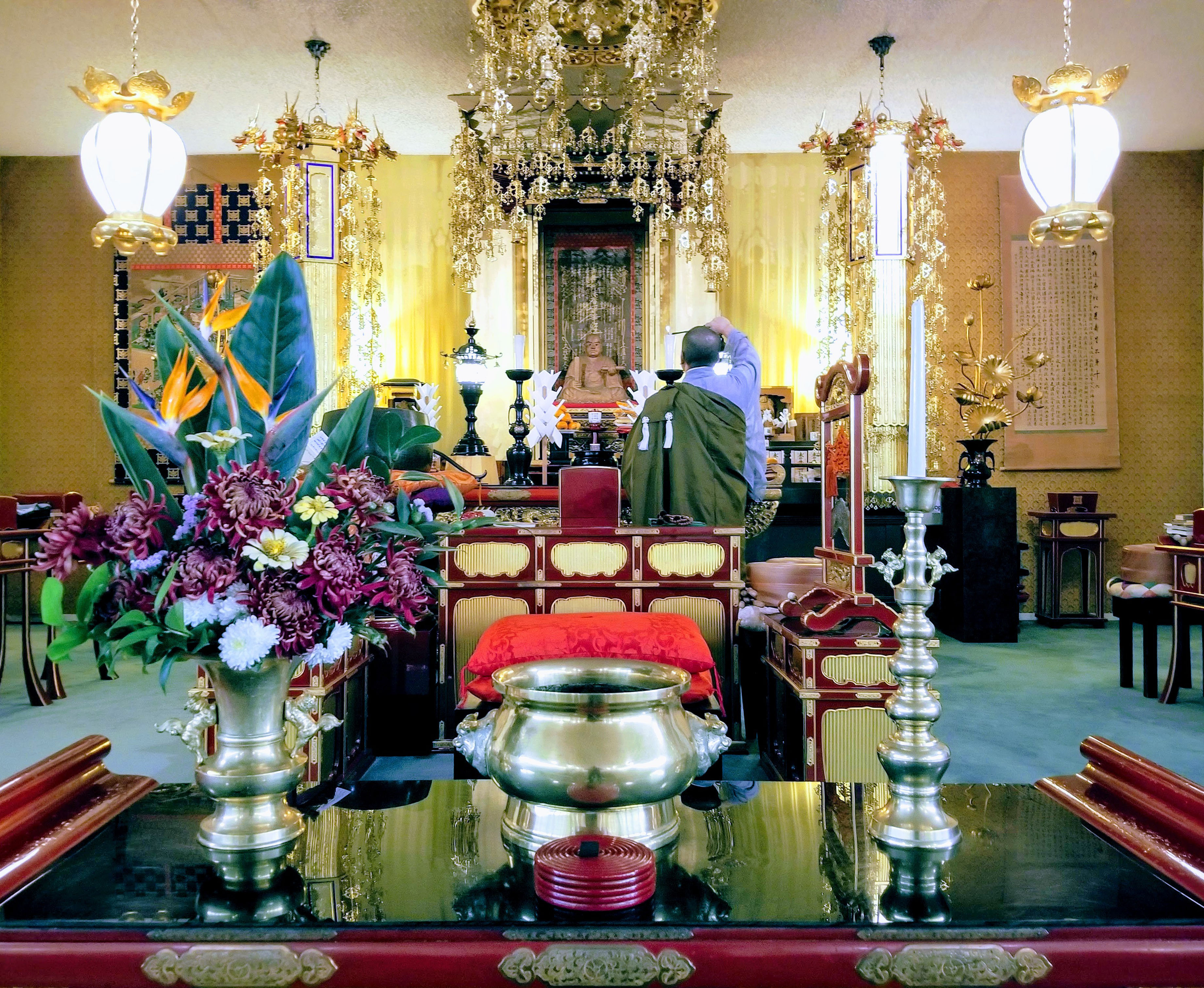
Ven. Kenjo Igarashi lighting candles before the service.
Recently I was hunting for refills for a staple gun in the printer room at the Sacramento Nichiren Buddhist Church. This is also the room where Ven. Kenjo Igarashi keeps his extra copies of books. While I was looking for the staples I took the opportunity to browse the books on the shelf. That’s when I came across a 54-page booklet entitled “Questions and Answers on Nichiren Buddhism” by Senchu Murano. The booklet was published in 1998 by the Nichiren Shu Overseas Propagation Promotions Association. Rev. Igarashi said I was welcome to take a copy.
Beginning this morning I will be reprinting portions of the book over the next several days.
The book is divided into three chapters:
Chapter I. Buddhist Concepts
Chapter Il. The Mandala
Chapter Ill. The Komon Ha and Taisekiji Temple
The entire third chapter and portions of Chapter 1 focus on Nichiren Shoshu and Soka Gakkai. Since my purpose in publishing quotes on this site is to help me remember important topics and concepts, I don’t see a point in publishing the disputes with Nichiren Shoshu and Soka Gakkai. It’s not important to me. However, I am making available the entire book for download here.
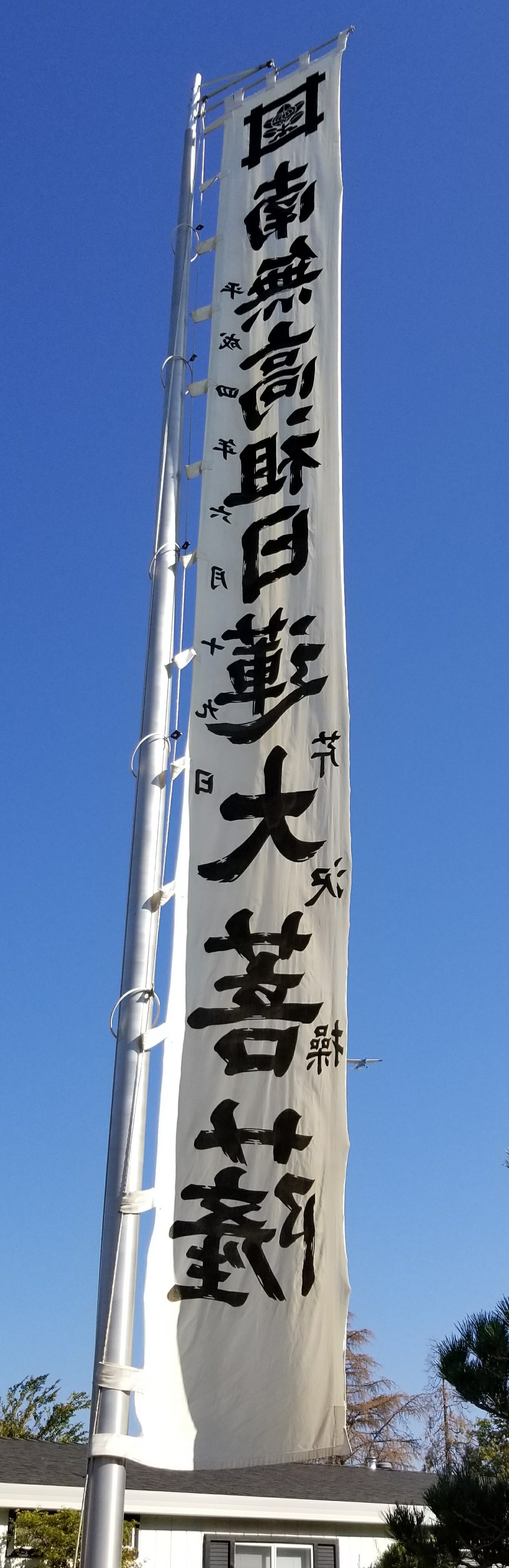
Cherry blossom decorations symbolizing the flowers that bloomed out of season when Nichiren diedBanner saying Namu Nichiren Bosatsu outside temple.
Attended the annual Oeshiki service at the Sacramento Nichiren Buddhist Church. During Ven. Kenjo Igarashi’s sermon he explained that 735 years ago Nichiren “returned to his original place.” That orginal place is as Jogyo, Superior Practice Bodhisattva, one of four leaders of the Buddha’s original desciples.
We decorate with paper flowers on bamboo branches in remembrance of the cherry tree that bloomed out of season on Oct. 13. 1282, when Nichiren died.
In Japan, Nichiren’s memorial is treated like a festival, with crowds parading with lanterns drapped in flowers, beating drums and ringing bells and dancing.
Why is everyone happy? Nichiren Shonin was a desciple of the original Sakyamuni Buddha, the Eternal Buddha. He was already a Bodhisattva. He chose to be born into this suffering world. It was his intention to enter this world to save people.
Everyone has causes and conditions that bring them to this suffering world. Everyone has a Buddha seed within them. If you don’t practice, you can’t get a good condition. The seed needs condition – soil, water, sun – otherwise it never grows. Everybody has a Buddha nature, this seed. That is why when you chant Namu-Myoho-Renge-Kyo you can approach enlightenment.
The Lotus Sutra is the supreme teaching of Sakyamuni Buddha. Today we can study the Lotus Sutra and chant Namu-Myoho-Renge-Kyo because Nichiren Shonin chose to come back to this suffering world. That’s why today the memorial service for Nichiren Shonin expresses our gratitude to him for his gift to us.
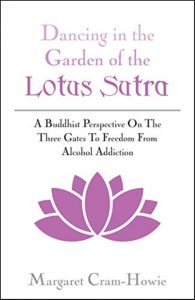
Finished reading “Dancing In The Garden Of The Lotus Sutra: A Buddhist Perspective On The Three Gates To Freedom From Alcohol Addiction” earlier this month. In reading, and subsequently reviewing this book, I arrive with an interest in seeing how Nichiren Shu’s teachings can be put to work in the real world, a world full of suffering. I have no actual experience in addiction recovery and therefore no way to judge the value of this work for recovering addicts beyond the declaration of author Margaret Cram-Howie of the benefits that blossomed in the garden of the Lotus Sutra.
For what it’s worth, I heartily recommend this book. I wrote the review pictured above, giving the book the first of what I hope will be many 5-star ratings.
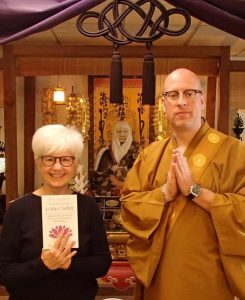
Margaret Cram-Howie and Rev. Kanjin CedermanWoven throughout the book are the lessons of the Parable of the Hidden Gem, the Parable of the Burning House, the Parable of the Poor Son and the Parable of the Magic City, the Five Precepts, the 10 Worlds, Mara’s challenge of Siddhartha and story of Kishimojin. Beyond the Lotus Sutra and teachings picked from her mentor, Kanjin Cederman Shonin of Seattle Choeizan Enkyoji Temple, Cram-Howie interweaves lessons from her studies with Marshall Rosenberg and Nonviolent Communication and her studies with Dr. Deepak Chopra, where she became a certified meditation teacher with The Chopra Center.
The book’s “Journey Out Of Addiction” passes through three gates, which are broken into nine chapters:
The First Gate: Awareness
Chapter One: Lifting the Veil of Delusion
Chapter Two: Discovering Your Buddha Nature
Chapter Three: Taking Refuge
The Second Gate: Introspection
Chapter Four: The Precepts
Chapter Five: Planting the Roots of Virtue
Chapter Six: Atonement
The Third Gate: The Dance of Life
Chapter Seven: Flow
Chapter Eight: Prayer and Meditation
Chapter Nine: Opening the Mind and Heart to Love
While reading I highlighted a number of quotes. I’ve taken those quotes and created what I consider to be a summary of the book’s teaching of the Lotus Sutra in the author’s words. This is not a summary of the book, since there is a great deal more in the book about addiction and recovery. However, I see this as a reasonable representation of the author’s effort to bring the Lotus Sutra and Nichiren Shu to bear on the problems of addiction recovery.
In the words of Margaret Cram-Howie:
The steps along the path in this book are loosely based on the principles I extracted from The Twelve Steps of Alcoholics Anonymous. I started my recovery journey in the rooms of AA. The primary difference between the twelve steps as presented in this book and the official twelve steps of Alcoholics Anonymous is that there is no mention of a god of any understanding in the steps along the path presented in this book. I never believed in an external god of any description and this was problematic for me in making sense of the steps.
…
The discrepancy between what I was being told in twelve-step programs and what I was personally experiencing finally became reconciled when I began to study Nichiren Shu Buddhism. The concept is actually very simple. The “Power” is my “Buddha Nature.” This power is within each of us. There is a “Buddha Nature” within me. There is a “Buddha Nature” within you. It is our original nature. We are born with it. The reference to “myself” is pointing to ego-self. In recovery, we need to look for help beyond our ego-selves, that serves only our self-interest, and instead cultivate our “Buddha Nature,” that connects and aligns us with all other beings. The Lotus Sutra is the primary text that Nichiren Shu Buddhists study. There is a story in Chapter 8 of The Lotus Sutra that helps illustrate this idea of going beyond our ego-selves and polishing the gem of our “Buddha Nature.” When we polish the gem of our “Buddha Nature” we see it more clearly.
…
This story is called a parable because it is used to illustrate a spiritual lesson. The poor man is each of us before we realize our hidden gem, our “Buddha Nature” that exists within each of us. Without awareness it will remain hidden. The wealthy friend is the Buddha who has given each of us this precious gift that can remove suffering and provide ease in our world. As long as we wander around in a drunken state, a state of unawareness, nothing will change. We remain lost in the world of the Ego.
…
So, how do we polish this stone, this gem, and bring out our “Buddha Nature”? Nichiren Daishonin states in Showa Teihon, p.1433, “A singing bird in a cage attracts uncaged birds, and the sight of these uncaged birds will make the caged birds want to be free. Likewise, the chanting of Odaimoku will bring out the Buddha nature within ourselves.” Chanting the Odaimoku is the primary practice of Nichiren Shu Buddhism. “Odaimoku” translates as “great” (O), “title” (dai), and “chant” (moku). The chanting of the Odaimoku is made up of the characters, “Namu Myoho Renge Kyo.” “Namu” is derived from a Sanskrit word meaning “I honor” or “I give reverence to.” Together it translates to “I give reverence to the Lotus Sutra.” The Lotus Sutra is the title of our primary text. Make it a practice to start each day by chanting the Odaimoku aloud a minimum of three times. “Namu Myoho Renge Kyo, Namu Myoho Renge Kyo, Namu Myoho Renge Kyo.” This is the starting place for becoming aware of and growing the Buddha seed that exists within you. As you become more comfortable with your chanting, increase the number of repetitions.
…
This final step on the path of awareness is all about making a decision, a personal choice. Choose wellness! Make the decision to cultivate your “Buddha Nature.” Allow your essential nature to grow. Allow happiness to permeate your life. There are many different forms of Buddhism, but one common characteristic is that each “takes refuge” in the Buddha, the Dharma, and the Sangha. To take refuge means both to seek protection from harm and danger and also to seek spiritual guidance and direction. A Buddhist is a person who seeks protection and guidance by turning to the Buddha (the Enlightened One), the Dharma (the teachings of the Buddha), and the Sangha (the community that learns and practices the Buddha’s teachings).
The Dharma includes all of the teachings of the Buddha. In Nichiren Shu Buddhism, the Lotus Sutra is considered to be the Buddha’s supreme teaching. In order to take refuge in the dharma, you will need to read and study the Lotus Sutra. … It is important to study the Lotus Sutra under the guidance of a Nichiren Shu minister. Look online to see where the nearest Nichiren Shu Temple is and then contact the minister attached to that temple.
…
Regardless of whether you participate in a Taking Refuge ceremony or not, it is important for you to create the habit of starting your day in front of your home altar. Up until this point, you have been starting your day by chanting “Namu Myoho Renge Kyo.” Once you make this decision to leave your addictive life behind and embrace recovery with the assistance of Nichiren Shu Buddhism, you need to learn more about this spiritual path.
Each morning, Nichiren Shu Buddhists start the day in front of their home altar. A candle is lit to represent light or enlightenment. Incense is lit using the light from the candle. The burning of incense purifies the air and also represents purifying our senses. Thus the day begins by being reminded to keep one’s senses clear, to not lay interpretation or judgment upon them. Being restored to sanity, becoming addiction-free, begins with seeing (or hearing, etc.) clearly. Start each day by chanting the Odaimoku in front of your simple home altar.
…
By tapping into our “Buddha Nature” during chanting or other mantra-based silent meditation practices, we are able to grow our “Buddha Nature.” As you grow your “Buddha Nature,” there is less and less room for troublesome thoughts or feelings. You become less reactive to specific situations and people. You see the bigger picture. You no longer see yourself as a separate being.
…
Being able to rest and renew ourselves through meditation is an exceptional skill. However, the peaceful land of meditation is not our destination any more than the Magic City was the final destination of the travelers in the parable. Once rested, they returned to the road and traveled on to the land of treasures. On our road through life, we may need to stop and rest from time to time. But then we return to the road of life until we reach our treasure land, the world of the bodhisattva.
In the world of the bodhisattva, you will recognize and use your innate talents and creativity in order to add happiness to your own life and to the lives of others. In this way, your human life becomes meaningful. The mind opens to all kinds of possibilities and the heart opens to all those who suffer. This is the treasure land, the Garden of the Lotus Sutra. Our destination, as humans, is full and abundant living in harmony with all others.
Full and abundant living involves inclining the mind towards wholesome mind-states. It is there that we will find the principles that guide us in this human life. These principles, these wholesome mind-states include, but are not limited to, the following: honesty, truth, acceptance, hope, commitment, willingness, courage, integrity, humility, love, reflection, justice, forgiveness, perseverance, vigilance, service, wisdom, compassion, responsibility, freedom, respect, generosity, joy, delight, and happiness. It is my wish that in reading this book, you may be able to bring sobriety and the fullness of life into your world. May it be so.
Today will begin the 25th time I’ve cycled through my 32-days of the Lotus Sutra and published a portion of that day’s reading. That’s 24 months of 32 days, or two Lotus Sutra years. I’ve taken this milestone as an opportunity to start using quotes from Introduction to the Lotus Sutra in conjunction with each day’s sutra offering.
The book, which covers the full Threefold Lotus Sutra, is more a general introduction than a study guide, offering summaries of each chapter and explanations of the meaning of what is happening. It’s the explanations that I’ll be publishing as quotes. Unfortunately, not all chapters include explanations. For example, the final two chapters are only summarized without explanation. To me that’s unfortunate since I find the message about teachers in King Wonderful-Adornment as the Previous Life of a Bodhisattva well worth exploration. Another complication is that chapters such as Expedients and The Duration of the Life of the Tathagata have much more worth quoting than other chapters. As a result the quotes published will not always be related to that day’s portion of the Sutra.
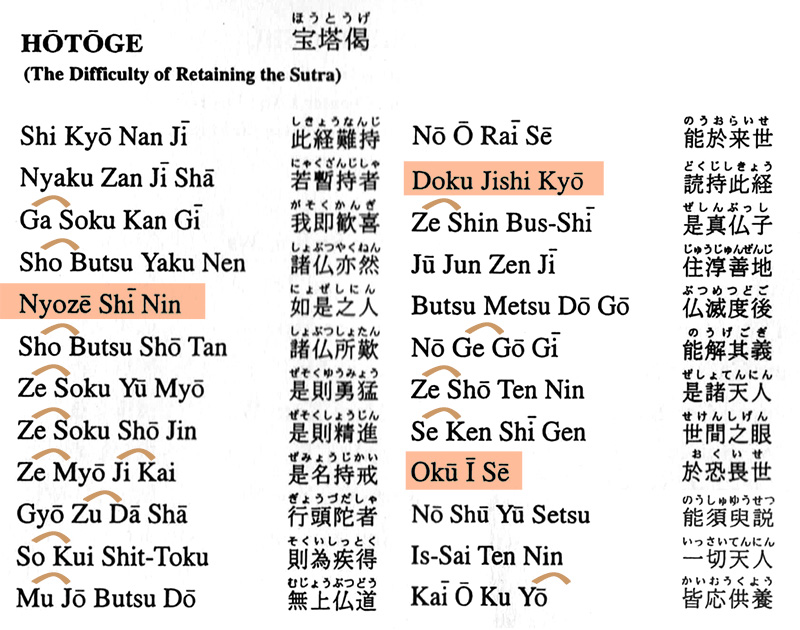
Here’s an updated illustration of the Hōtōge with the beats now illustrated fully. (See earlier blog post.)
There are no beats for the first two words – Shi Kyō – and then a single beat for each word thereafter until the final Yō, which gets a double beat. There are four beats per line, except those lines that are highlighted, which get three beats. Quick beats are struck where the words are linked.
Each service when I play this recording and recite the words I’m reminded of the reason for the odd beat. The story is told in Rev. Ryuei Michael McCormick’s Lotus in the Sea of Flames. The event takes place as Nichiren is being taken away to Izu on his first exile.
“I am no magistrate,” said the official. “I am not interested in your arguments. I am only interested in getting you onto that ship, out of Kamakura, and on to Izu. Now keep quiet!”
Nichiren put his palms together and bowed. His disciples cried out to him, some in tears. The guards kept back all but one. Nichiro, now a strong young man of 16, would not be cowed. He slipped past the guards and ran down to the boat just as it was being pushed off into the surf.
“Get back!” screamed the official.
But Nichiro would not get back. Crying for his master as he reached out to him, he waded out into the bay after the boat. Nichiren exhorted him to be calm, but his disciple was too overwrought and would not listen. “Take me with you!” He shouted again and again. Exasperated, the official took an oar and struck the young monk with bone shattering force. Clutching at his broken right arm, Nichiro finally backed away, his face white with pain.
Tears fell from Nichiren’s eyes as he saw his faithful disciple so brutalized. “Nichiro! Calm yourself. Is this how a disciple of the Buddha should act? From now on, when you see the sun setting in the west behind Izu, think of me. When I see the sun rising from the sea, I shall think of you.”
Nichiro nodded. “Forgive me, master.” Becoming faint, he went down on his knees in the water, sweat and tears coursing down his face. One of the guards finally reached him and escorted him back to where Nissho and the other monks were gathered.
As the boat moved away Nichiren began to chant the final verses from the eleventh chapter of the Lotus Sutra, “It is difficult to keep this sutra. I shall be glad to see anyone keeping it even for a moment.” The rocking of the waves caused his voice to fade in and out, giving the recitation an odd rhythm. The passage ended with, “Anyone who expounds this sutra even for a moment in this dreadful world should be honored with offerings by all gods and men.” From that point on Nichlren knew that he and his disciples had truly become practitioners of the Lotus Sutra as its predictions of hardships that would be faced by the teachers of the True Dharma began to be fulfilled in their own lives.
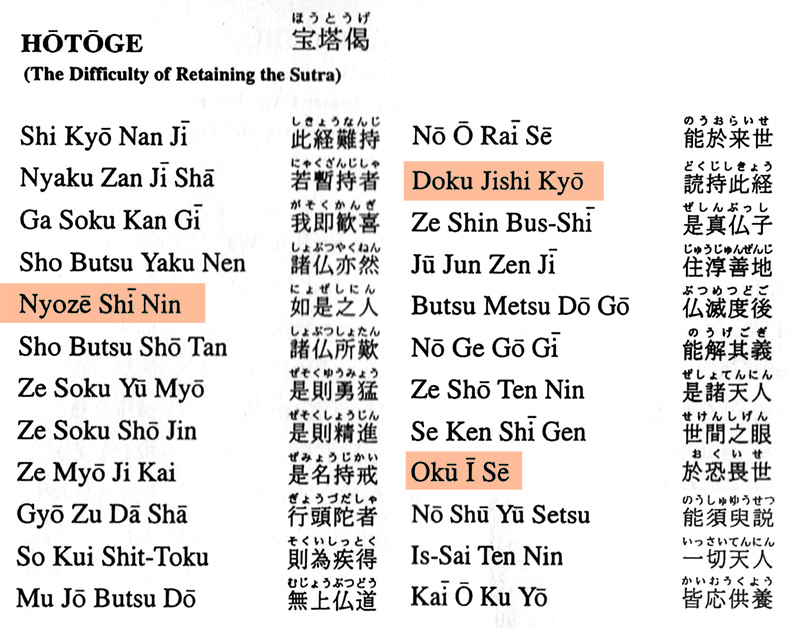
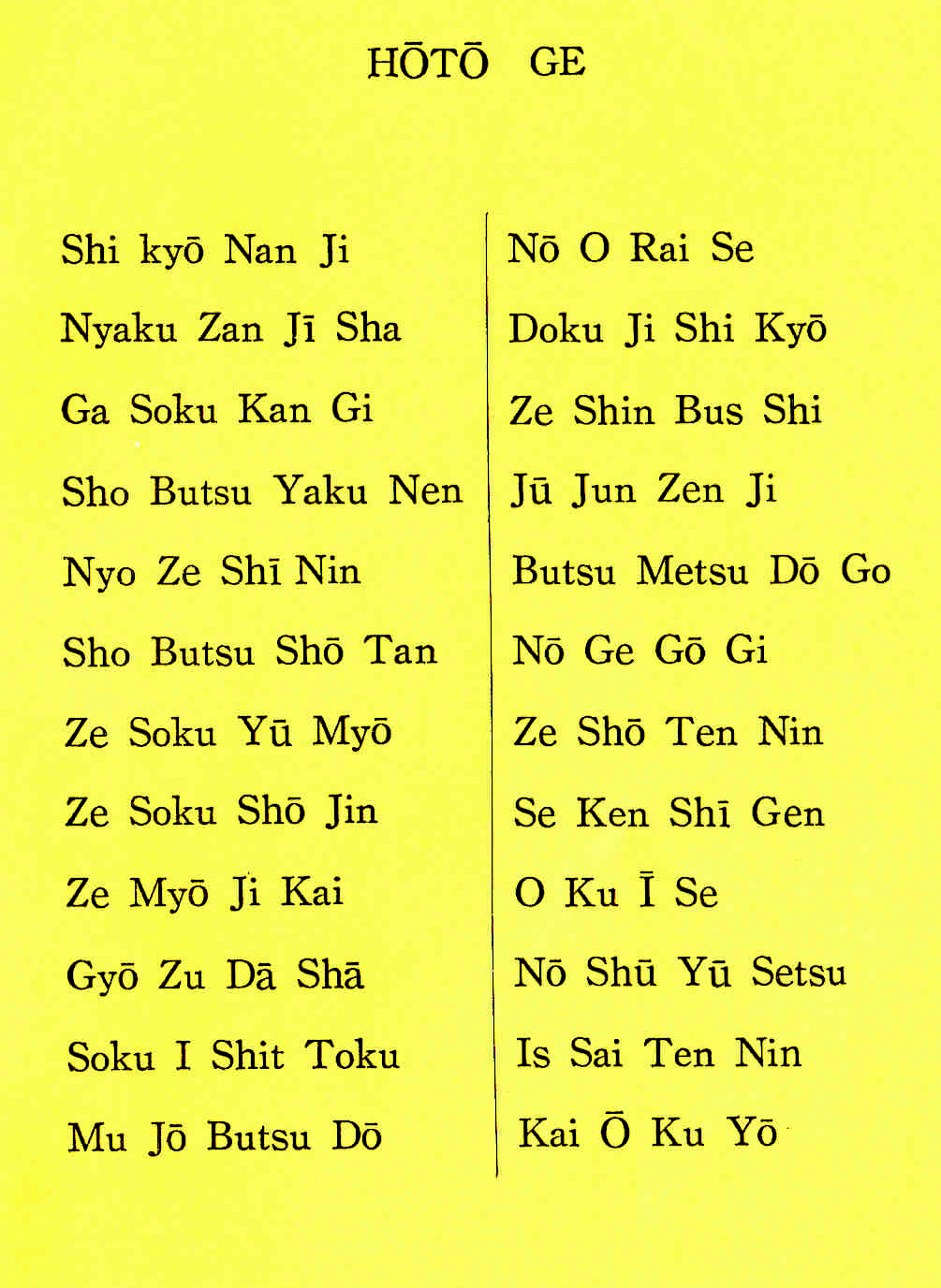
Hotoge from Nichiren-Shu Service Book published 2007Hoto Ge from Page 23 of the Nichiren Buddhist Service Companion published in 1968 by Headquarters of Nichiren Buddhist Temple of North America, Chicago, Illinois.
In April I published this post. At the time I had been attending the Sacramento Nichiren Buddhist Church since January 2015 and I was still unable to recite the version of Hotoge performed during the service immediately after chanting Daimoku.
I have recordings of the services but the mokusho and the drum overwhelm everything. So I made an appointment with Ven. Kenjo Igarashi and asked him to record the Hotoge so that I can play it during my home services.
But when I reviewed the recordings with the text in the service book used in Sacramento, the words didn’t line up. Two lines were short – three beats instead of four.
It was only this Sunday, Oct. 1, while attending the online service at Myoshoji that I finally found the reason. The highlighted lines above accurately reflect the beats in the recording.
Attended the Sacramento Nichiren Buddhist Church‘s fall Ohigan service. This is the third of the regular memorial services held each year in Nichiren Shu – Spring and Fall Equinox and Obon in Summer. When you add in family memorial services to the mix it raised the question of why we have so many services honoring our ancestors. That was the subject of Ven. Kenjo Igarashi‘s lecture after the Ohigan service today.
Rev. Igarashi told the story of a woman who complained that Buddhists have too many memorial services. She decided she’d rather be a Christian – no memorial services.
Each memorial service has special meaning.
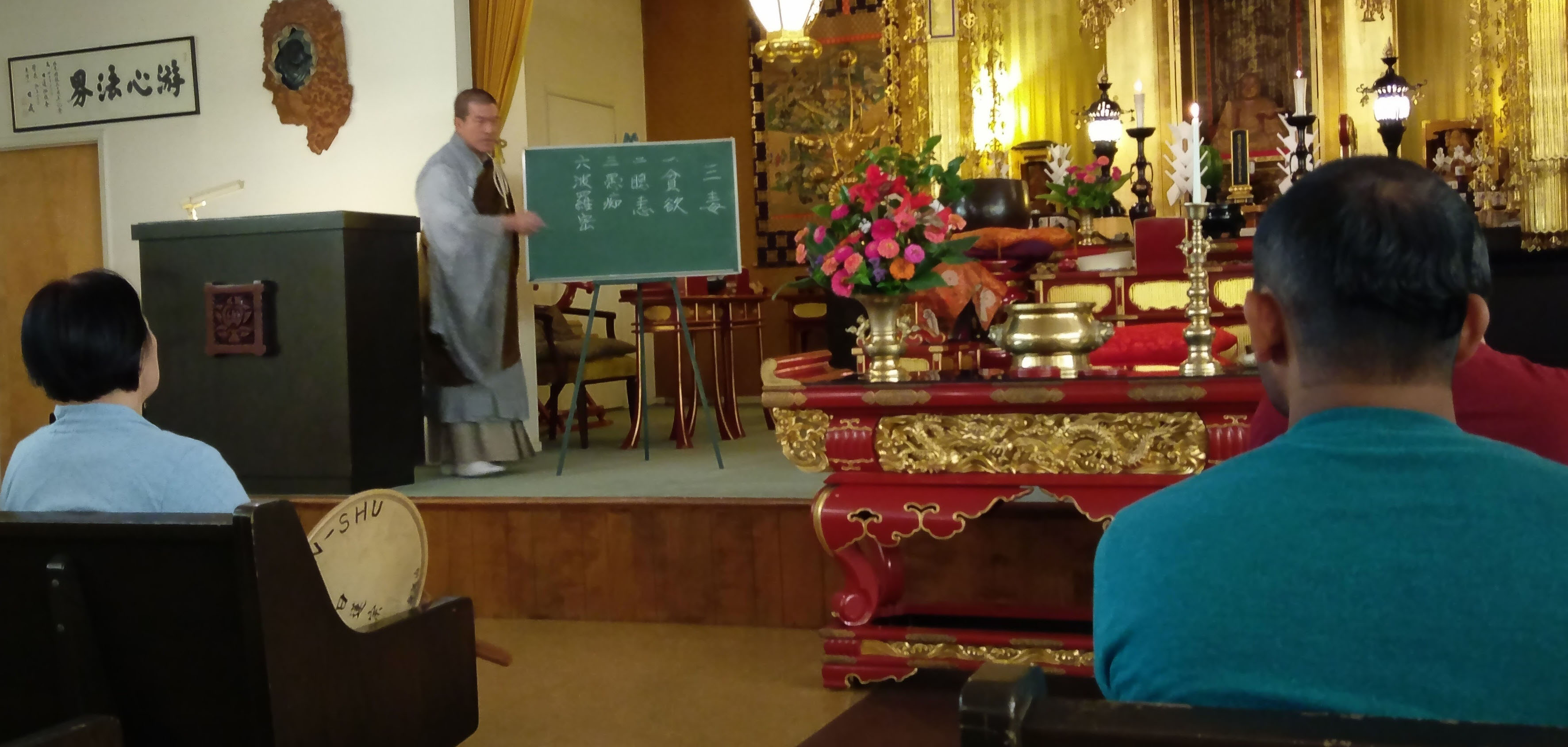
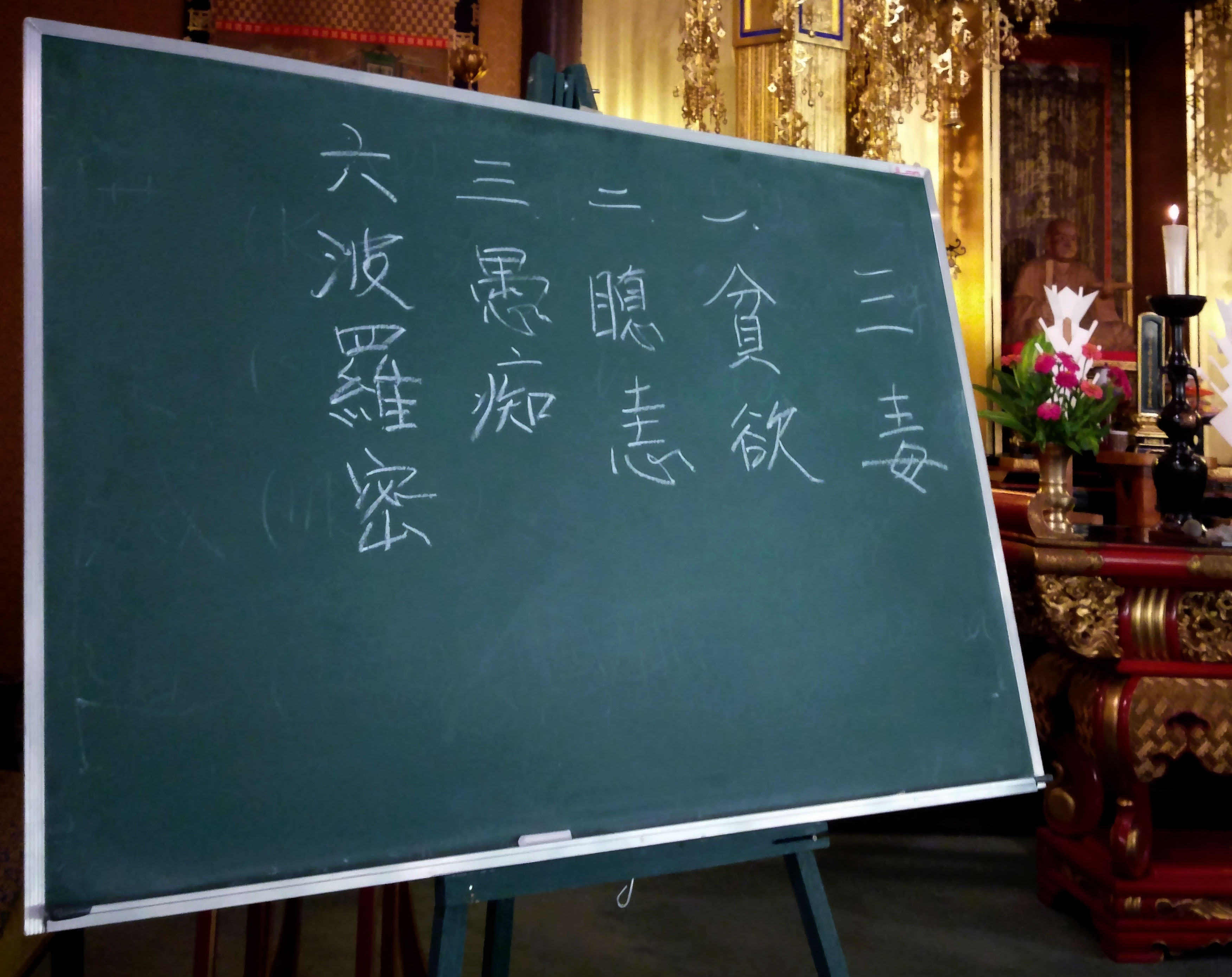
“Today I want to explain sandoku – three poisons,” he said. “These three poisons are why we suffer.”
What follows is my paraphrasing of the lecture.
The first of the poisons is greed. And greed is an essential component of living in this world. Everyone is competing with others all the time.
The second poison is anger. Everyone is fighting, fighting. Anger toward other people is easy.
The third poison is traditionallly translated as stupidity or ignorance. Rev. Igarashi suggested describing the third poison as “a lot of complaints. All the time complain. … All the time, I’m right and you’re wrong.”
Since these poisons cause our suffering that’s why Śākyamuni said we must eliminate these. If you don’t, you’ll never get happy in this life and after you pass away you won’t go to paradise or a good realm.
These three poisons are the reason we are born in this suffering world, but most people are ignorant of this fact.
People want to be happy. They want to be rich. They want to be famous. Everybody thinks like that. But we need to think about why we are born into this world.
The purpose of our Buddhist practice is to extinguish these three poisons. We can’t attain enlightenment or go to a good realm after we die without doing that.
It is hard to extinguish these three poisons. That’s why we had today’s pāramitā service.
fuse means to offer one’s self wholeheartedly and unconditionally, without any expectation of its return.
jikai is to follow and maintain the general precepts of the Buddha.
nin-niku suggests a resilience to persevere through hardship.
syojin refers to the necessity of conscientious effort in accomplishing one’s goals.
zenjo points to qualities existent in meditation, calling upon one’s concentration, adjoined by calmness and poise.
chie is the Buddha’s wisdom, reinforced with its practical application.
How does this apply to memorial services for deceased ancestors?
“Maybe [those ancestors] are still in the suffering world,” Rev. Igarashi said.
Today’s service is called Higan, which means the other shore. The other shore is enlightenment.
“We are living on this shore, the suffering world, so maybe our ancestors are still in this suffering world. That’s why we practice in order to send them to the other shore with us.”
The six kinds of practices – the six pāramitās – are very important. With them we can extinguish the three poisons while at the same time helping our ancestors reach the other shore as well.
This is not a practice twice or three times a year. Every day is Higan or Obon.