
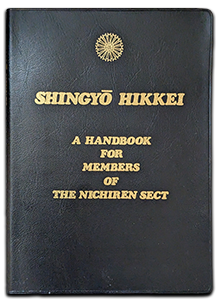
 In November 2023 I wrote about the Shingyō Hikkei, A Handbook for Members of the Nichiren Sect, which was the product of Nichiren Shu’s “Protect the Dharma Movement.” I had found the black, leatherbound pocketbook on a dusty shelf in an unused classroom at the Sacramento Nichiren Buddhist Church.
Given that (before I published this article) a Google search for “Protect the Dharma Movement” would get you exactly zero articles, one can assume the movement fizzled out. Whether Nichiren Shu headquarters lost interest, or the overseas ministers dropped the ball, the result is the same.
That’s unfortunate.
While I have many doctrinal arguments with Nichiren Shoshu and Soka Gakkai, one cannot fault the top-down direction of this global organization that focuses members on their practice. Go to any group meeting at a home or a chapter session at a community center and you feel right at home. It’s like going to Starbucks. No matter where you go, you know you’re in Starbucks and you know what you’ll get.
That’s not what you get with the confederation of temples that is Nichiren Shu. Less like Starbucks, the temples in America (the only ones I have experience with) are more like independent Italian restaurants. The restaurants are recognizable as Italian, but each has a different focus and flavor. The shami who left to strike out on his own focusing solely on Shodaigyo services has established the first pizzeria of the bunch.
The assumption I made at the time – that the “Protect the Dharma Movement” had fizzled out – was wildly off the mark. The Nichiren Shu headquarters had not lost interest, nor had the overseas ministers dropped the ball.
Today when you Google search “Protect the Dharma Movement” you still only get blog posts here and articles on the Sacramento Nichiren Buddhist Church website. The only other citation is for a Harvard study of Religion and State in Meiji Japan, which discusses conditions a century before the 1966 Nichiren Shu project.
The fact that Google search results are still so sparse is a measure of how far Google’s AI efforts have progressed. When you use Google’s Gemini Notebook and ask it to do deep research on the “Protect the Dharma Movement” you get a much different result.
Launched in 1966, the Protect the Dharma Movement (Gohō Undō) was a radical revitalization campaign designed to save Nichiren Shū Buddhism from a severe postwar institutional crisis. Facing a deteriorating reputation as spiritually stagnant “funeral Buddhism” and rapidly losing members to aggressive new religious movements, the sect needed a total paradigm shift.
The core mission of the movement was to transform passive, hereditary “parishioners” participating out of social obligation into active, dedicated “followers” who viewed themselves as Bodhisattvas with a personal spiritual mission.
To achieve this, the movement functioned like a unified public education system for the religion. It forged global unity through the 1972 publication of the Shingyō Hikkei (Handbook of Faith and Practice), which established a shared curriculum of standardized chanting methods, unified ethical guidelines, and synchronized daily global prayers directed toward Mt. Minobu.
Theologically, the movement explicitly rejected the confrontational and exclusionary conversion tactics used by rival sects. Instead, it embraced a theology of “deep humanism” and gentle persuasion (shōju). Inspired by Bodhisattva Never-Disparaging, the movement taught followers to combat modern “spiraling egotism” by bowing in absolute respect to the inherent Buddha-nature within every person.
Ultimately, the movement successfully modernized Nichiren Shū, transitioning it from a traditional Japanese cultural institution into a globally unified spiritual force dedicated to establishing world peace through internal spiritual discipline.
What became of the “Protect the Dharma Movement”?
The Protect the Dharma Movement did not fade away; rather, it reached its planned organizational culmination in 1981, aligning with the 700th memorial anniversary of Nichiren Shonin’s passing.
By successfully mobilizing followers, renovating temple infrastructure, and standardizing global practices through the Shingyō Hikkei, the movement set a new precedent for the sect. Following its conclusion, Nichiren Shū transitioned this momentum into a series of highly organized, multi-decade propagation campaigns driven by major historical anniversaries:
- The Odaimoku General Propagation Movement (1985–2002): After the Protect the Dharma Movement achieved its internal goal of unifying the faith of its followers, this 18-year successor campaign shifted the sect’s focus outward. Designed to culminate with the 750th anniversary of the sect’s founding in 2002, it aimed to spread the merits of the Odaimoku to the broader public while structurally enriching the sect through grants and commemorative projects.
- The Risshō Ankoku Odaimoku Kechien Campaign (2007–2021+): Initiated to commemorate the 750th anniversary of the submission of the Risshō Ankoku Ron (2009) and the 800th anniversary of Nichiren’s birth (2021), this campaign operates under the slogan “Inochi ni Gassho” (Palm to Palm with All Life). It builds upon the Protect the Dharma Movement’s call for social engagement by actively addressing modern societal crises—such as isolation, poverty, environmental degradation, and climbing suicide rates—through the bodhisattva ideal of absolute respect for life.
Ultimately, the Protect the Dharma Movement permanently transformed Nichiren Shū from a traditional Japanese institution reliant on hereditary parishioners into a globally unified spiritual network, laying the groundwork for all of the sect’s contemporary propagation efforts.
The Shingyo-Hikkei which the Protect the Dharma Movement created calls for a daily prayer for the protection of the Dharma.
Eight O’clock Every Morning is the Time for the Prayer for the Protection of the Dharma
At eight o’clock every morning we, members of the Nichiren Sect, wherever we are and whatever we are doing, should direct our hearts towards Lord Śākyamuni Buddha and Nichiren Shonin, who reside on Mt. Minobu, and recite the Odaimoku and say a prayer for the protection of the Dharma. Let us all practice this prayer and encourage our neighbors to join us.
The way you recite the Odaimoku is up to you. It may be voiced or silent; it may be said three times or ten times. The point is for everybody, no matter where he lives, to say a prayer at the same time in one mind.
Back in 2023 I whined:
If Nichiren Shu in America is going to continue to act as independent Italian restaurants, it would be nice if they could settle on a single act such as the Protect the Dharma Movement prayer to establish a little more itai doshin.
Rather than continue whining, I want to cheer on everyone to face Mt. Minobu and chant Namu-Myoho-Renge-Kyo. Here in American we can do it at 8 in the morning local time or in the morning Tokyo time, which here in Sacramento is 4pm. Of course Europe doesn’t have it as easy since 8am in Tokyo is midnight in London and 1am in Paris. Still, there’s always 8am local time.
I’ve set a daily timer on my phone for 4pm. Mt. Minobu is west-northwest from Sacramento.
My Gemini Notebook research is publicly available. You are welcome to explore the Nichiren Shu propagation efforts from 1966 to today. Click here.
I’ve used Google’s Gemini to review the content in the notebook and to write two articles. One discusses the situation Nichiren Shu faced in Postwar Japan and the other details the efforts to counter the Postwar threats.
Tomorrow: Nichiren Shū’s Postwar Crisis and Reform