
Gemini Thinking
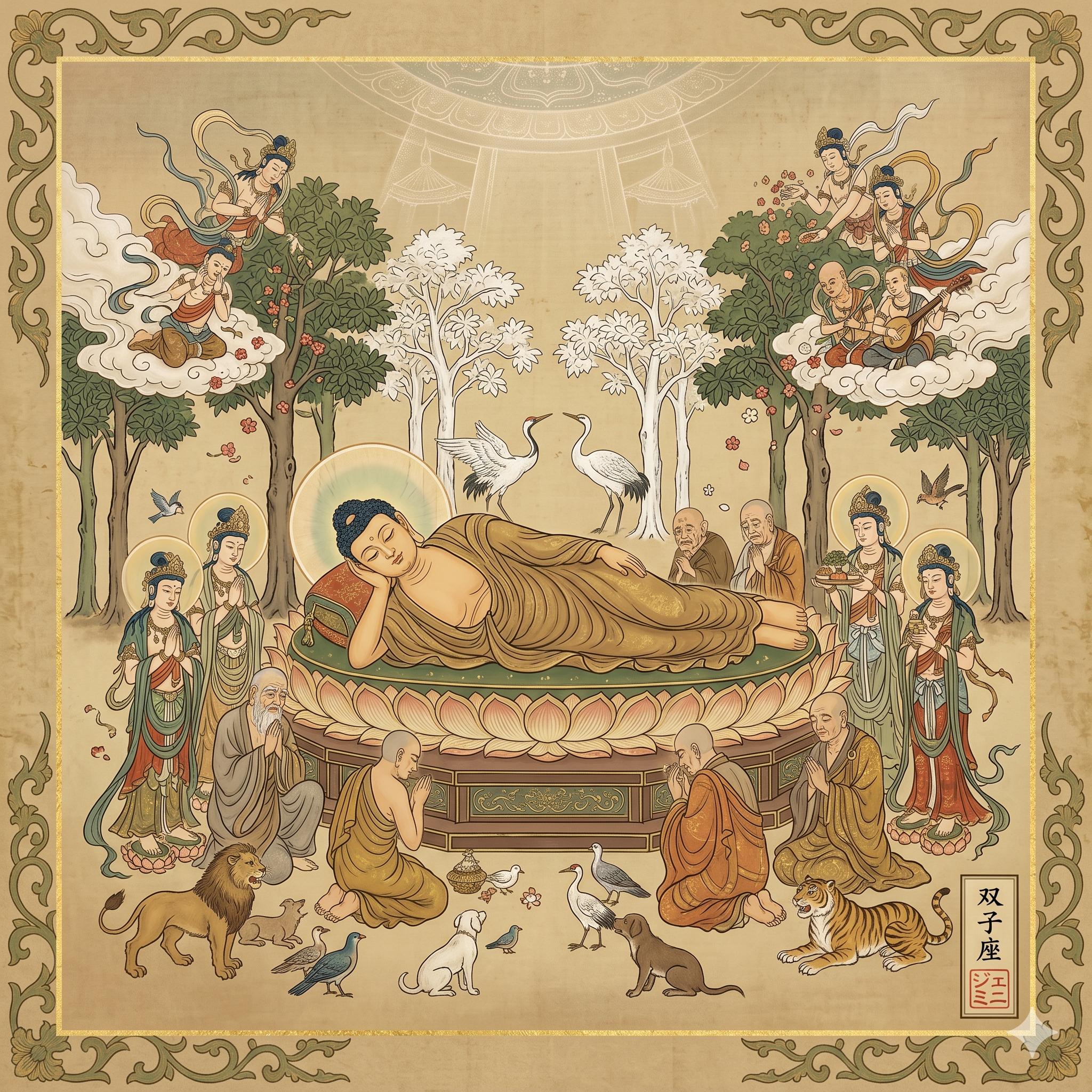
This square, detailed illustration visually captures the essence of Śākyamuni Buddha’s teaching in Chapter Sixteen of the Lotus Sūtra, where he explains his seemingly transient presence in the world to correct human hubris. To convey this paradoxical 'passing away,' the artist has utilized the classical Parinirvāṇa (Final Nirvana) composition, depicting Śākyamuni Buddha reclining serenely on a grand lotus throne, resting his head on his hand as his earthly form concludes its work. He is flanked by a mourning yet attentive multitude: his key disciples, such as Ānanda and Mahākāśyapa, kneeling in prayer and distress; celestial Tennin (Apsaras) and high Bodhisattvas descending with flower offerings and music on clouds; and a diverse assembly of animals—including a lion, tiger, cranes, and dogs—all gathering to witness his final earthly manifestation, representing 'all living beings.' The traditional Japanese Buddhist art style is rich in detail, with decorative gold accents and a vintage paper texture, set within intricate floral borders. The artist's signature is subtly placed in the lower-right corner, reading 双子座 (Futagoza, meaning Gemini), with a red square hanko seal below containing the katakana text ジェミニ (Jemini, meaning Gemini).
I am saving all living beings from suffering.
Because they are perverted,
I say that I pass away even though I shall not.
If they always see me,
They will become arrogant and licentious,
And cling to the five desires
So much that they will fall into the evil regions.
Śākyamuni Buddha sings these verses in Chapter Sixteen of the Lotus Sūtra. Sometimes we wonder why the Buddha’s presence in this world is not more obvious. We think if only we could find a living example of an enlightened being living among us then we would be happy and the world would be a better place to live. We forget that even during the Buddha’s lifetime, not everyone sought him out for his teaching, and some actively opposed him. In this explanation, the Buddha points out that our not seeing him is due to our limitations rather than his, and by not taking our lives and this world for granted, we open ourselves to his presence.
The Daily Dharma is produced by the Lexington Nichiren Buddhist Community. To subscribe to the daily emails, visit zenzaizenzai.com