Category Archives: LS32

Daily Dharma – Sept. 21, 2022

You, the World-Honored One, know
What all living beings have deep in their minds,
What teachings they are practicing,
And how much power of wisdom they have.

The children of Great-Universal-Wisdom-Excellence Buddha proclaim this to their father in a story told by Śākyamuni Buddha in Chapter Seven of the Lotus Sūtra. In our preoccupation with our pursuits in this world of conflict we are so focused on our schemes that we have forgotten the Buddha’s wisdom dormant in us all. With the Lotus Sūtra, the Buddha leads us to an unfamiliar and even uncomfortable way of seeing the world. But it is only when we leave the false safety of our delusions that we can truly benefit ourselves and others.

The Daily Dharma is produced by the Lexington Nichiren Buddhist Community. To subscribe to the daily emails, visit zenzaizenzai.com

Day 32

Day 32 covers Chapter 28, The Encouragement of Universal-Sage Bodhisattva, closing the Eighth Volume of the Sutra of the Lotus Flower of the Wonderful Dharma.


Having last month considered the prediction for those who keep, read and recite the Sūtra, we conclude Chapter 28, The Encouragement of Universal-Sage Bodhisattva.

Therefore, Universal-Sage! When you see the keeper of this sūtra in the distance, you should rise from your seat, go to him, receive him, and respect him just as you respect me.

When the Buddha expounded this chapter of the Encouragement of Universal-Sage, as many Bodhisattvas as there are sands in the River Ganges obtained the dhārāṇis by which they could memorize hundreds of thousands of billions of repetitions of teachings, and as many Bodhisattvas as the particles of dust of one thousand million Sumeru-worlds [understood how to] practice the Way of Universal-Sage.

When the Buddha expounded this sūtra, the great congregation including the Bodhisattvas headed by Universal-Sage, the Śrāvakas headed by Śāriputra, and the other living beings such as gods, dragons, men and nonhuman beings, had great joy, kept the words of the Buddha, bowed [to him], and retired.

[Here ends] the Eighth Volume of the Sūtra of the Lotus Flower of the Wonderful Dharma.

The Daily Dharma from May 7, 2022, offers this:

Therefore, Universal-Sage! When you see the keeper of this sūtra in the distance, you should rise from your seat, go to him, receive him, and respect him just as you respect me.

The Buddha gives this instruction to Universal-Sage Bodhisattva in Chapter Twenty-Eight of the Lotus Sūtra. When we open our eyes to the wonders of the world, and truly appreciate the innumerable beings who share it with us, we can feel alone and insignificant. The Buddha’s Wonderful Dharma shows us both the unimaginable expanse of this universe and the importance of our place in it. None of us can be replaced. Our purpose is neither the futile pursuit of pleasure, nor to make our isolated existence permanent. We are here to open the gate of the Buddha’s wisdom to all beings, to show all beings the joy of enlightenment, and to help them put themselves on the path to enlightenment. We do this by cultivating respect for all beings and, heeding the instructions in this verse, respecting all beings as much as we would the Buddha himself.

The Daily Dharma is produced by the Lexington Nichiren Buddhist Community. To subscribe to the daily emails, visit zenzaizenzai.com

Day 31

Day 31 covers Chapter 27, King Wonderful-Adornment as the Previous Life of a Bodhisattva.


Having last month considered the wonders displayed by the two sons and the effect those wonders had on their father, we consider two sons’ request to renounce the world.

“Thereupon the two sons descended from the sky, came to their mother, joined their hands together, and said to her, ‘Our father, the king, has now understood the Dharma by faith. He is now able to aspire for Anuttara-samyak-saṃbodhi. We did the work of the Buddha for the sake of our father. Mother! Allow us to renounce the world and practice the Way under that Buddha!’

“Thereupon the two sons, wishing to repeat what they had said, said to their mother in gāthās:

Mother! Allow us to renounce the world
And become śramaṇas!
It is difficult to see a Buddha.
We will follow that Buddha and study.
To see a Buddha is as difficult
As to see an udumbara[-flower ]
To avert a misfortune is also difficult.
Allow us to renounce the world!

“The mother said, ‘I allow you to renounce the world because it is difficult to see a Buddha.’

The Daily Dharma from May 25, 2022, offers this:

To see a Buddha is as difficult
As to see an udumbara[-flower].
To avert a misfortune is also difficult.

These verses are sung by two sons of a king in a story told by the Buddha in Chapter Twenty-Seven of the Lotus Sūtra. In the story, the boys have heard the Dharma from a previous Buddha and are asking permission from their parents to leave home and follow that Buddha. The legend of the udumbara flower is that it only blooms every 3000 years. Meeting a Buddha is not to be taken for granted. However, it is still important to remember the ties of our families. Rather than leaving in secret from their home, the sons’ asking permission from their parents creates more benefits. The King and Queen accompany their sons and learn the Wonderful Dharma. As Bodhisattvas it is important to use our relationships wisely as we lead all beings to enlightenment.

The Daily Dharma is produced by the Lexington Nichiren Buddhist Community. To subscribe to the daily emails, visit zenzaizenzai.com

Kern’s Sanskrit and Hurvitz’s Sanskrit

This is another in a series of weekly blog posts comparing and contrasting the Sanskrit and Chinese Lotus Sutra translations.


Before I leave the topic of 10 suchnesses and their absence in H. Kern’s 1884 translation, I want to digress for a moment to discuss the difference between the English translation of the Lotus Sutra published by Leon Hurvitz and other English language translations of Kumārajīva’s Chinese Lotus Sutra. Hurvitz translated both Kumārajīva’s Chinese and the Sanskrit, at times merging the two.

Hurvitz’s Sanskrit document was not the same as the Nepalese Sanskrit manuscript written on palm leaves and dated C.E. 1039 that Kern used. Instead, Hurvitz incorporated a later Sanskrit document compiled by Kern and Bunyiu Nanijio.

Unless otherwise noted, the Skt. Quotations are from H. Kern and Bunyiu Nanjio, eds., Saddharmapuṇḍarika, Bibliotheca Buddhica, vol. 10 (St. Petersburg: Académie Impériale des Sciences, 1912), and the translations are made from the same text.

First published in 1908, Kern and Bunyiu Nanijio combined multiple manuscripts in order to create one Sanskrit Lotus Sutra. From the book’s  “Preliminary Notice”:

The text of the for Saddharmapuṇḍarika, is now published for the first time, based upon the following MSS.:
A.: MS. of the Royal Asiatic Society, London.
B.: MS. of the British Museum, London.
Ca.: Add. MS. 1682 of University Library, Cambridge.
Cb.: Add. MS. 1683 of University Library, Cambridge.
K.: MS. in the possession of Mr. Ekai Kawaguchi, acquired in Nepal.
W.: MS. in the possession of Mr. Watters, formerly British Consul in Formosa.
O.: Indicates readings found in sundry fragments of MSS., all from Kashgar, now in possession of Mr. N.F. Petrovskij, and deposed by him in the Asiatic Museum of the Imperial Academy of Sciences in St. Petersburg. The fragments, though belonging to different MSS., show all of them the same peculiarities and evidently belong to the same family of texts.
P.: The lithographic text in Nāgarī published by Ph. Ed. Foucaux in his work Parobole de l’Enfant égaré (Paris, 1854).

A more detailed account will be given in the Preface after the completion of the whole work.
The Editors

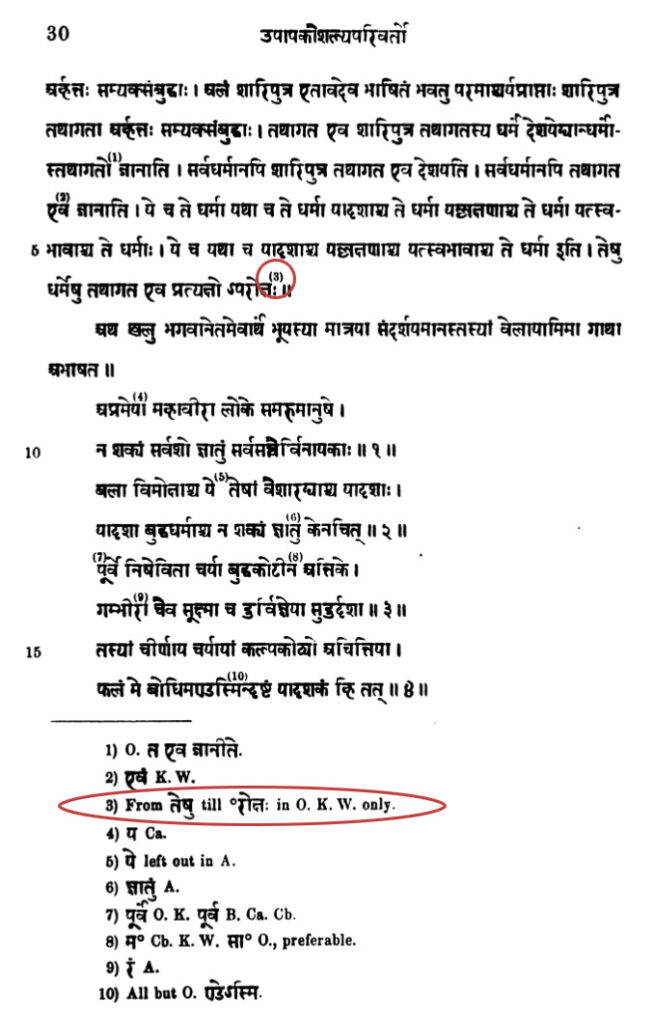
The text includes extensive footnotes pointing out which manuscripts contain or don’t contain material. Here is a screenshot from the end of the prose section of Chapter 2 and beginning of the gāthās:
20220812_kern-page30
Note 3, which appears where the 10 suchnesses would be found, says this part is only found in three of the manuscripts used in this compilation.

There is a significant difference between Kern’s translation of Chapter 2 and the translation of the same portion by Hurvitz.

Kern concludes the initial prose section of Chapter 2 with:

Enough, Śāriputra, let it suffice to say, that the Tathāgatas, &c., have something extremely wonderful, Śāriputra. None but a Tathāgata, Śāriputra, can impart to a Tathāgata those laws which the Tathāgata knows. And all laws, Śāriputra, are taught by the Tathāgata, and by him alone; no one but he knows all laws, what they are, how they are, like what they are, of what characteristics and of what nature they are.

As pointed out last week, this is a far cry from Kumārajīva’s 10 suchnesses:

No more, Śāriputra, will I say because the Dharma attained by the Buddhas is the highest Truth, rare [to hear] and difficult to understand. Only the Buddhas attained [the highest Truth, that is,] the reality of all things’ in regard to their appearances as such, their natures as such, their entities as such, their powers as such, their activities as such, their primary causes as such, their environmental causes as such, their effects as such, their rewards and retributions as such, and their equality as such [despite these differences].

When Hurvitz translated the Sanskrit version of the Lotus Sutra compiled by Kern and Nanijio, he found something closer Kumārajīva:

Enough, Śāriputra! Let this statement, at least, stand: the Thus Gone Ones, the Worthy Ones, the Properly and Fully Enlightened Ones, have arrived at the supremely wonderful, Śāriputra. Therefore let it be the Thus Gone One, Śāriputra, who shall teach the dharma of the Thus Gone One, what dharmas the Thus Gone One knows. All the dharmas, every one of them, Śāriputra, does the Thus Gone One himself teach. All the dharmas, every one of them, Śāriputra, does the Thus Gone One himself know. Which the dharmas are, how the dharmas are, what the dharmas are like, of what appearance the dharmas are, and of what essence the dharmas are: which and how and like what and of what appearance and of what essence the dharmas are, indeed it is the Thus Gone One who is the manifest eyewitness of these dharmas.

In this case, Hurvitz put this translation of the Sanskrit in his notes at the back. However, in other places he incorporates the unique content of the Sanskrit to create a translation of the Lotus Sutra that blends Kumārajīva’s Chinese with elements of the Sanskrit.

For example, in Murano’s translation of Kumārajīva, Chapter 3 concludes:

[Expound it to those]
Who receive [this sūtra]
And put it on their heads,
And who do not seek
Any other sūtra
Or think of the books of heresy!

(The Buddha said to Śāriputra:)
Those who seek the enlightenment of the Buddha
Are as various as previously stated.
A kalpa will not be long enough
To describe the variety of them.
They will be able to understand [this sūtra] by faith.
Expound to them
The Sūtra of the Lotus Flower of the Wonderful Dharma!

Kern contains additional material:

146. And he who keeps (in memory) the great Sūtras, while he never shows any liking for other books, nor even knows a single stanza from another work; to all of them thou mayst expound this sublime Sūtra.

147. He who seeks such an excellent Sūtra as this, and after obtaining it devoutly worships it, is like the man who wears a relic of the Tathāgata he has eagerly sought for.

148. Never mind other Sūtras nor other books in which a profane philosophy is taught; such books are fit for the foolish; avoid them and preach this Sūtra.

149. During a full Æon, Śāriputra, I could speak of thousands of koṭis of (connected) points, (but this suffices); thou mayst reveal this Sūtra to all who are striving after the highest supreme enlightenment.

In Hurvitz’s translation, we get a blended conclusion:

If there is a bhikṣu
Who for the sake of all-knowledge
Seeks the dharma in all four directions,
With joined palms receiving it on the crown of his head,
Desiring merely to receive and keep
The scriptures of the great vehicle,
Not accepting so much
As a single gāthā from the other scriptures,
For men like him,
And only for them, may you preach.
As a man wholeheartedly
Seeks the buddhaśarīra,
So may one seek the scriptures
And, having found them, receive them on the crown of one’s head,
Such a person shall never again
Wish to seek other scriptures,
Nor has he ever before thought
Of the books of the unbelievers.
For men like him,
And only for them, may you preach.
I say to you, Śāriputra,
That I, in telling of this sort
Of seekers of the buddha path,
Could spend a whole kalpa and still not finish.
If they are men of this sort,
Then they can believe and understand,
And for their sakes you may
Preach the Scripture of the Fine Dharma Flower.

Something to consider when Hurvitz’s translation is used in comparing English translations of the Lotus Sutra.

One last point: The order of chapters is different between Kern’s original English translation and the later compilation that Hurwitz’s used in his translation.

Hurvitz Sanskrit Kern’s Sanskrit
1. Introduction
(nidānaparivarta)
Introductory
2. Skill in means
(upāyakauśalyaparivarta)
Skillfulness
3. Parable
(aupamyaparivarta)
A Parable
4. Strong inclination, attachment
(adhimuktiparivarta)
Disposition
5. Medicinal herbs
(auṣadhīparivarta)
On Plants
6. Prophecy
(vyākaraṇaparivarta)
Announcement of Future Destiny
7. Former connection
(pūrvayogaparivarta)
Ancient Devotion1
8. Prophecy to five hundred mendicant monks
(pañcabhikṣuśata vyākaraṇaparivarta)
Announcement of the Future Destiny of the Five Hundred Monks
9. Prophecy to Ānanda and others
(Ānandādivyākaraṇaparivarta)
Announcement of the Future Destiny Of Ānanda, Rahula, and the Two Thousand Monks
10. Preachers of dharma
(dharmabhāṇakaparivarta)
The Preacher
11. Apparition of the stūpa
(stūpasaṃdarśanaparivarta)
Apparition of a Stūpa
Devadatta chapter is included at end of Chapter 11
12. Fortitude
(quanchi pin)
Exertion
13. Pleasant conduct
(sukhavihāraparivarta)
Peaceful Life
14. Rise of bodhisattvas out of an aperture in the earth
(bodhisattva-pṛthivīvivarasa mudgamaparivarta)
Issuing of Bodhisattvas from the Gaps of the Earth
15. The life span of the Thus Gone One
(tathāgatāyu pramāṇaparivarta)
Duration of the Life of the Tathāgata
16. Circuit of merits
(puṇyaparyāyaparivarta)
Of Piety
17. Exposition of the merits of appropriate joy
(anumodanāpuṇyanirdeśaparivarta)
Indication of the Meritoriousness of Joyful Acceptance
18. Praise of the dharma preachers
(dharmabhāṇakānuśaṃsāparivarta)
The Advantages of a Religious Preacher
19. Sadāparibhūtaparivarta Sadāparibhūta
20. The constituents of magic power of the Thus Gone One
(tathāgatarddhyabhisaṃskāraparivarta)
Conception of the Transcendent Power of the Tathāgatas
21. Entrustment
(anuparīndanāparivarta)
Spells (Dhārāṇis)
(Entrustment, called The Period, appears at end)
22. The former connection of Bhaiṣajyarāja
(Bhaiṣajyarājapūrvayogaparivarta)
Ancient Devotion of Bhaiṣajyarāja
23. Gadgadasvaraparivarta Gadgadasvara
24. The exposition of the miracles of Avalokiteśvara, entitled the
Chapter of Samantamukha
(samantamukhaparivarto nāmāvalokiteśvaravikurvaṇanirdeśaḥ)
Chapter Called that of the All-Sided One, Containing a Description of the Transformations of Avalokiteśvara
252 Magic formulas
(dhārāṇiparivarta)
Ancient Devotion
See Note 1
26. The former connection of Śubhavyūharāja
(Śubhavyūharājapūrvayogaparivarta)
Encouragement of Samantabhadra
27. The encouragements of Samantabhadra (Samantabhadrotsāhanaparivarta) The Period

Notes

1
Both Chapter 7 and Chapter 25 have the same title in Kern’s translation. return
2
In the Preface to the Revised Edition of Hurvitz’s Lotus Blossom of the Fine Dharma, a comparison of chapter titles between Kumārajīva and the Kern and Bunyiu Nanijio compilation lists the final chapter numbers as 21. Magic formulas, 25. The former connection of Śubhavyūharāja, and 26. The encouragements of Samantabhadra. return

Next: The Problem with Arhats and Pratyekabuddhas

Day 30

Day 30 covers all of Chapter 26, Dhāraṇīs


Having last month met the 10 rākṣasas daughters and the Mother-Of-Devils, we consider the vow of the rākṣasas.

They said to the Buddha:]

“Anyone may step on our heads, but shall not trouble this teacher of the Dharma. Neither shall any yakṣa, rākṣasa, hungry spirit, pūtana, kṛtya, vetāda, kumbhāṇḍa, umāraka, apasmāraka, yakṣa-kṛtya or human kṛtya. Neither shall anyone who causes others to suffer from a fever for a day, two days, three days, four days, seven days or forever. Neither shall anyone who takes the shape of a man, a woman, a boy or a girl and appears in his dream.”

Then they sang in gāthās before the Buddha:

Anyone who does not keep our spells
But troubles the expounder of the Dharma
Shall have his head split into seven pieces
Just as the branches of the arjaka-tree [ are split].

Anyone who attacks this teacher of the Dharma
Will receive the same retribution
As to be received by the person who kills his parents,
Or who makes [sesame] oil without taking out worms [from the sesame],
Or who deceives others by using wrong measures and scales,
Or by Devadatta who split the Saṃgha.

Having sung these gāthās, the rākṣasas said to the Buddha:

“World-Honored One! We also will protect the person who keeps, reads and recites this sūtra, and acts according to it so that he may be peaceful, that he may have no trouble, and that poison taken by him may be neutralized.”

The Daily Dharma from Nov. 12, 2021, offers this:

Anyone who does not keep our spells
But troubles the expounder of the Dharma
Shall have his head split into seven pieces
Just as the branches of the arjaka-tree [are split].

The ten rakṣasī demons and Mother-of-Devils sing these verses in Chapter Twenty-Six of the Lotus Sūtra. They are among the many gods and other supernatural beings who vow to protect all those who keep and practice the Buddha Dharma. These verses help us to understand the nature of those who create harm in the world and to develop a heart of compassion towards them. The nature of delusion is that it sets up a world separate from the world we all share. It puts a barrier between us and the world out of fear that this world will harm us. The Buddha’s teachings show us how to develop the courage to live in harmony with this world, rather than splitting ourselves from it, and splitting ourselves in it.

The Daily Dharma is produced by the Lexington Nichiren Buddhist Community. To subscribe to the daily emails, visit zenzaizenzai.com

800 Years: The Practices of Bodhisattvas

Arriving at the story of Never Despising Bodhisattva in Chapter 20, we enter the Lotus Sutra’s many lessons on how one who has faith in the sutra should act, beginning with the simplest practice: respect.

As Nichiren writes in “The ‘Emperor Sushun’ Letter”:

“A wise man named Confucius of China is said to have thought over what he intended to say nine times before he uttered a word. It is also said that Tan, the Duke of Chou, interrupted washing his hair, or having a meal, three times in order to see visitors without keeping them waiting. How much more you who have faith in Buddhism should take these examples to heart! Otherwise you will regret it later. Please do not bear a grudge against me. This is the teaching of the Buddha. The essence of Buddhism is the Lotus Sūtra, and the gist of practicing the Lotus Sūtra is shown in the “Never-Despising Bodhisattva” chapter. Contemplate why the Never-Despising Bodhisattva stood on the street to bow to passersby. The true purpose of Śākyamuni Buddha appearing in this world was to teach us how to behave ourselves on a daily basis.

Writings of Nichiren Shōnin, Faith and Practice, Volume 4,
Page 124

In The Stories of the Lotus Sutra, Gene Reeves underscores the importance of showing respect in our daily practice:

“Over and over again in the Dharma Flower Sutra we are encouraged to ‘receive, embrace, read, recite, copy, teach, and practice’ the Dharma Flower Sutra. Thus, the fact that Never Disrespectful Bodhisattva did not read or recite sutras is quite interesting. I think it is an expression of the general idea in the Dharma Flower Sutra that, while various practices are very important, what is even more important is how one lives one’s life in relation to others. The references to bodhisattvas who do not follow normal monastic practices, including reading and recitation of sutras, but still become fully awakened buddhas indicates that putting the Dharma into one’s daily life by respecting others, and in this way embodying the Dharma, is more important than formal practices such as reading and recitation.”

The Stories of the Lotus Sutra, p216-217

This practice can have real-world beneficial effects, as Thich Nhat Hanh explains in Peaceful Action, Open Heart:

“This bodhisattva removes the feelings of worthlessness and low self-esteem in people. “How can I become a Buddha? How can I attain enlightenment? There is nothing in me except suffering, and I don’t know how to get free of my own suffering, much less help others. I am worthless.” Many people have these kinds of feelings, and they suffer because of them. Never Disparaging Bodhisattva works to encourage and empower people who feel this way, to remind them that they too have Buddha nature, they too are a wonder of life, and they too can achieve what a Buddha achieves. This is a great message of hope and confidence. This is the practice of a bodhisattva in the action dimension. This is the practice of the Lotus Sutra.”

Peaceful Action, Open Heart, p146

Table of Contents Next Essay

Day 29

Day 29 covers all of Chapter 25, The Universal Gate of World-Voice-Perceiver Bodhisattva.


Having last month considered supernatural powers of World-Voice-Perceiver Bodhisattva, we consider merits of those who keep the name of World-Voice-Perceiver Bodhisattva.

“A woman who, wishing to have a boy, bows and makes offerings to World-Voice-Perceiver Bodhisattva, will be able to give birth to a boy endowed with merits, virtues and wisdom. [A woman] who, wishing to have a girl, [does the same,] will be able to give birth to a beautiful girl who will be loved and respected by many people because of the roots of virtue which the [newly-born] girl planted in her previous existence. Endless-Intent! Because World-Voice-Perceiver Bodhisattva has these powers, the merits of those who respect him and bow to him will not be fruitless. Therefore, all living beings should keep the name of World-Voice-Perceiver Bodhisattva.

“Endless-Intent! Suppose a good man or woman keeps the names of six thousand and two hundred million Bodhisattvas, that is, of as many Bodhisattvas as there are sands in the River Ganges, and offers drink, food, clothing, bedding and medicine to them throughout his or her life. What do you think of this? Are his or her merits many or not?”

Endless-Intent said, “Very many. World-Honored One!”

The Buddha said:

“Anyone who keeps the name of World-Voice-Perceiver Bodhisattva and bows and makes offerings to him even for a moment, will be given as many merits as to be given to the good man or woman as previously stated. The merits will not be exhausted even after hundreds of thousands of billions of kalpas. Endless-Intent! Anyone who keeps the name of World-Voice-Perceiver Bodhisattva will be given these benefits of innumerable merits and virtues.”

See Voice Perceiver Universal Gate

800 Years: Our Mind of Faith

Before I leave Chapter 19 and the purification of the six sense organs of the teacher of the dharma, I want to linger over the mental transformation that comes from our progression in faith.

In “Dannotsu Bō Gohenji, Response to a Follower,” Nichiren writes:

“Please remember that the service to your lord itself is practicing the teaching of the Lotus Sūtra. Interpreting the scriptural statement in the Lotus Sūtra (“The Merits of the Teacher of the Dharma” chapter), Grand Master T’ien-t’ai, therefore, states in his Great Concentration and Insight, “All the activities and daily work of the people in the secular world do not contradict the truth preached by the Buddha.” Please contemplate the spirit of this scriptural statement again and again.”

Writings of Nichiren Shōnin, Faith and Practice, Volume 4, Page 131

This is the transformation of the mind of faith. As explained in the Introduction to the Lotus Sutra:

“[Among] the teachings of the purification of the six sense-organs, especially important are the words in the section on purification of the mind: ‘When they expound the scriptures of non-Buddhists, or give advice to the government, or teach ways to earn a livelihood, they will always be in accord with the right teachings of the Buddha.’ ‘To give advice to the government’ means to enter into the realm of politics and administration. ‘To teach ways to earn a livelihood’ refers to the realms of industry, economics, and our daily work. Theories of politics and economics belong to the ever-changing secular world. Buddhism, on the other hand, belongs to the eternal world, which lies beneath the transitory. Buddhist teachings and the common law (social rules) are distinct. … However, in the teachings of the Lotus Sutra, the Dharma cannot ignore the rules of society. On the contrary, the Dharma (truth) is the basis for social rules. Human society cannot function properly, even in politics or economics, unless it is in accord with the basic law of the universe. This law is what is meant by Dharma.”

Or as Thich Nhat Hanh offers in Peaceful Action, Open Heart:

“Having received this great merit, with our mind faculty transformed, any thought we have, any concept we entertain – all have the flavor of the Buddhadharma. Even though we may not yet have realized perfect wisdom or put an end to all our mental afflictions, with a purified mind faculty every thought, every calculation, every deduction, every word we speak is in accord with the Buddhadharma. There is nothing we teach that is not the truth, and the value of what we teach is equivalent to that of the Dharma taught by all the Buddhas in the sutras. The far-reaching merit of the Lotus Sutra transforms all those who hear it, understand it, accept it in faith, and practice it into teachers of Dharma who share their insight and joy with others in order to help them realize the truth of the ultimate dimension and cross to the shore of freedom.”

Peaceful Action, Open Heart, p126

Table of Contents Next Essay

Day 28

Day 28 covers all of Chapter 24, Wonderful-Voice Bodhisattva, and concludes the Seventh Volume of the Sutra of the Lotus Flower of the Wonderful Dharma.


Having last month considered Wonderful-Voice Bodhisattva’s visit to the Saha-World, we consider the roots of good performed by Wonderful-Voice Bodhisattva.

Thereupon Flower-Virtue Bodhisattva said to Śākyamuni Buddha:

“World-Honored One! What root of good did this Wonderful-Voice Bodhisattva plant and what kind of meritorious deeds did he do in order to obtain this supernatural power?”

Śākyamuni Buddha said to Flower-Virtue Bodhisattva:

“There was once a Buddha called Cloud-Thunder-Sound-King, the Tathāgata, the Arhat, the Samyak-sambuddha. His world was called Appearance-Of-All-Worlds; and the kalpa in which he lived, Gladly-Seen. [There lived] a Bodhisattva called Wonderful-Voice [under that Buddha. The Bodhisattva] offered hundreds of thousands of kinds of music and eighty-four thousand patras of the seven treasures to Cloud-Thunder-Sound-King Buddha for twelve thousand years. Because of this, he was able to appear in the world of Pure-Flower-Star-King-Wisdom Buddha, and obtain supernatural power such as this.

“Flower-Virtue! What do you think of this? Wonderful-Voice Bodhisattva who had offered the music and the jeweled bowls to Cloud-Thunder-Sound-King Buddha [at that time] was no one but this Wonderful-Voice Bodhisattva-mahāsattva [whom you see here now].

“Flower-Virtue! This Wonderful-Voice Bodhisattva already made offerings to innumerable Buddhas, attended on them, and planted the roots of virtue a long time ago. He also already saw hundreds of thousands of billions of nayutas of Buddhas, that is, as many Buddhas as there are sands in the River Ganges.

See The True Worth of the Ideal

The True Worth of the Ideal

The teaching of an ideal state of mind is holy indeed, but it does not show its worth so long as it lies idle in one’s mind. The true worth of the ideal teaching is appreciated only when and where people realize it little by little in their daily lives.

This is clearly displayed through the actions of the Bodhisattva Wonder Sound [Wonderful-Voice Bodhisattva]: this Bodhisattva (or ideal), with a bright golden body of infinite size, went to Śākyamuni Buddha, who had perfected the thirty-two signs and the eighty distinctive bodily marks of a buddha but had assumed the form of an ordinary man, and the bodhisattva made obeisance at the Buddha’s feet and presented a precious necklace to him. The Bodhisattva Wonder Sound, as the symbol of an ideal, praised Śākyamuni Buddha, who appeared in this world as a perfected man, saying, “You are the one indeed who has realized our ideal.” The Bodhisattva Wonder Sound came to the actual world from an ideal realm for the purpose of praising and proving how great and holy a thing it is for people to endeavor to establish the Righteous Law and to build an ideal society in this sahā-world, filled as it is with defilements and evils.

Buddhism for Today, p376