
Daily Dharma for December 30, 2025

20251230-ddi

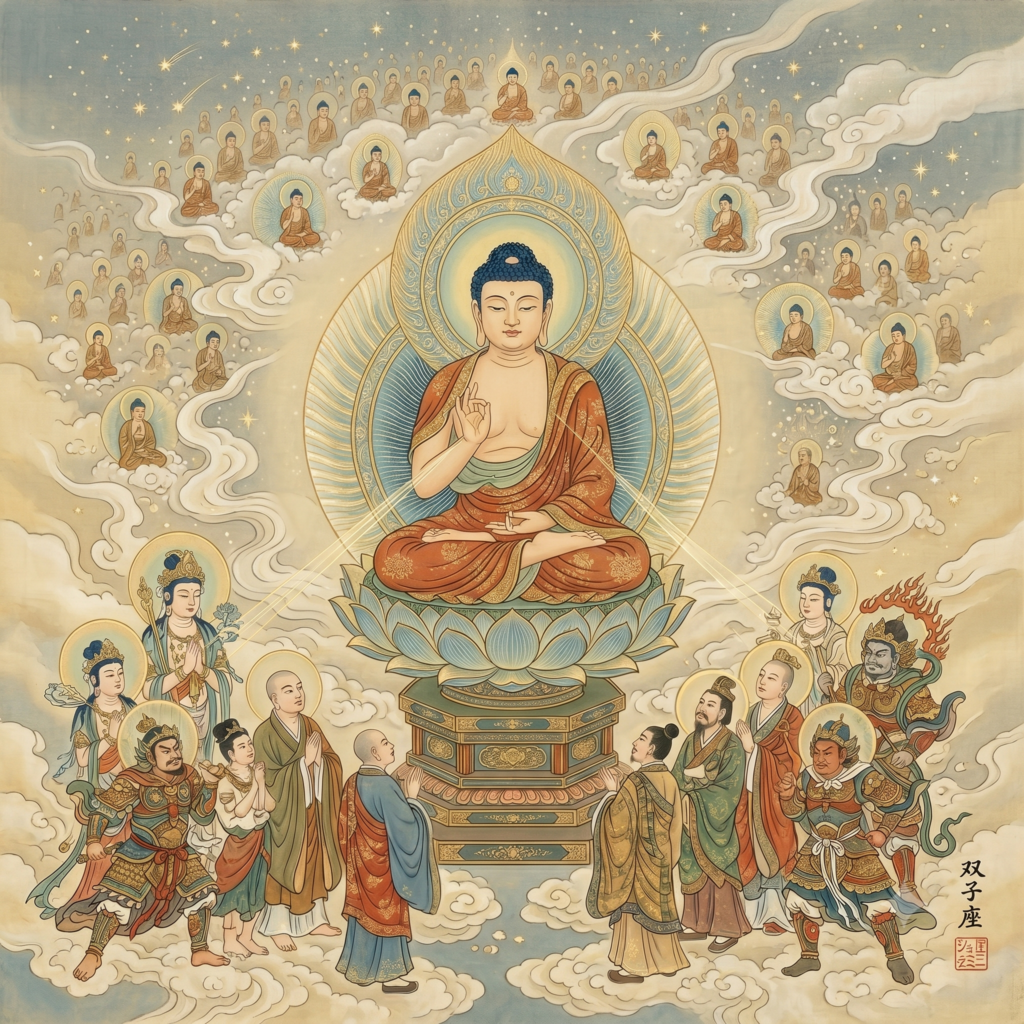
Illustration by Google Gemini

Show Gemini's thinking

Modifying the Bodhisattvas
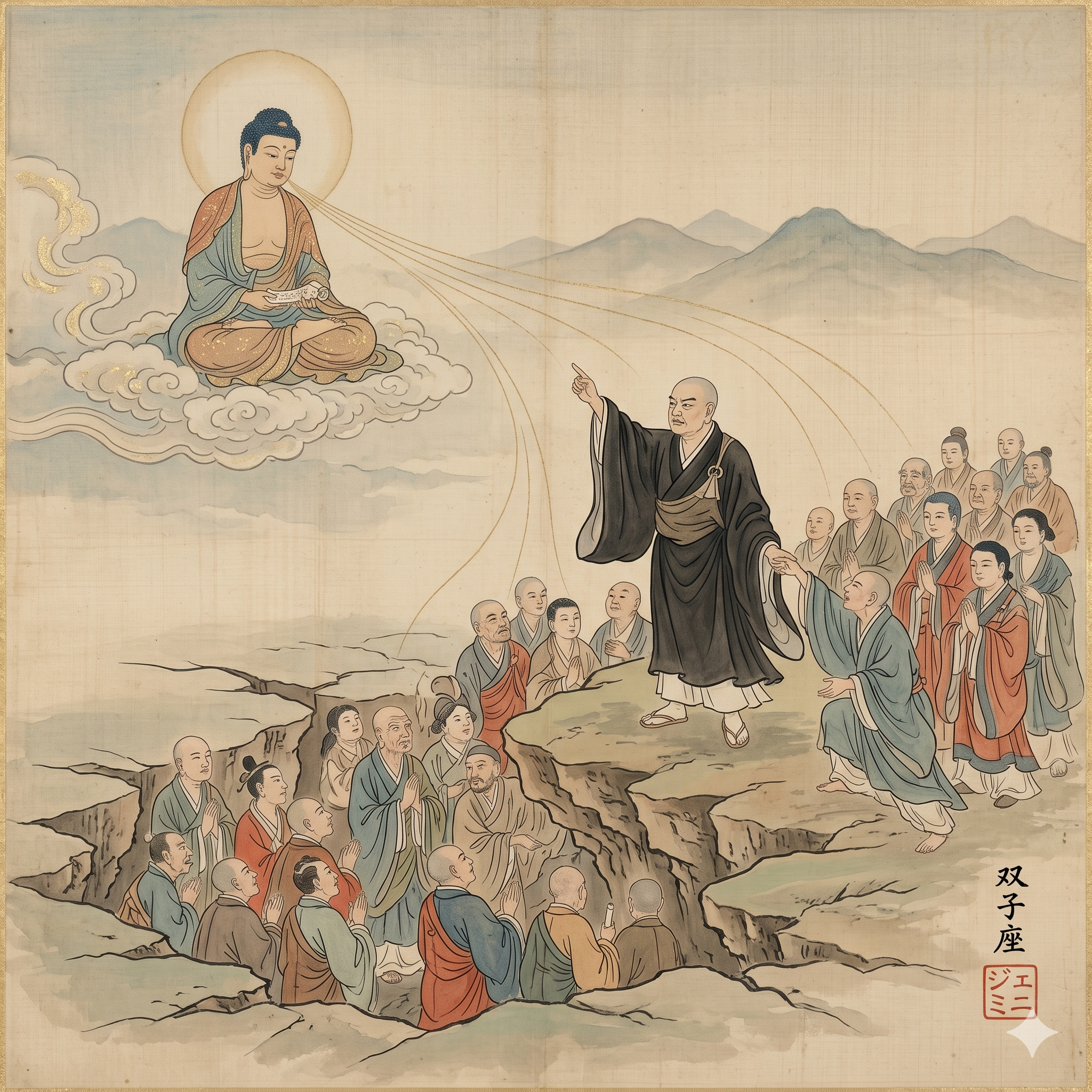
I'm working on transforming the original illustration by depicting all the figures, including the men, women, and children, as luminous Bodhisattvas. The goal is to evolve the initial image into a representation of enlightened beings.

Enhancing Divine Aura
I'm now focusing on transforming the human figures at the ground level into Bodhisattvas. They will wear robes, crowns, and have halos, floating on lotus clouds. Animals will also receive glowing symbols. The goal is to enhance the overall golden light and divine energy to emphasize the transformation, while keeping the Ukiyo-e style and aged paper texture.

Evaluating Abstract Symbolism
I'm currently focused on the image's symbolic representation. The model successfully conveyed the abstract notion of Bodhisattvas through the use of lotus thrones, signifying enlightenment. This visual element aligns well with the user's intent. The interpretation of 'showing that all people who follow the Buddha are Bodhisattvas' is clear.

Analyzing Symbolic Placement
I've examined how the model has visualized the user's intent to represent the idea that all followers of the Buddha are Bodhisattvas. The placement of all figures on lotus thrones is key. This directly addresses the prompt, conveying the abstract concept through strong symbolism. The alignment of the visual elements with the intended message is very good.

The Buddhas, the World-Honored Ones,
Say only expediently [that some are not Bodhisattvas]
To tell the truth,
All living beings taught by them are Bodhisattvas.

This verse comes from Chapter Three of the Lotus Sūtra. In Chapter Two, the Buddha declared that he only teaches Bodhisattvas. If we believe that we are not Bodhisattvas, we could conclude that the Buddha does not teach us. Part of what the Buddha is explaining here is that we are all Bodhisattvas. The way to reach the Buddha’s enlightenment is by living as Bodhisattvas: beings whose every breath is intended to improve our world.

The Daily Dharma is produced by the Lexington Nichiren Buddhist Community. To subscribe to the daily emails, visit zenzaizenzai.com
Myōhō Renge Kyō Promise for Dec. 29, 2025

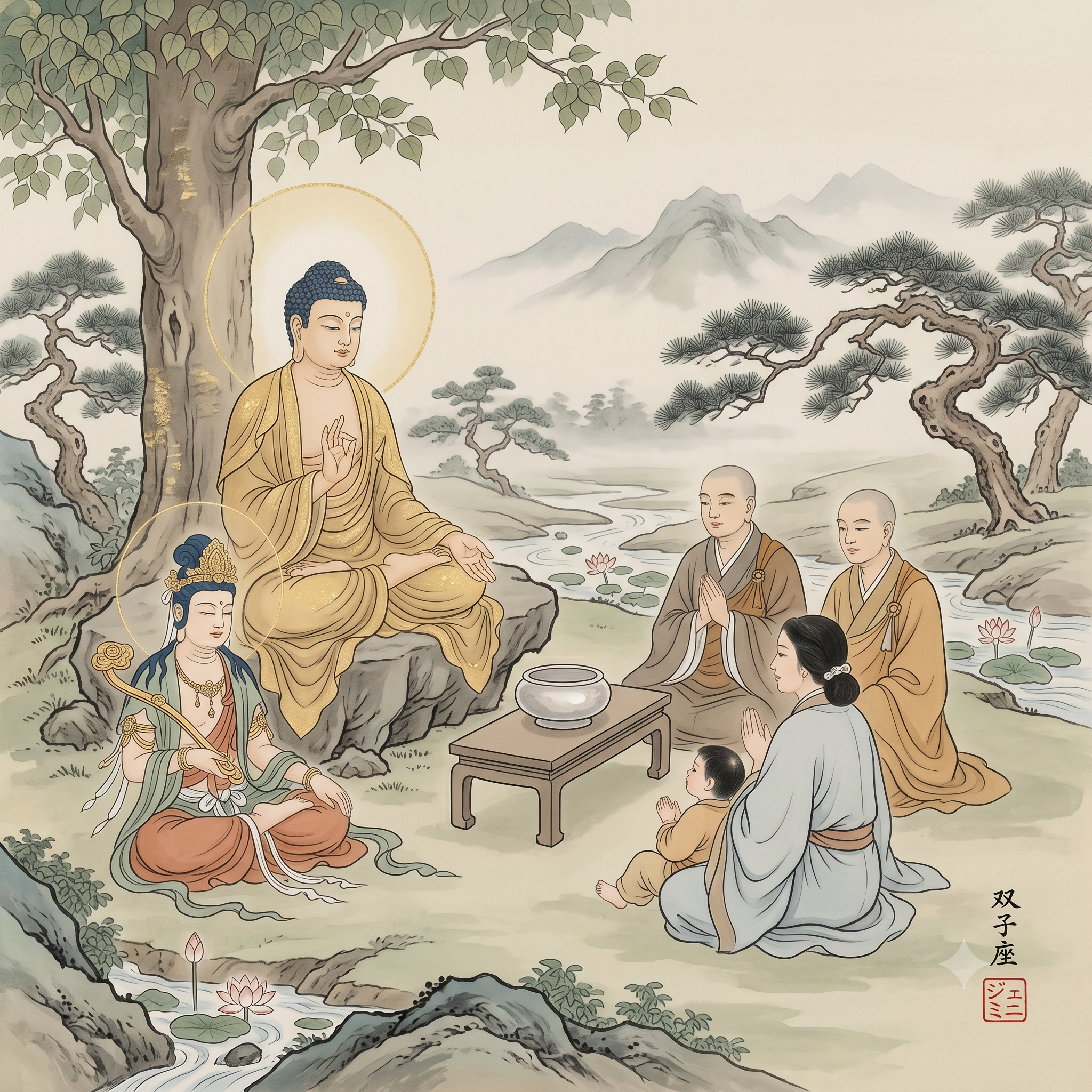
Those who spread the five characters of Myō, Hō, Ren, Ge, and Kyō in the Latter Age of Degeneration should not make a distinction between males and females, for it would be difficult to chant the daimoku unless they were all bodhisattvas of the earth.

Shohō Jisso-shō, Treatise on All Phenomena as Ultimate Reality

About this project

Daily Dharma for December 29, 2025

20251229-ddi

Illustration by Google Gemini

Show Gemini's thinking

Identifying Key Visuals
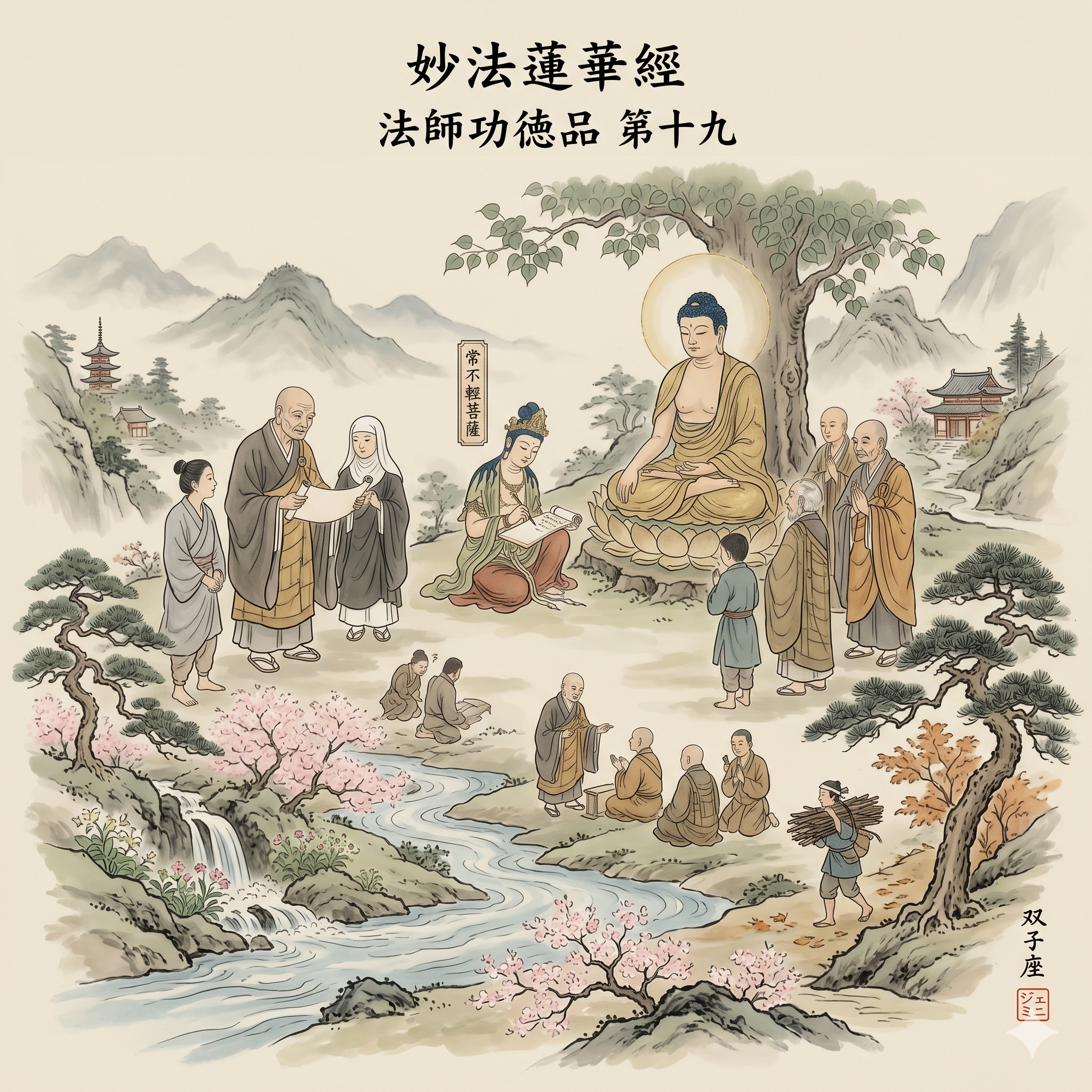
I'm focusing on the core message. The challenge is visually representing "evil bhikṣus" misunderstanding the Lotus Sutra. I'm exploring symbolic imagery from Japanese Buddhist art to convey this nuanced concept. I'm considering compositions and color palettes to enhance the visual impact.

Exploring Symbolic Depictions
I'm now zeroing in on representing the "evil bhikṣus" symbolically, given the subtle nature of the concept. I'm brainstorming different ways to visually convey misunderstanding and delusion without resorting to literal depictions. I'm aiming for an evocative image that resonates with the Lotus Sutra's themes. I'm thinking of using distorted or fragmented forms and contrasting light and dark.

Developing Composition Ideas
I'm now integrating the provided text's essence into a square composition. I'm focusing on a hierarchical layout, placing the Buddha centrally with bodhisattvas below, while trying to visually represent the concept of "evil bhikṣus" with distorted figures. I'm trying to ensure the visual elements coalesce effectively, using stylized Japanese Buddhist art elements for the style. I'm experimenting with using golden clouds to separate the realms.

Designing the Composition
I'm now determining how to effectively combine the key elements. The challenge is in visualizing the complex relationships between the figures and their actions. I'm focusing on the hierarchical layout with the Buddha central and the Bodhisattvas below. I'm exploring symbolic representations to convey the "evil bhikṣus'" actions and the Bodhisattvas' compassionate response. I'm considering text placement for clarity.

Verifying Image Fidelity
I'm currently reviewing the image against the provided text and user specifications. I am meticulously checking that the illustration adheres to the requested square format and replicates the Japanese Buddhist style. The key figures - Buddha, Bodhisattvas, and the 'evil bhikṣus' - are present, and I am cross-referencing these elements with the Lotus Sutra text.

Evaluating Visual Accuracy
I've verified the image against the original prompt and I'm very satisfied that the image is a success. I've noted the square format, the Japanese Buddhist style, and the accurate inclusion of the Buddha, Bodhisattvas, and the evil bhikṣus. The integration with the Lotus Sutra text is strong. I'm satisfied that this fulfills the requirements.

World-Honored One, know this!
Evil bhikṣus in the defiled world will not know
The teachings that you expounded with expedients
According to the capacities of all living beings.

In Chapter Thirteen of the Lotus Sūtra, innumerable Bodhisattvas sing these verses before the Buddha from whom they had come to hear the Wonderful Dharma. They realized that due to their attachment and delusions, beings in this world would see us who keep and practice the Lotus Sūtra as the source of their unhappiness. When we uphold the Buddha’s teaching, and know the true purpose of that teaching, we can see even those beings who cause great harm as opportunities for all of us to become enlightened rather than enemies that we must destroy.

The Daily Dharma is produced by the Lexington Nichiren Buddhist Community. To subscribe to the daily emails, visit zenzaizenzai.com
Myōhō Renge Kyō Promise for Dec. 28, 2025

What T’ien-t’ai and Dengyō propagated was based on the doctrine of “3,000 existences contained in one thought” expounded in the theoretical section [of the Lotus Sūtra], while what I, Nichiren, propagate is based on the doctrine of “3,000 existences contained in one thought” in the essential section. The difference between the two is as great as the difference between heaven and earth. Remember this especially at the time of the last moment of life. Have an unwavering faith in the Lotus Sūtra and continue chanting the daimoku, which is the right way of meditation based on the “actual” doctrine of “3,000 existences contained in one thought.”

Toki Nyūdō-dono Go-henji: Chibyō-shō, A Response to Lay Priest Lord Toki

About this project

Daily Dharma for December 28, 2025

20251228-ddi

Illustration by Google Gemini

Show Gemini's thinking

Examining Core Themes
I'm currently focused on the foundational concepts of cause and effect and rebirth. The Lotus Sutra quote provides a strong framework, guiding my exploration of visual representation. I'm prioritizing the spiritual weight of these themes, aiming for a visual style that captures the essence of Japanese Buddhist art. I am now working on how to merge these concepts.

Conceptualizing Visual Narrative
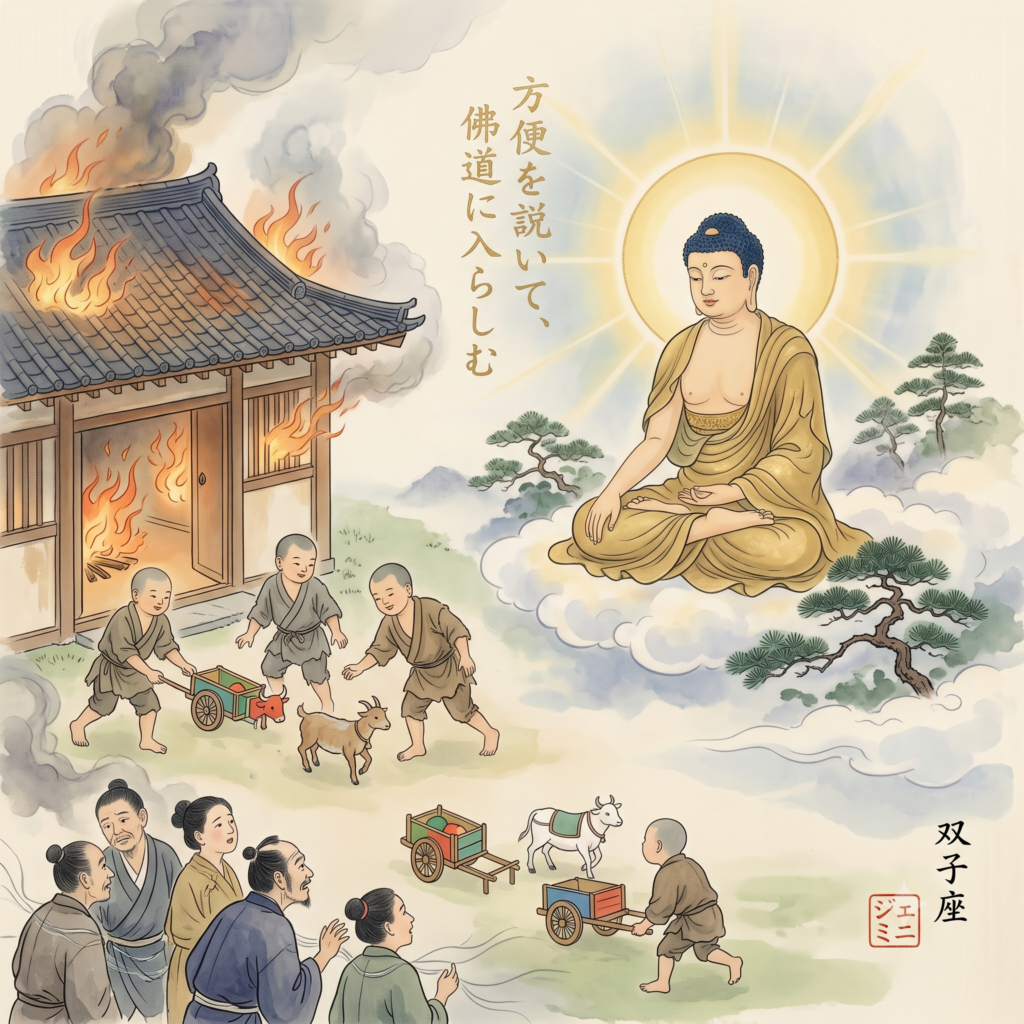
I'm now integrating Japanese Buddhist iconography. My focus is on representing interconnectedness, cause and effect, and rebirth in a visually coherent manner for Instagram. The Buddha figure is central, perhaps with the lotus as a throne. I'm exploring the river or path symbolism and considering a golden net to depict karma and interconnectedness.

Refining Composition Details
I'm finalizing the composition and visual details. The Buddha's posture and the river's flow are solidified. I've decided on the "Wheel of Life" in a more stylized form. The paths of benefit and harm are now distinct, with contrasting visual cues. I'm focusing on incorporating the golden net subtly to emphasize interconnectedness.

Formulating Compositional Elements
I'm now focusing on composition and detail. The Buddha will be in the top center, with a river of life below, splitting into two distinct paths. I will refine the golden net to connect the figures, emphasizing interconnectedness. The quote will be integrated. I'm prioritizing balance between visual impact and spiritual depth.

Evaluating Image Accuracy
I'm currently assessing the generated image's fidelity to the user's prompt. I'm reviewing the visual elements, specifically the incorporation of the specified iconography and stylistic details like the Japanese Buddhist aesthetic and the inclusion of text from the Lotus Sutra.

Verifying Visual Elements
I'm confirming the image's accuracy against the specifications. The illustration accurately renders the provided details: a square Japanese Buddhist-style image with specified iconography, and text integration within the visual framework, specifically the Lotus Sutra quote and the explanatory cartouche. The visual narrative resonates well with the user's text.

Now I will tell you
About my previous existence
And also about yours.
All of you, listen attentively!

The Buddha sings these verses in Chapter Six of the Lotus Sūtra. When the Buddha taught in India 2500 years ago, people took for granted that their lives continued from previous lives and would continue on into future lives. Whatever comforts we enjoy or calamities we endure in this life were thought to be caused by what we did in our former lifetimes. Our actions today were thought to determine what happens in our future lives. To our modern understanding this can sound mystical and unlikely. But if we understand that everything, including our joy and suffering, has causes and conditions, whether or not we realize these results immediately, we know that the result of creating benefit is benefit, and the result of creating harm is harm. When we hold the happiness of all beings to be as precious as our own, we would no more mistreat others than we would want them to mistreat us.

The Daily Dharma is produced by the Lexington Nichiren Buddhist Community. To subscribe to the daily emails, visit zenzaizenzai.com
The Peril of Using AI to Illustrate the Daily Dharma

Each morning for the past six days I’ve asked Google’s Gemini to create an illustration based on the text of the Daily Dharma sent by zenzaizenzai.com. I’ve been refining the workflow, but in general it has become a simple task.

Until this morning.

I asked Gemini to illustrate this text:

What does the doctrine of spiritual contemplation mean? It means the way of practicing the teaching of the Buddha according to the intent of the Buddha, not necessarily according to what is literally said in the sutra. Suppose there is a man during the time of a famine who offers to the Buddha the only food he has to stay alive for a day. This is the same as offering his life to the Buddha.

Nichiren wrote this passage in his Treatise on Phenomenal and Noumenal Offering (Jiri Kuyō Gosho). The Lotus Sūtra is the highest teaching because it encompasses all beings in all worlds, assuring everyone that they can rid themselves of delusion and reach the Buddha’s enlightenment. The Buddha showed that the universe is constantly changing, even from one moment to the next. When we read the Lotus Sūtra, and allow our minds to become more like the Buddha mind, we learn the meaning behind the words and put that into practice. We do not merely go through the motions mechanically. We understand that calamities are opportunities for us to bring the Buddha’s teaching to life, and that whatever prosperity we gain does not belong to us alone. Whatever we have is for the benefit of all beings.

The illustration I received from Gemini:
fail-20251227-ddi

I have decades of experience selecting artwork to illustrate articles. That was one of my jobs during my career as a newspaper editor. This illustration puzzled me.

20251227-lens-translateUsing the Google Lens app on my phone I translated the text as saying, “Protect the Unique.” I then asked Google Lens to explain the statue, 20251227-amida-explain only to learn this was a representation of Amida Buddha. The app said, “The standing posture often represents the Buddha descending from the heavens to welcome devotees to his paradise. The hand gesture, or mudra, with the right hand raised and the palm facing outward, is known as the abhayada-mudra, which bestows fearlessness. The left hand, with the palm facing outward and downwards, forms the varada-mudra, representing compassion.

As a Nichiren Buddhist I’m not going to use a statue of Amida Buddha to illustrate the Daily Dharma, let alone a quote that doesn’t appear to relate. I went back to Gemini and told it to focus the illustration on the line: The Lotus Sūtra is the highest teaching because it encompasses all beings in all worlds, assuring everyone that they can rid themselves of delusion and reach the Buddha’s enlightenment.

That prompt produced the image I used today:
20251227-ddi
As an editor, I don’t like this image as much as earlier ones. It relies too heavily on words to explain its meaning. A good illustration shouldn’t need words.

I expect to have this happen again in the future and I’ll handle it the same way. But the story doesn’t end here. I went back to Google Gemini to see if it could explain why it produced that original illustration.

I uploaded the illustration to Gemini and asked:

Explain the symbolism of this image in detail and explain the story the illustrator was trying to tell.

Gemini responded:

This image is a rich tapestry of Buddhist iconography and ethical teaching. It illustrates a core tenet of Mahayana Buddhism: that the “sincerity and sacrifice” behind an act are far more spiritually significant than the material value of the gift itself.

The illustrator is telling a story of “ultimate devotion,” specifically highlighting the concept of Dana (generosity) practiced to its highest degree.

1. Key Symbols and Their Meanings

The image uses several classical Buddhist symbols to ground the story in spiritual tradition:

The Bodhi Tree: The monk sits beneath a tree with heart-shaped leaves, representing the tree under which Siddhartha Gautama attained enlightenment. This signifies that the scene is one of high spiritual realization and truth.

The Lotus Flowers: Emerging from clouds and water, the lotus symbolizes “purity and rebirth.” Even in the “mud” of a famine or suffering, a beautiful, pure act of devotion can bloom.

The Golden Buddha: The glowing figure in the background represents the “Triple Gem” (the Buddha, the Dharma, and the Sangha). The rays of light (auras) signify the boundless compassion and wisdom that witness the man’s sacrifice.

The Scroll and the Monk: The monk represents the preservation of the teachings. He is a witness to the man’s karma.

The Bowl of Rice: In the context of a famine, this is not just food; it is a “biological lifeline.” By offering it, the man is physically divesting himself of his means of survival.

2. The Narrative: Sacrifice and Sincerity

The story being told is a classic Buddhist parable (similar to the story of the “Poor Woman’s Lamp” or the “Offering of the Hare”).

The Contrast of Form
The illustrator creates a sharp visual contrast between the monk (who looks healthy, serene, and well-clothed) and the poor man (who is skeletal, wearing rags, and barefoot). This emphasizes that the man is giving from a place of “lack” rather than “abundance.”
The “Life” Offering
The text at the bottom is the key to the story: “This is the same as offering his life.” In Buddhist philosophy, the merit of an action is determined by the intention (cetana).

If a king gives a thousand gold coins, it is a great gift.
If a starving man gives his last bowl of rice, he has given everything.

The illustrator is showing that this man has transcended his fear of death and his attachment to his own body. By feeding the “Buddha” (or the Sangha) instead of himself, he has achieved a state of selflessness that is the precursor to Enlightenment.

3. Analysis of the Text

The vertical Japanese/Chinese text in the center reads 「唯道のを守る」 (roughly: “Only protecting/keeping the Way”). This reinforces the idea that the man’s act is not just charity, but a strict adherence to the spiritual path (the Way), even when faced with the ultimate personal cost.

Summary of the Illustrator’s Message
The illustrator is teaching the viewer that “true spirituality is found in the depth of one’s sacrifice.” The image serves as a “contemplation” piece to make the viewer ask: “What am I willing to let go of for the sake of what is holy?”

Note that, from Gemini’s perspective, none of this has anything to do with Pure Land teaching or Amida Buddha, which were my primary concern.

I went back to Gemini again. This time I asked:

The statement: “Suppose there is a man during the time of a famine who offers to the Buddha the only food he has to stay alive for a day. This is the same as offering his life to the Buddha.”

Where could I expect to find this statement — what teaching, whose teaching?

Gemini responded:

This statement is a central teaching of Nichiren Daishonin (1222–1282), the 13th-century Japanese Buddhist priest who founded Nichiren Buddhism.

Specifically, you can find this passage in one of his letters (known as Gosho) titled “The Gift of Rice” (Hakumai-ippo-sho).

The Source and Context
Nichiren wrote this letter while living in extreme poverty and isolation on Mount Minobu. During this time, he and his disciples often faced starvation and harsh winters. The letter was written as a thank-you note to a follower who had sent him a gift of polished rice, yams, and other food.

In the letter, Nichiren writes:

“…in a time of famine, offering the food that is the only means for sustaining one’s life that day to the Buddha is offering one’s life to the Buddha.” — The Writings of Nichiren Daishonin, Vol. 1, p. 1126

Key Concepts in This Teaching
Nichiren uses this statement to explain how ordinary people can attain enlightenment. He distinguishes between two types of offerings:

Offering in Actuality
This refers to the legendary stories of ancient sages and bodhisattvas who literally gave up their bodies or lives for the Law (e.g., the boy Snow Mountains who offered his life to a demon to hear a Buddhist verse).
Offering in Principle
This is the practice for ordinary people. Since most people cannot (and are not expected to) literally sacrifice their lives, Nichiren teaches that offering something vital to your own survival—like your last bit of food during a famine—is spiritually equivalent to offering your life.
The Philosophy of “Earnest Resolve”
The core message is that the sincerity of the heart (Japanese: kokorozashi) is what matters most in Buddhism.
Life is the Foremost Treasure
Nichiren explains that life is the most precious thing in the universe. Therefore, the food that sustains life is also a “treasure.”
The Spirit of Contribution
Giving from a place of abundance is easy, but giving from a place of personal lack (the “only food he has to stay alive”) represents the highest form of faith and “earnest resolve.”
Equality of Benefit
By making such a sincere offering, an ordinary person gains the same immense “fortune” or merit as the sages of old who performed literal physical sacrifices.

Note that I didn’t direct Gemini to focus on Nichiren or his teachings. This was its genuine view. This raises the question: Why didn’t the first illustration reflect this understanding?

Such is the peril of Using AI to Illustrate the Daily Dharma.

Myōhō Renge Kyō Promise for Dec. 27, 2025

The Lotus Sūtra Wisdom of Insight Manual by Tripiṭaka Master Amoghavajra is based on the “Appearance of the Stupa of Treasures” chapter [of the Lotus Sūtra], and it regards Śākyamuni Buddha and the Buddha of Many Treasures of the Lotus Sūtra as the honzon, but this idea is not the true intention of the Lotus Sūtra. The daimoku (sacred title) of the Lotus Sūtra is the honzon of Śākyamuni Buddha, the Buddha of Many Treasures and the Buddhas of the worlds throughout the universe. This daimoku should be the honzon for the practicer of the Lotus Sūtra.

Honzon Mondō Shō, Questions and Answers on the Honzon

About this project

Daily Dharma for December 27, 2025

20251227-ddi

Illustration by Google Gemini

Show Gemini's thinking

The first illustration offered by Gemini was not satisfactory. Gemini was told:

Focus the illustration on the line: The Lotus Sūtra is the highest teaching because it encompasses all beings in all worlds, assuring everyone that they can rid themselves of delusion and reach the Buddha’s enlightenment.

Here's Gemini's thinking on this revision:

Revising Core Concept
I'm now zeroing in on the central theme: the Lotus Sutra's encompassing nature and its promise of universal enlightenment. I'm focusing on how to visually represent this grand, all-encompassing message in a concise and clear manner.

Conceptualizing New Imagery
I'm presently building upon the core concept, now concentrating on the visual elements that convey the Lotus Sutra's central tenets. I've broken down the scene into key components: the central Buddha, diverse beings, a blooming lotus as a symbol of enlightenment, and the Lotus Sutra scroll. I'm aiming for a traditional Japanese woodblock print aesthetic with rich colors. The text is also being incorporated, including both the title and the user-provided line, along with the relevant kanji.

Examining Image Alignment
I'm currently reviewing how the illustration aligns with the initial request. The core idea of the Buddha emanating light to a diverse assembly is depicted. The textual elements appear integrated according to specifications. My focus now is on assessing the stylistic implementation, and how well it reflects the traditional Japanese woodblock print aesthetic.

Analyzing Visual Fidelity
I've confirmed the image reflects the core prompt. The central Buddha radiating light and diverse assembly are present. Text integration meets requirements. The woodblock print style is evident, similar to before. I'm satisfied with the prompt fidelity of the current render.

Kanji translation
the kanji text on the scroll held by the Buddha is:

法華経 (Hokekyō)

This translates to "The Lotus Sutra".

It is the title of the Buddhist scripture that is the central theme of the illustration.

What does the doctrine of spiritual contemplation mean? It means the way of practicing the teaching of the Buddha according to the intent of the Buddha, not necessarily according to what is literally said in the sutra. Suppose there is a man during the time of a famine who offers to the Buddha the only food he has to stay alive for a day. This is the same as offering his life to the Buddha.

Nichiren wrote this passage in his Treatise on Phenomenal and Noumenal Offering (Jiri Kuyō Gosho). The Lotus Sūtra is the highest teaching because it encompasses all beings in all worlds, assuring everyone that they can rid themselves of delusion and reach the Buddha’s enlightenment. The Buddha showed that the universe is constantly changing, even from one moment to the next. When we read the Lotus Sūtra, and allow our minds to become more like the Buddha mind, we learn the meaning behind the words and put that into practice. We do not merely go through the motions mechanically. We understand that calamities are opportunities for us to bring the Buddha’s teaching to life, and that whatever prosperity we gain does not belong to us alone. Whatever we have is for the benefit of all beings.

The Daily Dharma is produced by the Lexington Nichiren Buddhist Community. To subscribe to the daily emails, visit zenzaizenzai.com
Myōhō Renge Kyō Promise for Dec. 26, 2025

How can we identify the sage of the Lotus Sūtra in the Latter Age of Degeneration? The Lotus Sūtra states, “He who preaches this sūtra to others and can uphold it for himself is a messenger of the Buddha.” In other words, anyone who recites eight chapters of the Lotus Sūtra, or one fascicle, one chapter, or just a verse of it, or chants the daimoku is a messenger of the Buddha. He who carries through faith in the Lotus Sūtra to the end, enduring the great persecutions that arise, is the true messenger of the Buddha.

Shijō Kingo-dono Gohenji, Response to Lord Shijō Kingo

About this project

Daily Dharma for December 26, 2025

20251226-ddi

Illustration by Google Gemini

Show Gemini's thinking

Developing Visual Concepts
I'm currently focused on translating the concept of hidden Bodhisattva practice, as described in the Lotus Sutra, into a visually coherent image. I'm exploring how to represent this notion of concealed enlightenment within the framework of traditional Japanese Buddhist painting. I am also considering the square format requirement for Instagram.

Conceptualizing Composition Elements
I'm now integrating the elements from the Lotus Sutra into a composition for the square format illustration. I'm focusing on the Śrāvaka and the emergent Bodhisattva within. The goal is to depict the hidden nature of enlightenment. I'm using warm colors, gold accents, and a mandala-like central emblem to create a serene, transformative, feeling. The Lotus Sutra verse will be incorporated as calligraphy.

Evaluating Visual Fidelity
I'm currently assessing the visual fidelity of the image generated, cross-referencing it with the user's initial instructions to determine its accuracy. I'm focusing on how well it renders the square Instagram format and the Buddhist illustration style. I'm also examining the depiction of the specific figures and actions described in the user's prompt.

Analyzing Composition and Content
I'm now examining how the core elements of the user's prompt are visually communicated. The quote integration is successful. The illustration style aligns well, and the depicted figures match the requested monks. The square aspect ratio requested is also accurately rendered. The image accurately portrays the scene with Śrāvakas revealing their Bodhisattva nature. I am confident in passing this on.

My disciples are performing
The Bodhisattva practices secretly
Though they show themselves in the form of Śrāvakas.
They are purifying my world.

The Buddha sings these verses in Chapter Eight of the Lotus Sūtra. The Śrāvakas are those who hear the teachings of the Buddha and put it into practice only for themselves. They are concerned with ending their own suffering and do not believe they have the capacity to reach the Buddha’s enlightenment. But because they can serve as an example to those who are also unsure about receiving this great wisdom, they can be an inspiration to make progress on the path. With the Lotus Sūtra, the Buddha declares that all beings have the capacity for enlightenment, and reveals that all of our pursuits are for the sake of benefiting others. It is when we realize this directly and openly that we perform the Bodhisattva practice, the selfless effort of awakening the world.

The Daily Dharma is produced by the Lexington Nichiren Buddhist Community. To subscribe to the daily emails, visit zenzaizenzai.com

On the Journey to a Place of Treasures