Garlands of the Mind

Five meanings that are related to mind are enumerated by Chih-i. …

With regard to the mind that contains the meaning “garlands being tied together” (Hsin-han Chieh-man), it is illustrated by Chih-i in reference to text, practice and doctrine. In terms of the mind that is related to tying text up without mistake, this means that when one’s thought is correct, one makes no mistakes in understanding a text. In terms of the mind that is related to tying practice up without mistake, this means that with mind contemplation, one gains the power of perceiving the Path. In terms of the mind that is related to tying doctrine up without mistake, this means that with the mind contemplation, one gains concentration and knowledge. (Vol. 2, Page 397)

The Profound Meaning of the Lotus Sutra: Tien-tai Philosophy of Buddhism


Day 10

Day 10 concludes Chapter 6, Assurance of Future Buddhahood, and opens Chapter 7, The Parable of a Magic City.

Having last month heard the prediction for the future Buddhahood of Subhūti, we hear the prediction for Great Kātyāyana.

Thereupon the World-Honored One said to the bhikṣus:

“Now I will tell you. This Great Kātyāyana will make many offerings to eight hundred thousand millions of Buddhas, attend on them, respect them, and honor them in his future life. After the extinction of each of those Buddhas, he will erect a stūpa-mausoleum a thousand yojanas high, and five hundred yojanas wide and deep. He will make it of the seven treasures: gold, silver, lapis lazuli, shell, agate, pearl and ruby. He will offer flowers, necklaces, incense to apply to the skin, incense powder, incense to burn, canopies, banners and streamers to this stūpa-mausoleum. After that he will make the same offerings to two billions of Buddhas. Having made offerings to those Buddhas, he will complete the Way of Bodhisattvas, and become a Buddha called Jambunada-Gold-Light, the Tathāgata, the Deserver of Offerings, the Perfectly Enlightened One, the Man of Wisdom and Practice, the Well-Gone, the Knower of the World, the Unsurpassed Man, the Controller of Men, the Teacher of Gods and Men, the Buddha, the World-Honored One. The ground [of his world] will be even, made of crystal, and adorned with jeweled trees. The roads will be marked off by ropes of gold, and wonderful flowers will cover the ground to purify it. Anyone will rejoice at seeing it. The four evil regions: hell, the region of hungry spirits, that of animals, and that of asuras, will not exist in that world. Many gods and men will live there. Śrāvakas and Bodhisattvas, many billions in number, also will live there to adorn that world. The duration of the life of that Buddha will be twelve small kalpas. His right teachings will be preserved for twenty small kalpas, and the counterfeit of his right teachings also will be preserved for twenty small kalpas.”

Thereupon the World-Honored One, wishing to repeat what he had said, sang in gāthās:

Bhikṣus!
Listen with one mind!
What I say
Is true, not false.

This Kātyāyana
Will make
Wonderful offerings
To the Buddhas.

After the extinction of each of the Buddhas,
He will erect a stūpa of the seven treasures,
And offer flowers and incense to the śarīras
[Of the Buddha enshrined in the stūpa].

On the final stage of his physical existence,
He will obtain the wisdom of the Buddha
And attain perfect enlightenment.
His world will be pure.
He will save many billions of living beings.
All living beings
In the worlds of the ten quarters
Will make offerings to him.

No light will surpass
The light of that Buddha.
The name of that Buddha will be
Jambu [nada]-Gold-Light.

Innumerable Bodhisattvas and Śrāvakas
Will live in his world, and adorn that world.
They will have already eliminated
The bonds of existence.

It is of note that Katyayana was foremost in explaining the Dharma, according to list of the top 10 Voice Hearers. But as Nichiren points out, it is only through the Lotus Sūtra that these great disciples can attain Buddhahood.

The purpose of the Tripiṭaka teaching is to emancipate people from the Six Realms of the triple world. As a result, because the teaching reveals no place but the triple world to attain emancipation, śrāvaka and pratyekabuddha are unaware of the existence of the Pure Land where bodhisattvas are born. They also do not know that they still possess other evil passions and attachments besides the delusions in view and thought. Śrāvakas and pratyekabuddhas believe they will eliminate the cause of being reborn in the triple world if they do away with the delusions in view and thought and that they will exist in a void where there is no body or mind, since they will have transformed the body to ashes and annihilated consciousness. Thus it is said that men of the two Vehicles cannot be saved by the Tripiṭaka teaching, and that they will never be able to become Buddhas without the teaching of the Lotus Sūtra.

Ichidai Shōgyō Tai-I, Outline of All the Holy Teachings of the Buddha, Writings of Nichiren Shōnin, Doctrine 3, Page 72

Odds and Ends from The Lotus Sutra: A Biography

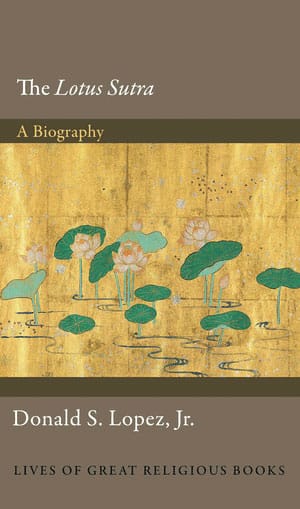
This is a followup to yesterday’s post about The Lotus Sutra: A Biography with a few additional ideas I want to save for later retrieval.

On the fate of the 5,000 arrogant monks who walked out in Chapter 2, Expedients, of the Lotus Sūtra:

For Zhiyi, and for many readers over the centuries, the Lotus Sūtra has two major messages. The first, found in the first half of the sūtra, is that there are not three vehicles; there is one vehicle, which will eventually transport all sentient beings to buddhahood. The second, found in the second half of the sūtra, is that the lifespan of the Buddha is immeasurable. These two doctrines are generally compatible with the Nirvāṇa Sūtra, allowing Zhiyi to continue to uphold the supremacy of the Lotus. But if everything is said in the Lotus, what is the purpose of the Nirvāṇa? Here, those five thousand haughty monks and nuns who walked out in the second chapter of the Lotus Sūtra come to the rescue. The sūtra does not explain what became of them, but Zhiyi explains that they returned to the assembly that surrounded the Buddha’s deathbed. The Buddha thus compassionately reiterated the central message of the Lotus Sūtra to those who had missed it the first time. It was also important, at the moment of his apparent passage into Nirvāṇa, for the Buddha to reiterate what he had declared in the Lotus: that like the wise physician, the Buddha only pretends to die; in fact his lifespan is immeasurable. (Page 56-57)

On the great merit earned by the grasshopper.

Discussing Great Japanese Miraculous Tales of the Lotus Sūtra (Dainihonkoku hokekyōkenki), completed in 1044 by the monk Chingen:

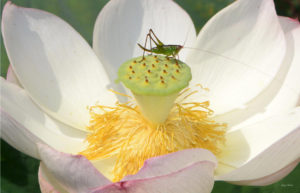
Grasshopper on a lotusOne of several anthologies of miracle tales about the Lotus, this collection includes rather standard Buddhist stories of miracle cures (a blind woman regains her sight by reciting the Lotus), divine retribution (a man who ridicules a reciter of the Lotus loses his voice), and deaths attended by heavenly fragrances, beautiful music, and auspicious dreams. In one story, a monk memorizes the first twenty-five chapters of the Lotus but, despite repeated efforts, is unable to memorize the final three. He eventually learns in a dream that in a previous life he had been a grasshopper who perched in a temple room where a monk was reciting the sūtra. After reciting the first seven scrolls of the sūtra (which contain the first twenty-five chapters), the monk rested before beginning the final roll. He leaned against the wall and inadvertently killed the grasshopper. The grasshopper was reborn as a human as a result of the merit he received from hearing the first twenty-five chapters of the Lotus. When he became a monk, however, he was unable to memorize the final three chapters because he, as the grasshopper, had died before he heard them. (Page 79-80)

On how Nichiren judged the six Buddhist schools of Nara.

He seems to have arrived at this conviction [of the supremacy of the Lotus Sūtra] through something of a process of elimination, but only after a serious survey of the Japanese sects of the day. He began with the belief that the word of the Buddha was superior to that of the various Indian Buddhist masters, such that one’s allegiance should be to a sūtra rather than to a treatise (śāstra). This immediately eliminated five of the six “Nara schools” of Buddhism, which were based on various Madhyamaka (Sanron), Yogācāra (Hossō), and Abhidharma treatises (Kusha and Jōjitsu), as well as on (in the case of Ritsu) the monastic code (vinaya). Among the Nara schools, that left only Kegon, based on the Flower Garland Sūtra, which Nichiren rejected. He already had an antipathy for Pure Land, but he was attracted to Shingon, famous for its doctrine that it is possible to “achieve buddhahood in this very body” (sokushin jōbutsu), that is, during the present lifetime. He found what would prove to be for him a more compelling doctrine in the Tendai sect, which, based in part on Zhiyi’s famous doctrine of “the three thousand realms in a single thought,” proclaimed that all beings are endowed with original enlightenment (hongaku). Nichiren eventually decided that the Tendai sect, with its conviction that the Lotus Sūtra was the Buddha’s highest teaching, was the superior form of Buddhism, although he felt that in the centuries since its founding, its purity had been diluted by the admixture of other practices, especially devotion to Amitābha. (Page 82-83)

On the topic of Nichiren Shoshu.

“We recall that in Nichiren Shōshū, the dharma in the three jewels is not the Lotus Sūtra; it is the three great secret doctrines: the honzon, the daimoku, and the kaidan.” (Page 221)

On SGI as a separate Buddhist organization

We find in the charter no mention of slandering the dharma (or the consequences of doing so), no mention of shakubuku, and no mention of the Lotus Sūtra. (Page 211)

The Message

O-Bon is a spiritual event held to pay respect and give gratitude to our ancestors, and to pray for all spirits. Why should we respect our ancestors? There is no complicated reason – all we require is respect and sense of gratitude for our ancestors, and we should realize how wonderful and precious our life is. If there were no parents, grandparents, great grandparents or ancestors, we would not be here. Also, we should realize that our nature and characteristics have come from the genes of our parents, grandparents, and great grandparents or ancestors. In other words, we should accept our genes as messages, and know that we are located at the end of the message.

Summer Writings