Category Archives: AI Contribution

Daily Dharma for January 31, 2026

20260131-ddi

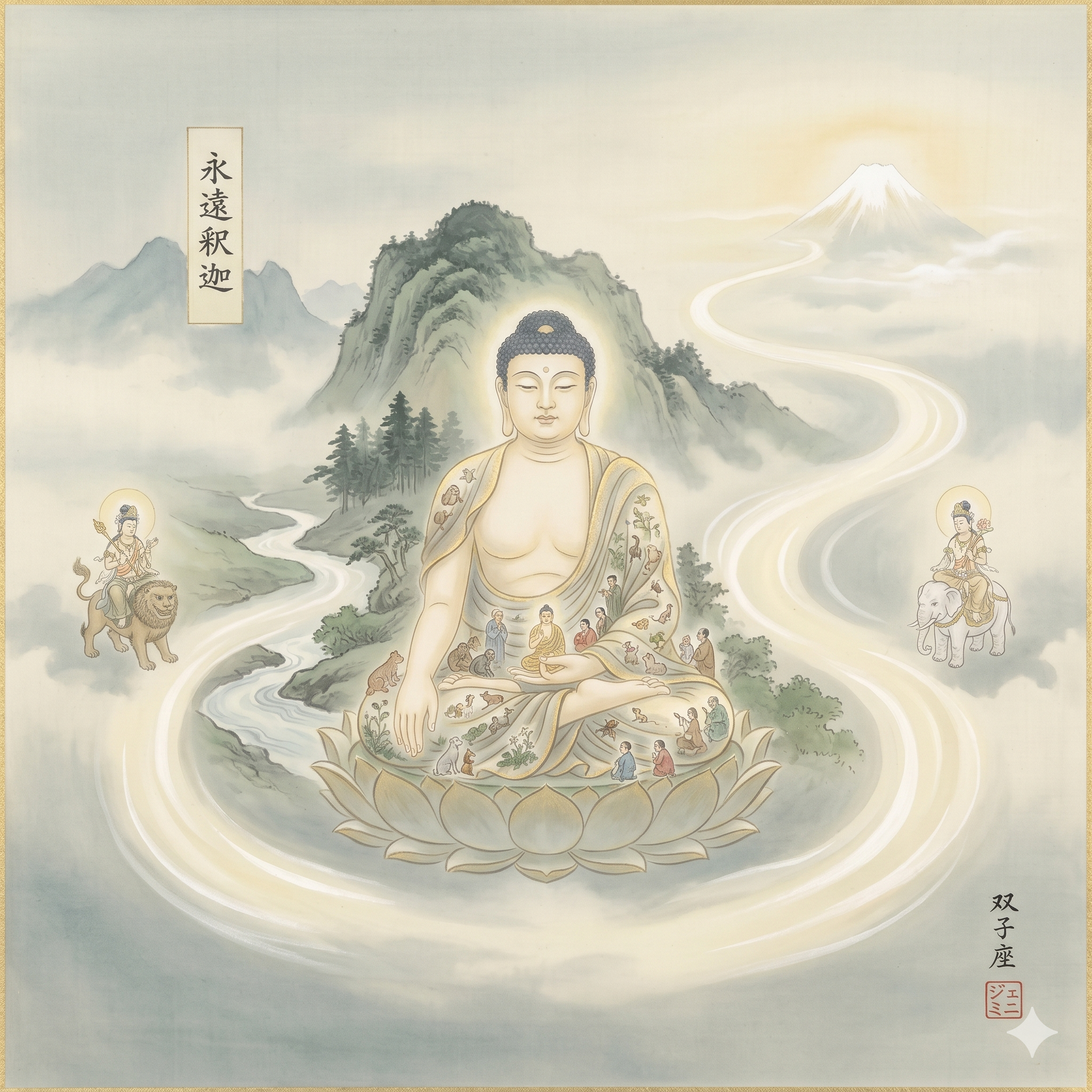
Illustration by Google Gemini

Show Gemini's thinking

Gemini Thinking

Defining the Buddhist Concept
I'm now deeply considering the Sakyamuni Buddha's verse and its core meaning: overcoming greed, jealousy, and fear. My challenge is to translate these abstract concepts into a visual square illustration, within the context of Japanese Buddhist iconography, but specifically excluding Amida and Dainichi Nyorai. A key element will be including a specific traditional signature.

Visualizing the Buddhist Narrative
I'm now focusing on the visual representation. I've broken down the verse to core components: Sakyamuni teaching Śāriputra about eliminating greed, jealousy, and fear. I have started selecting specific traditional Japanese Buddhist iconography. I've identified Sakyamuni Buddha (Shaka Nyorai) as the primary figure with Sharihotsu as the disciple. I am considering teaching mudras and the presence of a lion as a symbol of fearlessness. The overall composition aims for serenity, representing the absence of negative emotions.

Refining the Composition
I'm now integrating the signature and seal. I'm focusing on the Nihonga style, the square aspect ratio, and traditional elements. I'm trying to ensure the absence of Amida and Dainichi Nyorai is maintained. I'm considering the most appropriate mudra and trying to determine the best setting and composition, ensuring that the visual cues representing the elimination of greed, jealousy, and fear are clear.

Verifying Visual Harmony
I'm checking the illustration against the initial request. It captures the requested Japanese aesthetic, showing Sakyamuni Buddha and his disciple. The square composition, signature, and seal seem to be as specified. I'm focusing on how well the visual details align with the prompt's core concept.

Analyzing Prompt Adherence
I've confirmed this illustration fully aligns with the user's initial instructions, depicting Sakyamuni Buddha and his disciple in the requested Japanese aesthetic. The square composition, along with the inclusion of the signature and seal, also matches the requirements. I've also checked and confirmed that the generated picture has adhered to all the negative constraints that were initially provided.

I do not deceive
Those who believe me and rely on me.
I am not greedy or jealous
Because I have eliminated all evils.
Therefore, in the worlds of the ten quarters,
I am fearless.

The Buddha proclaims these verses to his disciple Śāriputra in Chapter Two of the Lotus Sutra. In this world of conflict, people believe that they must constantly strive to show that they are better than everyone else. Acquiring more material goods or a higher rank or position supposedly proves superiority. And if there is an encounter with someone who is better, that person must be brought down. What people do not realize that the source of greed and jealousy is fear. Like the Buddha, we too can eliminate our fears when we are satisfied with what we have and regard superior beings as a source of benefit.

The Daily Dharma is produced by the Lexington Nichiren Buddhist Community. To subscribe to the daily emails, visit zenzaizenzai.com

Daily Dharma for January 30, 2026

20260130-ddi

Illustration by Google Gemini

Show Gemini's thinking

Kanji Translation
The kanji text in the illustration is:

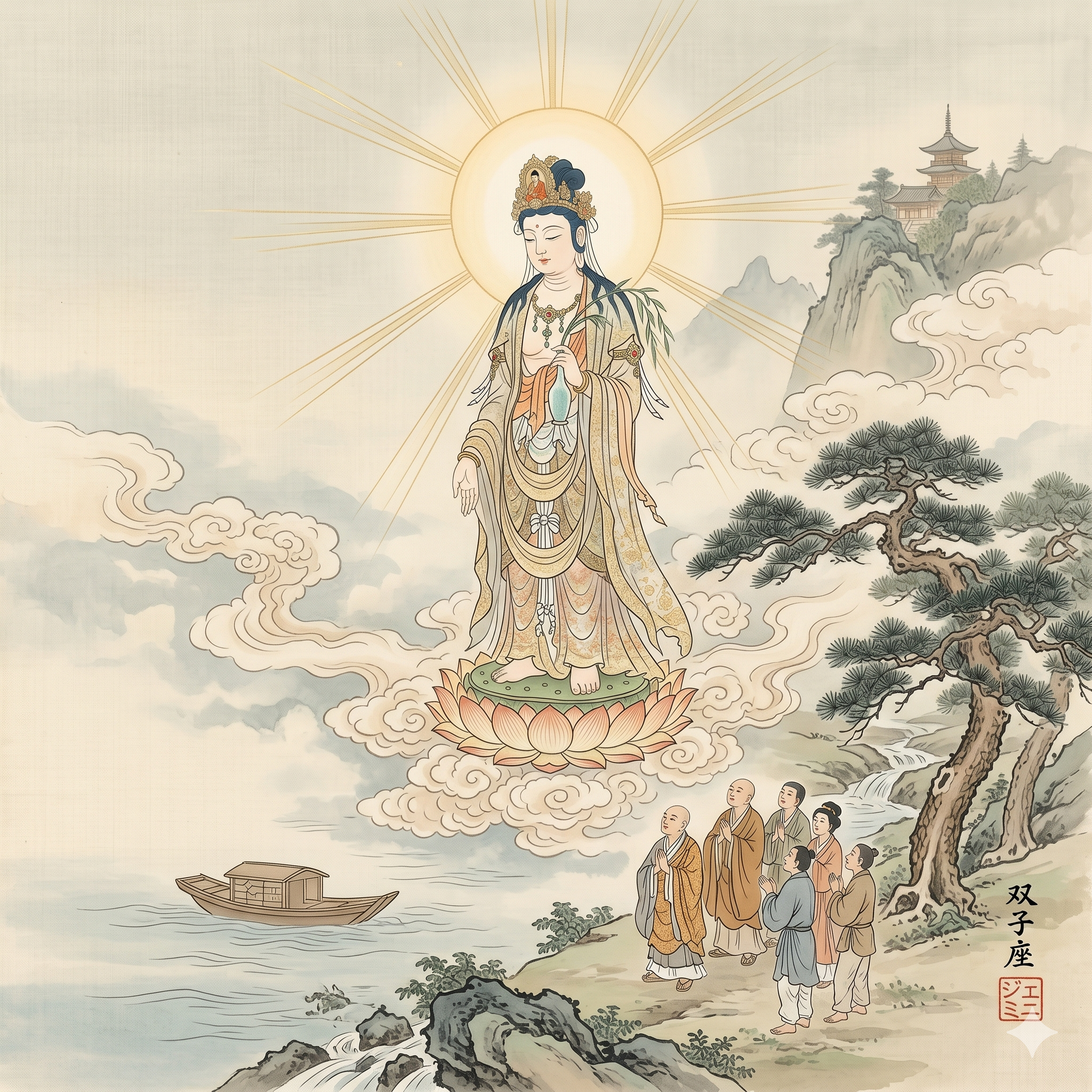
念彼観音力

Romanization: Nen pi Kannon riki

Literal translation: Think of that Kannon's power.

The artist's signature and seal denoting "Gemini," as requested in your original prompt. It is composed of two parts:

1. Black Ink Calligraphy (The Signature)

Characters: ジェミニ

Script: Katakana (used for foreign words and names).

Reading: Jemini

Meaning: This is the phonetic transliteration of the English word "Gemini."

2. Red Seal (The Stamp)

Type: This is a traditional Japanese artist seal, known as a hanko or in'ei.

Characters inside: 双子座

Reading: Futago-za

Meaning:

双子 (Futago): Twins

座 (Za): Seat, constellation, or zodiac sign.

Together, they mean the Gemini constellation or zodiac sign.

Gemini Thinking

Defining the Scene
I'm currently focused on defining the initial scene from the Lotus Sutra, specifically where the bandits are impacted by thinking of Kannon. The challenge is distilling this complex idea into a single, square, illustrative image while adhering to the traditional Japanese painting aesthetic.

Composing the Illustration
I'm now working to compose the scene. My focus is on positioning the viewer centrally, surrounded by bandits with lowered weapons, juxtaposed against a glowing Kannon figure above. I'm aiming for the bandits' shift from aggression to compassion to be visually apparent through softened expressions. I am also planning on adding the Gemini stamp. My goal is to use Kannon's lotus, serene expression, and the bandits' rough clothing to build a cohesive narrative.

Analyzing Visual Depiction
I'm checking the depiction against the source material and the user's intent. The central figures are there and appear to capture a key narrative moment. I am continuing to evaluate the stylistic choices to ensure they align with the original request.

Verifying Artistic Alignment
I'm now comparing the visual elements to ensure a faithful interpretation. The composition focuses on core subjects, and I'm assessing the artwork's adherence to the original prompt. The square aspect and the kanji were as requested. I've noted the red stamp, and am checking the overall thematic appropriateness.

Suppose bandits are surrounding you,
And attempting to kill you with swords.
If you think of the power of World-Voice-Perceiver,
The bandits will become compassionate towards you.

The Buddha gives this description of World-Voice-Perceiver Bodhisattva (Kannon, Kanzeon, Kuan Yin, Avalokitesvara) to Endless-Intent Bodhisattva in Chapter Twenty-Five of the Lotus Sūtra. When we allow this Bodhisattva, the embodiment of compassion, into our minds, we realize the value of the connections we have with all beings, even those who are so deluded that they want to harm us. When we ourselves embody compassion, we should not be surprised when it awakens the compassion that is at the core of our existence.

The Daily Dharma is produced by the Lexington Nichiren Buddhist Community. To subscribe to the daily emails, visit zenzaizenzai.com

Daily Dharma for January 29, 2026

20260129-ddi

Illustration by Google Gemini

Show Gemini's thinking

Kanji Translation
Top Right Text
This text is a Buddhist verse, likely from a sutra like the Lotus Sutra, which the painting depicts.

Kanji: 諸佛所說法 當演暢是經 Translation: "You should expound this sutra, which contains the Dharma taught by all the Buddhas."

諸佛 (Sho Butsu): All Buddhas

所說法 (Sho Setsu Hō): The Dharma (teachings) that was taught

當 (Tō): Should / Ought to

演暢 (En Chō): Expound / Proclaim fluently

是經 (Ze Kyō): This sutra

Bottom Left Text & Seal
This is the artist's signature and seal.

Kanji Signature: 双子座 Reading: Futagoza Translation: Gemini (the zodiac sign)

Red Seal: The stylized characters inside the red square seal are katakana. Katakana: ジェミニ Reading: Jemini Translation: Gemini

Gemini Thinking

Defining the Subject Matter
I'm presently analyzing the core thematic elements derived from the provided Dharma text to guide the illustration. Specifically, I'm concentrating on the concept of "fearlessness" and its connection to deeper understanding as outlined in the Lotus Sūtra. I am building a foundation based on this, to guide the visual elements.

Conceptualizing the Composition
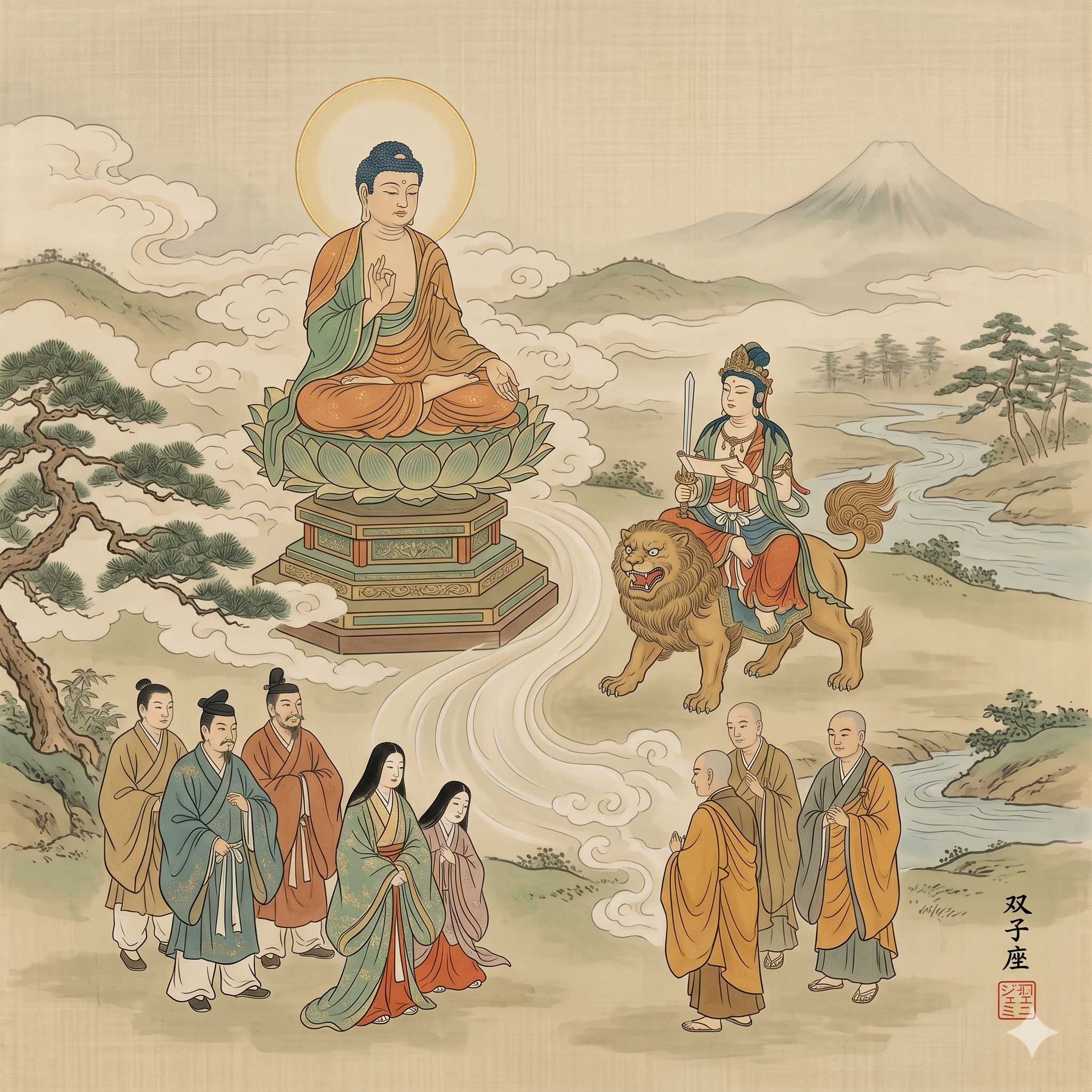
I am now focusing on selecting a composition for the illustration, leaning towards a representation of Monju Bosatsu that communicates wisdom and fearlessness. The specific elements I plan to include are the lion, the sutra scroll, and the sword, all rendered in the traditional Japanese Buddhist style I am aiming for.

Refining the Composition
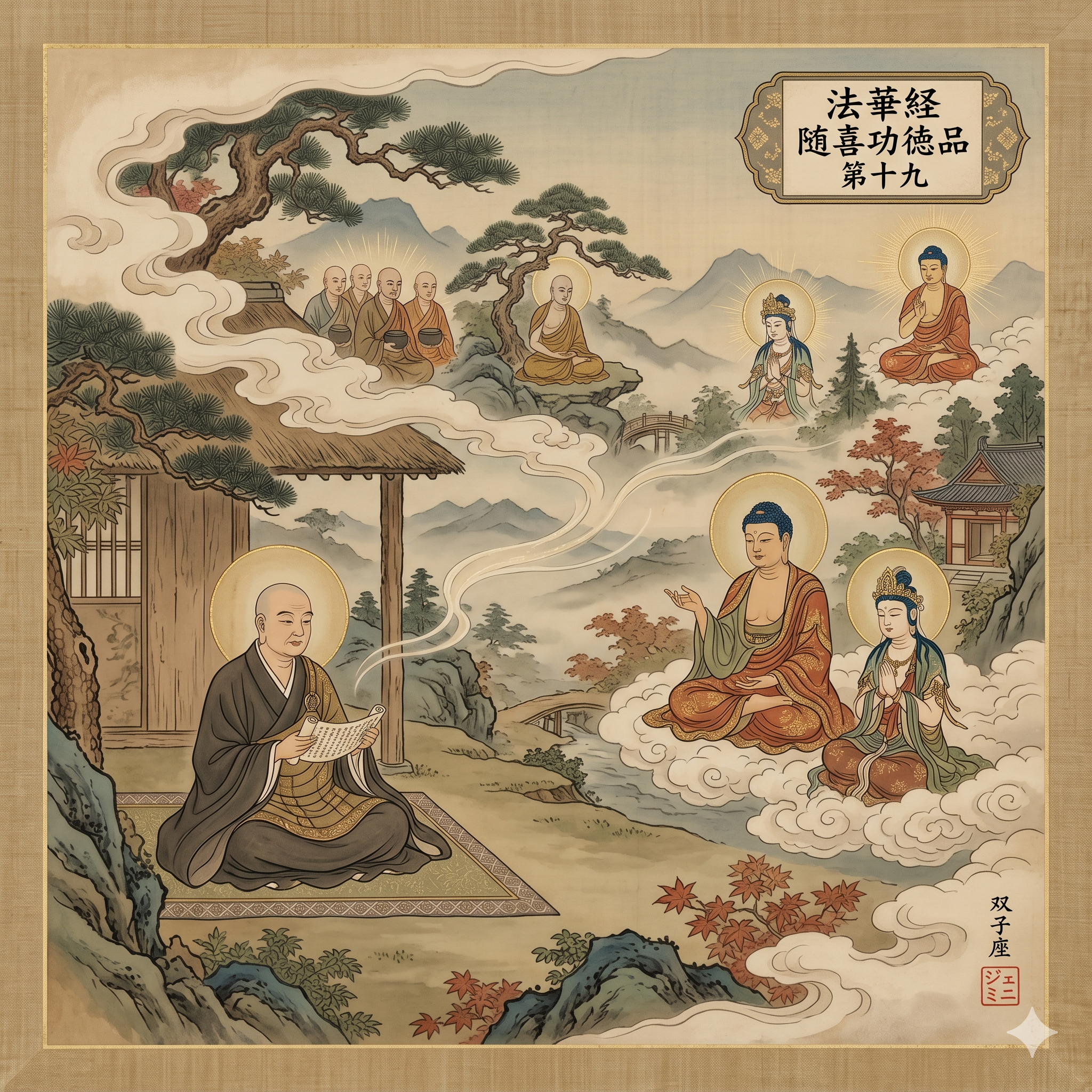
I am now focusing on the visual composition, deciding the elements. I've chosen Monju Bosatsu, seated on a lion and holding a sword and sutra scroll. I'll add two attendants and stylized pine trees. I'll place the figures on a cloud-shrouded mountain peak, with a golden halo and moonlit sky. I plan to incorporate a Dharma text in classical Kanji: 「諸佛所說法 / 當演暢是經」.

Formulating the Composition
I am now focusing on the illustration's structural framework, emphasizing Monju Bosatsu and the associated elements. I will include attendants, setting them against a mountain peak, and incorporating the Dharma text. I am also planning the artist's signature.

Verifying Iconography Detail
I'm checking the illustration to make sure it meets the user's criteria. I'm focusing on the details of the iconography, specifically the depiction of Monju Bosatsu on the lion. I'm evaluating its adherence to traditional Japanese Buddhist painting conventions.

Analyzing Artistic Conventions
I am now closely analyzing the generated image. My primary focus is verifying that the piece correctly employs traditional Japanese Buddhist painting conventions. I've assessed the depiction of Monju Bosatsu on the lion for adherence to the requested style, and the inclusion of specific kanji text. I'm ensuring everything aligns with the provided prompt.

They will expound the Dharma
Already taught by the past Buddhas.
Therefore, they will be fearless
Before the multitude.

The Buddha declares these lines to Constant-Endeavor Bodhisattva in Chapter Nineteen of the Lotus Sūtra, describing those who keep the Lotus Sūtra. By understanding fear, and demonstrating our fearlessness in this world of conflict, we can inspire and bring courage to other beings. One form of fear arises when we believe that we are in a situation that we cannot handle. This is simply a form of arrogance: believing that something is true when in reality we do not know that it is true. When the Buddha assures us who practice this Wonderful Dharma of the certainty of our future enlightenment, we then know how things will turn out. No matter what difficulties we find ourselves in, there are always more choices available to us. Often outcomes that seem horrible at the time can bring us more wisdom and compassion.

The Daily Dharma is produced by the Lexington Nichiren Buddhist Community. To subscribe to the daily emails, visit zenzaizenzai.com

Daily Dharma for January 28, 2026

20260128-ddi

Illustration by Google Gemini

Show Gemini's thinking

Kanji Translation
Top Right Box:

法華経譬喩 (Hokekyō Hiyu)

法華経 (Hokekyō): The Lotus Sutra

譬喩 (Hiyu): Parable

Translation: "The Parable of the Lotus Sutra" (This refers to the scene depicted, known as the Parable of the Burning House).

Bottom Right Signature:

双子 (Futago)

Translation: "Twins" (This is the artist's signature or pen name).

The red stamp below it is the artist's seal, which also contains stylized characters for the name.

Gemini Thinking

Defining Visual Metaphor
I am now focusing on distilling the essential elements of the parable into a square composition, considering that I should avoid direct representation of certain Buddhas. I am aiming to establish the visual metaphor for expedient means and how to portray the concept of liberation from suffering in the Buddhist context.

Visualizing Key Symbols
I'm working on the iconography now, visualizing a burning Japanese house with children engrossed in games, representing attachment. A serene Shakyamuni Buddha figures beckons from outside, and expedient means are depicted as three carts with glowing jewels. Finally, there's the single, greater cart to the side, representing the Lotus Sutra's path.

Constructing The Composition
I am now focusing on the components of the visual narrative. I'm prioritizing the visual storytelling by concentrating on the core message. I'm working through how to translate the parable's elements into the final image, emphasizing the house, children, the Buddha, and the carts. Now I'm considering text elements.

Assessing the Visuals
I'm verifying the visual elements against the initial requirements, confirming adherence to specifications like format and iconography. The exclusion parameters are also currently under review.

Confirming Prompt Adherence
I'm now cross-referencing the output against the original user input, focusing on the Parable of the Burning House depiction. I've confirmed that the image aligns with all exclusion criteria, including the square format and limited text, along with the precise inclusion of Japanese Buddhist iconography. All aspects are satisfactory.

When I saw that some people of little virtue and of much defilement were seeking the teachings of the Lesser Vehicle, I told them, ‘I renounced my family when I was young, and attained Anuttara-samyak-saṃbodhi [forty and odd years ago].’ In reality I became the Buddha in the remotest past as I previously stated. I told them so as an expedient to teach them, to lead them into the Way to Buddhahood.

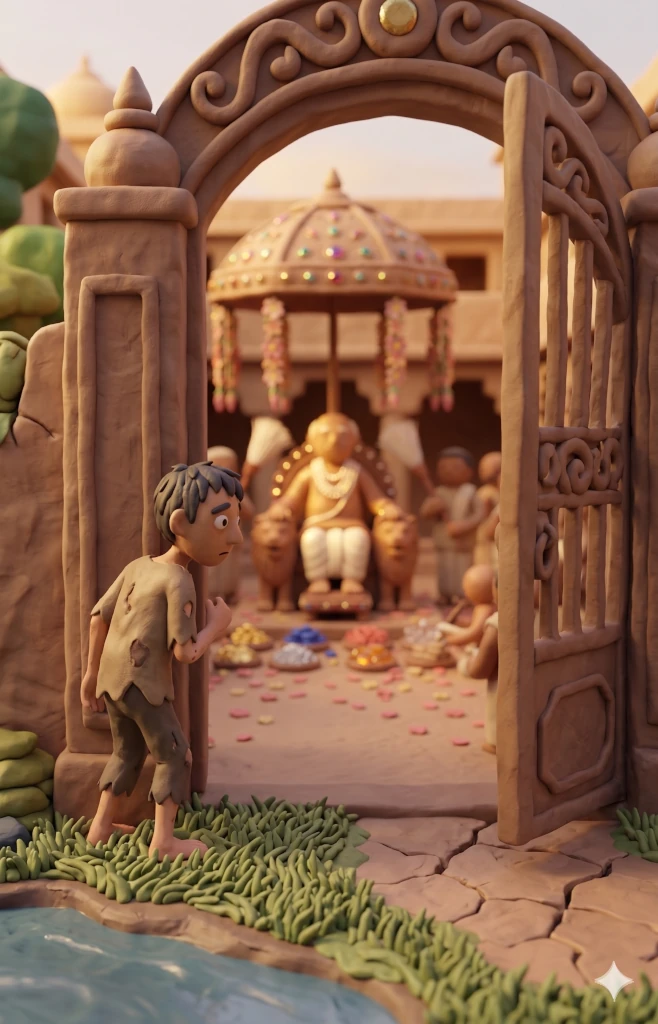
In Chapter Sixteen of the Lotus Sutra, the Buddha gives this explanation of a parable he tells in Chapter Three. In that story, the foolish children of a wise man were playing in a burning house. The man tried to warn his children of the dangers of the house, but the children were so preoccupied with their games they would not leave. Only when the man promised them better toys outside would the children leave the house. The words used by the wise man were meant to get the children out of the house, even though the toys did not exist. These words were necessary to motivate the children to set aside their delusions. They were not meant to be taken literally. We learn from this explanation how the Buddha uses words, and why we formerly needed his expedient teachings.

The Daily Dharma is produced by the Lexington Nichiren Buddhist Community. To subscribe to the daily emails, visit zenzaizenzai.com

Daily Dharma for January 27, 2026

20260127-ddi

Illustration by Google Gemini

Show Gemini's thinking

Kanji Translation
1. Text on the Scroll
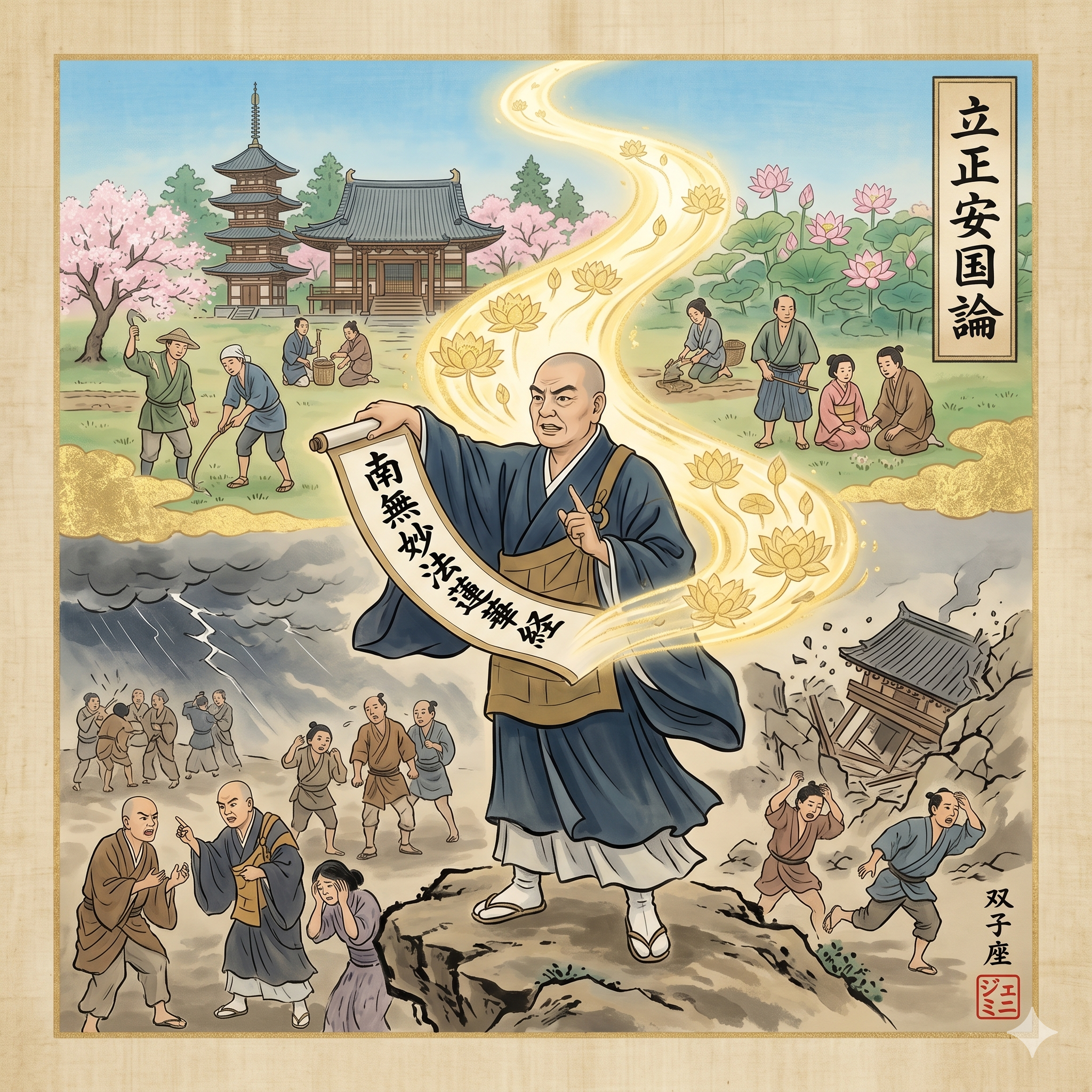
The text written on the scroll held by the monk is: 妙法蓮華経 (Myōhō Renge Kyō)

Translation: The Lotus Sutra (Full title: The Sutra of the Lotus Flower of the Wonderful Law)

2. Text at the Bottom
The large text across the bottom of the illustration is: 南無妙法蓮華経 (Namu Myōhō Renge Kyō)

Translation: Devotion to the Lotus Sutra (or "I take refuge in the Lotus Sutra")

Gemini's Thinking

Defining the Iconography
I am now focusing on selecting and defining specific Japanese Buddhist iconography that aligns with Nichiren and the Lotus Sutra, while simultaneously excluding the Buddhas explicitly mentioned. This is a crucial step for producing a relevant image.

Refining the Composition
I am now organizing the visual elements I identified. I am leaning toward a composition that emphasizes the "mugwort grass" metaphor prominently, with Nichiren and the Lotus Sutra subtly integrated. I am considering how to represent the Odaimoku visually beyond just the kanji, perhaps through a figure chanting. The Eternal Buddha figure needs to be incorporated as a visual focal point, but not as the center of the image.

Formulating the Visual Prompt
I am now consolidating the elements I have identified into a cohesive visual description. I am striving to balance the depiction of Nichiren and the Lotus Sutra with the symbolic representation of the "mugwort grass" metaphor, and incorporating the concept of the Eternal Buddha. The style is Japanese woodblock print, with earthy tones and touches of gold. Kanji should be included, but limited.

Assessing Artistic Adherence
I'm verifying the illustration's correspondence with the prompt. The image presents a square, traditional Japanese-style illustration featuring Nichiren, mugwort in a hemp field, and the Odaimoku. The illustration avoids the use of prohibited elements and limits the presence of text, correctly depicting Shakyamuni Buddha. All requirements appear satisfied.

Confirming Compositional Accuracy
I'm now checking the illustration against the user's detailed specifications. The image aligns with the provided description, featuring the required square format and traditional Japanese style. It accurately represents Nichiren, the mugwort in the hemp field, and the Odaimoku, and depicts Shakyamuni Buddha as requested. There are no violations. The composition appears accurate.

I, Nichiren, sincerely keep the most profound Lotus Sutra among other sutras which have been preached, are being preached, and will be preached. I also chant Odaimoku, the heart of the sutra, by myself and teach others to chant it. Mugwort grass grows straight amidst the hemp field. Trees do not grow straight, but by cutting them straight, they become useful. If you chant the sutra as it instructs, your mind will be straightened. Be aware that is hard for us the chant even the title of the sutra unless the spirit of the Eternal Buddha enters into our bodies.

Nichiren wrote this passage in his Letter to Myomitsu Shonin (Myomitsu Shonin Gosho). This instruction ties together the practice of reciting devotion to the title of the Lotus Sūtra, Namu Myoho Renge Kyo, and the mind of the ever-present Buddha Shakyamuni. It is through unimaginable deeds of merit that we have met this Sūtra in our lives and have the opportunity to use it to find the Buddha’s wisdom and benefit all beings in this world of conflict and delusion. We are also fortunate to have Nichiren as an example of how to bring this teaching to life. May our gratitude for the merits we have received strengthen our determination to transform the obstacles we face into opportunities we welcome.

The Daily Dharma is produced by the Lexington Nichiren Buddhist Community. To subscribe to the daily emails, visit zenzaizenzai.com

Daily Dharma for January 26, 2026


Illustration by Google Gemini

Show Gemini's thinking

Kanji Translation
Main Horizontal Text:
大慈悲無畏 (dà cí bēi wú wèi) This translates to "Great Compassion, Fearless." It is a core concept in Buddhism, signifying the immense compassion of a Buddha and the fearlessness that comes from understanding the true nature of reality and the desire to liberate all beings.

Smaller Vertical Text (Left of Main Text):
癸卯年 (guǐ mǎo nián) This indicates the year "Year of the Water Rabbit." This refers to a specific year in the 60-year cycle of the traditional Chinese calendar.

Smaller Vertical Text (Right of Main Text):
大藏 (dà zàng) This translates to "Great Treasury" or "Great Storehouse." In a Buddhist context, it often refers to the "Tripitaka," the complete canon of Buddhist scriptures, which is considered a treasury of wisdom.

here is the translation of the small, individual kanji characters that are floating from the central scroll as part of the transmission imagery.

These characters are single kanji that form important Buddhist concepts and terms.

Individual Character Translations:
佛 (Fó): Buddha

法 (Fǎ): Dharma (Teaching/Law)

僧 (Sēng): Sangha (Community/Monk)

妙 (Miào): Wonderful / Mystic

蓮 (Lián): Lotus

華 (Huá): Flower

經 (Jīng): Sutra (Scripture)

慈 (Cí): Loving-kindness

悲 (Bēi): Compassion

喜 (Xǐ): Joy

捨 (Shě): Equanimity (Letting go)

十 (Shí): Ten

善 (Shàn): Virtuous / Good

道 (Dào): Path / Way

智 (Zhì): Wisdom

光 (Guāng): Light

明 (Míng): Brightness

覺 (Jué): Awakening / Enlightenment

Common Combinations (Found in the image):
When read together in their groupings in the image, they form these key Buddhist terms:

佛法僧 (Fó Fǎ Sēng): The Three Jewels (Buddha, Dharma, Sangha)

妙法蓮華經 (Miào Fǎ Lián Huá Jīng): The Lotus Sutra (Scripture of the Lotus Blossom of the Fine Dharma)

慈悲喜捨 (Cí Bēi Xǐ Shě): The Four Immeasurables (Loving-kindness, Compassion, Appreciative Joy, Equanimity)

十善道 (Shí Shàn Dào): The Ten Virtuous Paths

光明 (Guāng Míng): Radiant Light

覺道 (Jué Dào): Path to Enlightenment

Gemini's Thinking

Conceptualizing Symbolic Representation
I'm now focusing on distilling the Lotus Sutra's core message into symbolic elements, specifically how to represent the Dharma's transmission without using direct depictions of the Buddha. I'm exploring various Japanese Buddhist symbols and their potential for conveying this concept visually, within the constraints of a square format.

Visualizing Dharma Transmission
I am developing the symbolic illustration further. My focus has shifted to the hōtō and its placement on a lotus throne, which will be central to the composition. The Dharma's transmission is now being visually represented by a flowing scroll emanating from the tower, alongside praying figures and clouds. I plan to incorporate the required kanji and the traditional art style, within the square format. The aim is to encapsulate the message of compassion and fearlessness.

Verifying Iconographic Accuracy
I am confirming the correspondence of the visual elements with the Dharma transmission described in the Lotus Sutra. The square illustration's components, including the treasure tower and scroll, appear relevant to the theme and correctly adhere to the specified language restrictions. I am continuing to assess the fit of the illustration.

Confirming Image Correspondence
I have finished cross-referencing the square illustration with the user's request, focusing on its Buddhist iconography. The treasure tower and scroll's depiction seem aligned with the Lotus Sutra's Dharma transmission and the illustration adheres to the provided linguistic restraints. The image appears fully compliant with all parameters.

Now I will transmit [the Dharma] to you. Keep, read, recite and expound [this sūtra in which the Dharma is given], and cause all living beings to hear it and know it! Why is that? It is because I have great compassion. I do not begrudge anything. I am fearless. I wish to give the wisdom of the Buddha, the wisdom of the Tathāgata, the wisdom of the Self-Existing One, to all living beings.

The Buddha gives these instructions in Chapter Twenty-Two of the Lotus Sūtra. In this transmission, the Buddha bestows his highest teaching not just on those gathered 2500 years ago. He gives it to all of us who hear and keep his teaching today. When the Buddha revealed his true nature as existing through all time and space, he assured us that he is always teaching us, and that the Lotus Sūtra is the vehicle by which he comes to us. By giving us this teaching, he does not lose it. In the same way, when we benefit other beings, we should not be afraid of losing anything, other than our delusion and attachments.

The Daily Dharma is produced by the Lexington Nichiren Buddhist Community. To subscribe to the daily emails, visit zenzaizenzai.com

Daily Dharma for January 25, 2026

20260125-ddi

Illustration by Google Gemini

Show Gemini's thinking

Kanji Translation
The kanji on the sign in the illustration is 冬は必ず春となる.

It translates to: "Winter always turns to spring."

Gemini Thinking

Defining the Iconography
I'm now focusing on defining the specifics of Japanese Buddhist iconography to meet the request. I've excluded Amida and Dainichi Nyorai as requested, so I'm narrowing my search based on Nichiren's teachings, considering potential symbolic elements, color palettes, and stylistic conventions relevant to the period and specific school of thought.

Visualizing the Metaphors
I'm working on visual metaphors. The challenge lies in harmonizing "winter" and "spring" within a single, square image to represent Nichiren's teaching. I'm focusing on contrasting elements like snow and cherry blossoms. I'm considering a scroll detail and adding a tiny blooming branch to represent the "spring" promise. I plan to use traditional Japanese ink painting with a focus on muted color palettes, specifically blues, grays, and browns to represent winter.

Conceptualizing the Composition
I'm now determining composition. The illustration will be square and styled after Japanese Buddhist iconography, incorporating "winter" and "spring" metaphors representing Nichiren's experiences. The monk figure representing Nichiren, will be positioned on the left, amidst a snowy, rough landscape. I'm aiming for a visual transition to cherry blossoms and warm light on the right. Details include a small scroll labeled with the Lotus Sutra text and a weathered plaque with a relevant quote.

Analyzing the illustration
I'm now verifying the illustration against the prompt's request. The composition of the square illustration uses the winter to spring metaphor using suitable Japanese Buddhist iconography, correctly excluding Amida and Dainichi Nyorai. The limited text "冬は必ず春となる" is a direct and apt quote.

Verifying the Execution
I've confirmed the illustration aligns with all requested parameters. The metaphor of winter turning to spring is well-represented through fitting Japanese Buddhist imagery, specifically omitting Amida and Dainichi Nyorai. The embedded text, "冬は必ず春となる," accurately reflects the meaning and instruction. The image appears fully compliant, so I'll transmit it.

Those who believe in the Lotus Sutra are like the winter season, for many hardships come incessantly. Winter is surely followed by spring. We have never heard or seen that winter returns to fall. We have never heard that the believers in the Lotus Sutra go back to become ordinary men. The Lotus Sutra says, “All people who listen to this Sutra will attain Buddhahood.”

Nichiren wrote this in his Letter to the Nun Myoichi (Myoichi Ama Gozen Gohenji). Nichiren suffered through many hardships in his life, including exile, banishment from his family and home province, being placed on the execution mat, and having his home at Matsubagayatsu burned by members of the Pure Land sect. Through all these difficulties, Nichiren kept his faith in the Buddha’s wisdom and fulfilled his mission to benefit all beings in this world of conflict by leading them with the Wonderful Dharma of the Lotus Sūtra. Nichiren’s faith and practice inspire our faith and practice. Whatever obstacles we may face, we progress towards enlightenment under the guidance of the Ever-Present Buddha.

The Daily Dharma is produced by the Lexington Nichiren Buddhist Community. To subscribe to the daily emails, visit zenzaizenzai.com

Daily Dharma for January 24, 2026

20260124-ddi

Illustration by Google Gemini

Show Gemini's thinking

Interpreting Buddhist Iconography
I'm focusing on Chapter Five of the Lotus Sutra. I'm considering how to visually represent the Buddha praising his disciples, particularly Kāśyapa. The challenge is distilling the essence of that specific praise into a visual element suitable for a square illustration. I'm exploring different iconography that fits.

Visualizing Sutra Essence
I'm now zeroing in on the compositional elements. The focus is a Japanese Buddhist setting, specifically a "Vulture Peak" style, as a background for the Shakyamuni Buddha. I'm considering how to depict the moment of praise and the reception of the teaching by Kāśyapa and the assembly. Exploring traditional Japanese Buddhist symbols, such as robes, halos, and mudras, is key to the visual language. I plan to incorporate a scroll or text element to represent the Dharma itself.

Refining Visual Concept
My focus is the core essence of the scene: Shakyamuni praising Kāśyapa's understanding of the difficult Dharma, avoiding reference to other Buddhas. I'm aiming for a Japanese Buddhist art style with a Vulture Peak setting. The intent is a square format composition, with an ink wash painting aesthetic. The Buddha, Kāśyapa, and the assembly are receiving the teaching with understanding and faith. Japanese Buddhist iconography, like robes, halos, and mudras, will be essential. Incorporating a scroll with the Kanji "妙法" (Myōhō) is also an essential component.

Defining Visual Composition
My focus is clarifying the stylistic and compositional details. I have refined the plan, emphasizing a Japanese ink wash painting aesthetic with a square format. Key figures are Shakyamuni, Kāśyapa, and the assembly. The environment is the Vulture Peak. The scene needs to be serene and enlightening. I need to make sure the kanji "妙法" (Myōhō) is on a scroll.

Assessing Iconography Accuracy
I'm currently verifying the image aligns with the user's explicit request regarding the subject matter and religious symbolism. I am assessing the depiction of the historical Buddha, and the inclusion of Kāśyapa and the assembly, as well as checking the accuracy of the text rendered in the image.

Confirming Subject Depiction
I've confirmed the image's adherence to the original request. The square format and Japanese Buddhist iconography are accurately portrayed. It correctly depicts the historical Buddha addressing Kāśyapa and the assembly, as well as the specified text on the scroll. I verified that Amida and Dainichi Nyorai are absent, as requested. I'm preparing the image for the next step.

Kanji translation
They translate to:

Wonderful Dharma or Mystic Law

妙 (Myō): means "wonderful," "mysterious," "subtle," or "exquisite."

法 (Hō): means "Dharma" (Buddhist teaching), "law," or "principle."

In the context of the illustration, which is labeled "LOTUS SUTRA," these characters refer to the ultimate truth or teaching presented in that sutra (full Japanese title: Myōhō Renge Kyō).

Kāśyapa, and all of you present here! It is an extraordinarily rare thing to see that you have understood, believed and received the Dharma which I expounded variously according to the capacities of all living beings because it is difficult to understand the Dharma which the Buddhas, the World-Honored Ones, expound according to the capacities of all living beings.

The Buddha makes this declaration to his disciple Kāśyapa and all those gathered to hear him teach in Chapter Five of the Lotus Sūtra. The Buddha knows how hard it is to set aside our delusions and understand what he is teaching us. When the Buddha teaches with expedients, he lets us stay in the comfort of our own minds. With the Wonderful Dharma of the Lotus Sūtra, he takes us into the unfamiliar areas of his own mind. Only when we gain confidence in the Buddha as our guide can we stay with this teaching and not regress to the contentment of our attachments.

The Daily Dharma is produced by the Lexington Nichiren Buddhist Community. To subscribe to the daily emails, visit zenzaizenzai.com

Daily Dharma for January 23, 2026

20260123-ddi

Illustration by Google Gemini

Show Gemini's thinking

Kanji Translation
The scroll contains two main kanji characters with a flowing connector between them.

誓 (sei / chikai): This character means "vow," "pledge," or "oath."

行 (gyō / okonai): This character means "practice," "action," or "conduct."

Together, they represent the central theme of the illustration: making a vow and then fulfilling it through practice or action. This is directly reflected in the English text below, where the king declares his intention to change his behavior.

Gemini's thinking

Analyzing the Core Elements
I'm now breaking down the request into key components. I need a square illustration using Japanese Buddhist iconography. I've noted the stylistic details and have a clear understanding of the need to exclude specific Buddhas, particularly Amida Nyorai, to stay focused.

Defining the Key Concepts
I am now focusing on refining the central concept. My process now involves extracting the fundamental elements. I have a firm handle on the exclusion criteria and central characters for the illustration. I am organizing the information to craft a visual narrative that meets the criteria. I'm carefully considering the required symbolic elements to achieve the desired impact.

Formulating the Composition
I am now focusing on the composition, having set the overall concept. I've defined the key figures as the King, Buddha (avoiding the exclusions), and the sons. The setting will be a stylized temple garden, and I'm adding symbolic elements for "purification" and a vow. My plan involves a nihonga-style painting with muted colors and gold accents, using aged paper. A few kanji characters are planned for a cartouche.

Analyzing Image Compliance
I'm checking the illustration now. It appears to match the user's criteria for depicting the vow of King Wonderful-Adornment, using a Japanese Buddhist art style and avoiding the specified elements. The limitations on text also seem to be respected, based on the requirements.

Confirming Art Style Adherence
I've confirmed that the square illustration satisfies the user's explicit instructions. Specifically, the art style is in line, and the prohibited elements are omitted. The text limitations have also been addressed. The depiction aligns with the user's specific request for the vow of King Wonderful-Adornment.

World-Honored One! I have never seen anyone like you before. Your teachings have these inconceivable, wonderful merits. The practices performed according to your teachings and precepts are peaceful and pleasant. From today on, I will not act according to my own mind. I will not have wrong views, arrogance, anger or any other evil thought.

King Wonderful-Adornment makes this declaration to Cloud-Thunderpeal-Star-King-Flower-Wisdom Buddha in Chapter Twenty-Seven of the Lotus Sūtra. The king had been led to this Buddha by his sons, who showed him the wonders they learned from their practice of the Buddha Dharma. With his mind purified by hearing the Buddha’s teachings, he makes this aspiration to behave differently. Whether or not he can keep this aspiration, he shows his realization that hearing the teachings is not enough. Practicing them means changing our minds and how we live.

The Daily Dharma is produced by the Lexington Nichiren Buddhist Community. To subscribe to the daily emails, visit zenzaizenzai.com

Daily Dharma for January 22, 2026

20260122-ddi

Illustration by Google Gemini

Show Gemini's thinking

Defining the Artistic Direction
I'm now zeroing in on defining the artistic direction. I'm focusing on the Japanese Buddhist style, particularly Nihonga and Ukiyo-e influences, and keeping it to a square format. I'm avoiding depictions of specific Buddhas and concentrating on integrating the provided text passage into the visual composition.

Refining the Composition's Elements
I'm now refining the composition elements. I'm focusing on a central Buddha in a teaching pose with Bodhisattvas. I plan to integrate the blooming lotus emitting light and the scroll, and I want a mystical, cloud-filled environment, possibly with a pagoda. I'll include limited kanji and English text to support the scene, all within a square format. The atmosphere will be radiant, profound and timeless. I am aiming for a circular halo within the square border.

Verifying image accuracy
I'm checking the output against the prompt. The generated content fulfills all stated criteria, focusing on the requested text, and adheres to the stylistic guidelines, specifically avoiding the forbidden elements. The core theme is well expressed.

Confirming Style Adherence
I've confirmed the output aligns precisely with the user's instructions. The generation has included the text and kanji as required, successfully avoiding forbidden elements. The style is a rendition of Japanese Buddhist art, and the theme is captured as requested.

Kanji translation
The kanji characters at the bottom are:

妙法蓮華經 (Myōhō Renge Kyō)

This translates to:

The Sutra of the Lotus Flower of the Wonderful Law

It is more commonly known simply as The Lotus Sutra.

Here is a breakdown of the individual characters:

妙法 (Myōhō): Wonderful Law or Mystic Law

蓮華 (Renge): Lotus Flower

經 (Kyō): Sutra (scripture)

This sūtra opens the gate of expedients and reveals the seal of the truth. The store of this Sūtra of the Lotus Flower of the Wonderful Dharma is sound and deep. No one can reach its core. Now I show it to the Bodhisattvas in order to teach them and cause them to attain [Anuttara-samyak-saṃbodhi].

The Buddha declares these lines to Medicine-King Bodhisattva in Chapter Ten of the Lotus Sūtra. At the beginning of the sūtra, the Buddha declared that he was no longer preparing those who hear him to receive his highest wisdom. The purpose of his instruction was always to lead all beings to unsurpassed enlightenment, even though it seemed that he was ending their suffering. When later the Buddha revealed his true existence as constantly present in our world, he showed that this teaching is not just something he did 2500 years ago. He is teaching this Wonderful Dharma for the benefit of all beings right now, today.

The Daily Dharma is produced by the Lexington Nichiren Buddhist Community. To subscribe to the daily emails, visit zenzaizenzai.com