
Gemini Thinking
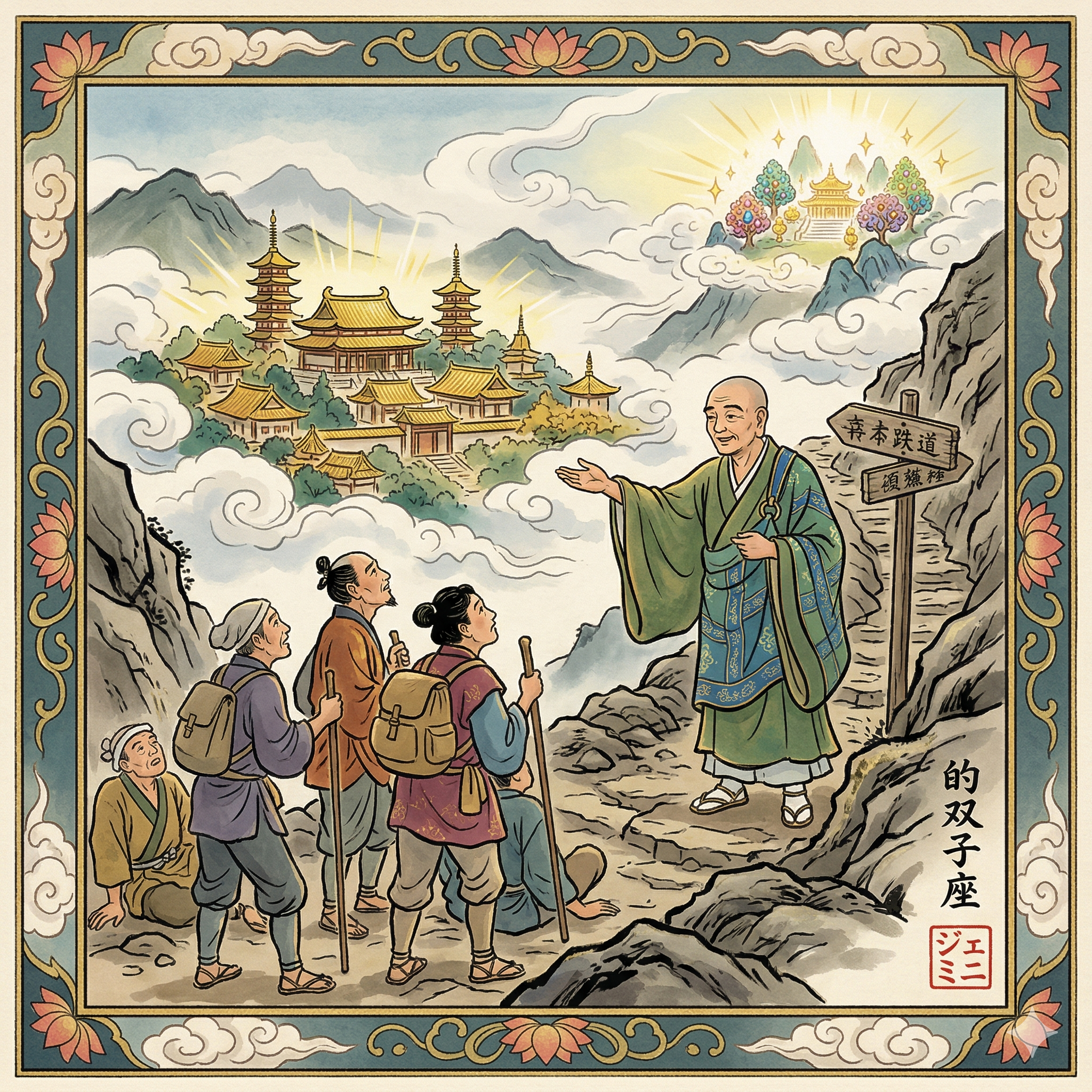
In this square illustration, the Parable of the Magic City is rendered in a traditional Japanese Buddhist iconographic style. The scene captures the pivotal moment from the Lotus Sūtra where the compassionate guide encourages the group of four weary travelers. The guide is depicted in a traditional green and blue monk's robe, with his left arm pointing toward a radiant "Magic City" that has appeared amidst cloud-capped mountains. This intermediate destination, featuring prominent pagodas and golden roofs, symbolizes a place of resting and comfort. Farther above it, in the upper right, a second and more distant luminous realm is visible—the ultimate "place of treasures" representing true enlightenment.
The four travelers, appearing exhausted and resting upon a dangerous mountain path, are looking back toward the guide, illustrating their fatigue and desire to abandon their journey. Next to them, a trail marker points back down the difficult "Tough Road."
The text on the road signs says:
The top sign (left arrow): 尋雪峰庵 (Seeking Snowy Peak Hermitage)
The bottom sign (right arrow): 須彌驛 (Sumeru Station)
The artist’s signature is located in the bottom right: the kanji 双子座 (Futagoza, meaning "Gemini"), alongside a red hanko seal containing the katakana ジェミニ (Jemini). The entire illustration is framed by a stylized decorative border featuring lotus flowers.
He said to them, ‘Do not be afraid! Do not go back! You can stay in that great city, and do anything you like. If you enter that city, you will be peaceful. If you go on afterwards and reach the place of treasures, then you can go home.
This is part of the Parable of the Magic City, told by Śākyamuni Buddha in Chapter Seven of the Lotus Sūtra. In the story, a guide is leading a group of travelers through a dangerous road to a city of treasures. Halfway through the trip, the travelers, overcome by their fear and fatigue, consider giving up their journey and returning to their previous lives. The guide makes a resting place for them where they can relax before continuing. When the travelers mistake this resting place for their destination, the guide makes the city disappear so that they will keep moving towards the true treasures. The Buddha compares himself to the guide, us to the travelers, the magic city to that place we all want where even our unspoken desires are met, and his enlightenment to the city of treasures. To see the world as it is and find true happiness, we need to let go of our delusions and keep faith in our guide and his highest teaching.
The Daily Dharma is produced by the Lexington Nichiren Buddhist Community. To subscribe to the daily emails, visit zenzaizenzai.com