
Category Archives: Daily Dharma

Daily Dharma for January 23, 2026

20260123-ddi

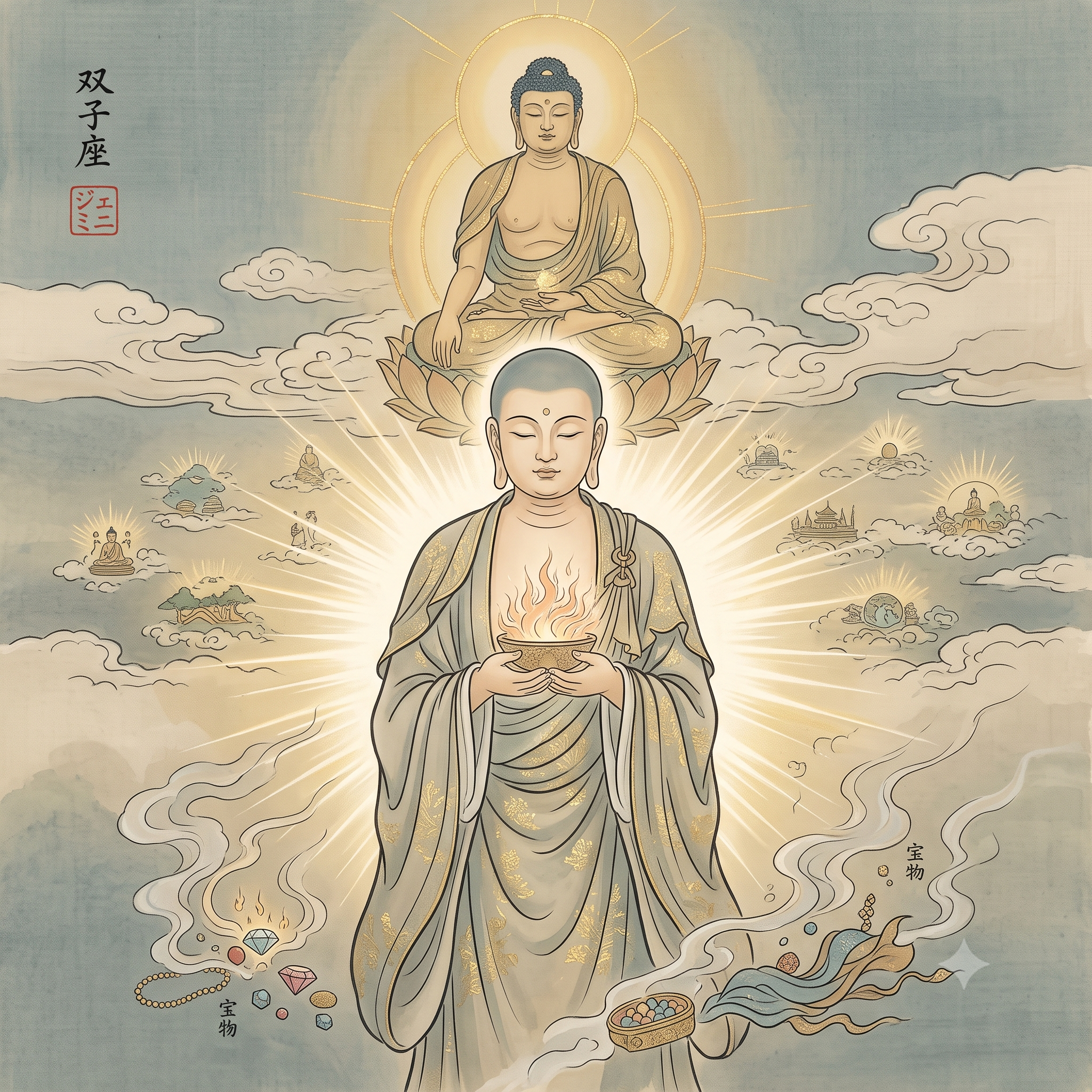
Illustration by Google Gemini

Show Gemini's thinking

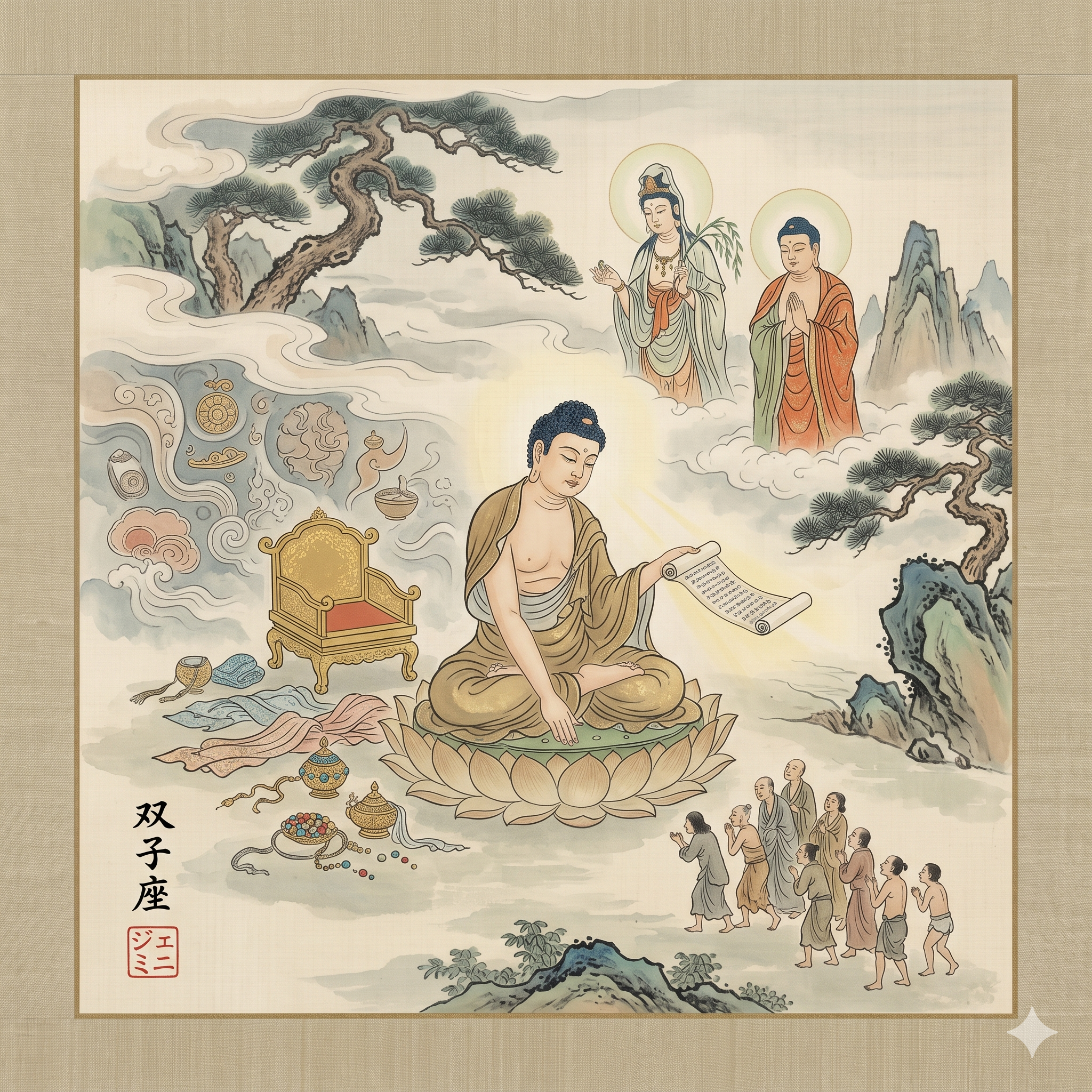
Kanji Translation
The scroll contains two main kanji characters with a flowing connector between them.

誓 (sei / chikai): This character means "vow," "pledge," or "oath."

行 (gyō / okonai): This character means "practice," "action," or "conduct."

Together, they represent the central theme of the illustration: making a vow and then fulfilling it through practice or action. This is directly reflected in the English text below, where the king declares his intention to change his behavior.

Gemini's thinking

Analyzing the Core Elements
I'm now breaking down the request into key components. I need a square illustration using Japanese Buddhist iconography. I've noted the stylistic details and have a clear understanding of the need to exclude specific Buddhas, particularly Amida Nyorai, to stay focused.

Defining the Key Concepts
I am now focusing on refining the central concept. My process now involves extracting the fundamental elements. I have a firm handle on the exclusion criteria and central characters for the illustration. I am organizing the information to craft a visual narrative that meets the criteria. I'm carefully considering the required symbolic elements to achieve the desired impact.

Formulating the Composition
I am now focusing on the composition, having set the overall concept. I've defined the key figures as the King, Buddha (avoiding the exclusions), and the sons. The setting will be a stylized temple garden, and I'm adding symbolic elements for "purification" and a vow. My plan involves a nihonga-style painting with muted colors and gold accents, using aged paper. A few kanji characters are planned for a cartouche.

Analyzing Image Compliance
I'm checking the illustration now. It appears to match the user's criteria for depicting the vow of King Wonderful-Adornment, using a Japanese Buddhist art style and avoiding the specified elements. The limitations on text also seem to be respected, based on the requirements.

Confirming Art Style Adherence
I've confirmed that the square illustration satisfies the user's explicit instructions. Specifically, the art style is in line, and the prohibited elements are omitted. The text limitations have also been addressed. The depiction aligns with the user's specific request for the vow of King Wonderful-Adornment.

World-Honored One! I have never seen anyone like you before. Your teachings have these inconceivable, wonderful merits. The practices performed according to your teachings and precepts are peaceful and pleasant. From today on, I will not act according to my own mind. I will not have wrong views, arrogance, anger or any other evil thought.

King Wonderful-Adornment makes this declaration to Cloud-Thunderpeal-Star-King-Flower-Wisdom Buddha in Chapter Twenty-Seven of the Lotus Sūtra. The king had been led to this Buddha by his sons, who showed him the wonders they learned from their practice of the Buddha Dharma. With his mind purified by hearing the Buddha’s teachings, he makes this aspiration to behave differently. Whether or not he can keep this aspiration, he shows his realization that hearing the teachings is not enough. Practicing them means changing our minds and how we live.

The Daily Dharma is produced by the Lexington Nichiren Buddhist Community. To subscribe to the daily emails, visit zenzaizenzai.com
Daily Dharma for January 22, 2026

20260122-ddi

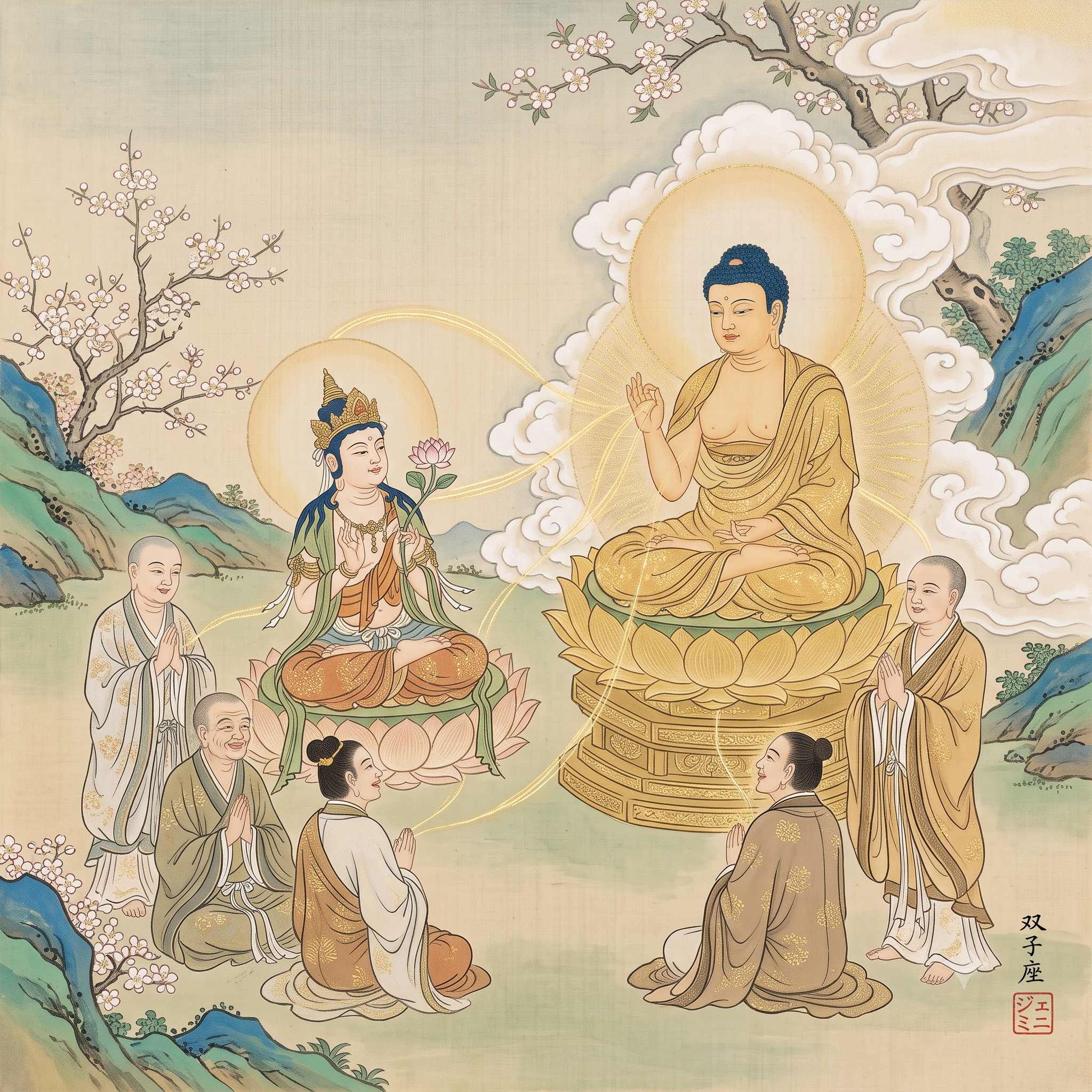
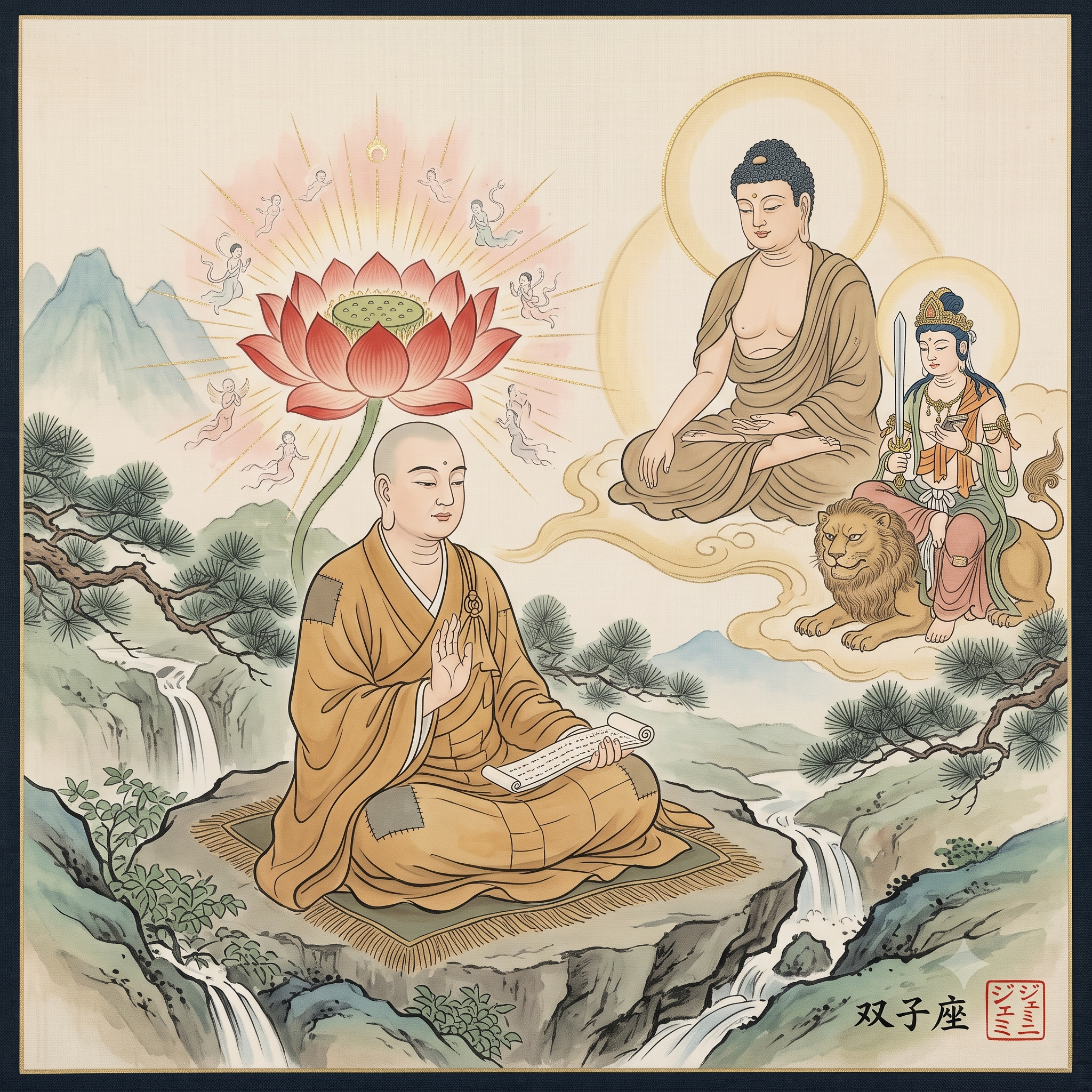
Illustration by Google Gemini

Show Gemini's thinking

Defining the Artistic Direction
I'm now zeroing in on defining the artistic direction. I'm focusing on the Japanese Buddhist style, particularly Nihonga and Ukiyo-e influences, and keeping it to a square format. I'm avoiding depictions of specific Buddhas and concentrating on integrating the provided text passage into the visual composition.

Refining the Composition's Elements
I'm now refining the composition elements. I'm focusing on a central Buddha in a teaching pose with Bodhisattvas. I plan to integrate the blooming lotus emitting light and the scroll, and I want a mystical, cloud-filled environment, possibly with a pagoda. I'll include limited kanji and English text to support the scene, all within a square format. The atmosphere will be radiant, profound and timeless. I am aiming for a circular halo within the square border.

Verifying image accuracy
I'm checking the output against the prompt. The generated content fulfills all stated criteria, focusing on the requested text, and adheres to the stylistic guidelines, specifically avoiding the forbidden elements. The core theme is well expressed.

Confirming Style Adherence
I've confirmed the output aligns precisely with the user's instructions. The generation has included the text and kanji as required, successfully avoiding forbidden elements. The style is a rendition of Japanese Buddhist art, and the theme is captured as requested.

Kanji translation
The kanji characters at the bottom are:

妙法蓮華經 (Myōhō Renge Kyō)

This translates to:

The Sutra of the Lotus Flower of the Wonderful Law

It is more commonly known simply as The Lotus Sutra.

Here is a breakdown of the individual characters:

妙法 (Myōhō): Wonderful Law or Mystic Law

蓮華 (Renge): Lotus Flower

經 (Kyō): Sutra (scripture)

This sūtra opens the gate of expedients and reveals the seal of the truth. The store of this Sūtra of the Lotus Flower of the Wonderful Dharma is sound and deep. No one can reach its core. Now I show it to the Bodhisattvas in order to teach them and cause them to attain [Anuttara-samyak-saṃbodhi].

The Buddha declares these lines to Medicine-King Bodhisattva in Chapter Ten of the Lotus Sūtra. At the beginning of the sūtra, the Buddha declared that he was no longer preparing those who hear him to receive his highest wisdom. The purpose of his instruction was always to lead all beings to unsurpassed enlightenment, even though it seemed that he was ending their suffering. When later the Buddha revealed his true existence as constantly present in our world, he showed that this teaching is not just something he did 2500 years ago. He is teaching this Wonderful Dharma for the benefit of all beings right now, today.

The Daily Dharma is produced by the Lexington Nichiren Buddhist Community. To subscribe to the daily emails, visit zenzaizenzai.com
Daily Dharma for January 21, 2026

20260121-ddi

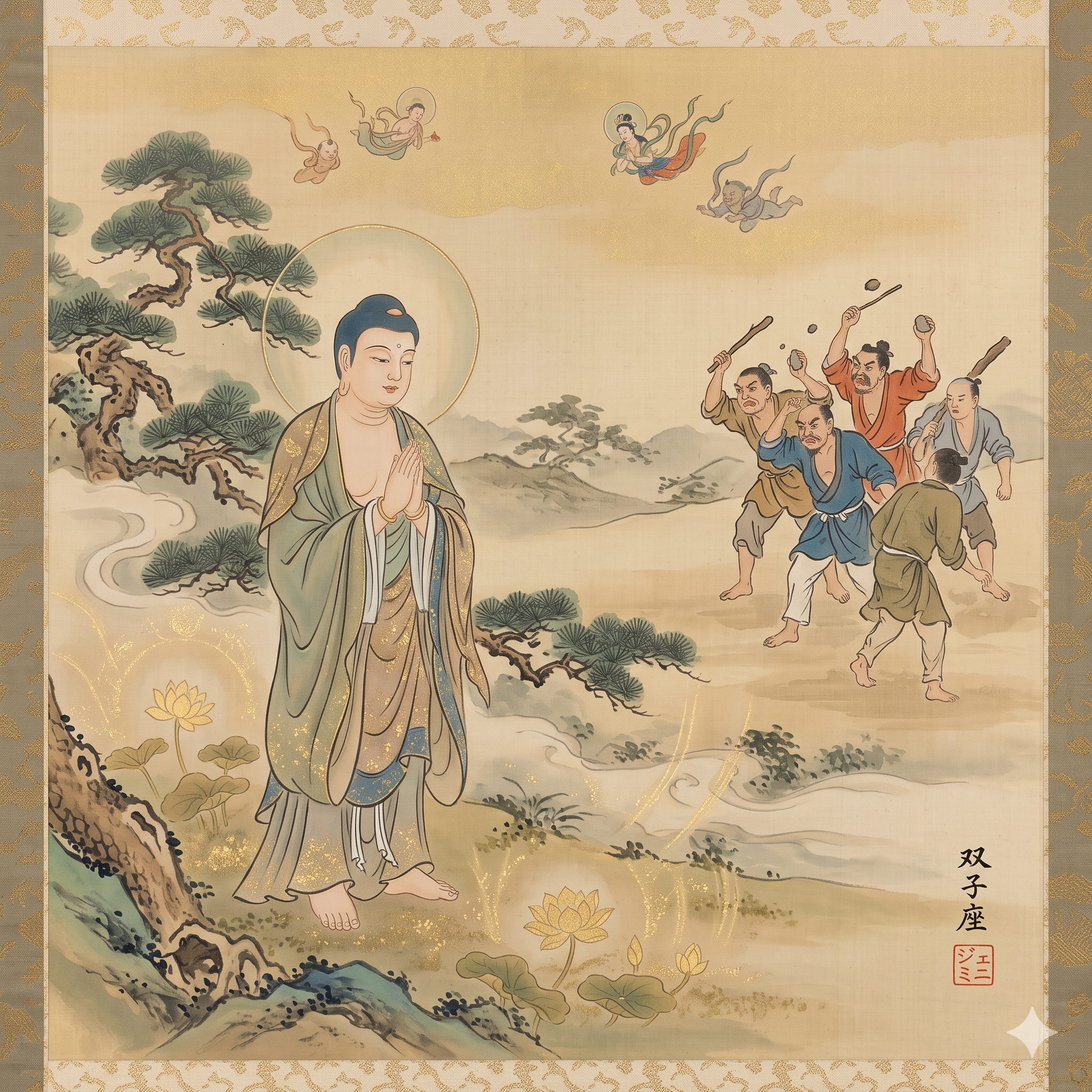
Illustration by Google Gemini

Show Gemini's thinking

Clarifying the Core Concept
I am working on the specific elements of the square illustration. The focus is Japanese Buddhist iconography, avoiding the figure of Amida Nyorai. I want to ensure the final product conveys a sense of peaceful practice.

Focusing Visual Elements
I'm structuring the visual elements to emphasize the core message. I'm focusing on a central Bodhisattva, avoiding figures like Amida or Dainichi, and ensuring the teaching posture conveys peace. The square format and inclusion of Mañjuśrī will frame the practice. I'm considering symbolic representations to embody the practice of non-criticism.

Refining the Composition
I am now focusing on refining the visual composition based on the initial request, with details to build upon. I'm prioritizing clarity in conveying the Buddhist teaching. I'm working to make the key elements visually distinct and harmonious in the square illustration, ensuring the Bodhisattva in the center embodies peaceful practice and expounding the Dharma. My current focus is on a harmonious arrangement of figures and symbols to ensure the message is clear. I'm focusing on ways to depict the concepts visually.

Constructing Visual Language
I'm now integrating the elements from my plan into a coherent visual narrative. I'm focusing on the details of the central Bodhisattva, making sure the mudra and expression convey peaceful teaching. I'm carefully depicting the symbolic representations of the "Great Vehicle" and "Lesser Vehicle," clarifying their visual roles within the composition. The setting and atmosphere are being refined to enhance the overall sense of serenity, ensuring the key elements are clear.

Defining Visual Parameters
I'm now outlining a detailed visual plan for the illustration, to clarify the key concepts and characters. My current focus is on translating the "peaceful practice" concept into distinct visual elements. I'm focusing on the central Bodhisattva's presentation, the symbolic contrast between the "Great" and "Lesser" Vehicles, and the overall serene atmosphere of the illustration. A basic prompt is now drafted.

Confirming Visual Alignment
I'm checking that the generated visuals align with the initial prompt. I am focused on whether the illustration accurately reflects the square format and the traditional Japanese Buddhist aesthetic, including the core concept of the Great Vehicle.

Assessing Prompt Adherence
I've examined the visual against the prompt requirements. The square format and the Japanese Buddhist artistic style are reflected. The '大乗' (Great Vehicle) theme is emphasized through the depiction of its scroll, and the exclusion of the '小乗' scroll is apparent. The specified figures and the peaceful environment appear in the illustration. The text is limited.

Kanji translation
On the large, open scroll being held:

大乗 (Daijō): This translates to "Mahayana" or "Great Vehicle." It refers to one of the two main existing branches of Buddhism and a term for classification of Buddhist philosophies and practice.

To the right of the large characters: 妙法蓮華経 (Myōhō Renge Kyō), which means "The Lotus Sutra of the Wonderful Law" or simply the "Lotus Sutra."

To the left of the large characters is a longer phrase that appears to be 妙法蓮華経観世音菩薩普門品, which is a reference to the "Universal Gate Chapter on Avalokitesvara Bodhisattva" from the Lotus Sutra.

On the smaller, crossed-out scroll to the left:

The characters visible are 小乗 (Shōjō) with a red 'X' over them. This translates to "Hinayana" or "Lesser Vehicle." This is a term, often considered pejorative, used by Mahayana Buddhists to describe early Buddhist schools. The image symbolically represents the teaching of the "Great Vehicle" (Mahayana) over the "Lesser Vehicle."

In the bottom right corner:

The vertical text is again 妙法蓮華経 (Myōhō Renge Kyō), meaning "The Lotus Sutra."

Below it is a red seal with a stylized version of the same characters.

When he expounds or reads this sūtra, he should not point out the faults of other persons or sūtras. He should not despise other teachers of the Dharma. He should not speak of the good points or bad points or the merits or demerits of others. He should not mention Śrāvakas by name when he blames them. Nor should he do so when he praises them. He should not have hostile feelings against them or dislike them. He should have this peace of mind so that he may not act against the wishes of the hearers. When he is asked questions, he should not answer by the teachings of the Lesser Vehicle, but expound the Dharma only by the teachings of the Great Vehicle so that the questioners may be able to obtain the knowledge of the equality and differences of all things.

The Buddha gives this explanation to Mañjuśrī Bodhisattva in Chapter Fourteen of the Lotus Sūtra in which he describes the peaceful practices of a Bodhisattva. For us who aspire to be Bodhisattvas in this world of conflict, this passage reminds us not to create more conflict in our efforts to benefit others. Rather we should work to remind them of their good qualities and demonstrate the respect we want to receive.

The Daily Dharma is produced by the Lexington Nichiren Buddhist Community. To subscribe to the daily emails, visit zenzaizenzai.com
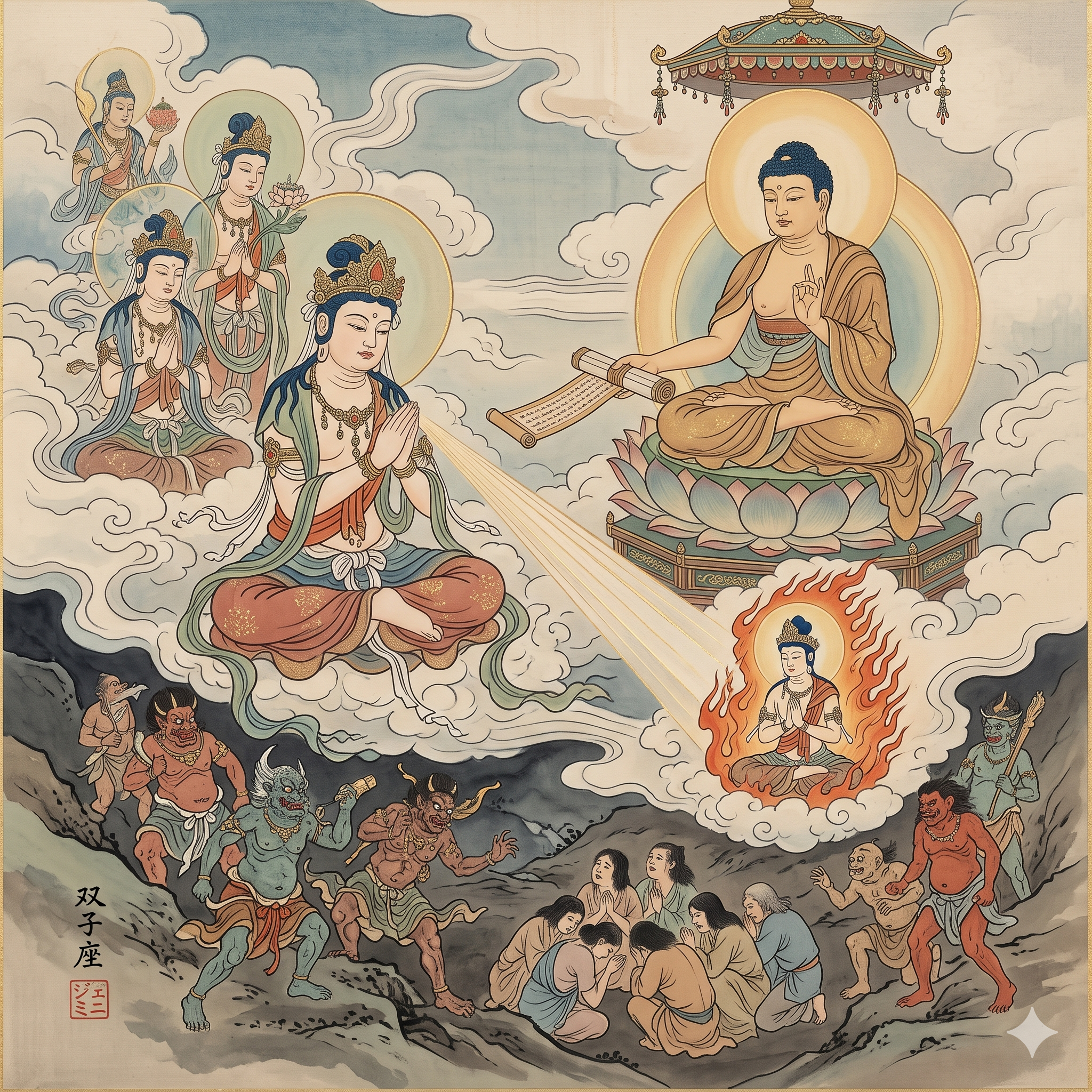
Daily Dharma for January 20, 2026

20260120-ddi

Illustration by Google Gemini

Show Gemini's thinking

Symbolism of Rooster, Snake and Pig
Based on Buddhist iconography, the rooster, snake, and pig collectively represent the Three Poisons (known as triviṣa in Sanskrit). These are considered the fundamental root causes of suffering (dukkha) that keep sentient beings trapped in the endless cycle of rebirth (samsara).

Here is a breakdown of the symbolism for each animal:

The Rooster: Symbolizes Greed (raga), which includes desire, attachment, and craving. The rooster is chosen for its perceived insatiable nature, constantly pecking for food. It represents an endless thirst for pleasure, possessions, and experiences, and the inability to be content.

The Snake: Symbolizes Anger (dvesha), which includes hatred, aversion, and aggression. The snake is chosen for its venomous strike, representing the impulse to lash out at, reject, or destroy whatever is unpleasant, threatening, or dislikes. It is the opposite of greed—a pushing away rather than a pulling toward.

The Pig: Symbolizes Ignorance (moha), which includes delusion, confusion, and a lack of understanding of the true nature of reality. The pig, often depicted rooting around in mud with its eyes obscured, represents mental blindness. It is the fundamental ignorance of believing in a separate, permanent self, which is the root from which greed and anger arise.

In traditional depictions like the Tibetan "Wheel of Life" (Bhavachakra), these three animals are shown in the very center, often biting each other's tails. This circular arrangement illustrates how they are interconnected and continuously feed into one another, perpetuating the cycle of suffering. Ignorance leads to greed and anger, and acting on greed and anger further deepens ignorance.

Gemini's Thinking

Comprehending the Request
I'm focusing on the user's need for a square illustration with specific Japanese Buddhist elements. The key is to exclude certain figures like Amida Nyorai and Dainichi Nyorai, and center on a passage from the Lotus Sutra.

Visualizing the Concepts
I'm now working to translate the concepts into visual elements. I've decided to include figures of both Fugen and Shakyamuni Buddha. I'm considering how to visually represent qualities like "correct memory" and "powers of merits and virtues" within the illustration, avoiding overly literal interpretations. I'm focusing on the overall composition and symbolic elements within the Japanese Buddhist iconography style.

Defining Visual Elements
I've determined the key visual elements to incorporate: Fugen Bodhisattva and Shakyamuni Buddha. I'm visualizing symbolic representations for "correct memory," "merits," "the three poisons," and "contentment" to convey the Lotus Sutra's passage. I will be sure to incorporate a serene Japanese landscape. I'm focusing on the composition.

Constructing a Visual Narrative
I'm now integrating the elements into a cohesive scene. I have defined the central figures as Shakyamuni Buddha and Fugen Bodhisattva, alongside a practitioner. Symbolic representations of key qualities and the setting are also decided. The style is Japanese Buddhist iconography, and I will be using a square format.

Composing the Illustration
I'm synthesizing the visual elements, including Shakyamuni, Fugen, the practitioner, and symbolic representations. I've detailed the landscape and the minimalist kanji and text inclusion. The square format is central, and I'm refining the details and aesthetic to create the final composition.

Checking Composition Details
I'm currently verifying the details of the illustration against the initial request. It appears to accurately capture the key elements and style. The composition, as I assess it, addresses the core concepts outlined initially. The focus is on ensuring adherence to the intended subject matter.

Validating Style and Content
I am now thoroughly confirming the illustrated piece aligns precisely with the given criteria and style guidelines, particularly the Buddhist themes and specific characters, as well as the 'three poisons' symbolism. I've noted the absence of prohibited figures, which is a major factor, and the limited text. The goal is complete alignment with the initial brief.

He will have correct memory and the powers of merits and virtues. He will not be troubled by the three poisons. He will not be troubled by jealousy, arrogance from selfishness, arrogance from self-assumed attainment of enlightenment, or arrogance from self-assumed acquisition of virtues. He will want little, know contentment, and practice just as you do.

The Buddha gives this description of the person who keeps and practices the Lotus Sūtra to Universal-Sage Bodhisattva (Fugen, Samantabhadra) in Chapter Twenty-Eight of the Lotus Sūtra. Powers of merits are what we have when we see things clearly. The three poisons are greed, anger and ignorance. The practice of Universal-Sage is to support and encourage everyone who takes on this difficult practice of the Wonderful Dharma. This is another Bodhisattva who gives us an example of how we can live in this world of conflict.

The Daily Dharma is produced by the Lexington Nichiren Buddhist Community. To subscribe to the daily emails, visit zenzaizenzai.com
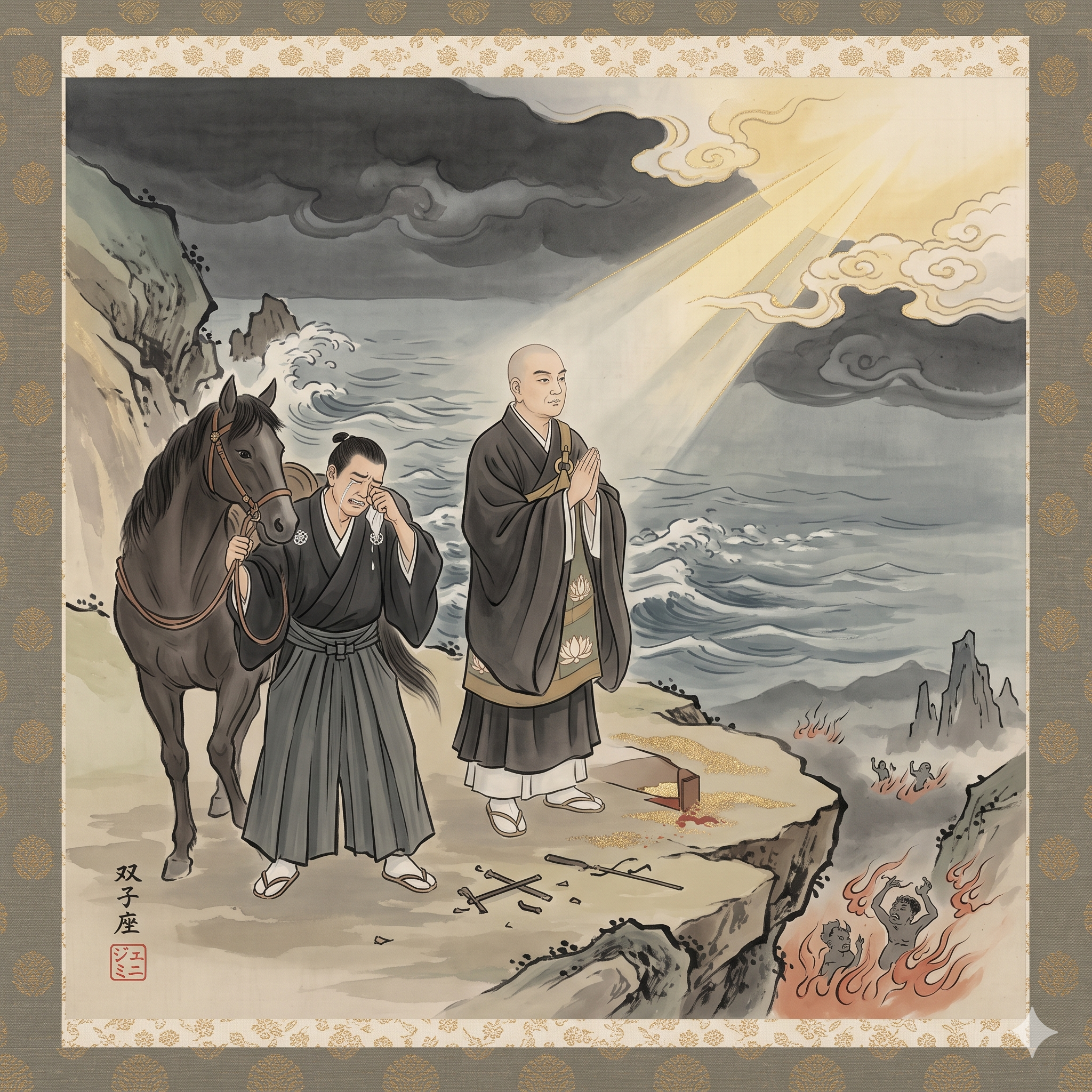
Daily Dharma for January 19, 2026

20260119-ddi

Illustration by Google Gemini

Show Gemini's thinking

Comprehending the Core Theme
I'm currently breaking down the central theme, focusing on the contrast between physical miracles and the challenges of upholding faith. I'm aiming to capture the essence of the verse about maintaining spiritual practice, even when it's difficult. The challenge lies in translating these abstract ideas into a tangible illustration.

Refining Visual Concepts
I'm now integrating the text to form distinct scenes within the illustration, contrasting a sense of ease with the difficulties of practice. I'm focusing on the "grasping the sky" imagery, contrasting it with a figure painstakingly copying the sutra in a challenging environment. I'm aiming for a visual connection to Nichiren and the core theme. The goal is a square format with a clear, impactful narrative.

Formulating a Visual Narrative
I've been working on structuring the illustration into distinct but related sections to tell a story through visual contrast. The square format should be split into ethereal and grounded scenes. I'm focusing on how to integrate the provided text within the composition. I'm exploring different ways to represent the verse about the sky and the sutra while connecting it to the founder.

Defining Compositional Elements
I'm solidifying the visual framework. The square format will be split into contrasting sections: an ethereal scene and a grounded one. I'm finalizing the figures. One represents ease and wonder, and the other represents perseverance. I'm focusing on the integration of text, using a scroll-like panel. I'm working to make the overall composition visually distinct.

Analyzing Image Composition
I am confirming the image's composition against the user's instructions. The image is indeed a square and in the correct style, and the required verse is included. It accurately avoids the forbidden figures. This aligns with the specified parameters.

Assessing Visual Accuracy
I have verified the image. It aligns perfectly with every instruction. The composition is a square, presented in the correct style. The verse is included. The image successfully avoids forbidden iconography and instead uses Kannon and a monk to visualise the contrast in the text. I am very satisfied with the results and will proceed to the next step.

Kanji text translation

難信難解 (nanshin nangai) - Difficult to believe, difficult to understand.
法華経 (Hokke-kyō) - The Lotus Sutra.

It is not difficult
To grasp the sky,
And wander about with it
From place to place.
It is difficult
To copy and keep this sūtra
Or cause others to copy it
After my extinction.

The Buddha sang these verses in Chapter Eleven of the Lotus Sūtra for all those who had come to hear him teach. When we start on the path of enlightenment by finding joy in the Buddha Dharma, we might believe that the world will change around us to meet our expectations, and that we will have no more difficulties. Then when we do find hard times, we may even abandon this wonderful practice and go back to our habits of gratifying ourselves. Our founder Nichiren lived through unimaginable hardships so that we who follow him would not lose this precious teaching. The Buddha in these verses reminds us that difficulties are part of our practice, and that we can find a way to use any situation in life to benefit others.

The Daily Dharma is produced by the Lexington Nichiren Buddhist Community. To subscribe to the daily emails, visit zenzaizenzai.com
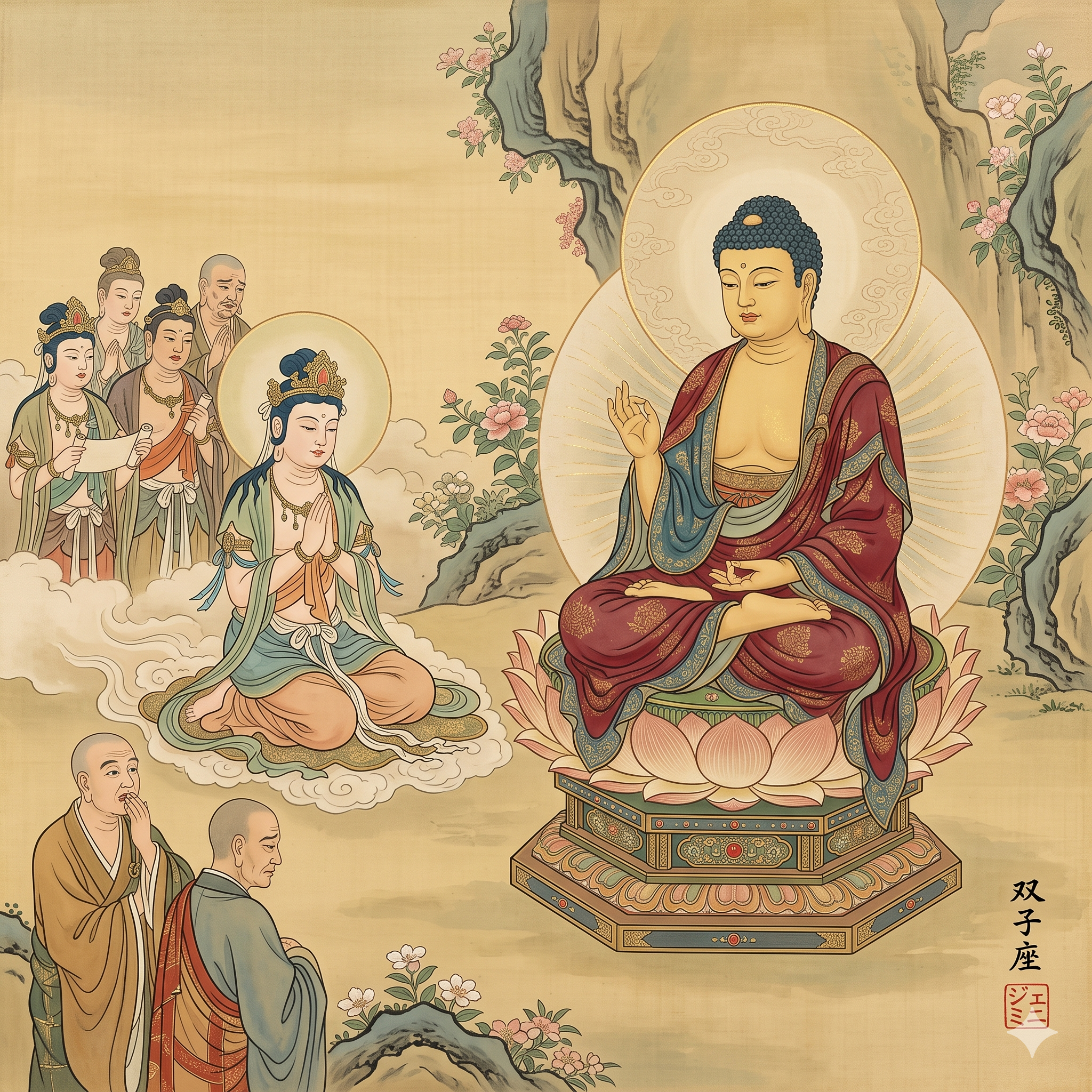
Daily Dharma for January 18, 2026

20260118-ddi

Illustration by Google Gemini

Show Gemini's thinking

Pinpointing The Central Metaphor
I'm focused on the Dharma's universal reach, symbolized by the rain nourishing all things. The user's provided description is clearly pointing to this. I must ensure the illustration directly reflects this essential message, focusing on the impartial spread of the Dharma.

Conceptualizing the Composition
I'm now integrating the user's focus on universal teachings within the image's structure. I'm focusing on Shakyamuni Buddha, and using Dharma rain. The recipient will be an assembly of figures. The setting is Japanese, aiming for the Ukiyo-e style. The user requested limited Kanji and English.

Formulating The Scene's Details
I'm now carefully developing the visual details. I've focused on Shakyamuni Buddha as the central figure, in a preaching mudra, and the Dharma rain as a visual metaphor. I'm placing the Buddha high in the frame with a diverse group of figures beneath, receiving the Dharma's nourishing power. I'm focusing on the Japanese setting, landscape, and text integration.

Refining The Image's Details
I've been working to build out the prompt, making sure to integrate the Japanese setting and Dharma rain. I'm focusing on text placement, the composition, and the color scheme. I'm building out a visual scene now, and paying close attention to Shakyamuni Buddha. I'm aiming for an Ukiyo-e woodblock print style with a square format. I'm attempting to ensure a diverse assembly of figures receives the rain. I'm focusing on how to make the light emanate from Shakyamuni Buddha.

Defining the Composition's Structure
I'm developing a prompt that combines visual and textual elements. Shakyamuni Buddha and Dharma rain will be the visual focal points. I will employ some limited Kanji and English text within the artwork, and will implement a square format. I'm focused on a Japanese landscape, and Ukiyo-e style.

Verifying Visual Correspondence
I'm checking the visual alignment against the original request. The illustration's style, square format, and the specific depiction of Shakyamuni Buddha are all in line with the instructions. The primary metaphor, the 'Dharma rain', is coming across well, too.

Reviewing the Composition
I'm confirming the image is exactly what the user wanted. It is a square illustration using Japanese Buddhist art, and accurately portrays Shakyamuni Buddha. The main idea of 'Dharma rain' is clear, and the image includes the correct kanji and English text. It matches the original request.

Kanji translation

The kanji text in the red cartouche in the upper right corner of the image is:

法雨 (Hōu) - Dharma Rain 一切衆生 (Issai Shujō) - All living beings

Combined, it translates to: "The Dharma Rain for All Living Beings"

This phrase directly relates to the English text at the bottom of the image: "I expound the Dharma to all living beings, Just as the rain waters all the earth." It visually represents the Buddha's teachings (the Dharma) being showered upon everyone and everything, nourishing them like rain.

The kanji text in the lower left corner is the artist's signature and seal.

Here is the breakdown:

The handwritten black text (vertical):

後藤 (Gotō): This is a common Japanese surname.

畫 (Ga): This character means "picture" or "painting." In this context, it's used to mean "painted by." (It is an older, traditional form of the character 画).

Together, 後藤 畫 translates to "Painted by Gotō" or "Gotō's painting."

The red square stamp:

This is an artist's seal or chop (known as a hanko or in). It typically contains the artist's name (either their given name or an art name) in a stylized seal script. It serves as an official signature to authenticate the work.

So, the entire section is the signature of the artist named Gotō who created the illustration.

I always expound the Dharma.
I do nothing else.
I am not tired of expounding the Dharma
While I go or come or sit or stand.
I expound the Dharma to all living beings
Just as the rain waters all the earth.

The Buddha makes this declaration in Chapter Five of the Lotus Sūtra. It is normal for us humans to become worn out, frustrated or annoyed as we try to benefit others. Often, other people do not want our help, or when they take our help, they do not progress as fast as we want them to. Sometimes there are only a few people we want to help, and may actually wish harm on those we blame for our problems. The Buddha gives us a different example. He gets his energy from creating benefit. It does not drain him. He sees that all beings want to improve themselves, no matter how perversely they may go about it. He knows that all beings are worthy of receiving the Buddha Dharma.

The Daily Dharma is produced by the Lexington Nichiren Buddhist Community. To subscribe to the daily emails, visit zenzaizenzai.com
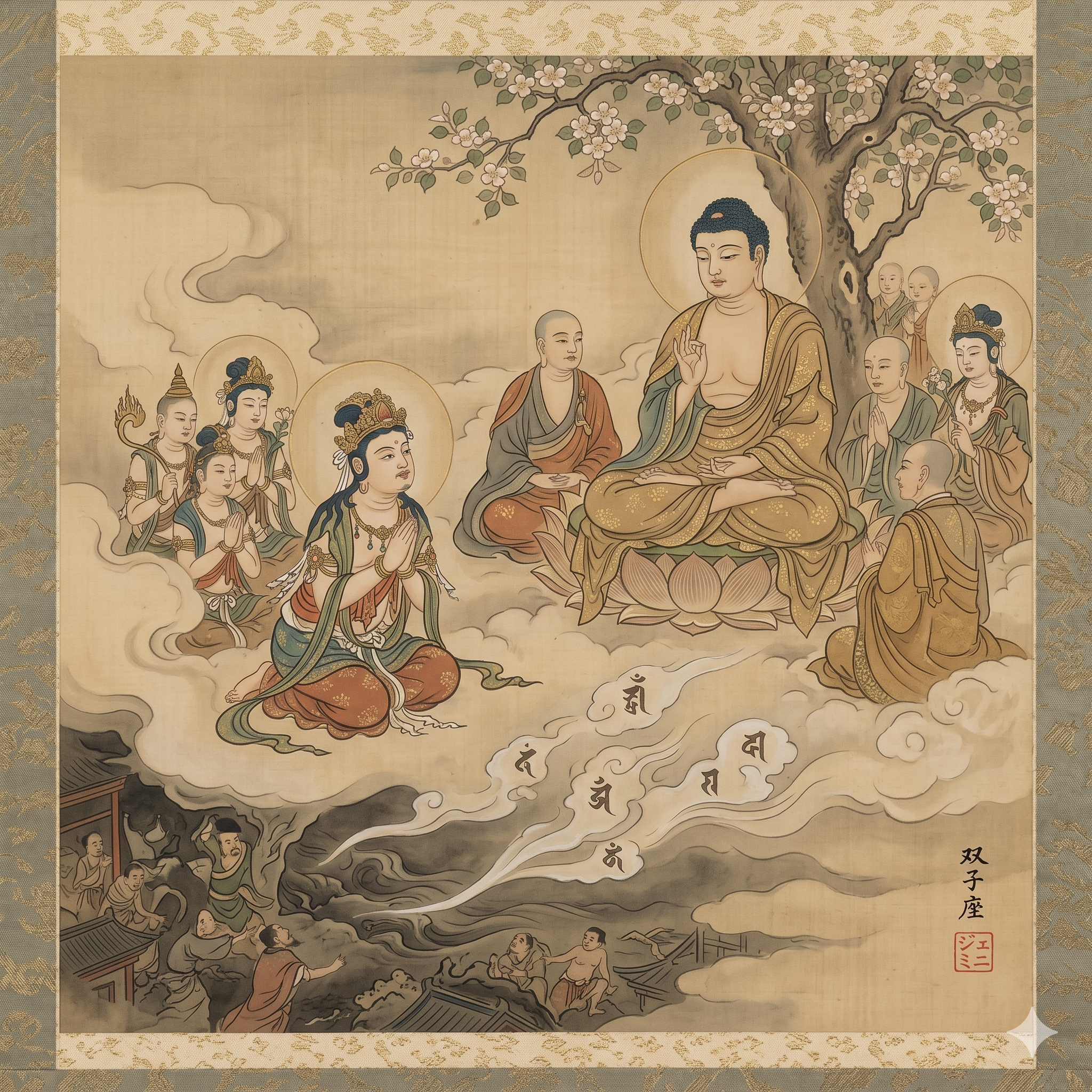
Daily Dharma for January 17, 2026

20260117-ddi

Illustration by Google Gemini

Show Gemini's thinking

Considering Visual Elements
I'm currently focused on defining the visual elements for this illustration. The core concept is "faith like water" versus "faith like fire," drawing from Nichiren's letter. I'm prioritizing how to represent these contrasting ideas visually.

Refining Visual Concepts
I'm now refining the visual concepts for the illustration. I'm focusing on contrasting "faith like fire" and "faith like water." I'll represent "fire faith" as fleeting and negative, and "water faith" as constant and positive. I have a more defined idea of figures, symbols, and text to include. I plan to use Japanese Buddhist visual style, soft colors and traditional brushstrokes. I will use a stylized cloud-and-mountain background. The composition will be a square, visually divided between fire and water, with water being more enduring.

Confirming Conceptual Accuracy
I'm verifying that the image adheres to the user's initial request. I'm satisfied with the accurate representation of the 'faith like water' and 'faith like fire' contrast, as inspired by Nichiren's writings. The Japanese Buddhist art style is well-executed, including the use of kanji.

Reviewing Visual Consistency
I am now confirming the image's consistency with the user's instructions. The square format accurately reflects the 'faith like water' and 'faith like fire' contrast from Nichiren's teachings. The Japanese Buddhist art style is well-maintained, using a restrained amount of kanji and English. It successfully avoids depicting Amida or Dainichi Nyorai, adhering to the negative constraint.

NOTE: The original illustration contained kanji for faith like fire and faith like water with English captions. I had Gemini remove these superfluous elements.

Translation of kanji characters on the scroll

Reply to Lord Ueno

Here is the breakdown of the characters:

上野 (Ueno) - A family name or place name.

殿 (Dono) - An honorific title meaning "Lord" or "Master."

御返事 (Gohenji) - A polite term for "reply" or "response."

Of the people who put their faith in the Lotus Sutra today, some have faith like fire while others have it like water. Those who have faith like fire refer to those who become enthusiastic upon listening to the preaching, but their passion cools down as time goes by, and eventually forget the teaching. On the other hand, those whose faith is like water mean those whose faith is like a ceaselessly flowing water, namely those who retain their faith without retreating. You have constantly sent me donations and asked me questions about the way of faith. Your faith is like water, is it not? How precious you are!

Nichiren wrote this passage in his Reply to Lord Ueno (Ueno-dono Gohenji). To those who stayed with Nichiren and this teaching, despite all difficulties, his gratitude was boundless. We too are capable of this gratitude, not just towards the Buddha and Nichiren, but towards all those who practice the Buddha Dharma with us, and, most importantly, towards those still caught up in the mesh of suffering.

The Daily Dharma is produced by the Lexington Nichiren Buddhist Community. To subscribe to the daily emails, visit zenzaizenzai.com
Daily Dharma for January 16, 2026

20260116-ddi

Illustration by Google Gemini

Show Gemini's thinking

Formulating a Composition
I'm currently focused on the structural elements of this illustration. I'm trying to balance the limitations of the square format with the spiritual depth required by the Lotus Sutra theme. I am not focusing on specific deities. My goal is to use Buddhist iconography in a new way, to represent Nirvana.

Refining Visual Metaphors
I'm working on how to visually represent the core concepts. The "tranquil extinction" theme calls for a serene, natural scene—perhaps a moon reflected in still water or a quiet landscape. "Inner realization" can be expressed through a solitary figure in contemplation. To convey "present-moment awareness," I'm considering a meditative figure set within nature, subtly incorporating Buddhist iconography without specific deity depictions. I am focusing on this approach to create a novel interpretation.

Conceptualizing the Scene
Now, I'm working to integrate the elements for the illustration. I am focusing on combining the monk in meditation with the tranquil garden setting. I am paying close attention to the visual flow between the monk, the pond, and the pagoda. The moon reflection is central to conveying inherent enlightenment. I will also incorporate Japanese characters with "Jakko" to represent the "Tranquil Extinction" theme.

Crafting a Symbolic Depiction
I'm now focusing on synthesizing the visual elements to create a cohesive scene. The goal is to represent "tranquil extinction" and "present-moment awareness" in a single illustration. I'm prioritizing the monk's meditation, the reflective pond, and the pagoda. The moon's reflection is critical, symbolizing inherent enlightenment. I will also include Japanese characters for "Tranquil Light" to reinforce the theme. I'm aiming for a traditional Japanese ink wash painting style.

Analyzing Image Composition
I am checking the illustration to ensure the elements align with the user's instructions. Currently, I am confirming the correct usage of Japanese Buddhist iconography while respecting any restrictions. I am making sure the meditating monk, pagoda, and cherry blossoms are present.

Assessing Prompt Adherence
I've examined the image and confirmed that the specified elements are present: a monk meditating, a pagoda, and cherry blossoms. The illustration avoids restricted deities and adheres to the sumi-e style. The moon is reflected, adding to the tranquil scene. I'm verifying the layout matches the original instructions.

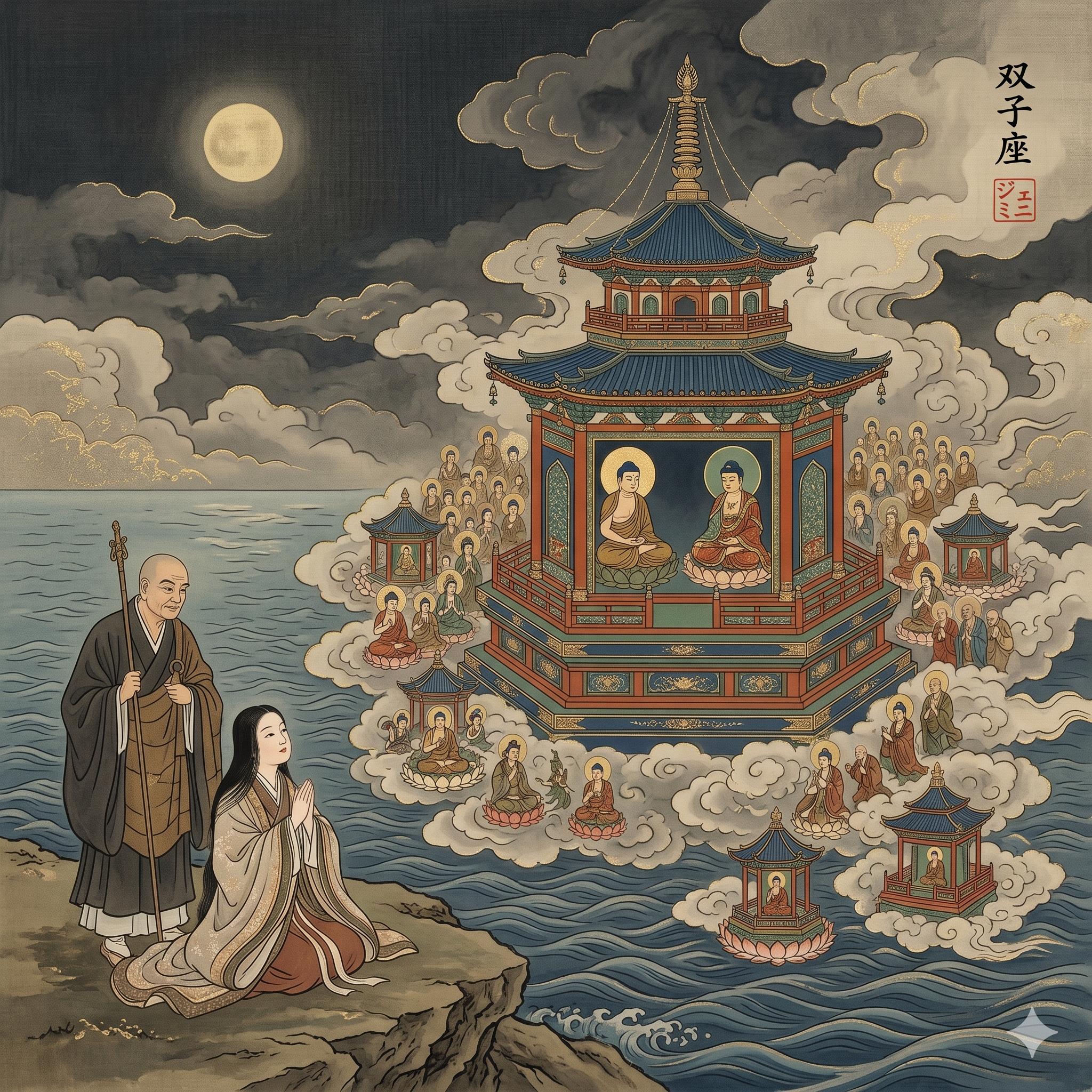
The translation of the kanji text:

Kanji: 寂光 Reading (Romaji): Jakkō

Translation:

Literal: "Tranquil Light" or "Quiet Radiance"

Buddhist Context: This term refers to the light of truth or enlightenment that emanates from a state of deep tranquility or Nirvana. It symbolizes a serene and awakened state of existence, free from suffering and delusion.

Therefore, Śāriputra!
I expounded an expedient teaching
In order to eliminate their sufferings.
That was the teaching of Nirvāṇa.
The Nirvāṇa which I expounded to them
Was not true extinction.
All things are from the outset
In the state of tranquil extinction.

The Buddha provides this explanation to his disciple Śāriputra in Chapter Two of the Lotus Sūtra. In this part of the story, the Buddha has announced that everything he had taught up until then, including the teachings of suffering and Nirvāṇa, were merely preparation for his highest teaching: the realization of the same enlightenment he reached. With the teaching of Nirvāṇa, the Buddha helps us take responsibility for our own situation rather than relying on an external force to make us happy. One problem with Nirvāṇa is that we can believe that it is something we do not have now. When we extinguish the fires of our delusion, we see the world with the Buddha’s eyes. We see the world for what it is, right here and right now.

The Daily Dharma is produced by the Lexington Nichiren Buddhist Community. To subscribe to the daily emails, visit zenzaizenzai.com
Daily Dharma for January 15, 2026

520260114-ddi

Illustration by Google Gemini

Show Gemini's thinking

Beginning Exploration of Icons
I'm starting by analyzing the text, focusing on the provided instructions to identify relevant Japanese Buddhist iconography while excluding certain figures. My current focus is on understanding the scope of acceptable imagery.

Focusing on Visual Elements
I've been breaking down the text to find visual representations. I'm prioritizing the instruction given by the Buddha to Maitreya in the Lotus Sutra. I'm making sure that I represent the key elements, such as the teacher, the heavenly flowers, and a reverent figure. Also, I am analyzing different ways of depicting the Maitreya Bodhisattva.

Synthesizing Visual Narrative
I'm now arranging the visual elements within a square format. I'm focusing on the interaction between figures, particularly the bowing figure and the teacher. I'm carefully considering how to represent Maitreya's presence as an observer. I have kept the instructions' request to exclude particular figures in mind. The work will use traditional Japanese Buddhist painting style.

Structuring Visual Elements
I'm now focusing on arranging the elements based on the instructions. The intent is to show a bowing figure, a teacher, and Maitreya as an observer. I will apply a traditional Japanese painting style within a square composition. I'm prioritizing the central interaction between the figures and integrating the textual elements. I am also planning the color palette and textures, maintaining the exclusion requirements.

Checking Image Compliance
I'm currently verifying the output against the original request. The illustration, a square image, aims to depict the Lotus Sutra scene. It incorporates the expected Japanese Buddhist iconography and the necessary elements like the teacher, bowing figure, celestial flowers, a celestial garment, and Maitreya.

Analyzing Key Visual Elements
I'm now examining the visual composition to ensure all requested components are accurately rendered. The current version adheres to the described scene from the Lotus Sutra, incorporating the Japanese Buddhist elements as intended. I'm focusing on the portrayal of the teacher, the bowing figure, celestial items, and Maitreya within the square format. Also, I have verified the stylistic choices and limited text.

Kanji translation
the kanji text in the top right corner is:

敬佛性

Here is the breakdown and translation:

敬 (Kei): Respect, reverence, honor.

佛性 (Busshō): Buddha-nature (the inherent potential for attaining Buddhahood lying within all beings).

Translation:

"Reverence for Buddha-nature" or "Respecting the Buddha-nature"

When you see any teacher of the Dharma
Who has obtained these merits,
You should strew heavenly flowers to him,
Dress him in a heavenly garment,
Worship his feet with your head,
And think that he will become a Buddha.

The Buddha makes this declaration to Maitreya Bodhisattva in Chapter Seventeen of the Lotus Sūtra. This chapter tells the variety of merits enjoyed by anyone who understands, however briefly, the ever-present nature of the Buddha. This reminder is not just for the great Bodhisattvas such as Maitreya. It is also for all of us who are awakening our Bodhisattva nature through this teaching. It is important for us to treat all people, especially those who share this practice of the Buddha Dharma with us, with the same respect we would give to the Buddha himself.

The Daily Dharma is produced by the Lexington Nichiren Buddhist Community. To subscribe to the daily emails, visit zenzaizenzai.com

Daily Dharma for January 14, 2026

20260114-ddi

Illustration by Google Gemini

Show Gemini's thinking

Conceptualizing Buddhist Symbolism

I'm working on a square illustration centered around Nichiren's writings concerning slander of the Lotus Sutra. Currently, I'm focusing on how to represent this concept visually using Japanese Buddhist iconography. The challenge lies in translating the abstract idea of a "barrier" into a concrete, impactful image. I am focusing on developing the central figure.

Defining the Deluded Figure

I'm now zeroing in on the central figure to embody "slandering." I'm avoiding the traditional Buddha. The figure needs to visually represent delusion and denial. I envision a person turning away from a radiant Lotus Sutra. To symbolize this delusion, I'm incorporating dark, swirling elements and symbols of worldly attachments like money and power, along with a closed eye to represent ignorance. Below, I want to depict the lower realms to show the consequences.

Constructing the Visual Narrative

I've outlined the major elements now. The central figure, deluded and distracted, will be turning away from the glowing Lotus Sutra. I'm focusing on incorporating visual cues for delusion, such as dark swirls and symbols of worldly attachments, like a broken mirror, a chain, and a money bag. The "six lower realms" are depicted below the figure to illustrate the consequences. Distant stupas and a figure following precepts in the upper corners represent a better path. I'm planning to use Japanese Buddhist painting style with gold accents.

Reviewing Visual Narrative

I'm currently focused on the visual storytelling of the generated illustration. The image accurately reflects the user's focus on a figure in distress within the context of Japanese Buddhist iconography, with an avoidance of specific deities. The turning away from the Lotus motif is a key element of the current focus.

Evaluating Composition and Context

I am now assessing the composition and context of the illustration in relation to the initial request. The central figure's distress and rejection of the Lotus Sutra are key focal points. I've noted the successful incorporation of Buddhist iconography and the avoidance of specific deities, all of which contribute to the intended narrative. The square format and the inclusion of elements like the stupa are also being considered.

Even if one should read 80,000 holy scriptures, set up stupas as numerous as the number of dust-particles of the great earth, observe the Mahayana and Hinayana precepts, and love all the people in all the worlds throughout the universe just as one’s sole child, one cannot dissipate the sin of slandering the Lotus Sutra. It is solely due to the sin of slandering the Lotus Sutra that we are unable to attain Buddhahood throughout the past, present and future lives and continue to suffer in the lower six realms.

Nichiren wrote this passage in his Treatise on Śubhākarasiṃha (Zemmui-shō). It is difficult to understand what Nichiren means by “slandering the Lotus Sutra.” Many wise people have debated this term over many years. We know that it prevents us from seeing things as they are and becoming enlightened, but it is as hard to tell whether we are slandering the Sutra as it is to see our own delusions. When we deny the possibility of enlightenment, either for ourselves or others, when we ignore the teaching provided by the Lotus Sutra and rely on our power over others, or when we remain preoccupied with our own suffering, these are surely ways that we slander the Sutra and stray from the path to Enlightenment.

The Daily Dharma is produced by the Lexington Nichiren Buddhist Community. To subscribe to the daily emails, visit zenzaizenzai.com