
Lecture on the Lotus SutraWe see the actions of Bodhisattva Never Despise as being of respect for others, yet this respect is based upon the absolute conviction or faith that the other person is also a Buddha worthy of respect. The action is not based upon a theoretical doctrine, but on the realization that within self is Buddha and within the other is Buddha.
Category Archives: LS32
Daily Dharma – Aug. 2, 2022
Thereupon the Buddha said to World-Voice-Perceiver Bodhisattva:
“Receive it out of your compassion towards this Endless-Intent Bodhisattva, towards the four kinds of devotees, and towards the other living beings including gods, dragons, yakṣas, gandharvas, asuras, garuḍas, kiṃnaras, mahoragas, human and nonhuman beings!”
In Chapter Twenty-Five of the Lotus Sūtra, Endless-Intent Bodhisattva offers a necklace of gems with inestimable value to World-Voice-Perceiver Bodhisattva. At first World-Voice-Perceiver refuses to take it, and only accepts it when the Buddha asks him to receive it for the benefit of all beings. This reminds us that when we cultivate a mind of compassion, anything we receive is not meant to be held for our personal benefit. It is meant to be transformed into something beneficial for all beings.
The Daily Dharma is produced by the Lexington Nichiren Buddhist Community. To subscribe to the daily emails, visit zenzaizenzai.com
Wonderful-Voice Bodhisattva’s 16 Samādhis
In Chapter 24 of the Lotus Sutra we are introduced to a bodhisattva. Rissho Kosei-kai’s 1975 translation calls this bodhisattva Wonder Sound, Leon Hurvitz names him Fine Sound and Senchu Murano calls him Wonderful-Voice Bodhisattva. We are told that this bodhisattva has accumulated more samādhis than there are sands in the River Ganges. Of all those samādhis, 16 are listed at the opening of the chapter in the Rissho Kosei-kai and Hurvitz translations, but only 14 are listed in Murano’s translation.
| 1975 Rissho Kosei-kai | 2012 Murano Third Edition | 2009 Hurvitz Revised Edition |
| the contemplation of the wonderful banner sign, | the samadhi as wonderful as the banner of a general, | the samādhi of the Fine Standard (dhvajāgrakeyūrasamādhilabdhaḥ), |
| the contemplation of the Law-Flower, | the samādhi of the Dharma Blossom (saddharmapuṇḍarīka), | |
| the contemplation of pure virtue, | the samādhi of Pure Excellence (vimaladatta), | |
| the contemplation of the Constellation King’s sport, | the samadhi for the traveling of the king of the stars, | the samādhi of the Sport of the King of Constellations (Nakṣhatrarājavikrīḍita), |
| the contemplation of causelessness, | the samadhi for freedom from causality, | the samādhi of No Objects (anilambha), |
| the contemplation of the knowledge seal, | the samadhi for the seal of wisdom, | the samādhi of the Seal of Knowledge (jñānamudrā), |
| the contemplation of interpreting the utterances of all beings, | the samadhi by which one could understand the words of all living beings, | the samādhi that Enables One to Understand the Speech of All Living Beings (sarvarutakaśalya), |
| the contemplation of collection of all merits, | the samadhi by which one could collect all merits, | the samādhi that Collects All Merits (sarvapuṇyasamuccaya), |
| the contemplation of purity, | the samadhi for purity, | the Pure samādhi (prasādavatī), |
| the contemplation of supernatural sport, | the samadhi for exhibiting supernatural powers, | the samādhi of the Play of Magical Powers (ṛddhivikrīḍita), |
| the contemplation of wisdom torch, | the samadhi for the torch of wisdom, | the samādhi of the Lamp of Knowledge (jñānolkā), |
| the contemplation of the king of adornment, | the samadhi for the Adornment-King, | the samādhi of the King of Adornments (vyūharāja), |
| the contemplation of pure luster, | the samadhi for pure light, | the samādhi of Pure Glow (vimalaprabhāsa), |
| the contemplation of the pure treasury, | the samadhi for pure store, | the samādhi of the Pure Womb (vimalagarbha), |
| the contemplation of the unique, | the samadhi for special teachings, | the Unshared samādhi (apkṛtsna), |
| the contemplation of sun revolution; | the samadhi for the revolution of the sun. | the samādhi that Turns to the Sun (sūryāvarta) |
I discovered this discrepancy when I was reviewing Nikkyō Niwano’s discussion of Chapter 24 for the Rissho Kosei-kai in North America (RKINA) advanced course on the Threefold Lotus Sutra that I’ve been attending this year. You can see what prompted this in my essay on Lesson 28.
Since each of these translations is based on Kumārajīva’s Chinese translation, they should all agree. And when I checked my other English translations of Kumārajīva’s translation I found they all agreed. Only Murano’s Third Edition lacked the second and third samādhis. Even H. Kern’s 1884 translation from the 11th century Nepalese Sanskrit document lists 16 samādhis.
At the time, I did not possess a copy of the first or second editions of Murano’s translation, but I did know the email address for Rev. Shinkyo Warner, the editor of the Third Edition. I contacted Rev. Shinkyo Warner and he responded that apparently the two samādhis, which are present in the second edition, were inadvertently dropped during the editing for the third edition.
A few days later I was at the Sacramento Nichiren Buddhist Church meeting with workmen who were estimating the cost of repairs needed to Rev. Igarashi’s home, and I asked Rev. Igarashi if he had a copy of the second edition of Murano’s translation. Later, after the workmen had departed, Rev. Igarashi presented me with copies of both the second and the first editions of Murano’s translation. The second edition was autographed by Senchu Murano. Apparently, when the second edition came out in 1991, Murano signed a bunch of the books and shipped them to Rev. Igarashi, who at the time had been the head priest of the Sacramento Nichiren Buddhist Church for just two years. He still has several of these autographed books.
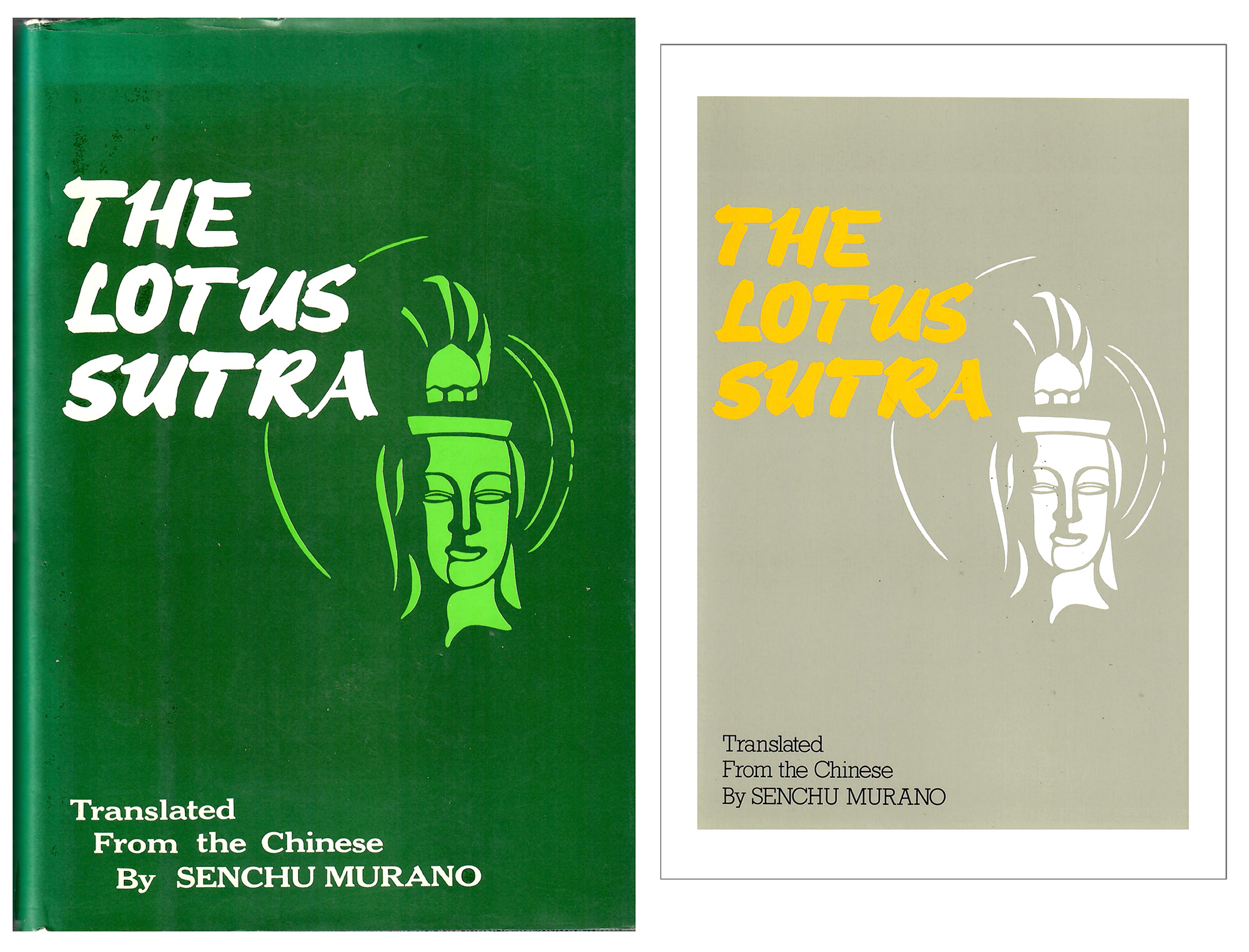
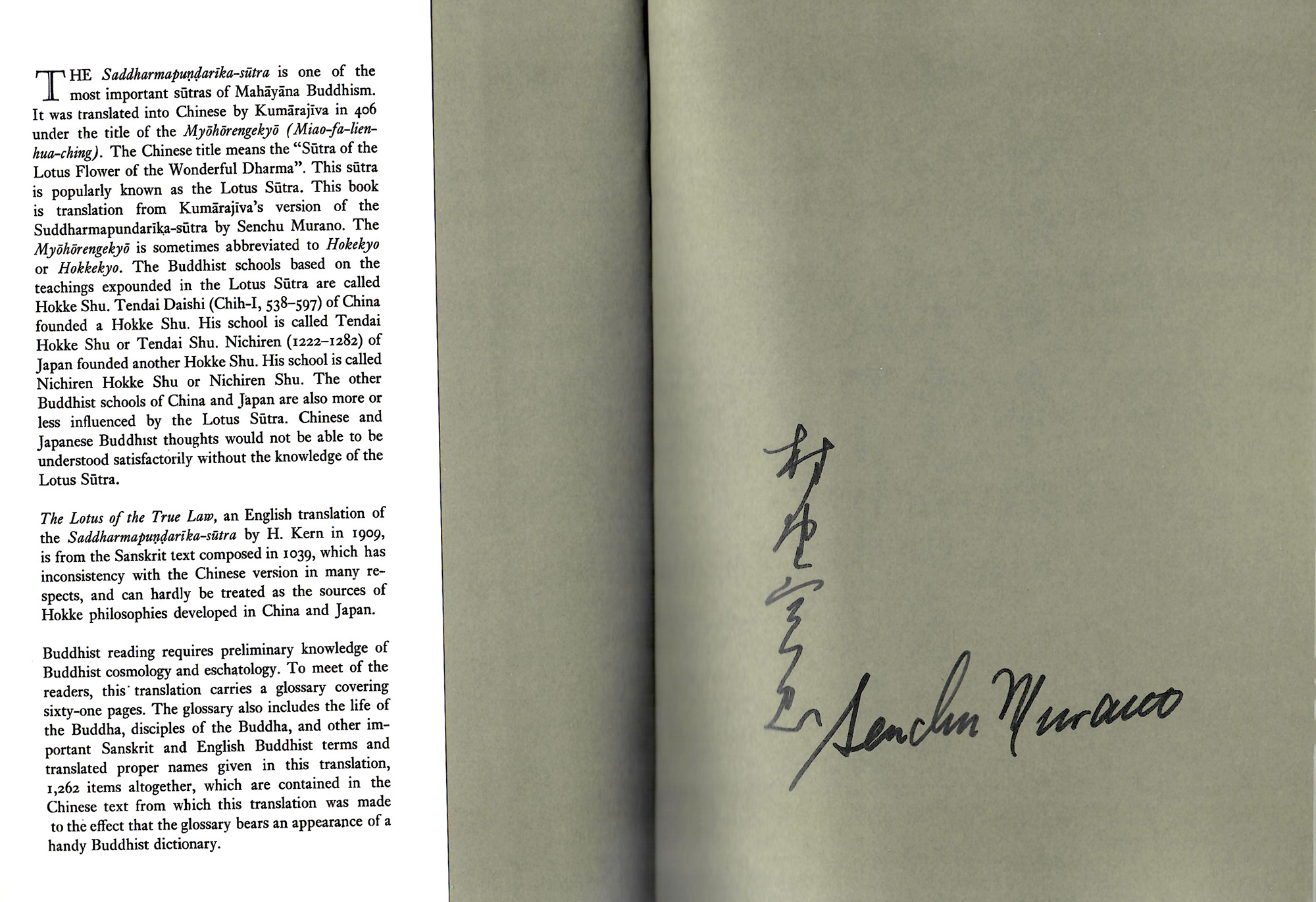
Missing from the third edition are the samādhi for the Lotus Flower of the Wonderful Dharma and the samādhi for pure virtue. I’ve restored those to my online edition. Rev. Shinkyo Warner says the third edition is no longer pre-printed and therefore the text can be easily updated. I passed on to him a number of other small typos I’ve noticed during my 32 Days of the Lotus Sutra practice. I have no idea when the “print-on-demand” text will be updated to restore the missing samādhis. On July 1, 2023, Rev. Shinkyo Warner emailed me to announced he had released an update to the printed version of the third edition of Bishop Murano’s translation of the Lotus Sutra. “This includes the corrections you found along with several others,” he said. “I’m still working on the ePub version.”
Day 16
Day 16 concludes Chapter 11, Beholding the Stūpa of Treasures, and completes the Fourth Volume of the Sūtra of the Lotus Flower of the Wonderful Dharma.

Having last month considered the seating of Śākyamuni’s replicas, we consider the message from Śākyamuni’s replicas.
Thereupon one of the Buddhas on the lion-like seats under the jeweled trees, wishing to inquire after Śākyamuni Buddha, gave a handful of jeweled flowers to his attendant, and said to him, [wishing to] dispatch him:
“Good man! Go to Śākyamuni Buddha who is now living on Mt. Gṛdhrakūṭa! Ask him on my behalf, ‘Are you in good health? Are you peaceful? Are the Bodhisattvas and Śrāvakas peaceful or not?’ Strew these jeweled flowers to him, offer them to him, and say, ‘That Buddha sent me to tell you that he wishes to see the stūpa of treasures opened.”‘
All the other Buddhas also dispatched their attendants in the same way.
The Daily Dharma from Aug. 1, 2022, offers this:
“Good man! Go to Śākyamuni Buddha who is now living on Mt. Gṛdhrakūṭa! Ask him on my behalf, ‘Are you in good health? Are you peaceful? Are the Bodhisattvas and Śrāvakas peaceful or not?’ Strew these jeweled flowers to him, offer them to him, and say, ‘That Buddha sent me to tell you that he wishes to see the stūpa of treasures opened.’”
In Chapter Eleven of the Lotus Sūtra, Buddhas and their devotees from innumerable worlds come to our world of conflict and delusion to see Śākyamuni Buddha open the tower inhabited by Many-Treasures Buddha. As our capability for enlightenment wells up from within us, the tower of treasures sprang up from underground when the Buddha asked who would teach the Wonderful Dharma after the Buddha’s extinction. The treasures in the tower are nothing more than Many-Treasures Buddha declaring the Lotus Sūtra to be the Teaching of Equality, the Great Wisdom, the Dharma for Bodhisattvas and the Dharma upheld by the Buddhas.
The Daily Dharma is produced by the Lexington Nichiren Buddhist Community. To subscribe to the daily emails, visit zenzaizenzai.com
Day 15
Day 15 concludes Chapter 10, The Teacher of the Dharma, and opens Chapter 11, Beholding the Stūpa of Treasures.
Having last month considered why the stupa appeared, we conclude today’s portion of Chapter 11, Beholding the Stūpa of Treasures.
Thereupon Great-Eloquence Bodhisattva, resorting to the supernatural powers of [Śākyamuni] Tathāgata, said to him, “World-Honored One! We wish to see that Buddha.”
The Buddha said to Great-Eloquence Bodhisattva-mahāsattvas:
“Many-Treasures Buddha made another great vow: ‘If a Buddha wishes to show me to the four kinds of devotees when my stūpa of treasures appears before him in order that l may be able to hear the Sūtra of the Lotus Flower of the Wonderful Dharma [directly from him], he must call back all the Buddhas of his replicas who will be expounding the Dharma in the worlds of the ten quarters at that time. Then I will show myself [to the four kinds of devotees].’ Great-Eloquence! Now I will collect the Buddhas of my replicas who are now expounding the Dharma in the worlds of the ten quarters.”
Great-Eloquence said to him, “World-Honored One! We also wish to see the Buddhas of your replicas, bow to them, and make offerings to them.”
Thereupon the Buddha emitted a ray of light from the white curls [between his eyebrows, and faced the east]. The congregation saw the Buddhas of five hundred billion nayuta worlds, that is, as many worlds as there are sands in the River Ganges, in the east. The ground of those worlds was made of crystal. Those worlds were adorned with jeweled trees and garments, and filled with many thousands of billions of Bodhisattvas. Jeweled curtains were stretched and jeweled nets were hung over those worlds, where the Buddhas were expounding the Dharma with loud and wonderful voices. The congregation also saw that many thousands of billions of Bodhisattvas, with whom those worlds were filled, were expounding the Dharma to the living beings of those worlds.
The Buddha also illumined the worlds of the south, west, north, the four intermediate quarters, zenith, and nadir, with rays of light emitted from the white curls [between his eyebrows]. The worlds of those quarters looked like those of the east.
The Daily Dharma from May 17, 2021, offers this:
800 Years: The Historical and the Ultimate
Chapter 15, The Appearance of Bodhisattvas from Underground, is the pivot point from which the Lotus Sutra turns from lessons of the historical Buddha, to the revelation of the eternal nature of Śākyamuni and the lessons we are to take into our daily lives.
Thich Nhat Hanh offers a wonderful description of this in Peaceful Action, Open Heart:
Peaceful Action, Open Heart, p108“In the Upper Hamlet of Plum Village where I live there is an area where wild daffodils manifest in late February. When we first arrived on the land to begin building Plum Village, we were not aware that there were so many beautiful daffodils, hundreds of thousands of them, waiting there to manifest in early spring. We had only a historical perception of the land; we had not yet seen its ultimate dimension. … You can’t see the Dharma realm (dharmadhatu), until it manifests to you. If you’re too attached to your perception of the historical dimension of reality, you may not be able to see the ultimate dimension manifest. When you know how to look deeply into the historical dimension, you touch the ultimate dimension.”
Both the historical and the ultimate dimension exist simultaneously. Nikkyō Niwano illustrates the historical aspect in Buddhism for Today:
Buddhism for Today, p177-178“Buddhism differs distinctively from other religions. Though all have fine teachings, there is no clear evidence of another case in which the founder of a religion attained his own supreme enlightenment and established his own religion. …
“Unlike these religions, the teaching of Buddhism is the truth that Lord Sakyamuni, who was born as a human being like all of us and experienced human suffering and worry, aspired to enlightenment, practiced ascetic disciplines, and attained enlightenment after six years of spiritual effort. The process through which he attained his enlightenment can be clearly seen. … [B]ecause this teaching is one that sprang up out of the earth (actual life), we who actually live in this world can follow it. Chapter 15 makes this point emphatically.”
Ryusho Jeffus offers the ultimate dimension in his Lecture on the Lotus Sutra:
“As we gather our thoughts and purify our altar then we sit down to celebrate the teaching of the Lotus Sutra, to hear once again the beautiful teaching of the Buddha telling us of the ever-existing nature of Buddhahood and of the enlightenment of our own lives, we are engaging in a celebration. It is as if we are going before the Eternal Buddha and asking him not so much what we can get for ourselves but knowing our own lives are secure because of our practice we can focus on the beauty and truth of the message contained in the Lotus Sutra. We are not supplicants going before some great dispenser of benefit. No, we are the golden-hued erect Bodhisattvas who emerge from the ground and bow to the Buddha and fulfill our vow of teaching and practicing the Lotus Sutra in this age in which we live.”
Table of Contents Next Essay
Day 14
Day 14 covers all of Chapter 9, The Assurance of Future Buddhahood of the Śrāvakas Who Have Something More to Learn and the Śrāvakas Who Have Nothing More to Learn, and opens Chapter 10, The Teacher of the Dharma.
Having last month considered the reaction of eight thousand Bodhisattvas who had just resolved to aspire for Anuttara-samyak-saṃbodhi, we consider Ānanda reaction to the prediction of his future Buddhahood.
Having heard from the Buddha that he was assured of his future Buddhahood, and that his world would be adorned, Ānanda was able to fulfill his wish. He had the greatest joy that he had ever had. At that moment he recollected the store of the teachings of many thousands of billions of past Buddhas perfectly and without hindrance as if he had heard those teachings just now. He also recollected his original vow.
Thereupon Ānanda sang in gāthās:
You, the World-Honored One, are exceptional.
You reminded me of the teachings
Of innumerable Buddhas in the past
As if I had heard them today.Having no doubts, I now dwell peacefully
In the enlightenment of the Buddha.
I will expediently become the attendant
Of future Buddhas, and protect their teachings.
The Daily Dharma from Nov. 21, 2021, offers this:
You, the World-Honored One, are exceptional.
You reminded me of the teachings
Of innumerable Buddhas in the past
As if I had heard them today.
Ānanda, the Buddha’s cousin and one of his leading disciples, sings these verses in Chapter Nine of the Lotus Sūtra. In the Story, Ānanda had just been personally assured by the Buddha that he would become a Buddha himself in a future life. All the teachings of the Buddha across all time are always available to us. What prevents us from hearing them and putting them into practice is nothing more than our own attachment to our suffering and our doubts about our capacity for wisdom and compassion. When we take to heart the assurance that we and all beings can become enlightened, it clears away our delusion and allows to see the Buddha teaching us in all aspects of our lives.
The Daily Dharma is produced by the Lexington Nichiren Buddhist Community. To subscribe to the daily emails, visit zenzaizenzai.com
800 Years: Rising from the Dirty Pond
When we are considering the lessons of Chapter 15, The Appearance of Bodhisattvas from Underground, it is best to begin by taking to heart the advice offered by the Buddha. We should “concentrate your minds, wear the armor of endeavors, and be resolute” but most important:
“Arouse your power of faith,
And do good patiently!
You will be able to hear the Dharma
That you have never heard before.”
When Maitreya Bodhisattva looked upon the vast cloud of many thousands of billions of Bodhisattva-mahāsattvas who sprang up from underground simultaneously, he didn’t recognize any of them. However, he was able to observe the qualities of these bodhisattvas clearly:
“They have studied the Way of Bodhisattvas well.
They are not defiled by worldliness
Just as the lotus-flower
Is not defiled by water.”
We, too, can live in the mundane world without being defiled by it. In fact, it is essential that followers of the Lotus Sutra do just that. As the Introduction to the Lotus Sutra says:
“The lovely lotus flower grows out of muddy water and is not defiled by it. In the same way, Bodhisattvas, persons who put the Buddha’s teachings into practice, can live in the midst of a world defiled by vice and corruption, and yet not be contaminated by it. They can teach and awaken other people while keeping their own minds pure. They can save others, however, only when they live with them here in this evil world.”
Or as Nikkyō Niwano suggests in Buddhism for Today:
Buddhism for Today, p183“These words represent the ideal way of life that the Buddha teaches us in the Lotus Sutra. We should not withdraw from society but should lead beautiful and pure lives within society. The ideal of the Lotus Sutra consists in making all society pure and beautiful. The title Sutra of the Lotus Flower of the Wonderful Law expresses this ideal.”
This is the great task that followers of the Lotus Sutra are expected to take up. Our goal is not a private benefit confined to ourselves and our immediate family. To be true followers of the Sutra of the Lotus Flower of the Wonderful Dharma we must act the part. We do not wish to escape from this world. Instead, we seek to purify it, to do the work of the Eternal Śākyamuni. In his Lecture on the Lotus Sutra, Ryusho Jeffus offers this clear explanation of what such a life entails:
Lecture on the Lotus Sutra“When we choose to live our lives with the firm belief that we are the most qualified to become Buddhas, that we don’t need anything else other than our faith in the Lotus Sutra to qualify us, and when we devout ourselves to practice with faith, and when we strive to save others, then we will actually manifest the characteristics of those Bodhisattvas who arose from beneath the ground. We cannot just call ourselves that and end the day. We actually have to do the things required to fulfill our vows as those Bodhisattvas.”
Table of Contents Next Essay
Day 13
Day 13 covers all of Chapter 8, The Assurance of Future Buddhahood of the Five Hundred Disciples.
Having last month considered the prediction for the twelve hundred Arhats, we consider the reaction of the five hundred Arhats.
Thereupon the five hundred Arhats, having been assured by the Buddha of their future Buddhahood, felt like dancing with joy, stood up from their seats, came to the Buddha, worshipped him at his feet with their heads, and reproached themselves for their faults, saying:
“World-Honored One! We thought that we had already attained perfect extinction. Now we know that we were like men of no wisdom because we were satisfied with the wisdom of the Lesser Vehicle although we had already been qualified to obtain the wisdom of the Tathāgata.
“World-Honored One! Suppose a man visited his good friend. He was treated to drink, and fell asleep drunk. His friend had to go out on official business. He fastened a priceless gem inside the garment of the man as a gift to him, and went out. The drunken man did not notice what his friend had given him. After a while he got up, and went to another country. He had great difficulty in getting food and clothing. He satisfied himself with what little he had earned. Some time later the good friend happened to see him. He said, ‘Alas, man! Why have you had such difficulty in getting food and clothing? T fastened a priceless gem inside your garment on a certain day of a certain month of a certain year so that you might live peacefully and satisfy your five desires. The gem is still there, and you do not notice it. You are working hard, and worrying about your livelihood. What a fool you are! Trade that gem for what you want! You will not be short of anything you want.’
“You, the Buddha, are like his friend. We thought that we had attained extinction when we attained Arhatship because we forgot that we had been taught to aspire for the knowledge of all things by you when you were a Bodhisattva just as the man who had difficulty in earning his livelihood satisfied himself with what little he had earned. You, the World-Honored One, saw that the aspiration for the knowledge of all things was still latent in our minds; therefore, you awakened us, saying, ‘Bhikṣus! What you had attained was not perfect extinction. I caused you to plant the good root of Buddhahood a long time ago. [You have forgotten this; therefore,] I expounded the teaching of Nirvāṇa as an expedient. You thought that you had attained true extinction when you attained the Nirvāṇa [ which I taught you as an expedient].’
“World-Honored One! Now we see that we are Bodhisattvas in reality, and that we are assured of our future attainment of Anuttara-samyak-saṃbodhi. Therefore, we have the greatest joy that we have ever had.”
The Daily Dharma from March 31, 2022, offers this:
World-Honored One! Now we see that we are Bodhisattvas in reality, and that we are assured of our future attainment of Anuttara-samyak-saṃbodhi. Therefore, we have the greatest joy that we have ever had.
Ājñāta-Kauṇḍinya and the others gathered to hear the Buddha teach make this declaration in Chapter Eight of the Lotus Sūtra. He and the others thought that their existence was merely to hear and preserve what the Buddha taught them, and to transmit it to others. They believed they were incapable of becoming as enlightened as the Buddha, because the Buddha’s earlier teachings had only led them so far. With the Lotus Sutra, the Buddha reminds all of us of our decision to come to this world of conflict to benefit all beings. He awakens us to our capacity to see the world with his eyes and experience the joy of reality.
The Daily Dharma is produced by the Lexington Nichiren Buddhist Community. To subscribe to the daily emails, visit zenzaizenzai.com
Day 12
Day 12 concludes Chapter 7, The Parable of the Magic City, and completes the Third Volume of the Sutra of the Lotus Flower of the Wonderful Dharma.
Having last month considered the Brahman-heavenly-kings of the five hundred billion worlds in Zenith asking the Buddha to turn the wheel of the Dharma, we consider the reaction of the 16 princes.
“When the Buddha expounded these teachings to the great multitude of gods and men, six hundred billion nayuta men emancipated themselves from āsravas, and obtained profound and wonderful dhyāna-concentrations, the six supernatural powers including the three major supernatural powers, and the eight emancipations because they gave up wrong views. At his second, third and fourth expoundings of these teachings also, thousands of billions of nayutas of living beings, that is, as many living beings as there are sands in the River Ganges, emancipated themselves from āsravas because they gave up wrong views. [They became Śrāvakas.] Those who became Śrāvakas thereafter were also innumerable, uncountable.
“The sixteen princes were young boys at that time. They renounced the world and became śramaṇeras. Their sense organs were keen; and their wisdom, bright. They had already made offerings to hundreds of thousands of billions of Buddhas, performed brahma practices, and sought Anuttara-samyak-saṃbodhi in their previous existence. They said to the Buddha simultaneously, ‘World-Honored One! All these Śrāvakas of great virtue, many thousands of billions in number, have already done [what they should do]. World-Honored One! Expound to us the teaching of Anuttara-samyak-saṃbodhi! If we hear that teaching, we will study and practice it. World-Honored One! We wish to have the insight of the Tathāgata. You know what we have deep in our minds.’