Category Archives: LS32

Day 11

Day 11 continues Chapter 7, The Parable of the Magic City


Having last month concluded today’s portion of Chapter 7, The Parable of the Magic City, we return to the top and consider what happened when Great-Universal-Wisdom-Excellence Buddha attained Anuttara-samyak-saṃbodhi.

The Buddha said to the bhikṣus:
“When Great-Universal-Wisdom-Excellence Buddha attained Anuttara-samyak-saṃbodhi, five hundred billion Buddha-worlds in each of the ten quarters quaked in the six ways, and all those worlds, including those intercepted from the brilliant rays of light of the sun and the moon by the neighboring worlds, were illumined [by great rays of light], and the living beings of those worlds were able to see each other for the first time. They said to each other, ‘How did you appear so suddenly?’ The palaces of the gods of those worlds, including the palace of Brahmans, also quaked in the six ways. The great rays of light which illumined all those worlds were brighter than the rays of light emitted by those gods.

See The Importance of Perseverance in Practice

Day 10

Day 10 concludes Chapter 6, Assurance of Future Buddhahood, and opens Chapter 7, The Parable of a Magic City.


Having last month concluded today’s portion of Chapter 7, The Parable of the Magic City, we return to today’s portion of Chapter 6, Assurance of Future Buddhahood, and consider the Buddha’s prediction for Subhūti.

Thereupon the World-Honored One, having understood the wishes of the great disciples, said to the bhikṣus:
“In his future life, this Subhūti will see three hundred billion nayutas of Buddhas, make offerings to them, respect them, honor them, praise them, perform brahma practices, complete the Way of Bodhisattvas, and become a Buddha on the final stage of his physical existence. He will be called Beautiful-Form, the Tathāgata, the Deserver of Offerings, the Perfectly Enlightened One, the Man of Wisdom and Practice, the Well-Gone, the Knower of the World, the Unsurpassed Man, the Controller of Men, the Teacher of Gods and Men, the Buddha, the World-Honored One. The kalpa in which he will become that Buddha will be called Having-Treasures; and his world, Treasure-Born. The ground [of his world] will be even, made of crystal, adorned with jeweled trees, and devoid of mounds, pits, rubble, thorns and dirt. Jeweled flowers will cover the ground to purify it. The people of that world will live in buildings of wonderful treasures. His disciples in Śrāvakahood will be numberless, beyond calculation or comparison. The Bodhisattvas will be many thousands of billions of nayutas in number. The duration of the life of that Buddha will be twelve small kalpas. His right teachings will be preserved for twenty small kalpas. The counterfeit of his right teachings will be preserved also for twenty small kalpas. That Buddha will always stay in the sky, expound the Dharma to the multitude, and save innumerable Bodhisattvas and Śrāvakas.

Thereupon the World-Honored One, wishing to repeat what he had said, sang in gāthās:

Bhikṣus!
Now I will tell you.
Listen to me
With one mind!

Subhūti, a disciple of mine,
Will be able
To become a Buddha
Called Beautiful-Form.

He will make offerings
To many billions of Buddhas, and practice
According to the practices of the Buddhas,
And finally attain great enlightenment.

On the final stage of his physical existence,
He will obtain the thirty-two physical marks,
And become as beautiful and as wonderful
As a mountain of treasures.

The world of that Buddha
Will be the purest.
Anyone will be happy to see it.
That Buddha will save
Innumerable living beings
Of that world.

Many Bodhisattvas
In the world of that Buddha
Will be clever.
They will turn
The irrevocable wheel of the Dharma,
And adorn that world.

The Śrāvakas in that world also
Will be countless.
They will have the six supernatural powers,
Including the three major supernatural powers.
They will have the eight emancipations.
They will be exceedingly powerful and virtuous.

The supernatural powers
Employed by that Buddha
For the expounding of the Dharma
Will be inconceivable.

As many gods and men
As there are sands in the River Ganges
Will join their hands together
And listen to the words of that Buddha.

The duration of the life of that Buddha
Will be twelve small kalpas.
His right teachings will be preserved
For twenty small kalpas.
The counterfeit of his right teachings
Also will be preserved for twenty small kalpas.

The Daily Dharma from May 13, 2022, offers this:

The supernatural powers
Employed by that Buddha
For the expounding of the Dharma
Will be inconceivable.

The Buddha sings this verse in Chapter Six of the Lotus Sūtra after predicting the future Buddhahood of his disciple Subhūti. Anything we do not understand can seem supernatural. Things we find common in our modern world would seem magical to those who lived in the Buddha’s time. It is only through our greater understanding that we can create our modern wonders. It should not then surprise us that with the Buddha’s mind, which he reminds us that we too can reach, the things we can accomplish will seem magical to those mired in delusion.

The Daily Dharma is produced by the Lexington Nichiren Buddhist Community. To subscribe to the daily emails, visit zenzaizenzai.com

800 Years: The Merits of the Inexperienced Practicer

Grand Master Miao-lê in his Annotations to the Words and Phrases of the Lotus Sūtra asserts, “Most people make mistakes, without knowing how great the merits of the inexperienced practicers can be. They imagine that only the experienced practicers can have merits and slander the inexperienced. Therefore, in the ‘Merits of Rejoicing at Hearing This Sūtra’ chapter it is shown that the merits of the inexperienced practicer can be great and how great the merits of the Lotus Sūtra are.” This passage means that the merit of the 50th person rejoicing at hearing the Lotus Sūtra transmitted one after another was preached to show that the merit of an ignorant person with little capacity in the Latter Age rejoicing even for a moment at hearing the sūtra preached is superior to the merit of sages who practice the pre-Lotus sūtras preached during the 40 or so years before the Lotus Sūtra. This is preached so that the Lotus Sūtra is not mistaken as the teaching attained by only persons of superior capacity and devotion.

Therefore, Grand Master T’ien-t’ai in his Words and Phrases of the Lotus Sūtra compares the 50th person rejoicing at hearing the Lotus Sūtra transmitted one after another, the lowest rank in the practice of the Lotus Sūtra, against the practicers of non-Buddhist teachings, Hinayana Buddhism, and provisional Mahayana Buddhism. He states that the merits of the lowest rank in the practice of the Lotus Sūtra are superior to those of any other practice.

Shō Hokke Daimoku-shō, Treastise on Chanting the Daimoku of the Lotus Sūtra, Writings of Nichiren Shōnin, Faith and Practice, Volume 4, Page 7-8

What’s Up, Doc?

This is the first in a series of weekly blog posts comparing and contrasting the Sanskrit and Chinese Lotus Sutra translations.


Definition of Rabbit Hole

Last week I mentioned that I’ve decided to compare and contrast H. Kern’s 1884 English translation of the Lotus Sutra with Senchu Murano’s 1974 translation.

Today I find myself engrossed in exploring one rabbit hole after another. Take for an example what happened when I attempted to compare the Bodhisattvas named in the first chapter of the Lotus Sutra.

Murano names 18 of the eighty thousand Bodhisattva-mahāsattvas present in the congregation:

  1. Manjushri Bodhisattva
  2. Regarder of the Cries of the World Bodhisattva
  3. Great Strength Bodhisattva
  4. Constant Effort Bodhisattva
  5. Never Resting Bodhisattva
  6. Jeweled Palm Bodhisattva
  7. Medicine King Bodhisattva
  8. Bold Almsgiver Bodhisattva
  9. Jeweled Moon Bodhisattva
  10. Moon Light Bodhisattva
  11. Full Moon Bodhisattva
  12. Great Power Bodhisattva
  13. Immeasurable Power Bodhisattva
  14. Above the Threefold World Bodhisattva
  15. Bhadrapala Bodhisattva
  16. Maitreya Bodhisattva
  17. Accumulated Jewels Bodhisattva
  18. Guidance Bodhisattva

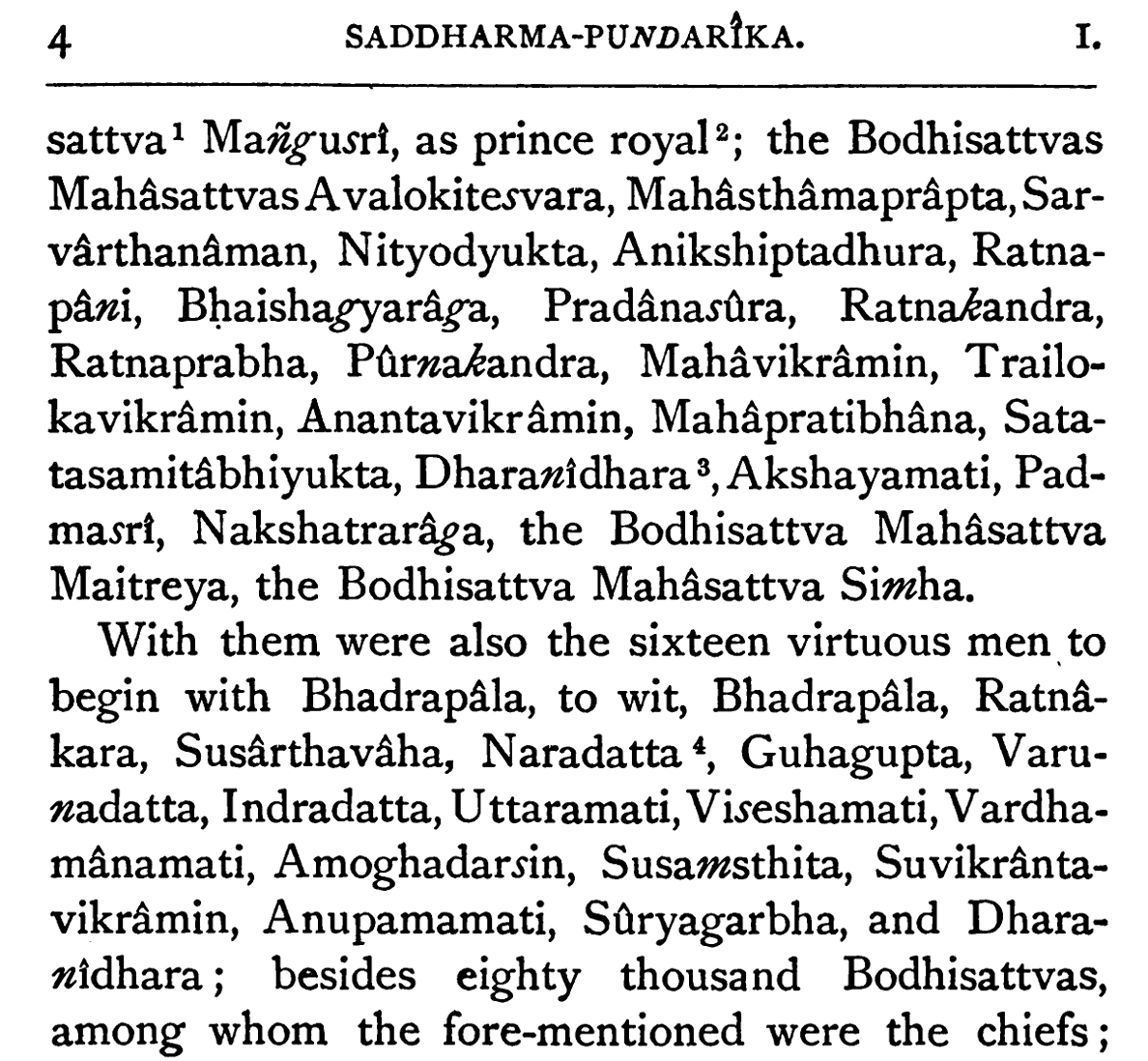
Kern names 23 Bodhisattvas and adds an additional sixteen virtuous men.

page from Kern's translationBodhisattvas:

  1. the Bodhisattva Mahāsattva Mañjuśrī, as prince royal
  2. the Bodhisattva Mahāsattvas Avalokiteśvara
  3. Mahāsthāmaprāpta
  4. Sarvārthanāman
  5. Nityodyukta
  6. Anikśhiptadhura
  7. Ratnapāni
  8. Bhaiṣajyarāja
  9. Pradānaśūra
  10. Ratnacandra
  11. Ratnaprabha
  12. Pūrṇacandra
  13. Mahāvikrāmin
  14. Trailokavikrāmin
  15. Anantavikrāmin
  16. Mahāpratibhāna
  17. Satatasamitābhiyukta
  18. Dhārāṇidhara
  19. Akshayamati
  20. Padmasrī
  21. Nakshatrarāja
  22. the Bodhisattva Mahāsattva Maitreya,
  23. the Bodhisattva Mahāsattva Simha.

Virtuous men:

  1. Bhadrapāla
  2. Ratnākara
  3. Susārthavāha
  4. Naradatta
  5. Guhagupta
  6. Varunadatta
  7. Indradatta
  8. Uttaramati
  9. Viseshamati
  10. Vardhamānamati
  11. Amoghadarsin
  12. Susamsthita
  13. Suvikrāntavikrāmin
  14. Anupamamati
  15. Sūryagarbha
  16. Dhārāṇidhara

Now Mañjuśrī for Manjushri  is easy enough, and I already know that World Voice Perceiver’s Sanskrit name is Avalokiteśvara and Medicine King is Bhaiṣajyarāja. But what about the others?

In considering how to compare the two lists it occurred to me that in  Gene Reeves’ translation of the threefold Lotus Sutra he has a glossary of proper names. This lists the Name in English; the Category (Buddha, Bodhisattva, Buddha land, king, shravaka, etc.); Sutra (Lotus Sutra, Innumerable Meanings, Universal Sage); Sanskrit word; and the Chinese, Pinyin and Japanese characters.

Here are Reeves’ 18 names in English and Sanskrit:

  1. Manjushri Bodhisattva [Mañjuśrī],
  2. Regarder of the Cries of the World Bodhisattva [Avalokiteśvara],
  3. Great Strength Bodhisattva [Mahāsthāmaprāpta],
  4. Constant Effort Bodhisattva [Nityodyukta],
  5. Never Resting Bodhisattva [Anikśhiptadhura],
  6. Jeweled Palm Bodhisattva [Ratnacandra],
  7. Medicine King Bodhisattva [Bhaiṣajyarāja],
  8. Bold Almsgiver Bodhisattva [Pradānaśūra],
  9. Jeweled Moon Bodhisattva [Ratnatejobhyudgatarāja],
  10. Moon Light Bodhisattva [Ratnaprabha],
  11. Full Moon Bodhisattva [Pūrṇacandra],
  12. Great Power Bodhisattva [Mahāvikrāmin],
  13. Immeasurable Power Bodhisattva [Anantavikrāmin],
  14. Above the Threefold World Bodhisattva [Trailokavikrāmin],
  15. Bhadrapala Bodhisattva,
  16. Maitreya Bodhisattva,
  17. Accumulated Jewels Bodhisattva [Ratnākara],
  18. Guidance Bodhisattva [Susārthavāha].

But when I try comparing Reeves’ Sanskrit names to Kern’s I find I can’t match Jeweled Moon Bodhisattva, which Reeves lists as Ratnatejobhyudgatarāja.

Now I’m no Sanskrit scholar but even I know rāja is king. For example, Medicine King – Bhaiṣajyarāja.

When I Googled Ratnatejobhyudgatarāja I discovered that this is the Sanskrit name for Treasure-Power­-Virtue-Superior-King, the Buddha with whom Universal Sage is living when he hears the Lotus Sutra expounded in this Sahā World in Chapter 28.

At this point it occurred to be that the BDK Tripiṭaka translation of the Lotus Sutra uses only Sanskrit names in its translation of Kumārajīva’s Chinese translation.

The BDK Tripiṭaka names:

  1. Mañjuśrī
  2. Avalokiteśvara
  3. Mahāsthāmaprāpta
  4. Nityodyukta
  5. Anikṣiptadhura
  6. Ratnapāni
  7. Bhaiṣajyarāja
  8. Pradānaśūra
  9. Ratnacandra
  10. Candraprabha
  11. Pūrṇacandra
  12. Mahāvikramin
  13. Anantavikramin
  14. Trailokyavikrama
  15. Bhadrapāla
  16. Maitreya
  17. Ratnākara
  18. Susāthavāha

Now this compares well with Kern’s list with the exception of Candraprabha, who is Moon Light Bodhisattva.  Both Kern and Reeves use Ratnaprabha, but my limited Sanskrit tells me ratna means jewel. For example, Many Treasures Buddha is Prabhūtaratna. How could Kern and Reeves agree and also be  wrong?

So, sticking my head up from the rabbit hole, I look around and wonder just how this compare and contrast thing is going to work.

NEXT: The Arhats Present at the Beginning

Day 9

Day 9 covers Chapter 5, The Simile of Herbs, and introduces Chapter 6, Assurance of Future Buddhahood.


Having last month repeated in gāthās why the Buddha has been reticent on this truth, we consider the large cloud that rains on all the plants.

Kāśyapa, know this!
Suppose a large cloud rose in the sky,
And covered everything on the earth.
The cloud was so merciful
That it was about to send a rainfall.
Lightning flashed,
And thunder crashed in the distance,
Causing people to rejoice.

The cloud covered the sun,
And cooled the earth.
It hung down
As low as if we could reach it.

Now the rain came down
To all the quarters of the earth.
The rainwater was immeasurable.
It soaked all the earth.
There were many plants
In the retired and quiet places
Of the mountains, rivers and ravines.

They were herbs, cereal-plants, young rice-plants,
Vegetables, sugar canes, and other grasses;
Fruit-trees including vines,
And other trees, tall and short.
They were sufficiently watered by the rain.
So were all the dry lands.

The herbs and trees grew thick by the rain.
All the grasses and trees in thickets and forests
Were watered variously according to their species
By the rain water of the same taste
Coming down from the [same] cloud.

All the trees grew differently
According to their species.
They became superior or middle or inferior
Or tall or short trees.

The roots, trunks, branches, leaves,
Flowers and fruits of the various trees
Were given a fine and glossy luster
By the same rain.

Although watered by the same rain,
Some of them were tall, while others not,
Because they were different
In their entities, appearances and natures.

See The Dharma is Universal

Day 8

Day 8 concludes Chapter 4, Understanding by Faith, and closes the second volume of the Sutra of the Lotus Flower of the Wonderful Dharma.


Having last month concluded today’s portion of Chapter 4, Understanding by Faith, we return to the top and consider the expedient the rich man used to persuade his son to return.

Thereupon the rich man thought of an expedient to persuade his son to come to him. He [wished to] dispatch messengers in secret. He said to two men looking worn-out, powerless and virtueless, ‘Go and gently tell the poor man that he will be employed here for a double day’s pay. If he agrees with you, bring him here and have him work. If he asks you what work he should do, tell him that he should clear dirt and that you two also will work with him.’
“The two messengers looked for the poor son. Having found him, they told him what they had been ordered to tell. The poor son [came back with them,] drew his pay in advance, and cleared dirt with them. Seeing him, the father had compassion towards him, and wondered [why he was so base and mean]. Some days later he saw his son in the distance from the window. The son was weak, thin, worn-out, and defiled with dirt and dust. The father took off his necklace, his garment of thin and soft cloth, and other ornaments. He put on tattered and dirty clothing, smeared himself with dust, and carried a dirt-utensil in his right hand. He looked fearful. He [came to the workers and] said, ‘Work hard! Do not be lazy!’

“With this expedient the father came to his son. He said to him, ‘Man! Stay here and work! Do not go anywhere else! I will pay you more. Do not hesitate to take trays, rice, flour, salt and vinegar as much as you need! You can have an old servant if you want to. Make yourself at home! I feel like your father. Do not worry any more! I am old, and you are young. When you work, you do not deceive [the other workers]. You are not lazy. You do not get angry [with the other workers], or reproach them. You are not like the other workers who do these evil things. From now on I will treat you as my son.’

“The rich man gave him a name and called him son. The poor son was glad to be treated kindly, but still thought that he was a humble employee. Therefore, the rich man had him clear dirt for twenty years. After that the father and son trusted each other. Now the son felt no hesitation in entering the house of his father, but still lodged in his old place.

See Basic Lessons

800 Years: Bodhisattvas from Underground

In Rev. Ryusho JeffusLecture on the Lotus Sutra he sets the stage for discussing Chapter 15, The Appearance of Bodhisattvas from Underground, with this observation:

“We each may think we are rather ordinary people, not capable of great things. Yet our ordinariness is in fact a disguise for our true self, Bodhisattvas from beneath the ground, the disciples of the Buddha from the infinite past, and beings perfectly endowed with Buddhahood.”

Lecture on the Lotus Sutra


As the Buddha explains to the four great leaders of those Bodhisattvas:

“The living beings are ready to be saved. They do not fatigue me because I already taught them in their consecutive previous existences, and also because they have already honored the past Buddhas respectfully and planted the roots of good. As soon as they saw me and heard my teachings, they received my teachings by faith and entered into the wisdom of the Tathāgata.”

We are those Bodhisattvas who have been studying and practicing with the Eternal Śākyamuni since the remotest past. Since we have forgotten we are asked today to have faith:

“Arouse your power of faith,
And do good patiently!
You will be able to hear the Dharma
That you have never heard before.

“Now I will relieve you.
Do not doubt me! Do not be afraid!
I do not tell a lie.
My wisdom is immeasurable.
The highest Dharma that I attained
Is profound and difficult to understand.
Now I will expound it.
Listen to me with all your hearts!”

And here we need faith to understand and to act. As Rev. Ryusho Jeffus argues:

“This is our relationship with the Eternal Buddha, not with the historical Buddha. As Bodhisattvas from underground we read the Lotus Sutra from the perspective of an infinite bond with the Buddha, as lifelong practitioners of the Eternal Buddha who have in this lifetime manifested as the beings we currently are but who underneath it all are in fact golden-hued Bodhisattvas. We have received training and are eminently qualified to carry out the lives we have and attain enlightenment in our present form. Everything we need is within us, and the Lotus Sutra is our activation code to actualize our true identities.”

Lecture on the Lotus Sutra

As we faithfully chant the daimoku we join our brethren.

“At first only I, Nichiren, started chanting the daimoku, Namu Myōhō Renge Kyō, but then two, three, then one hundred people, gradually began chanting it. This will continue in the future. Isn’t this what emerging from the earth means? When an innumerable number of people emerge from the earth and this Wonderful Dharma spreads extensively, there will be no mistake, just as a shooting arrow never misses the earth, Japan will be filled with people chanting Namu Myōhō Renge Kyō. You should therefore establish your fame as the practicer of the Lotus Sūtra and devote your life to it.”

Shohō Jisso-shō, Treatise on All Phenomena as Ultimate Reality, Writings of Nichiren Shōnin, Faith and Practice, Volume 4, Page 78


Table of Contents Next Essay

Day 7

Day 7 concludes Chapter 3, A Parable, and begins Chapter 4, Understanding by Faith.


Having last month concluded today’s portion of Chapter 4, Understanding by Faith, we return to Chapter 3, A Parable, and consider how this triple world is the Buddha’s property.

This triple world
Is my property.
All living beings therein
Are my children.
There are many sufferings
In this world.
Only I can save
[All living beings].

I told this to all living beings.
But they did not believe me
Because they were too much attached
To desires and defilements.

Therefore, I expediently expounded to them
The teaching of the Three Vehicles,
And caused them to know
The sufferings of the triple world.
I opened, showed, and expounded
The Way out of the world.

Those children who were resolute in mind
Were able to obtain
The six supernatural powers
Including the three major supernatural powers,
And to become cause-knowers
Or never-faltering Bodhisattvas.

Śāriputra!
With this parable I expounded
The teaching of the One Buddha-Vehicle
To all living beings.
All of you will be able to attain
The enlightenment of the Buddha
If you believe and receive
These words of mine.

See Awakening Aspiration for Buddhahood

800 Years: Winning the Jewel in the King’s Top-Knot

In last week’s discussion of Chapter 14, I made a big deal about the Peaceful Practices without discussing the other side of that coin – the war we are asked to fight.

“Mañjuśrī! I will tell you a parable. Suppose a powerful wheel-turning-holy-king demanded surrender of the kings of smaller countries by threat of force. They did not obey his demand. He led soldiers, and went and suppressed them. He was very glad to see that some soldiers distinguished themselves in war. According to their merits, he gave them paddy fields, houses, villages, cities, garments or ornaments; or various treasures such as gold, silver, lapis lazuli, shell, agate, coral or amber; or elephants, horses, vehicles, menservants, maidservants or subjects. But he did not give a brilliant gem which he was keeping in his top-knot to anyone because the gem on the head of the king was the only one [in the world]. If he had given it to anyone, the followers of the king would have been much surprised.”

We can make light of Nichiren’s ardor in his battle to save Japan and establish an ideal buddha land in this world, suggesting he was just the high-spirited son, but we shouldn’t ignore the task we are asked to accomplish.

“Mañjuśrī! I am like the king. I obtained the world of the Dharma by my powers of dhyāna-concentration and of wisdom, and became the king of the triple world. But the kings of the Maras did not assent to my demand for surrender to me. Therefore, my army led by generals, that is, by sages and saints, fought with them.”

We are asked to be soldiers. We fight not just for our own benefit but for the defeat of the Maras, the victory that brings everyone peace. Can we do that without the ardor of Nichiren?

Yes, this is not Medieval Japan and we are not challenging the authority of a state religion, at least not hear in the United States. But we have the highest goal before us. “Sentient beings are innumerable; we vow to save them all.”

As with everything, we must seek a middle path. This is just as true with our faith. As Nichiren wrote in Ueno-dono Gohenji, A Reply to Lord Ueno:

“Of the people who put faith in the Lotus Sūtra today, some have faith like fire while others have it like water. Those who have faith like fire refer to those who become enthusiastic upon listening to the preaching but their passion cools down as times goes by, and eventually forget the teaching. On the other hand, those whose faith is like water mean those whose faith is like a ceaselessly flowing water, namely those who retain their faith without retreating.

Writings of Nichiren Shōnin, Faith and Practice, Volume 4, Page 126

We are asked to fight a war. We will win some battles and we will suffer setbacks, but with faith that is like ceaselessly flowing water we can carve a path to our goal.


Table of Contents Next Essay

Day 6

Day 6 continues Chapter 3, A Parable


Having last month considered how the rich man saved his children from the burning house, we consider the carts the father gave to his children.

Seeing them come out
Of the burning house
To the safe crossroad,
He sat on the lion-like seat,
And said to others with joy:
“I am happy.
These children are difficult to bring up.
They are young and ignorant.
They entered the dangerous house.
In that house were
Many poisonous vermin
And many dangerous mountain spirits.
Raging flames of big fires rose
From the four sides of the house
At the same time.
But my children were
Engrossed in playing.
Now I saved them
From the dangers.
Therefore, I am happy.”

The children saw their father
Sitting in peace.
They came to him,
And said:
“Give us
The three kinds of jeweled carts
That you promised us!
You said:
“Come out, and I will give you
The three kinds of carts as you like.”
Now is the time for that.
Give them to us now!”

He was a very rich man.
He had many storehouses.
He made many large carts
Adorned with treasures,
Such as gold, silver,
Lapis lazuli, shell and agate.

[The carts] were beautifully adorned.
Railings were put around them.
Bells were hanging on the four sides
With ropes of gold.

[The carts] were roofed
With nets of pearls.
Garlands of golden flowers
Were hanging on all sides.

Other ornaments of fabrics
Of divers colors
Encircled the bodies of the carts.
Bedding was made of soft cloth.
[The bedding] was covered
With the most wonderful woolen fabrics.
They were bright, white, pure and clean,
Worth hundreds of thousands of millions.

Large white bullocks,
Fat, stout, powerful,
And beautiful in their build,
Were yoked to the jeweled carts.
The carts were also guarded
By many attendants.

[The rich man] gave to each of his children
One of these wonderful carts.
The children
Danced with joy.

They drove these jeweled carts
In all directions.
They were happy and delighted.
Nothing could stop their joy.

See The Three Stages of Preaching