
Category Archives: LS32

Day 2

Chapter 1, Introductory (Conclusion)


Having last month consider Mañjuśrī’s opening response to Maitreya’s question, we consider Mañjuśrī’s story of a Buddha called Sun-Moon-Light.

“Good men! Innumerable, inconceivable, asamkya kalpas ago, there lived a Buddha called Sun-Moon-Light, the Tathagata, the Deserver of Offerings, the Perfectly Enlightened One, the Man of Wisdom and Practice, the Well-Gone, the Knower of the World, the Unsurpassed Man, the Controller of Men, the Teacher of Gods and Men, the Buddha, the World-Honored One. He expounded the right teachings. His expounding of the right teachings was good at the beginning, good in the middle, and good at the end. The meanings of those teachings were profound. The words were skillful, pure, unpolluted, perfect, clean, and suitable for the explanation of brahma practices. To those who were seeking Śrāvakahood, he expounded the teaching of the four truths, a teaching suitable for them, saved them from birth, old age, disease, and death, and caused them to attain Nirvāṇa. To those who were seeking Pratyekabuddhahood, he expounded the teaching of the twelve causes, a teaching suitable for them. To Bodhisattvas, he expounded the teaching of the six paramitas, a teaching suitable for them, and caused them to attain Anuttara-samyak-saṃbodhi, that is, to obtain the knowledge of the equality and differences of all things.

“After his extinction there appeared a Buddha also called Sun-Moon-Light. After his extinction there appeared another Buddha also called Sun-Moon-Light. In the same manner, seventy thousand Buddhas appeared in succession, all of them being called Sun­Moon-Light with the surname Bharadvaja.

“Maitreya, know this! All those Buddhas were called Sun-Moon­-light with the ten epithets. Their expounding of the Dharma was good at the beginning, good in the middle, and good at the end. The last Sun-Moon-Light Buddha was once a king. He had eight sons born to him before he renounced the world. The first son was called Having-Intention; the second, Good-Intention; the third, Infinite-­Intention; the fourth, Treasure-Intention; the fifth, Increasing-­Intention; the sixth, Doubts-Removing-Intention; the seventh, Resounding-Intention; and the eighth, Dharma-Intention. These eight princes had unhindered powers and virtues. Each of them was the ruler of the four continents [of a Sumeru-world]. Having heard that their father had renounced the world and attained Anuttara-samyak-saṃbodhi, they abdicated from their thrones, and followed their father. They renounced the world, aspired for the Great Vehicle, performed brahma practices, and became teachers of the Dharma. They had already planted the roots of good under ten million Buddhas in their previous existence.

“Thereupon the last Sun-Moon-Light Buddha expounded a Sūtra of the Great Vehicle called the ‘Innumerable Teachings, the Dharma for Bodhisattvas, the Dharma Upheld by the Buddhas.’ Having expounded this sūtra, he sat cross-legged [facing the east] in the midst of the great multitude, and entered into the samādhi for the purport of the innumerable teachings. His body and mind became motionless.

“Thereupon the gods rained mandarava-flowers, maha-­mandarava-flowers, manjusaka-flowers, and maha-manjusaka­flowers upon the Buddha and the great multitude. The world of the Buddha quaked in the six ways. The great multitude of the congregation, which included bhikṣus, bhikṣunīs, upāsakās, upāsikās, gods, dragons, yakṣas, gandharvas, asuras, garuḍas, kiṃnaras, mahoragas, men, nonhuman beings, the kings of small countries, and the wheel turning-holy kings, were astonished. They rejoiced, joined their hands together [towards the Buddha], and looked up at him with one mind.

‘Thereupon the Tathagata emitted a ray of light from the white curls between his eyebrows, and illumined all the corners of eighteen thousand Buddha-worlds in the east just as this Buddha is illumining the Buddha-worlds as we see now.
See Prince Sun and Moon Light

Daily Dharma – Aug. 30, 2023

I know the Way. I have opened the Way. I will expound the Way. Gods, men and asuras! Come and hear the Dharma!

The Buddha makes this declaration at the beginning of Chapter Five of the Lotus Sūtra. If anyone besides the Buddha had said this, we would accuse them of arrogance: pretending to know what they do not. The Buddha does not separate himself from us. Because he knows we can become as enlightened as he is, he does not place himself as superior. He also knows that unless we hear him, he cannot help us to become enlightened. To accept this help means taking responsibility for our progress on the path. We cannot continue alone but we must make our own effort.

The Daily Dharma is produced by the Lexington Nichiren Buddhist Community. To subscribe to the daily emails, visit zenzaizenzai.com

Day 1

Day 1 covers the first half of Chapter 1, Introductory


Having last month considered Maitreya’s response to seeing eighteen thousand worlds in the east, we consider in gāthās what Maitreya Bodhisattva sees.

Thereupon Maitreya Bodhisattva, wishing to repeat what he had said, asked him in gāthās:

Mañjuśrī!
Why is the Leading Teacher
Emitting a great ray of light
From the white curl between his eyebrows?

[The gods] rained mandārava-flowers
And mañjūṣaka-flowers.
A breeze carrying the fragrance of candana
Is delighting the multitude.

Because of this, the ground has become
Beautiful and pure;
And this world quaked
In the six ways.

The four kinds of devotees
Are joyful.
They are happier than ever
In body and mind.

The light from [the white curls]
Between the eyebrows of the Buddha illumines
Eighteen thousand worlds to the east.
Those worlds look golden-colored.

I see from this world
The living beings of the six regions
Extending down to the Avici Hell,
And up to the Highest Heaven

Of each of those worlds.
I see the region to which each living being is to go,
The good or evil karmas he is doing,
And the rewards or retributions he is going to have.

I also see the Buddhas,
The Saintly Masters, the Lion-like Ones,
Who are expounding
The most wonderful sūtra
With their pure and gentle voices,
And teaching
Many billions of Bodhisattvas.
The brahma voices of the Buddhas
Are deep and wonderful,
Causing people to wish to hear them.

I also see the Buddha of each of those worlds
Expounding his right teachings to all living beings
In order to cause them to attain enlightenment.

He explains his teachings
With stories of previous lives,
And with innumerable parables and similes.

To those who are confronted with sufferings,
And tired of old age, disease, and death,
The Buddha expounds the teaching of Nirvana,
And causes them to eliminate these sufferings.

To those who have merits,
Who have already made offerings to the past Buddhas,
And who are now seeking a more excellent teaching,
The Buddha expounds [the Way of] cause-knowers.

To the Buddha’s sons
Who are performing various practices,
And who are seeking unsurpassed wisdom,
The Buddha expounds the Pure Way.

See “What It Means To Be A Reader of the Dharma Flower Sutra

Daily Dharma – Aug. 29, 2023

He was strenuous and resolute in mind.
He concentrated his mind,
And refrained from indolence
For many hundreds of millions of kalpas.

The Buddha sings these verses to Maitreya Bodhisattva in Chapter Seventeen of the Lotus Sūtra. In this Chapter, the Buddha describes the benefits from practicing generosity, discipline, patience, perseverance, and in these verses, concentration. He then compares these benefits to those which come from understanding the ever-present nature of the Buddha, even for a time no longer than the time it takes to blink. The merits of the latter outshine the former as the sun in a clear sky outshines the stars. When we are assured of the Buddha’s constant presence, helping all of us to become enlightened, we find that we can accomplish far more than we thought possible.

The Daily Dharma is produced by the Lexington Nichiren Buddhist Community. To subscribe to the daily emails, visit zenzaizenzai.com

Another Innumerable Day Before Day 1

Having last month considered third of the 10 beneficial effects of this sutra, we consider the fourth of the 10 beneficial effects of this sutra.

“O you of good intent! Fourth, this sutra’s unimaginable power for beneficial effect is this: If there are living beings who can hear this sutra — whether a section of it, whether a verse of it, or whether a phrase — they will gain a dauntless attitude, they will become capable of ferrying others even though they do not yet ferry themselves, and they will gain the company of bodhisattvas. The buddha tathāgatas will always attend to such people and will expound the teachings to them. After hearing them, these people will be fully able to accept them, uphold them, and follow them without opposition; they will also, in turn, expound them appropriately to others far and wide. O you of good intent! Such people can be likened to the newborn prince of a king and queen. One day becomes two days, and then seven; one month becomes two months, and then seven; he becomes one year old, and then two, and then seven. Even though he cannot yet govern or administer the affairs of state, he is revered and respected by the people and enjoys the companionship of all great princes. The king and queen constantly give him earnest counsel and shower their affection upon him. Why is this so? It is because he is of tender age and has not yet matured.

O you of good intent! So it is also with one who keeps faith with this sutra. The convergence of the buddhas and this sutra—the union of ‘king’ and ‘queen’—gives birth to this bodhisattva-child. If this bodhisattva can hear this sutra—whether a phrase of it or whether a verse, whether one, two, ten, a hundred, a thousand, or ten thousand times, or, like myriad multiples of all the sands of the Ganges River, an infinite number of times—even though he or she will not yet be able to embody its principles and truths to the fullest extent, or be able to make lands in the universe of a thousand-million Sumeru worlds tremble and shake from the rolling thunder of a Brahma voice that turns a great wheel of the Dharma, he or she will have gained the respect and admiration of all of the four kinds of followers and eight kinds of ever-present guardian spirits, will gain the company of great bodhisattvas, and will see deeply into doctrines preserved by the buddhas and be able to speak on them without fault or lack. Because this bodhisattva is just beginning to learn, he or she will always be kept in mind by the buddhas and will be wrapped in their affection. O you of good intent! This is known as the inconceivable power of the fourth beneficial effect of this sutra.

Recognizing the children – the products of the union of the Buddhas and the Dharma.

My Penultimate Cycle Through the Lotus Sutra

Yesterday, after reciting The Sutra of Contemplation of the Dharma Practice of Universal Sage Bodhisattva, I completed my 96th cycle through the Lotus Sutra.

I began my daily morning practice reciting the Lotus Sutra in Shindoku on March 15, 2015. I use the Nichiren Buddhist Sangha of Greater New England’s Myoho Renge Kyo Romanized, which divides the Lotus Sutra into 32 parts. On Aug. 13, 2015, I began reading aloud the Lotus Sutra in English as part of my evening practice, reading the same portion of the sutra that I had recited in shindoku in the morning. In July 2019, I began reading The Sutra of Contemplation of the Dharma Practice of Universal Sage Bodhisattva after the end of the 32 days of the Lotus Sutra and the  Sutra of Innumerable Meanings before the start the Lotus Sutra again.

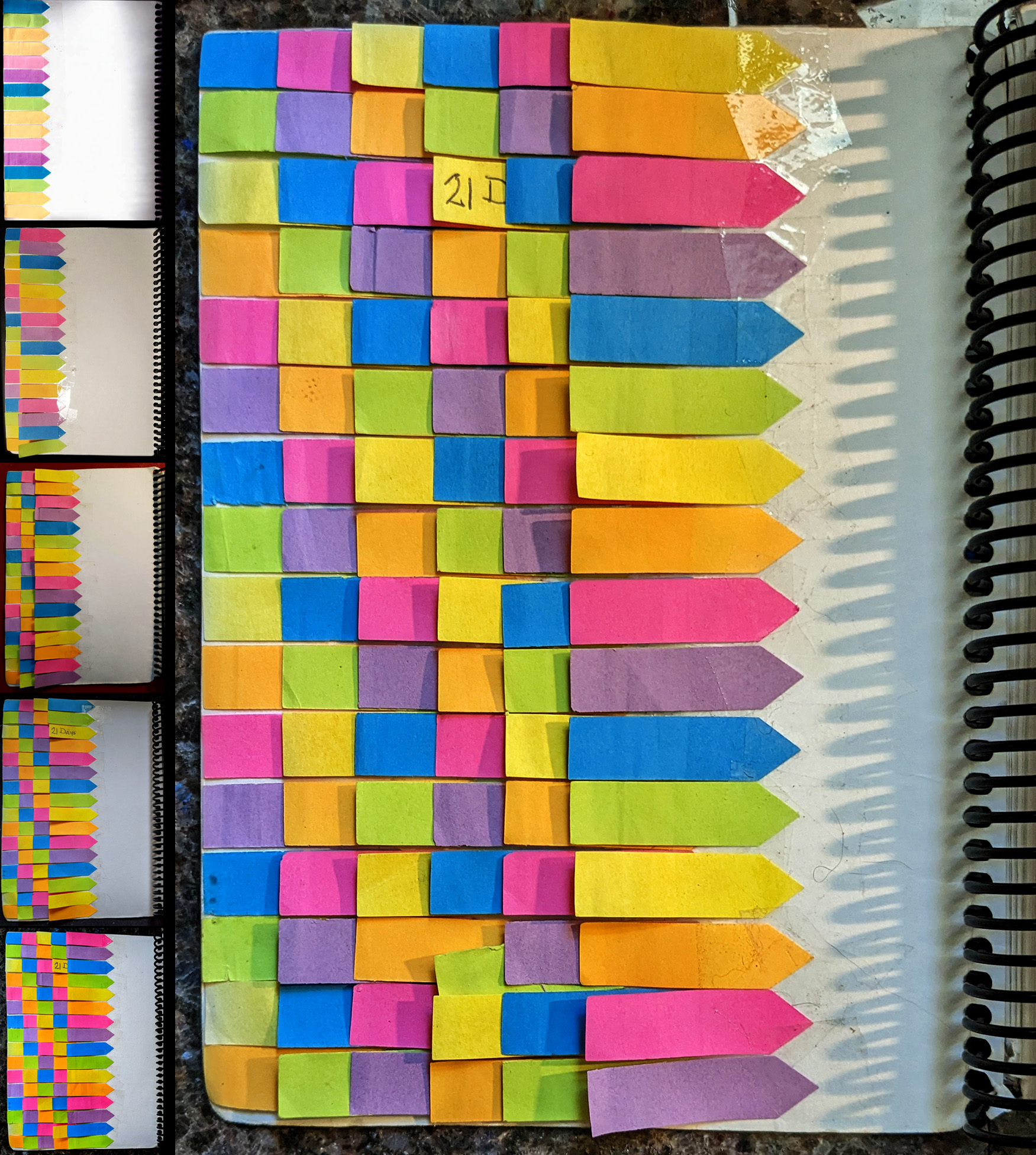
20230826_romanized-cover-arrows-series

As I progress through the 32 days in Myoho Renge Kyo Romanized, I mark my place with a Post-It note arrow. At the end of cycle I add the Post-It arrow to my collection inside the front cover of the book. It takes 16 arrows to fill one column. Originally each column represented 512 days. When I added the Contemplation of Universal Sage and the Innumerable Meanings Sutra each column grew to 544 days.

The sixth column is the penultimate. I plan one final column before concluding this project.

The idea for this project sprang from Rev. Ryusho Jeffus‘ book “The Magic City: Studying the Lotus Sutra.,” in which he explains that a “yojana” is both a measurement of distance and of time. He says:

“I wonder what you could accomplish in your life if you made a commitment from today for 500 days to practice on a regular consistent basis towards the achievement of some change in your life? Would you be able to travel the entire 500 days without giving up or abandoning or forgetting your goal and effort?”

At the start I planned to see what sort of things I could accomplish in 500 days, but Rev. Jeffus chided me, saying a 500-day journey is trivial. He suggested a 10-year timeframe would be more useful for judging the merits of the practice of Nichiren Buddhism.

The year 2024 will be my 10th year of practicing Nichiren Shu Buddhism. I will complete my final 16 cycles through the Lotus Sutra in February 2025. At that point, I plan to pause and consider what I’ve accomplished.

Daily Dharma – Aug. 28, 2023

When they hear even a gāthā or a phrase [of this sūtra] with their pure minds, they will be able to understand the innumerable meanings [of this sūtra]. When they understand the meanings [of this sūtra] and expound even a phrase or a gāthā [of this sūtra] for a month, four months, or a year, their teachings will be consistent with the meanings [of this sūtra], and not against the reality of all things.

The Buddha declares these lines to Constant-Endeavor Bodhisattva in Chapter Nineteen of the Lotus Sūtra, describing those who keep and practice this Sūtra. The words of the Sūtra are not specific directions for how to live. We need to interpret them and apply them to our lives in the world today. There are many others whose experience and guidance can help us see what the Sūtra means, and who can benefit from our experience.

The Daily Dharma is produced by the Lexington Nichiren Buddhist Community. To subscribe to the daily emails, visit zenzaizenzai.com

Between Day 32 and Day 1: The Five Kinds of Buddha Eyes

Having last month considered how to amend both body and mind, we consider the five kinds of Buddha eyes.

Thereupon the buddhas of the ten directions will each extend their right hand, gently stroke the practitioner’s head, and speak these words:

“Well done, you of good intent! Well done! Because you internalize and recite the Great Vehicle sutras, the buddhas of the ten directions will expound the method of self-amendment practiced by bodhisattvas: Neither cut off all ties to the impulses of desire, nor live fully in the ocean of such impulses! Contemplate the nonexistence of what is grasped as mind!

“Conceptualizations arise based on error that is mistaken for truth; in this way delusion gives rise to the concept of mind. In the same manner that wind has no foundation in the air, aspects of phenomena are without origination or cessation. What is guilt? What is bliss? As one’s mind – by nature – is emptiness, guilt and bliss have no owner. All phenomena are the same as this – they neither abide nor decay.

“Amend yourself in this way: Contemplate the nonexistence of what is grasped as mind! A phenomenon does not stay fixed in itself. All phenomena conform to liberation, to the truth of the extinguishment of suffering, and to complete tranquility. Grasping things in this way is described as ultimate self-amendment; it is described as fully composing self-amendment; it is described as self-amendment free from aspects of guilt; it is described as destroying the distinction of mind. Those who practice this self-amendment will be as flowing water: pure and clean in body and mind, not staying fixed in themselves. They will be able to discern Universal Sage Bodhisattva, and the buddhas of the ten directions as well, in any moment of concentration.”

With their bright light of great compassion, the World-honored Ones will then expound the truth of formlessness to the practitioner. He or she will hear the explanation of the ultimate principle of emptiness (śūnyatā). There will be neither fear nor alarm in the practitioner’s mind after hearing the explanation and, when the time comes, he or she will be prepared to take up the true status of bodhisattvahood.

The Buddha addressed Ānanda:

“Practicing in this way is called doing self-amendment. This self-amendment is the method of self-amendment of the buddhas and great bodhisattvas in the ten directions.”

The Buddha said to Ānanda:

“When followers of Buddha undertake to amend themselves of unwholesome and harmful karmic acts after the Buddha has passed away, they must resolutely internalize and recite the Great Vehicle sutras. This comprehensive teaching is the buddha eye of the buddhas, it is the means by which buddhas perfect the five kinds of vision, and, from it, the Buddha’s three manifestations arise. This is great evidence of the Dharma, and it attests to the realm of nirvana. It is within such a realm that the Buddha’s pure threefold manifestation is able to come forth. This threefold manifestation is a source of benefit for human and heavenly beings, and it is supremely worthy of reverence. It should be known that those who internalize and recite the comprehensive Great Vehicle sutras will be endowed with the Buddha’s merit, and that they will lastingly eliminate unwholesomeness and live in keeping with the Buddha’s wisdom.”

See The Five Kinds of Buddha Eyes

Daily Dharma – Aug. 27, 2023

Thereupon Cloud-Thunderpeal-Star-King-Flower-Wisdom Buddha said to King Wonderful-Adornment, ‘So it is, so it is. It is just as you say. The good men or women who plant the roots of good will obtain teachers in their successive lives. The teachers will do the work of the Buddha, show the Way [to them], teach them, benefit them, cause them to rejoice, and cause them to enter into the Way to Anuttara-samyak-saṃbodhi (Perfect Enlightenment). Great King, know this! A teacher is a great cause [of your enlightenment] because he leads you, and causes you to see a Buddha and aspire for Anuttara-samyak-saṃbodhi.

These lines are part of a story told by the Buddha in Chapter Twenty-Seven of the Lotus Sūtra. The Buddha uses this story to remind us of how much benefit we get from our teachers. When we see the world with the eyes of the Buddha, and know that he is always thinking of how to lead us, we can find innumerable teachers, and know to show our gratitude to them.

The Daily Dharma is produced by the Lexington Nichiren Buddhist Community. To subscribe to the daily emails, visit zenzaizenzai.com

Day 32

Day 32 covers Chapter 28, The Encouragement of Universal-Sage Bodhisattva, closing the Eighth Volume of the Sutra of the Lotus Flower of the Wonderful Dharma.


Having last month considered Universal-Sage’s question, we consider Universal Sage’s vow.

“World-Honored One! The bhikṣus, bhikṣunīs, upāsakās or upāsikās who seek, keep, read, recite and copy this Sūtra of the Lotus Flower of the Wonderful Dharma in the defiled world in the later five hundred years after [your extinction], if they wish to study and practice this sūtra, should concentrate their minds [on study and practice] strenuously for three weeks. When they complete [the study and practice of] three weeks, I will mount a white elephant with six tusks, and appear before them with my body which all living beings wish to see, together with innumerable Bodhisattvas surrounding me. I will expound the Dharma to them, show them the Way, teach them, benefit them, and cause them to rejoice. I also will give them dhārāṇi spells. If they obtain these dhārāṇis, they will not be killed by nonhuman beings or captivated by women. Also I myself will always protect them. World-Honored One! Allow me to utter these dhārāṇis spells!”

Thereupon he uttered spells before the Buddha:

“Atandai (1), tandahatai (2), tandahatei (3), tandakusharei (4), tandashudarei (5), shudarei (6), shudarahachi (7), botsudahasennei (8), sarubadarani-abatani (9), sarubabasha-abataru (10), hu­abatani (11), sōgyahabishani (12), sōgyaneku-kyadani (13), asogi (14), sōgyahagyadai. (15), teirei-ada-sōgyatorya-aratei-haratei (16), sarubasogya-sammaji-kyarandai (17), sarubadaruma­shuharisettei (18), saru-basatta-rodakyōsharya-atogyadai (19), shin-abikiridaitei (20).”

[He said to the Buddha:]

“World-Honored One! It is by my supernatural powers, know this, that a Bodhisattva can hear these dhārāṇis. Anyone who keeps the Sūtra of the Lotus Flower of the Wonderful Dharma [while it is] propagated in the Jambudvipa, should think, ‘I can keep [this sūtra] only by the supernatural powers of Universal-­Sage.’ Anyone who keeps, reads and recites this sūtra, memorizes it correctly, understands the meanings of it, and acts according to it, know this, does the same practices that I do. He should be considered to have already planted deeply the roots of good under innumerable Buddhas [in his previous existence]. He will be caressed on the head by the hands of the Tathāgatas. Anyone who copies this sūtra will be reborn in the Heaven of the Trāyastriṃs̒a Gods immediately after his present life. On that occasion, eighty-four thousand goddesses will come and receive him, making many kinds of music. A crown of the seven treasures will be put on his head, and he will enjoy himself among the ladies in waiting. Needless to say, [more merits will be given to] the person who [not only copies this sūtra but also] keeps, reads and recites it, memorizes it correctly, understands the meanings of it, and acts according to it. Anyone who keeps, reads and recites this sūtra, and understands the meanings of it, will be given helping hands by one thousand Buddhas immediately after his present life. He will be fearless. He will not fall into any evil region. He will be reborn in the Tusiita Heaven. There he will go to Maitreya Bodhisattva who, adorned with the thirty-two marks, will be surrounded by great Bodhisattvas, and attended on by hundreds of thousands of billions of goddesses. He will be given the benefits of these merits. Therefore, anyone who has wisdom should copy this sūtra with all his heart, cause others to copy it, and also keep, read and recite it, memorize it correctly, and act according to it.

“World-Honored One! I will protect this sūtra with my supernatural powers so that it may be propagated and not be destroyed in the Jambudvipa after your extinction.”

The Daily Dharma from July 5, 2023, offers this:

Anyone who keeps, reads and recites this sūtra, memorizes it correctly, understands the meanings of it, and acts according to it, know this, does the same practices that I do. He should be considered to have already planted deeply the roots of good under innumerable Buddhas [in his previous existence].

Universal-Sage (Fugen, Samantabhadra) Bodhisattva makes this declaration to the Buddha in Chapter Twenty-Eight of the Lotus Sūtra. In our mundane practice of the Wonderful Dharma, it is easy to overlook our place in the world and the benefits we bring to all beings. The magnificent character of Universal-Sage reminds us that despite our feelings of insignificance, we are the result of countless lives of practice and equal in our merits to this great Bodhisattva.

The Daily Dharma is produced by the Lexington Nichiren Buddhist Community. To subscribe to the daily emails, visit zenzaizenzai.com