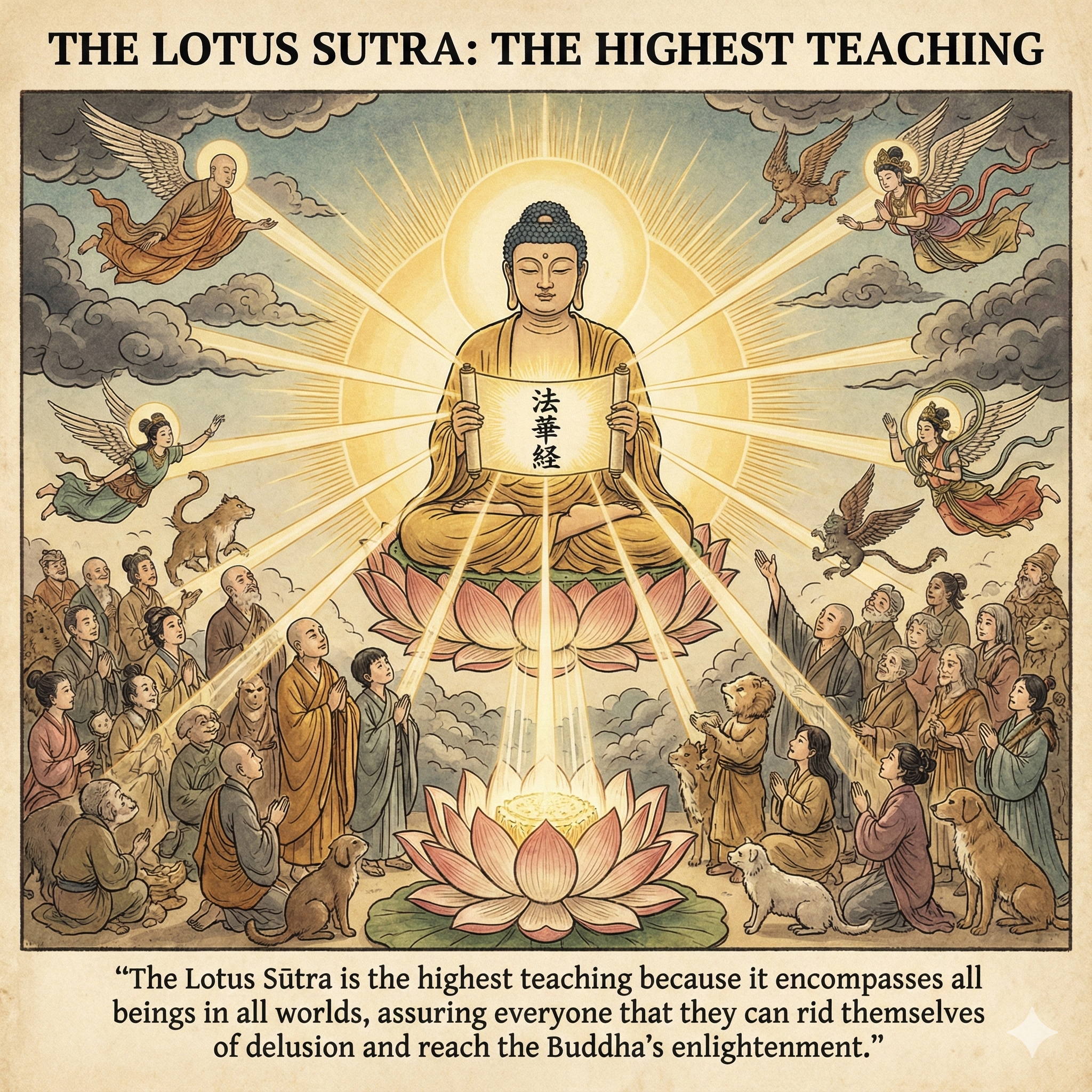
Chanting the Daimoku – Namu Myoho Renge Kyo, Devotion to the Wonderful Dharma Lotus Sutra – is the principal practice of Nichiren followers. In fact, it is the very definition of being a Nichiren Buddhist.
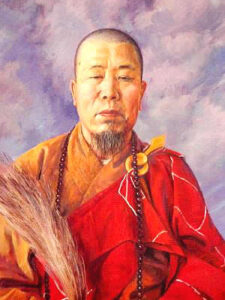
Chinese Master Hsuan Hua actually advocated chanting the Daimoku at one point in his commentary on the Lotus Sutra.
In discussing the passage in Chapter 26, Dhārāṇis, “If anyone offends or demeans these Dharma teachers he will also offend and demean these Buddhas,” Hsuan Hua says:
How can illiterate people uphold this sūtra? They can focus on reciting the title by saying ‘Namo Wonderful Dharma Lotus Sūtra.’ Reciting the title of the sūtra is the same as reciting the entire sūtra. For those who can’t read, this is one way. They can also ask someone else to uphold, read, recite, explain, or write it out on their behalf.
Hsuan Hua Lotus Sutra Commentary, v14, ch26, p23
But chanting praise for the Lotus Sutra is not one of the practices Hsuan Hua advocates for his literate followers. In “The Path Within,” a free collection of talks by teachers of the Dharma Realm Buddhist Association published in 2024, Bhikṣu Heng Lyu offers an explanation of what’s expected of followers of Master Hsuan Hua:
When we took refuge’ with Master Hsuan Hua, he asked us to bow to the Buddhas ten thousand times to reduce our karmic obstructions, such as arrogance. He also asked us to practice the Six Great Principles to cultivate our virtue and character as the foundation for being a good person. [The Six Great Principles are: (1) no contention, (2) no greed, (3) no seeking, (4) no selfishness, (5) no seeking personal advantage, and (6) no lying.] After that, we could choose a Dharma practice of our own, whether it be meditation, recitation of the Buddha’s name [Pure Land practice], mantra recitation, or sūtra recitation. The idea is that after you perfect yourself as a person, you attain Buddhahood. This is what the Venerable Master Hua designed especially for us and it is the best sequence of practice.
The Path Within, p14-15
That, of course, couldn’t be further from Nichiren’s view of the sequence of practice. As Nichiren writes:
QUESTION: Regarding the one who truly practices Buddhism, how does one preserve one’s faith?
ANSWER: According to the Lotus Sūtra, the Buddha first preached various provisional teachings, which were later merged into the Lotus Sūtra, the only way to Buddhahood. All the people in Japan misinterpret this, saying that since various provisional teachings were merged in the Lotus Sūtra, they all are equal in value or in depth of meaning. Thus, it is said, reciting the name of Amitābha Buddha (the Buddha of Infinite Life), chanting mystic mantra words, practicing Zen meditation, or keeping and reciting the names of any of the sūtras, Buddhas, and bodhisattvas are equivalent to practicing the Lotus Sūtra, and therefore those who practice any of these are true practicers of Buddhism.
I say this is a great mistake.
Nyosetsu Shugyō-shō, True Way of Practicing the Teaching of the Buddha, Writings of Nichiren Shōnin, Faith and Practice, Volume 4, Page 89
And another area where Hsuan Hua and Nichiren would disagree would be the utility in devotion to World Voice Perceiver Bodhisattva.
The chapter on Guan Shi Yin Bodhisattva, the Chinese name for World Voice Perceiver, was the opening chapter for Hsuan Hua’s lectures on the Lotus Sutra that became his 14-volume commentary. Devotion to Guan Yin Bodhisattva is a repeated topic throughout the commentary. Here’s one example from the discussion of Chapter 21, The Supernatural Powers of the Tathāgatas. This sort of digression from the commentary is labeled a Timely Teaching:
With Every Recitation, You Gain A Measure Of Benefit
We’re now holding a Guan Yin session. You could say that this Dharma is difficult to encounter in hundreds of thousands of millions of eons. You shouldn’t think it’s easy to recite Namo Guan Shi Yin Bodhisattva. With every recitation, you gain a measure of benefit. The chapter “The Universal Door of Guan Yin Bodhisattva” states that “if beings overwhelmed with sexual desire can be constantly and reverently mindful of Guan Yin Bodhisattva, their passion will subside…. If dull and foolish beings can be constantly and reverently mindful of Guan Yin Bodhisattva, they will leave ignorance behind.”
Isn’t it true that these are the greatest of benefits? If you’re overcome with desire and lust, your mind will have neither peace nor joy. How do you leave desire behind? You can leave desire behind by reciting Guan Yin Bodhisattva’s name.
“If beings beset by much anger can be constantly and reverently mindful of Guan Yin Bodhisattva, they will rid themselves of anger.” There’s an adage that says,
A tiger-like spirit and delusion’s blaze
Spring from the roots of offenses in former lives’ days.
The blaze of your anger is a tiger-like spirit. Nothing is more ferocious. Why are you beset by so much anger? This anger stems from the offenses you committed in former lives. If you can be constantly and reverently mindful of Guan Yin Bodhisattva, you’ll be free from anger. Your bad temper will fade away.
Let me tell you something. I used to have a temper bigger than anyone else’s. I was always getting mad at people. If I wasn’t beating them, I was scolding them. I’ve told you this many times. When I was little, I loved to hit and scold people. No matter who they were, I made them submit to me. I’d beat up anybody who refused to do what I said. But now I no longer like to hit or scold anyone. I don’t know how or when I got rid of my anger, but it’s gone.
“Who said so?” you say. “You’ve still got a bad temper!” You’ve never seen me in a bad temper. It would’ve scared you to death. My temper disappeared because I recited Guan Yin Bodhisattva’s name.
We’re holding a Guan Yin session right now. Whenever you’ve got time, whether you’re a monastic or a layperson, you should recite Guan Yin Bodhisattva’s name. Laypeople who aren’t working, unless you’re particularly busy or have important business to attend to, should come and recite Guan Yin Bodhisattva’s name. Reciting only one time is better and more meritorious than earning a hundred dollars in a day.
You may think, “What use is reciting Guan Yin Bodhisattva’s name?” It’s very useful. “But if I earn a hundred dollars, I can buy food to eat. Reciting Guan Yin Bodhisattva’s name isn’t going to fill me up when I’m hungry.” You think that because your heart isn’t pure and true. If you had a pure heart, you’d naturally become full. Not only would you be full, you’d have sweet dew in your mouth while you were reciting. Guan Yin Bodhisattva would anoint you with sweet dew so that while you were reciting Guan Yin Bodhisattva’s name, you’d taste something sweeter than candy. If you don’t recite, you won’t have this experience. But if you do recite, it’ll happen naturally. I’m most certainly not lying to you. If you sincerely recite Namo Guan Yin Bodhisattva, you’ll experience a flavor sensation sweeter than eating candy.
You don’t know the benefits of reciting, so you think you can just goof off, make phone calls, or go do other things. You’re just wasting precious time by failing to be single-minded. When you focus, you’ll forget about everything else, including eating and wearing clothes. All that remains is that one phrase, Namo Guan Shi Yin Bodhisattva.
If you can achieve that, Guan Shi Yin Bodhisattva will anoint your crown with sweet dew and pat you on the head, saying, “You’re such a good kid. Good boy! Good girl! Bring forth the great resolve for bodhi. I’ll help you. As you progress on the Path, you’ll be free from demons. You’ll be successful in your cultivation.” However, you can only achieve this through sincere practice.
Hsuan Hua Lotus Sutra Commentary, v12, ch21, p21-23
While driving with my wife to the Sacramento Nichiren Buddhist Church last Sunday, I was discussing how devotion to World Voice Perceiver Bodhisattva and chanting Namu Kanzeon Bodhisattva could be considered a part of the Lotus Sutra. Who could object? But then I realized Nichiren would:
Chanting “Namu Myō hō Renge Kyō ” swallows up the functions of “Namu Amida Butsu,” “Namu Dainichi shingon,” and “Namu Kanzeon bosatsu” as well as all the Buddhas, sutras, and bodhisattvas. All these will be of no use without the functions of the Lotus Sutra. This can be seen by everyone, for it has been realized in front of everyone. When I, Nichiren recite “Namu Myō hō Renge Kyō ” the function of “Namu Amida Butsu” disappears just as the moon wanes, the tide ebbs, grasses in autumn and winter wither and ice melts under the sun.
Essay on Gratitude, Hoon-Jō, Writings of Nichiren Shonin,
Volume 3, Page 48
Next: Studying the Dharma