
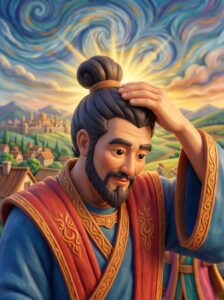
 The Parable of the Priceless Gem in the Topknot is, for me, the most difficult to understand or to imagine as a children’s storybook.
To summarize:
The parable describes a powerful, wheel-turning king who seeks to subdue rebellious lesser kings by dispatching his army to conquer them. When his soldiers fight bravely and distinguish themselves in battle, the king generously rewards them with “paddy fields, houses, villages, cities, garments or ornaments; or various treasures such as gold, silver, lapis lazuli, shell, agate, coral or amber; or elephants, horses, vehicles, menservants, maidservants or subjects.”
However, the king deliberately withholds one specific treasure: a priceless gem kept hidden in his topknot. Because this jewel is meant exclusively for the top of a king’s head, giving it away recklessly would alarm his subjects. But “when he saw a soldier of extraordinary merit, the wheel-turning-holy-king joyfully gave that soldier the unbelievably precious gem, which he had kept in his topknot for a long time and had not given to anyone.”
The Buddha explains that the “lesser kings” who won’t capitulate are the various “maras” that trouble his disciples. The soldiers are the Buddha’s disciples, led by “sages and saints.” The rewards are the benefits received from the various practices of the lesser vehicle.
This is all very straightforward and easily grasped. But what is a literalist like myself to make of this single soldier who is rewarded for his valor in combat? That’s where I get stuck.
I uploaded a copy of Senchu Murano’s translation of the parable to Gemini and told Gemini I wanted to create a 10- to 15-page storybook for 10-year-olds. Gemini quickly produced a script for a 15 page booklet, which included the text and descriptions of illustrations.
Gemini’s script adheres closely to Murano’s translation until page 7, where we learn of the priceless jewel in the king’s hair. On the next page, the story returns to the Buddha, who explains the meaning of this story to Mañjuśrī.
In Gemini’s telling, the Buddha says:
The Buddha saw that people everywhere were facing their own hard battles. They were struggling under the pressure of deep sufferings, illusions, and worries, fighting hard to find true happiness and freedom.
Out of great compassion, the Buddha sent his wise helpers—the sages and saints—to guide them. He gave the people wonderful spiritual treasures, lessons on peace, and paths to calm their minds, showing them how to find happiness.
Yet, just like the wheel-turning king, the Buddha held back his most precious treasure of all. For a very long time, he kept the ultimate teaching—the Lotus Sutra—hidden away in secret, waiting for the perfect moment.
Why did he keep it hidden? The Buddha knew that if he shared this deep and profound teaching too early, people might not understand its true value, and many would find it too difficult to believe.
Over time, the followers worked incredibly hard. The Buddha saw that they had gained extraordinary merits, conquered their biggest worries, left behind bad habits, and filled their hearts with kindness.
When the wheel-turning king finally saw a soldier achieve the most difficult feats of all, he joyfully reached up, untied his hair, and gave away the unbelievably precious gem he had guarded for so long.
“Now, you are ready too!” said the Buddha. With great joy, he shares the Lotus Sutra—the most honorable and excellent teaching—to guide every single living being to ultimate wisdom, happiness, and peace.
I really like Gemini’s version of the parable. No, it doesn’t strictly adhere to Murano’s translation, but neither is it inherently wrong. After all, we can all agree that the Lotus Sutra guides every single living being to ultimate happiness and peace, and that’s a great message for a children’s storybook.