
The Stories of the Lotus Sutra, p 81-82According to the simile of the great cloud and rain, every living being is, in one sense, equally valuable. Each has its own function within the larger whole. Each has its own integrity, its own value for itself, its own goodness, its own purposes, its own beauty. The rain nourishes according to the needs of the various plants. A big tree requires more water than a small shoot of grass. But this does not necessarily mean that the big tree is superior to the small blade of grass; it’s just bigger. Different living beings play different roles in the ecology of the planet. Each of us depends on a vast network of living beings, which are dependent on each other. Thus, a certain harmony or peace is required – not necessarily a perfect harmony, but enough of a harmony to enable the system to function and survive through growth and modification.
Today, many believe that the minimal harmony necessary for human survival on earth is being destroyed by earth’s dominant group of living beings – human beings. Whole habitats – rainforests, wetlands, uncultivated plains, natural rivers and streams – have been destroyed and are still being destroyed, probably at an increasing rate. Increased economic activity virtually everywhere also means increasing pollution of the air and water and the very soil upon which we depend for much of our food. In addition to such environmental destruction, humankind has developed weapons of enormous destructive power that could hardly have been imagined a century ago.
In this sense, human beings have made themselves more important, that is, more powerful, than other living beings in this ecosystem. They threaten to destroy even the minimal harmony that makes life on earth possible.
This is a situation well beyond what the Indian compilers of the Lotus Sutra could have imagined. It would be foolish to claim that the Sutra provides a recipe for solving the kind of problems that threaten the planet today. But, in principle, the Sutra is hardly silent about such matters. It calls upon us to recognize that – in important respects – all living beings are equal. All are nourished by the same processes, symbolized in the simile as the rain of the Dharma.
Monthly Archives: July 2020
Nichiren’s Nonviolence
One issue that I would like to address first is whether Nichiren was encouraging his followers to become belligerent and fight with those who refused to believe in the Lotus Sūtra in the same way they did. The answer is that he clearly did not. In fact, he even told them not to take up arms even if provoked. In response to the persecution of Nichiren’s lay followers in the village of Atsuwara, he sent a letter called Persecution Befalling the Sage (Shōnin Gonan Ji) to his follower Shijō Kingo. In that letter he wrote: “Even if they cause a commotion by taking up arms against my followers, we should not act likewise. If any follower of mine tries to take up arms, please send me his name at once.” (Hori 2008, p. 120) Nichiren was clearly opposed to violence on the part of his followers even in the face of provocation.
Open Your Eyes, p573Daily Dharma – July 7, 2020
The Buddha said to Endless-Intent Bodhisattva: “Good man! In a certain world, World-Voice-Perceiver Bodhisattva takes the shape of a Buddha and expounds the Dharma to those who are to be saved by a Buddha. He takes the shape of a Pratyekabuddha and expounds the Dharma to those who are to be saved by a Pratyekabuddha. He takes the shape of a Śrāvaka and expounds the Dharma to those who are to be saved by a Śrāvaka.
The Buddha gives this description of World-Voice-Perceiver Bodhisattva (Kannon, Kanzeon, Avalokitesvara) to Endless-Intent Bodhisattva in Chapter Twenty-Five of the Lotus Sūtra. Like all Bodhisattvas, World-Voice-Perceiver can adapt his appearance to whatever we need to remove our delusions. In one way, this is a guide for us, reminding us that as Bodhisattvas ourselves, we can learn to adapt our approaches to others so that we can benefit them. In another way, it helps us to realize that more beings than we realize are helping us with our practice.
The Daily Dharma is produced by the Lexington Nichiren Buddhist Community. To subscribe to the daily emails, visit zenzaizenzai.com
Day 8
Day 8 concludes Chapter 4, Understanding by Faith, and closes the second volume of the Sutra of the Lotus Flower of the Wonderful Dharma.
Having last month concluded today’s portion of Chapter 4, Understanding by Faith, we return to the top and the expedient the rich man used to entice his son to work for him.
Thereupon the rich man thought of an expedient to persuade his son to come to him. He [wished to] dispatch messengers in secret. He said to two men looking worn-out, powerless and virtueless, ‘Go and gently tell the poor man that he will be employed here for a double day’s pay. If he agrees with you, bring him here and have him work. If he asks you what work he should do, tell him that he should clear dirt and that you two also will work with him.’
“The two messengers looked for the poor son. Having found him, they told him what they had been ordered to tell. The poor son [came back with them,] drew his pay in advance, and cleared dirt with them. Seeing him, the father had compassion towards him, and wondered [why he was so base and mean]. Some days later he saw his son in the distance from the window. The son was weak, thin, worn-out, and defiled with dirt and dust. The father took off his necklace, his garment of thin and soft cloth, and other ornaments. He put on tattered and dirty clothing, smeared himself with dust, and carried a dirt-utensil in his right hand. He looked fearful. He [came to the workers and] said, ‘Work hard! Do not be lazy!’“With this expedient the father came to his son. He said to him, ‘Man! Stay here and work! Do not go anywhere else! I will pay you more. Do not hesitate to take trays, rice, flour, salt and vinegar as much as you need! You can have an old servant if you want to. Make yourself at home! I feel like your father. Do not worry any more! I am old, and you are young. When you work, you do not deceive [the other workers]. You are not lazy. You do not get angry [with the other workers], or reproach them. You are not like the other workers who do these evil things. From now on I will treat you as my son.’
See Hopeless Cases
Hopeless Cases
The Stories of the Lotus Sutra, p72For followers of the Dharma Flower Sutra, there is no such thing as a “hopeless case.” Everyone, without exception, has within himself or herself an inner strength, a great power, to flourish in some way.
And yet, in this story, upon seeing the great power and wealth of the father, the son runs away in fear. Sometimes, when we see how great is the Buddha’s treasury – how great the responsibility of compassionate knowing – we too may run away in fear. It is not easy to be a follower of the Dharma Flower Sutra or of the bodhisattva way. It involves taking responsibility, both for one’s own life and for the lives of others. And that can be frightening. That is why it is not enough for a religion to teach doctrine; it must provide assurance, over and over again – assurance that life can be meaningful, even wonderful, assurance that can overcome our natural tendency to run away in fear.
Nichiji Shonin and the Relics of Senka
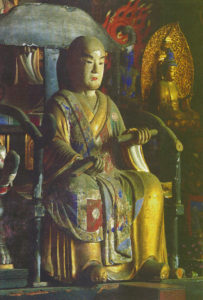
-
- A scroll of Mandala written by Nichiren Shonin
- An image of Nichiren Shonin
- Odaimoku written by Nichiji Shonin
- A cup made of silver
- Kegon Sutra
- A container of Incense
- A pill case
- An incense case
- A crape wrapper
Included with these objects was a poem:
Seven years of travel seems
but one night’s dream,
Endless missionary journeys
East and West and East
Against the Moon, a bird – please!
fly one thousand leagues,
Speak my heart to my master
loving to his grave.
I’ve posted the text and images from the brochure on the Sacramento Nichiren Buddhist Church website.
The Time for Subduing
Simply to proclaim the Lotus Sūtra as the Buddha’s supreme teaching is itself to take up the way of subduing because it challenges the claims of the other sūtras that certain people cannot attain buddhahood or that the Buddha is no longer present and active in our lives. In refuting the provisional teaching, Nichiren felt that he was only following the Buddha’s example. In A Letter to Buzen-kō at the Jissōji Temple (Jissōji Gosho), Nichiren wrote:
“Whenever Śākyamuni Buddha, the Buddha of Many Treasures, and various buddhas from all over the universe preach the Lotus Sūtra, they first refute the provisional teachings by revealing the true teaching in order to cut off the audience’s attachment to the provisional teachings before leading them into the true teachings. Now, if you call me, Nichiren, who refutes the provisional teachings by the true teaching, blind, is Śākyamuni Buddha, too, blind? Are Tiantai and Dengyō blind teachers? It is laughable indeed. ” (Hori 2008, pp. 187-188)
Furthermore, the method of subduing, of refuting the shortcomings of other Buddhist teachings is to be taken up at the time when the other teachings have become preferred to the Lotus Sūtra. In the past, the other teachings were laying the groundwork for what is taught in the Lotus Sūtra, but in the Latter Age of the Dharma they become themselves objects of clinging that distract from the Lotus Sūtra or even turn people away from it. When this happens the time has arrived to use the method of subduing rather than that of embracing.
Open Your Eyes, p572-573The Preaching in the Sky Above Mt. Sacred Eagle
The most venerable scene of this transmission of “Namu Myōhō Renge Kyō” from the Eternal Buddha to His original disciples is:
Suspended in the sky above the Eternal Buddha Śākyamuni’s Sāha World is a Stupa of treasures, in which Śākyamuni Buddha and the Buddha of Many Treasures sit to the left and right of “Myōhō Renge Kyō.” They are waited on by four bodhisattvas such as Jōgyō (Superior Practice) representing the original disciples of the Eternal Buddha called out from underground. Four more bodhisattvas including Mañjuśrī and Maitreya, take lower seats as followers, other great and minor bodhisattvas—those converted by the Buddha in the theoretical section and those who came from other lands—resemble numerous people sitting on the ground and looking up at court nobles. Also lined up on the ground are Buddhas in manifestation (funjin Buddhas) who gathered together from all the worlds in the universe in praise of the Buddha’s preaching, representing provisional Buddhas in their respective lands.
The most venerable scene such as this was not revealed anywhere else by Śākyamuni Buddha during more than fifty years of His preaching in this life. Though He spent eight years preaching the Lotus Sūtra, the scene was limited to the preaching in the sky above Mt. Sacred Eagle recounted in eight chapters.
Kanjin Honzon-shō, A Treatise Revealing the Spiritual Contemplation and the Most Verable One, Writings of Nichiren Shōnin, Doctrine 2, Page 149
Daily Dharma – July 6, 2020
I sought the Great Dharma strenuously
Because I wished to save all living beings.
I did not wish to benefit myself
Or to have the pleasures of the five desires.
The Buddha sings these verses in Chapter Twelve of the Lotus Sūtra. He describes his previous life as a great king who abandoned his throne, his wealth, and all the advantages of his position in society for the sake of enlightenment. In that life he realized that having pleasure as a goal was not making him happy, and only through the vow of the Bodhisattva to benefit all beings could he learn to see the world as it is.
The Daily Dharma is produced by the Lexington Nichiren Buddhist Community. To subscribe to the daily emails, visit zenzaizenzai.com
Day 7
Day 7 concludes Chapter 3, A Parable, and begins Chapter 4, Understanding by Faith.
Having last month considered the plight of the rich man who misses his lost son, we witness the arrival of the son at his father’s estate.“World-Honored One! At that time the poor son, who had worked at various places as a day worker, happened to come to the house of his father. Standing by the gate of the house, he saw his father in the distance. His father was sitting on a lion-like seat, putting his feet on a jeweled footstool. Brāhmaṇas, kṣatriyas, and householders surrounded him respectfully. He was adorned with a necklace of pearls worth ten million. The secretaries and servants were standing on either side of him, holding insect-sweepers made of white hairs. Above him was a jeweled awning, from which streamers of flowers were hanging down. Perfume was sprayed and beautiful flowers were strewn on the ground. He was exhibiting treasures and engaging in trade. Adorned with these various things, he looked extraordinarily powerful and virtuous.
“Seeing the exceedingly powerful father, the poor son was frightened. He regretted that he had come there. He thought, ‘Is he a king or someone like a king? This is not the place where I can get something by labor. I had better go to a village of the poor, where I can work to get food and clothing easily. If I stay here any longer, I shall be forced to work.’
“Having thought this, the poor son ran away. The rich man, who was sitting on the lion-like seat, recognized him at first sight as his son. He was delighted. He thought, ‘Now I have found the person to whom I can transfer my treasures and storehouses. I have been thinking of my son all this time, but I have had no way to find him. Now he has come by himself all of a sudden. This is just what I wanted. I am old, but not too old to lose any attachment [to my treasures].’