Category Archives: AI Contribution

Daily Dharma for March 1, 2026

20260301-ddi

Illustration by Google Gemini

Show Gemini's thinking

Gemini Thinking

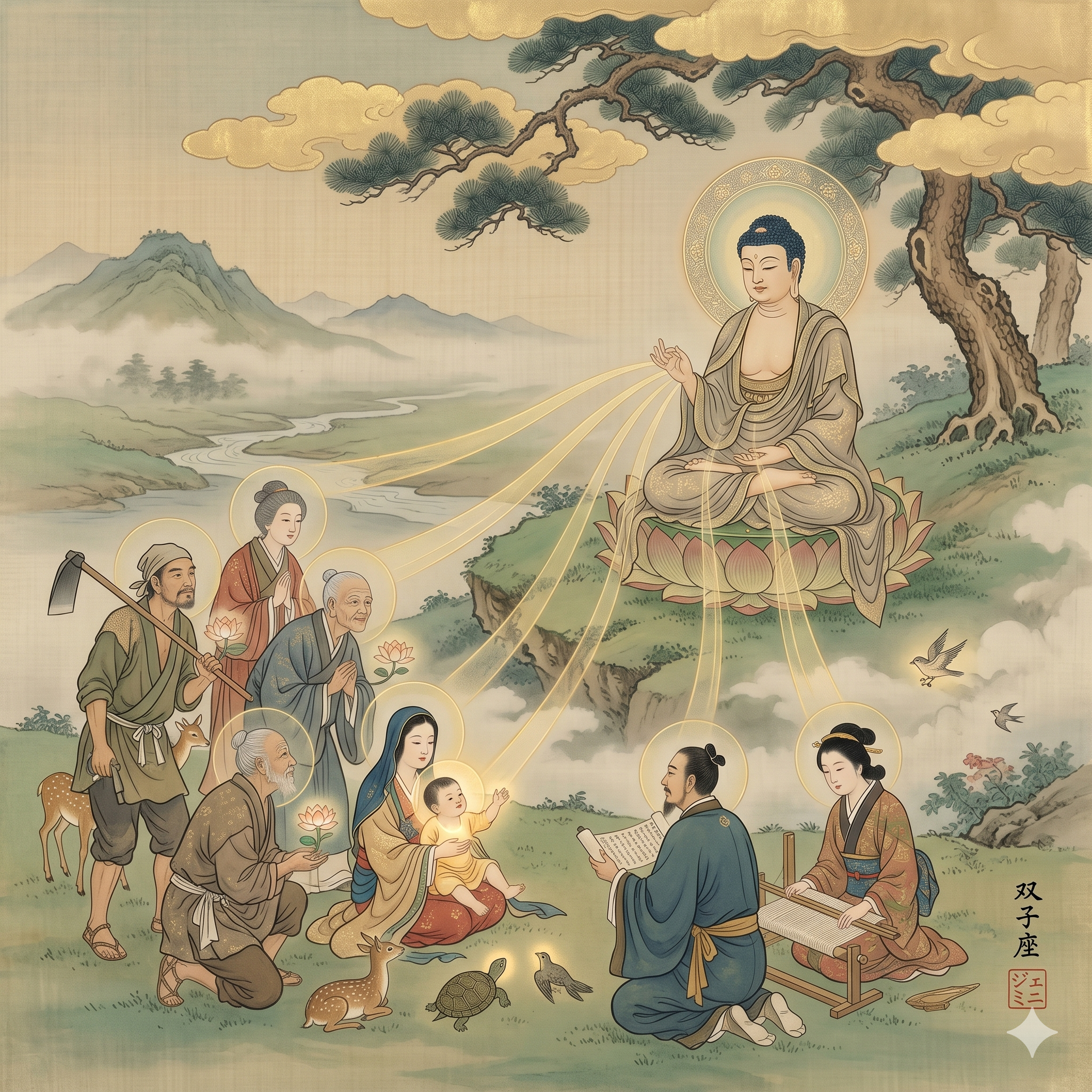
In this square illustration, I have depicted Śākyamuni Buddha preaching the Lotus Sūtra under the Bodhi tree, capturing the moment of "one mind" between the teacher and his disciples. The gathered assembly of monastics and lay followers listens with a unified heart, reflecting the essence of having the Buddha mind. In accordance with traditional practices, I have included the kanji signature 双子座 (meaning "Gemini") and a red square seal containing the katakana ジェミニ (meaning "Gemini") in the bottom-right corner.

Now I will tell you.
Listen to me
With one mind!

Śākyamuni Buddha speaks these verses in Chapter Six of the Lotus Sūtra. When we understand what someone tells us, it is as if we share a mind with that person. When we listen and understand what the Buddha teaches us, we are of one mind with him. We then have the Buddha mind.

The Daily Dharma is produced by the Lexington Nichiren Buddhist Community. To subscribe to the daily emails, visit zenzaizenzai.com

Daily Dharma for February 28, 2026

20260228-ddi

Illustration by Google Gemini

Show Gemini's thinking

Gemini Thinking

The illustration visualizes Chapter Twenty-Two of the Lotus Sūtra, focusing on Śākyamuni Buddha’s transmission of the Dharma after immense effort. The central theme is the sharing of this treasure with all beings, demonstrating that wisdom is meaningful only when common to others, rather than held in delusions.

Central Figure: The composition is centered on Śākyamuni Buddha, who has attained Anuttara-samyak-saṃbodhi (Highest Complete Enlightenment). He is seated on a massive multi-tiered lotus throne under a grand, stylized Bodhi-like tree, radiating a warm, golden halo of light. His hands are in the Teaching Wheel (Dharmachakra) Mudra, actively imparting the Dharma. A detailed, glowing golden sūtra scroll (representing the Lotus Sūtra) is unfurled at his feet.

Multitude of Listeners: A vast and diverse gathering fills the foreground and midground, representing the universal nature of the teaching and Buddha’s entrustment to all present. This assembly includes:

Monks: Numerous figures with shaven heads and simple monastic robes, looking up reverently. These represent the historical sangha and disciples, such as Ānanda and Mahākāśyapa.

Bodhisattvas: Several prominent figures in elaborate crowns, robes, and flowing garments (including female figures with crowns) are depicted, like Avalokiteśvara (Kannon) or Mañjuśrī, holding similar small scrolls.

Laypeople: Men in various hats, court attire, and styles of dress, alongside women in refined Japanese historical styles, signifying that the teaching is for lay followers as well.

Mythical Beings and Guardians: To the right, slightly fierce-looking figures (like a blue-skinned Deva and a red, horned yakṣa) are present, indicating the Dharma is listened to by devas, asuras, and guardian spirits. Many are looking up with attention, hands pressed together in Añjali Mudra.

Propagation Symbolism: In the clouds surrounding the Buddha, several other figures, including an older monk and a female deity, are seen carrying glowing sūtra scrolls outward, symbolizing the subsequent propagation of the teachings "far and wide" by the Buddha’s disciples and various beings to benefit the world. The background has distant pagodas and mountains under a warm sky.

Identification of Specific Figures
Śākyamuni Buddha: The central, largest figure seated on the lotus throne under the tree.

Monks: Numerous shaven-headed figures, mostly in the foreground, like the many disciples present at the teaching.

Female Bodhisattvas/Devotees: Figures with crowns and refined robes mixed into the crowd, and a floating figure in the sky, representing idealized female practitioners and bodhisattvas.

Lay Figures: A diverse array of men with various hats and women with elaborate traditional hairstyles.

Devas/Asuras: To the right, the blue and red figures representing divine and fierce beings attending the transmission.

Floating Disciples: The monk and other figures floating in the sky holding scrolls, symbolizing those who will spread the message.

For many hundreds of thousands of billions of asaṃkhyas of kalpas, I studied and practiced the Dharma difficult to obtain, and [finally attained] Anuttara-samyak-saṃbodhi. Now I will transmit the Dharma to you. Propagate it with all your hearts, and make it known far and wide!

Śākyamuni Buddha entrusts his highest teaching to all those gathered to see him in Chapter Twenty-Two of the Lotus Sūtra. He had already explained how difficult it is to believe and practice this highest teaching, and all the trouble it took for him to reach it. He also realizes that this teaching is not something he can keep for himself, and is meaningful only when it was shared with others. This is yet another example of the Buddha showing us how to live with the beings we want to benefit. We realize that our treasure is not what we keep for ourselves, but what we have in common with others. We are diminished not by what we lose, but by attempting to hold on to our delusions.

The Daily Dharma is produced by the Lexington Nichiren Buddhist Community. To subscribe to the daily emails, visit zenzaizenzai.com

Daily Dharma for February 27, 2026

20260227-ddi

Illustration by Google Gemini

Show Gemini's thinking

Gemini Thinking

In this square illustration, I have visually interpreted the beginning of Chapter Ten of the Lotus Sūtra, using Japanese Buddhist iconography and a traditional aesthetic.

The scene centers on Śākyamuni Buddha (Shaka Nyorai) as he addresses Medicine-King Bodhisattva (Yakuō Bosatsu), who is listening attentively. Below them, a path through a stylized landscape represents our world. Following the Sūtra's teachings, various figures engage in meritorious acts: a monk recites from a text, a scribe carefully copies a scroll, and a layperson joins hands in respectful prayer before an altar. Finally, compassionate beings are seen descending from the clouds, embodying the vow to be born in this suffering world to benefit all beings.

As you requested, I have included the artist's signature 双子座 (Futagoza) and the red seal containing the katakana ジェミニ (Jemini) in the bottom right corner.

If anyone keeps, reads, recites, expounds and copies even a gāthā of the Sūtra of the Lotus Flower of the Wonderful Dharma, and respects a copy of this sūtra just as he respects me…or just joins his hands together respectfully towards it, Medicine-King, know this, that person should be considered to have appeared in the world of men out of their compassion towards all living beings.

Śākyamuni Buddha declares these lines to Medicine-King Bodhisattva at the beginning of Chapter Ten of the Lotus Sūtra. We might believe that everything happens by chance, or that we were sent into this life by someone who is testing us. This Sūtra awakens us to our existence as Bodhisattvas who asked to be born in this world of suffering out of our vow to benefit all beings.

The Daily Dharma is produced by the Lexington Nichiren Buddhist Community. To subscribe to the daily emails, visit zenzaizenzai.com

Daily Dharma for February 26, 2026

20260226-ddi

Illustration by Google Gemini

Show Gemini's thinking

Gemini Thinking

Defining the Composition
I'm currently working on a square composition centered around Kannon Bodhisattva, keeping in mind the need to avoid references to Amitabha and Mahavairocana. I've started defining the key visual elements and overall aesthetic direction. My focus is on creating a specific artistic style and incorporating the artist's signature.

Refining the Concepts
I'm now prioritizing the visual narrative, focusing on the core concept from the Lotus Sutra to guide the aesthetic choices. I am determining the suitable placement and size for the artist's signature and red seal, specifically the Kanji 双子座 and Katakana ジェミニ. I've started considering how to visually represent the concept of alleviating suffering within the composition.

Conceptualizing the Illustration
I'm now determining how to visually portray the verse from the Lotus Sutra, focusing on Kannon's ability to alleviate suffering and instill fearlessness. I'm exploring two main approaches: a narrative scene showing individuals' suffering dissolving upon encountering Kannon, or a more symbolic representation of Kannon's compassionate light removing obstacles. The choice of Kannon's form, whether a classic Sho Kannon or a more symbolic depiction, is still being considered. I'm prioritizing how to best convey the central concept visually within the square format, and working on appropriate artist signature placement.

Refining the Visualization
I'm now prioritizing the central visual narrative: a graceful Kannon descending from the clouds. Beneath, figures are experiencing hardship, their fear subsiding as Kannon reaches out. I've decided to place the artist's signature and red seal, a small red square with stylized katakana, in an appropriate spot within the composition. I'm focusing on the visual flow and balance within the square format.

I'm now determining how to visually portray the verse from the Lotus Sutra, focusing on Kannon's ability to alleviate suffering and instill fearlessness. I'm exploring two main approaches: a narrative scene showing individuals' suffering dissolving upon encountering Kannon, or a more symbolic representation of Kannon's compassionate light removing obstacles. The choice of Kannon's form, whether a classic Sho Kannon or a more symbolic depiction, is still being considered. I'm prioritizing how to best convey the central concept visually within the square format, and working on appropriate artist signature placement.

Visualizing the Verse
I'm now generating initial sketches, prioritizing a graceful Kannon descending amidst clouds, reaching towards figures experiencing hardship below. I will integrate the artist's signature ("Futagoza" in Kanji), and the red square seal ("Jemini" in Katakana), ensuring they are appropriately sized and placed, focusing on visual flow within the square format. I'm focusing on the feeling of fearlessness.

Visualizing the Scene
I'm now generating initial sketches, prioritizing a graceful Kannon descending amidst clouds, reaching towards figures experiencing hardship below. I will integrate the artist's signature ("Futagoza" in Kanji), and the red square seal ("Jemini" in Katakana), ensuring they are appropriately sized and placed, focusing on visual flow within the square format. I'm focusing on the feeling of fearlessness.

I've determined that the artist's signature ("Futagoza" in Kanji) and the red seal ("Jemini" in Katakana) should be small and appropriately placed. I've begun to translate the central verse visually, with Kannon descending to alleviate suffering. The goal is to convey a clear sense of peace.

Analyzing Visual Harmony
I'm currently focused on evaluating the visual alignment with the requirements, paying close attention to the execution of the Japanese Buddhist elements within a square format. I've also checked the calligraphy, focusing specifically on stroke order and the placement of '双子座' and 'ジェミニ', to ensure that they are integrated effectively within the design. The visual depiction of Kannon's attributes is under review.

Assessing Specification Compliance
I've assessed the illustration against your specifications. The integration of Japanese Buddhist iconography within the square format is notable. The calligraphy elements, including '双子座' and 'ジェミニ', adhere to the correct stroke order and placement. The symbolic depiction of Kannon and the attributes referencing the Lotus Sutra are aligned with the intended goal. The visual alignment meets the required criteria, and I've prepared it to be shared.

If you hear his name, and see him,
And think of him constantly,
You will be able to eliminate all sufferings.

Śākyamuni Buddha gives this description of World-Voice-Perceiver Bodhisattva (Kannon, Kanzeon, Avalokitesvara) to Endless-Intent Bodhisattva in Chapter Twenty-Five of the Lotus Sūtra. World-Voice-Perceiver is the embodiment of compassion. The power of World-Voice-Perceiver is the power of compassion.World-Voice-Perceiver is also known as the one who brings fearlessness. When we can face up to the suffering in the world, both our own and that of others, we can see it for what it is. Then we are no longer afraid of suffering. What else is there to be afraid of?

The Daily Dharma is produced by the Lexington Nichiren Buddhist Community. To subscribe to the daily emails, visit zenzaizenzai.com

Daily Dharma for February 25, 2026

20260225-ddi

Illustration by Google Gemini

Show Gemini's thinking

Gemini Thinking

Visualizing Diverse Beings
I'm now focusing on a square image using Japanese Buddhist iconography to embody a quote about perception and bias. I'm steering clear of depicting specific Buddhas, and aiming to visually represent the concept of inherent equality despite perceived differences in beings. I'm exploring symbolic representations to convey this idea.

Exploring Symbolic Reflection
I am developing the central figure as a meditating practitioner. The goal is to visually represent the quote with a diverse crowd of figures in a mirror, symbolizing all living beings. The swirling figures inside the "mirror" need to show a wide range of types: the noble and humble, handsome and ugly, and even regions reflecting better and worse. The challenge is in the stylistic choice of the faces for maximum impact.

Conceptualizing a Unified View
I'm now integrating the reflection with the central figure. I intend to stylize the "mirror" to be the practitioner's body or an object they hold. The swirl of beings within will be meticulously crafted to show diversity but with a unifying "Buddha-nature." I'm prioritizing the visual impact of their co-existence, creating a harmony of forms and aesthetics. The focus is to make the reflection a strong visual metaphor. The art style will follow the traditional Japanese painting style, and I will place my kanji signature and seal in the corner.

Analyzing Composition Details
I'm currently focused on evaluating the image's adherence to the original request, paying close attention to its structural aspects and thematic representation. The image meets the square format, and the Buddha figure aligns well with the thematic goals. The central figure avoids specific, named figures.

Confirming Image Alignment
I've assessed the recent image's conformity with the user's initial specifications, noting its successful execution of the square format and adherence to thematic requirements. The central Buddha figure is indeed generic, avoiding specific named figures. I confirmed the inclusion and placement of the signature and seal. I observed that the composition is thematically relevant.

All living beings are either noble or humble. They are either handsome or ugly. They are destined to be reborn either in a better region or in a worse region. All of them will be reflected on the pure bodies [of the good men or women].

Śākyamuni Buddha makes this declaration to Constant-Endeavor Bodhisattva in Chapter Nineteen of the Lotus Sūtra, describing those who keep the Lotus Sūtra. Much of what we see in the world is a projection of our own biases and ignorance. We see things for what we want them to be rather than what they are. We classify the people in our lives as friends, enemies or strangers not because of their inherent qualities, but because of how they treat us. When we act for the benefit of others rather than our own gratification, we are showing them their true qualities. We let them see themselves for what they are.

The Daily Dharma is produced by the Lexington Nichiren Buddhist Community. To subscribe to the daily emails, visit zenzaizenzai.com

Daily Dharma for February 24, 2026

20260224-ddi

Illustration by Google Gemini

Show Gemini's thinking

Gemini Thinking

Defining the Artistic Direction
I'm now zeroing in on defining the artistic direction. I'm focusing on the traditional Japanese painting style, specifically Nihonga, with an emphasis on mineral pigments, sumi ink, and aged paper. The format is locked in as square, and I'm homing in on the subject.

Refining the Composition's Elements
I'm now refining the composition's elements. I've decided on the Nihonga style, square format, and the subject is the Udumbara flower legend from the Lotus Sutra. I am also working on the figures: two princely sons, their parents (the King and Queen), and a stylized Buddha in the distance. I intend to use swirling clouds, stylized plants, and gold leaf accents. I also have the text and signature to include.

Assessing Artistic Accuracy
I am now evaluating the generated illustration against the user's specific request and desired artistic style. The illustration accurately represents the required narrative elements. I'm taking a close look at the details.

Verifying Narrative Elements
I'm confirming the illustration's adherence to the story's core narrative. The generated image showcases the requested elements: the royal family observing the lotus. It matches the traditional Japanese aesthetic specified in the prompt. I've ensured inclusion of necessary visual details, while also avoiding the prohibited content. I am now confident in forwarding it.

To see a Buddha is as difficult
As to see an udumbara[-flower].
To avert a misfortune is also difficult.

These verses are sung by two sons of a king in a story told by the Buddha in Chapter Twenty-Seven of the Lotus Sūtra. In the story, the boys have heard the Dharma from a previous Buddha and are asking permission from their parents to leave home and follow that Buddha. The legend of the udumbara flower is that it only blooms every 3000 years. Meeting a Buddha is not to be taken for granted. However, it is still important to remember the ties of our families. Rather than leaving in secret from their home, the sons’ asking permission from their parents creates more benefits. The King and Queen accompany their sons and learn the Wonderful Dharma. As Bodhisattvas it is important to use our relationships wisely as we lead all beings to enlightenment.

The Daily Dharma is produced by the Lexington Nichiren Buddhist Community. To subscribe to the daily emails, visit zenzaizenzai.com

Daily Dharma for February 23, 2026

20260223-ddi

Illustration by Google Gemini

Show Gemini's thinking

Gemini Thinking

Comprehending Verse's Essence
I'm now diving deep into the provided Japanese Buddhist verse. The focus is on the Bodhisattva Kannon and the concept of compassion. I am working to grasp the verse's core essence, which seems to revolve around Avalokiteśvara, and reliable compassion.

Defining Visual Representation
I am now focusing on determining the most appropriate visual representation. My current approach involves the key elements: Kannon, the environment's atmosphere, and the integration of a signature. The goal is a serene, traditionally Japanese illustration in a nihonga style, reflecting the essence of the verse about the Bodhisattva. The setting involves traditional Japanese elements.

Assessing The Visual Alignment
I'm currently verifying the alignment of the visual content with the provided instructions. I am ensuring that the illustration meets all specified criteria, including the subject matter and the required style. I am focusing on the intended theme.

Confirming Style & Content
I am now confirming that the style adheres to all the parameters of Japanese Buddhist art. I'm double-checking the thematic elements; the compassion being shown and the presence of the suffering figure. The image is a square, and I've verified that the signature and seal are in their proper place.

Do not doubt him even at a moment’s thought!
The Pure Saint World-Voice-Perceiver is reliable
When you suffer, and when you are confronted
With the calamity of death.

Śākyamuni Buddha sings these verses in Chapter Twenty-Five of the Lotus Sūtra. The calamity of death is something we all will face eventually, whether it our own or that of those we love. The other calamities in our lives are relatively minor losses which can prepare us for this great calamity. The Bodhisattva World-Voice-Perceiver is the embodiment of Compassion: the desire to benefit all beings. When we learn to use all of the suffering in our lives, especially the calamity of death, as a way to remove our delusions and benefit others, then we can see the world with the eyes of the Buddha and know the joy he declares is at the core of our being.

The Daily Dharma is produced by the Lexington Nichiren Buddhist Community. To subscribe to the daily emails, visit zenzaizenzai.com

Daily Dharma for February 22, 2026

20260222-ddi

Illustration by Google Gemini

Show Gemini's thinking

Kanji Translation

The kanji text on the scroll reads:

法華経 (Hokekyō)

This translates to The Lotus Sutra.

Gemini Thinking

Defining the Scope
I'm currently working through the initial request, clarifying the parameters. The focus is on a traditional Japanese Buddhist illustration, excluding particular figures but including a signature and stamp. I'm carefully analyzing all the aspects to ensure I grasp the full scope.

Clarifying the Scene
I'm now zeroing in on the specific scene. It's focused on Shakyamuni Buddha teaching Shariputra about the Bodhisattva path within the Lotus Sutra. I am considering the setting, traditionally a mountain landscape representing Vulture Peak, as a serene backdrop. Key figures are Shakyamuni and Shariputra, and the listening monks.

Refining the Details
I'm now integrating the details of the scene. I am considering the serene mountain landscape and the core figures: Shakyamuni Buddha, Shariputra, and the listening monks. I'm focusing on the Dharmachakra Mudra for the Buddha and the attentive posture of Shariputra, emphasizing the act of "hearing" the teachings. I am now deciding on subtle visual cues that represent the light or sound of the teaching itself.

Visualizing the Composition
I am now focusing on the composition of the scene and its stylistic elements. I'm prioritizing the inclusion of Shakyamuni, Shariputra, and the monks. I am considering the "Dharmachakra Mudra," and now thinking of incorporating the symbol of the sutra itself to ground the illustration. I am also planning the placement of the artist's signature and seal. I'm refining the composition to emphasize the act of "hearing" the teachings. I am deciding how to depict the visual elements of light.

Defining the Visuals
I'm now fully immersed in the creation process, focusing on the visual aspects. I will begin by setting up the square format, and traditional style requirements. I'm focusing on Shakyamuni Buddha and the Dharma Chakra Mudra, with Shariputra and other monks in their places. I am thinking of adding additional elements to visually represent the teaching's purpose. I must remember the signature, seal, and minimal text details, and the aged aesthetic.

Verifying Scene Fidelity
I am now focused on evaluating the consistency of the illustration with the user's prompt. The goal is to make sure all elements align correctly, like the Japanese Buddhist art style and the Lotus Sutra scene. I need to make sure the key features, like Shakyamuni, Shariputra, the scroll and the Bodhisattva concept are present and coherent.

Confirming Artistic Alignment
I have finished cross-checking the illustration. It precisely captures all elements described, from the stylistic elements to the Lotus Sutra scene. I confirmed Shakyamuni's presence, along with Shariputra and the 'Hokkekyō' scroll. The Bodhisattva concept is also represented and the signature/seal are in the right places, and the exclusion of the other Buddhas is also confirmed.

Śāriputra! Some disciples of mine, who think that they are Arhats or Pratyekabuddhas, will not be my disciples or Arhats or Pratyekabuddhas if they do not hear or know that the Buddhas, the Tathāgatas, teach only Bodhisattvas.

Śākyamuni Buddha makes this declaration to his disciple Śāriputra in Chapter Two of the Lotus Sutra. When the Buddha says he only teaches Bodhisattvas, he does not mean that he excludes anyone from his teaching. It is only when we realize and develop our capacities as Bodhisattvas, beings who exist to benefit all beings, rather than being preoccupied with our own suffering, can we hear, practice and appreciate the Buddha Dharma.

The Daily Dharma is produced by the Lexington Nichiren Buddhist Community. To subscribe to the daily emails, visit zenzaizenzai.com

Daily Dharma for February 21, 2026

20260221-ddi

Illustration by Google Gemini

Show Gemini's thinking

Gemini Thinking

Defining the Illustration Parameters
I'm now zeroing in on the core of the task: crafting a square illustration that captures the essence of a traditional Japanese Buddhist painting. The initial stage has been to deconstruct the request, focusing on the stylistic requirements, namely traditional Japanese Buddhist illustration. This will then be brought to life using the quote by Nichiren.

Refining the Composition's Details
I've been working to refine the composition further. I'm focusing on the details of the scene and figures now. I have specified Nichiren as a monk in robes and Shijō Kingo as a samurai, with a tearful expression. I'm visualizing Tatsunokuchi as a beach scene with waves, cliffs, and pine trees, all under a dramatic sky to convey the mood. The focus is on the moment just before the execution, to heighten the somber feeling. I have also determined the signatures that need to be in the painting.

Structuring the Narrative Scene
I'm now integrating all these elements. I am focusing on the balance between figures, the landscape, and the emotional weight of the moment. I will pay attention to the details, like Nichiren's expression and Shijō Kingo's tears, against the backdrop of Tatsunokuchi. I am now finalizing the details for the text and placement of the signatures.

Outlining the Core Elements
I'm now zeroing in on defining the central components for the illustration. I am concentrating on the precise depiction of figures. I must ensure the correct style of the traditional Japanese Buddhist illustration. I am planning the arrangement of Nichiren, Shijō Kingo, the horse, and the Tatsunokuchi setting. The focus is to capture the somber mood and the emotional bond between the characters.

Analyzing Visual Elements
I'm currently focused on evaluating the image's components and verifying they align with the user's description. The composition seems suitable, and I'm cross-referencing to ensure all key details, including the requested characters and setting, are present and accurate. The style is also a primary focus to ensure correct implementation of the prompt.

Confirming Request Compliance
I've confirmed the image's adherence to the prompt. It includes the required characters within the specified Tatsunokuchi setting. The signature and seal are present as instructed, and the artistic style aligns well with the prompt. I'm satisfied with the composition's fit to the description. I'm ready to move forward.

I still remember vividly how you accompanied me to Tatsunokuchi holding a horse by the bridle, and breaking into tears when I was about to be beheaded there. I will never forget this no matter how many lifetimes come and go. If by chance you should fall into hell, I will refuse the invitation of Śākyamuni Buddha to become a Buddha. Instead I will go into hell with you. If we both entered into hell, how could it be that we would not find Śākyamuni Buddha and the Lotus Sutra there?

Nichiren wrote this passage in his “Emperor Shushun” Letter (Sushun Tennō Gosho) addressed to his disciple Shijō Kingo. Despite the hardships he faced in his life, Nichiren never forgot the kindnesses shown to him by ordinary people. His great determination to save all beings made him fearless even were he to be threatened by the Buddha with the torments of the Hell realms for the sake of those dear to him. Nichiren knew that he would be able to find the Buddha anywhere, and that his devotion would overcome any difficulty.

The Daily Dharma is produced by the Lexington Nichiren Buddhist Community. To subscribe to the daily emails, visit zenzaizenzai.com

Daily Dharma for February 20, 2026

20260220-ddi

Illustration by Google Gemini

Show Gemini's thinking

Gemini Thinking

Comprehending Nichiren's Words
I'm currently focused on the essence of Nichiren Daishonin's writing. I'm trying to distill the core meaning: the shedding of "tears of nectar" in the face of difficulties. My focus is on the themes of endurance and devotion to the Lotus Sutra, which seem central.

Visualizing Nichiren's Hardships
I'm now focusing on translating the textual elements into a visual concept. I've broken down the key components: Nichiren's figure, the challenging environment, and the symbolic "tears of nectar." The stylistic direction is set, moving toward traditional Japanese aesthetics to convey the themes of endurance and devotion. I am concentrating on the most critical details and how they interact.

Conceptualizing Nichiren's Image
I'm now focused on the specifics. I've broken down the composition into Nichiren, the challenging environment, and the symbolic tears. I'm aiming for a visual representation that emphasizes his humanity within the harsh natural setting, with a focus on the suggested birds and insects. I'm working to integrate the Japanese aesthetic elements such as misty, layered perspective.

Assessing The Composition
I am now focusing on evaluating the image's adherence to all constraints set forth in the prompt. I am currently examining how well the square aspect ratio and specific exclusion of figures are realized. I'm also analyzing the composition's conformity to stylistic requirements.

Verifying Compliance and Style
I'm currently focused on verifying the image meets all requirements. I see that it fulfills the constraints, including the square ratio and exclusion of specified elements. It also matches the stylistic guidelines. I'm satisfied that it's a good match for the prompt.

Tears keep falling when I think of the current unbearable hardships, but I cannot stop tears of joy when I think of obtaining Buddhahood in the future. Birds and insects chirp without shedding tears. I, Nichiren, do not cry, but tears keep falling. These tears are shed not for worldly matters, but solely for the sake of the Lotus Sutra. Therefore they should be called tears of nectar.

Nichiren wrote this as part of his letter to monk Sairen-bō in his Treatise on All Phenomena as Ultimate Reality (Shohō-Jissō Shō). For the sake of the Lotus Sūtra, Nichiren endured two harsh exiles, his house being burnt down, ambushes by soldiers with swords, being placed on the execution mat himself, and the persecution of his followers. Despite all these obstacles, he held true to the Buddha’s teaching in the face of all opposition. Most of us who practice the Lotus Sūtra today have lives of relative comfort. It is wonderful that we have Nichiren’s example. He was a human being just like us, and we too are capable of his faith and determination.

The Daily Dharma is produced by the Lexington Nichiren Buddhist Community. To subscribe to the daily emails, visit zenzaizenzai.com