The Diamond Chalice Precept (Japanese: Kongō-hōki-kai, 金剛宝器戒), also known as the Precept of the Diamond Vessel, occupies a central position within the theological development of East Asian Mahayana Buddhism.1, 2 This precept represents a fundamental paradigm shift from the ethical framework of early Indian Buddhism.3, 4
Rather than defining morality through a massive, prohibitive code of conduct designed to regulate external bodily and vocal behaviors, the Diamond Chalice Precept conceives of ethical purity as an indestructible, inherent state of cosmic awakening.5, 6 Activated through faith and the contemplation of the ultimate Dharma, this single precept is understood to encompass and fulfill all other moral rules within itself.2, 5
The concept emerged from Chinese apocryphal scriptures, underwent rigorous systematization by Saichō within the Japanese Tendai school, and was ultimately reinterpreted by Nichiren as the singular, universal precept necessary for the salvation of all beings in the Latter Day of the Law (Mappō).3, 4, 6
Scriptural Origins and Philological Foundations
The textual lineage of the Diamond Chalice Precept begins with the Brahma’s Net Sūtra (Chinese: Fanwang jing; Japanese: Bonmō-kyō), a text compiled in China during the fifth century to provide a distinctively Mahayana foundation for ethical discipline.4, 6, 7 This scripture introduced the Bodhisattva precepts, consisting of ten major and forty-eight minor vows.6, 7 These vows were intended to either supplement or entirely replace the traditional Prātimokṣa rules of the Indian Vinaya.4, 7
Philological analysis reveals that the specific term “Diamond Chalice Precept” (金剛寶器戒) is not present in the canonical text of the Brahma’s Net Sūtra.8 Instead, the sutra refers to the “radiant adamantine (or diamond) precepts” (Chinese: Kōmyō kongō hōkai, 光明金剛寶戒).8
The historical emergence of the term “Diamond Chalice Precept” in East Asian commentaries is partially attributed to a well-known punctuation error in the Taisho Tripitaka edition of the Brahma’s Net Sūtra, which incorrectly parsed the term Kōmyō (光明, radiant) with the preceding sentence, leaving the subsequent commentators to synthesize the concepts of the “adamantine jewel” (kongō-hō) and the “vessel” or “chalice” (ki) into a unified terminology.8
| Attribute |
Traditional Bodhisattva Precepts (Fanwang jing) |
The Diamond Chalice Precept (Kongō-hōki-kai) |
| Scriptural Basis |
Literal text of the Brahma’s Net Sūtra.6, 8 |
Synthesized commentary based on the Brahma’s Net Sūtra and the Lotus Sūtra.3, 8 |
| Structure |
Plurality of codes (10 major, 48 minor rules).6, 7 |
Singular, absolute, and comprehensive precept.5, 9 |
| Primary Focus |
Prohibition of specific negative actions (killing, stealing, lying).6, 7, 10 |
Direct alignment with and embodiment of the Buddha-nature through faith.5, 8 |
| Efficacy |
Dependent on the continuous vigilance of the practitioner.4, 6 |
Indestructible and permanently active once received.2, 8 |
| Audience |
Formally ordained monastic elites and advanced lay Bodhisattvas.4, 7, 11 |
Universally accessible to all beings regardless of social or spiritual status.3, 5 |
The Brahma’s Net Sūtra describes these adamantine precepts as the ultimate source of all Buddhas, the origin of all Bodhisattvas, and the core seed of the Buddha-nature inherent in all sentient beings.6, 8 The Korean scholar-monk Taehyeon, in his influential eighth-century work Exposition of the Sūtra of Brahmā’s Net, explained that the Buddha used the term “adamant” or “diamond” because of its extreme hardness and durability.8
According to Taehyeon, the diamond represents a foundational spiritual reality that supports all forms of moral merit, prevents positive karma from dispersing, and actively dispels unwholesome states of mind.8 This commentary became a primary source for Japanese Buddhist schools, linking the metaphor of the indestructible diamond with the moral vessel of the practitioner.8
The Tendai Systematization: Saichō, Vessel Metaphors, and Medieval Debates
The formal institutionalization of the Diamond Chalice Precept in Japanese Buddhism was achieved by Saichō (Dengyō Daishi, 767–822), the founder of the Tendai school.12, 13 In his effort to secure imperial permission for an independent Mahayana ordination platform (Kaidan-in) on Mount Hiei, Saichō sought to completely abandon the traditional Hinayana Vinaya ordination.6, 12, 13 He argued that Japanese monks should be ordained exclusively under the “Perfect and Immediate Precepts” (Endon-kai, 圓頓戒) of the Mahayana tradition.6, 14
To theoretically justify this departure, Saichō wrote the Secret Decisive Teachings on the One-Mind Diamond Precept Essence (Isshin Kongō Kaitai Hiketsu, 一心金剛戒体秘決) in 805.14 In this text, he categorized the historical stages of Buddhist morality by comparing the spiritual “precept-body” (kaitai, 戒体) received by an ordinand to three distinct types of vessels.2
| Vessel Classification |
Associated Buddhist Precepts |
Durability & Lifespan of the Precept-Body |
Hermeneutical Meaning |
Gaki (瓦器)
Clay or Earthenware Vessel2 |
Hinayana / Nikaya Precepts (e.g., 250 vows for monks, 500 for nuns).2 |
Jinjōju (尽形寿): Lasts only as long as the current physical body and lifetime endure.2 |
Highly fragile; if the vessel is broken or if the physical body dies, the precept-body is lost entirely.2 |
Kinginki (金銀器)
Gold or Silver Vessel2 |
Provisional Mahayana / Bodhisattva Precepts.2 |
Extends beyond a single lifetime, persisting across rebirths.2 |
Precious and noble when used; even if the vessel is damaged or “broken” by moral failure, the raw material retains its value.2 |
Kongō-hōki (金剛宝器)
Diamond Vessel2 |
True Mahayana Precepts of the Lotus Sūtra.2 |
Eigō (永劫): Permanently active throughout eternal eons.2 |
Absolutely indestructible; once received, it cannot be broken, bestowing its great function across the Ten Worlds.2 |
Saichō’s deployment of the Kongō-hōki metaphor established that the Lotus Sūtra was the ultimate container of all Buddhist vows.2 This perspective asserted that the mutual possession of the Ten Worlds (Jikkai Gogu) and the immediate attainment of Buddhahood (Sokushin Jōbutsu) are inherently present within the diamond precept-body.2
Following Saichō’s death, medieval Tendai theologians engaged in protracted debates regarding the nature and administration of these ordinations.11 In particular, Jitsudō Ninkū (1309–1388) defended the validity of these ordinations for ordinary, unenlightened worldlings (bonbu) against critics from the traditional Nara schools.11 The Nara establishment argued that because Tendai monks received the same Fanwang precepts as lay practitioners, they were not technically monks, but merely laymen or novices.11
This controversy highlighted the tension between two competing models of ordination within the Tendai lineage:11
| Ordination Theory |
Primary Proponent |
Conceptual Definition & Scope |
Structural Impact on the Sangha |
Betsuju (別受)
Separate Ordinations11 |
Enchin (814–891)11 |
Administering distinct sets of precepts progressively as a practitioner transitions through different statuses (layperson, novice, monk).11 |
Maintained strict, visible distinctions between monastics and laypeople.11 |
Tsūju (通受)
Comprehensive Ordinations11 |
Annen (fl. late 9th century)11 |
Conferring a single, unified set of precepts that simultaneously fulfills all three collections of pure precepts (sanjū jōkai).11 |
Collapsed administrative barriers, allowing laypersons and monks to receive the same ordination.11 |
Under the Tsūju model championed by Annen, which eventually became the standard doctrine of the Tendai school, the three collections of pure precepts—prohibiting evil (shō-ritsugi-kai), promoting good (shō-zembō-kai), and benefiting sentient beings (shō-shujō-kai)—were conferred simultaneously to any recipient, regardless of their social or monastic status.11, 15, 16 This unified approach laid the groundwork for the radical simplification of Buddhist practice in the Kamakura period.3
Within the ritual life of Mount Hiei, the reception of these precepts was eventually integrated with esoteric consecrations (kaikanjō).11, 17 These rituals, such as the Nyuudan Kanjo (initiation consecration) and Kaidan Kanjo, culminated in the conferral of the status of Ajari (Sanskrit: Ācārya, master) within intimate, dimly lit, and incense-filled chambers.17 These secret initiations symbolized the direct transmission of the adamantine precept-body down the patriarchal lineage.17
Nichiren’s Radical Reductionism and the Latter Day of the Law
During the Kamakura period, Nichiren (1222–1282) reformulated the Tendai doctrine of the Endon-kai and the Kongō-hōki-kai to address the cosmological and spiritual realities of Mappō.3, 5, 18 Nichiren asserted that in this degenerate age, humanity’s spiritual capacity (kikon) had degraded to the point where individuals could no longer attain liberation by attempting to master the complex, multifaceted rules of the past.2, 3
He declared that the historical Buddha had spent over forty years teaching provisional doctrines to prepare the minds of his disciples, but that the ultimate, concentrated essence of all moral discipline was contained solely within the five characters of Myōhō-Renge-Kyō.2, 8, 9
Consequently, Nichiren formulated the landmark doctrine of Jujisoku-jikai (受持即持戒), which posits that the single act of accepting and upholding the Lotus Sūtra—specifically by chanting the Daimoku (Namu Myōhō Renge Kyō)—inherently encompasses the observance of all Buddhist precepts.2, 19 In his treatise Teaching, Practice, and Proof (Kyōgyōshō Gosho), he defined this direct realization as the true Diamond Chalice Precept:3, 5
“Once the practitioner has this comprehensive Wonderful Precept, even if he wants to destroy it, he cannot. This has been called the ‘Diamond Chalice Precept.’ All buddhas of the past, present, and future keep this precept. All the Dharma-bodies, reward-bodies, and accommodative-bodies become the buddhas of no beginning and no end.”3, 5
To support this non-dualistic perspective, Nichiren drew upon the writings of Tiantai and Guanding’s Perfect and Sudden Contemplation, which argued that at the highest level of realization, there is no separate path to be practiced and no suffering to be severed.8 Ignorance and afflictions (klesas) are indivisible from bodhi, and samsara is identical to nirvana.8 By embracing the Daimoku, the practitioner enters this non-dual state of immediate enlightenment, rendering the prohibitive codes of provisional schools obsolete and devoid of salvific merit.3
To anchor this faith, Nichiren cited Chapter 21 of the Lotus Sūtra (“Supernatural Powers of the Tathagata”), where the Buddha instructs his followers to single-mindedly receive, embrace, read, recite, expound, copy, and practice the sutra after his passing.5 In the Recorded Lectures (Onkō kikigaki), Nichiren made a critical distinction between two qualities of practice:20
- Faith like Fire: Passionate and intense at the beginning, but easily extinguished when encountering external obstacles or intellectual doubts.20
- Faith like Flowing Water: Quiet, steady, and continuous, flowing day and night without ever slackening or ceasing in its course.20
Nichiren emphasized that the true keeping of the Diamond Chalice Precept requires a steady commitment resembling flowing water.20 He acknowledged that because human nature is highly unstable—resembling water that forms to the shape of its vessel or the reflection of the moon dancing on waves—practitioners will inevitably face severe psychological and external challenges.20
According to his text Questions and Answers between a Sage and a Foolish Man (Shōgu mondō-shō), the Devil of the Sixth Heaven detests the true Law and will deploy various obstacles to cause the practitioner to regress.20
However, Nichiren asserted that true faith must act like a mountain of gold, which only increases in brightness when a wild boar brushes against it.20 In his famous pledge in The Opening of the Eyes (Kaimoku-shō), he vowed to remain completely unmoved even if threatened with execution, declaring himself to be the pillar, the eyes, and the great ship of Japan.20 This absolute, irreversible commitment is the psychological and spiritual foundation of the unbreakable Diamond Chalice Precept.20
Ritual Implementation: The Gojukai and Clerical Initiation
In modern Nichiren Buddhist traditions—including Nichiren Shōshū, Nichiren Shū, and various international lay organizations—the Diamond Chalice Precept is formally transmitted and received through a ceremony known as the Gojukai (御授戒, “Acceptance of the Precept”).9, 10, 20 During this ritual, the new believer takes the “Oath of Acceptance” before the Gohonzon.10, 20 This oath maps the Three Great Secret Laws (Sandai Hihō) directly onto the classical Three Treasures of Buddhism.21
| Three Great Secret Laws |
Associated Three Treasures |
Function in the Gojukai Oath |
Practical Execution |
Honzon (本尊)
Object of Devotion9, 21 |
The Buddha21 |
Vow to protect the Gohonzon as the enlightened life of the True Buddha.9, 10 |
Discarding previous objects of worship and recognizing the Buddha-nature within oneself.9, 10 |
Daimoku (題目)
Sacred Title21 |
The Dharma21 |
Vow to practice and believe in the true teachings of Nichiren.10, 20 |
Chanting Namu Myōhō Renge Kyō with complete devotion in daily life.5, 22 |
Kaidan (戒壇)
Precept Platform21, 23 |
The Sangha21 |
Vow to keep the precept of Nichiren and practice for self and others.9, 10 |
Universalizing the platform; any place where one chants the Daimoku becomes the Kaidan.21 |
During the Gojukai, the administering priest or master asks the candidate three specific questions, and the initiate responds with “I do” to seal the unbreakable covenant.9, 10 In some lineage traditions, such as Quantum Life Buddhism (a Western adaptation of the Nichiren school), this ritual includes symbolic physical actions.9 For example, the master administers three taps on the candidate’s shoulders, with the first tap indicating that the practitioner renounces all previous religious attachments to dedicate their life entirely to the lineage of the Lotus Sutra.9
The Diamond Chalice Precept radically simplifies modern lay practice.5 The practitioner is taught that there is no need to reside in a monastery, wear expensive clothing, or spend hours in silent meditation.5 Instead, a quiet space to hang the scroll (Gohonzon) and chant even a single daimoku is sufficient to achieve a sudden awakening.5 This awakening involves surrendering the illusion of the permanent self (“I, me, mine”) to merge with the eternal, cosmic Buddha.5
Lay practice is further structured around the “six recollections” (roku-nen), where the practitioner maintains deep mindfulness of:24
- The Buddha24
- The Dharma24
- The Sangha24
- The Precepts (embodied in the Diamond Chalice Precept of Myōhō-Renge-Kyō)24
- Almsgiving (practiced as the active, compassionate propagation of the teachings, or shakubuku)24
- Heaven (offering the flavor of the Dharma to the protective deities, shoten zenjin, to secure their modern guardian role).24
For those who pursue clerical ordination as ministers or priests, the Diamond Chalice Precept requires a much deeper set of commitments.22 Clerical candidates must undertake several key practices:
- Deepening the Aspiration for Awakening (Bodaishin): Making the pursuit of enlightenment the central driving force of one’s life and taking active responsibility to cultivate this aspiration in others.22
- Cutting off Relatives’ Ties (Internal Intent): Prioritizing the Bodhisattva ideal over mundane family expectations.22 Rather than literally abandoning family responsibilities, the candidate fulfills these duties within the context of saving all sentient beings.22
- Monastic Rule Training: Abiding by the spirit of the Vinaya through courtesy, integrity, and mindfulness, constantly evaluating whether one’s thoughts and speech align with the Daimoku.22
- Departing from Secular Life: Striving to be “in the secular world but not of it,” recognizing the vanity of worldly ambitions and dedicating oneself to the Buddha Dharma.22
- Protecting the Dharma: Actively correcting misrepresentations or slanders of the teachings, while working to strengthen the Sangha and share the Dharma with others.22
Finally, the future outlook of the Diamond Chalice Precept is tied to the concept of the Kaidan of the Essential Teaching.3, 25 Discussed in the Sandai hihō shō (attributed to Nichiren), this doctrine envisions a future era where the ruler’s law (ōbō) and the Buddha-Dharma (buppō) merge into a unified reality.25
When the leaders and citizens of the world fully embrace the three great secret laws, a grand national ordination platform will be erected by imperial and shogunal decree.25 This future platform will serve as the physical and spiritual center where all people of the world can perform repentance, eradicate their negative karma, and receive the indestructible Diamond Chalice Precept under the protection of the deities Brahma and Indra.25

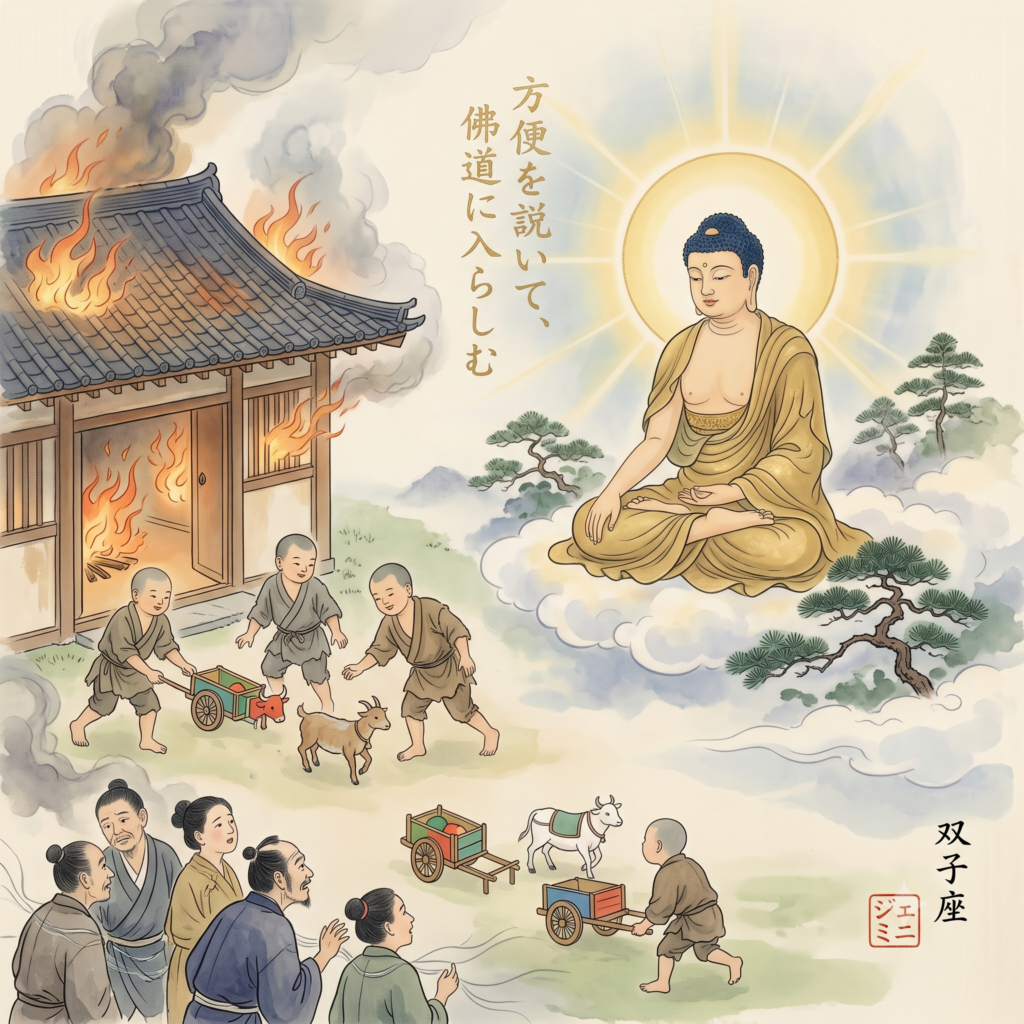
 The Parable of the Burning House